Guest post by Philip Mulholland
1. Introduction.
The following two figures, showing the principal features of the Earth’s Energy Budget, were published in 1997 by the Oklahoma Climatological Survey (OK-First) and are reproduced here with kind permission.


Both of these diagrams when combined provide detailed energy budget information for the Earth’s climate; however, their parameters are recorded as percentages of solar insolation at the top of the atmosphere (TOA). Neither diagram published by OK-First records the actual values of solar power intensity, nor is it demonstrated how they can be used to estimate the global average temperature for the surface of the Earth.
A number of assumptions must be made in order to understand how the OK-First diagrams can be used to estimate the average global temperature under an expected solar insolation radiant power intensity of *1368 W/m2, and the albedo of 0.30 used in Figure 1. *N.B. The standard NASA Earth irradiance is 1361 W/m2 and the Bond albedo is 0.306 (Williams, 2019). However, in 1997 the solar irradiance used by Kiehl and Trenberth (1997) was 1368 W/m2, and so this value is used here to give the most appropriate match to this historic paper (Fig. 3) (reproduced below with kind permission).

2. Filling in the Gaps.
At first sight it is clear that Figure 1 shows that 30% of the solar insolation is bypassed via albedo loss, and so only 70% of the power intensity is available to heat the planet. If we now apply the standard divide by 4 spherical geometry rule to the expected (but not yet confirmed) solar irradiance of 1368 W/m2, then the TOA power intensity will be reduced to 235 W/m2 post-albedo (as per Kiehl and Trenberth, 1997). However, and confusingly, because the percentages relate to the unfiltered TOA power intensity, it follows that the power intensity values in the OK-First diagrams are percentages of the assumed (but not yet confirmed) pre-albedo value of 342 W/m2, and so this power intensity number must be used. By this means consistency in both percentages and also power intensity values will be maintained throughout the OK-First diagrams, the elements of which are presented below in Table 1.

The next assumption we must make is that the standard partition of energy by the atmosphere is being applied. The standard assumption is that for all energy fluxes intercepted by the atmosphere, half of the flux is directed upwards, and lost to space, and half of all captured flux is returned to the surface as back radiation and recycled. This concept is shown in figure 4 (reproduced here with kind permission).
 Fig. 4: Equipartition of energy flux by the Atmospheric layer (Jacob, 1999 Fig.7-12)
Because the intercepted energy flux is being recycled this feed-back loop is an endless sum of halves of halves. It has the mathematical form of a geometric series, and is a sum of the descending fractions in the power sequence 2– n, where minus n is a continuous sequence of natural numbers ranging from zero to infinity.
Equation 1: 1/2 + ¼ + 1/8 + 1/16 + 1/32 + …. + 2-n = 1
Equation 1 describes the cumulative effect of the feed-back loop (after an infinite series of additions), where for each turn of the cycle, half the ascending energy flux is passed out to space and lost, and the other half is returned back to the ground surface and then re-emitted. It is a feature of this form of an infinite series that the sum of the series is not itself an infinite number, but in this case the limit is the finite natural number 1.
As a direct consequence of applying Equation 1 to the OK-First atmospheric model we must double the energy flux within the atmosphere, because the atmosphere retains and stores an energy flux equal to that of the total intercepted flux. When we apply the logic of the 50%:50% atmospheric energy flux partition to the OK-First analysis, then we are able to create the following table of percentage atmospheric energy recycling (Table 2): –

Table 2 demonstrates that the power intensity experienced by the atmosphere is 128% of the incoming solar beam, and in addition the power intensity flux emitted by the surface, and directly attributable to the high frequency solar insolation, adds another 51% to the planetary energy budget. This means that the total power intensity flux that drives the Earth’s climate is 179% of the pre-albedo TOA insolation according to the OK-First diagram.
In order to justify what is clearly a contentious statement I will now apply the identical process of deconstruction to the accepted diagram of Kiehl and Trenberth, with its recorded power intensity values (Fig. 3), and compare this with the atmospheric absorption elements as listed in Figs. 1 & 2 by OK-First.

Table 3 demonstrates that the total power intensity flux absorbed by the atmosphere in the Kiehl and Trenberth diagram is 195 W/m2, and that this power intensity is then doubled to 390 W/m2 by the process of atmospheric recycling, which includes recycling of both the thermals and also evaporation energy fluxes. Using the standard Stefan-Boltzmann equation to convert irradiance power intensity to thermodynamic temperature
Where j* is the black body radiant emittance in Watts per square metre, then the average temperature of the Earth’s atmosphere for a total atmospheric power intensity flux of 390 W/m2 is 288 Kelvin (15o Celsius).
Table 4 below demonstrates that the total energy budget for the Earth is driven by 168 W/m2 of surface intercepted and incoming atmospheric absorbed solar insolation. This flux must be added to the intercepted and recycled atmospheric flux of 390 W/m2 (that contains the direct atmospheric solar interception of 67 W/m2) to give a planetary energy budget of 558 W/m2, which equates to a thermodynamic temperature of 315 Kelvin (42o Celsius). The surface fluxes of 1. Surface Longwave Radiation, 2. Thermals and 3. Evaporation are all losses that create surface cooling and so combine to produce the expected Surface Radiation flux of 390 W/m2, which equates to a thermodynamic temperature of 288 Kelvin (15o Celsius).

If at this point you are beginning to wonder why the much-vaunted back radiation has been adjusted, and why some of the returning radiant flux in the Kiehl and Trenberth diagram can be replaced with recycled energy fluxes from the descending air (returned thermals) then please bear with me.
Let us return to the OK-First diagrams (Figs. 1 & 2) now that the table of flux values has been validated using the Kiehl and Trenberth power intensity metrics and apply the same TOA input flux of 342 W/m2 used in Fig. 3 to the table of percentages created from the OK-First diagrams and displayed in Table 2.

This insolation power intensity flux of 342 W/m2, when combined with the published percentages of OK-First can be used to create a table of power intensity values (Table 6) and associated thermodynamic temperatures (Table 7).


The global average surface temperature of 23oC calculated using the OK-First data is higher than that calculated by Kiehl and Trenberth. This temperature difference arises from a number of possible causes.
1. The OK-First model is using a lower Bond albedo.
2. The solar irradiance used by OK-First for the calculation of percentages is unknown but assumed to be the same number as that used by Kiehl and Trenberth.
3. The balance of energy partition fluxes within the OK-First model is different from the canonical model, and this is the most likely cause of the bias towards the calculated higher global average temperature.
3. Discussion.
Kiehl and Trenberth and OK-First, use identical concepts in the formation of their global energy budget diagrams, however both originators present their results in ways that do not clearly demonstrate the commonality or the rigor of the concepts used. In particular both sources fail to illustrate the implicit role of atmospheric mass movement in the process of energy recycling that also heats the surface of our planet. In the presence of a gravity field that binds the atmosphere to the surface of a planet, what goes up must come down. The distribution of energy fluxes in Table 3 show that for the total atmospheric energy budget of 558 W/m2 (Table 4), 63.44% (354 W/m2) is transmitted by radiation fluxes and 36.56% (204 W/m2) is carried by mass motion (Table 8).

So clearly mass motion is an important energy carrying process within the Earth’s atmosphere. It is critical to understand at this point that because our energy budget is formulated in terms of power intensity, if the proportion of flux carried by mass motion increases due to an increase in moist convectional overturning, then the proportion of energy transmitted by radiant processes must decrease (and vice versa), a given energy flux cannot do two things at once.
In addition, we find that because the energy budgets of OK-First and also Kiehl and Trenberth are clearly built on the equipartition of energy by the atmosphere (half up and half down), then there are only two ways that the internal energy budget of the Earth’s atmosphere can be increased.
1. The longwave surface to space atmospheric window is closed, which causes more energy to be recycled within the atmosphere.
2. The planetary Bond albedo is decreased which allows more solar energy to enter the climate system.
Issue #1 relates directly to concerns that carbon dioxide emissions increase the opacity of our semi-transparent atmosphere, and will close the atmospheric window (Fig. 5). We can test the effects of closing this window on global average temperature by using Table 3, and diverting the 40 W/m2 direct to space radiant emission into atmospheric capture and heating (Table 9).


The impact of closing the Earth’s long wave emission atmospheric window is to raise the global average temperature from 15oC to 29oC (Table 10). This 14oC increase is the maximum possible temperature increase that the Earth can experience by internal energy recycling for a constant Bond albedo of 0.306.

In order to further raise the Earth’s average global temperature above 29oC to form a Cretaceous hothouse world it is necessary to either increase the atmospheric mass, (thereby raising atmospheric pressure and also the boiling point of water), and/or reduce the planetary brightness by lowering the Earth’s Bond albedo. Assuming total blocking of the atmospheric thermal radiant window and also assuming no increase in atmospheric mass, then it is possible to achieve a Cretaceous global average temperature of 36oC with a planetary Bond albedo of 0.244 (Table 11).

This reduction in planetary brightness can be achieved by having a Cretaceous world with no surface icecaps, and also an increased continental surface inundation associated with a high global sea level to create a putative low albedo hothouse world (Table 12).

Replacing reflective continental solid land surfaces with a liquid surface of shallow solar energy absorbing seas means that the Earth would capture and transmit more solar energy from the tropics to the poles via the oceanographic currents of a flooded world (e.g. the Tethys Ocean). Assuming a Cretaceous meteorological distribution of energy flux, pro-rata to that of the modern world, then the key energy budget metrics for a 36oC world are speculatively recorded in Table 13.

4. Conclusions.
There are some fundamental messages that come from this analysis of these diagrams of the Earth’s energy budget: –
Issue #1. Internal energy recycling limits the maximum possible temperature rise to an increase of plus 14oC, assuming total blocking of the longwave atmospheric window and an unchanged Bond albedo. It is impossible for the Earth to experience a runaway greenhouse effect if the total mass of the atmosphere does not increase.
In order to achieve a putative Cretaceous global average temperature of 36oC, it is necessary to both reduce the Earth’s albedo to 0.244, and also to apply total blocking of surface to space longwave radiation (and/or raise the total mass of the atmosphere).
Total blocking of the atmospheric window by Carbon Dioxide may not be possible. This is an issue that was studied by Ferenc Miskolczi (2010) in his paper “The Stable Stationary Value of the Earth’s Global Average Atmospheric Planck-Weighted Greenhouse-Gas Optical Thickness”.
Miskolczi stated his conclusions as: –
New relationships among the flux components have been found and are used to construct a quasi-all-sky model of the earth’s atmospheric energy transfer process. In the 1948-2008 time period the global average annual mean true greenhouse-gas optical thickness is found to be time-stationary. Simulated radiative no-feedback effects of measured actual CO2 change over the 61 years were calculated and found to be of magnitude easily detectable by the empirical data and analytical methods used.
The data negate increase in CO2 in the atmosphere as a hypothetical cause for the apparently observed global warming. A hypothesis of significant positive feedback by water vapor effect on atmospheric infrared absorption is also negated by the observed measurements. Apparently major revision of the physics underlying the greenhouse effect is needed.
Issue #2. Changes in the value of the Earth’s planetary Bond albedo are a valid mechanism by which global warming can occur. Variations in water distribution in the forms of either reflective ice and/or cloud; or absorbing surface water areal variations by either short term sea-ice distribution or long-term geologic ocean distribution (e.g. The Tethys Ocean) is the primary route to change planetary albedo. This dominance of water either in its reflective role of clouds and ice leading to planetary albedo increase, or in its absorptive form as a transparent surface liquid replacing polar sea ice, means that there is no albedo role for atmospheric carbon dioxide to change global average temperatures. Unlike water, carbon dioxide is not a condensing gas in the Earth’s atmosphere, and so it has no impact on insolation energy capture via changes in reflective planetary brightness.
Issue #3. The standard climate model has the following basic features with specific rules applied.
1. The planetary disc intercept rule. – The average solar irradiance is divided by 4 and spread over the surface of the globe.
2. The albedo bypass rule. – A given percentage of the planetary insolation is bypassed by planetary brightness and not used within the climate system.
3. The remaining solar insolation is absorbed by the planet/atmosphere.
4. The planetary atmosphere is leaky. – Low frequency thermal radiation can pass from the surface directly out to space.
5. The atmosphere is an energy reservoir.
6. Energy recycling by the atmosphere doubles the quantity of energy in this reservoir. – The half in / half out rule of back radiation energy flux partition.
7. Rule six limits the maximum possible gain to times 2. –The infinite recycling geometric series limit.
What this all means is that for a planet with a zero albedo surface (that is with 100% insolation high-energy absorption under a totally clear atmosphere) and a totally opaque atmosphere for exiting surface thermal radiation (that is no surface leaks to space and total 100% atmospheric thermal radiant blocking) then the absolute limit of the internal energy budget is 3 times the Solar Irradiance flux divided by 4.
For planet Earth, with a planetary solar irradiance of 1361.0 W/m2 (Williams, 2019), the maximum possible planetary energy budget for a hypothetical Bond albedo of zero and total atmospheric insolation clarity is 1361*0.75 = 1020.75 W/m2. This flux translates into a maximum possible energy budget thermodynamic temperature of 366.3 Kelvin (93.3oC) (Table 14).

For Venus, with a solar irradiance of 2601.3 W/m2 (Williams, 2018), the maximum possible planetary energy budget for a hypothetical Bond albedo of zero and total atmospheric insolation clarity is 2601.3*0.75 = 1951 W/m2. This flux translates into a maximum possible energy budget thermodynamic temperature of 430.7 Kelvin (157.7oC), but the surface temperature of Venus is 737 Kelvin (464oC) (Williams, 2018).
From this analysis we can deduce that the standard climate model is compromised. The back-radiation concept cannot explain why Venus has a surface temperature of 464oC by atmospheric radiant energy flux recycling. The solar flux captured by the Venusian atmosphere is far too low to produce the observed surface temperature, even if that planet had a Bond albedo of zero and total atmospheric insolation clarity (which it clearly does not have).
5. References.
Jacob, D.J. 1999. Introduction to Atmospheric Chemistry. Princeton University Press.
Kiehl, J.T and K.E. Trenberth, 1997. Earth’s Annual Global Mean Energy Budget. Bulletin of the American Meteorological Society, Vol. 78 (2), 197-208.
Miskolczi, F.M., 2010. The stable stationary value of the earth’s global average atmospheric Planck-weighted greenhouse-gas optical thickness. Energy & Environment, 21(4), pp.243-262.
Oklahoma Climatological Survey 1997 Earth’s Energy Budget.
Williams, D.R. 2018 Venus Fact Sheet.
Williams, D.R. 2019 Earth Fact Sheet.
I just wish these ‘energy budgets’ would include the fact the planet is hot and there is a significant flux of nearly unknown magnitude from the planet’s interior. Many say this is a relatively tiny flux but for compleatness it should be included, and realistically there is no true understanding of how this flux varies geographically and through time,
Surfer Dave , you can lead a horse to water but you can’t make it drink .
“About 50% of the heat given off by the Earth is generated by the radioactive decay of elements such as uranium and thorium, and their decay products. That is the conclusion of an international team of physicists that has used the KamLAND detector in Japan to measure the flux of antineutrinos emanating from deep within the Earth. The result, which agrees with previous calculations of the radioactive heating, should help physicists to improve models of how heat is generated in the Earth.”
https://physicsworld.com/a/radioactive-decay-accounts-for-half-of-earths-heat/
What an incredible read; I give you all credit for discussing some impressive discrepancies of the physics involved in all GHG concepts, and in planetary thermal budgets. This is what science is supposed to look like, from the experience of my career as a geologist.
However, one observation I certainly can make–‘the science is certainly NOT settled’. After reading the article and the many informed discussions in the comments, anyone making a statement about settled science has to be a fool.
There exists a self-proclaimed group in which 97% must apparently be fools.
Phil: Figure 4 doesn’t illustrate the correct physics for radiation traveling through an atmosphere. When scattering is negligible (as it is for LWR), the incremental CHANGE in spectral intensity (dI) when radiation of a given wavelength passes an increment of distance (ds) through an atmosphere is given by the Schwarzschild eqn:
dI = -n*o*I*ds + n*o*B(lambda,T)*ds
where n is the density of GHG (absorbing/emitting molecules), o is absorption cross-section at wavelength lambda (not the Stefan-Boltzmann constant), I is the spectral intensity of the incoming radiation, and B(lambda,T) is the Planck function for the local temperature T and the wavelength lambda. The first term is the increment of absorption by the layer and the second term is the increment of emission by the layer. To properly calculate the CHANGE in radiation as it passes through an atmosphere, you need to numerically integrate this equation from the surface to space for OLR or from space to the surface for DLR. In the real atmosphere, most of these parameters are functions of altitude: n(z), o(z), I(z) and T(z). If the radiation comes from a filament at several thousand degK in the light source of a laboratory spectrophotometer, the emission term is negligible and this equation simplifies to Beer’s Law. When dI is 0, incremental absorption and emission are equal, and I must equal B(lambda,T). Planck’s Law was derived assuming radiation in equilibrium with its environment with absorption balanced by emission.
https://en.wikipedia.org/wiki/Schwarzschild%27s_equation_for_radiative_transfer
The Schwarzschild equation basically says that the intensity of radiation passing through an atmosphere approaches blackbody intensity for the local temperature at a rate proportional to the density of GHGs (n) and its absorption cross-section (o). In our atmosphere, this process can occur within meters for the most strongly absorbed wavelengths and has no effect on the most weakly absorbed wavelengths in the “atmospheric window”.
It should be obvious that an equation that encompasses both Beer’s Law for absorption and Planck’s Law for emission contains the correct physics for most radiation transfer. The interesting question is whether or not your ad hoc methodology contains the same physics (or a reasonable approximation of the same physics) expressed in very different terms. I’ll try exploring that next.
Phil wrote: “The next assumption we must make is that the standard partition of energy by the atmosphere is being applied. The standard assumption is that for all energy fluxes intercepted by the atmosphere, half of the flux is directed upwards, and lost to space, and half of all captured flux is returned to the surface as back radiation and recycled. This concept is shown in figure 4 (reproduced here with kind permission).
Fig. 4: Equipartition of energy flux by the Atmospheric layer (Jacob, 1999 Fig.7-12)
Because the intercepted energy flux is being recycled this feed-back loop is an endless sum of halves of halves. It has the mathematical form of a geometric series, and is a sum of the descending fractions in the power sequence 2– n, where minus n is a continuous sequence of natural numbers ranging from zero to infinity.”
Phil: Figure 4 is a type of figure that is often found in beginning textbooks that allows students to do simple radiative heat transfer calculations that have nothing to do with the real atmosphere. These are sometimes called shell models and the shells are sometimes made of solid material. All such models are grossly wrong. To get heat through a solid or gas shell, there must be a temperature gradient across the shell. Heat only flows from hot to cold, not between places with the same temperature. So, you can’t have the same amount of radiation going up as going down unless you are imagining a very thin layer. So, you model must be comprised of many very thin layers. (That is what one does when integrating the Schwarzschild equation.)
In the real world, excited states of GHGs produced by absorbing a photon are relaxed by collisions much faster than they can emit a photon. Collision occur in the lower atmosphere occur about once a nano-second, while it takes an average of 1 second for the average excited state of CO2 to emit a photon. So absorbed photons become heat and the local temperature in the troposphere is generally controlled by convection, not radiation. There is NO significant re-emission of absorbed photons.
The idea that absorbed energy is recycled back to the surface is incorrect, because upward and downward emission from the atmosphere is controlled by the local temperature, not simply by the local absorption of photons from below. Most of the troposphere is in a state of “radiative-convective” equilibrium. When temperature drops too rapidly with altitude – an unstable lapse rate – warm air from below rises because it is less dense until convection restores a stable lapse rate. Convection automatically transports upward whatever solar heat is absorbed by the surface that can’t escape upward fast enough as radiation because the lower troposphere is too opaque to thermal IR.
Likewise the DLR photons that are absorbed by the surface become heat long before they can be “re-emitted” by the surface and re-cycled upward.
Finally, the traditional solution to Figure 4 assuming NO CONVECTION doesn’t involve the sum of an infinite series. f is the absorptivity of a layer of atmosphere, which by Kirckhoff’s Law is also equal to its emissivity
Energy Balance at the TOA:
F_s*(1-A)/4 = (1-f)*o*T_s^4 + f*o*T_a^4 = o*T_s^4 – f*o*(T_s^4 – T_a^4)
Energy Balance at the surface:
F_s*(1-A)/4 = o*T_s^4 + f*o*T_a^4
The two right hand sides must be equal:
o*T_s^4 – f*o*(T_s^4 – T_a^4) = o*T_s^4 + f*o*T_a^4
Simplifying: 2*T_a^4 = T_s^4
This is an result that is found in many textbooks, possibly including the one you cited. The relationship between T_s and T_a doesn’t depend on f! (If f=0, then we divided both sides of the equation by zero when eliminating the f term from both sides, so this solution isn’t correct for f=0.) Given F_s and A, you can now calculate Ts and Ta.
As I said before, none of this applies to a real atmosphere with convection
Frank,
Thank you for looking at this with such and even handed and open-minded manner.
My analysis of this issue started with the following linked diagram: Our Energy Budget published online by Professor Patricia Shapley, formerly of The University of Illinois at Urbana-Champaign.
http://butane.chem.uiuc.edu/pshapley/genchem2/c1/1.html
Professor Shapley has now retired from UIUC and I was not able to contact her to obtain permission to publish this diagram. However, she linked this analysis to NOAA who in turn referenced OK-First.
I invite interested readers to also use this more detailed diagram. My calculation shows that using a none standard solar irradiance of 1300 W/m2 and the albedo of 31% given in this diagram, then the calculated average global surface temperature is 15C (the standard NASA irradiance of 1361 W/m2 generates a temperature of 18C).
Please note that the figures I am using for my calculations are not my invention, they are implicitly buried within the published diagrams. The half in / half out rule is also hidden there in plain sight as my spreadsheet calculations show (Tables 3 & 4).
Phil: The idea that half of the energy absorbed by a “shell” representing GHGs in the atmosphere is returned to the surface is fundamentally incorrect. The shell MODEL allows students to make calculations showing how absorption and “re-emission” of absorbed energy in both directions. These calculations show how such shells can mimic a GHE. However, without atmospheric emission of LWR that depends on the local temperature and without convection determining the local temperature, you aren’t using the correct physics.
I’m not sure why climate scientists don’t refer to Schwarzschild equation by name when they are discussing radiation transfer calculations and radiation transfer through the atmosphere. (I wrote the article in Wikipedia because there were few useful sources of information about how radiation transfer calculations were actually performed. Useful comments would be appreciated.)
FWIW: The surface temperature of the Earth is actually controlled by what happens high in the troposphere. At steady state, the downward flux of energy (SWR+DLR) and the upward flux of energy (OLR + latent heat + sensible heat) at ALL altitudes must be the same. At the TOA, both directions average 240 W/m2 and are carried only by radiation. At the surface, both directions average 490 W/m2. Except for the atmospheric window, our atmosphere is almost totally opaque to LWR, but as you go higher in the atmosphere, more and more photons emitted upward escape to space. Near the surface, the average net upward LWR flux is only about 60 W/m2 (390 OLR – 333 DLR) and must be supplemented by 100 W/m2 of latent and convection to balance the 160 W/m2 of SWR that reaches the surface. By the time you get to the tropopause, the atmosphere has become less opaque to LWR and the average net upward radiative flux of LWR (OLR-DLR) is the 240 W/m2 needed to maintain a steady state. Below the tropopause, the upward flux needs to be supplemented by convection – and convection requires an unstable lapse rate. Therefore, from a critical point just below the tropopause, the temperature in the atmosphere is determined by the lapse rate. Let’s assume that critical altitude is 10 km, that the local temperature is 223 K, and that is warm enough for 240 W/m2 of net upward radiation (OLR-DLR) will escape to space from there. If the lapse rate averages 6.5 K/km to the surface, the surface it will be 288K.
Much more SWR is delivered to the tropics and extra humidity makes the atmosphere more opaque. The critical altitude where LWR alone can carry the necessary outward flux is much higher and colder, say 16 km and 196 K. A 6.5 K/km lapse rate from there to the surface would make the surface 300 K.
Frank,
Happy to talk to you off line.
You can reach me via Research Gate.
Phil
So absorbed photons become heat and the local temperature in the troposphere is generally controlled by convection, not radiation. There is NO significant re-emission of absorbed photons.
The idea that absorbed energy is recycled back to the surface is incorrect, because upward and downward emission from the atmosphere is controlled by the local temperature, not simply by the local absorption of photons from below.
That’s bad, that’s pretty bad if models taught in the schools and universities have little to do with reality.
Parameter: These (shell) models allow students to practice simple calculations involving radiation. They show a mechanism by which a planet could be warmed by absorbing outgoing radiation, producing something analogous to a GHE. They are valuable for these purposes.
Unfortunately, activists want the public to think that the GHE and the anthropogenically enhanced GHE are simple phenomena that anyone can understand. So they don’t make the caveats and limitations of these models clear. They are happy if you believe in the aeGHE for any reason. So when a reasonably intelligent person like the author of this post recognizes some of the limitations of the material he has been taught, he has nowhere to turn for a more complete answer. Unfortunately, the answer Phil devised in this post didn’t begin with a correct description of the physics involved.
We can calculate from first principles heat transfer by radiation through the atmosphere given its composition and temperature at all locations. However, such calculations require numerical integration of a differential equation that doesn’t have an analytical solution. We can calculate from first principles the steepest stable lapse rate the atmosphere can support, but we can’t used that to directly quantify heat transfer by convection.
Jim says,
“Because the ground can emit heat at all IR frequencies it cools more rapidly than the atmosphere. O2 and N2 do not radiate heat. They must collide with a greenhouse gas for their heat to be radiated. ”
They do radiate: Quantum Mechanics and Raman Spectroscopy Refute Greenhouse Theory
https://www.researchgate.net/publication/328927828_Quantum_Mechanics_and_Raman_Spectroscopy_Refute_Greenhouse_Theory
Since this involves a metastable state it is in practice only excited/de-excited by collisions, so the cited statement by Jim is correct.
No, In my paper I have found that electrons and photon exit the O2 and O2 molecules and their IR spectra 1558cm-1 and 2348cm-1. The N2-CO2 laser exploits this and can operate on photons – just what the Sun emits. N2 and O2 absorb IR radiation- better that CO2.
Besides, collisions is very Newtonian, hardly quantum.
The Greenhose-theorie failed. Science beats green dreams.
Good morning all.
93 comments posted before I got out of bed.
Not sure if I can keep up, but thanks anyway.
Some atmosphere compositions will absorb much more heat than other compositions. Meaning that some will reach equilibrium at a higher temperature.
J
Yes, but it is the specific gravities that matter rather than radiative capability.
The greenhouse effect is a product of atmospheric mass conducting and convecting and not radiative gases.
If one increases radiative gases then conduction and convection change ever so slightly to neutralise their effect.
Great. Yet another Energy Budget that side-steps the issue of life on this planet and the energy it stores away.
Yet more reductionist BS!
So it take no energy to sustain life?
OK where’s just where is the bit of energy that it took for humans (and all that they need) to go from about 1 billion 200 years ago and and today’s 8billion or so individuals. Oh, of course it take no energy for populations to increase, humans don’t need energy from the sun that why they eat rocks (sarc).
Great bladders of unthinking complacent computer modeling prefossilized coprolite, can not see that life itself is one of the main modulators of this planet’s energy budget. Life itself in many forms, sequesters away large chunks of solar energy only to release it again spasmodically at some later date (seconds, hours, weeks, centuries later). Life affect how the carbon and water cycle operate. Life is the conversion of solar energy to chemical bonds!
Hi Philip,
there is very simple solution to confirm GHG warming theory. Without trying to simulate whole physics on molecular level. You will like it because it needs simple averaging of emission from whole Earth area to one value.
If Earth is receiving more energy because closing of LWIR window of CO2. It can be very simply confirmed by satellite measurement tuned to this frequency (as I remember it is around 4.5um). If this thermal energy is staying on Earth (and warming it) Earth must be disappearing from IR pictures made on this wavelength and amount of radiation on this wavelength must be decreasing with relation to CO2 amount increase.
It is simply about one 1 pixel instrument on satellite, sensing at 4.5um whole Earth area. And if GHG theory is true, it MUST detect decrease and increase (CO2 is fluctuating during year) of energy radiated from Earth on 4.5um, and it can tell us directly how much energy on this wavelength is still escaping Earth.
This article along with the debate in comments, clearly show that the ‘greenhouse gas property’ is not being measured. We can’t measure it here on Earth and apparently we can’t even measure CO2’s ‘greenhouse gas property’ on Mars where it makes up 95% of the atmosphere.
If it can’t be measured, how do we know it exists?
Since nothing is being directly measured, we can’t derive any formulae to extend our knowledge.
What other ‘properties’ are there that can’t be measured?
If this is accurate: “A physical property is any property that is measurable” … then there is no Greenhouse Gas Physical Property because it can’t be measured.
Your analysis is wrong, there is no requirement for equal partition up and down of atmosphere absorbed radiation inferred or implied in the KT radiative model. This changes everything, and makes Venus surface temperature possible.
Radiation is emitted in all directions equally which must imply half on an upward trajectory and half on a downward trajectory.
However, following that rule the high surface temperature of Venus cannot be accounted for so the radiative theory is wrong just as Philip points out.
The truth is that the upward and downward portions can vary as a result of the intervention of conduction and convection.
It is that variability that leads to the greenhouse effect and not downward radiation from ghgs.
The surface of Venus emits around 17 kW per m2, yes? The atmosphere emits nearly all, but emits only around 160 W/m2 up and about 17 kW down. By what imagination can you say the Venusian atmosphere emits half up and half down?
“By what imagination can you say the Venusian atmosphere emits half up and half down?”
Neogene Geo
It does so at the mid-point depth.
The formula for the area of a triangle is: –
Half base length times perpendicular height.
or if you prefer: –
Base length times half perpendicular height.
At which end do you crack open your boiled egg?
Jonathan Swift would have loved this.
I was investigating this little bit and I found that this LWIR CO2 window is on 4.3um.
http://www.cis.rit.edu/files/512_SPIE_2004_Griffin.pdf
Actually between 4.1 and 4.6um.
Closest pictures I found are here on 5um
http://sci.esa.int/rosetta/46276-virtis-view-of-the-earth-ir-2/
And here combination of three channels of 4.92 µm, 2.25 µm and 1.20 µm, where 4.9 is another absorption maximum for CO2 but masked by H20.
http://sci.esa.int/rosetta/46274-virtis-view-of-the-earth-ir-1/
If Earth is opaque on 4.3um there can not be any greenhouse effect, because this window is already saturated. And all reflected IR is on 4.3um is staying on Earth.
@tty May 23, 2019 at 1:46 pm
The geothermal flux (GF) through the crust is only ~0,065 W/m^2 on average.

Yet the crust TEMPERATURE is high, and gets hotter the deeper you go.
Are you saying that these temperatures can be neglected and that the surface temperatures would be the same if Earths interior was cold (like 0K cold) ?
You’re right to question the statement you quoted:
“Geothermal heat flow is only on the order of 0.1 Wm-2. Negligible.”
Shall we calculate the mass of the Earth which is heated from geothermal heat flow and contrast it with the mass of the atmosphere? What temperature would the oceans be without geothermal heat flow?
Thomas Homer
“What temperature would the oceans be without geothermal heat flow?”
To obtain an answer to your question you need to compute the effect of 240 W/m² of solar irradiance arriving at ocean’s surface.
Searching for “ocean heating comparison geothermal flux with solar irradiance” gives as first link:
https://core.ac.uk/download/pdf/11532717.pdf
Allez-y, Monsieur.
@Thomas Homer May 24, 2019 at 10:05 am
Except for the upper ~10m of crust and the upper ~500m of ocean the entire Earth is hot due to geothermal energy.
The sun only increases the temperature of these layers a bit to reach our observed surface temperatures.
At 290K without atmosphere Earth would radiate ~400 W/m^2 directly to space.
Thanks to the atmosphere we only loose ~240 W/m^2 and have an energy balance with incoming solar energy.
On the other hand, the atmosphere prevents some 140 W/m^2 of solar from reaching the surface.
So the idea of the atmosphere “further heating the ground” (*) is pretty absurd imo.
(*) https://www2.bc.edu/jeremy-shakun/Lacis%20et%20al.,%202010,%20Science.pdf
Ben: If the atmosphere can’t “further heat the ground”, what heats Venus. Radioactive decay from deep inside the planet?
Don’t tell me pressure heats anything. Pressure times a change in volume is work/energy, but pressure alone doesn’t heat anything. The soil under the foundation of a skyscraper is essentially the same temperature as nearby soil. You can heat gases by subjecting them to pressure, but you can’t stop them from cooling (by radiation, convection or conduction) once they are hot.
Frank May 25, 2019 at 7:42 pm
I’m not very familiar with Venus, but a possible explanation along the same lines as for Earth seems possible.
Think of the Venus CO2 atmosphere as existing of two parts,:
– high density, not receiving any solar radiation, like our oceans.
– low(er) density and receiving solar energy, more like our atmosphere.
A layer with higher temperatures due to solar energy would block the internal geothermal energy from escaping to space, unless the temperatures of the deep layer (oceans), heated by geothermal, is high enough.
So yes, the high temperature of the solid surface (~ocean floor) could well be caused by geothermal energy.
Yes, the soil temperature determines the start temperature of the geothermal gradient.
In principle the geothermal gradient starts at the average surface temperature at that location. Due to the very low FLUX it takes time for the gradient to adjust to changing temperatures like when coming out of a glacial.
https://en.wikipedia.org/wiki/Geothermal_gradient#Variations
Ben wrote: “So the idea of the atmosphere “further heating the ground” (*) is pretty absurd imo.”
I’ll try to be clearer this time. Our climate system is heated by the sun (SWR): 240 W/m2 after albedo on the average. Our climate system is cooled by radiative cooling to space (LWR): 240 W/m2 on the average (240-0.7 W/m2 according to ARGO measure of the rate of ocean warming). The heat coming from inside the Earth is negligible (0.1 W/m2, https://en.wikipedia.org/wiki/Earth's_internal_heat_budget).
Everything else is an INTERNAL transfer of energy. These fluxes don’t heat or cool our climate system; they move energy around inside that system. The atmosphere “further heating” the surface is an internal transfer of energy. The average net radiative transfer of energy from the surface to the atmosphere is: 390 W/m2 emitted by the surface – 40 W/m2 escaping directly from the surface to space through the atmospheric window – 333 W/m2 of DLR reaching the surface of the Earth = 17 W/m2. The net flux of energy is called heat and it always flows from warmer to cooler, as it does here. To this 17 W/m2, you might add 80 W/m2 of latent heat and 20 W/m2 of sensible heat (conduction when cooler air molecules collide with the warmer surface).
When you have multiple sources of energy, it is impossible to say that one particular source “heated” anything. Likewise, an object can get warmer if you slow down the rate at which it loses heat and keep inputs the same. Because the term “heat” has a special meaning in the 2LoT, it is safer to discuss transfer of energy. According to the law of conservation of energy, if an object gains more energy by all routes than it loses by all routes, the difference between these fluxes becomes “internal energy”. Heat capacity is the factor that converts higher internal energy to higher temperature. If an object loses more energy by all routes than it gains by all routes, the difference between these fluxes comes from the objects “internal energy” – it cools.
Individual molecules and photons have energy, but they don’t have a temperature or obey the 2LoT. Temperature and heat are terms that only apply to large groups of colliding molecules – their temperature is proportional to their MEAN kinetic energy. The 2LoT is a consequence of large numbers of individual molecules and photons obeying the laws of quantum mechanics.
“I’ll try to be clearer this time.”
Frank,
Very clear.
Thank you for providing us with a very useful analysis.
Philip
Ben: For a simple one-dimensional situation between to surfaces, heat transfer is calculated by Fourier’s Law:
q = -k*(T2-T1)/L
where q is heat transferred, L is the distance over which heat is transferred, T2 and T1 are the temperatures on each surface and k is thermal conductivity.
Imagine a layer of granite 1 m thick. Thermal conductivity for granite is 2 W/m/K. So, if it is 1 K warmer at the bottom of this layer, 2 W of heat will be conducted through the granite. If we focus on each square meter of granite, that will be 2 W/m2 of heat flowing through the granite. Replace the granite with polyurethane foam insulation (k = 0.03 W/m/K) and only 0.03 W/m2 of heat will be conducted over this 1 m.
Now make the granite layer 1 km thick and the temperature difference between the top and bottom 1000 K. 2 W/m2 will still be flowing from the bottom surface to the top surface.
Now let’s take enough uranium-238 so that radioactive decay produces 100 W. Place it inside a 1m thick shell of granite with a surface are of 10,000 m^2 (ie radius about 28 m. Put the shell and uranium in interstellar space. When the system reaches equilibrium, 0.01 W/m2 of thermal radiation will be leaving the surface of the granite. We will need a temperature difference of only 0.005 K, to drive 0.01 W/m2 through 1 m of granite. Assuming an emissivity of 1, the surface will need to be about 20 K to emit 0.01 W/m2.
Now let’s look at the our planet. The estimate is that about 50 TW of heat are released inside the Earth by radioactive decay. That is an average of about 0.1 W/m2 of surface. Let’s say that the crust is 10 km of solid granite. The temperature difference across the 10 km of granite would need to be 500 K to drive 0.1 W/m2 of heat through 10 km of granite AT STEADY STATE. Therefore, if the surface temperature of our planet were 288 K, then below a 10 km granite crust the temperature would be 788 K. And that 788 K would only produce a flux from below of 0.1 W/m2 to add to the 160 W/m2 of SWR and 333 W/m2 of DLR that arrive at the surface from above. Negligible. (A 36 K surface with an emissivity of 1 would emit 0.1 W/m2.) 10 km of granite is effective insulation that can keep the interior of the planet at 800 K using a power source equivalent to a 100 W light bulb in a sphere 10 m in radius. A mantle at near 800 K can’t deliver a significant amount of power THROUGH 10 km of granite. Even if we raised the temperature to 8000 K, we would only get 1 W/m2 to the surface.
To put it more simply (I should have started here), if there is only enough radioactive material inside the Earth to release 0.1 W per m^2 if the planet’s surface, then the surface of the planet can only receive 0.1 W/m2 of power from the interior! The thermal conductivity of the crust determine how much hotter it will be inside the planet than at the surface, not how much power the surface receives from below at steady state. If we make the conductivity of the crust lower or higher, the temperature inside the Earth will change, but the amount of power delivered to the surface will remain the same.
Frank May 29, 2019 at 12:38 pm
Thanks for the extensive reply. Can agree with most of what you write.
Imo it is possible to distinguish between the influence of the geothermal flux and the solar heating of the solid surface because the sun doesn’t shine continuously.

Over a year the avg. surface temperature changes typically like in this image:
In spring and summer the surface gets warmer and this heat penetrates into the soil.
In autumn and winter the surface cools again and the stored heat from the sun returns to the surface and is lost to space eventually.
In this example the maximum penetration of solar influence is ~10m.
Imo is the temperature of the crust below this 10m entirely caused by geothermal heat.
Without sun the surface would indeed be ~34K to radiate away the geothermal flux (GF) and the crust would be cold. At eg. 3km the temperature would be around 140K.
Compare this to:
Temperature at 3km ~390K
So the sun heating the surface causes the crust to be so hot that the flux can “flow” , unless the surface gets hotter than the core of course 😉
Same for our oceans, the seasonal warming/cooling creates a warm mixed surface layer.
Solar influence in this example is to around 400m deep:
http://www.climate4you.com/images/ArgoTimeSeriesTemp59N.GIF
This solar heated layer completely blocks bottom heated water from reaching the surface, unless that surface is as cold as the deep oceans (high latitudes)
To me it is clear that the heat content of the deep oceans is of geothermal origin.
Young oceans were hot since they sat on more or less bare magma.
Since then their temperature has been maintained by geothermal heating (flux and large magma eruptions) minus cooling at high latitude.
100 mW/m^2 flux is capable of warming the average ocean column 1K every 5000 year.
Magma eruptions like the Ontong Java one (100 million km^3 magma) deliver enough energy to warm ALL ocean water ~100K.
Unless enough energy is lost at high latitudes the oceans warm up.
Last ~85 million years the deep oceans cooled some 17K after the Ontong Java heating,
eventually bringing us into the current ice age.
(i’ll stop here to see if my post comes through)
Ben wrote: “So the idea of the atmosphere “further heating the ground” (*) is pretty absurd imo.”
Our climate system is heated by about 240 W/m2 of post-albedo SWR. Our climate system is cooled by 240 W/m2 of LWR escaping to space.
(If you want to be picky and account for the current warming rate of the ocean, melting of permanent ice, and heat from inside the Earth, radiative cooling is about 0.8 W/m2 less the solar warming.)
Radiation from the atmosphere to the surface is an INTERNAL transfer of energy. It does NOT ” heat” or cool our climate system (the surface, atmosphere and oceans).
The term “heat” is tricky because it has a special meaning with regard to the 2LoT. If is safer to say that that atmosphere delivers an average of 333 W/m2 of energy to the surface in the form of absorbed DLR, while the surface is delivering an average of 350 W/m2 of energy to the atmosphere (390 W/m2 of upward thermal radiation, 40 W/m2 of which escapes directly to space through the atmospheric window). Technically, heat is the difference between these two radiative fluxes, 17 W/m2 that is flowing from the warmer Earth to the cooler atmosphere.
However, when an object is receives and loses energy by multiple mechanisms, it is grossly misleading to say that ANY one of these fluxes “heats” the object. According to conservation of energy, if the sum of the inward fluxes is bigger than the sum of the outward fluxes, the “internal energy of the object rises. Heat capacity tells us how to convert a change in internal energy into a change in temperature. When an object receives less inward energy flux than it losses via outward fluxes, the difference is taken from its internal energy and the object cools. If you insulate an object and slow down the rate at which it LOSES energy, it will get warmer. This is why it is misleading to say that any particular flux “warms” the object when multiple fluxes are involved – even changes in outgoing fluxes can cause a temperature increase.
In addition to the obvious radiative fluxes, energy leaves the surface of the planet as latent heat (evaporation of water) and sensible heat (conduction when air molecules collide with the surface). And both of these mechanisms are technically the NET result of TWO-WAY transfers, just like radiation. When relative humidity is 100%, water molecules still escape from the surface of the ocean, but just as many are returning to the ocean, meaning NET evaporation is zero. Relative humidity over the oceans is 80%, so the water molecules escaping to the atmosphere carry 400 W/m2 of energy (heat of evaporation) and those returning (without precipitating) carry 320 W/m2. Energy transfer is almost always in two directions, but in thermodynamics NET transfer is called “heat”.
Finally, individual molecules and photons have energy, but they don’t have a temperature or carry heat. They obey the laws of quantum mechanics, not the 2LoT. Temperature is the MEAN kinetic energy of a large group of rapidly colliding molecules. When large groups of rapidly colliding molecules obey the laws of quantum mechanics, the result is macroscopic behavior consistent with the 2LoT: The NET flux of energy is always from the hotter GROUP to the colder GROUP.
Ben wrote: “Imo it is possible to distinguish between the influence of the geothermal flux and the solar heating of the solid surface because the sun doesn’t shine continuously. Over a year the avg. surface temperature changes typically like in this image:
How far below the surface of the Earth does one need to go before heat transfer from below determines the temperature?
As you can see from your link, temperature vs depth changes with the seasons only a few meters into the ground. The seasonal change in surface temperature is a little more than 20 degC and about 1.5 m down it is only about 10 degC. Caves famously have the same temperature all year round.
At Prudhoe Bay, Alaska, the permafrost extends 1.5 km into the ground. So the colder surface temperature in the Arctic than elsewhere on the planet extends far into the ground.
https://en.wikipedia.org/wiki/Permafrost
Your linked graph showing temperature vs depth at several locations in Europe shows a gradient of 3.5 degC/100 m, which means that this temperature gradient is to convect 0.1 W/m2, a thermal conductivity of about 3 W/m/K, slightly more than the figure I looked up for granite. The yellow line in France and green line for Italy have much different slopes near the surface, 0.1 K/m and 1 K/m. Their thermal conductivities are 1 and 0.1 W/m/K.
The plot of Argo data is from 59 degN, 330-360 degE, which I presume means the North Atlantic just south of southern tip of Greenland. It is not typical of the seasonal change in most locations, possibly because this is where the Gulf Stream brings heat from the tropics. The “mixed layer” of the ocean is the average depth that seasonal changes in temperature penetrate the ocean. It is calculated by summing up the heat flux at all depths associated with seasonal temperature change and then dividing by the surface temperature change. The mixed layer averages 50 m: deeper in the SH where the wind is stronger and shallower in equatorial regions where there is little seasonal change. Willis used ARGO data in a WUWT post to calculate the depth of the mixed layer. If you look at the link below, you can see that seasonal surface temperature change can be seen globally at 2.5 m (amplitude of average change 0.6 degK) and at 100 m (amplitude 0.2 degK), but not at 200 m. The other ARGO plots at climate4you are consistent with the idea that the mixed layer is about 50 m.
http://www.climate4you.com/images/ArgoWorldOceanSince200401%2065N-65S.gif
Ben wrote: “To me it is clear that the heat content of the deep oceans is of geothermal origin.”
Most authorities would disagree with you. There are two bodies of water in the deep ocean with temperatures and salinities characteristic of the location where they sink below the surface: Antarctic Bottom Water and North Atlantic Deep Water. There are some hot spots where magma and heat from inside the planet cause local warming (and usual bacteria and other species live). For the most part, the ocean is “stably stratified”, with denser (colder and saltier) water below and less dense (warmer) near the surface. Pushed by deep water formation in the Arctic and Antarctic, the ocean turns over about every 1500 years. The process is called the thermohaline circulation.
Frank June 5, 2019 at 8:45 am
I haven’t seen anything that shows seasonal influence below ~10m.
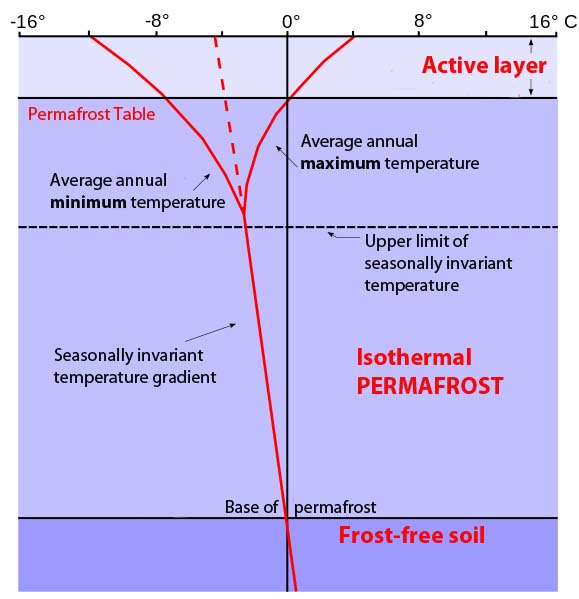
Also the Permafrost example shows no influence deeper down.
The Geothermal Gradient starts at the average surface temperature, and the temperature steadily increases with depth.
Without sun the surface would be 30-40K to radiate away the GF. You would have to go some 7 km deep before the temperature reaches 0C.
Probably geologically active areas. Italy for sure. Could be a magma chamber close to the surface.
Probably correct, but I needed to show what the maximum depth is where solar influence can be detected. Assuming the plot shows the effect of the Gulfstream, then this is solar heated water that reaches down to ~400m.
Same for el Nino, solar heated water at some 300 m deep.
The THC is mostly driven by AABW plunging down into the deep oceans. The second driver is the 0,1 W/m^2 GF that warms the water in contact with the ocean floor. Without heating at the ocean floor the ocean would just fill up with AABW and the THC would stop.
http://talleylab.ucsd.edu/ltalley/sio210/nov5/schmitz_conveyor.jpg
0,1 W/m^2 GF is capable of warming ALL ocean water 1K every ~5000 year.
To warm the deepest ~40 m 1K would take ~50 years.
Realize that every liter of bottom heated water must be physically transported to the surface at high latitudes before its energy can be transferred to the atmosphere and space.
http://www.ewoce.org/gallery/P15_TPOT.gif
For Stephan Wilde
Ozone and Sun driving climate – have you seen Erl Happ’s pages on this?
https://reality348.wordpress.com/2016/06/11/25-where-is-ozone-part-a-ionization/comment-page-1/#comment-577
Yes indeed but Erl still accepts the consensus view that an active sun increases ozone whilst a quiet sun reduces ozone which appears not to be correct in that apparently the ozone response to solar variations is reversed above 45 km and over the poles.
I have a separate hypothesis regarding that which is not directly relevant to this particular thread.
This post has been made twice now, and never showed up:
@ur momisugly tty May 24, 2019 at 9:11 am @ur momisugly1449845598381/Ground-temperature-variation-with-depth-at-different-months-for-Maslak-Istanbul-Turkey.png' />
The sun heats Earths surface, and blocks the internal heat unless the crust is hot enough to losse heat in winter time.@ur momisugly1449845598381/Ground-temperature-variation-with-depth-at-different-months-for-Maslak-Istanbul-Turkey.png'>
Without sun the surface would be ~30-40K to radiate away the GF and the geothermal gradient would start at this surface temperature.
Same mechanism is true for the oceans. The sun maintains a warm surface layer that prevents geothermal energy from reaching the surface, except at (very) high latitudes.
Once you realize that the heat content of the oceans is mostly of geothermal origin it is simple to explain our surface temperatures:
the solar energy that reaches the surface only increases the temperature of the mixed layer a bit above the geothermally heated deep(er) oceans.
The thermohaline circulation transports bottom “heated” water mostly towards Antarctica, where energy can be exchanged with the atmosphere.
http://talleylab.ucsd.edu/ltalley/sio210/nov5/schmitz_conveyor.jpg
Mechanical driver (gravity) seems to be the brine formed during ice creation, that “plunges” towards the ocean floor like a waterfall.
[Wordpress has for some reason flagged you for deletion. A moderator needs to regularly look in the Trash folder, and pull out those wrongly put on the Blacklist. I will delete your first 2 attempts. Mod]
Ben, May 25, 2019 at 2:52 pm
That is a graph and a diagram that both have lots of interesting features.
I recommend that you build a post around them and submit your ideas to Anthony, so we can discuss the points you raise on a dedicated thread.
Philip
Philip Mulholland May 26, 2019 at 5:44 am
I made a few posts on this subject on “that other site” but it seems I do not strike the right cords to get my ideas across.
https://tallbloke.wordpress.com/2014/03/03/ben-wouters-influence-of-geothermal-heat-on-past-and-present-climate/
https://tallbloke.wordpress.com/2014/10/14/ben-wouters-geothermal-flux-and-the-deep-oceans/
Only change I would make now is adding a calcuation showing that 1 million km^3 magma carries enough energy to warm ALL ocean water 1K.
Philip Mulholland
“That is a graph and a diagram that both have lots of interesting features.”
Really?
1. Did you have a look at the paper hidden behind the graph?
Experimental and computational performance comparison between different shallow ground heat exchangers
Aydin & al. 2015
https://www.researchgate.net/publication/286456011_Experimental_and_computational_performance_comparison_between_different_shallow_ground_heat_exchangers
From there I downloaded the pdf file and read it carefully.
The paper has nothing to do with any kind of geothermal heating let alone with a comparison of geothermal vs. solar flux.
But you don’t need to read the full paper to understand that Ben Wouters misunderstood its goal: the intro is enough. I paste it here (my emphasis in bold):
This is in perfect contradiction to what Wouters tried to interpret out of the article.
The ground heat exchange systems described by the four Turkish scientists operate at a depth of about 2 (two) meters: this is far far above the average depth used for geothermal heat extraction: around 400 (four hundred) meters.
If the horizontal GHE system doesn’t work during cold winters, then the probability is very high that this technique is based on solar radiation.
And it is also very probable that it only works in those countries showing an average solar radiation by far higher than e.g. in… the Netherlands 🙂
2. The little student education web page above the 3D-diagramme does not have anything to do with geothermal heat. It doesn’t even contain that word.
Look at these picture describing temperature in relation to depth and longitude in the Atlantic:
http://talleylab.ucsd.edu/ltalley/sio210/nov5/A16_THETA.gif
… and in the Pacific:
http://talleylab.ucsd.edu/ltalley/sio210/nov5/p16_ptem.gif
Interesting, isn’t it? You perfectly see here the amazing contribution of geothermal heat to ocean’s temperatures.
Sorry: that is what happens when people present information solely intended to match their personal narrative.
Bindidon
“1. Did you have a look at the paper hidden behind the graph?”
No.
Did you read my second sentence?
“I recommend that you build a post around them and submit your ideas to Anthony, so we can discuss the points you raise on a dedicated thread.”
Philip
Of course I did.
@Bindidon May 26, 2019 at 3:50 pm
What I wrote:
Accompanied by an image showing typical temperature vs depth plot over a year, in this case for some place in Turkey.
In this image some temperature vs depth plots:

Are you saying that these profiles would be the same when we had no sun warming the surface?
More convincing:
http://www.climate4you.com/images/ArgoTimeSeriesTemp59N.GIF
A plot showing typical seasonal warming/cooling of the mixed surface layer of our oceans over 15 years. No influence of whatever heats the surface below ~400m.
What is in your opinion the energy source for the oceans below this 400m (or below 1000m to be generous).
Especially interested in how you explain the very high deep ocean temperatures in the Cretaceous. (ocean floor temperatures up to 17 degrees higher then today)
Like others, I don’t follow the author’s math. In Kiehl and Trenberth 1997’s figure 7 (author’s figure 3), the atmosphere upward flux is 195 W/m^2 and the downward flux is 324 W/m^2. That’s 195 W/m^2 + 324 W/m^2 = 519 W/m^2. As a check (for consistency), we have the total input to the atmosphere as 67 W/m^2 from the Sun, 24 W/m^2 sensible heat flux, 78 W/m^2 latent heat flux, and 350 W/m^2 from the surface, and this also adds to 519 W/m^2. The percentage of downward flux is 324 W/m^2 / 519 W/m^2 = 62.4%. The percentage of upward flux is 195 W/m^2 / 519 W/m^2 = 37.6%. It’s not exactly fifty-fifty.
I’ve modeled the atmosphere using multiple layers. As the layers get thinner, the fifty-fifty upward-downward radiation assumption of a layer becomes more valid. But taken as a whole, the 40/60 split is more valid for the Earth.
I also modeled K & T 1997 using a simple EXCEL spreadsheet. To deal with feedback (which EXCEL won’t allow), I created a macro that transfers the contents from one cell to another cell multiple times in a loop. It’s interesting, but this EXCEL model will stabilize at the K & T 1997 numbers.
As the author mentioned, there are two ways to warm the surface: 1) narrow the IR window (increase the GHE), and 2) reduce the albedo (make the planet darker). In one case, the atmosphere warms first, then the surface warms, then the atmosphere, then the surface, and so on until the system stabilizes. In the other case, the surface warms first, then the atmosphere warms, then the surface, then the atmosphere, and so on until it stabilizes at a new value.
Is it possible to distinguish between these two cases? My simple EXCEL model isn’t going to do an exact job with the physics, but for very small changes it should be in the ball park.
We have the heat flux for the atmosphere and the surface. What we need are the emissivities. The surface is close to 1.0, so using 1.0 won’t be too far out-of-line. The atmosphere is another matter. I tend to think its emissivity is around 0.6. I’ve seen some estimates as low as 0.36, whereas 1.0 is probably far too high.
Using a range of emissivities, and narrowing the IR window until the surface warms by 1 K, I get an atmosphere change of 1.3 K to 1.6 K. If I decrease the albedo until the surface warms by 1 K, I get an atmosphere change of 0.6 K to 0.9 K. So we can distinguish between the two cases.
I’ve tried to compare actual temperatures, but the surface temperatures are so doctored, that they no longer reflect reality. Even so, it looks like the current warming is being caused by a change in the Earth’s albedo–not a GHE.
Jim
“Like others, I don’t follow the authors math”
Jim,
Thank you for posting and for taking up the struggle.
First where to start? I recommend that you start at ground level. Here we find that there are three upwelling fluxes, these are: –
1. Surface Radiation which is 390 W/m^2,
2. Surface Thermals which are 24 W/m^2,
3. Surface Evaporation which is 78 W/m^2.
These three outgoing components sum to a total surface outgoing flux of (390 + 78 + 24) = 492 W/m^2.
From the diagram we also know that the there are two incoming energy fluxes; –
1. Insolation Absorbed by Surface (168)
2. Back Radiation Absorbed by Surface (324)
These two components sum to a total Downward Flux reaching the Surface of (168 + 324) = 492 W/m^2. So, at the surface we have a balance.
Now we can see that the surface radiation of 390 W/m^2 is clearly labelled in the diagram. Using Stefan-Boltzmann (S-B) this flux converts to a thermodynamic surface temperature of 288 Kelvin (15C). This is the global average temperature that the authors’ list in their paper.
We also see in the diagram that from this 390 W/m^2, 40 W/m^2 is lost to space via the Atmospheric Window, which leaves the (390-40) = 350 W/m^2 of Surface Radiation Absorbed by the Atmosphere. This is also listed in the diagram, but 324 W/m^2 is returned to the Surface as Back Radiation. This means that the net back radiation gain to the Atmospheric Reservoir is (350-324) = 26 W/m^2. This value is the Greenhouse Gas Radiant Blocking effect.
Next, we calculate the fluxes which are Absorbed by the Atmosphere. These are as follows: –
1. Solar Insolation Absorbed by the Atmosphere (67),
2. Thermals delivered to the Atmosphere (24),
3. Latent Heat delivered to the Atmosphere (78) and of course
4. The Greenhouse Gas Radiant Blocking mentioned above (26).
These four components sum to (67 + 24 + 78 + 26) = 195 W/m^2.
Now the target flux is 390 W/m^2 and 195 is half of 390, so where does the other 195 W/m^2 come from? The answer is infinite recycling in a geometric series of halves of halves.
So how does that work? Well the atmosphere has a linear gradient loss rate from the surface to the TOA. There is very little loss at the base and total loss at the top. We can collapse this infinitely thin series loss staircase into a single calculation at the mid-point depth. (Think of standard calculus for computing the area of a triangle for example)
At this mid-point level, we have half the flux passing up and lost to space, and half the flux passing down and recycled.
So now we can double the flux in the atmospheric reservoir from 195 W/m^2 to the 390 W/m^2 value reported in the diagram. This doubling occurs because the limit of an infinite geometric series of fractions to the base two (1/2 + 1/4 +1/8 + 1/16 + etc.) =1
The doubling of the flux within the atmospheric reservoir by infinite recycling creates the flux value of 390 W/m^2 that is required to explain the S-B global average temperature of 288 Kelvin (15C).
>>
Now the target flux is 390 W/m^2 and 195 is half of 390, so where does the other 195 W/m^2 come from? The answer is infinite recycling in a geometric series of halves of halves.
<<
Again your math is faulty. You subtracted 324 W/m^2 from the surface-atmosphere loop, so your question should be: “Where does the 324 W/m^2 come from?”
With the missing 324 W/m^2 (you subtracted it out), then the surface is radiating 26 W/m^2 + 40 W/m^2 = 66 W/m^2. The total energy flux leaving the surface is 24 W/m^2 + 78 W/m^2 + 66 W/m^2 = 168 W/m^2. That’s the exact value that the surface absorbs directly from the Sun. You need to increase the atmosphere from 195 W/m^2 to 519 W/m^2 or 519 W/m^2 – 195 W/m^2 = 324 W/m^2.
I’m afraid you’re mixing up the atmosphere energy flux with the surface energy flux. You can’t make that 324 W/m^2 up with a fifty-fifty split from the atmosphere–you need something like a 62-38 split.
Jim
“Again your math is faulty. You subtracted 324 W/m^2 from the surface-atmosphere loop, so your question should be: “Where does the 324 W/m^2 come from?””
Jim,
I call it like this: –
1. The Surface Thermals (24 W/m^2) and
2. The Surface Evaporation (78 W/m^2) are both surface cooling losses
Both of these processes are powered by solar insolation. Therefore, these two values must be subtracted from the only credible source of energy that can power them, namely solar insolation.
Solar insolation is 168 W/m^2 so that means we have (168 – 24 -78) = 66 W/m^2 of surface radiant energy left over. Now 40 w/m^2 of this surface radiant energy is lost to space through the atmospheric window, so we have (66 -40) = 26 left over to add to the atmospheric reservoir.
As before, for the atmospheric reservoir we have we have: –
1. Solar Insolation Absorbed by the Atmosphere (67),
2. Thermals delivered to the Atmosphere (24),
3. Latent Heat delivered to the Atmosphere (78) and of course
4. The Greenhouse Gas Radiant Blocking mentioned above (26).
These four components sum to (67 + 24 + 78 + 26) = 195 W/m^2.
This 195 W/m^2.is the raw power that drives the climate system. Everything else in the system e.g. the 324 W/m^2 of Back Radiation is a consequence of flux recycling. How that flux recycling occurs is a matter for interesting debate. But power intensity flux recycling is what it is.
>>
I call it like this: –
<<
And then you reproduce my calculations.
A surface emitting 66 W/m^2 has a temperature of about 184 K (using Stefan-Boltzmann law). That’s (184 K – 273 K)*(1 °C/K) = -88 °C. It is really cold. Carbon dioxide freezes out at about -78.5 °C at 1 atmosphere. There shouldn’t be any (major) GHGs at that temperature.
Your numbers (actually K & T 1997’s numbers) are only valid for a surface temperature of 288 K with plenty of water vapor in the atmosphere. You would need a model with lots of physics in it to determine the various fluxes (albedo, sensible heat flux, latent heat flux, IR window, etc.) with such a large change in surface flux. That 66 W/m^2 wouldn’t be correct with 324 W/m^2 missing either. All these fluxes depend on each other in complex ways.
>>
How that flux recycling occurs is a matter for interesting debate.
<<
It’s simple really: up, down, up, down, up, down, and so on. However, if you use multiple layers and solve them simultaneously, the recycling is taken care of.
Jim
“And then you reproduce my calculations”
Jim,
In the diagram K&T show that the surface flux is composed of 3 elements: –
1. Thermals delivered to the Atmosphere (24),
2. Latent Heat delivered to the Atmosphere (78)
3. Surface Radiation (390)
Together these three elements, clearly shown in the diagram, sum to (24 + 78 + 390) = 492 W/m^2 which provides us with a S-B thermodynamic temperature of 305.2 Kelvin (32.2C).
All I trying to do is describe the published elements in the K&T diagram using their numbers.
However, a description is not an explanation.
For an explanation we needed clarity by the authors’ in the presentation of their ideas.
To create a diagram that shows Back Radiation in the form given by K&T pretty much boils down to: –
“And then at this point a miracle occurs.”
“Using a range of emissivities, and narrowing the IR window until the surface warms by 1 K, I get an atmosphere change of 1.3 K to 1.6 K. If I decrease the albedo until the surface warms by 1 K, I get an atmosphere change of 0.6 K to 0.9 K. So we can distinguish between the two cases.”
Jim,
A really nice piece of analysis, I hope that you persevere.
Phillip
There seems to be a hell of a lot of numbers and confusion. This comment might clarify some things for you…
https://thestandard.org.nz/farrar-peddles-climate-change-denial-nonsense/#comment-1521081
This comment might clarify some things for you”
Mack,
Useful link.
Thanks
>>
A really nice piece of analysis, I hope that you persevere.
<<
Thanks, but as I’ve said elsewhere, it’s no longer about the math and the science–it’s about power, control, money, and taxes.
Jim
Atmospheric long wave emissivity is easily calculated if upward surface flux and the atmospheric window flux are known. Using the KT diagram above, e= 0.9. The problem is that there is no time-series observation or calculation of AtMWindow, so we cannot see how it changes over time. You need AtmWin to determine the atmospheric partition factor, which as you correctly surmised is 0.38 if you include non-radiative heat transfers into the atmosphere. These kinds of energy budgets don’t have the observational data necessary to solve for emissivity in principle
>>
Atmospheric long wave emissivity is easily calculated if upward surface flux and the atmospheric window flux are known.
<<
Interesting! What’s the exact formula for that?
Jim
If atm longwave emissivity is e, and surface flux is SF, then atmosphere absorbs eSF and transmits (1-e)SF. That transmitted bit is the atmospheric window.
Thank-you!
Jim
@Bindidon May 26, 2019 at 3:50 pm
What I wrote:
Accompanied by an image showing typical temperature vs depth plot over a year, in this case for some place in Turkey.
In this image some temperature vs depth plots:

Are you saying that these profiles would be the same when we had no sun warming the surface?
More convincing:
http://www.climate4you.com/images/ArgoTimeSeriesTemp59N.GIF
A plot showing typical seasonal warming/cooling of the mixed surface layer of our oceans over 15 years. No influence of whatever heats the surface below ~400m.
What is in your opinion the energy source for the oceans below this 400m (or below 1000m to be generous).
Especially interested in how you explain the very high deep ocean temperatures in the Cretaceous. (ocean floor temperatures up to 17 degrees higher then today)
“Abstract
Telluric currents are natural electrical phenomena in the Earth or its bodies of water. The strongest electric currents are related to lightning phenomena or space weather. Earth electricity can cause damage to structures, and may be useful for earthquake forecasting and other applications. Thirty-two distinct mechanisms that cause Earth electricity are described, and a broad selection of current research is highlighted. © 2013 by the Istituto Nazionale di Geofisica e Vulcanologia. All rights reserved”
https://www.researchgate.net/publication/266971680_Earth_electricity_A_review_of_mechanisms_which_cause_telluric_currents_in_the_lithosphere
“INTRODUCTION
How does atmospheric electricity affect man and his technological systems? Is our electrical environment
changing as a result of air pollution, the release of radioactive materials, the construction of high-voltage power lines,
and other activities? It is clear that modern technological advances can be seriously affected by various atmospheric
electrical processes and that man is also beginning to affect the electrical environment in which he resides.”
https://books.google.com.au/books?hl=en&lr=&id=7j4rAAAAYAAJ&oi=fnd&pg=PA232&dq=telluric+currents+wireless+communications+and+remote+sensing&ots=sIlHZNiSd2&sig=KLBr5vaIbBJq8reodTY2zoBPp6Q#v=onepage&q&f=false
“Telluric Currents and Atmospheric Temperature
Posted on March 8, 2016 by Louis Hissink
Philip Callahan is an entomologist, or studies insects, and has written a book for the layman that’s easy to read but he did write a clanger or two when he states that a dimagnetic material is slightly repelled by a magnetic field, and that a paramagnetic one is attracted to a magnetic field.
The problem is the phrase “magnetic field” – is it the north seeking or south seeking pole of a magnetic field that is causing the observations?
And while he concentrates on magnetic fields, by omitting the role of electric currents, or telluric currents, miniscule as they might be, in the process also limits comprehension.”
https://lhcrazyworld.wordpress.com/2016/03/08/telluric-currents-and-atmospheric-temperature/