“…scientists were so shocked to find the change.”
From NASA JPL: Cold Water Currently Slowing Fastest Thinning Greenland Glacier
NASA research shows that Jakobshavn Glacier, which has been Greenland’s fastest-flowing and fastest-thinning glacier for the last 20 years, has made an unexpected about-face. Jakobshavn is now flowing more slowly, thickening, and advancing toward the ocean instead of retreating farther inland. The glacier is still adding to global sea level rise – it continues to lose more ice to the ocean than it gains from snow accumulation – but at a slower rate.
The researchers conclude that the slowdown of this glacier, known in the Greenlandic language as Sermeq Kujalleq, occurred because an ocean current that brings water to the glacier’s ocean face grew much cooler in 2016. Water temperatures in the vicinity of the glacier are now colder than they have been since the mid-1980s.
In a study published today in Nature Geoscience, Ala Khazendar of NASA’s Jet Propulsion Laboratory in Pasadena, California, and colleagues report the change in Jakobshavn’s behavior and trace the source of the cooler water to the North Atlantic Ocean more than 600 miles (966 kilometers) south of the glacier. The research is based on data from NASA’s Oceans Melting Greenland (OMG) mission and other observations.
The scientists were so shocked to find the change, Khazendar said:
“At first we didn’t believe it. We had pretty much assumed that Jakobshavn would just keep going on as it had over the last 20 years.”
However, the OMG mission has recorded cold water near Jakobshavn for three years in a row.
The researchers suspect the cold water was set in motion by a climate pattern called the North Atlantic Oscillation (NAO), which causes the northern Atlantic Ocean to switch slowly between warm and cold every five to 20 years. The climate pattern settled into a new phase recently, cooling the Atlantic in general. This change was accompanied by some extra cooling in 2016 of the waters along Greenland’s southwest coast, which flowed up the west coast, eventually reaching Jakobshavn.
When the climate pattern flips again, Jakobshavn will most likely start accelerating and thinning again.
Josh Willis of JPL, the principal investigator of OMG, explained,
“Jakobshavn is getting a temporary break from this climate pattern. But in the long run, the oceans are warming. And seeing the oceans have such a huge impact on the glaciers is bad news for Greenland’s ice sheet.”
Water Temperature and Weather
Jakobshavn, located on Greenland’s west coast, drains about 7 percent of the island’s ice sheet. Because of its size and importance to sea level rise, scientists from NASA and other institutions have been observing it for many years.
Researchers hypothesized that the rapid retreat of the glacier began with the early 2000s loss of the glacier’s ice shelf – a floating extension of the glacier that slows its flow. When ice shelves disintegrate, glaciers often speed up in response. Jakobshavn has been accelerating each year since losing its ice shelf, and its front (where the ice reaches the ocean) has been retreating. It lost so much ice between 2003 and 2016 that its thickness, top to bottom, shrank by 500 feet (152 meters).
The research team combined earlier data on ocean temperature with data from the OMG mission, which has measured ocean temperature and salinity around the entire island for the last three summers. They found that in 2016, water in Jakobshavn’s fjord cooled to temperatures not seen since the 1980s.
“Tracing the origin of the cold waters in front of Jakobshavn was a challenge,” explained Ian Fenty of JPL, a co-author of the study. “There are enough observations to see the cooling but not really enough to figure out where it came from.”
Using an ocean model called Estimating the Circulation and Climate of the Ocean (ECCO) to help fill in the gaps, the team traced the cool water upstream (toward the south) to a current that carries water around the southern tip of Greenland and northward along its west coast. In 2016, the water in this current cooled by more than 2.7 degrees Fahrenheit (1.5 degrees Celsius).
Although the last few winters were relatively mild in Greenland itself, they were much colder and windier than usual over the North Atlantic Ocean. The cold weather coincided with the switch in the NAO climate pattern. Under the influence of this change, the Atlantic Ocean near Greenland cooled by about 0.5 degrees Fahrenheit (1 degree Celsius) between 2013 and 2016. These generally cooler conditions set the stage for the rapid cooling of the ocean current in southwest Greenland in early 2016. The cooler waters arrived near Jakobshavn that summer, at the same time that Jakobshavn slowed dramatically.
The team suspects that both the widespread Atlantic cooling and the dramatic cooling of the waters that reached the glacier were driven by the shift in the NAO. If so, the cooling is temporary and warm waters will return when the NAO shifts to a warm phase once again.
Wider Implications
The warming climate has increased the risk of melting for all land ice worldwide, but many factors can speed or slow the rate of ice loss. “For example,” Khazendar said, “the shape of the bed under a glacier is very important, but it is not destiny. We’ve shown that ocean temperatures can be just as important.”

A view of the calving front of Jakobshavn Glacier from the window of a NASA research plane.
Credit: NASA/John Sonntag
Tom Wagner, NASA Headquarters program scientist for the cryosphere, who was not involved in the study, said, “The OMG mission deployed new technologies that allowed us to observe a natural experiment, much as we would do in a laboratory, where variations in ocean temperatures were used to control the flow of a glacier. Their findings – especially about how quickly the ice responds – will be important to projecting sea level rise in both the near and distant future.”
The paper on the new research in Nature Geoscience is titled “Interruption of two decades of Jakobshavn Isbrae acceleration and thinning as regional ocean cools” Besides JPL, co-authors are at Remote Sensing Solutions in Barnstable, Massachusetts, and the University of Utrecht in the Netherlands.
Last fall, the DMI reported that that the 2018 “melt” season was unusually cool. As was 2017.
With the snow cover extent, the albedo was unusually high.
These researchers should also be looking at the top-end of glacial flow.
As well as the time it takes to get from snow turning to ice and then, eventually, sliding into the sea.
Perhaps their fund-raising was just limited to sensationalism about glacier retreat?
OMG = Oh my God!
You don’t understand something when you are constantly surprised by it. They aren’t experts on anything.
I’m surprised that there wasn’t a comment earlier pointing out “OMG”! LOL! …. OMG had to be intentional …. the Oh My God study ….. we can’t believe it.
‘The scientists were so shocked to find the change, Khazendar said: “AT FIRST WE DIDN’T BELIEVE IT. We had pretty much ASSUMED THAT JAKOBSHAVN WOULD JUST KEEP GOING on as it had over the last 20 years.”
However, the OMG mission has RECORDED COLD WATER NEAR JAKOBSHAVN FOR THREE YEARS IN A ROW. When the climate pattern flips again, Jakobshavn will MOST LIKELY start accelerating and THINNING AGAIN.
‘Josh Willis of JPL, the principal investigator of OMG, explained; “JAKOBSHAVN IS GETTING A TEMPORARY BREAK from this climate pattern. But in the long run, the oceans are warming. And seeing the oceans have such a huge impact on the glaciers is bad news for Greenland’s ice sheet.”
Damn! I wish I could get a climastrologist’s free pass to study the evidence and then cook up a totally contradictory conclusion backed up by nowt other than wild speculation. These guys aren’t researchers, they’re fiction writers.
Water cooling for three years but somehow the previous trend of warming water means the cooling is temporary and will of course flip? According to what evidence (other than the script from ‘End of Days; the climastrologist’s edition)? Readers are supposed to take this speculation seriously, even after they’ve admitted they had already drawn their conclusion?
Your taxes at work people, funding the ineptocracy.
Not a scientist but have heard rumors that real scientists are taught not to assume things will carry on as they have been. That would be particularly true if “as they have been” is twenty years and we are talking about very long term natural processes.
Instead of we were shocked we are idiots would be more appropriate to this scenario. Seriously people. We really are wasting a wheel barrow load of money on this crap. Meanwhile the Jet Propulsion Laboratory should consider getting back to what it was founded to do. Climate has infested science in the USA.
I guess they don’t understand the word oscillation?
Solar cycles also seem to be beyond their abilities. Anything that isn’t a linear (or preferably exponential) consistently increasing graph is beyond their mathematical imagination.`
”The ”scientists” had pretty much assumed……..”. I assume, my window cleaner assumes but should scientists assume?
” the Atlantic Ocean near Greenland cooled by about 0.5 degrees Fahrenheit (1 degree Celsius) between 2013 and 2016″ Nope. C = 5/9 (F-32) so the conversion is trash.
Even in the face of empirical data showing Jakobshavn glacier is exhibiting cyclical behavior, our vaunted climate change seancetists cling to their linear CO2 thinking.
Perhaps during the latest NAO cold cycle, Jakobshavn glacier will return to its previous elevated levels of ice mass and height….. What will they call it then? CO2 ‘collusion’? CO2 ‘obstruction’? CO2 ‘conspiracy’?
Newton:
an object either remains at rest or continues to move at a constant velocity, UNLESS ACTED UPON BY A FORCE.
Sounds like they assumed that a linear law like “continues to move at a constant velocity” was at work. I guess they forgot that there are other forces.
To stop sea level rise, construct a berm of rock rubble to protect the glacier from the ocean currents.
The basic problem with global mean things to represent the planet is that they are so generalized, they don’t represent anything real.
HOw can it be slowing and advancing towards the ocean at the same time?
Constipated?
Glaciers are always moving forward (until they have almost completely melted away), but the melting edge may retreat or advance in response to the supply of heat. There’s a dynamic balance between the amount of ice coming down the glacier and the rate of melting.
So it slowed its speed, but the melting slowed even more, and so the front advanced.
Not quite. A glacier is gaining mass through snowfall and losing it by surface melting plus calving (into the sea or a lake). If accumulation is larger than loss it will advance, if the loss is larger than the accumulation it will retreat.
The speed it moves with is more complicated since it also depends on the topography and the bed over which it moves.
To complicate things further the various processes work on completely differen time-scales. For example a glacier may advance because it is a cold summer this year with little surface melting near the glacier front, or because it snowed heavily 500 years ago and this increased accumulation has now reached the glacier front.
Scientists Shocked??
Real Scientists wouldn’t be shocked.
This was totally predictable with the AMO (Atlantic Multidecadal Oscillation) “rolling over” from positive to negative.
Warmer currents heading north into Greenland causes some melting. When the AMO turns negative.. like it has been recently less melting should be expected.
DocSiders, I’d say the AMO is neutral. It has been slightly negative which could be the start of a phase change. We should know more as the year progresses. It could also return back positive.
Another thought is El Nino conditions usually lead to higher AMO values. We’ve had El Nino conditions for around 6 months now. If the AMO doesn’t go back positive that would be interesting.
Sounds like these computer modelers are in denial.
I had always under stood that Glaciers were “Driven” by two simple facts. Temperature either by air or water, and snowfall.
So if the water temperature is a bit higher then the ice shelf will melt a bit fester, but if during that time a lot of snow falls, then things balance out.
So why are the so called “Scientists” “shocked”. . I would have thought that “Very interesting” would be the correct response, but of course if you are a dedicated ” End of the World” type, then yes they would be shocked.
MJE VK5ELL
Add in the fact that Jakobshavn Glacier had already retreated onshore… where water temperatures underneath the ice tongue ceased to be a factor.
Are you sure it had retreated onshore?
I’ve never seen a map showing where that would be, for Jakobshavn. I’ve only seen maps like these, where the shoreline isn’t shown:
It hasn’t. It is still calving into the sea, but the glacier front is now grounded, it is no longer a floating ice tongue.
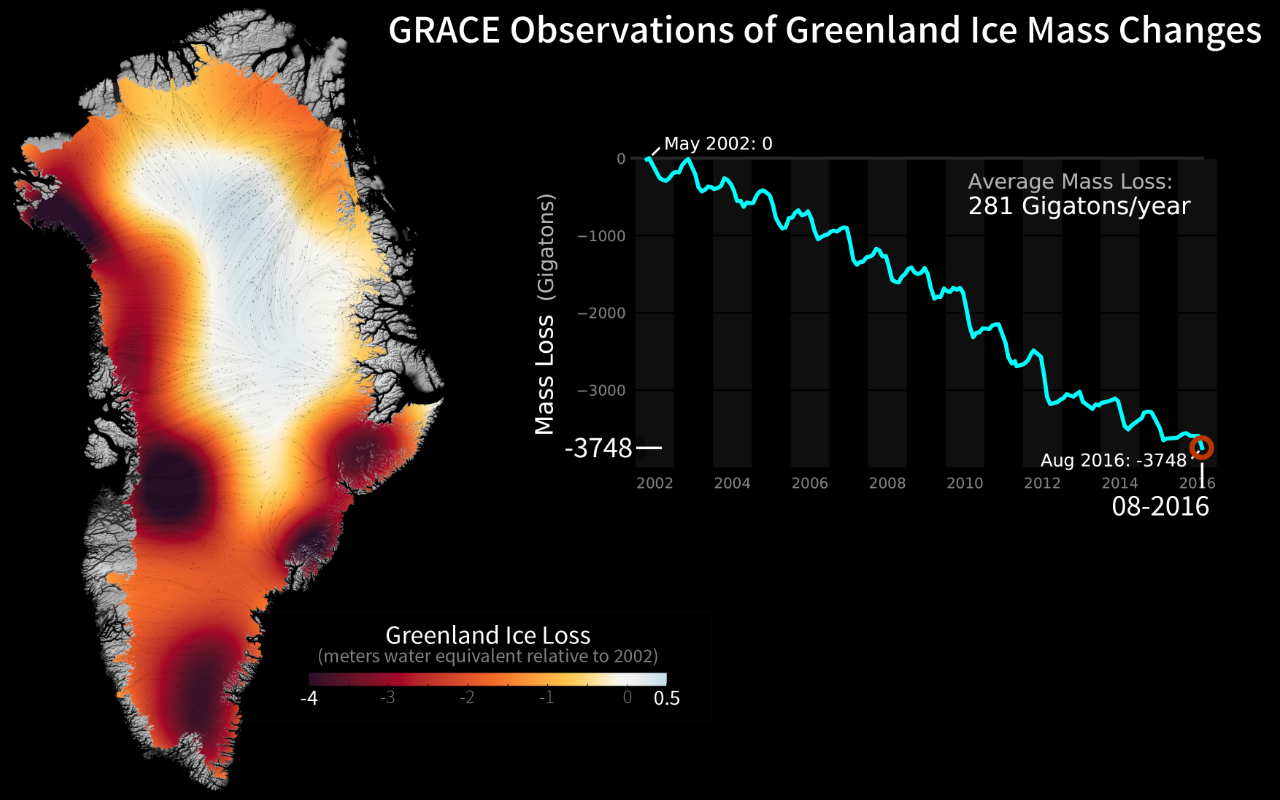
What this article didn’t mention Greenland’s Net Land Ice Mass actually increased from 2016~17 and 2017~18.
When it first happened, NOAA said this was just an anomalous 1-in-100 year event, so having two back to back is a 1-in-10,000 year event, right?
What’s actually happening is that the PDO, NAO and AMO are now all in their respective 30-year ocean cool cycles, so global temperature trends will start to fall, and Arctic Ice Extents and Greenland Land Ice Mass will increase for the next 30 years, just as they did from 1945~1975, and from 1880~1910 when these ocean cycles were in their respective cool cycles…
Moreover, a 50-year Grand Solar Minimum event just started, which will likely add to global cooling for the next 50 years…
In addition, the next La Niña cycle should be a strong one, which will likely cause UAH 6.0’s global temp anomaly to hit -0.2C, which will be impossible for CAGW advocates to explain, especially since we apparently, “only have 12 more years before the earth becomes unhibitable from the ravages of Global Warming.”
Things aren’t going so well for the CAGW cult these days..
SAMURAI, I think you might be jumping the gun a bit. The AMO may just be in a short swing into slightly negative territory. The PDO was still positive last I looked but hasn’t been updated for months.
When these go negative we will see what happens. If it cools like it did last time both of them were negative, it will be the end of the climate scam.
It should be the end, but in post-modern science and journalism, it could just be a sign that the magic, evil CO2 molecule can do anything. But whatever it does, is always bad. Because people.
Richard-san: Yeah, maybe I’m a bit early on the PDO and AMO, but both of these ocean cycles are very near entering their 30-year cool cycles, which will have a global cooling effect even as these ocean cycles approach their respective 30-year cool cycles.
The 2015/16 Super El Nino delayed the PDO’s 30-year cool cycle a bit, but the fall in ocean temps since the last Super El Nino is having a cooling effect. After the 2020/21 La Nina, the 30-year PDO cool cycle should begin.
We’ll see soon enough.
Cheers!
So much for the only supposed actual example of “marine ice-cliff instability”… This should kill sea level alarmism about as quickly as the Mueller report killed Trump Derangement Syndrome.
https://wattsupwiththat.com/2019/01/05/terrifying-sea-level-prediction-now-looks-far-less-likely-but-marine-ice-cliff-instability-is-just-common-sense/
D.M. – ….about as quickly as the Mueller report killed Trump Derangement Syndrome.
Seems to me that T.D.S. was shifted down a gear and pedal to the metal!
The Democrats are Wailing louder than ever!
Well about that. People who constantly scream about “climate change” are shocked when the climate…changes.
I predicted this in 2014.
http://landscapesandcycles.net/Will-Greenland-Begin-Accumulating-Ice-in-2015-and-Beyond-.html
“Using satellite altimetry to measure changes in sea level, Chafik (2014) reported the flow of warm Atlantic waters into the Irminger Current had increased significantly between 1992-1998 (B. below), but over the past 18 years the volume of warm water has been declining. Accordingly researchers had reported that large glaciers, like the Jakobshavn with submarine grounding points, had been stable or advancing between the 1960s and early 1990s. Then coincident with the arrival of a warmer water via the Irminger Current, the glaciers abruptly began retreating. Since 1997 the loss of Greenland ice accelerated culminating in the widely trumpeted loss of 570 gigatons in 2012-2013, which was opportunistically portrayed as evidence of CO2 warming.”
“Because the inflow of warm water has been waning since the late 1990s, it suggested that accelerated loss of ice would soon wane as well. Based on the drop in sea level (B. above) the volume of intruding warm Atlantic water has decreased by 10%. If the previous pulse of warm water has been the driving force for retreating Greenland glaciers and melting Barents Sea ice, then that reduced inflow predicts Greenland’s glaciers should soon stabilize”
Jim Steele
Thanks, very interesting stuff.
The authors need to look at the longer term. Their long-term ocean warming is just a bump in the longer (4-5000 year) cooling of the world and its oceans from the holocene optimum. Before that there was some incredible global warming of truly epic scale as we warmed out of the last glaciation. But no one has a decent model as to why these much larger cycles happened. Until you can explain the big swings in temperature, how can you claim to know what is driving a relatively small blip or cycle? They don’t even have enough data to know if this is a cyclic behavior.
I’m sorry, Josh Willis, but I never want to hear another thing you have to say about natural systems, glaciers, ocean temperatures, or tree rings, for that matter. Go find the broken ARGO floats whose data you deleted so you would not interrupt the CAGW cult narrative, prove that those floats were malfunctioning at the time, and do this on your own dime, and maybe a tiny bit of your scientific credibility and integrity would be restored to you. As a taxpayer, I do so wish I could prevent you from getting one more penny of federal research funding.
Since they didn’t forecast the cold flip what makes them think it will flip back warm (the good news)? Shouldn’t the super computers have predicted this?
So much we really don’t know.
SAMURAI
“What’s actually happening is that the PDO, NAO and AMO are now all in their respective 30-year ocean cool cycles, so global temperature trends will start to fall, and Arctic Ice Extents and Greenland Land Ice Mass will increase for the next 30 years…”
Well, if even a rather unconditional follower of AMO as is Richard M writes “I think you might be jumping the gun a bit”, than the probability is high that you are in fact exaggerating quite a lot.
Samurai, we all are no more than lay(wo)men here, with the exception a few real profressionals like e.g. Leif Svalgaard. But that doesn’t exonerate us from data inspection when publicly available.
1. PDO
http://research.jisao.washington.edu/pdo/PDO.latest.txt
2. NAO
https://crudata.uea.ac.uk/cru/data/nao/nao.dat
3. AMO (undetrended)
https://www.esrl.noaa.gov/psd/data/correlation/amon.us.long.data
4a. Arctic sea ice extent & area
ftp://sidads.colorado.edu/DATASETS/NOAA/G02135/north/monthly/data/
4b. Greenland Ice sheet
http://nsidc.org/greenland-today/files/2018/10/Figure3.png
5. SILSO’s SSN medium 12-month forecast
http://www.sidc.be/silso/predikfml
I have all the stuff on my computer, but please feel free yourself to download the raw data, and to process it using Excel, Libre Office or similar. You then will see how far you are from the reality.
Antialarmism is the same nonsense as alarmism, just with the opposite sign.
Just how elementary can “science” be to be published in Nature these days?
Anyone can go to the NASA Worldview page (https://worldview.earthdata.nasa.gov/) and see for himself that the Jakobshavn Isbrae is advancing.
Or go to the DMI site and their annual Greenland report (http://polarportal.dk/en/home/2018-season-report/) and read about it.
“known in the Greenlandic language as Sermeq Kujalleq”
https://www.google.com/search?q=greenlandic+language&oq=greenlandic+l&aqs=chrome.
says Denmark is no more interested in Greenland any more.
Greenland do your own thing.
https://www.google.com/search?q=Greenland+juveniles+drugs&oq=Greenland+juveniles+drugs&aqs=chrome.
My fault: no more –> not
“known in the Greenlandic language as Sermeq Kujalleq”
https://www.google.com/search?q=greenlandic+language&oq=greenlandic+l&aqs=chrome.
says Denmark is not interested in Greenland any more.
Greenland do your own thing.
https://www.google.com/search?q=Greenland+juveniles+drugs&oq=Greenland+juveniles+drugs&aqs=chrome.