“…scientists were so shocked to find the change.”
From NASA JPL: Cold Water Currently Slowing Fastest Thinning Greenland Glacier
NASA research shows that Jakobshavn Glacier, which has been Greenland’s fastest-flowing and fastest-thinning glacier for the last 20 years, has made an unexpected about-face. Jakobshavn is now flowing more slowly, thickening, and advancing toward the ocean instead of retreating farther inland. The glacier is still adding to global sea level rise – it continues to lose more ice to the ocean than it gains from snow accumulation – but at a slower rate.
The researchers conclude that the slowdown of this glacier, known in the Greenlandic language as Sermeq Kujalleq, occurred because an ocean current that brings water to the glacier’s ocean face grew much cooler in 2016. Water temperatures in the vicinity of the glacier are now colder than they have been since the mid-1980s.
In a study published today in Nature Geoscience, Ala Khazendar of NASA’s Jet Propulsion Laboratory in Pasadena, California, and colleagues report the change in Jakobshavn’s behavior and trace the source of the cooler water to the North Atlantic Ocean more than 600 miles (966 kilometers) south of the glacier. The research is based on data from NASA’s Oceans Melting Greenland (OMG) mission and other observations.
The scientists were so shocked to find the change, Khazendar said:
“At first we didn’t believe it. We had pretty much assumed that Jakobshavn would just keep going on as it had over the last 20 years.”
However, the OMG mission has recorded cold water near Jakobshavn for three years in a row.
The researchers suspect the cold water was set in motion by a climate pattern called the North Atlantic Oscillation (NAO), which causes the northern Atlantic Ocean to switch slowly between warm and cold every five to 20 years. The climate pattern settled into a new phase recently, cooling the Atlantic in general. This change was accompanied by some extra cooling in 2016 of the waters along Greenland’s southwest coast, which flowed up the west coast, eventually reaching Jakobshavn.
When the climate pattern flips again, Jakobshavn will most likely start accelerating and thinning again.
Josh Willis of JPL, the principal investigator of OMG, explained,
“Jakobshavn is getting a temporary break from this climate pattern. But in the long run, the oceans are warming. And seeing the oceans have such a huge impact on the glaciers is bad news for Greenland’s ice sheet.”
Water Temperature and Weather
Jakobshavn, located on Greenland’s west coast, drains about 7 percent of the island’s ice sheet. Because of its size and importance to sea level rise, scientists from NASA and other institutions have been observing it for many years.
Researchers hypothesized that the rapid retreat of the glacier began with the early 2000s loss of the glacier’s ice shelf – a floating extension of the glacier that slows its flow. When ice shelves disintegrate, glaciers often speed up in response. Jakobshavn has been accelerating each year since losing its ice shelf, and its front (where the ice reaches the ocean) has been retreating. It lost so much ice between 2003 and 2016 that its thickness, top to bottom, shrank by 500 feet (152 meters).
The research team combined earlier data on ocean temperature with data from the OMG mission, which has measured ocean temperature and salinity around the entire island for the last three summers. They found that in 2016, water in Jakobshavn’s fjord cooled to temperatures not seen since the 1980s.
“Tracing the origin of the cold waters in front of Jakobshavn was a challenge,” explained Ian Fenty of JPL, a co-author of the study. “There are enough observations to see the cooling but not really enough to figure out where it came from.”
Using an ocean model called Estimating the Circulation and Climate of the Ocean (ECCO) to help fill in the gaps, the team traced the cool water upstream (toward the south) to a current that carries water around the southern tip of Greenland and northward along its west coast. In 2016, the water in this current cooled by more than 2.7 degrees Fahrenheit (1.5 degrees Celsius).
Although the last few winters were relatively mild in Greenland itself, they were much colder and windier than usual over the North Atlantic Ocean. The cold weather coincided with the switch in the NAO climate pattern. Under the influence of this change, the Atlantic Ocean near Greenland cooled by about 0.5 degrees Fahrenheit (1 degree Celsius) between 2013 and 2016. These generally cooler conditions set the stage for the rapid cooling of the ocean current in southwest Greenland in early 2016. The cooler waters arrived near Jakobshavn that summer, at the same time that Jakobshavn slowed dramatically.
The team suspects that both the widespread Atlantic cooling and the dramatic cooling of the waters that reached the glacier were driven by the shift in the NAO. If so, the cooling is temporary and warm waters will return when the NAO shifts to a warm phase once again.
Wider Implications
The warming climate has increased the risk of melting for all land ice worldwide, but many factors can speed or slow the rate of ice loss. “For example,” Khazendar said, “the shape of the bed under a glacier is very important, but it is not destiny. We’ve shown that ocean temperatures can be just as important.”

A view of the calving front of Jakobshavn Glacier from the window of a NASA research plane.
Credit: NASA/John Sonntag
Tom Wagner, NASA Headquarters program scientist for the cryosphere, who was not involved in the study, said, “The OMG mission deployed new technologies that allowed us to observe a natural experiment, much as we would do in a laboratory, where variations in ocean temperatures were used to control the flow of a glacier. Their findings – especially about how quickly the ice responds – will be important to projecting sea level rise in both the near and distant future.”
The paper on the new research in Nature Geoscience is titled “Interruption of two decades of Jakobshavn Isbrae acceleration and thinning as regional ocean cools” Besides JPL, co-authors are at Remote Sensing Solutions in Barnstable, Massachusetts, and the University of Utrecht in the Netherlands.
Tony Heller figured this out over a year ago.
Here is what the climate change agenda is about. Writ loud and clear on London streets by demonstrating students carrying hammer a sickle red flags whilst Climbing the statue of the late, great, Winston Churchill.
https://www.thegwpf.com/dominic-lawson-brainwashed-at-the-blackboard/
We will be told that this is further evidence that we are doomed. They will say that the glacier is gaining mass because of the warmer water and more humidity in the air and so more snow. Doomed, doomed I tell you, doomed. Bah!
Indeed you are correct shrnfr.
This story (not the WUWT link) is also being carried on DrudgeReport here:
https://www.nbcnews.com/mach/science/key-greenland-glacier-growing-again-after-shrinking-years-nasa-study-ncna987116
And in true NBCNews propaganda fashion, the bottom-line is uncritically turned-around into a “worse-than-we-thought” propaganda piece.
In any other branch/discipline of science, when your key predictions are falsified, your model and your hypothesis are wrong and discredited.
But NOT for Climate Change, it’s a religion infected with GroupThink Rentseekers after all.
In the NBC News piece they quote a climate priest-glaciologist as saying,
Only in Climate Change, with the supportive Ministry of Truth conveniently on your side, can you get away with having your key prediction falsified, yet claim it’s verified and worse than thought.
And I would seriously question Mr Willis’s scientific basis for saying, “he said, noting that about 90 percent of the heat trapped by greenhouse gases goes into the oceans.” The by-far-and-away the vast majority of heat trapped in the oceans is from SW solar energy to which GHG are transparent. The DWIR component from added GHG only slightly slows the oceans heat dissipation. SO Mr Willis’s physics understanding of how GHG work is probably quite deficient.
And if your physics basis for understanding the role of GHG’s is deficient (as Mr Willis’s is), well, it’s all snowballing crapball downhill from there trying to understanding a complex system like a big glacier’s responses to the many different factors that govern its long-term behavior.
Good old Josh Willis. He’s the guy who equates global warming to “the Apocalypse.”
https://wattsupwiththat.wordpress.com/2017/05/21/climate-scientist-josh-willis-shows-you-how-to-deal-with-your-climate-change-denying-uncle-but-fails/
He’s also the guy who fixed the problem with the Argo floats, so that they measured warming, rather than cooling:
https://earthobservatory.nasa.gov/Features/OceanCooling/
I’m not suggesting that he’s consciously dishonest. But he’s a fervent climate alarmist, so when the floats found cooling instead of warming, he looked hard for an error.
People tend to find what they look for. Would he have looked as hard for the opposite error?
Yes, it is, of course the best and newest technology that is wrong, the Argo buoys. Designed or built incorrectly, obviously, they provide data that is obviously wrong and must be adjusted to give the right answer.
And Josh could have calibrated them in his bathtub before they were thrown to oceans. Those low price hightech technologies are so unreliable. They don´t do what they are expected to do.
Ah, the moral high ground the Left loves to justify their means.
Nothing like bringing Nobel Cause Corruption and activism to your “science.”
If that is what he can call it. Makes making data adjustments justified. He must not have had any argobuoys near the fjord to “adjust”. Bad Luck.
Yep, same names over and over again. Interesting work for a Jet Propulsion Laboratory. Funny they have to model where the cold water comes from,what did they think would happen with reduced ice cover allowing more ocean heat content to escape to space.The cold water originated in the Arctic.
well said
Hey – global warming will cause sea levels TO DROP SO MUCH THERE WILL BE A GLOBAL SHORTAGE OF WATER. What used to be the oceans will be deserts of salt!
/sarc
Could it be that alarmists are now going to spend the next thirty five years rediscovering the Atlantic multidecadal oscillation? Apparently, it gets warmer, then cooler, then warmer, then cooler. Why was nobody told about this?
indefatigablefrog
It’s almost as if Mother Nature misplaced her computer forecasts.
Gu es bit when the AMO goes back into warm phase we are doomed.
When the AMO goes back to its warm phase in 25-30 years (like 1950-1980) of freezing our arse’s off, humanity will be welcoming the end of global cooling.
Let’s just hope the Eco-nutter Socialists haven’t led Western society to completely destroyed both reliable electricity and the world’s economies by then.
So, hockey club climatologists, specifically which predictive model got this one right (i.e. that ice loss for this glacier would slow significantly at this point)? {Crickets}
Call me a cynic but the scenario was likely that they got a healthy portion of the rent-seeker govt trough diverted their way to write a paper that claimed, “it’s worse than we thought”. Good on them, however, to REPORT rather than ADJUST the results away in this case. (And believe me, even that small concession is tough for me, given that 20 of the past 32 years working with NASA has shown me the organization is populated 90% with bozos who have to rely on industry to do a majority of the work within their original charter for which they take credit without even mention of industry contributions.)
Still, they found a way to claim “it’s worse than we thought”.
“But in the long run, the oceans are warming. And seeing the oceans have such a huge impact on the glaciers is bad news for Greenland’s ice sheet.”
This statement in spite of measurement error bars on ocean temperatures being probably an order of magnitude bigger than the reported ocean temperature increase.
If they tell us AMO´s cycles are the truth, they are going to end moneyflow to their wallets. Truth doesn´t sell.
When it cools, it´s iceage propagandas turn to rise it´s head. And this time it´s anthropogenic. That is perpetual money making machine.
Shit, yes. And I just remembered that when the AMO reverses to cooling, then they are going to call it the “shutting down of the Atlantic heat conveyor”. Caused by… guess what… yes…anthropogenic climate change.
So, it’s tails they win, and heads we lose.
They can dramatize a small fraction of a degree as something significant and unprecedented, but they greatly downplay any sort of cooling.
A rational person might say that this is an unprecedented occurrence of cooling over the past twenty years.
A climate alarmist [doesn’t count as a “person”, and certainly NOT “rational”] would say that this is just a fluke in an ever warming world.
They implied that warming narrative throughout the entire article. Even if the cooling/warming switches nothing we can do about it.
Glaciers are not static mechanical/thermal entities they are dynamic sinks effected by many different input vectors.
“bad news for Greenland’s ice sheet”
I don’t get this – is bad news for ice, good news for water? Maybe it’s good news for the land below?
Bad news for animals I can understand – disease, starvation, old age – bad news for plants perhaps – wilting, pests, poor soil – but bad news for ice? How do you think the ice will take it? If you’re going to anthropomorphise a molecule, perhaps the water would prefer to be fluid, rather than trapped in a slow-moving solid? Is gaseous water the happiest water?
I believe gaseous water is happiest, especially when combined with some malt, hops and yeast.
OK, I really don’t understand this. Do we want it to be like Florida or Antarctica? If the people hearing this AGW baloney understood that global cooling might again have a mile of ice over New York City, maybe they could put up with a little higher waterfront by 2100😁
Nonono, everything is OK. Warming = Cooling. In modern newspeak everything is just as they said. Don´t worry, be happy.
“…scientists were so shocked to find the change.” What else would one expect from a research team named OMG? Warmist scientists are always “shocked” when the data donesn’t fit the Alarmist narrative.
From the “Linear Thinking in a Non-linear World Department” comes statements like this:
“We had pretty much assumed that Jakobshavn would just keep going on as it had over the last 20 years.”
“assume” = ass-u-me, a conclusion which sums up Climate Change Cargo Cult science.
True. There are more assumptions than facts in most projections.
My thoughts exactly, Joel.
So it’s a big surprise to the scientists that the glacier is affected by ocean currents, specifically the AMO? They expected the glacier melting rate to stay constant until the glacier was gone? Did they just receive their degrees?
Yes minus1.5 deg I think….
One might assume the glacier would behave as it had over the last 20 years if one believes CO2 is the primary driver of climate change. If, however, you recognize natural climate variability (like any scientist would), this change is quite expected
To wit: They are activists with a moral cause, not scientists.
You probably meant amoral.
It’s a result of being tied to linear regression analysis. By the time something changes enough to affect the slope of the linear curve the inflection point is long past! Recent trends, which will become new long term trends, are missed completely! As you say, linear thinking in a non-linear world!
Khazendar said:
“At first we didn’t believe it. We had pretty much assumed…..”
Is this how science is supposed to work?
Makes me wonder how much climate “data” are assumptions instead of actual factual measurements.
Data are data
And conclusions are assumptions
And never the twain shall meet.
It’s how the circular reasoning of climate science works. I’m actually amazed they let observations override their assumptions.
Yep, they didn´t adjust the data as per usual.
They “didn’t believe” a 30-meter increase in the glacier’s height? But they can measure the change in height of the world’s ocean’s to the tenth of a centimeter? OMG indeed.
I suggest that the word in the phrase “Scientists were shocked..” ought to be replaced by “dismayed”
As in “OMG! The world is not going to end! We are not all going to die! Who will pay our salaries and bow to us as high priests now!!!”
The last time i legitimately heard of a scientist being shocked was when Rutherford was running experiments with alpha particles in 1909.
And then he hid under a bed for 40 years, and refused to publish his results in case they contradicted his pet theory, right?
Consider Alfred Wegener, the father of continental drift, now called plate tectonics. He was a meteorologist and polar researcher who published his first paper on the topic in 1911. Immediately considered an outsider by the geology community, it just so happened he was correct. Imagine — a non-geologist formulating one of the great advances in Earth science of the past 100 years.
It took over 50 years for enough evidence to accumulate to convince the rest of the geology world that he was correct — but they were convinced, because they were scientists.
And there was no money involved.
From the “Science Press Release Written by a Journalism Major Department,” come statements like this:
“The cold weather coincided with the switch in the NAO climate pattern. Under the influence of this change, the Atlantic Ocean near Greenland cooled by about 0.5 degrees Fahrenheit (1 degree Celsius) between 2013 and 2016.”
Doooh….
Nice catch; I was just going to post on that, so I will. 1.8 F degree = 1 Celsius degree. And, by unnecessarily rounding off, probably so we mere “idiots” could more easily understand it, he managed to get it both backwards, and otherwise bolixed. If our public “schools” would stop wasting precious time on the intersectionality, gender fluid, etc., etc., nonsensical brainwashing, which is messing up the kids’ heads so completely, and concentrate on reading, writing, and basic math, in order to enable critical thinking, this society would have far fewer problems.
I overlooked that, but this puzzles me: If Jakobshavn is now “thickening, and advancing toward the ocean instead of retreating farther inland,” then how can it also still be losing ice? If it is lengthening and thickening, where is it losing ice?
Note that Jakobshavn has been retreating for a lot longer than twenty years. In fact, it was already retreating rapidly over 150 years ago, when CO2 was under 290 ppmv. Here’s a map:
So, who else is shadowbanned by the NASA Goddard thought police?
I posted a comment on their Youtube video, here:
https://www.youtube.com/watch?v=ZHcB5EFDylc&lc=UgwgVIkAzxD5DLaY-CN4AaABAg
But that link only works for me. If you click on the link, you can’t see my comment, because it’s shadowbanned.
Here’s a screenshot, showing what I see when I click that link, while logged into my Google/Youtube account (my shadowbanned comment):
Dave, if you post the comment in full here i will copy and paste it into the comments after asking why it was taken down.
Thanks, bit chilly.
Technically, they didn’t take down the comment. It’s still there, but only I can see it.
That’s what “shadowbanning” does. It’s an underhanded way of censoring people while trying to prevent them from realizing that they’ve been censored.
NASA GISS appears to have blacklisted my Youtube ID, so that all my comments on their videos are automatically shadowbanned. Perhaps they did so because they were annoyed that I called this propaganda article and video of theirs “propaganda,” and posted comments about its flaws. You can read here about that, and how they shadowbanned those comments, on both Youtube and Facebook.
They probably feel that censoring critics is justified, for the same reason they feel justified slandering Prof. Happer: because saving the planet (and incidentally protecting their gravy train) requires silencing dissent. Your tax dollars at work.
Anyhow, here’s the text of my shadowbanned comment on their Jakobshavn video:
_ _ _ _ _ _ _ _ _ _
Here’s the accompanying article:
https://climate.nasa.gov/news/2852/cold-water-currently-slowing-fastest-greenland-glacier/
It begins, _”NASA research shows that Jakobshavn Glacier, which has been Greenland’s fastest-flowing and fastest-thinning glacier for the last 20 years, has made an unexpected about-face. Jakobshavn is now flowing more slowly, thickening, and advancing toward the ocean instead of retreating farther inland. The glacier is still adding to global sea level rise – it continues to lose more ice to the ocean than it gains from snow accumulation – but at a slower rate.”_
That doesn’t make sense to me. If Jakobshavn is now _”thickening, and advancing toward the ocean instead of retreating farther inland,”_ then how can it also still be losing net ice mass? If it is both lengthening and thickening, it must be gaining ice mass (from snowfall upstream) faster than losing ice mass (at the calving face).
Note that Jakobshavn has been retreating for a very long time. In fact, it was retreating rapidly in the mid-1800s, when CO2 was under 290 ppmv; here’s a map:
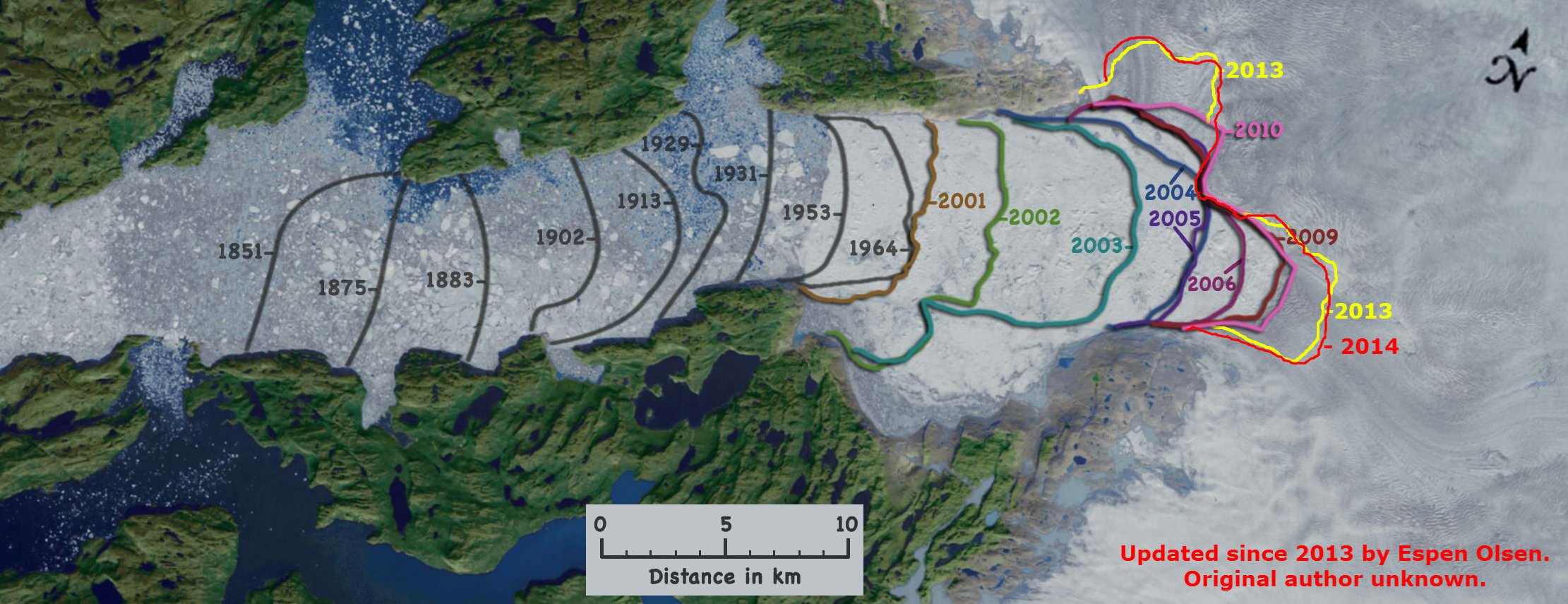
So, it moved more than half a way from 1851 until 1964 (that means before the major GHG influence), hardly moved at all from 1964 to 2001, then made most of the recent losses in 5 years.
Anyway, to out it in prospective, it’s a really small spot on the map of Greenland https://www.google.com/maps/place/Ilulissat,+Gr%C3%B6nland/@68.0771442,-54.9497177,1459099m/data=!3m1!1e3!4m5!3m4!1s0x4ef2ac312385d59d:0xe228279619f90f6a!8m2!3d69.2198118!4d-51.0986031
Michael L Combs, BertK, Joel, et al. – sorry, guys – you’ve got it all wrong! This is a newly discovered (and documented in a peer reviewed paper, or at least the press release thereof) psychological inversion function: in USA-targeted communications, when temps are rising, the conversion factor for degr F to degr C or K is just shy of 2:1. When temps are rising, the conversion factor is just over 0.5:1. “The Great Miscommunicator of AGW Psych,” Dr. Stephan Lewandowsky, is REALLY ticked off that he did not discover that inversion function! It fits so well with his 97%!
Dang – meant to say when temps are falling, >0.5:1. 🙁
This is great. Now well known oscillations are “weather coincidents”. Beautiful logic.
The GND is working already and it will never be implemented. Hooray!
“In 2016, the water in this current cooled by more than 2.7 degrees Fahrenheit (1.5 degrees Celsius).”
“Under the influence of this change, the Atlantic Ocean near Greenland cooled by about 0.5 degrees Fahrenheit (1 degree Celsius) between 2013 and 2016. ”
Computational error in the second quotation from the article (9/5 ≠ .5/1).
So much for the “myth” that ocean cycles influence climate, huh? The real myth is that CO2’s forcing is greater than water’s on a daily basis.
That warmer oceans produce more vapor to form snow near the poles would be obviously part of the planet’s regulation system, if they would quit ASSUMING that the only control factor is the dry gas portion of the greenhous.
The You Tube blabs on and on about deep water warming up and melting the Jakobshavn glacer. Does anyone really believe that? In my world warm water rises. and the You Tube reminds me of “The dog ate my homework” excuse.
My opinion? Glacier retreats and advances are a function of how much snow fell decades or centuries ago. Temperature doesn’t have a lot to do with with it.
By the way did everyone recognize Dr. Josh Willis with the laptop in the video?
Here’s his Ask a Climate Scientist You Tube
First, the polar bears. Now, the glaciers. Next, the politics. The climate is changing.
Fluctuations in regional climate due to various causes can be substantial. The heat that is being redistributed around the world seems to create regional temperature changes that dwarf any change in the average for the planet. That’s not to say that the cumulative effects of 100 years of gradual warming aren’t going to have dramatic effects, but anything that takes 100 years to happen provides 100 years to adjust ourselves to.
Wasn’t that Josh Willis the guy that found cooling in the ARGO float data, and kept massaging until it showed warming, because that is what he expected (or that’s what his pay-masters/sponsors expected?
In his first Argos presentation he actually apologized for not finding enough heat…
He removed the buoys that showed cooling. The result is Argo data is now useless for doing science.
That Mother Nature, she is such a climate denier.
I’ll bet not all scientists were “so shocked to find the change.” Many scientists recognize that nature has cycles of various degrees . . . it is only some poorly-informed climate “scientists” that think nature behaves in a monotonic fashion such as they THINK they have observed over the last X years.
So NASA is also doing linear extrapolations and getting paid for that?
I thought maybe it was just politicos and their advocacy spokesmen.
“Ocean near Greenland cooled by about 0.5 degrees Fahrenheit (1 degree Celsius) between 2013 and 2016.”
They have this backwards. One degree Celsius would be 0.56 degrees Fahrenheit. This is so basic, I wonder what else they missed?
1 deg C = 1.8 deg F
As long as folks don’t get the labels in the correct space these statements are prone to error.
1 C. deg is not the same thing as 1 deg C. (1°C.) = 33.8°F.
And,
1 Celsius deg = 1.8 Fahrenheit deg.
Some publications have auto-insert for such things and a writer might have the temperature going up 5 Celsius degrees. The printed version will show: 5°C. (40.1°F.), when 9 F. degrees is what is wanted.
Otherwise, it is a nice day. Hope that’s true for everyone.
Michael.
Dooohh…. don’t-cha’ hate the lack of edit.
“scientists were shocked.” Not nearly as shocked as I was when I read it. Honesty, after a 20+year hiatus is sneaking back into the climate discussion. Without Trump and his soon to be organized “Climate Commission” the authors would never have dared publish the report. Hillary and her ilk would have demanded that heads roll claiming that the author’s had sold out to big oil. The long term blabber is understandable…Trump isn’t going to be around forever and they’ll still need to eat.
Does this mean NASA is not even considering cyclical ocean current temps in the projections for glaciers?
Yep!
Change = rising CO2.
There are no other equations in climate science that matter to the warmists.