Guest Opinion; Dr. Tim Ball
A recent article in the British newspaper The Express titled, “Northern Lights in the UK: Can you watch Aurora Borealis from UK? Where can you see it?” raises interesting questions and comparisons with historical events. It also appears to reinforce the climate forecasts for the next few decades.

Source: Daily Express
Sir Edmund Halley (1656 – 1742) was one of the great astronomers in history. He proved his science in the best way possible by making an accurate prediction. He predicted the return of a comet that they then named after him. I became familiar with his work while working on the climate record of the Hudson’s Bay Company (HBC) at Churchill, Manitoba.
The record was given a great scientific boost when in 1768/9 two astronomers, William Wales and Joseph Dymond arrived in Churchill to measure the Transit of Venus. Halley first identified this event and devised a procedure to gather data to determine the distance of the Earth from the Sun. This distance was critical to accurately testing Newton’s theory of gravity. A Transit occurred in 1761, but lack of knowledge and a useable technique resulted in failure. The 1769 Transit was critical because another Transit would not occur for 105 years.
Sir Neville Maskelyne, President of the Royal Society, sent the astronomers. They brought a range of instruments made specifically for them by the Society to carry out a range of scientific measures including thermometers and barometers. They left them at Churchill where the HBC employees continued to maintain some of the earliest instrumental records in North America.
In an interesting irony, Halley’s life spanned the coldest portion of the Little Ice Age with the nadir in 1680. To my knowledge, he did not write about this, but he did write about astronomical events related to it. For example, he was invited by the Royal Society to visit Scotland to observe and submit a report on the newly seen Aurora Borealis. His submission was published in their Philosophical Transactions, in 1714 under the magnificent title,
An account of the late surprizing appearance of the lights seen in the air, on the sixth of March last; with an attempt to explain the principal phænomena thereof; as it was laid before the Royal Society by Edmund Halley, J. V. D. Savilian Professor of Geom. Oxon, and Reg. Soc. Secr.
His abstract is very different from those we see in today’s academic or scientific journals, but this is a time when the title scientist did not exist. He wrote,
The Royal Society, having received accounts from very many parts of Great Britain, of the unusual lights which have of late appeared in the heavens ; were pleased to signify their desires to me, that I should draw up a general resation (sic) of the fact, and explain more at large some conceptions of mine I had proposed to them about it, as seeming to some of them to render a tollerable solution of the very strange and surprizing phænomena thereof.
He knew about them from earlier reports, and he also knew about their relationship with sunspots. He knew about sunspots from Galileo’s work but had not seen them either because his life also spanned a period with very few sunspots. The diagram shows the most accepted reproduction of sunspot numbers with only a few over Halley’s lifetime.

Aurora borealis or northern lights are among the most spectacular atmospheric displays. Called Aurora australis in the southern hemisphere they are visible evidence of the relationship between the sun and climate. In early days they called them Petty Dancers from the French petite danseurs. In England, they were also called Lord Derwentwater’s lights because they were unusually bright on February 24th, 1716, the day he was beheaded. A bad omen for him, but they were also an indicator of the bad weather and harvest failures of the period.
Ionized particles streaming out from the sun are called the solar wind. The term is misleading because they are solid electrically charged particles. Activity on the Sun is seen as sunspots and solar flares and coincides with variations in the strength of the solar wind. When these charged particles reach the upper levels of the earth’s atmosphere, they collide with the molecules of nitrogen and oxygen. This collision creates electrical charges that make the gas molecules glow. The gas determines the colours of the Aurora. Nitrogen produces red and oxygen the shades from almost white through yellow to green.
Many northern North American First Nations people used them to predict the weather. The Cree in Manitoba expected three to four weeks of cold weather after a prolonged period of display. This is very accurate as it relates to the average eastward movement of the Rossby Waves. Henry Youle Hind, leader of a scientific expedition across Canada, wrote on the 19th of September 1858 about Ojibway predictions:
We arrived at the mouth of the river at 10 A.M. and hastened to avail ourselves of a south-east wind just to rise. Last night the aurora was very beautiful, and extended far beyond the zenith, leading the voyageurs to predict a windy day. The notion prevails with them that when the aurora is low, the following day will be calm; when high, stormy.
Samuel Hearne spent two and one-half years with the Chipewyan, (then called the Northern Indians.) His report on their explanation of the aurora is fascinating.
The Northern Indians call the Aurora Borealis, Ed-thin; and when that meteor is very bright, they say that deer is plentiful in that part of the atmosphere;,,, Their ideas in this respect are founded on a principle one would not imagine. Experience has shewn tham, (sic) that when a hairy deer-skin is briskly stroked with the hand in a dark night, it will emit many sparks of electrical fire, as the back of a cat will.
This describes the phenomenon of static electricity and is remarkably close to the current explanation of the Aurora.
The composite image from NASA shows the Aurora from space as a circle around the Magnetic Pole.

Although at a higher altitude it is coincident with the dome of cold air that sits over the Pole.

The auroral ring expands and contracts as the cold air dome expands and contracts. This means when the Aurora is seen closer to the Equator there is cold pervading the Northern hemisphere. This is the situation of the last several years. It is accentuated by the change of pattern in the Rossby Waves along the Polar Front from low to high amplitude Waves. It results in more extreme outbreaks of cold air pushing further toward the Equator and warm air penetrating further to the Pole as the cold air moves out of the way.
Similar conditions occurred in the 17th century. Diarist Samuel Pepys (1633-1703) wrote about the conditions on many occasions. They were especially concerned about the mild winters, so the government recommended action. On January 15, 1662, Pepys wrote,
“And after we had eaten, he (Mr. Bechenshaw, a friend) asked me whether we have not committed a fault in eating today, telling me that it is a fastday, ordered by the parliament to pray for more seasonable weather it hitherto had been some summer weather, that is, both as to warm and every other thing, just as if it were the middle of May or June, which doth threaten a plague (as all men think) to follow, for so it was almost all last winter, and the whole year after hath been a very sickly time, to this day.”
The prayers paid off. On January 26th Pepys wrote,
“It having been a very fine clear frosty day. God send us more of them, for the warm weather all this winter makes us fear a sick summer.”
Pepys’ concern mirrors an old English saying that,
“A green winter makes a fat churchyard.”
His concern was well-founded because the plague returned, reaching London in 1665.
When you read the entire series of weather entries in Pepys’ diaries that cover the period 1660 – 1690, the pattern of remarkably variable weather is symptomatic of a Meridional Rossby Wave flow.
It was a similar pattern described in Barbara Tuchman’s 1978 book “A Distant Mirror; The Calamitous Fourteenth Century.” It was another example, like Halley of an important person, the nobleman Enguerrand VII de Courcy, whose life spanned an important climate period the 14th century, with weather comparable to the 17th century and the early 21st century. It lasted longer and was more profound because it was a transitional century as the world cooled from the Medieval Warm Period (MWP) to the Little Ice Age (LIA).
The current debate attracting more and more people is that we are cooling with the only question left as to the extent and intensity. Will it be weather similar to the cooler period coincident with the Dalton Minimum from 1790 – 1830? Alternatively, will it be colder with similar conditions to those by the early fur traders in Hudson Bay or those that spanned the life of Sir Edmund Halley? The appearance of Aurora in northern England suggests the latter, although I can predict who will protest this suggestion.
Secular drift of the auroral ovals: How fast do they actually move?
N. A. Tsyganenko
Geophysical Research LettersAccepted Articles
First published: 04 March 2019
Abstract
Abstract
A surprisingly fast secular drift of the Northern geomagnetic dip pole during the last two decades has attracted much interest lately, in particular, evoking speculations about a possibility of a sweeping relocation of the auroral oval. This letter presents first results of a model investigation of this issue, based on an empirical representation of the distant magnetosphere combined with a series of internal geomagnetic field models for 12 epochs, covering the interval from 1965 through 2020. The secular drift of the Northern auroral oval was found to result in its net displacement over the 55‐year period, commensurate with the concurrent shifts of the centered, eccentric, and corrected geomagnetic poles, all of them much smaller than the enormous spurt of the Northern dip pole. In the Southern Hemisphere, the shift of the auroral oval and of the poles over the same period is much weaker, revealing a remarkable interhemispheric asymmetry.
According to Vuk’s model the inner liquid core has three vertically rising off centre vortices driving the Earth’s field.
http://www.vukcevic.co.uk/TIF.gif
However, the nearly settled science thinks otherwise
http://www.vukcevic.co.uk/JC.gif
During my travels to that far northern community of the upper peninsula of Michigan in the period of 1978 to 1980 there was both a measured set of phenomena of great snow, cold, and ice accumulation (Lake Superior) with a star gazer spectacle from the Northern Lights.
Thanks for reminding me of the observed connections.
El Niño will remain weak.
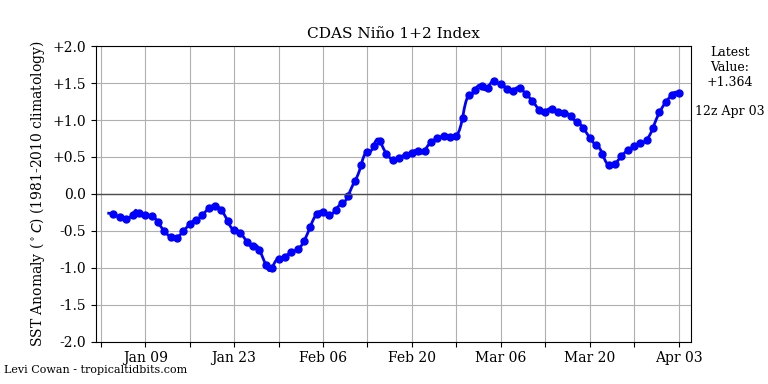
Strong cooling for sure in region 1+2. ..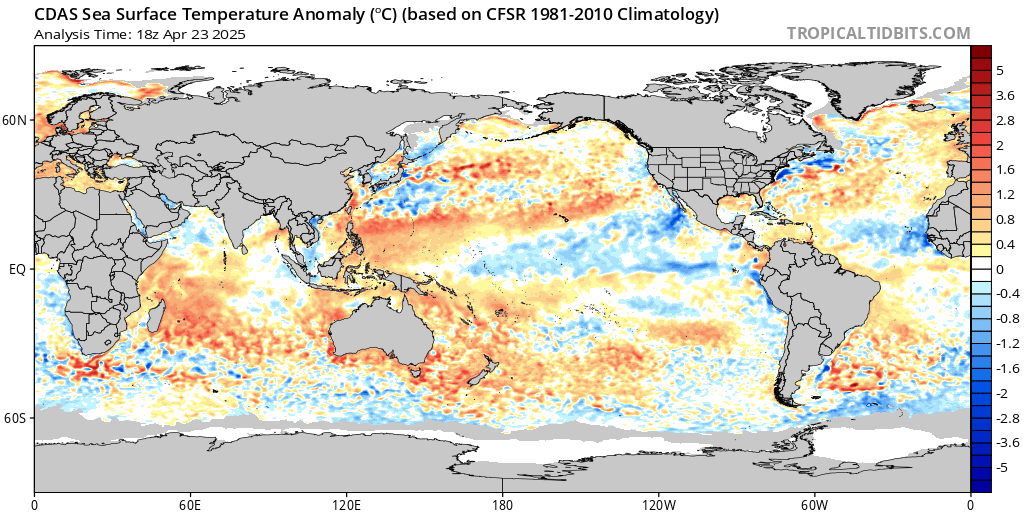
Observe the circulation in the Pacific.
https://earth.nullschool.net/#current/wind/isobaric/1000hPa/overlay=mean_sea_level_pressure/orthographic=-135.08,0.77,390
When describing the shifts of the aurora oval and the reasons, it seems to me you would also need to include how the meandering if the magnetic pole might enter in to it. Besides shifting eactly where the oval is, I suspect the further away it is from the axis, the more the distortions would be – just a gut feeling.
Unfortunately, the sun’s position of climate control has been outsourced, and its services are no longer required due to climate downsizing. We sincerely regret this turn of events, and note with gratitude the many millennia of faithful service the sun has performed.
In other news, we welcome aboard the newest, and even more powerful addition to the Climate Team, Carbon.
Further details will be forthcoming, but it is safe to say that moving forward, Carbon will add a compelling and uniqely unifying aspect to ClimeCentral Inc.
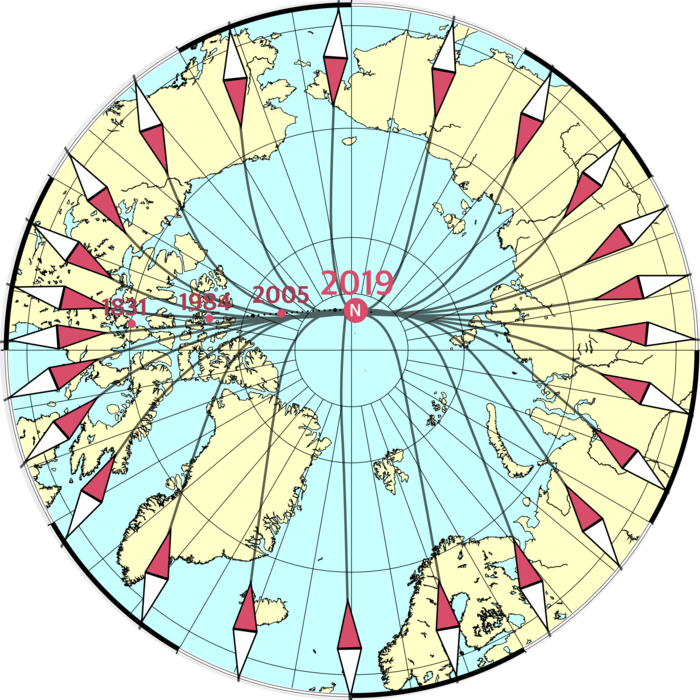
MAGNETIC NORTH ON THE MOVE
They are also responsible for ‘aurora arcs’, the familiar, slow-moving green curtains of light that can extend from horizon to horizon.
While much is known about these current systems, recent observations by Swarm have revealed that they are associated with large electrical fields.
Heated ions travel upward
These fields, which are strongest in the winter, occur where upwards and downwards Birkeland currents connect through the ionosphere.
Bill Archer from the University of Calgary explained, “Using data from the Swarm satellites’ electric field instruments, we discovered that these strong electric fields drive supersonic plasma jets.
“The jets, which we call ‘Birkeland current boundary flows’, mark distinctly the boundary between current sheets moving in opposite direction and lead to extreme conditions in the upper atmosphere.
“They can drive the ionosphere to temperatures approaching 10 000°C and change its chemical composition. They also cause the ionosphere to flow upwards to higher altitudes where additional energisation can lead to loss of atmospheric material to space.”
http://www.esa.int/var/esa/storage/images/esa_multimedia/images/2017/03/birkeland_currents/16872202-1-eng-GB/Birkeland_currents_node_full_image_2.jpg
https://www.esa.int/Our_Activities/Observing_the_Earth/Swarm/Swarm_details_energetic_coupling
Slightly OT but this discussion take me (way) back to my teen years, and a fall weekend of grouse hunting near the Flambeau River in northern Wisconsin. My father and I stopped by the local fire watchtower around 10 pm–just as the auroras began a sky-wide, magical dance of light. At one point there was a pulsating circle of light persisting directly overhead, surrounded by horizon-to-horizon curtains. I can honestly say the sensation was one of being in the presence of ‘The Great Spirit’ (subject to personal interpretation). It was truly an awe-inspiring experience, and one I’d wish everyone to have.
I can relate to your experience as I witnessed something similar.
While spending the summer fishing in SE Alaska in July, 1986, directly overhead were swirls and curtains of various shades of purple, lavender, pink and greens and the aurora appeared to be within arm’s length, so close but out of reach. It seemed as though the sky was falling all around us. The faint crackling of static electricity was surprising and I just stood there in utter amazement. The display lasted only ten minutes and when it ended, my fellow fishermen let out a sigh of sadness. What a breathtaking moment of splendor.
From Scafetta & Willson 2013 Planetary harmonics in the historical Hungarian aurora record (1523–1960), from the pdf
“The maxima of the Hungarian auroral record (near 1610, 1725, 1784, 1834, 1870, 1913 and 1945) correspond closely with the maxima in the sunspot record. The Maunder (1645–1715) and Dalton (1790–1830) solar activity minima are clearly seen in both records. “
https://www.sciencedirect.com/science/article/pii/S0032063313000081?via%3Dihub
“He predicted the return of a comet that they then named after him”
Halley did conjecture three previous comets which appeared roughly 75 years apart were the same comet (which was eventually named after him)
However his prediction of return was off by almost 2 years. It took some French astronomers and I believe a Cathic bishop to calculate the correct return and they were also off by a month.
Just to point out – science is tricky and not always clear cut.
With all do respect to all learned and initiated in knowledge,
If you lack basic knowledge of electricity and how it happens to be there in every aspect of your life,
as granted and a given, you lack the proper understanding, regardless of tittles or else, in science or what so ever.
With all your best interest there no chance of proper addressing of the issues.
Ignoring your own illiteracy in prospect of electricity, does not really help…try to learn what it basically is..
if you cold, before jumping in maverick ventures…in complete lack of understanding in electricity.
If you do not have it, that is it, you do not have it…period…regardless.
Try to mend your knowledge by at least accepting that much….
No any disrespect, or insult meant, but hey, that is how it is, and is not any easy matter…even when it seems so easy to grapple with!
cheers
It is cold in the high Arctic this winter. Polar vortexes notwithstanding.
http://ocean.dmi.dk/arctic/meant80n.uk.php
We have let ourselves get anchored in the cult of CAGW’s paradigm.
We hence have no explanation of past cyclic climate change and if CAGW/AGW is incorrect, have no idea how our climate will change in the future.
Climate has changed in the past.
https://journals.sagepub.com/doi/abs/10.1177/030913339902300101
Author’s copy.
https://people.earth.yale.edu/sites/default/files/files/Thomas/Adamsetal99.pdf
Yes, William. Despite all that dumping of bitterly cold air over North America and Russia from November to… still going on in Eastern US and Canada, it is still -40 below up there. WUWT?
I am surprised Leif doesn’t mention that Tim gets the relationship between aurorae and solar activity backwards.
This article is superstitious nonsense from beginning to end, and what little science is in there is wrong. Reading Tim’s articles of late has become an exercise in scientific parody comic relief. But hey! cooling alarmists have a long tradition of making a fool of themselves. Predicting a mini ice age on an aurora sighting, it just cannot get any worse than that. Thanks for the fun.
Javier
Could you be more specific as to what you object to regarding Ball’s article? As I read it, he tryies to establish a historical correlation between auroras, both in time and space, and cold weather. While auroras are more common during high sunspot activity, they are not unknown during sunspot minima.
Isn’t that sufficiently absurd to you? Weather is regional. February was cold in North America and warm in Europe. Trying to establish a correlation between weather and sunspots is so 18th century, and aurorae are much worse as the record is spotty. Aurorae and sunspots correlate, so he can go back to sunspots. It is all anecdotal evidence with a selection bias and having the correlation backwards. It can’t get any worse than that. The Mini Ice Age part is a bad joke.
Had other person signed the article Leif and Willis would have demolished it systematically, since it is Tim Ball he gets a free pass. What a couple of hypocrites that defend their principles only against some people.
I thought you knew this one Javier. Obviously, if you are witnessing Aurorae, especially if it is 18th/19th century and you have no other long range communication, you have a clear view of the skies and it is a high pressure system that more than likely stays entrenched for awhile. So if you are seeing the northern lights in winter, it is probably very clear and cold already and probably going to stay that way for awhile. You don’t see many aurorae under cloudy skies, so for practical purposes they don’t exist and it is generally warmer under cloudy skies in the mid/far north. Most every time I see the northern lights in winter, it is already cold and clear so is a very apt prediction.
Earthling2
The last time a remember seeing a memorable aurora was in early-January 1968. It was about 4:00 AM and I was driving from Woodstock (VT) to Hanover (NH). The stars were clear and there was a wispy yellow veil shimmering in the north sky. It was probably about -40F because as I started to drop down into the Connecticut River valley, I observed a thin ice-fog over the river. When I mustered out at Ft. Devens (MA) a few days later, and headed back to California, it was about -30F; it had been below zero, night and day, for 10 days.
I grew up in Manitoba and I can attest to aurora’s fine displays in the coldest of weather – black starry skies, no wind or clouds, frost binding your nostril hairs with each breath. We never waited 11yrs between sitings. I think they were there every winter.
You noticed that too, eh?
“Although at a higher altitude it is coincident with the dome of cold air that sits over the Pole.”
…and coincidence is all it is.
“The auroral ring expands and contracts as the cold air dome expands and contracts.”
No, the auroral ring expands and contracts as the energy from the Sun gets larger or smaller associated with coronal holes, solar flares, etc.
With all the anecdotes associating auroras with cold air, he failed to note the anecdotes associating auroras with WARM air which was occurring a few degrees of longitude away where the warm ridge was building northward as the cold trof was building southward – high amplitude jet stream, teleconnections, you know – all that meteorology stuff 😉
So what about “Steve”? That fairly new aurora color which I have seen SpaceWeather discuss 3 or 4 times now.
Has anyone done an FFT on that sunspot data? Sure looks like at least three frequencies beating there.
This thread about historical aurorae and weather and human health too, is fascinating…there is so much that we don’t know. At the same time, there is nothing new in this world
I’ve yet to see any aurorae, a big regret in my life.
Another wave of Arctic air flows to the Midwest.

Solar wind activity very low.
El Niño is weakening.

The colder years of the Dalton Minimum 1807-1817 had a lack of observed aurora.
Secular variation of the aurora for the past 500 years. Page 11:
https://pdfs.semanticscholar.org/a71c/9a8dc957a28064b9bda5d5e489ddf536fa67.pdf
This was one of the most important elements of observing the Sun’s activity.
Very interesting story about the transit of Venus which was covered in this magazine in 2003:
https://canadashistory.partica.online/canadas-history/the-beaver-apr-may-2003/flipbook/1/
An extremely interesting submission as always from Dr. Ball. I am in agreement with everything he says. And I think as a climatologist this should carry some weight. Thank-you for this, Rod Chilton, climatologist.