From NASA Earth Observatory and the “doing what ice shelves normally do but now we have satellites to observe them” department.
Countdown to Calving at Brunt Ice Shelf
Cracks growing across Antarctica’s Brunt Ice Shelf are poised to release an iceberg with an area about twice size of New York City. It is not yet clear how the remaining ice shelf will respond following the break, posing an uncertain future for scientific infrastructure and a human presence on the shelf that was first established in 1955.
The cracks are apparent by comparing these images acquired with Landsat satellites. The Thematic Mapper (TM) on Landsat 5 obtained the first image (left) on January 30, 1986. The second image (right), from the Operational Land Imager (OLI) on Landsat 8, shows the same area on January 23, 2019.
The crack along the top of the January 23 image—the so-called Halloween crack—first appeared in late October 2016 and continues to grow eastward from an area known as the McDonald Ice Rumples. The rumples are due to the way ice flows over an underwater formation, where the bedrock rises high enough to reach into the underside of the ice shelf. This rocky formation impedes the flow of ice and causes pressure waves, crevasses, and rifts to form at the surface.
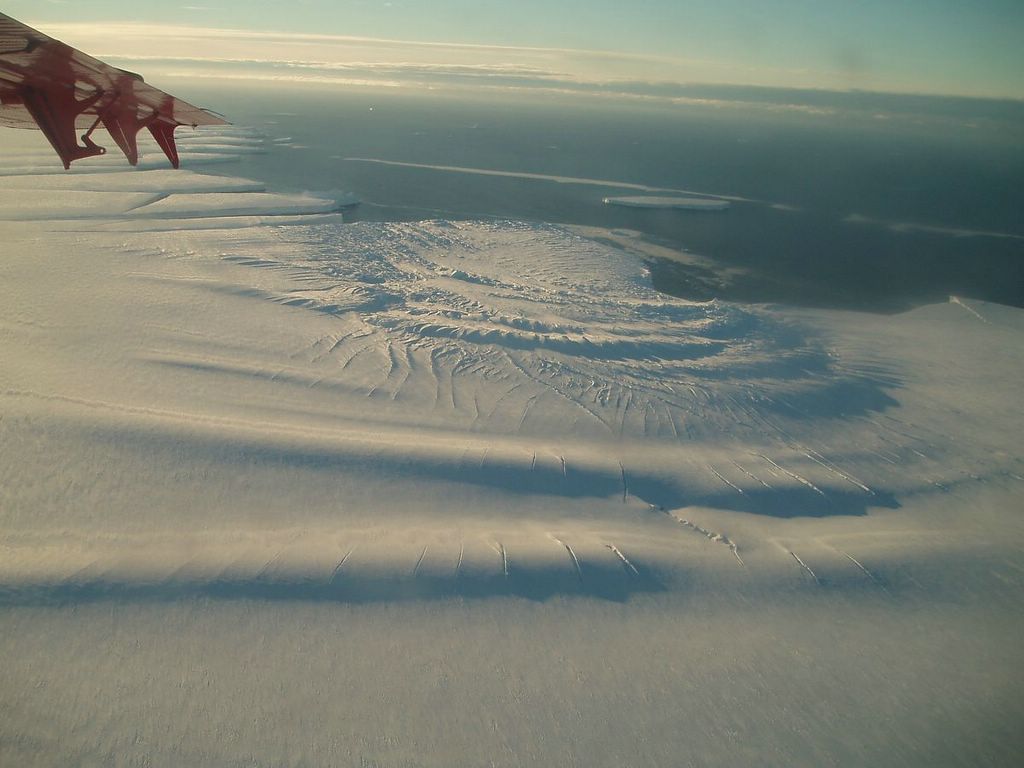
The more immediate concern is the rift visible in the center of the image. Previously stable for about 35 years, this crack recently started accelerating northward as fast as 4 kilometers per year.

The detailed view shows this northward expanding rift coming within a few kilometers of the McDonald Ice Rumples and the Halloween crack. When it cuts all the way across, the area of ice lost from the shelf will likely be at least 1700 square kilometers (660 square miles). That’s not a terribly large iceberg by Antarctic standards—probably not even making the top 20 list. But it may be the largest berg to break from the Brunt Ice Shelf since observations began in 1915. Scientists are watching to see if the loss will trigger the shelf to further change and possibly become unstable or break up.
“The near-term future of Brunt Ice Shelf likely depends on where the existing rifts merge relative to the McDonald Ice Rumples,” said Joe MacGregor, a glaciologist at NASA’s Goddard Space Flight Center. “If they merge upstream (south) of the McDonald Ice Rumples, then it’s possible that the ice shelf will be destabilized.”
The growing cracks have prompted safety concerns for people working on the shelf, particularly researchers at the British Antarctic Survey’s Halley Station. This major base for Earth, atmospheric, and space science research typically operates year-round, but has been closed down twice in recent years due to unpredictable changes in the ice. The station has also been rebuilt and relocated over the decades. The detailed image shows the station’s location (Halley IV) until it was closed in 1992. In 2016-2017, the Halley VI station was relocated to a safer location (Halley VIa) upstream of the growing crack.
Calving is a normal part of the life cycle of ice shelves, but the recent changes are unfamiliar in this area. The edge of the Brunt Ice Shelf has evolved slowly since Ernest Shackleton surveyed the coast in 1915, but it has been speeding up in the past several years.
“We don’t have a clear picture of what drives the shelf’s periods of advance and retreat through calving,” said NASA/UMBC glaciologist Chris Shuman. “The likely future loss of the ice on the other side of the Halloween Crack suggests that more instability is possible, with associated risk to Halley VIa.”
NASA Earth Observatory image by Joshua Stevens, using Landsat data from the U.S. Geological Survey. Story by Kathryn Hansen, with image interpretation by Chris Shuman (NASA/UMBC).
Discover more from Watts Up With That?
Subscribe to get the latest posts sent to your email.
They have been following this for years. British Antarctic Survey (BAS) has closed Halley in winter since 2016. There is another picture here:
https://www.bas.ac.uk/media-post/115024/
Halley VI Research Station was the station that lost power in 2014.
https://wattsupwiththat.com/2014/08/07/record-cold-in-antarctica-threatens-lives-of-british-antarctic-survey-members-during-power-outage-with-little-chance-of-rescue/
It’s a cold case in a much different sense of the word.
Bonavista RCMP are investigating the theft of approximately 30,000 litres of iceberg water from a warehouse in Port Union, the value of which is between $9,000 to $12,000.
https://www.thetelegram.com/news/local/30000-litres-of-iceberg-water-stolen-in-port-union-rcmp-284204/
Some time ago, I was working on a Molybdenum property on the BC Coast.
Just up the Taku River from Juneau.
Lot of ice fields and glaciers there.
We would chip off some the ice and declare that it was 400 years old.
It turned ordinary Scotch into 20-year old stuff!
With the appropriate weightings on relative ages–Sure!
Hi Bob, to the north of that in the Kluane Range, our exploration crew ca1970 had a Cree prospector from Ross River , Yukon and our cook who was a posh hotel chef in his pre alchoholic days. The prospector advised it was legal for him to shoot dahl sheep if we could helicopter him up onto Mount Kluane and the cook said he could make ice cream if we brought back glacier ice on the side racks. We had a 5 star feast that day!
It’s Dall sheep, not Dahl.
It can’t be an ice shelf. There’s no polar bear on top.
Don’t worry, one can and will be photoshopped onto it if needed for the narrative.
Nope, too much ice for a photoshop. Won’t fit the narrative.
Actually ice shelves and polar bear don’t occur in the same hemisphere.
That’s never stopped the photoshoppers before.
If events are occurring more quickly (frequently) on the ice shelf, I suggest that increasing snowfall may be the culprit. What are the figures for snowfall in that part of Antarctica for the past few years?
It’s always the same song: That iceberg is the size of [insert panicky term here]. If that iceberg melts, it will flood the entire {add more panicky words here]. We’re all doomed.
The size of NYC? Not impressed. Make it the size of Chicago from the south suburbs to the north state line, and I’ll pay attention.
I have yet to see a glass of ice water that overflowed when the ice melted. 🙂
Place a 3 foot tall ice core sample into a 4″ tall glass of the same diameter.
It will over flow when it melts 🙂
(but … then it wasn’t floating in the water it was grounded)
The problem with your analogy, as you yourself end up pointing out, is the ice core isn’t floating, it’s grounded. Try the same experiment only start with oh say half a glass of water in it. Try putting that 3 foot tall ice core sample into that 4″ tall glass *without* causing the water to overflow before the ice even has a chance to melt. There’s a reason the vast majority of an ice’s mass is under the water when it’s floating (whether it be in an ice cube in a glass or an iceberg in the ocean).
“McDonald Ice Rumples and the Halloween crack”…dang, I missed those, just like I missed the McRib…and I think crack is illegal, even on Halloween.
What I want to know is, can we get New York City to calve off into the Atlantic?
Don’t tell me, let me guess – this is all CO2’s fault, isn’t it?
Not sure how that translates. Here in the UK we are more used to reporting area as in a loss of Amazonian Rain-forest the area the Size of Wales.
Volume has been traditionally reported by the MSM as an equivalent number of St. Paul’s Cathedrals.
And length, of course, is reported as being the number of times “to the moon and back”. (There is a ruder definition, but that is not fit for a family show like WUWT).
Calving most of the times means ice thickness grows.
Anyways OK with me.
Maybe they should check to see if there are any “active geothermal vents” in play like what is happening under the West Antarctic ice sheet (120+ active geothermal vents)
How many Manhattans are there in a New York City? Ice shelf units should be standardised.
“…The more immediate concern is the rift visible in the center of the image.”
What “concern” is that? A large ice shelf grows and extends from the coast. The pattern of ridges proves it is moving away from the mainland. Then it breaks off in chunks. So what? What else should happen? Should it spread over the whole southern ocean to ‘retain its integrity? Good grief. This is too much ado about literally nothing.
It is like the wailing about each iceberg that melts in the North Atlantic. What else should icebergs do?
It is a small part of Antarctica. The island is comparable to the whole US. It is easy to forget how large a landmass Antarctica is.
A chance to practice recycling!
“When glaciers calve, alarmist have a cow. That explains all the bellowing”
Twilight of the Sailing Ships 1965
By Robert Carse
Grosset and Dunlop
Chapter 7 page 77-83
During the era of the great sailing vessels many were lost in great numbers rounding Cape Horn because of Antarctic ice floes.
Ice floes 60 miles by 40 miles in size and 1000 to 1500 feet high were described by surviving sea captains
during trips between the Atlantic and Pacific making the trip extremely hazardous.
“Three breakages of the Antarctic ice mass brought great peril to Cape Horn Sailing ships in the years when records were kept.”
“The first reports were sighted by 21 ships between December of 1854 and April 1854. The Australian clipper Great Britain steamed fifty miles along the outer edge and stayed clear. But the Guiding Star was trapped between huge ice cliffs and yet could not make headway against the current. She was lost with all hands.”
“The second breakage was 1892-93…ships officers were more concerned about leaving the ice field as quickly as possible. They needed no measurements to know that they were in imminent danger.
“The next great test came in 1908 when a new mass of ice broke away from the Antarctic ice field. The Ben Voirlich was one of the vessels that was nearly lost. She collided with a berg, suffered injury to her jibboom and bowsprit before she could stand clear on safe course.”
That’s funny, I didn’t even know that Antarctica was pregnant. Who’s the father?
Never mind the Halloween crack, beware the builder’s crack.
Commi, I have tolerance and acceptance for anyone who engaged in consensual interactions with other adults. How they live or dress or any of that, isn’t my concern, but I will shame them depending on the circumstances.
Many of them deserve shaming.
But what is really going on is the agenda to destroy the family and usher in their dystopian socialist dream world. It is only about power with them. Few want to actually be seen as equals, love freely: the vast majority want to punish normal white males for some perceived Injustice
““doing what ice shelves normally do but now we have satellites to observe them”
huh?
“That’s not a terribly large iceberg by Antarctic standards—probably not even making the top 20 list. But it may be the largest berg to break from the Brunt Ice Shelf since observations began in 1915.”
1. Since we have no observations prior to 1915 its hard to say exactly what ice shelves do “Normally”
2. Observations started before Landsat, as the article points out. The on ice research facility was closed in 1992.
3. There is no claim made about whether this is normal or abnormal ,speculation that this is “normal”
really is not grounded in any analysis of what counts as “normal”
I am quite certain that if the world got warmer an antarctica lost al its ice, someone would say
A) maybe it was soot
b) maybe it was volcanoes
c) its probably happended before, we dont have satellite records from millionsof years ago.
d) you cant prove it was warming.
e) in the whole history of earth this is “normal”
Any way, last I looked there was an LIA. That means the world is warmer now than it was then.
Expect the sea level to be higher, water expands when warmed
Expect some ice to melt.
OR when these things happen you can find something else to blame. it always could be some other cause.
unicorns done it.
Actually there was no continuous human presence anywhere in the Antarctic before 1944, and none in the Brunt glacier area before 1955 so to claim observational data from 1915 seems somewhat optimistic.
When I read the post title Antarctica about to calve an Iceberg about twice size of New York City I can’t help but picture Antarctica sitting on the can with a newspaper.
[LOL. Heck of a first comment! Almost spewed my coke across the desk because of this… 🙂 -mod]
This is more silly and useless hand wringing. If Antarctic ice didn’t regularly calve into the ocean, all the water on the planet would wind up in the Antarctic. Apparently, these silly people want the Earth to be a desert planet like Mars.
Jim
OMG My fridge’s ice maker just calved another load of cubes the size of a shoebox
COOL!!!!
Is there a handy site so we can watch this in (near) real time?
I’d really like to see a ‘calving cam’-you know, like they monitor Mt St Helens?
the size of the tripod is presenting some issues