

Guest essay by Eric Worrall
According to the Guardian, cute endangered animal toys trick our minds into thinking the animals represented by the toys are all around us.
Using cute animals in pop culture makes public think they’re not endangered – study
Proliferation of giraffes, lions, tigers and elephants in toy shops and films creates ‘virtual population’ and skews our perception.
Agence France-Presse
Fri 13 Apr 2018 10.38 AEST
Animals such as elephants, tigers, lions and panda bears are everywhere in movies, books and toy stores. But their wide pop culture presence skews public perception of how endangered these animals really are, researchers say.
Online surveys, zoo websites, animated films and school questionnaires were scoured by US and French researchers for the study, published in journal PLOS Biology.
…
Lead author Franck Courchamp of the University of Paris said these animals are so common in pop culture and marketing materials that they create a “virtual population” in people’s minds, one that is doing far better in perception than reality.
“Unknowingly, companies using giraffes, cheetahs or polar bears for marketing purposes may be actively contributing to the false perception that these animals are not at risk of extinction, and therefore not in need of conservation,” Courchamp said.
…
The abstract of the study;
The paradoxical extinction of the most charismatic animals
Franck Courchamp , Ivan Jaric, Céline Albert, Yves Meinard, William J. Ripple, Guillaume Chapron
Published: April 12, 2018
A widespread opinion is that conservation efforts disproportionately benefit charismatic species. However, this doesn’t mean that they are not threatened, and which species are “charismatic” remains unclear. Here, we identify the 10 most charismatic animals and show that they are at high risk of imminent extinction in the wild. We also find that the public ignores these animals’ predicament and we suggest it could be due to the observed biased perception of their abundance, based more on their profusion in our culture than on their natural populations. We hypothesize that this biased perception impairs conservation efforts because people are unaware that the animals they cherish face imminent extinction and do not perceive their urgent need for conservation. By freely using the image of rare and threatened species in their product marketing, many companies may participate in creating this biased perception, with unintended detrimental effects on conservation efforts, which should be compensated by channeling part of the associated profits to conservation. According to our hypothesis, this biased perception would be likely to last as long as the massive cultural and commercial presence of charismatic species is not accompanied by adequate information campaigns about the imminent threats they face.
Read more: http://journals.plos.org/plosbiology/article?id=10.1371/journal.pbio.2003997
Could this perceptual skew apply to other subjects? Do news reports about violent weather make us insensitive to warnings that climate change will cause violent weather?
Or perhaps it is all the wild exaggerations and fake news which make us skeptical of media claims about endangered species and global warming.
Some people are simply upset by everything, including that water is wet.
That’s the beauty of virtue signalling. You convince yourself that you matter, without actually having to do anything.
Agreed. People who engage in virtue signalling to justify their lives must have pretty sad lives.
I always thought it was the exact opposite.
Seriously, the polar bear was presented as a cuddly looking mascot that was/is being gravely threatened because of global warming and melting Artic sea ice.
Images of baby polar bears and starving polar bears. Not sure how many more stuffed toy polar bears were manufactured but the reality if that the polar bear is a vicious carnivore that thinks of humans as food. People that live with them are the species that are threatened……..and the evidence of polar bear numbers dropping was manufactured.
Fortunately, not many humans live amongst these beasts and fortunately, they have been doing just fine with less ice.
The population of the black-capped vireo, a rare Texas songbird, has recovered to such an extent that it will be moved off the endangered species list, U.S. Fish and Wildlife officials are expected to announce today [13-Apr-2018].
Grizzly bears and wolves were taken off too.
“..,,which should be compensated by channeling part of the associated profits to conservation.”
There’s the real reason for the study. Look out, Disney!
People don’t know because they don’t look. What about all the endangered animals that are never portrayed in the media? Do people act on conservation because there seems to be so few?
Mike drop
Scroll down the paper and you will find this:
“Currently, companies do not pay a fee to use lions for their branding but, as we hypothesize, may unknowingly and indirectly weaken conservation support by contributing to a mistaken perception that lions are abundant, akin to a competition for attention from the public. Linking the use of threatened animal representations for commercial use to payment to conservation efforts could contribute to turning competition into cooperation between virtual and real populations.”
So basically another money grab through taxation and regulation. Why am I not surprised?
The basic premise of the paper is nonsense.
But if Disney wants to raise awareness and donate based on sales of a character. I’m all for it.
This guy isn’t talking voluntary participation though.
Why stop at animals? Tax everything used in media. If your movie has a tree, you must pay a fee.
@ur momisugly Reg,
No, then the lawyers will start defining, “what is a tree exactly?”. And come up with a stratified quanta on what constitutes a tree in a movie vs a virtual reality based one via CGI. Let’s just not go there OK? Lawyers define wayyyyyyyyyy tooooooooo much in our society already. /sarc
How are we ever going to make room for new cuddly species that have never existed before if we don’t allow the extinction of some of the old species that have had their hour on the stage. Isn’t Recycling one of the cardinal virtues of the new improved morality, along with Tolerance and Self Indulgence?
I want to know where the cute cuddly insects are in this scheme of making money? Nobody seems concerned about them except for bees. What about all the other pollinators that are being wiped out? Sure they may not look all that cuddly, but they deserve their own toy too!
#wontsomeonethinkoftheinsects?
/sarc
and on the heels of that, what about the bacteria and fungi? Surely they deserve their own toy too!
When you start seeing kids desperately holding their stuffed bacterium, let me know will you? LOL
Enter the Pet of the Future© – tapeworms!
quiet, goes where you go, eats what you eat..
And what of the mites that live in the hair follicles of our eye lashes?
well they’re just creepy..
The proliferation of junk science is dangerous for humanity. It is as though we’ve forgotten the past centuries years of progress and are back to blaming things on evil spirits.
so…my cute chucky the doll toy I had (as joke) years ago means I am NOT surrounded by possessed dolls? ?dl=0
?dl=0
huh….imagine that.
Those things make me grab a hatchet and chop them to bits.
Having been responsible for an endangered species program we faced several significant problems. First the so called environmental organizations, who claimed to support us, especially single species groups, drove the agenda by hyperbole. Meanwhile the people were actually seeing more of the animal in question. Hyperbole was at every level of their “business model.” For example they would tell politicians that their organization had tens of thousand or even millions of members when many of the so called “members” had been signed up as school children visiting an exhibit. Second, they didn’t strive for or demand, often even opposed, the best science and certainly not the best population estimates but supported techniques easily questioned or discounted altogether. Third, their agenda was often as much pure progressive politics, using the species in questions to drive their agenda. Fourth, a lot of what these groups did was primarily to attract funding to pay for their lobbyists and staff. Little went to actually benefit the species which they saw as the responsibility of government. Yet the single biggest reason that the average person today is skeptical or worse pays little attention to any reference to endangered species is when we are successful restoring a population to sustainable levels the special interest groups oppose any suggestion of the listing being changed, e.g. California Gray Whale. Or as most of you here are familiar we bring species back from the brink, the agenda changes and then we actually “permit” increase anthropogenic mortality, e.g., raptors and other birds, with little objection from the groups that lobbied so hard in the beginning.
Another problem with this article is the fact that many people would not even realize that many animals exist were it NOT for the cute stuffed animals and the animals in zoos. It is easy to ignore something if you feel no connection to it. Talk to people who are involved in legitimate conservation and research, and most will tell you about being inspired by seeing animals in person, be it in the wild or at a zoo. Kids who are really into a particular animal usually have a favorite toy that is that animal. Most people will never see an endangered animal in the wild. Most people have day to day concerns that understandably preoccupy them. Those toys are probably the biggest exposure the general public gets to these animals.
People do not do much about conservation because they do not know WHAT to do. They do not know which charities are actually doing something effective and necessary and which “charities” are not. Ratings on Charity Navigator and such can tell you about how much is being spent on overhead, but they do not necessarily reflect the actual impact of projects. If you read an article about how cheetahs or elephants or rhinos are in trouble, that article may not mention organizations that are doing something about it, at least not in the sense of “donate to this group, here is how”.
Lifting people out of poverty so that they are less tempted to poach these animals is what will save these animals. The really effective conservation organizations do not just focus on the animals, they focus on helping local people thrive so that coexistence is possible. Ultimately, it is not the rich foreigners who will “save” the animals. It is the local people. And stuffed animals are not affecting THEIR impression of how abundant a particular species is.
Lifting people out of poverty will definately help, but centuries of myth and legend and customs are also involved. I thought when Viagra came out it would help with the rhinos and tigers being killed for aphrodisiacs. Turned out, the ingrained customs meant people rejected Viagra and kept killing the lions and rhinos. It’s tough to change thinking like this.
The people who are left to convince are the hard ones. 🙁
AllyKat, you do understand who buys most of the illicit products, e.g., Ivory, rhino horn, tiger parts, bear parts, etc. As China has become ever more affluent the price for these items has skyrocketed. For the poachers the reward is well worth the risk. Violators are seldom caught, if caught seldom prosecuted and if prosecuted the penalties not close to the economic worth, much less the ecological worth. With the internet it is not hard to find out which groups actually do something besides spend more money to get more donations. One of the single biggest problems today you only occasionally hear about is pirate fishing. In some areas of the ocean pirate fishermen take more than the local country. Still I don’t want a another species to go extinct but they will regardless of what humans do or not. The USA has strict regulations on “endangered” and “threatened” sea turtles. Not just harvest direct or indirect, but habitat protection, etc. Yet coastal villages in Central and South America still harvest sea turtles and eggs for food. Or as a very good turtle biologist explained to me, we protect them here so they can eat them there.
https://www.thinkgeek.com/product/6708/
These guys are cute and far from extinct.
One thing that rarely is discussed has to do with the “all species are interconnected”. That would mean HUMANS too. Many of the more radical enviros want humans gone or at least vastly reduced. Wouldn’t that trigger whatever kind of catastrophe that lions and tigers going extinct or being vastly reduced in number would? If we suddenly pulled the human species out of an area, wouldn’t the whole ecosystem just collapse? That seems to be one argument on why we have to save all species, even those that are not really fit and probably should have been allowed to vanish. System collapse. Pulling out humans would do the same thing, wouldn’t it?
Has anyone ever actually seen an ecosystem collapse due to the extinction of one or two species? How many species going extinct would it actually take to “collapse” the whole system? I would think the collapsed system would just be the fittest of critters and would continue on as everything does as things change. It would be the new ecosystem that replaced the original. It has happened many times in earth’s history. Yet the planet still has life—a huge amount of life.
absolutely….if we had not evolved…something else would have
People seem to forget that evolution is survival of the fittest……it has a built in fault mechanism…sometimes things make very bad evolutionary choices….but that’s how it works, constantly throwing different things out there to see what sticks to the wall
Some frog that evolved to live only on one mountain, at one specific elevation, with a specific rainfall, and eats only one food…..made a very bad evolutionary choice
Sheri, it comes down to how you define “ecosystem.” The State of Florida decided to manage natural resources in the 1990s through “ecosystem management.” The first problem they faced was defining exactly what a manageable ecosystem was. They debated it for several years. It ended with them deciding to call individual watersheds/ drainages ecosystems. One thing that was documented in small isolated ecosystem was the system changed dramatically with a removal of a “keystone” species. The patch was different but still existed just in a different form than prior to the “keystone” species being eliminated.
To me, the “dramatic change” is just evolution in action.
Let me get this straight. They are not sure what charismatic animals are yet they picked the top 10 to include in their study. They fit right in with all of the rest of the alarmist community.
Wow. Either these researchers think the general population has really weak minds, or more likely, these researchers have really weak weak minds. To conflate a toy tiger with a real one might explain why a few people take selfies with the real deal – and end up mauled or dead. But I suspect it is more likely that they’ve bought into the “Nature is serenity” BS. Nature is NOT soft and cuddly. I recently read an article (here?) about otters attacking a man, and reading that they are quite violent little puppies. A wild dog can represent a real danger. But I don’t think it is the toys that lead to this. How many pink felines do you really think exist in the world?
Liberals in general believe that the population as a whole has very weak minds.
That’s why they want government (run by themselves of course) to make all of the important decisions in our lives.
I know of a zoo that fed some of their otters medication so that they would not fight. Apparently a couple members of the family were rather aggressive. It did the trick. People would probably freak out if they knew.
Are you implying that pink leopards are not real???
I saw a green polar bear once.
I’ve seen pink elephants. On parade!
If “cute fluffy cuddly toys” desensitize people to the plight of rare animals, to such an extent they die out, can somebody do a big production run of “cute fluffy cuddly climate scientists.” Don’t forget the Mann one.
Hmmm…a “cute fluffy cuddly” Mann doll?
I’d rather have a Chucky doll.
At least the harm Chucky caused was fictional.
Your choice. I want 20 or 30 for trap.
“Pull!”
Let me see if I’ve got this straight.
It’s OK to use baby (alleged) endangered species (polar bear cubs etc.) or just dogs and cats to stir the emotions to prompt people to send money to the groups using them (such as the World Wildlife Fund, HSUS etc.) but it’s not OK for a kid to have teddy bear?
They would rather kids watch videos like this:
Elephants aren’t endangered at all.
‘“Unknowingly, companies using giraffes, cheetahs or polar bears for marketing purposes may be actively contributing to the false perception that these animals are not at risk of extinction, and therefore not in need of conservation,” Courchamp said.’
Here we have Courchamp using giraffes, cheetahs and polar bears for marketing.
Maybe he should write to Frito-Lay and encourage them to put a blurb about cheetah conservation on every bag of Cheetos. (I actually would not mind this.) I am sure that people everywhere believe that cheetahs are doing just fine since they see Chester the Cheetah on snack bags and in TV commercials. /sarc
I love cheetahs, to the point that I was excited to work with their scat and urine in a lab. I promote their conservation. But I do not believe for one second that people are ignorant of any animal’s status in the wild because of stuffed animals and food commercials. Humans are idiots, but few of us are that dumb.
I cannot even imagine how someone would come up with this idea. It is weird. Have you ever heard someone say, oh, tigers are not endangered. There are stuffed tiger toys everywhere!
Enjoy your cheetahs while you can. Their CITES listing has doomed them. With the stroke of a pen, they became pests.
“Get rid of all the cuddly toys and then there might be rather more attention to the real-life animals which as [are] being systematically wiped out based on current trends.” – ivankinsman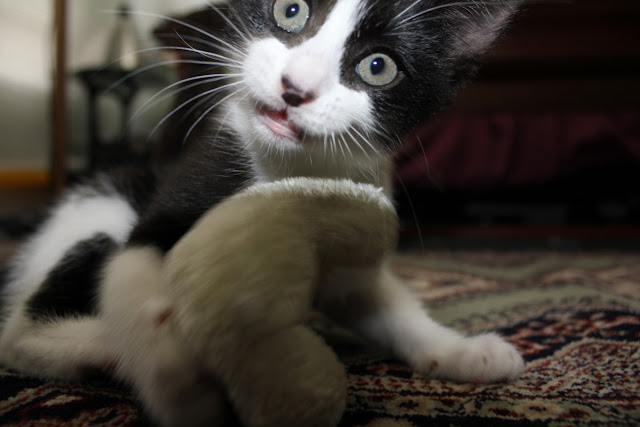
“You’ll have to pry that cuddly toy from my cold dead paws”
Then Lilly helped dress her catch, pack it out, and cook up venison stew that evening.
She’s going to be a keeper!
At least she wasn’t using an AR-15.
(Yes, she’s a keeper. Closer to what is “natural” than the “environmentalist”.)
The heartless, self absorbed, misanthropic, side of the never correct climate obsessed on display.
Which does bring back the memory of a previous display of how sensitive the climate extremists are:
https://youtu.be/sE3g0i2rz4w
“Cute animal toys” do not lull our sensitivity to endangered species, but cute antinomian ideologues with their endless narcissistic drivel surely do.