From the UNIVERSITY OF CALIFORNIA – BERKELEY
Einstein’s equations allow a non-determinist future inside some black holes
In the real world, your past uniquely determines your future. If a physicist knows how the universe starts out, she can calculate its future for all time and all space.
But a UC Berkeley mathematician has found some types of black holes in which this law breaks down. If someone were to venture into one of these relatively benign black holes, they could survive, but their past would be obliterated and they could have an infinite number of possible futures.

Such claims have been made in the past, and physicists have invoked “strong cosmic censorship” to explain it away. That is, something catastrophic – typically a horrible death – would prevent observers from actually entering a region of spacetime where their future was not uniquely determined. This principle, first proposed 40 years ago by physicist Roger Penrose, keeps sacrosanct an idea – determinism – key to any physical theory. That is, given the past and present, the physical laws of the universe do not allow more than one possible future.
But, says UC Berkeley postdoctoral fellow Peter Hintz, mathematical calculations show that for some specific types of black holes in a universe like ours, which is expanding at an accelerating rate, it is possible to survive the passage from a deterministic world into a non-deterministic black hole.
What life would be like in a space where the future was unpredictable is unclear. But the finding does not mean that Einstein’s equations of general relativity, which so far perfectly describe the evolution of the cosmos, are wrong, said Hintz, a Clay Research Fellow.
“No physicist is going to travel into a black hole and measure it. This is a math question. But from that point of view, this makes Einstein’s equations mathematically more interesting,” he said. “This is a question one can really only study mathematically, but it has physical, almost philosophical implications, which makes it very cool.”
“This … conclusion corresponds to a severe failure of determinism in general relativity that cannot be taken lightly in view of the importance in modern cosmology” of accelerating expansion, said his colleagues at the University of Lisbon in Portugal, Vitor Cardoso, João Costa and Kyriakos Destounis, and at Utrecht University, Aron Jansen.
As quoted by Physics World, Gary Horowitz of UC Santa Barbara, who was not involved in the research, said that the study provides “the best evidence I know for a violation of strong cosmic censorship in a theory of gravity and electromagnetism.”
Hintz and his colleagues published a paper describing these unusual black holes last month in the journal Physical Review Letters.
Beyond the event horizon
Black holes are bizarre objects that get their name from the fact that nothing can escape their gravity, not even light. If you venture too close and cross the so-called event horizon, you’ll never escape.
For small black holes, you’d never survive such a close approach anyway. The tidal forces close to the event horizon are enough to spaghettify anything: that is, stretch it until it’s a string of atoms.
But for large black holes, like the supermassive objects at the cores of galaxies like the Milky Way, which weigh tens of millions if not billions of times the mass of a star, crossing the event horizon would be, well, uneventful.

Because it should be possible to survive the transition from our world to the black hole world, physicists and mathematicians have long wondered what that world would look like, and have turned to Einstein’s equations of general relativity to predict the world inside a black hole. These equations work well until an observer reaches the center or singularity, where in theoretical calculations the curvature of spacetime becomes infinite.
Even before reaching the center, however, a black hole explorer – who would never be able to communicate what she found to the outside world – could encounter some weird and deadly milestones. Hintz studies a specific type of black hole – a standard, non-rotating black hole with an electrical charge – and such an object has a so-called Cauchy horizon within the event horizon.
The Cauchy horizon is the spot where determinism breaks down, where the past no longer determines the future. Physicists, including Penrose, have argued that no observer could ever pass through the Cauchy horizon point because they would be annihilated.
As the argument goes, as an observer approaches the horizon, time slows down, since clocks tick slower in a strong gravitational field. As light, gravitational waves and anything else encountering the black hole fall inevitably toward the Cauchy horizon, an observer also falling inward would eventually see all this energy barreling in at the same time. In effect, all the energy the black hole sees over the lifetime of the universe hits the Cauchy horizon at the same time, blasting into oblivion any observer who gets that far.
You can’t see forever in an expanding universe
Hintz realized, however, that this may not apply in an expanding universe that is accelerating, such as our own. Because spacetime is being increasingly pulled apart, much of the distant universe will not affect the black hole at all, since that energy can’t travel faster than the speed of light.
In fact, the energy available to fall into the black hole is only that contained within the observable horizon: the volume of the universe that the black hole can expect to see over the course of its existence. For us, for example, the observable horizon is bigger than the 13.8 billion light years we can see into the past, because it includes everything that we will see forever into the future. The accelerating expansion of the universe will prevent us from seeing beyond a horizon of about 46.5 billion light years.
In that scenario, the expansion of the universe counteracts the amplification caused by time dilation inside the black hole, and for certain situations, cancels it entirely. In those cases – specifically, smooth, non-rotating black holes with a large electrical charge, so-called Reissner-Nordström-de Sitter black holes – an observer could survive passing through the Cauchy horizon and into a non-deterministic world.
“There are some exact solutions of Einstein’s equations that are perfectly smooth, with no kinks, no tidal forces going to infinity, where everything is perfectly well behaved up to this Cauchy horizon and beyond,” he said, noting that the passage through the horizon would be painful but brief. “After that, all bets are off; in some cases, such as a Reissner-Nordström-de Sitter black hole, one can avoid the central singularity altogether and live forever in a universe unknown.”
Admittedly, he said, charged black holes are unlikely to exist, since they’d attract oppositely charged matter until they became neutral. However, the mathematical solutions for charged black holes are used as proxies for what would happen inside rotating black holes, which are probably the norm. Hintz argues that smooth, rotating black holes, called Kerr-Newman-de Sitter black holes, would behave the same way.
“That is upsetting, the idea that you could set out with an electrically charged star that undergoes collapse to a black hole, and then Alice travels inside this black hole and if the black hole parameters are sufficiently extremal, it could be that she can just cross the Cauchy horizon, survives that and reaches a region of the universe where knowing the complete initial state of the star, she will not be able to say what is going to happen,” Hintz said. “It is no longer uniquely determined by full knowledge of the initial conditions. That is why it’s very troublesome.”
He discovered these types of black holes by teaming up with Cardoso and his colleagues, who calculated how a black hole rings when struck by gravitational waves, and which of its tones and overtones lasted the longest. In some cases, even the longest surviving frequency decayed fast enough to prevent the amplification from turning the Cauchy horizon into a dead zone.
Hintz’s paper has already sparked other papers, one of which purports to show that most well-behaved black holes will not violate determinism. But Hintz insists that one instance of violation is one too many.
“People had been complacent for some 20 years, since the mid ’90s, that strong cosmological censorship is always verified,” he said. “We challenge that point of view.”
###
“It is no longer uniquely determined by full knowledge of the initial conditions. That is why it’s very troublesome.”
Nothing new here. The human condition. Only Laplace’s demon could know the position and velocity of every subatomic particle at the big bang event horizon. Anyway, the big bang is just an inside out black hole…
Einstein’s equations allow a non-deterministic future inside some black holes.
————
Problem with this is, that according to Einstein’s equations such constructs as per above,while can be considered as allowed, simply end up to be considered as figments of imagination at the very least, from the most basic point of view…and when considering it further, are even worse, figments of wild fictions.
(as that claim stated, it stands truly as a circular reasoning)
The entirety of the subject, as per this blog post consist only as a clear moaning of the spoiled ones…against the scientific method, in principle.
The scientific method in essential and spirit stands as very determining, clearly deterministic in nature…with all the nullification and falsification determined position, as per the main point of this method…
That is what actually the Einstein’s equations actually do offer and give to scientific method in regard to physics, and in the same time subject the astrophysics and cosmology to…an impossible fence to jump over.
In and as per this kind of context the Einstein’s equations consist only as an upgrade of that fence…as a method to make it better, by “electrifying it”…The fence already was there, strong and very high, prior even to Einstein and his equations…
This:
“E = mc2 is the world’s most famous equation—a mathematical formula with the power to transcend the barriers of language and culture.”
This one equation can not be joked around, can not be bypassed or transcended over…under any circumstances, as it stands very much accommodated by the support of the reality of the very science of physics, as an equation passing the test with flying colors, the test of nullification…and it happens to be very much propagating and upholding the deterministic way of the scientific test and scientific method to the out most possible towards and against any hypothesis out there, to a point that this particular equation even consist as the only one with a proper clear Quantum knob, at some given reference.
This equation is a proof of the scientific method being essentially and in spirit deterministic…
That is what moaned and complained about…
The deterministic way of the scientific method, especially as per the above equation is simple:
“No much care what the hypothesis means or not, but when a line under a hypothesis contemplated or propagated, then the nullification and falsification grounds automatically applied and engaged, regardless of one not providing the raw data, or the algorithms processes of such data, or the possible falsification or nullification grounds of the hypotheses….
it simply automatically the scientific method raises its “ugly” head of determinism to be a proper means of test for such claims… regardless how long it may take or not”
This still missing in climatology, no much of a surprise there, as there not yet any Newtons or Einsteins or Mendeleyevs yet, only hansens, phils and manns…
too poor as for the scientific method requirements up to now…
Scientific method, again consist as predetermining…essentially and in its “spirit”…
I can go on and on with my rumblings with this, even in the case of the Dark matter-Dark energy clause, or the Supernovae and the chain reaction considered there, or the silliness of the accelerated expansion of the universe.
The famous equation above, subjects the claim of the expansion of universe to a default failure if contemplated in the grounds of energy-matter, meaning “no way hosey it could be accelerating, in that energy-matter context, as it, could not even be considered as expanding at all under that clause anyway “…
The very grounds of the moaning and the cry out against the determinism and therefor against the scientific method application in physics.
Please do poke me at this. 🙂
cheers
Peter Hintz
In general relativity, a black hole singularity means infinite spacetime curvature, infinite density, infinite energy. In mathematical physics, when you see infinities in your equations, that means your solutions are wrong. They are not real physical solutions. In quantum mechanics, physicists got rid of infinities by using a mathematical trick (renormalization) But physicists working on black holes just ignore the problem and pretend they have real physical solutions. The singularity theorems of Hawking and Penrose are math not physics. Stop the fantasy and start doing real physics.
One problem people seem to forget is that time slows down in a gravity well. That means it will take an infinite amount of time for the singularity to actually form. A black hole singularity. a mathematical point for a non-rotating black hole and a ring for a rotating black hole, hasn’t completely formed yet. So if Hawking radiation is true, then a black hole will eventually evaporate. It may take trillions and trillions of years, but it’s still a short time compared to infinity.
So assuming you could survive the trip, as you fall into a black hole and head for the dense center, it should evaporate (disappear) before you reach a singularity.
Jim
The time dilation is for observer outside the black hole. No time dilation for observer inside the black hole, or she cannot detect it in principle. The singularity will form in finite time from the reference frame inside the black hole.
I don’t believe in Hawking radiation. It requires a pair of virtual particles becoming real. One with positive energy outside the black hole and one with negative energy inside the black hole. I say it’s crap. We know that virtual particles disappear within the time allowed by the Uncertainty Principle and a pair of virtual particles are non-locally entangled so the different time frames inside and outside the black hole have no effect on them. They interact instantaneously as if time doesn’t exist.
>>
The time dilation is for observer outside the black hole. No time dilation for observer inside the black hole, or she cannot detect it in principle. The singularity will form in finite time from the reference frame inside the black hole.
<<
She’s still falling. She’s falling in our reference frame (if we could observe her); and she’s still falling in her reference frame. Her “finite” time to the singularity represents an “infinite” time in our reference frame.
>>
I don’t believe in Hawking radiation.
<<
Then you don’t believe that the area of an event horizon represents the entropy of the black hole. It was a problem in Thermodynamics that led Hawking to make his (original) claim that black holes must have a temperature.
Jim
It doesn’t matter that we cannot observe from outside the singularity (assuming it exists) it’s still part of the theory because it is observable from the inside. But the singularity is a failure of general relativity.
“The area of the event horizon represents the entropy of the black hole.” True, because the area is proportional to the cube of the Schwarzchild radius, and the radius is directly proportional to the mass of the black hole, and the mass is proportional to number of particles. Boltzmann formula for entropy:
S = k ln W
Where k is the Boltzmann constant and W is the number of microstates, which is a function of the number of particles. That’s how the relationship is derived.
There’s no temperature in the above formulation of entropy. Why is Hawking talking about temperature? Clausius formula for differential entropy:
dS = cQrev/T
Where Q is heat flow and T is temperature of a cyclical reversible process. Assuming black hole as a cyclical reversible heat engine is a stretch of imagination. There’s no heat flow in black holes unless you further assume Hawking radiation. But that is not part of the entropy theory. It’s an additional assumption that is dubious unlike the well-established Boltzmann and Clausius entropy.
>> or
or 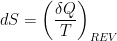 .
. . I simply don’t see how you can say temperature (and heat) is not a part of entropy–it’s how it is defined. The entropy involved in any heat transfer is directly proportional to the inverse of the system temperature.
But that is not part of the entropy theory.
<<
You’re being serious? As you said, the Clausius formula for entropy is
>>
Assuming black hole as a cyclical reversible heat engine is a stretch of imagination.
<<
The use of reversibility makes the computation easier. For all other non-reversible processes, you use
Jim
>> .
.
There’s no temperature in the above formulation of entropy.
<<
The units of entropy are energy per temperature. In SI units, that would be joules per kelvin. It’s the same units as heat capacity, but heat capacity has a slightly different definition from entropy:
The W in Boltzmann’s formula has no units, so the units come from Boltzmann’s constant. Those units are energy per temperature or in SI units, joules per kelvin. Thus there is temperature in the Boltzmann formula–has to be.
Jim
Can anyone answer this question? If the Universe is extremely large, almost infinite, and every expanding, what is the Universe expanding into?
jymmn
February 24, 2018 at 3:17 am
If there is a Beauty,
How many could there be, perceptions of it, in accordance with the “eye of the beholder”!
The Universe, and many universes, many perceptions, as per many observation points imagined.
You can imagine it like, one universe per each and every galaxy point of observation.
Please note the difference between the Universe and the universe.
It is the perception, the observation that expands, therefor is like from our point of observation that the universe expands, where the expanding of the universe is not in the proper means of matter- energy , but more like in the “light scanning radius” expanding. (weird yes, like backwards 🙂 )
So from this point of view is not the Universe that expands, but only the size of the bubble view perception of it by our point of observation, according to our observing of it. (like in the “is not the spoon that bends……”)
Imagine it like a bubble of view expanding outwards through the Universal space (at the speed of light), constantly.
So, again, is the universe that expands through time in to the Universe, constantly.
Not sure if this kinda of answer makes it more confusing or not, but just offering it as per my point of view.
Just one other point of view among many. 🙂
The observable universe is finite, about 46 billion lightyears in radius. We don’t know if there’s a bigger universe beyond. I speculate the universe sits in a 42-dimensional hyperspace. It has to be 42 – the answer to life, the universe and everything 🙂
I just wonder if that observable 46 billion light years is something so tiny in something so much larger we cannot even contemplate the the enormity of it. Are we no more than the equivalent of an atom in this larger entity? When we look at all the universe, how violent it can be, how much energy it contains, how sterile it seems. how isolated we are, you have to wonder what the is the purpose of all this immensity. I understand my question is more philosophical than scientific, but I wonder if science has any answers.
Dr. Strangelove
February 24, 2018 at 8:34 pm
The observable universe is finite, about 46 billion lightyears in radius.
—————–
When every thing considered ok, the above, no matter how appealing, it simply consists as a fake position, to contemplate, at this stage, as far as my understanding permits…the “46” as a number happens to be an assessment,, an educated guess, no more no less…, an academic assumption, or an academic guess…an assessment, not really directly supported by observations.
It really does not really matter whether it happens to be 46 or 86, what matters is the principle.
In principle you and me diverge significantly, I do accept and try to accommodate that earth happens to be the center of universe in a relative point of consideration (as per observation), in the context of relativity, When in the other hand your position, as put forward, states that this has to be wrong, as earth, actually happens to be the center of universe in an absolute form and position in that regard.
At this point my next question will have to be in the lines, of ,who actually needs to be put under the condition of a straight jacket!…. and live happy ever after!
cheers
Jim
February 25, 2018 at 2:58 am
I just wonder if that observable 46 billion light years is something so tiny in something so much larger
——————–
Maybe I am wrong, but that 46 thingy, is not really a result of observations, not a direct one, only some result of assumptions and or a further “scientific’ exercise….
The 46 or 47 billion lightyear radius is based on the best fit model for the observed accelerating expansion of the universe.
http://www.astro.ucla.edu/~wright/cosmology_faq.html#DN
Dr. Strangelove
February 26, 2018 at 2:41 am
————-
Thank you Doctor…
cheers
http://www.iflscience.com/physics/physicist-claims-have-proven-mathematically-black-holes-do-not-exist/
I should add that I mention Mersini-Houghton’s work solely to advance debate. I cannot say whether it has any merit, and I can neither confirm nor deny that black holes exist.
The existence of black holes is almost certain and generally accepted by astronomers. The hypotheses that physicists invent about black holes are doubtful. It’s annoying they take Hawking’s speculation as fact. The Hawking radiation requires observational evidence. At face value it’s dubious. It predicts bizarre things like negative energy and virtual particles becoming real. Fantastic claims require fantastic evidence.
So it’s a consensus?