Guest essay by Sheldon Walker
For a long time, there has been strong disagreement over the idea of a recent slowdown in global warming. Many people believe that there never was a slowdown. While other people have argued about when the slowdown occurred, and why.
This article will use the GISTEMP global temperature series, to investigate whether the slowdown is real. I know that some people will throw up their hands in horror, at the thought of using the GISTEMP temperature series. I have deliberately used GISTEMP, because it has a reputation as a heavily adjusted, warmist friendly, temperature series. If I can show strong evidence for a recent slowdown in GISTEMP, then the recent slowdown can not be denied.
The first thing that we need to establish, is when the slowdown occurred. Some people insist that the slowdown started in 1998. 1998 was a very strong El Nino year, and temperatures climbed abnormally high because of this. Some people claim that the temperatures in the years that followed 1998, only appear to rise more slowly than normal, because of the abnormally high temperatures in 1998. This explanation is often used to push the idea that the slowdown was not a “real” slowdown. It was just caused by an abnormally warm 1998.
This is a wonderful story. Unfortunately, it is almost totally incorrect. The scientific way to find out when the slowdown occurred, is to look at the evidence in GISTEMP. We need to look at the warming rate for different date ranges, and try to identify a date range with a warming rate that is significantly lower than the normal warming rate. If we cannot find a date range with a warming rate that is significantly lower than the normal warming rate, then the slowdown can be regarded as fake news.
Following is an explanation of how date ranges are specified in this article.
Date ranges are specified using 2 years, e.g. 2000 to 2001.
A year with no month specified means January of that year.
So 2000 to 2001 means January 2000 to January 2001, which is a date range one year in length.
So 2002 to 2012 means from January 2002 to January 2012, which is a date range 10 years long.
This method makes the calculation of the length of a date range very easy, just subtract the first year from the second year, and the answer is the length in years.
But, the date range does NOT include the second year specified in the date range, except for January. E.g. 2000 to 2005 does NOT include the data for 2005, except for January 2005.
In order to find out when the slowdown was, I calculated the warming rate for every possible date range that started in or after 1990, that was 10 years or more in length. I ignored date ranges which were less than 10 years in length, because short date ranges have a more variable warming rate, and would not provide good evidence of a significant slowdown. This gave me a table of date ranges which I sorted by warming rate, from lowest to highest. I threw away all of the rows in this table, except for the first 10 rows. This left me with a table holding the 10 date ranges with the lowest warming rates. This table held the best possibilities for the slowdown.
The following table shows the 10 date ranges which had the lowest warming rates. Date ranges had to start in 1990 or later, and had to be of length 10 years or greater. The column headed “Warm Rate” is the warming rate in degrees Celsius per century.

Table 1
To check whether the slowdown could have started in 1998, look at the following table. This table shows the warming rate for every possible date range of length 10 years or greater, that started in 1998.

Table 2
The warming rates in Table 2 are considerably higher than the warming rates in Table 1. This means that the date ranges starting in 1998 are not as significant (in the slowdown sense), as the date ranges in Table 1. This shows that 1998 is NOT an important year for the slowdown.
Looking back at Table 1, we can see that the starting years are 2001, 2002, 2003, and 2004. All of these starting years are near each other. The ending years are 2012, 2013, 2014, and 2015. All of the ending years are also near each other. This is not unexpected. Most slowdowns have some “core” years when the slowdown is strongest. But the slowdown does not suddenly start full strength, or end suddenly from full strength. There will be a few years at the start and end when the slowdown is increasing in stength, or decreasing in strength. If you add these increasing/decreasing years to the core years, then you still get a slowdown, but one which has less strength than the core years.
Because it has the lowest warming rate of any date range (+0.09 degrees Celsius per century), I am going to use the date range from 2002 to 2012 as the “core” years of the recent slowdown. This makes it a 10 year slowdown.
To make this result easier to visualize, I have plotted some graphs which compare the slowdown decade to the 3 previous decades. Because all of the date ranges are 10 years long, it should be possible to compare “apples with apples”.
So I will be graphing the relative temperature anomalies and linear regression lines, for
- 1972 to 1982
- 1982 to 1992
- 1992 to 2002
- and 2002 to 2012 (the slowdown decade).
I have given each temperature series a common time axis, which runs from year 0 to year 10. I have shifted each temperature series to have the same starting value of zero. This makes comparison easier because all of the temperature series start at the same point.
4 temperature series and 4 linear regression lines on the same graph, is a little crowded. So I have created 2 versions of the graph. Both are based on exactly the same data, but highlight different aspects.
The first graph shows each temperature series (and the corresponding linear regression line) in a different color. The slowdown decade is shown in red.

Graph 1
The second graph is based on exactly the same data, and shows the linear regression lines for each temperature series. The slowdown decade is shown in red.

Graph 2
When looking at this graph, remember that the slope of the regression line is the warming rate for the temperature series.
If you look at Graph 2 and think, “that looks like 3 parallel sloping lines, and one flat line”, then you have made a very accurate observation.
Table 3 shows the warming rates for various date ranges.

Table 3
You can see that the 3 earlier decades had warming rates of +3.07, +2.90, and +3.08 degrees Celsius per century. This compares to a warming rate of +0.09 for the slowdown. This means that the earlier decades each had a warming rate of between 33 and 35 times the warming rate of the slowdown.
While putting together Table 3, I found that the average warming rate from 1970 to 2017 was +1.78 degrees Celsius per century. This is considerably less than the warming rates for the 3 decades that I compared to the slowdown. The three 10 year decades that I compared to the slowdown were actually “speedups” (a greater warming rate than average), when compared to the average warming rate from 1970 to 2017.
Some people may consider it “unfair” to compare the slowdown to 3 speedups, when trying to determine if the slowdown is significant. I think that this is a valid viewpoint, and I will therefore repeat my analysis of the slowdown, but this time comparing it to the average warming rate from 1970 to 2017 (which was +1.78 degrees Celsius per century).

Graph 3
Graph 3 compares the warming rates (slope of the linear regression line) for 3 date ranges. I have made sure that this graph is drawn using exactly the same scale as Graph 2, so that there are no tricks to fool people into believing that there is a slowdown.
This graph shows the regression line for 1992 to 2002 (one of the speedup intervals), the regression line for 1970 to 2017 (the “average” warming rate for a long date range), and the regression line for 2002 to 2012 (the slowdown). I have given all of the regression lines a common origin, at (0.00, 0.00).
It can be seen that the speedup interval has the greatest warming rate, the long date range has the next greatest warming rate, and the slowdown has the lowest warming rate (quite close to zero). In my opinion, the graph makes it clear that the “average” warming rate is closer to the speedup warming rate, than it is to the slowdown warming rate. This means that the slowdown warming rate is quite different to the “average” warming rate.
As can be seen from Table 3, the average warming rate from 1970 to 2017 was 20 times the warming rate from 2002 to 2012 (the slowdown). I think that most people would consider this to be a fairly large difference. Imagine if your income was reduced to 1/20 of its current value, or if it was increased to 20 times its current value. Most people would find those changes significant.
To make the slowdown more understandable, consider the following analogy. Imagine that you are driving along on the motorway at 100 km/hour. Suddenly you encounter roadworks on the motorway. You are forced to reduce you speed to about 5 km/hour, and must keep to that speed for some time. That is the equivalent of the slowdown. But you are lucky, because you don’t have to stay at 5 km/hour for the next 10 years.
Is that enough to convince everybody that there was a recent significant slowdown? I strongly doubt it. Warmists will continue to deny the slowdown. The fact is, that this was a slowdown that lasted for 10 years, and that had a warming rate that was:
- not just 1/2 of the normal warming rate
- not just 1/4 of the normal warming rate
- not just 1/8 of the normal warming rate
- not just 1/16 of the normal warming rate
- but about 1/20 of the normal rate.
I am sure that this will be quickly ignored or forgotten. Look, there is a squirrel over there!
I would like to point out that this analysis of the slowdown is very easy to repeat. Anybody who doubts my results, can download the GISTEMP temperature series and calculate the linear regressions for the date ranges that I used. Anybody familiar with Excel (or a similar product) can easily repeat the calculations.
I suggest that “The Pause” has actually existed since about 1982, because there has been NO NET WARMING in the Nino34 area ocean temperatures since then.
Global Lower Troposphere temperatures can be accurately predicted ~4 months in the future using the Nino34 temperature anomaly, and ~6 months using the Equatorial Upper Ocean temperature anomaly.
The Nino34 temperature anomaly successfully predicted the sharp global cooling of November 2017 – see the plot below – and more cooling should follow.
https://www.facebook.com/photo.php?fbid=1527601687317388&set=a.1012901982120697.1073741826.100002027142240&type=3&theater
The Nino34 temperature anomaly is absolutely flat over the period from 1982 to present – there is only apparent atmospheric warming during this period due to the natural recovery from two major volcanoes – El Chichon and Pinatubo..
There probably was some real (natural) global warming just after the Great Pacific Climate Shift circa 1977.
It is unlikely that increasing CO2 plays a significant role in global temperature change.
Best, Allan
“The Nino34 temperature anomaly is absolutely flat over the period from 1982 to present – there is only apparent atmospheric warming during this period due to the natural recovery from two major volcanoes – El Chichon and Pinatubo..”
The Nino34 region does not govern the GMT in terms of NV.
The PDO does…..
http://3.bp.blogspot.com/-PfowN-rghWg/VVHjdmO8xdI/AAAAAAAAJas/ISlJ3Oa1bZg/s1600/PDO%2Band%2Bsurface%2Btemperature.png
Nonsense as usual from ToneB.
I have provided you with strong evidence – and you have countered with crap.
Global surface temperatures (ST’s) are repeatedly “adjusted” frauds that has no credibility. See Tony Heller’s analysis here: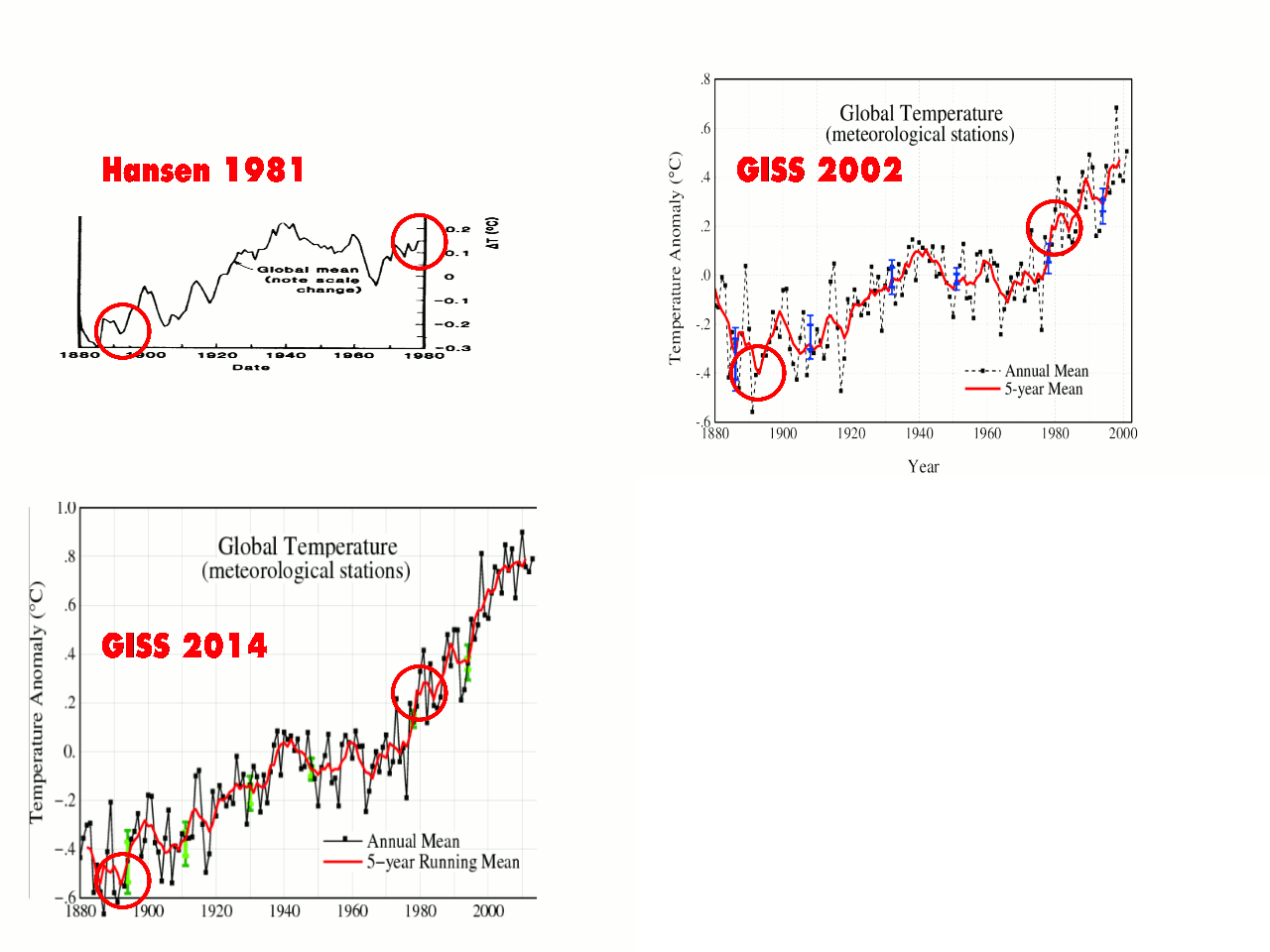
The only excuse for using ST’s is to obtain pre-1979 temperature data, before the satellite era, and then one should use older datasets recorded before all the corruption of data by repeated “adjustments”.
More evidence of ST data tampering:
https://realclimatescience.com/all-temperature-adjustments-monotonically-increase/
“I have provided you with strong evidence – and you have countered with crap.
Global surface temperatures (ST’s) are repeatedly “adjusted” frauds that has no credibility. See Tony Heller’s analysis here:”
That’s your opinion, I disagree. And I am not alone in that.
As I said, please be so kind as to provide me with a link to Mr Heller’s NASA data (which has miseriously disappeared) in order to contradict the two graphs from NASA that I posted above.
If and when you can do that to prove Heller’s analysis then I shall continue to believe what I see, and to boot, use commoon sense, rather than resort to conspiracy theory to bolster my confirmation bias.
Meanwhile I shall use your own words and call “crap” in return.
ToneB, not only does Tony Heller supply all the links to his NASA data, he also privides all the algorithms and Programming to test it for yourself.
Please answer my question on 1997.
“Please answer my question on 1997.”
And
“By the way Mr Bellman NASA GISS is not the Original Data Series.”
Again from the NASA Gistemp history ….
“To summarize, no raw data has changed over the years (except for minor quality control, elimination of duplicate data, etc.), but the GISTEMP analysis has varied because of the addition of more observations and changes in methodology. The GISTEMP analysis does not change the raw observations over time (these are curated by weather services around the world), but rather the estimate of the global mean change varies as we discover and correct for contaminating influences, as well as increasing the amount of raw data used. The differences over time can be helpful in giving an idea of the structural uncertainty in these estimates — particularly in the pre-war years and before 1900.”
Allen,
The extremely low R-squared values (0.1616 and 0.00008) for the linear regression lines on your plot indicates that the model explains little of the variability of the data around its mean or that the model doesn’t fit the data. The trends are not statistically significant.
Renee you wrote:
“The extremely low R-squared values (0.1616 and 0.00008) for the linear regression lines on your plot …”
R-squared gives you the percentage variation in y (temperature) explained by x-variables (time).
There is a small correlation of warming wrt time (R2 = 0.16) – the yellow line in the plot – which tracks the LT temperature data (actual and modeled) vs time, which is an artifact of the natural recovery of the atmosphere from the two major volcanoes in 1982 and 1991.
There is NO significant warming wrt time (R2 = 0.00) – the blue line in the plot, which tracks Nino34 area ocean temperatures vs time. There is NO significant Nino34 warming since about 1982, and no global warming crisis.
Allan,
While there appears to be no change in the Nino34 since the 1980s, there is definitely a change in the integral of Nino34 over that period.
In the 1970s the average Nino34 was strongly negative (-0.3, using CDC data from 2009), In the 1980s it was mildly positive, and in the 1990s it was strongly positive (+0.3). I would like to suggest that it is the integral of Nino34, over an approximately 10 yr. time period, that is correlated with the rise in global temperatures.
Since 2000 the integral, over a 10 yr. period, of Nino34 has paused, just as has the temperature.
dh:
I think the integral of Nino34 is not a meaningful parameter. But I will think about it. Do you have any calcs and figures?
The correlation of Nino34 with global atmospheric temperature 4 months later is strong, except when atm. temperature is cooled by major volcanoes.
I do suspect that the integral of solar activity is a good indicator of multi-decadal global temperature change, moderated by the PDO. See Dan Pangburn’s work – Fig 11 at.
http://globalclimatedrivers2.blogspot.ca/
Happy New Year!
Why not just plot the climate data with a linear scale on the X-axis and a logarithmic scale on the Y-axis?
You have done a lot of work that seems to me to be unconvincing even though I believe there has been no significant global warming since the mid-1990s.
My usual issue with all these “slow downs” is they never demonstrate any change in the underlying rate of warming.
Using GISTEMP the warming from 1970 – 2002 was 1.69 C / century.
So what effect did these 10 years of slowdown have on the long term trend?
From 1970 – 2012 the trend was 1.72 C / century.
No significant difference, but if anything a slight increase in the rate of warming.
“My usual issue with all these “slow downs” is they never demonstrate any change in the underlying rate of warming.”
But they falsify warmists’ past claims that natural variability plays a minor role in temperature changes, and modelers’ model-runs that found long-termm (e.g., 10-year) slowdowns to be quite unlikely.
In some branches of human endeavour when the ‘science’ cannot explain certain phenomenon instead admitting to the human ‘fallibility’, self appointed arbitrators of scientific truths resort to a standard dodge as ‘pseudo-science’ , ‘nonsense’, etc.
On this graph we can see that the North Hemisphere’s temperature data (CRUTemp4) has two prominent periodicities ascending well above the noise level:
– 9 years, most likely associated with the AMO 9 years decadal periodicity
– 21.8 years, most likely associated with solar magnetic cycle (2 x sunspot cycle) periodicity.
http://www.vukcevic.talktalk.net/CT4spec.gif
Unless it can be shown that the 21.8 periodicity has some other external source or alternatively some kind of an internal oscillation time constant, than it should be, within the reason, accepted to be a reflection of the solar activity effect on the NH’s temperature natural variability.
On that consensus defying note, Happy New Year to all.
Here are what the trends for the four decades mentioned in this article look like in context.

Each of the “fast warming” decades start a fair bit cooler than the previous decade, whilst the “slow down” decade starts warmer than the end of the previous decade. This illustrates the problem of just looking at trends, especially when cherry picking the start dates.
Here for comparison is the same process but shifting the start date back a couple of years.

GISTEMP is completely Adjusted data and not fit for the purpose you are putting to.
Only fit for the purpose of climate propaganda.
What you need to do to identify any CO2 based warming is to look between the major El Nino events.
When you do this, it becomes very apparent that there is absolutely NO CO2 warming in the whole of the satellite data .
No warming from 1980 – 1997

No warming from 2001 – 2015

No CO2 warming signature at all..
So you want me to refute Sheldon Walkers claim of a significant slowdown in GISTEMP data, but not by using GISTEMP data?
Bellman – you should make it clear that your date range starts at the end of a cooling period (1970 +/-) and ends at the end of a long warming period. So this is yet another example of cherry-picking.
But skeptics need to acknowledge that we are in the midst (maybe near the end) of a significant period of warming and refrain from trying to disprove something that’s obvious on its face. Attribution, of course, is something else altogether, and offers the most fertile ground for challenge.
I used the same periods as Sheldon Walker used in this article. It makes sense to look at trends since the start of the 70s as that’s around the time temperatures started to warm, and have continued to warm in a roughly linear fashion for the past 40 plus years. Sadly there’s no evidence that the warming period is coming to an end yet.
Nothing unusual about the above, temperature has done it before (probably many times) and it will do it again, it is part and parcel of the natural variability.
http://www.vukcevic.talktalk.net/4Temps.gif
Temperature doesn’t care much for calendar decades, if it cares about anything it is the length and intensity of solar activity and its side effects, such as the GCR showers and geomagnetic storms.
It’s time for science to get out of its ‘resonant chamber’ and realise the Earth isn’t an island to itself , it is an inseparable constituent of the system in which its resides.
Yes a warming period that has nothing to do with CO2 and everything to do with Cloud Cover.
http://www.climate4you.com/images/HadCRUT3%20and%20TropicalCloudCoverISCCP.gif
“Yes a warming period that has nothing to do with CO2 and everything to do with Cloud Cover.”
But it wasn’t a warming period was it, it was the “hiatus” in the warming (slower).
That graph of tropical cloud cover is exactly what I would expect to see during a period of a dominant -ve PDO/ENSO regime in the Pacific …. less cloud (because of cooler SST’s).
That correlation shows an effect not a cause.
IOW: cooler surface waters > less convection THEN the Pac tropical ocean absorbs the extra solar SW into the deeper ocean whilst the cooler SST’s suppress GMT.
Do you or Climate4you have more recent data?
Going to answer my 1997 challenge any time soon, or how about 1995, that was also 3.6 degrees F hotter than 2016s record breaking 58.69F in that 1998 Report.
What matter is what happens going forward from here. I think global warming comes to a screeching end.
Solar now very low and it should cause overall surface oceanic cooling and increase the albedo slightly.
If so say good bye to AGW.
Less UV light should result in overall oceanic cooling while an increase in MAJOR volcanic activity ,global snow/cloud coverage should result in a slight increase in albedo.
All of you “warmests” need to start riding bikes, then you won’t be hypocrits
If you say so.
Allan Macrae
Re: the integral of Nino3.4
Remember, energy transfer is always an integral. Thus if there is an energy transfer between the oceans and the atmosphere it is an integral of the forcing function, in this case Nino34, multiplied by time.
As well, the integral can also be interpreted as an average, i.e. the integral divided by time.
For forcing functions such as Nino3.4, I like to use the EWMA function (Exponentially Weighted Moving Average). If you use an EWMA with the most recent month weighted at 1/8, you get almost the equivalent of an 8-month moving average, delayed by 4 months. This EWMA of Nino3.4 is well correlated with short term perturbations in global atmospheric temperature, as you suggest.
However if I use an EWMA of Nino3.4 with the most recent month weighted at 1/100, I get something roughly equivalent to an 8 year moving average, delayed by 4 years. The correlation between this EWMA and global atmospheric temperature is much stronger again, as correlates not only with the short term perturbations of temperature, but also with the long term trends.
Using this same EWMA (1/100) on the sunspot number (assuming that SSN is a good proxy for solar forcing) shows a remarkable increase in solar forcing during the mid-20th century. The increase in ENSO forcing, from 1980 to 2000, parallels this increase in solar forcing, although with a significant lag (about 30 years or so).
I have calcs and figures, but don’t seem to be able to post them here. I can send by e-mail if you like.
dh – I post my figures on Facebook and then refer to them here – there are certainly better ways, but that is what I use.
dh – you wrote:
“Remember, energy transfer is always an integral. Thus if there is an energy transfer between the oceans and the atmosphere it is an integral of the forcing function, in this case Nino34, multiplied by time.”
ON further reflection, you may have something here. This integral could tie into the ~3-month delay of UAH LT Tropical temperatures after the Nino34 temperatures and the ~4-month delay of UAH LT Global temperatures after the Nino34 temperatures.
I would very much like to see you work posted here on wattsup. If suitable, you could submit an article, or just a post.
Allan,
I can send you a paper, by e-mail. So far I am not into social media.
dh-mtl and Allan were discussing “energy transfer is always an integral”.
However, you need to consider energy transfer out and well as energy transfer in. The rate of energy transfer out depends on the current temperature! That makes the problem far more complex.
Consider a radiative forcing of 1 W/m2 and assume that ECS is 3.7 K/doubling or 1 K/W/m2. A simple calculation shows that 1 W/m2/K can warm a 50 m mixed layer of ocean (and the atmosphere and land surface) at a rate of 0.2 K/year. If that initial rate continued for 5 years, one would reach a new equilibrium at 1 K warmer. However, after 2.5 years, the earth will be 0.5 K warmer and therefore emitting an additional 0.5 W/m2. Our initial radiative forcing of 1 W/m2 is now a radiative IMBALANCE of only 0.5 W/m2. The warming rate will be down to 0.1 K/year.
If ECS is 1.8 K/doubling or 0.5 K/W/m2, then equilibrium would be reached in 2.5 at the initial rate, but the radiative imbalance would be cut in half in 1.5 years by rising surface temperature. The take-home lesson is that the mixed layer of the ocean alone would mostly respond to a forcing in less than a decade, but not in a year.
Unfortunately, some heat travels below the mixed layer in less than a decade (but certainly not enough to reach equilibrium). Current forcing is about 2.5 W/m2, but the current imbalance is only about 0.7 W/m2. So current warming is about 70% of the warming expected from 2.5 W/m2. If we say current warming is 1.0 K, then we have 1 K/2.5 W/m2 or 0.4 K/(W/m2) or 1.5 K/doubling.
You should do the same sort of exercise on the UAH satellite data
http://www.drroyspencer.com/wp-content/uploads/UAH_LT_1979_thru_November_2017_v6.jpg
The fact that we are obliged to have these interminable ‘discussions’ with the warmunards is the clearest possible indicator that the climate currently isn’t doing much of anything at all. If the loons wish to claim that the not much of anything at all is entirely due to anthro co2 then submit the evidence. Otherwise shadap and stop wasting everyone’s time and money.
“is the clearest possible indicator that the climate currently isn’t doing much of anything at all.”
You’ve obviously not noticed that the Earth has had it’s warmest non-EN year in the instrumental record.
So what? As far as I’m aware we didn’t have much by way of global temperature monitoring prior to the Little Ice Age. Why would I think that warming since then is anything other than natural? Why would I do that? Seriously is everything alright at home because you seem to be utterly unhinged.
“So what? As far as I’m aware we didn’t have much by way of global temperature monitoring prior to the Little Ice Age. Why would I think that warming since then is anything other than natural? Why would I do that? Seriously is everything alright at home because you seem to be utterly unhinged.”
Funny that, becasue there I was thinking you “seem to be utterly unhinged”
Like I said the Earth has had it’s warmest non El Nino year on INSTRUMENTAL RECORD.
Have you comprehended now?
Listen to yourself, he says they didn’t have Instruments over 250 years ago and you talk about the Instrumental Record.
It is a blip in time, what do you expect the temperatures to do coming out of the LIA, they should be increasing all the time.
Why don’t you ask yourself how much warmer it was in the previous Warm Periods?
“Listen to yourself, he says they didn’t have Instruments over 250 years ago and you talk about the Instrumental Record.”
No you “listen yo yourself”
What’s difficult to comprehend about “Warmest non El Nino year” on record.
All we can be sure of is what has happened during the instrumental record … well unless you think it’s been “fabricated” anyway, and that is the “last resort of …..”.
So it is irrelevant to my comment “what happened 250 years ago”
We have a period of instrumental record measuring the oscillations of the ENSO.
In that time this past year has been the warmest year with a La Nina.
OK. Just that. No goal posted shifted Ta.
It seems to me, if small changes to the start and end dates of trend calculations causes large changes to the results, then the error bars for the result need to be massively increased.
This is not a statistics problem it is a methods problem.
Sheldon –
It’s a good treatment, but it isn’t conclusive in any way.
The failure of existing science has been to ignore natural variation. Unless you’ve established the expected range of variation (both positive and negative around the mean), any claims you make of significance are just opinion. They have no formal meaning.
So even though I happen to agree with your agenda (and it’s clear from both the subject and your chosen media that you have an agenda), I have to disagree with you for the same reason I have to disagree with cAGW alarmists; there’s been no quantification of natural variation and the range of that variation that would allow anyone to determine the significance of any observed change.
Keep up the work, it’s good in as much as it challenges contemporary wisdom, but in the absence of an unequivocal understanding of expected values, it’s merely further conjecture. It can easily (and rightfully) be accused of “cherry picking”. You need to do the heavy lifting that hasn’t been done yet by climate science; you must establish the range of natural variation before declaring the significance of your observations.
One thing I don’t understand is quite often they say today was the hottest day for 100 years or 200 years or 50 years so on so on. That means that 100 or 200 years ago it was that hot so is it not just a cycle? Personally I am not convinced of global warming.
Sheldon Walker wants ro know if the recent slowdown of global warming is real or fake but has no idea how to analyze the relevant data. His choice of using Gstemp ss a basis a bad start because we know, and he himself admits, that these data have been falsified. And then come his three figures, each featuring three or four straight lines fitted to the data lines which are of arbitrary length. This is simply impermissible because these data are not random data and should not be fitted to any arbitrary-length straight line.
For these reasons I suggest tossing out all pf these suggested data and using instead the latest UAH satellite temperature graph that can be downloaded for free. It runs from the year 1979 to the latest complete month. To start it, first use a magic marker to smooth the appearance of data lines. Certain precautions must be used with any climate data. To start off, outliers like El Nino peaks and La Nina valleys must not be incorporated into the final global temperature curve. That is because they are only temporary features of the ocean and do not reflect the true temperature curve itself. To handle El Ninos, put a dot at the center of each line connecting an El Nino peak with an adjacent La Nina valley, then connect the dots. When this is not feasible eliminate the peak. The super El Nino of 1998, for example, must not be used at all. The UAH temperature curve itself does need to be subdivided because several changes in data gathering take place within it. They divide the full length of the data set into five individual segments designated by years as follows:
1. 1979 to 1997 (Five ENSO peaks and valleys)
2. 1997 to 2000 (Super El Nino of 1998)
3. 2000 to 2002 (global temperature rises 0.3 degrees Celsius)
4. 2002 to 2012 (Straight line slopes down at the rate of 1 degree per century)
5. 2012 to 2016 (El Nino peak 2016 and its surrounding temperature rise)
That is sufficient to resolve any questions brought up by Sheldon Walker. Observe the short warming in section 3 and the cooling in section 4.
We may conclude from these observations that:
There has been no warming since 1979 except for the short burst associated with the departure of the 1q998 super El Nino in 2000. The only actual warming since 1979 occurred between 2000 and 2002. It was caused by the warm water mass left behind by the departure of the super El Nino. A warm hump centered at 2002 is its peak. By eliminating all ENSO-specific featutres from consideration we see that the only true temperature change now occurring is due to the the slow cooling of this warm water mass.
Global warming is scary but if we do the right thing we can prevent the worse to come