As the sun gets successively more blank with each day, due to lack of sunspots, it is also dimming. According to data from NASA’s Spaceweather, so far in 2017, 96 days (27%) of the days observing the sun have been without sunspots. Here is the view today from the NASA Solar Dynamics Observatory satellite:

Today at Cape Canaveral, SpaceX launched a new sensor to the International Space Station named TSIS-1. Its mission: to measure the dimming of the sun’s irradiance. It will replace the aging SORCE spacecraft. NASA SDO reports that as the sunspot cycle plunges toward its 11-year minimum, NASA satellites are tracking a decline in total solar irradiance (TSI).
Across the entire electromagnetic spectrum, the sun’s output has dropped nearly 0.1% compared to the Solar Maximum of 2012-2014. This plot shows the TSI since 1978 as observed from nine previous satellites:

In the top plot, we drew the daily average of measured points in red (so there are a lot of points, 14187 to be precise). On the left is a red vertical bar showing a 0.3% change in TSI. The black curve is the average of TSI over each year. The dashed horizontal line shows the minimum value of year-averaged TSI data. The vertical black bar shows the 0.09% variation we see in that average. The bottom plot shows the annual sunspot number from the SIDC in Belgium in blue. Source: NASA Solar Dynamics Observatory Mission Blog.
What do we learn from these plots? First, TSI does change! That’s why we stopped calling it the solar constant. Second, as the sunspot number increases, so does TSI. But the converse is also true. As the sunspot number decreases so does TSI. We have watched this happen for four sunspot cycles. This waxing and waning of TSI with sunspot number is understood as a combination of dark sunspots reducing TSI below the dashed line and long-lived magnetic features increasing TSI. SORCE has even observed flares in TSI.
Third, the horizontal dashed line is not an average, it is drawn at the lowest value in the year-averaged TSI data (that happened in 2009). When there are no sunspots the Sun’s brightness should be that of the hot, glowing object we always imagined it to be. We would expect TSI to be the same at every solar minimum. There is much discussion over whether the value of TSI at solar minimum is getting smaller with time, but it is not getting larger.
These data show us that the Sun is not getting brighter with time. The brightness does follow the sunspot cycle, but the level of solar activity has been decreasing the last 35 years. The value at minimum may be decreasing as well, although that is far more difficult to prove. Perhaps the upcoming solar minimum in 2020 will help answer that question.
The rise and fall of the sun’s luminosity is a natural part of the solar cycle. A change of 0.1% may not sound like much, but the sun deposits a lot of energy on the Earth, approximately 1,361 watts per square meter. Summed over the globe, a 0.1% variation in this quantity exceeds all of our planet’s other energy sources (such as natural radioactivity in Earth’s core) combined. A 2013 report issued by the National Research Council (NRC), “The Effects of Solar Variability on Earth’s Climate,” spells out some of the ways the cyclic change in TSI can affect the chemistry of Earth’s upper atmosphere and possibly alter regional weather patterns, especially in the Pacific.
NASA’s current flagship satellite for measuring TSI, the Solar Radiation and Climate Experiment (SORCE), is now more than six years beyond its prime-mission lifetime. TSIS-1 will take over for SORCE, extending the record of TSI measurements with unprecedented precision. It’s five-year mission will overlap a deep Solar Minimum expected in 2019-2020. TSIS-1 will therefore be able to observe the continued decline in the sun’s luminosity followed by a rebound as the next solar cycle picks up steam. Installing and checking out TSIS-1 will take some time; the first science data are expected in Feb. 2018.
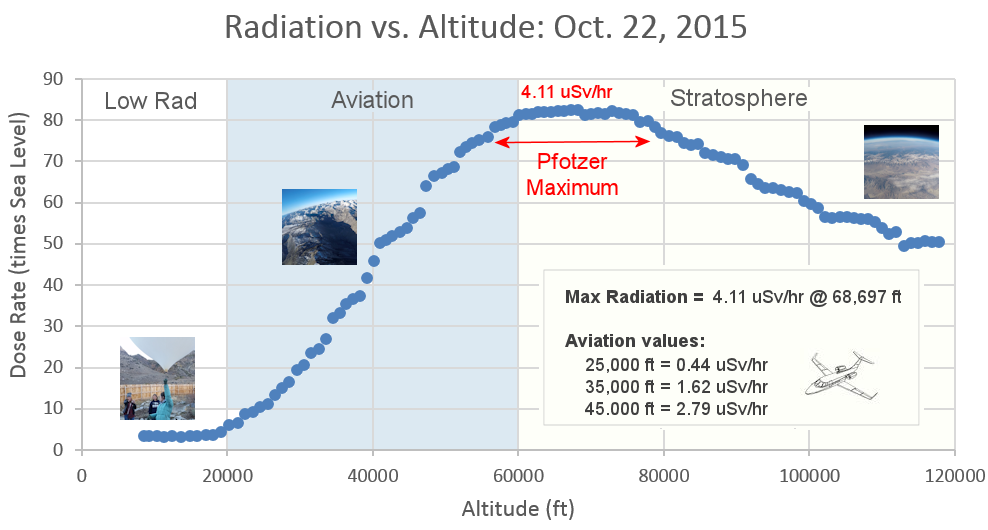
In other news, as the magnetic activity of the sun decreases, influx of Galactic Cosmic Rays (GCR’s) increase as has been observed by balloon measurements over California:

Why are cosmic rays intensifying? The main reason is the sun. Solar storm clouds such as coronal mass ejections (CMEs) sweep aside cosmic rays when they pass by Earth. During Solar Maximum, CMEs are abundant and cosmic rays are held at bay. Now, however, the solar cycle is swinging toward Solar Minimum, allowing cosmic rays to return. Another reason could be the weakening of Earth’s magnetic field, which helps protect us from deep-space radiation.
The radiation sensors onboard our helium balloons detect X-rays and gamma-rays in the energy range 10 keV to 20 MeV. These energies span the range of medical X-ray machines and airport security scanners.
The data points in the graph above correspond to the peak of the Reneger-Pfotzer maximum, which lies about 67,000 feet above central California. When cosmic rays crash into Earth’s atmosphere, they produce a spray of secondary particles that is most intense at the entrance to the stratosphere. Physicists Eric Reneger and Georg Pfotzer discovered the maximum using balloons in the 1930s and it is what we are measuring today.
NASA’s spaceweather.com website follows the progress of the sun on a regular basis. Our WUWT Solar Reference Page also has data updated daily.
Hahaha. Arrogant liberal idiots think man has an effect on this planet when nature has its own plans.
Okay, I’ve always been suspicious of all those solar panels sucking up the Sun’s energy…
They don’t destroy the energy. That is impossible. The energy is put to work, and the ultimate result is heat.
Yeah, can’t help but agree. The sun will come up tomorrow, so don’t worry…!
Blasphemy! It’s racist to suggest that the sun has anything to do with climate.
You took the words right out of my mouth! Damn racists!
IT’S BEING CAUSED BY GLOBAL WARMING™!!! WE MUST STOP CARBON “POLLUTION” IMMEDIATELY OR THE SUN WILL GO AWAY FOREVER AND WE WON’T BE ABLE TO SEE WHERE WE’RE GOING!!!!
Alberto Gorez, the noted S. American Global Cooling climatologist was 100% correct, when he warned the world of the upcoming Maunder Minimum, and subsequent GLOBAL COOLING CRISIS!
The sun is going out!
Quick! Shovel some more coal in to it – before ‘Global Cooling’ ™ plunges us all into the next Ice Age …
How can we believe anything this fake nazi oriented space psyeudosciece agency says??? Its just as probable that we live in an enclosed system….the sun is closer then they say….think for yourselfs and ask questions…..
Being open minded is a good thing, unless your mind is so open your brains fall out.
There are some nice safety net collars on the market for just that type of problem. That way the person doesn’t have to bend down to pick his brains off of the ground, and it makes for easier reinsertion.
Global warming
Maybe the spraying in sky is to block the sun’s rays that are not being blocked as they were in previous years. Or they just like custom sunsets?
bwaaaaa ha ha ha ha ya can’t make this stuff up. Really folks, this is such a laughable situation we current live in. Opportunistic Climate Change Scientists get caught faking their data to support their arguments. Then go absolutely ape crazy if you call them out on it. They call you a what again? oh yeah, a Climate DENIER, and go after your employment if you don’t suckle up to their demands. they being, massively invasive Government regulations that don’t do jack to fix what Nature has already dealt out.
Look folks, we have been living in a relatively quiet period of astronomically speaking a Cool Spell. Cyclically speaking we have enjoyed a longer than expected roll of the dice Ice Age period. All of the events suggest we are about to hit all of the hyper cold long Ice Ages.
But we know our liberals are hyper ventilating about global warming climate change. That’s the flavor of the month with these peoples. They spent so much money protecting their lies and fake data we can’t get a word in edge wise with habitual criminality prone Climate Change scientists. To admit they were wrong draws huge questions about their egos over science. There’s nothing worse than an egotistical Professor being called out on their ERRORS.
Thoughts: (1) this could be a sell signal for anyone invested in TSI (ok, just kidding:wanted to start opt with a joke. With today’s central banks, stocks only go up). (2) It wouldn’t take a large solar catastrophy to be earth-life-catastrophic. Are we sure of our solar models? That sure? (3) As TSI<>, so farstrike lightning which follows G paths should >> as well. I wonder if other earth phenomena will, too. (4) Remembering book of Revelations and the sun first having the power to burn men, and then dimming, and the published photo of what looked like an angel doing something to the sun… Oh well. That’s not in my power to affect.
The sun obviously is much stronger than 2 years ago. This ciop article is bizzare. We are obviously in the photon belt, now rolling into 5th dimension. Liars do ciops, will wake up on a slave plsnet, 3 dimension.
[???? .mod]
Legalized pot?
No, most likely chemically induced.
Colder or warmer it seems no one can prove definitively what the correct temperature “should be” on any given day year or period. humans exist just fine across a range of 180 degrees in temperature. Plus or minus a few degrees just has no impact globally. cold or warm, humans will exist just fine. Massive floods will not drown people as sea levels rise a few mm a year unless you believe that death from a steam roller is possible when it is approaching from half a mile away.
Ric, and/orAnthony
we did not get any response from you on our reasonable query?
https://wattsupwiththat.com/2017/12/15/the-sun-is-blank-nasa-data-shows-it-to-be-dimming/comment-page-1/#comment-2695690
So which is the most insignificant effect for global warming? solar cycle, cosmic rays, political climate science, or climate psychology science contributions
I purposely left out climate theater productions since that is the furthest token political outlier funded by NSF.
Reply to comment on the paper “ on a role of quadruple component of magnetic field in defining solar activity in grand cycles” by Usoskin (2017).
Abstract
In this communication we provide our answers to the comments by Usoskin (2017) on our recent paper (Popova et al, 2017a). We show that Principal Component Analysis (PCA) allows us to derive eigen vectors with eigen values assigned to variance of solar magnetic field waves from full disk solar magnetograms obtained in cycles 21–23 which came in pairs. The current paper (Popova et al, 2017a) adds the second pair of magnetic waves generated by quadruple magnetic sources. This allows us to recover a centennial cycle, in addition to the grand cycle, and to produce a closer fit to the solar and terrestrial activity features in the past millennium.
http://computing.unn.ac.uk/staff/slmv5/kinetics/zharkova_etal_reply_jastp17.pdf
ABSTRACT
In this paper we revise our prediction of solar activity using a solar background magnetic field as a proxy by the
inclusion of eigen vectors of solar magnetic waves produced by quadruple magnetic sources, in addition to the
principal eigen modes generated by two-layer dipole sources (Zharkova et al., 2015). By considering the interference
of two dipole and one quadruple waves we produce the revised summary curve for the last 400 years
accounting for the additional minima of solar activity occurred at the beginning of 19th (Dalton minimum) and
20th centuries. Using the dynamo model with meridional circulation and selecting the directions of circulation for
quadruple waves, we estimate the parameters of quadrupole waves best fitting the observations in the past grand
cycle. The comparison shows that the quadruple wave has to be generated in the inner layer of the solar
convective zone, in order to provide the additional minima observed in 19 and 20 centuries, thus, naturally
accounting for Gleissberg centennial cycle. The summary dynamo wave simulated for the dipole and quadruple
sources reveals much closer correspondence of the resulting summary curve derived from the principal components
of magnetic field variations to the solar activity oscillations derived from the average sunspot numbers in
the current grand cycle.
http://computing.unn.ac.uk/staff/slmv5/kinetics/popova_etal_jastp17.pdf
Great story, DC Cowboy, except Marie Antoinette never said “Let them eat cake”. That’s right, there’s no evidence that she ever said that. It’s a story made up long afterward. Fake news, we call that stuff today. Oh and Sarah Palin never said she could see Russia from her house. Nor did Christopher Columbus’s critics think the world was flat and that he’d fall off the edge if he sailed beyond the western horizon. And Monty Python skits aren’t history lessons.
The atmospheric cooling I predicted (4 months in advance) using the Nino34 anomaly has started to materialize in November 2017 – more to follow. This is weather, not climate (I hope). Happy Holidays to all!
https://www.facebook.com/photo.php?fbid=1527601687317388&set=a.1012901982120697.1073741826.100002027142240&type=3&theater
Question for Bill Illis:
This Aerosol Optical Depth data stops in late 2012. Doe you have more recent data? Where?
https://data.giss.nasa.gov/modelforce/strataer/tau.line_2012.12.txt
A huge drop in the sun’s power of………0.1% excuse me…..that doesn’t sound like a huge drop to me.
[do the math, and tell us how many terawatts of power loss that is, then get back to us -mod]
Always a flake around to represent the mass of shallow minded. Thanks for the information. As a Ham, I expect long range communications will become more challenging as this low approaches.
The current Sunspot number is 11,
I can’t seem to observe any sunspots in this image, just a fading penumbra.
Any sunspot number below 20-30 seems to be historically blank.
It raises the threshold somewhat, of what is being counted as an actual sunspot.
http://spaceweather.com/images2017/28dec17/hmi1898.gif
The current Sunspot number is 11,
SILSO says zero:
24 December : 25
25 December : 21
26 December : 15
27 December : 13
28 December : 0
http://www.sidc.be/silso/home
The current EISN shows an average of 9 and NB stations show between 10-30.
Just wondering why daily international sunspot numbers are showing 11 (according to space-weather) for a fading penumbra.
http://www.sidc.be/silso/DATA/EISN/EISNcurrent.png
So far there are 15 spotless days this month and 12 days with sunspots according to the data.
http://www.sidc.be/silso/DATA/EISN/EISN_current.txt
Are fading penumbra being counted as sunspots?
The current EISN shows an average of 9 and NB stations show between 10-30.
Can’t you read?
28 December : 0
*Average of 8
I understand that 28 December is 0
I have no issue with that.
Notable Stations are plotted as counting the sunspot number between 10-30 on the EISN graph, it’s there in front of you.
The data shows that there are more spotless days this month than there are days with sunspots.
Are there more spotless days this month of less spotless days this month in your view?
Quoting you:
I can’t seem to observe any sunspots in this image, just a fading penumbra.
As we get closer to sunspot minimum there will be more spotless days. It makes no sense to worry about the count over a time scale of a month.
“It makes no sense to worry about the count over a time scale of a month.”
Obviously it does matter, maybe I enjoy discussing minor details for educational purposes, maybe take a different path, maybe find out facts and be more competent and accurate, but that’s just me.
Obviously it does matter
Not at all.
Time scales matter.
If they are comparable…
otherwise not so much.
Sunspot number below 20-30 seems to be the new zero. Why?