As the sun gets successively more blank with each day, due to lack of sunspots, it is also dimming. According to data from NASA’s Spaceweather, so far in 2017, 96 days (27%) of the days observing the sun have been without sunspots. Here is the view today from the NASA Solar Dynamics Observatory satellite:

Today at Cape Canaveral, SpaceX launched a new sensor to the International Space Station named TSIS-1. Its mission: to measure the dimming of the sun’s irradiance. It will replace the aging SORCE spacecraft. NASA SDO reports that as the sunspot cycle plunges toward its 11-year minimum, NASA satellites are tracking a decline in total solar irradiance (TSI).
Across the entire electromagnetic spectrum, the sun’s output has dropped nearly 0.1% compared to the Solar Maximum of 2012-2014. This plot shows the TSI since 1978 as observed from nine previous satellites:

In the top plot, we drew the daily average of measured points in red (so there are a lot of points, 14187 to be precise). On the left is a red vertical bar showing a 0.3% change in TSI. The black curve is the average of TSI over each year. The dashed horizontal line shows the minimum value of year-averaged TSI data. The vertical black bar shows the 0.09% variation we see in that average. The bottom plot shows the annual sunspot number from the SIDC in Belgium in blue. Source: NASA Solar Dynamics Observatory Mission Blog.
What do we learn from these plots? First, TSI does change! That’s why we stopped calling it the solar constant. Second, as the sunspot number increases, so does TSI. But the converse is also true. As the sunspot number decreases so does TSI. We have watched this happen for four sunspot cycles. This waxing and waning of TSI with sunspot number is understood as a combination of dark sunspots reducing TSI below the dashed line and long-lived magnetic features increasing TSI. SORCE has even observed flares in TSI.
Third, the horizontal dashed line is not an average, it is drawn at the lowest value in the year-averaged TSI data (that happened in 2009). When there are no sunspots the Sun’s brightness should be that of the hot, glowing object we always imagined it to be. We would expect TSI to be the same at every solar minimum. There is much discussion over whether the value of TSI at solar minimum is getting smaller with time, but it is not getting larger.
These data show us that the Sun is not getting brighter with time. The brightness does follow the sunspot cycle, but the level of solar activity has been decreasing the last 35 years. The value at minimum may be decreasing as well, although that is far more difficult to prove. Perhaps the upcoming solar minimum in 2020 will help answer that question.
The rise and fall of the sun’s luminosity is a natural part of the solar cycle. A change of 0.1% may not sound like much, but the sun deposits a lot of energy on the Earth, approximately 1,361 watts per square meter. Summed over the globe, a 0.1% variation in this quantity exceeds all of our planet’s other energy sources (such as natural radioactivity in Earth’s core) combined. A 2013 report issued by the National Research Council (NRC), “The Effects of Solar Variability on Earth’s Climate,” spells out some of the ways the cyclic change in TSI can affect the chemistry of Earth’s upper atmosphere and possibly alter regional weather patterns, especially in the Pacific.
NASA’s current flagship satellite for measuring TSI, the Solar Radiation and Climate Experiment (SORCE), is now more than six years beyond its prime-mission lifetime. TSIS-1 will take over for SORCE, extending the record of TSI measurements with unprecedented precision. It’s five-year mission will overlap a deep Solar Minimum expected in 2019-2020. TSIS-1 will therefore be able to observe the continued decline in the sun’s luminosity followed by a rebound as the next solar cycle picks up steam. Installing and checking out TSIS-1 will take some time; the first science data are expected in Feb. 2018.
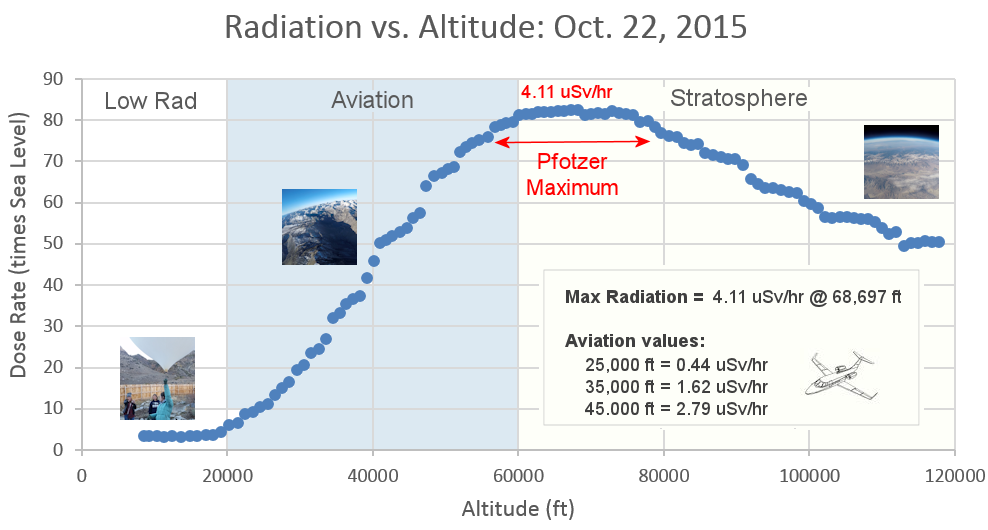
In other news, as the magnetic activity of the sun decreases, influx of Galactic Cosmic Rays (GCR’s) increase as has been observed by balloon measurements over California:

Why are cosmic rays intensifying? The main reason is the sun. Solar storm clouds such as coronal mass ejections (CMEs) sweep aside cosmic rays when they pass by Earth. During Solar Maximum, CMEs are abundant and cosmic rays are held at bay. Now, however, the solar cycle is swinging toward Solar Minimum, allowing cosmic rays to return. Another reason could be the weakening of Earth’s magnetic field, which helps protect us from deep-space radiation.
The radiation sensors onboard our helium balloons detect X-rays and gamma-rays in the energy range 10 keV to 20 MeV. These energies span the range of medical X-ray machines and airport security scanners.
The data points in the graph above correspond to the peak of the Reneger-Pfotzer maximum, which lies about 67,000 feet above central California. When cosmic rays crash into Earth’s atmosphere, they produce a spray of secondary particles that is most intense at the entrance to the stratosphere. Physicists Eric Reneger and Georg Pfotzer discovered the maximum using balloons in the 1930s and it is what we are measuring today.
NASA’s spaceweather.com website follows the progress of the sun on a regular basis. Our WUWT Solar Reference Page also has data updated daily.
So…… The Sun is the cause of Global Warming and Climate Change.
Yes.
But I was under the impression that the science is settled that cow flatulence was the cause of climate change. Have I been lied to?
Great article Anthony! Minor challenge: suggesting a significant amount of other energy, you wrote, “natural radioactivity in Earth’s core”. There’s almost no radioactivity there. It’s concentrated in the Earth’s *continental* crust, and even there, preferentially around granite. I had a contentious interview with physicist Dr. Lawrence Krauss (he’s an alarmist, but our interview was on another topic) and the lack of significant radioactivity in the core (and mantle for that matter) was the only point that he and I agreed upon.
Bob
I also noticed this.
I think what is meant is: the radiation coming from the inner core of earth
Ric, can you comment on this?
Anyway, don’t underestimate the radiation from earth’s inner core. In fact, come down 1km into a gold mine here and discover how big that elephant in the room really is. But there is very little data.
Yet, my results indicate that it is for a large part the movement of earth’s inner core [magnetic stirrer effect] that is the reason for the arctic ice melt.
Nice to see discussion from people who can string sentences together, we realize we must be better stewards of our resources, lets get on with it. Railing at politico-economic factors better than paganestic Gaia Earth mother relgious fantasies. Laws of thermodynaics at work, pure of simple. The author of those laws planned for this within His time line, what an intelligent design He made. 😑
Just what we need…another crisis. I would include a link to Monty Python singing “Always Look on the Bright Side of Life”, but that does not appear to be an option on this site. 😉
This will get buried it makes Trump look smart
I have been having great fun ascribing this phenomena to anthropogenic sunspot depletion brought on by all the various solar energy installations.
Very interesting and revealing climatic prospects lie ahead in my opinion as the prolonged solar minimum becomes more established.
Overall sea surface temperatures thus far are on the decline and will translate to lower overall global temperatures if trend holds up.
It is a wait and see situation.
Well, since this solar cycle REALLY started in 2006, the year of no sunspots and an awkward scrambling to account for it, and the Sun didn’t switch its magnetic poles the way it usually does at the end of a solar cycle, there was widespread talk of another Maunder Minimum. And FWIW, the frost fairs on the frozen Thames are on record as taking place during the Regency period.
So then, the Sun goes back to “normal” (whatever that is) in 2008, eighteen months after it stalled out and scared people, but it didn’t come back to quite the level it had reached before that Solar Minimum, and now we’re in another. It’s the length of time, not the level (as indicated in a previous WUWT article) that counts. The longer Old Sol stays quiet, the more affected the Earth is.
Oh, and Earth’s magnetic field is weakening, too, which lets in more cosmic radiation, because the Earth’s magnetic poles are in the process of getting ready to swap ends. I sincerely hope you all know how to navigate by sight instead of GPS, because magnetic compasses will be pointing South, just to confuse you. The real question is will this cause massive episodes of volcanism everywhere? And if so, how will it affect commerce? Will you kids still be able to use your electronic toys, or will we all be reduced to writing letters to each other?
It doesn’t explain why last winter was nice and mild after a brief, if nasty, spell of cold and snow, or why we’re having a repeat in my kingdom, but it’s going to hit 47F on Tuesday and then get cold again. Polar vortices are interesting, aren’t they?
And I wish you all a very merry Christmas.
Wow, as it goes low it is only .1% from the maximum. What amazing consistency the sun has. This chicken little article is embarrassing.
The liberals blame mankind!
This whole thing will be devastating to the “Climate Change” (previously known as “global warming”) group. Perhaps now Al-Buffoon can finally retire his long-winded, boring “oratory” about it.
He won’t shut up about it; he will discredit the scientists who made this study or say something stupid like the Sun’s temperature has no effect on the temperature of the Earth. Gore has made well over 100 million dollars peddling these carbon credits. He says he purchases carbon credits, and he does, but what he doesn’t say is that he owns the company that he purchases them from, Generation Investment Management.
Read a story 20+ years ago about an EBE telling a person that the our sun was going out, at the time I dismissed it. Now I tend to believe it, I have been watching these NASA websites for many years and the sun has been getting dimmer and dimmer each year. And the sun has been going into this solar minimum for quite a number of years as well. Seems the story cannot be kept a secret for ever, the powers that be have known for quite awhile. Nothing we can do about it anyway, unless you have an extra long set of jumper cables we can jump start the sun with.
those jumper cables actually exist.
myself and a few others here are aware of the relationship between the position of the planets and with what happens on the sun. I am inclined to believe this correlation is causal to the various solar cycles that we have….it seems the balance of power is indeed in the hand of a small portion of the solar system: some additional gravitational pull throwing an electrical switch on the sun.
Amazing, is it not?
So what happens if one planet goes missing?
Disaster!!!
Lately, nothing happened badly. It seems we arrived safely on the other side of the GB cycle.
Solar panels on Earth are sucking the energy out of the sun. This has been reported by the scientific community
Just like the solar powered Death Star in the previous Star Wars movie drawing the heat directly from the surface of the planet’s sun.
Not only are we experiencing cooling but we are ill prepared to supply the world with the fuel they will need to survive. The amount of coal, oil, shale and natural gas required cannot all fall to the U.S. If Asia, EU, MENA, LATAM are to survive, they must develop their own full cycle supply chain resources. Nuclear power for massive cities is also an answer…. Prime example of falling asleep at the wheel…. NY in the U.S. has soaring energy costs and they close their most affordable sources. The governing of energy policy has nothing to do with science or common sense any longer. It has become ideological political witchcraft to serve those seeking new currencies and the control of populations. The Sun controls the Earth’s climate not the amount of money you send to Al Gore, The Queen of England or Goldman Sachs as tribute.
“NY in the U.S. has soaring energy costs.” And National Grid is applying a rate increase. Meanwhile, here in Indian Lake in the ADKs it was -11 degrees this morning, a full month in advance of the bitter chill we usually get in Jan-Feb.
Reaching 0 at 10 am.
Someone going by the handle “Me” at the start of these comments made the statement that the US is a “net exporter of oil”. This is not true. We are a net exporter of refined products (gasoline, diesel, etc.) but a net importer of crude oil, and a net importer overall, That is our net imports of crude oil exceed our net exports of refined products by several million barrels per day, 3.991 million barrels per day (167 million gallons per day) in the latest week reported. (See http://ir.eia.gov/wpsr/overview.pdf Compare line 4 of Current week column and line 21)
All I know is the front of the glaciers will have to be a mile from downtown Manhattan before
Al gore will say “Hmm, you know i may have been wrong about that warming thing.”
I am site that some people will somehow claim that the hippies are wrong about climate change
Forecast for the winter of 2017/2018 for North America.
The air from the south will not reach far north. In the south-west will be high pressure due to La Niña. From the north, the jet stream will go far to the south.
All of this research is driven by our curiosity of “why’ and “how”. The more we learn the less we know. My question is why do those who think they have the answers think they do ?
Of course, the sun’s losing it’s energy. It’s from all the solar panels we’ve put it sucking the energy away.
It’s been cooling since the day it was created. BUT, never mind that, the global warming racketeers will blame it, somehow, on global warming.
It’s been cooling since the day it was created
No, it has been warming since the day it was created. Today it shines with energy output 30% higher than in its youth.
Hopefully not at a rate fast enough to contribute to global warming.
The increase is so gentle that we cannot yet actually measure it with instruments on our satellites, but the goal is to improve the sensitivity to the point where we can actually measure the increase. Not because it will cause measurable global warming, but to check if our understanding of the Sun is correct.
We will before very long, be wishing that the AGW fraud had in fact been more of a reality.
Considering the age of the sun, 6,000 + years if you subscribe to Creation as described in the Bible or what, 4.5 Billion years with the scientific explanation of it’s birth, and coupling this data with the scientific method as a principal to analyze such things, I do not believe that less than 40 years of observation is going to establish a trend whereby any reliable prediction or warning can be made regarding the health of the sun or it’s current activity. There are simply not enough data points that have been gathered to make any sort of reliable comment on this. So, until there is I don’t believe that I am going to worry about it much.
If we would take this information as proof then we should most likely adopt the ingestion of manure as a good source of food simply because billions of flies, insects and other animals alive today use it as a source of food. Happy dining. 🙂
It’s not the gathering of this information that I object to. It’s the outlandish determinations of what it all actually means and indicates. Now when you can show me a tread of at minimum 600 years (10%) or even 60 years (1%), then I will start to listen. Seems we still have a long way to go before that can happen now doesn’t it? As it stands now its no more meaningful than a political poll where 1,000 citizens out of close to 3 million citizens were asked a question.
Once again scientists utterly fail to use the scientific method of analysis and have jumped to a conclusion before it can be really determined. And people wonder why no one much believes in the lie of Global Warming?
I’m pretty sure the climate models include this huge variability in irradiance, and account for all its consequences.
Don’t they?
The models do not consider solar at all, much less solar changes.
Yes, they do. Please don’t flaunt your ignorance too much.
Not if they want their government grant money flowing!
Yes, they do.
Well, we are informed that “A 2013 report issued by the National Research Council (NRC), “The Effects of Solar Variability on Earth’s Climate,” spells out some of the ways the cyclic change in TSI can affect the chemistry of Earth’s upper atmosphere and possibly alter regional weather patterns, especially in the Pacific.”
Note that it spells out *some* of the ways the change can affect…weather patterns.
So do the climate models account for only some, or all of the ways TSI and changes therein can affect weather patterns? What ways are included in the climate models that were not in the 2013 NRC Report?
Also, if the climate models to take account all of the TSI changes and their effects on the atmosphere and weather patterns, then presumably the modelers know all that is to be known about TSI variability. So what’s the point of the new satellite?
all of the ways TSI and changes therein can affect weather patterns?
All the ways we know of.
So what’s the point of the new satellite?
To continue the TSI data time series [so it can be used in the models] as the older satellites are failing.
All the ways we know of.
So the models are wrong at least to the extent that they omit unknown effects of TSI changes. Thanks.
Are you saying that the 2013 NRC report referenced earlier comprises “all the ways we know of?” Or are there others? Your answer wasn’t clear.
To continue the TSI data time series [so it can be used in the models] as the older satellites are failing.
So the modelers don’t know all that is to be known about TSI, otherwise the data time series would be irrelevant — they could predict with confidence what the TSI would be at any point in time. Got it.
So your assertion that the climate models are inclusive of TSI effects on climate isn’t really on a sound foundation.
The best you could say with honesty is that “some unknown proportion of all TSI effects are included in models; we don’t really know if it’s correct because we can’t demonstrate that we even know all possible effects, much less how to quantify them.”
Could this be at least partly the source of the very poor performance of the models in predicting climate?
So the models are wrong at least to the extent that they omit unknown effects of TSI changes.
No, they are right to omit unknown effects. What we don’t know we can’t use.
are there others? Your answer wasn’t clear.
There are the unknown unknowns, but it doesn’t make sense to incorporate what we don’t know.
So the modelers don’t know all that is to be known about TSI
They know all that is known. What more can one do?
So your assertion that the climate models are inclusive of TSI effects on climate isn’t really on a sound foundation.
As sound as we know how to make it. Going beyond that would be really unsound.
we can’t demonstrate that we even know all possible effects, much less how to quantify them
What we don’t know, we cannot use, and should not base policy on what we don’t know.
Could this be at least partly the source of the very poor performance of the models in predicting climate?
No, because the solar influence [that we know of] is too tiny to have any impact. The poor performance is most likely due to the grid-size [determined by available computer technology] is too coarse and that we have to parameterize the micro-physics, e.g. of cloud formation. With time that may improve.
No, they are right to omit unknown effects. What we don’t know we can’t use.
Are you saying that the models are thus correct and produce correct predictions?
I would think a proper statement would be “The models include only what the modelers know or think they know. To the extent that there are influences on that which is being modeled that the modelers don’t know, or that knowledge of the modelers is incomplete or wrong, the models must either be incorrect, or, like a stopped clock, be correct only by coincidence.”
Is that a sound basis for policy?
What we don’t know, we cannot use, and should not base policy on what we don’t know.
But yet you say that there are unknown effects that are omitted. How is that not basing policy on that which is not known? Do you know the magnitude of the unknown, omitted effects? How, when the predictions of the models don’t even come close to matching observations (except when they are over-fit, and even then of course only in retrospect)?
You seem to be saying that the models are known to be incorrect, yet somehow basing policy on that which is known to be incorrect is acceptable. Do I have that right?
Wouldn’t it make more sense to forget about all this global climate policy nonsense and use the vast wealth thus released to help people make local adaptations to local conditions? And wouldn’t the best way of doing that be to do away with the middle-man, and devolve the decision-making to the level of those directly affected?
The only people to whom that approach doesn’t make sense are the middle-men themselves, I would imagine.
Are you saying that the models are thus correct and produce correct predictions?
I am saying that the models include what we know.
“The models include only what the modelers know or think they know.
Which is all that ever can be done. And is thus correct and sound.
But yet you say that there are unknown effects that are omitted.
No, you can only omit something you know. What is not known cannot be omitted.
Do you know the magnitude of the unknown, omitted effects?
If what is unknown has an effect that we can measure and identify, then it no longer unknown.
basing policy on that which is known to be incorrect is acceptable. Do I have that right?
No, we base policy on what it known to be correct [as far as we know, which is all anybody can do]
Wouldn’t it make more sense to forget about all this global climate policy nonsense and use the vast wealth thus released to help people make local adaptations to local conditions?
That is not how human nature works. People with vast wealth usually don’t spend that on helping the poor homeless bugger on the street. I, for one, would welcome some of that wealth. Please follow your ethical guideline and send me some money.
.
I, for one, would welcome some of that wealth. Please follow your ethical guideline and send me some money
All my free cashflow has been confiscated to pay for failed “green-energy” projects. Sorry.
No, we base policy on what it known to be correct [as far as we know, which is all anybody can do]
Would you invest your money using a demonstrably incorrect model of the stock market if it incorporated all the knowledge of some unknown 3rd party?
I didn’t think so.
Apart from the stock market [by definition] is unpredictable, what goes into climate models is known. We do not and cannot incorporate something that is unknown.
“Are you saying that the models are thus correct and produce correct predictions?
I am saying that the models include what we know.”
I think that answer is only partially true. The models include a simplified version of that part where climate scientists think are the essential weather drivers simulated through various functions. Reality is much too complex to be completely modelled.
To my knowledge the current climate models do not include a proper energy transfer on the vertical column of air – do not calculate a modelled lapse rate.
Also no cosmic rays modelling. Cloud formation is done over a simplified functionality, and so on.