From the EUROPEAN COMMISSION JOINT RESEARCH CENTRE
The annual assessment of global greenhouse gas (GHG) emissions by the JRC and the Netherlands Environmental Assessment Agency (PBL) confirms that CO2 emissions have stalled for the third year in a row.
The report provides updated results on the continuous monitoring of the three main greenhouse gases: carbon dioxide (CO2), methane (CH4) and nitrous oxide (N2O).
Global GHG emissions continue to be dominated by fossil carbon dioxide (CO2) emissions, which however show a slowdown trend since 2012, and were stalled for the third year in a row in 2016.

Russia, China, the US and Japan further decreased their CO2 emissions from 2015 to 2016, while the EU’s emissions remained stable with respect to the previous year, and India’s emissions continued to increase.

-Other greenhouse gases keep creeping up
Information on the other two greenhouse gases, methane (CH4) and nitrous oxide (N2O), is only available until 2012, as international statistics on agricultural activities – the main source of these emissions – are not updated as frequently as on energy and industry-related activities.
Uncertainty is also higher for these emissions than for CO2 emissions.
However, the data until 2012 shows a steady increase in global GHG emissions, with an overall increase of 91% from 1970 to 2012.
CH4 is mainly generated by agricultural activities, the production of coal and gas, as well as waste treatment and disposal. N2O is mainly emitted by agricultural soil activities and chemical production.
In the EU, 60% of the CH4 and N2O emissions are emitted by the top six emitting countries – Germany, UK, France, Poland, Italy and Spain.
The upward trend in CH4 and N2O emissions is also visible in the US, China, Japan and India which all recorded increasing GHG emissions.
-Europe’s downward trend stalling
Over the past two decades, the EU28 has steadily decreased its CO2 emissions, which still represent two thirds of the EU’s total greenhouse gas emissions.
In 2016, the EU’s CO2 emissions were 20.8% below the levels in 1990 and 17.9% below the levels in 2005. Since 2015, the EU’s CO2 emissions have stabilised, representing 9.6% of global emissions.
-Country profiles
The report is based on the JRC’s Emissions Database for Global Atmospheric Research (EDGAR), which is not only unique in its space and time coverage, but also in its completeness and consistency of the emissions compilations for multiple pollutants: the greenhouse gases (GHG), air pollutants and aerosols.
The new report contains country-specific fact sheets for 216 countries. The factsheets show the evolution of country-level CO2 emissions from 1990 to 2016 and the evolution of country-level GHG emissions from 1970 to 2012.
###
Read the full report here: http://edgar.jrc.ec.europa.eu/booklet2017/CO2_and_GHG_emissions_of_all_world_countries_booklet_online.pdf
The man is being more stupid by the comment,
“Robert Kernodle
October 20, 2017 at 8:36 pm Edit
Sunsettommy ….. co2science.org is a blog.
….
If you wrote a paper and used a blog as a citation, you’d be a laughingstock.”
You are being an idiot since I posted the links that the “blog” cited to show clear evidence that increasing CO2 levels does indeed increase plant growth. You have yet to counter the posted science.
Gave you linked examples which shows you where the data came from,you ignore it because you are an idiot.
You are a troll.
In Alaska, the winter fully. ?oh=a7085912055e47488218a21fb7aa7f9c&oe=5A67BBC4
https://weather.gc.ca/saisons/animation_e.html?id=month&bc=sea
Robert Kernodle. You are woefully ignorant arguing that increasing levels of CO2 are not increasing yields of food crops around the world .You are saying white is black and black is white .I can not understand why the mods allow you to talk so much utter rubbish and thenallow you to put up some stupid argument
about statistics and the argument about CO2 growing more weeds and suppressing yields is absolutely laughable .
‘Have you ever grown cereal crops or root crops or any crops at all .We spread the stuff that you are spouting on the land and it grows good crops
.We call it Bull S—t ,
When you grow large areas of crops your weed control is critical .We use various techniques such as preplant soil incorporation .Spraying selected chemicals pre emergence and then if needed special chemicals before canopy closure . Of course weeds will respond to Co2 as all vegetation does but weed control is not affected by CO2 and that is a a proven fact as we are killing seedlings with two to four true leaves not weeds as high as the crop grows .
gwan, you almost have to feel PITY for the likes of chernoble.
He has probably never been out of his inner city latte ghetto.
Never actually planted a tree or eaten anything except from a supermarket shelf.
A friend of mine actually grows produce in a greenhouse farm (some 250 greenhouses), and because of the incredibly HIGH QUALITY, and ABUNDANCE due to CO2 ENRICHMENT, he makes a motza selling to some of the top restaurants in the region.
Not just fruit and vege, but also flowers, herbs etc, out of season etc etc
CO2 is a GODSEND to him, like it is to the whole of life on this glorious CARBON BASED planet of ours.
note.. I said “almost” 😉
let the poor sap stew in his own ignorance.
You people are completely wasting your time responding to the TROLL, please stop feeding it.
Let’s summarize (It is early here so don’t nitpick my wording):
1. Atmospheric CO2 lags temperature by hundreds or thousands of years in the ice core record.
2. The rate of change dCO2/dt correlates strongly with global temperature T in the modern data record, and its integral CO2 lags temperature by ~9 months in the modern data record.
3. CO2 satellites show that the high concentrations of atm. CO2 are located in tropical and agricultural areas and the far North, and less so in industrialized areas.
4. Natural CO2 flux into and out of the atmosphere dwarfs humanmade CO2 emissions from fossil fuel combustion.
5. The year-to-year correlation of atm. CO2 with fossil fuel CO2 emissions is low.
6. The year-to-year correlation of atm. CO2 with changes in global temperature is very high, with CO2 lagging temperature.
7. Since ~1940, fossil fuel combustion has greatly increased and global temperature has declined or stayed ~constant for ~52 years, and increased for ~25 years.
8. The evidence strongly suggests that the sensitivity of climate to increasing atm. CO2 is very low.
9. Atm. CO2 is not alarmingly high, it is in fact far too low for optimal plant and crop growth.
10. Atm. CO2 is, in the longer term, alarmingly low for the continued survival of carbon-based terrestrial life on Earth. Past major glaciations (ice ages) were near-extinction events.
11. Excess winter mortality in the human species totals about 2 million Excess Winter Deaths per year, and is high in both warm and cold climates.
12, A slightly warmer Earth with higher concentrations of atm. CO2 would be beneficial for both humanity AND the environment.
13. In conclusion, based on all the above evidence, the warmist gang is terrified of increasing atmospheric CO2, and has squandered many trillions of dollars of scarce global resources on foolish CO2 abatement programs that have also driven up energy costs, reduced electric grid reliability, increased winter mortality, especially harmed the elderly and poor of the world, and diverted our attention and our resources from solving the real and pressing needs of humanity and the environment.
Regards to all, Allan
Addendum, having now had my coffee:
14. We know to a reasonable degree of confidence what drives global temperature and it is almost entirely natural and has an INsignificant causative relationship from increasing atm. CO2:
– in sub-decadal time frames, the cause is primarily Pacific Ocean natural cycles, moderated by occasional cooling from major volcanoes;
– in multi-decadal time frames, the cause is the integral of solar activity;
– in the very long term, the cause is planetary cycles.
15. The next trend change in global temperature will probably be moderate naturally-caused global cooling, staring by ~2020-2030, due to reduced solar activity (as we published in 2002).
16. Cool and cold weather kills many more people than warm or hot weather, even in warm climates. Excess Winter Mortality Rates are surprisingly high in countries with warmer climates, and are lowest in advanced countries that have cheap energy and modern home insulation and heating systems.
17. Adaptation is clearly the best approach to deal with the moderate global warming and cooling experienced in recent centuries.
18. Cheap, abundant, reliable energy is the lifeblood of society. When politicians fool with energy systems, real people suffer and die. That is the tragic legacy of false global warming alarmism.
Allan, just be thankful that you actually get good sleep. As an insomniac for nearly two decades, i get some really bad days that coffee only makes worse. (today just so happens to be one of those bad days, so if i ramble too much then you’ll have to pardon me for that)…
i think that the greens have stumbled backwards into the truth (while wearing a blindfold) here. The cost of energy relies mostly on availability. If energy is scarce or even relatively scarce the price of energy goes up. So the more energy that is out there the lower energy prices are on the whole. Over a decade ago during the expanding bush economy, here in the states electricity prices increased 33%, and gasoline prices reached $4+ per gallon. During this current economic expansion, electicity prices have remained flat and gas is just $2.50 a gallon. The unemployment rate here is actually lower than at any point during the bush boom and the inflation rate is a modest 2% (thanks in large part due to the low cost of energy). It appears that because of this the federal reserve seems prepared to let the u.s. unemployment rate dip below 4% for the first time since the 90s. Yes, people in green areas bear the brunt of higher costs for energy, but we are all benefactors through low inflation and cheaper gasoline prices. And true, although natural gas may not exactly be green, it was tapped into largely because of the push for “going green”. Now that world wide demand for energy is high, it will do us well to have as much energy out there on the market to keep in check the spiraling higher energy prices and its accompanying inflation that we saw a decade ago. Yer (humble) fonz needs to crunch some more numbers on this as i just woke up (figuratively speaking here) to the concept when i glanced at the lastest economic data a short while ago. My thinking is that more energy means cheaper energy on the whole. AND this could mean an ecomomic prosperity that we haven’t seen since (yes) the 50s and 60s…
Allan
Please provide your chart showing the annual lag of nine months.
Regards
HI Fonz,.
RE your insomnia – Moderator or Anthony – please give Fonz my email address (or Fonz please email me through my website) – If we discuss, I may be able to suggest some solutions.
Re low energy prices and abundant energy supply – this,is due to fracking of first gassy and then oily shales in the USA. However, costs should rise somewhat because the industry is losing money today due to excessive competitiveness and these very low prices are not economically sustainable, imo.
Best, Allan
Hi ozonebust,
the information you seek is here:
https://wattsupwiththat.com/2017/10/06/news-from-vostok-ice-cores/comment-page-1/#comment-2630026
[excerpt].
There is incontrovertible evidence that global temperature T drives atmospheric CO2 much more than CO2 drives global temperature. This fact was demonstrated in my January 2008 paper at http://icecap.us/images/uploads/CO2vsTMacRae.pdf and verified by others, such as Humlum et al 2013 http://www.sciencedirect.com/science/article/pii/S0921818112001658
My conclusion does NOT mean that current temperature change is the only or even the primary driver of increasing CO2 – other major drivers of increasing CO2 could include fossil fuel combustion, deforestation, deep ocean exsolution of CO2, etc., and any or all of these could explain the observed baseline increase in atmospheric CO2.
The strong correlation of dCO2/dt vs T and the resulting 9-month lag of CO2 after T demonstrates that CO2 is NOT a major driver of temperature – if it were otherwise, the close correlation of dCO2/dt vs T and the resulting 9-month lag of CO2 after T would not exist.
http://www.woodfortrees.org/plot/esrl-co2/from:1979/mean:12/derivative/plot/uah5/from:1979/scale:0.22/offset:0.14
Many seem reluctant to accept of even discuss this reality, or confuse it with unnecessary complications that obscure the basic fact:
“Atmospheric CO2 lags temperature at all measured time scales – the future cannot cause the past.”
I think that the observed ~9-month lag of CO2 after temperature is important to understanding the carbon cycle and the true relationship between temperature and atmospheric CO2. I think this CO2 vs T relationship is important – far too important to be ignored, as it has been for the past decade.
Regards, Allan
Allen
While reading your breakdown it triggered a thought that I haven’t really pieced together.
What happened over the period in the post to modern industrial age was a war on smog that was a majority of Carbon Monoxide, Nitrogen and Sulfur oxides that reduced the Monoxide to Dioxide and the elimination of most of the Nitrogen and Sulfur oxides. By eliminating smog that is in part like what happens with volcanic activities cooling effect over those local areas. Those areas have warmed. Not because the CO2 increased there as much as the cooling effect was removed.
Hi johchi7,
This hypo has been used by others but does not seem to have much credibility, imo – the amount of industrial smog in the “bad old days” was not large enough in intensity or areal extent to have much impact on global temperatures. Some of the evidence is here (there is much more):
http://wattsupwiththat.com/2015/05/26/the-role-of-sulfur-dioxide-aerosols-in-climate-change/#comment-1946228
It requires a “century-scale” volcano to have a significant impact on global. temperatures.
Evidence is here:
https://wattsupwiththat.com/2017/09/20/from-the-the-stupid-it-burns-department-science-denial-not-limited-to-political-right/comment-page-1/#comment-2616345
I did point out localized areas…without expanding to global.
Hi jochi7,
Yes, I missed your reference to localized areas – I have no opinion on that – could be true but of limited areal extent. There definitely is an Urban Heat Island (UHI) effect vs the countryside, which has generally been attributed to increased pavement, increased energy use, etc, within cities. I suppose cleaner city air could also contribute to UHI.
Thanks Allen. Yes the UHI has been witnessed by me since I was born in 1960 in the “Valley of the Sun” Arizona. The small towns with miles of farm land and desert land and dairies and feed lots between them are now mostly urban sprawling and industrialization with parking lots asphalt and concrete connected by pavement…with a few sparingly left fields and the fruit orchards mostly gone with houses scattered through them. All the usual irrigation ditches are gone or now underground and replaced with swimming pools and lake communities lined with plastic. The yards of homes are lined with plastic to control weeds. The sewer systems and drainage systems adding to the heat of the concrete and asphalt that retains the heat longer after sunset…along with the buildings themselves. Farm crops and orchards that thrived on the CO2 and irrigation were replaced by grasses and yard shrubbery and imported trees. The natural aquafirs that are scattered in this ancient ocean bed have been depleted by all the massive ground cover of urbanization. With fewer areas of open ground the rains cause greater flooding because it can’t penetrate the plastic, concrete and asphalt. With the increased urbanization the “GHG” increased along with the pollen from non-native flora and the constant traffic keeping higher dust in the valley 24/7/365 until enough wind blows it away through the few passes between the mountains. Those cool nights in summer are now just memories to us that have lived here before these changes. Only when passing by a field or orchard that has survived, can you feel the temperature drop a few degrees after dark set in.
ristvan
ozonebust
quote from wikipedia
By volume, dry air contains 78.09% nitrogen, 20.95% oxygen,[1] 0.93% argon, 0.04% carbon dioxide, and small amounts of other gases. Air also contains a variable amount of water vapor, on average around 1% at sea level, and 0.4% over the entire atmosphere.
end quote
So, just for the record, my 0.48% water vapor when looked at it on average over the entire atmosphere was correct
[do you want me to check my original source again?]
I’m not near my data collection to be accurate. But, studies on human respiration show most of the air we breath in removes most of the Oxygen and we exhale Carbon Dioxide nearly the amount of the Oxygen we inhaled.
All fauna to various degrees during respiration does this exchange between the Oxygen inhaled and Carbon Dioxide exhaled, from the microbial to the largest whales. Where fish process their oxygen from the water molecules they too exhale Carbon Dioxide. The microorganisms have their own systems of respiration to do the same thing in the environment they live in, and convert other sources of Oxygen – Sulfur oxides and Nitrogen Oxides – to Carbon Dioxide.
Rocks containing carbon decompose into soils causing a respiration that releases Carbon Dioxide into the environment. Where other minerals have the ability to reduce Carbon Dioxide from the environment by converting into other minerals.
The Carbon Cycle is complex, but more things produce CO2 than sequestration of it. Because many sinks that are organic die and/or burn and/or are consumed by fauna – and that includes fauna that eat fauna – where they return CO2 back into the environment.
Jochie
Some people argued with me about the water content in air. I said it is about 0.48 %. Average. Whole atmosphere.
All of what you said has nothing to do with that?
Henry’s
I made no comment on your water vapour values
Ferdinand
I think we may assume that the 2 ppm of CO2 currently being added every year is man made.
However, the warming that we are seeing is not man made. According to me..
Concerned to show that man made warming (AGW ) is correct and indeed happening (remember my diesel truck), I thought that here [in Pretoria, South Africa} I could easily prove that. Namely the logic following from AGW theory is that more CO2 would trap heat on earth, hence we should find minimum temperature (T) rising pushing up the mean T. Here, in the winter months, we hardly have any rain but we have many people burning fossil fuels to keep warm at night. On any particular cold winter’s day that results in the town area being covered with a greyish layer of air, viewable on a high hill outside town in the early morning.

I figured that as the population increased over the past 40 years, the results of my analysis of the data [of a Pretoria weather station] must show minimum T rising, particularly in the winter months. Much to my surprise I found that the opposite was happening: minimum T here was falling, any month….I first thought that somebody must have made a mistake: the extra CO2 was cooling the atmosphere, ‘not warming’ it. As a chemist, that made sense to me as I knew that whilst there were absorptions of CO2 in the area of the spectrum where earth emits, there are also the areas of absorption in the 1-2 um and the 4-5 um range where the sun emits. Not convinced either way by my deliberations and discussions as on a number of websites, I first looked at a number of weather stations around me, to give me an indication of what was happening:
The results puzzled me even more. Somebody [God/Nature] was throwing a ball at me…..The speed of cooling followed a certain pattern, best described by a quadratic function.
I carefully looked at my earth globe and decided on a particular sampling procedure to find out what, if any, the global result would be. Here is my final result on that:
Hence, looking at my final Rsquare on that, I figured out that there is no AGW, at least not measurable.
El Niño 3.4 index fell the lowest since July this year.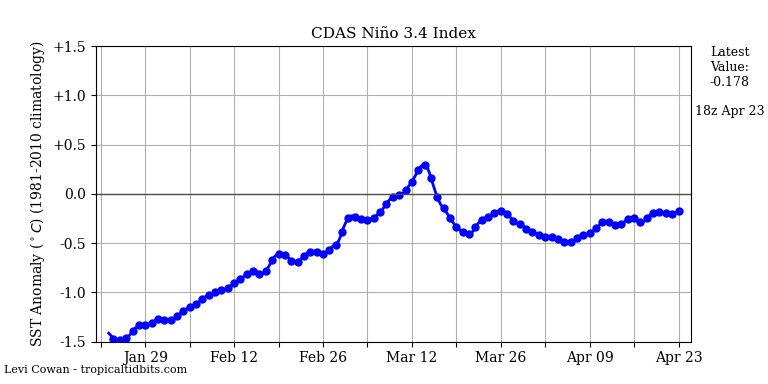
That looks like a cold summer for us here SH
Russian decline traces fall of USSR and sanctions, US switch to NG plus slow ec, China slow ec, EU economically may have reached one of their famous tipping points some time ago. With stubborn embrace of bankrupt climate policy, death spiral is next, with still no sign of any ‘actionable’ global warming negatives. Oh and a lot of that carbon is being sucked in by forests taking over the planet.
“The science is all in”… except for world CO2 still rising while Sea Level has paused for 2 years.
Another variable is those Gassy Baltic Clams which some claim are producing more gas thanks to (the variable of) Agriculture Fertiliser.
What crisis? The crisis is that we are continuing to pump millions of tons of CO2 into the atmosphere every year.
Another aspect of the crisis is that web sites like this one continue to pump millions of tons sophistry and pseudo-science into the public discussion every year.
Crisis AVERTED.
The effect of human release of accidentally sequester carbon, has been to BOOST the whole CARBON CYCLE.
Plant life has been lifted from purely subsistence level to a level where it can actually feed the world’s population (assuming decent distribution and that it isn’t co-oped for fuel.)
The REAL crisis comes if the moronic CO2-HATRED of so many anti-science cretins worshiping at the feet of the likes of Mickey Mann, manages to actually reduce the atmospheric percentage of CO2.
Are you one of those moronic cretins, Jesse?
Jesse
Truth is that most of us ‘sceptics’ have done their own investigations of looked at those of others to conclude that there is no man made warming.
Let me therefore not allow your comment to pass without a challenge. Please enlighten us with your own results or those of others as to why you think current global warming is real and that it is not natural.
[those are two distinct and separate questions]
Fair enough. First, do you mean that there is no warming at all, or that the warming that there is, is not man made? If the former, it would be idle for us try to talk about this — we live in different realities.
But you seem to agree that there is global warming, but that it is natural. I do not believe that it is natural, for the following reasons:
So, first, there is no natural “forcing” known to science that could be causing the warming. Volcanic eruptions, solar cycles, etc. etc. cannot account for a rising trend that is clearly discernable over recent decades.
But secondly, the growing concentration of CO2 in the atmosphere does account for it. We have known, since Fourier published his papers in the 1820s on the subject, that the composition of gases in the atmosphere has a great deal to do with the average surface temperature of the earth. Studies made by Tyndall and others shortly after Fourier’s identified the greenhouse gases: CO2, methane, nitrous oxide, ozone, and water vapor, principally. These scientific discoveries are now almost 200 years old. Generations of scientists have questioned and tested them, and they have stood the test. And we do know that the amount of CO2 in the atmosphere is rising, and that the additional CO2 in the atmosphere comes from the burning of fossil fuels.
A useful primer of the subject is “What We Know About Climate Change”, by Kerry Emmanuel of MIT. A far more challenging but essential book is “The Warming Papers”, ed. by Archer and Pierrehumbert, an anthology of the classic papers on global warming and climate change. You say that skeptics have done their own investigations; perhaps, but if they are unacquainted with the body of scientific studies in an anthology such as this, they have more investigation ahead of them.
Jesse,
Since the end of the Little Ice Age, there was a warming cycle in the mid-19th century, followed by a cooling cycle in the late 19th and early 20th centuries, followed by a warming cycle in the early 20th century, followed by a pronounced cooling cycle from the 1940s until 1977, when the PDO fillped, despite rising CO2 during those decades, followed in the late 20th century by a slight warming cycle, indistinguishable from the previous such interval, followed by the present flat period in the early 21st century.
So-called “climate science” does not know all the natural “forcings”, so cannot attribute the late 20th century warming to human activities. If we did have a measurable effect, it is from cleaning the air rather than adding CO2 to it. The GHE of a fourth molecule of CO2 per 10,000 dry air molecules is at best negligible.
Since during the increase in CO2 since the end of WWII, earth has cooled dramatically, warmed slightly and stayed flat, there is no temperature or climate fingerprint from more of this essential trace gas in the atmosphere.
OTOH, the increase has contributed to the greening of the planet, especially in areas like the Sahel, where the vegetation promoted is woody (hence C3 plants) and in places where there has not been irrigation. So far, more CO2 has been beneficial, and more will be more so.
It has been known for almost 200 years that CO2 and other so-called greenhouse gases keep the surface of the earth a lot warmer than it would be without such gases. Most calculations put the likely surface temperature of an earth without greenhouse gases at around zero degrees fahrenheit.
We are dumping millions of tons of CO2 into the atmosphere every year, year after year. The amount of CO2 in the atmosphere continues to rise accordingly.
We are seeing warming that is very much in line with what scientists expected from the given rise in atmospheric CO2. We are also seeing things that can be accounted for only by a rise in atmospheric CO2: warmer nights world-wide, and a warming of the troposphere with a corresponding warming of the lower stratosphere.
The alternative explanations for all this offered on the web site have been refuted by compentent scientists over and over. Repetition will never make them true.
I would urge everyone reading this thread to read a standard text book on the subject we are discussing, such as John E. Frederick’s “Principles of Atmospheric Science”. This book has no ax to grind; it barely mentions global warming. It does describe how greenhouse gases influence the earth’s average surface temperature, even though they exist in the atmosphere in small amounts.
Jesse
https://wattsupwiththat.com/2017/10/20/what-crisis-global-co2-emissions-stalled-for-the-third-year-in-a-row/#comment-2643448
\
I am sure you have read the book and know the answer to my question?
Water vapor is lighter than air, CO2 is heavier than air. Water vapor concentrates on the equator, rises and transfers latent heat from the equator to the poles. You can never compare the effects of water vapor and CO2, as CO2 does not changes physical state in the atmosphere.
http://tropic.ssec.wisc.edu/real-time/mtpw2/product.php?color_type=tpw_nrl_colors&prod=global×pan=24hrs&anim=html5
“cannot account for a rising trend that is clearly discernable over recent decades. ”
The ONLY warming has come from El Nino and ocean events (ignoring the blatant data manipulation of the surface fabrications)
That is the ONLY discernible warming , and it does NOT come from any human influence.
“the growing concentration of CO2 in the atmosphere does account for it. ”
brain-washed RUBBISH.
There is no empirical evidence that CO2 causes warming in our convectively controlled atmosphere.
Its a LIE, as blatant piece of anti-science garbage.
Jesse
My own investigations lead me to believe there was warming until some time ago [when looked at it on average over a number of SC’s {=solar cycle}
By me, all warming and cooling is natural, as my results suggest:
https://wattsupwiththat.com/2017/10/20/what-crisis-global-co2-emissions-stalled-for-the-third-year-in-a-row/comment-page-1/#comment-2642525
Arrhenius {not Fourier} and Tyndall looked at closed box experiments and their results looked correct – just like you feel the cold when stepping out of the cubicle where you just showered. Instinctively you feel inclined to believe that they must have been right.
However, GHG’s also cool the atmosphere, as I can easily prove to you from a certain paper, by deflecting sunlight, straight from the atmosphere back to space. In fact, even Trenberth has admitted that ozone on its own is responsible for deflecting at least 25% of all that is being deflected away from earth.
So, to form an opinion, one would have to see tests and results to show us exactly how much incoming energy is deflected by GHG’s 0-5 um versus how much is being trapped on earth 10-15 um.
Did you ever see such an investigation ever having taken place, done on any GHG?
Let me know.
Greenhouse gases do not deflect any solar energy into outer space, apart from those that contribute to the earth’s albedo effect, such as water vapor. Water vapor is problematic in its overall effect: it acts as a greenhouse gas, trapping heat, and to the extent that it is reflective, it cools the earth. It’s problematic because water vapor in different formations and concentrations behaves differently.
CO2, however, is not reflective at all. It is transparent to high frequency solar energy but it absorbs the lower frequency infrared energy that the earth gives off in turn; after absorbing infrared, it re-emits it in all directions, one of the directions being back down to the surface of the earth.
Jesse, you say
CO2, however, is not reflective at all.
This is an incorrect statement.
Look at Fig.6 bottom to find deflected light from CO2 in the 1-2 um.
http://astro.berkeley.edu/~kalas/disksite/library/turnbull06a.pdf
[we are looking at earthshine – i.e. light deflected from earth.]
There are also absorptions of CO2 4-5 um and to top it all we also have a few absorptions of CO2 below 300 nm – which is why we are able to identify and quantify CO2 on other planets….
Now, where is your report to show us the balance sheet, i.e. how much energy is deflected away from earth 0-5 um versus how much energy is trapped on earth 10-18 um?
Henry, I know of no such balance sheet, but your position on this question implies that you know of such a balance sheet yourself. If so, I would like to see it, for this is an interesting question. However, I stand corrected: in my earlier post I was ignoring the infrared component of the solar energy that reaches us from the sun.
Anyway, what happens when CO2 absorbs infrared radiation coming from the sun? It is warmed by it, and then re-emits it as infrared, in all directions. But only one of these directions is back into outer space. The rest is radiated into the atmosphere laterally or downward. So even though CO2 bounces some of the infrared coming from the sun back into space, it emits the rest into the atmosphere.
And infrared radiation is only one of the components of the solar energy that reaches the Earth, the other two being visible light and infrared radiation. Here, the case is different. These components pass through the atmosphere to the Earth without interference from CO2; CO2 deflects little or none of it. The earth re-emits some of the energy in these components in the same wavelength, again without interference from CO2. But it re-emits much of the energy in these components as infrared, which is absorbed by CO2.
It is the action of CO2 in absorbing this outgoing infrared radiation than makes CO2 a greenhouse gas. Here, the effect of CO2 on warming cannot be neutral; it permits some components of solar energy to reach the earth without interference, but traps a significant part of the energy in these components and holds it against the earth.
For almost 200 hundred years, there has been nearly universal agreement among physicists and atmospheric scientists that CO2 is indeed a greenhouse gas. I believe that they are right and I hope that I have not garbled their reasoning in this post.
“there has been nearly universal agreement among physicists and atmospheric scientists that CO2 is indeed a greenhouse gas.”
The interpretations have been proven to be nothing but “beginner’s” science.
Which is where you seem to be stuck.
There is NO proven mechanism by which CO2 can cause warming in our convectively controlled atmosphere.
And there is ZERO empirical evidence either.
AndyG55, The ability of CO2 to absorb infrared radiation can be verified by a high school science fair project. We are dumping millions of tons of CO2 into the atmosphere every year. As we have been doing this, the average surface temperature of the Earth has been rising, as the much maligned computer models said that they would. The climate change that was predicted to result from global warming has also been very much as expected: more of the tropical storms that occur have been reaching the highest level of intensity; droughts and wildfires are being more severe and extensive, and are reaching into higher altitudes; the polar ice cap is losing mass; glaciers world-wide are shrinking; nights are staying warming, increasing the lethal potential of heat waves.
To to explain all this, you will invoke “cycles of nature”, without explaining the “mechanisms” by which they work. You prefer the hocus-pocus of ideology to the hard-won insights of scientific research. You are in no position to scold anyone for being stuck at the level of “beginner’s science.”
Jesse says
Anyway, what happens when CO2 absorbs infrared radiation coming from the sun? It is warmed by it, and then re-emits it as infrared, in all directions. But only one of these directions is back into outer space. The rest is radiated into the atmosphere laterally or downward. So even though CO2 bounces some of the infrared coming from the sun back into space, it emits the rest into the atmosphere.
Henry says
You are not getting it [much] and now you want us to ‘learn’?
The quote I made from you shows the basic misunderstanding. You cannot absorb ‘much’ heat in the atmosphere, because there is not much mass. Absorption [by water] takes place in the UV and IR and here there is the mass of the oceans…
What happens when you put your brights on when in misty conditions ? the light is returned to you, mostly in the direction where the light came from: in your face….that is not only one direction. That is THE direction.
Just to give you one problem to ponder: Ozone is mentioned as a GHG because, indeed, we have a little dent in earth’s emission 9-10 um. However, we have strong absorption of ozone in the UV meaning that a lot of incoming radiation is deflected away from earth [like I said, mostly in the direction of the sun, where it came from]
The energy coming in at 300 nm is many times higher than the energy trapped on earth 9-10 um.
Trenberth menrtioned that ozone [he has no figures on peroxides and N-oxides also formed TOA] is responsible for about 25% of all that this returned to space [i.e. 25% of 25-30% which is earth’s albedo]
So what do you think: what is the net effect of more ozone in the atmosphere? Warming or cooling?
let me know.
henryp,
The incoming solar energy in the UV band is definitely warming the lower startosphere where ozone absorbs much of that UV energy. Even the 11-year solar cycle makes an about 1ºC difference in the equatorial stratosphere which pushes the jet streams (and rain patterns) polewards at high solar activity.
The main band of CO2 is at 15 microm where water vapor is not active. That is not only measured in laboratoria, but also by satellites as a dip in transmittance and at two stations on earth as back radiation.
Thus that difference in energy is absorbed and partly reflected by CO2, leading to a warming of the troposphere and the surface. Even if the theoretical result is modest (~1ºC for 2xCO2) and probably lowered by negative feedbacks, as in practice no real warming is measured, CO2 is a proven GHG.
Ferdinand
You are not answering the question?
henryp,
I do miss my reaction on ozone, but here again:
Ozone warms up the lower stratosphere when hit by UV. Even the small change in total solar energy (but about 10% in the UV-range) over the maximum period in a solar cycle gives a warming of ~1ºC in the tropic stratosphere. That increases the equatorial – polar stratospheric air flux and pushes the Jet Streams (including the accompanying rain patterns) polewards. At low solar activity, the reverse can be noticed.
Ferdinand
on the ozone,
look again at the graph
https://wattsupwiththat.com/2017/10/20/what-crisis-global-co2-emissions-stalled-for-the-third-year-in-a-row/#comment-2645525
note that the white area under the red line is what is sent to space by the ozone and some raleigh scattering.
That is a lot of energy…
OTOH there is a tiny bit of absorption of ozone in the 9-10 um that does make a small dent in earth’s emission. Do you see it?
Now what do you think is the net effect of more ozone in the atmosphere?
let me know.,
[the amount of ozone / peroxide and N-Oxide made TOA depends on the amount of the most energetic parts being released from the sun. That depends on the polar magnetic field strength of the sun….the lower, the more of the most energetic particles are being released from the sun…..]
https://www.nasa.gov/topics/earth/features/2012-poleReversal.html
In this is a comment that I can’t copy from my phone. It basically says that when our magnetic field wealens it allows more solar radiation in. Which from my understanding the Earth magnetic field has been weakening and our magnetic poles moving more rapidly. That even that with a Solar Minimum the Earths weakened magnetic field is allowing more solar radiation in. With our ozone as the next line of defense having been weakened allowed more solar radiation in and as it is regaining would trap more in below it from escaping and bouncing back.
johchi
true
the elephant in the room has been moving a bit, north east, in fact, and quite fast,
faster then was originally expected.
Must be a magnetic stirrer effect? i.e. following the sun?
There never was a man made ozone hole. At the time the theory was put forward I was fooled into believing it to be true and even did some research in getting rid of CFC’s.
{I was successful in finding another much cheaper solution for cleaning PC boards]
However, at the time I did realize that I should check the results.
My moment of truth came when I saw the the spectra of peroxide and ozone: almost identical, i.e. doing exactly the same thing.
Going by me: The ozone hole is not a hole. It is where there are more OH radicals forming peroxide doing exactly the same thing as ozone…
Henry, Any object in the universe that is at a temperature above absolute zero emits heat in the form of electromagnetic radiation. Objects emit this radiation in all directions. The warmer the object, the higher the frequency (and lower the wavelength) of the radiation that it emits.
When CO2 absorbs infrared radiation, it does just that — it absorbs it. It does not reflect it. So your illustration about headlights being reflected by mist in only one direction is not to the point here. We are not talking about reflection.
As CO2 absorbs infrared radiation, it grows warmer. When it grows warm enough, it emits electromagnetic radiation in the frequencies of infrared. It emits infrared in all directions — upwards, laterally, and down.
And, yes, the atmosphere does have enough mass to retain heat. Are the terms “hot air” and “cold air” meaningless to you? And as the atmosphere warms, it radiates heat — in all directions, again, one of the directions being down to the surface of the earth. In fact, the surface of the earth receives more heat from the atmoshpere than it does directly from the sun.
Henry, As to ozone, it is a greenhouse gas, so its effect is warming. But it is not one of the major greenhouse gases. The issue around ozone involves its role in blocking harmful ultraviolet radiation from reaching the earth. This radiation is harmful to many forms of life — plant and animal.
For example, a colleague of mine at work was sent to Australia to work with our office there for a couple of months. The first weekend he was there, he went to the beach. He put on the usual amount of the sunscreen that he always uses here in the USA. He got horribly burned right away. He was under a hole in the ozone layer. He skin healed, but now he has to watch for skin cancer.
This problem was universally recognized. In 1988, Reagan signed the Montreal Protocol, an international treaty limiting the production of hydrofluorocarbons, which destroy ozone. This treaty went into effect in 1989, and it has been effective — the holes in the ozone layer are slowly closing.
The NCEP GDAS and CPC temperature and height analyses are used to monitor processes in the Stratosphere and Troposphere. In the table below are zonal mean time series of Temperature.
http://www.cpc.ncep.noaa.gov/products/stratosphere/strat-trop/gif_files/time_pres_TEMP_MEAN_ALL_EQ_2017.png
Ozone releases energy under the effect of very short UV radiation.
Jesse\
You say
When CO2 absorbs infrared radiation, it does just that — it absorbs it. It does not reflect it. So your illustration about headlights being reflected by mist in only one direction is not to the point here. We are not talking about reflection.
end quote
You got that completely wrong and I can also detect that you are listening to the wrong kind of people instead of relying on your own intellect. For some reason – most probably financial – you want to toe the line?
There is no mass in the atmosphere. In the water and the oceans : there is the mass and indeed the UV and IR that gets through the window allowed [by G-D] is what triggers the climate [a lot]
As matter of fact, I investigated this problem [remember I am an analytical chemist, originally]
Go back to my previous comments I made to you and read this summary I made for people just like you a few years ago:
“I am watching with some amusement a lot of scholar discussions on the green house effect as I realized again that the people that I encounter on most scientific blogs don’t understand the chemistry principle of absorption and subsequent re-radiation. In fact very few people do understand it because if they did they would have raised the alarm bells ringing long time ago. But they all got stuck at Tyndall and Svante Arrhenius. …
They know that CO2 (carbon dioxide) “absorbs” in the 14-15 um region. Most people think that what it means is that the molecules absorbs photons here which then subsequently get transferred as heat to neighboring molecules. Then it absorbs again, and so on, and so on…and all the absorbed light is continuously transferred to heat…
Although this may happen up to a certain saturation point as soon as the light or radiation hits on the gas, that is in fact not what is causing the heat entrapment / cooling effect.
The best way to experience re-radiation is to stand in a moist dark forest just before dawn on a cloudless night. Note that water vapor also absorbs in the visible region of the spectrum. So as the first light of sun hits on the water vapor around you can see the light coming from every direction. Left, right, bottom up, top down. You can see this for yourself until of course the sun’s light becomes too bright in the darkness for you to observe the re-radiated light from the water vapor.
A second way to experience how re-radiation works is to measure the humidity in the air and the temperature on a certain exposed plate, again on a cloudless day, at a certain time of day for a certain amount of time. Note that as the humidity goes up, and all else is being kept equal, the temperature effected by the sun on the plate is lower. This is because, like carbon dioxide, water vapor has absorption in the infra red part of the spectrum.
We can conclude from these simple experiments that what happens is this: in the wavelengths areas where absorption takes place, the molecule starts acting like a little mirror, the strength of which depends on the amount of absorption taking place inside the molecule. Because the molecule is like a perfect sphere, 62,5% of a certain amount of light (radiation) is send back in the direction where it came from. This is the warming or cooling effect of a gas hit by radiation.
Unfortunately, in their time, Tyndall and Arrhenius could not see the whole picture of the spectrum of a gas which is why they got stuck on seeing only the warming properties of a gas.
If people would understand this principle, they would not singularly identify green house gases (GHG’s) by pointing at the areas in the 5-20 um region (where earth emits pre-dominantly) but they would also look in the area 0-5 um (where the sun emits pre-dominantly) for possible cooling effects.
For comprehensive proof that CO2 is (also) cooling the atmosphere by re-radiating sunshine, see footnote below.
In all of this we are still looking at pure gases. The discussion on clouds and the deflection of incoming radiation by clouds is still a completely different subject.
So what everyone should be doing is looking at the whole spectrum of the gas molecule 0-20 um. Unless you come to me with a balance sheet of how much cooling and how much warming is caused by a gas, we don’t actually know whether a substance is a GHG or not. So, all that we can say now is that we don’t know what the net effect is of an increase in CO2 in the atmosphere…..
Seeing that CO2 also causes cooling by taking part in the life cycle (plants and trees need warmth and CO2 to grow), and because there is clear evidence that there has been an increase in greenery on earth in the past 4 decades, I think the total net effect of more carbon dioxide in the atmosphere could even be zero or close to zero. But unless we cone up with a test method and measurements, we will never know for sure.
FOOTNOTE
For proof that CO2 is (also) cooling the atmosphere by re-radiating sunshine, see here:
http://astro.berkeley.edu/~kalas/disksite/library/turnbull06a.pdf
They measured the re-radiation from CO2 as it bounced back to earth from the moon. So the direction was sun-earth-moon -earth. Follow the green line in fig. 6, bottom. Note that it already starts at 1.2 um, then one peak at 1.4 um, then various peaks at 1.6 um and 3 big peaks at 2 um. It all comes back in fig. 6 top.
This paper here shows that there is absorption of CO2 at between 0.21 and 0.19 um (close to 202 nm):
http://www.nat.vu.nl/en/sec/atom/Publications/pdf/DUV-CO2.pdf
There are other papers that I can look for again that will show that there are also absorptions of CO2 at between 0.18 and 0.135 um and between 0.125 and 0.12 um.
We already know from the normal IR spectra that CO2 has big absorption between 4 and 5 um.
So, to sum it up, we know that CO2 has absorption in the 14-15 um range causing some warming (by re-radiating earthshine) but as shown and proved above it also has a number of absorptions in the 0-5 um range causing cooling (by re-radiating sunshine). This cooling happens at all levels where the sunshine hits on the carbon dioxide same as the earthshine. The way from the bottom to the top is the same as from top to the bottom. So, my question is: how much cooling and how much warming is caused by the CO2? How was the experiment done to determine this and where are the test results? (I am afraid that simple heat retention testing does not work here, we have to use real sunshine and real earthshine to determine the effect in W/m2/ m3 / [0.03%- 0.06%]CO2/24hours).
I am doubtful of the analysis of the spectral data. I have not seen any work that convinces me. Also, I think the actual heat caused by the sun’s IR at 1-2 and 4-5 um could be underestimated. Here in Africa you cannot stand in the sun for longer than 10 minutes, just because of the heat of the sun on your skin.
So you have some absorption of CO2 14-15 um trapping some heat compared to so much radiation going back to space? What do you think is the net effect of more CO2 in the atmosphere?>
Let me know what you actually FIND yourself?
I don’t understand what happened to my answer to Jesse?
[Comment found and rescued. -mod]
OK. It seems my original comment went up in the air and did not bounce back…..let me try again
@Jesse and @ferdinand meeus
[who both don’t understand]
Jesse says
When CO2 absorbs infrared radiation, it does just that — it absorbs it. It does not reflect it. So your illustration about headlights being reflected by mist in only one direction is not to the point here. We are not talking about reflection.
end quote
This shows me how you misunderstand and how you keep listening to other people instead of using your own brains and observations….Originally, I am an analytical chemist and I wrote this GHG 101 quite a few years ago:
I am watching with some amusement a lot of scholar discussions on the green house effect as I realized again that the people that I encounter on most scientific blogs don’t understand the chemistry principle of absorption and subsequent re-radiation. In fact very few people do understand it because if they did they would have raised the alarm bells ringing long time ago. But they all got stuck at Tyndall and Svante Arrhenius. …in a closed box!
They know that CO2 (carbon dioxide) “absorbs” in the 14-15 um region. Most people think that what it means is that the molecules absorbs photons here which then subsequently get transferred as heat to neighboring molecules. Then it absorbs again, and so on, and so on…and all the absorbed light is continuously transferred to heat…
Although this may happen up to a certain saturation point as soon as the light or radiation hits on the gas, that is in fact not what is causing the heat entrapment / cooling effect.
The best way to experience re-radiation is to stand in a moist dark forest just before dawn on a cloudless night. Note that water vapor also absorbs in the visible region of the spectrum. So as the first light of sun hits on the water vapor around you, you can see the light coming from every direction. Left, right, bottom up, top down. You can see this for yourself until of course the sun’s light becomes too bright in the darkness for you to observe the re-radiated light from the water vapor.
A second way to experience how re-radiation works is to measure the humidity in the air and the temperature on a certain exposed plate, again on a cloudless day, at a certain time of day for a certain amount of time. Note that as the humidity goes up, and all else is being kept equal, the temperature affected by the sun on the plate is lower. This is because, like carbon dioxide, water vapor has absorption in the infra red part of the spectrum.
We can conclude from these simple experiments that what happens is this: in the wavelengths areas where absorption takes place, the molecule starts acting like a little mirror, the strength of which depends on the amount of absorption taking place inside the molecule. Because the molecule is like a perfect sphere, we can calculate that ca. 62,5% of a certain amount of light (radiation) is send back in the direction where it came from. This is the warming or cooling effect of a gas hit by radiation.
Unfortunately, in their time, Tyndall and Arrhenius could not see the whole picture of the spectrum of a gas which is why they got stuck on seeing only the warming properties of a gas.
If people would understand this principle, they would not singularly identify green house gases (GHG’s) by pointing at the areas in the 5-20 um region (where earth emits pre-dominantly) but they would also look in the area 0-5 um (where the sun emits pre-dominantly) for possible cooling effects.
For comprehensive proof that CO2 is (also) cooling the atmosphere by re-radiating sunshine, see footnote below.
In all of this we are still looking at pure gases. The discussion on clouds and the deflection of incoming radiation by clouds is still a completely different subject.
So what everyone should be doing is looking at the whole spectrum of the gas molecule 0-20 um. Unless you come to me with a balance sheet of how much cooling and how much warming is caused by a gas, we don’t actually know whether a substance is a GHG or not. So, all that we can say now is that we don’t know what the net effect is of an increase in CO2 in the atmosphere…..
Seeing that CO2 also causes cooling by taking part in the life cycle (plants and trees need warmth and CO2 to grow), and because there is clear evidence that there has been an increase in greenery on earth in the past 4 decades, I think the total net effect of more carbon dioxide in the atmosphere could even be zero or close to zero. But unless we cone up with a test method and measurements, we will never know for sure.
FOOTNOTE
For proof that CO2 is (also) cooling the atmosphere by re-radiating sunshine, see here:
http://astro.berkeley.edu/~kalas/disksite/library/turnbull06a.pdf
They measured the re-radiation from CO2 as it bounced back to earth from the moon. So the direction was sun-earth-moon -earth. Follow the green line in fig. 6, bottom. Note that it already starts at 1.2 um, then one peak at 1.4 um, then various peaks at 1.6 um and 3 big peaks at 2 um. It all comes back in fig. 6 top.
This paper here shows that there is absorption of CO2 at between 0.21 and 0.19 um (close to 202 nm):
[not sure the reference is still valid]
There are other papers that I can look for again that will show that there are also absorptions of CO2 at between 0.18 and 0.135 um and between 0.125 and 0.12 um.
We already know from the normal IR spectra that CO2 has big absorption between 4 and 5 um.
So, to sum it up, we know that CO2 has absorption in the 14-15 um range causing some warming (by re-radiating earthshine) but as shown and proved above it also has a number of absorptions in the 0-5 um range causing cooling (by re-radiating sunshine). This cooling happens at all levels where the sunshine hits on the carbon dioxide same as the earthshine. The way from the bottom to the top is the same as from top to the bottom. So, my question is: how much cooling and how much warming is caused by the CO2? How was the experiment done to determine this and where are the test results?
I am doubtful of the analysis of the spectral data. I have not seen any work that convinces me. Namely, the level of incoming energy [below 1 um] is how many times higher than what goes up from earth [>10um]?
Even these simple evaluations of trapped energy versus deflected energy I do not find in any paper….
I would be interested in seeing an evaluation of trapped earth vs deflected energy. Nevertheless, the deflected energy represents only part of the radiations of the CO2 that is doing the deflecting. The rest of the radiation is emitted laterally and downwards. CO2 is ever a unidirectional emitter.
And CO2 does not absorb the visible light and ultraviolet radiation received from the sun. But these forms of solar energy warm the earth, which re-emits the warmth/solar energy as radiation in the infrared ranges. The CO2 absorbs this earthshine, and then re-emits it, again in all directions.
Eventually, the earth with re-emit as much solar energy as it receives — otherwise, we would burn up. But adding CO2 to the atmosphere means that more energy has to back up in and below the atmosphere before the Earth can emit enough energy to achieve its input/out energy balance.
eishhh
Jesse, you did not get it GHG 101 and I cannot help you further. I hope Ferdinand gets it.
henryp,
As B.S. chemical engineer, I was involved in the detection of chlorine in different parts of the processes as failure detection and around the factory as early detection of leaks. That was by radiation in the visible spectrum (chlorine is green…). Thus I know something about radiation, be it from a long time ago.
As far as I remember, there is a time lag between absorption and re-radiation. Thus when CO2 re-radiates it would be evenly in all directions, not more reflection like water drops in clouds.
Further during the time span between absorption and re-radiation, the CO2 molecule may collide with N2 or O2 molecules. That transfers the potential energy of the excitated CO2 molecule to kinetic energy of the other molecules and CO2 doesn’t re-radiate anymore, it heats the atmosphere up. The potential for collissions is higher at the air pressure in the troposphere, lower in the stratosphere. That is why CO2 warms the troposphere and cools the stratosphere…
My impression is that you misinterprete the earthshine spectrum in Fig.6 of your reference: the CO2 bands show absorption, not reflection, thus CO2 warms the atmosphere even with parts of the incoming sunlight…
the level of incoming energy [below 1 um] is how many times higher than what goes up from earth [>10um]
If the earth’s radiation is in balance, as much energy should go out as is coming in, or we are in big trouble (and not from that small influence of CO2…).
Ferdinand
there is no real great ‘mass’ in the atmosphere to absorb a lot of heat. Once the gas molecule is filled it can only act as mirror. You must understand that. With water {i.e. the oceans] it is different. Water absorbs the UV and IR [that gets through God’s window] and transfers it to heat [in the water] rather than re-radiating [most of ] it.
That is how I know that that whatever amount of high energy [i.e. UV and below} is let through, is what determines the [change in ] climate….
Look at the UV coming through the atmosphere and you know what the climate is going to be….
Maybe ren has a comment on that?
henryp:
Once the gas molecule is filled it can only act as mirror.
Huh? Never heard of such mechanism… Do you have some background info on that?
Further, the heat content of the atmosphere is relative small (compared to the oceans), but an increase of temperature at a certain height propagates over the full air column (at a fixed lapse rate) down to the surface (for the same convection rate)…
Ferdinand Engelbeen @ur momisugly October 24, 2017 at 11:09 am
“Further during the time span between absorption and re-radiation, the CO2 molecule may collide with N2 or O2 molecules. That transfers the potential energy of the excitated CO2 molecule to kinetic energy of the other molecules and CO2 doesn’t re-radiate anymore, it heats the atmosphere up.”
Yes, but the process also works in reverse. The kinetic energy of N2 or O2 molecules can be transferred to the vibrational states of the CO2 molecule, from which it can then radiate away. So, there is a cooling, as well as a heating, potential from each CO2 molecule, and both potentials increase with increasing concentration.
The net impact depends then on which process dominates, the heating, or the cooling?
Bart,
Agreed that collissions can go both ways, but as measured in laboratories (HITRAN) at different air pressures and mixtures of air + GHGs, CO2 normally heats the atmosphere in the troposphere and cools the atmosphere in the stratosphere…
Doesn’t take into account convective air currents. Laboratory experiments are just not sufficiently scalable to be extrapolated to the Earth’s entire atmosphere.
Bart:
Doesn’t take into account convective air currents. Laboratory experiments are just not sufficiently scalable to be extrapolated to the Earth’s entire atmosphere.
For the same convection at the same height, the temperature of the air in the troposphere will increase. WIth the same lapse rate, that leads to a warming surface. On the other hand, warmer air and/or surface will increase convection…
The only point which is measured is that both the outgoing IR in the CO2 bands and backradiation show that part of the outgoing IR energy is absorbed by the atmosphere and in part sent back to the surface. The difference in energy anyway must heat the atmosphere…
“The only point which is measured is that both the outgoing IR in the CO2 bands and backradiation show that part of the outgoing IR energy is absorbed by the atmosphere and in part sent back to the surface.”
Yes, but this is a gross measure, not an incremental one.
Think of a parabolic arch, e.g., such as you would get throwing a stone into the air. Everywhere on the parabola, the stone is above the ground, i.e., the function is everywhere positive.
However, there is a point of maximum height, after which the stone is less high than it was before. A line drawn from the origin to the position of the stone is a secant line. Its slope is everywhere positive. It tells you the average change in height of the stone over the distance measured. But, if you want to know how much the height is changing per increment of distance, you have to draw a tangent line. And, the slope of the tangent line is not always positive. In fact, it goes decidedly negative after maximum height is achieved.
Just so, the GHE is everywhere positive. There is always a dip in the OLR spectrum. A secant line drawn on the graph of impeded OLR versus CO2 concentration will always have positive slope. But, what we are looking for is the incremental change in impeded OLR for a given increment of change in GHG, and there is no guarantee that the slope of that line is always positive.
There has been no systematic study, as far as I can tell, of incremental sensitivity. Indeed, I do not think there are data actually suitable for such a study, controlling for other factors besides the rise in CO2. The data would have to have global coverage, consistently gathered over time, with data for all confounding factors also available. We just don’t have it.
I have seen a few studies which purport to show increasing sensitivity, but A) they are generally regional in scope, and B) in fact, they show changes that are consistent merely with a change in the outgoing radiation spectrum due to the change in temperature alone.
Bart says
Think of a parabolic arch, e.g., such as you would get throwing a stone into the air. Everywhere on the parabola, the stone is above the ground, i.e., the function is everywhere positive.
Henry says
Bart, Ferdinand
Sorry. I honestly don’t get it. Or you don’t..I don’t think this is a good representation of what is happening.
We are talking about incoming radiation being deflected away to space 25-30% and upgoing radiation trapped 70-85%,
https://wattsupwiththat.com/2017/10/20/what-crisis-global-co2-emissions-stalled-for-the-third-year-in-a-row/#comment-2645525
right?
Don’t make it too difficult. Think of the molecule acting like a mirror at certain wavelengths.
If you claim that the net effect of more CO2 is that of warming rather than cooling you must come up with the test results or the proof that the heat trapped at 14-15 um caused by the CO2 is more than the heat deflected away from earth by the CO2 0-5 um.
[there are absorptions of CO2 in the UV – which is how we can measure it on other planets – and 1-2 um and 4-5 um]
remember that the ‘spectral intensity’ shown in my graphic is out of scale, i.e. the energy coming from the sun should be shown 20x bigger than what goes up from earth, looking at K…
If you genuinely believe that more CO2 causes some [more] warming you must have that report to show it?
Mod – my response appears to be lost in the queue. Could you please look for it? Thx.
I don’t think it’s an issue of incoming light being deflected, Henry. The amount of sunlight coming in that that wavelength is very small.

What we are talking about is this. The total amount of radiated energy leaving the Earth has to balance the incoming to achieve equilibrium. That is, the total area under the curves depicted above has to match.
CO2 takes a divot out of the curve at the right.

So, to get the same area, the curve has to move upward compared to what it would be if that divot were not taken out. And, that means temperature of the surface will have to increase in order to move that curve higher.
Standard thinking is that, that divot will get deeper if you increase the CO2 concentration. The inescapable conclusion is that this will force surface temperatures to rise to a greater level to boost the curve higher, and reestablish equality of area under the curves.
However, what if that prima facie conclusion is wrong? What if the initial impact of concentration is to make the divot deeper, but beyond some concentration level, it doesn’t actually get deeper, and perhaps even shrinks? How could that come about?
What I am suggesting is that, initially, the CO2 does impede outgoing radiation, and does create a divot. But that, beyond a particular concentration, the CO2 molecules may start collecting as much heat from the ambient atmosphere, and radiating it away, as they intercept from the surface, and prevent from leaving.
In that case, the heating tendency and the cooling tendency are balanced, and you are at a maximal heating potential. Sensitivity to changes in concentration would be zero at that point. Net warming would only be infinitesimally reduced to either side of that critical concentration level. We would be, analogously, at the top of that parabolic arch, with no further increase in that direction achievable.
@moderator
Thanks!
Ferdinand
You don’t need background information of what you can see is happening?
If you put your brights on in misty humid conditions, the light is immediately returned to you, blinding you in the face? this never happened to you?
Like I said,
there is not enough mass in the atmosphere to be the cause of a change in climate….
Man made warming is a hoax perpetuated by men feeling guilty about their car- and aviation trips…
henryp,
What happens in the mist is that water drops, which are spheric, reflect light. As good as glass pearls do or anything spherical that is tranparant for light and has a sufficient light breaking index.
That mechanism doesn’t work for single molecules: either a photon of the right wavelength is absorbed or it passes by if not of the right wavelength. As far as I know there isn’t something like reflection by CO2, as that doesn’t cluster in spheres as there is no condensation of CO2 in the earth’s atmosphere…
Ferdinand/Jesse
https://www.bing.com/images/search?q=emission+spectrum+earth+sun+atmosphere&id=EB58DD1D3D266F84DB4865AA002B1DF2D9E22CE0&FORM=IQFRBA
http://www.barrettbellamyclimate.com/userimages/Sun2.jpg
Ferdinand
water vapor is a gas. No need to make a distinction because of some special properties of water.
Like I said, go to a forest and watch the sun coming up. It is an amazing thing to experience re-radiation.
carbon dioxide is a gas. Note that in the graph I show in the above comment, looking at the area where CO2 re-radiates and the sun emits, i.e. below 5 um: the total surface area is more or less the same area as what we have in the earth’s emission spectrum where CO2 absorbs between 14 and 15 um.
However, the energy below 5 um is many time higher than that of 15 um energy. Note that water vapor also absorbs a bit 14-15 um….
So, CO2 reflects, deflects, back -radiates, re-radiates (whatever word you prefer) a very similar amount of radiation as what it traps [on earth]. In fact, looking at it again now, I would say the net effect of more CO2 in the air is probably that of cooling rather than warming. Remember that the spectra of the sun and earth are not on scale [looking at K], but there is a factor of about 20 x difference (in K) between the sun and earth.
But like I said before, there is no mass in the atmosphere and what we are talking is about 0.01% of the mass of the atmosphere as a result of human activities. That cannot possibly be a cause of any warming.
It is utterly ridiculous to keep hanging on to a theory that cannot be correct?
[“Absorption” is also a word that brings some confusion to the argument. Originally we used the word extinction, if I remember correctly]
henryp,
The reflection of light when there is mist is not from water vapor, it is from water drops, that is een essential difference. Light scattering in the morning is from both water drops and ice even extremely high in the atmosphere and partly from re-radiation.
Further, no matter if it is from incoming sunlight and NIR or outgoing IR, both water vapor and CO2 absorb photons of the right wavelength. Depending of the ratio re-radiation (equally in all directions) and collissions, that warms the atmosphere or does sent half of it back towards space and half towards the earth’s surface.
As both the drop in outgoing radiation and increase in backradiation from CO2 were measured, the difference between outgoing radiation from the surface and what is re-radiated and lost to space is the energy that heats the atmosphere. That is not zero, or you are destroying energy.
Any change in temperature at the same height in the troposphere gives a shift in temperature at the surface, as long as the lapse rate and the convection remain the same. The sum of backradiation reaching the surface and the shift in temperature of the troposphere is what heats the surface.
So, while the effect is proven small, you can’t say that CO2 gives more cooling than warming…
http://www.sciencedirect.com/science/article/pii/S0896844605000343
https://refractiveindex.info/?shelf=main&book=CO2&page=Bideau-Mehu
http://www.dictionary.com/browse/refraction
http://www.biocab.org/Emissivity_CO2.html
https://www.merriam-webster.com/dictionary/emissivity
http://web.physics.ucsb.edu/~lgrace/chem123/troposphere.htm
I’ll just say I’ve been following your thread for days now. With the ideology of CO2 and water vapor acting like a mirror “Reflecting” when “Refracting” and “Deflecting” and ‘Emissivity” is happening in these gases in constant chaotic movement in the atmosphere there is no single direction heat is directed in a molecule in chaotic rotation and movement in every direction, like in a lab experiment that gives the controlled environment to obtain refraction, etc… Just because the experiment said the infrared was (refracted) directed down as it was passing through a CO2 molecule in this controlled condition of a vacuum still air and a set direction of the light to pass into it, doesn’t mean it reacts like it in a chaotic air. Therefore in the case of mist or fog those molecules hit with light are not “Mirrored” they are “refracting” (bending) the light passing through in a chaotic movement of the molecules that redirects the light back to your eyes, as other molecules are hit with the same light (photon) that passed through other molecules, and so on. Only a fraction of the heat is retained in a molecule for a given time, while more is passing through it in refraction, or deflected from it when it hits the molecule at an angle and doesn’t penetrate it – which is the only real mirror effect that happens and that light is directed away from the source of the light on a sphere.
johchi7,
I agree about refraction as main mechanism in reflection in liquids or semi-liquids like supercritical CO2, but I disagree on CO2 as gas or water as vapor: while there is of course refraction for all wavelengths that are not aborbed, any photon that is absorbed and exitated a CO2 or water vapor molecule can leave the same molecule as a new photon in any direction, with equal probability…
Of course there is the 50:50 ratio of where it goes to or away from the surface of the Earth. Just as the higher up the molecules are increases the probability going away from the surface. As the closer to the surface increases the probability of it toward the surface. Just as the closer to the surface increases the probability that it gets caught by a sink. The higher it goes in the atmosphere the less likely it touches any sink and remains in the atmosphere longer. Time to go to work… Oh. Although it’s a different mechanism of how light reacts on something. Because it really is a reflection and not a refraction. Colloidal suspension of partials in a solution hit with a beam of light is observed by looking through the beaker at an angle to that light direction. Because the particles are in motion. Much like gases in the atmosphere are in motion. The light direction is changed upon refraction and their movements.
henryp, I am interested in your contention that there is no mass in the atmosphere. The atmosphere does, incontestably, contain a lot of nitrogen and oxygen, and a miscellany of other elements. How is it that these elements, once they become part of the atmosphere, lose all their mass?
Jesse
Indeed the atmosphere consists of mostly N2 and O2 and these two gases are fully permeable i.e. they cannot absorb any photons, also not from the re-radiated wavelengths of H2O or CO2. It just passes through.
That leaves the so-called GHG’s, which I think make up for about 0.5% of the atmosphere. But what you are saying is that the 0.01% of CO2 that was added in the past 50 years is causing the warming of the whole earth? There is no mass?
Interestingly, my findings show that the so-called global warming has not at all been global. On average, there was no warming in the SH. It is all taking place in the NH>>>
How do I explain that [to myself?]
Come down 1 km down into a gold mine here and I show you the elephant in the room, which has been moving…. Now, down there, there is your mass. And don’t forget the oceans……
Your 0.01% more CO2 in the atmosphere is not doing anything but help plants and trees and crops grow better.
Ferdinand, Jochi
The absorption spectra of water vapor and water [whatever in between form] are almost identical.
Anyway, my example of the light on bright is an illustration of what happens when you cannot see re-radiation..
But we did measure the actual re-radiation from water in the earth shine, remember? Fig 6. Bottom.
Now where is your report showing us the balance sheet of how much energy is deflected by the specific GHG to outer space 0-5 um and how much is bounced back to 5-15 um?
henryp,
You should consult the spectra of liquid water again… The transparancy of water for different colors in the visible spectrum is quite diverse and absolutely different from that of water vapor in the atmosphere:
https://en.wikipedia.org/wiki/Electromagnetic_absorption_by_water
Not only for visible light, but also for UV and near IR.
And you misinterpreted Fig.6 in the earthshine report: it shows the absorption of near IR by CO2 in the 0-5 microm band, not the reflection, which BTW is small, as the absorption bands of CO2 are in the NIR where the sun’s energy is fading to near zero…
Ferdinand,
I am not sure if you are interested in genuine debate or if you want to keep confusing issues?
Let me know.
Up to 2 um the ‘absorption’ spectra of liquid water and water vapor look pretty much the same to me.
In fact in the earthshine report, that I mentioned, they just show H2O, i.e. no distinction between vapor and liquid….
Up to 2 um is also where most of the incoming energy comes from… it enters the ocean, is absorbed and re-radiated, but it disperses as heat – because here is mass – and that keeps us warm…
Now you say.
it shows the absorption of near IR by CO2 in the 0-5 microm band, not the reflection (sic)
I am assuming you don’t understand what is happening. I have done many measurements of substances and elements in gases and in liquids. Obviously one does that at the wavelengths where big ‘absorption’ takes place. In the case of CO2, in N2, you measure at 4.6 um. What actually happens during these measurements is that the light scatters – i.e it does not pass the cuvette – and the scattered light is picked up by the sensors.
What you guys and the ‘books’ are saying is that the light is not scattered, but it is ‘absorbed’ and is ‘transformed’ to heat [in the atmosphere]. This is, in fact, not at all what is happening. If it were, I think I should have seen many explosions as many times I forgot the spectrometers on after measuring and if what you guys are saying were true, the cuvette should have exploded?.
What happens is this: at the wavelengths where absorption takes place the light is sent back , by my calculation, 62.5% in the direction where it came from. The rest is scattered in all other directions. Hence we are able to pick up that same radiation via the moon coming back to us.
If you don’t get it, take the time to again read all my comments on this thread.
henryp,
OK, I now see what you mean…
If the layer of CO2 is thick enough, it is almost opaque in the wavelengths where CO2 is active. In that case the absorption and re-emission is so high that some more IR in these bands is emitted back than diverted towards other directions, as in the forward direction another CO2 molecule will do the same job. Just a matter of probability. That is backradiation, which is the same ‘mechanism as for the earths surface IR going outwards.
In the case of CO2 in the atmosphere, I suppose that the concentrations are a lot smaller and that the probability of collissions with other molecules – in the troposphere – is a lot higher, transferring energy to these molecules, thus increasing the temperature of the air.
Your use of the word “reflection” was rather confusing, as that is sure for light and water drops, not for vapor, where the main action is more backradiation…
With the whole spectrum of scientific advances in less than a century not being able to prove what is happening in our lower troposphere…you want proof of how much is escaped or returned? The problem is that alarmist – on any side – jump to conclusions when new information is found and in reality proves nothing in a chaotic environment with constantly changing variables. Scientific advances have just not reached a point that can answer most questions. Which is why “models” have failed to be accurate. To answer your question may take an unknown time for science to get that far with any accuracy.