From the POTSDAM INSTITUTE FOR CLIMATE IMPACT RESEARCH (PIK) and the “take what PIK says wth a heavy dose of salt” department. On the plus side, if true, this means that burning coal will prevent a global glaciation.
Formation of coal almost turned our planet into a snowball

CREDIT (Image courtesy of NASA)
While burning coal today causes Earth to overheat, about 300 million years ago the formation of that same coal brought our planet close to global glaciation. For the first time, scientists show the massive effect in a study to be published in the renowned Proceedings of the US Academy of Sciences. When trees in vast forests died during a time called the Carboniferous and the Permian, the carbon dioxide (CO2) they took up from the atmosphere while growing got buried; the plants’ debris over time formed most of the coal that today is used as fossil fuel. Consequently, the CO2 concentration in the atmosphere sank drastically and Earth cooled down to a degree it narrowly escaped what scientists call a ‘snowball state’.
“It is quite an irony that forming the coal that today is a major factor for dangerous global warming once almost lead to global glaciation,” says author Georg Feulner from the Potsdam Institute for Climate Impact Research. “However, this illustrates the enormous dimension of the coal issue. The amount of CO2 stored in Earth’s coal reserves was once big enough to push our climate out of balance. When released by burning the coal, the CO2 is again destabilizing the Earth system.”
The study examines the sensitivity of the climate in a specific period of Earth’s deep past by using a large ensemble of computer simulations. While some of the changes in temperature at that time can clearly be attributed to how our planet’s axis was tilted and the way it circled the sun, the study reveals the substantial influence of CO2 concentrations. Estimates based on ancient soils and fossil leaves show that they fluctuated widely and at some point sank to about 100 parts CO2 per million parts of all gases in the atmosphere, and possibly even lower. The model simulations now reveal that global glaciation occurs below 40 parts per million.
Burning that same coal dangerously raises greenhouse gas concentration in our atmosphere
Today, CO2 levels in the atmosphere have reached more than 400 parts per million. Carbon dioxide acts as a greenhouse gas: the Sun warms Earth’s surface, but most of the heat radiated by the surface escapes into space; CO2 and other greenhouse gases hinder part of this heat from escaping, hence warming the planet.
“We should definitely keep CO2 levels in the atmosphere below 450 parts per million to keep our climate stable, and ideally much lower than that. Raising the amount of greenhouse gases beyond that limit means pushing ourselves out of the safe operating space of Earth,” says Feulner. “Earth’s past teaches us that periods of rapid warming were often associated with mass extinction events. This shows that a stable climate is something to appreciate and protect.”
###
Article: Feulner, G. (2017): Formation of most of our coal brought Earth close to global glaciation. Proceedings of the National Academy of Sciences (PNAS)
http://www.pnas.org/content/early/2017/10/03/1712062114.abstract
Discover more from Watts Up With That?
Subscribe to get the latest posts sent to your email.
A major problem with this is that there is no real evidence that CO2 has any effect on climate. There is no such evidence in the paleoclimate record. There is evidence that warmer temperatures caused more CO2 to enter the atmosphere but there is no real evidenct that the additional CO2 added to warming. There is plenty of sceintific rational to support the idea that the climste sensivity of CO2 is really zero. If CO2 really affected climate then one would expect that the increase in CO2 over the past 30 years would have caused at least a measureable increase in the dry lapse rate in the troposphere but such has not happened. The AGW conjecture is based upon only partial science and is full of flaws. The AGW conjecture depends upon the existance of a radiant greenhouse effect caused by trace gases with LWIR absorption bands but no such radiant greenhouse effect has been observed anywhere in the solar system including the Earth. It is a convective greenhouse effect, as derived from first principals, that keeps the Earth’s surface 33 degrees C warmer than it might otherwise be. 33 degrees C is the derived amount and 33 degrees C is what has been observed. Additional warming caused by a radiant greenhouse effect has not been observed. The radaint greenhouse effect is sceince fiction which renders the AGW conjecture as science fiction as well. The article seems to ignore the effect of carbonate rock formation on the CO2 level in the Earth’s atmosphere.
I think you are at least half right. I doubt the 33 degrees. Comparison with the Moon would seem to suggest rather more for the ATE if you do the math.(see that infamous paper by Nikolov & Zeller). I am not sure they are right either but 33 degrees does look too low by my reckoning. More work could be done in this area. We need several people working on it with different views to thrash out the mathematics and ideas in more detail. Getting the ATE figure right is pretty fundamental to all this stuff.
It’s at least half from water vapor, but because it’s condensing at this temp/pressure it’s a regulating mechanism.
https://micro6500blog.wordpress.com/2016/12/01/observational-evidence-for-a-nonlinear-night-time-cooling-mechanism/
But you are right about Co2, it’s effect is near zero.
Well at least the Potsdam Institute is consistent with their low and high CO2 predicted effects on global temperature. But maybe they should have a more in depth look at the negative feedbacks, since their results seem to be “accentuating the positive” when it comes to feedbacks. A hint here Potsdamers, a degree increase at sea level wants to put 7% more water vapour into the air above the water. The 7% more water vapour wants to make up to 7% more clouds somewhere a couple of days later a few hundred miles away…but before the 7% more cloud can reflect a hundred watts per square metre of sunlight back into outer space, a lot of the water rains down from the sky and the clouds dissipate….net result, doubling of CO2 doesn’t increase ground level temperature very much, about a degree C.
The folks in Potsdam need to look at the Pleistocene glacial record–CO2 ALWAYS lags climate change. The reason for low CO2 was cooling of the oceans which allowed the oceans to take in more CO2, not the other way around. The other problem with this study is that no one has yet proven that CO2 has any significant effect on climate.
The latter is a biggy that today, still, no one has yet to even provide ANY evidence. An unobserved mechanism is not evidence, and that to date is all they have.
Also this study stinks of brainstorming for ideas for a study, and is childlike intuitive thinking.
There is no promotion of real science here, so the results are going to be like as they are because these people have 0 self awareness, they cannot see how ludicrous this study is, it’s not even a study.
They no doubt had an idea of the conclusion, and merely modeled to support that.
“The study examines the sensitivity of the climate in a specific period of Earth’s deep past by using a large ensemble of computer simulations.”
There you go, PlayStation again.
I’m almost ready to go Las Vegas on the next bloody so called peer reviewed and “as reported in the MSM” person/people/institute that play computer games and think they are actual Earth Scientists
I really doubt that any of them even have any Horticultural Qualifications, just Hort 101 would remove the CO2 =EVIL mindset.
Feulner in PIK seems to believe mankind has the power to adjust average global outside air composition and “stabilise climate”? Funny. What’s next?
This sentence is nothing less than bizarre:
“The amount of CO2 stored in Earth’s coal reserves was once big enough to push our climate out of balance. When released by burning the coal, the CO2 is again destabilizing the Earth system.”
Destabilizing what exactly? What a crock! And waht was the CO2 concentration when this period of vast global growth took place?
2000 ppm? Is that correct?
And now 450 ppm is going to kills us all?
What they really found is that there is no threat whatsoever from 2000 ppm and they are trying to bury the good news under a cloud of pretended danger, saying that being close to a frozen snowball under a mile of ice is preferable to living on a rich, green and productive planet.
What they really found is….CO2 is sequestered and unless it’s replaced..it becomes so limiting we all die
“Earth’s past teaches us that periods of rapid warming were often associated with mass extinction events” When did this happen?
The “low” CO2 levels, which they claim had Earth teetering on the verge of snowball-ville were about 400-450 ppm.
Note the CO2 minimum of the Mississippian (Lower Carboniferous), all of the Pennsylvanian (Upper Carboniferous) and minimum of the Permian.
These clowns are actually saying that 400-450 ppm is low enough to be on the verge of “snowball Earth;” but it’s imperative to keep CO2 below 450 ppm to avoid “overheating.”
Earthly greenhouse ‘no return’ tipping point happened already in the Cambrian and Ordovician biodiversification periods? And now it’s come back to haunt us? Again? Ooh no, this time we’re doomed for real. /sarc
“These clowns are actually saying that 400-450 ppm is low enough to be on the verge of “snowball Earth;” but it’s imperative to keep CO2 below 450 ppm to avoid “overheating.””
You are not comparing apples with apples David.
300m ya the Sun was ~2% fainter..
Dont you think that played a part?
You seem to be on the right track this time Toneb. The sun warms the earth – enough to resolve devastating glaciations. A far more interesting question is what causes glaciations?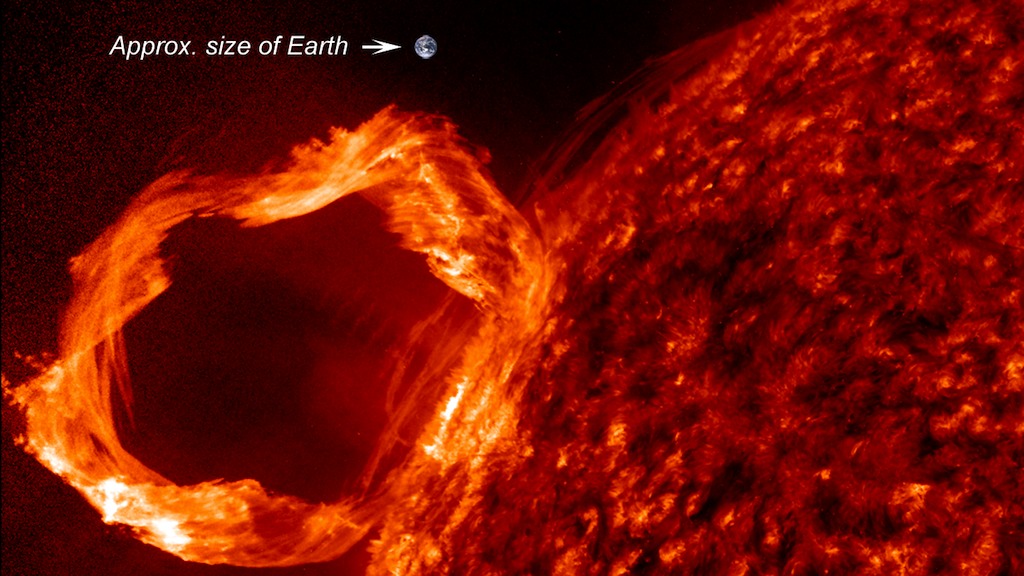
Either way and based on NASA’s illustration below, the mankind influences it less than a tick hair swings an elephant’s tail:
Not at all.
http://onlinelibrary.wiley.com/doi/10.1111/ter.12097/full
“After removing the warming influence of solar evolution,” the Pennsylvanian with its 450 ppm CO2 was at least as warm as present day Earth.
“Earth’s past teaches us that periods of rapid warming were often associated with mass extinction events”
Very doubtful. The reason for most mass extinctions is quite uncertain, except for the K/Pg one which was due to an asteroid impact.
And the only case of ancient “rapid warming” that is well documented, the PETM, was not associated with a mass extinction, quite the opposite (rapid diversification) as a matter of fact.
And during the present glacial age with very frequent extreme climate shifts extinctions almost always occur during cooling intervals, not warming.
Actually the pCO2 during the Permo-Carboniferous glaciations is quite uncertain. It is known to have been rather low (meaning <1000 ppm) , at least during some intervals, but the best pCO2 proxy for such old deposits (pedogenic carbonates) is known to be very insensitive for low pCO2 levels, and for example can’t really distinguish 0 from 500 ppm, while plant-based proxies are very uncertain that far back since the plants were very different from even the most conservative living forms (with known reactions to pCO2).
http://digitalcommons.unl.edu/cgi/viewcontent.cgi?article=1103&context=geosciencefacpub
It is however worth noting that C4 photosynthesis, which has evolved independently about 60 times in different plant groups as an adaptation to low CO2 levels during the present glacial epoch never evolved during the Permo-Carboniferous, though in this case too, the archaic plants living then may not have had the ability to evolve it.
All this is based on the idee that CO2 drives the climate. It doesn’t, not at at levels higher than 150 ppm. CO2 depletion will therefore not have caused snowball Earth, just as current increases will not lead to hothouse Earth.
Just a short point to add to the many excellent criticisms of this uninformative Potsdam porridge of speculative dementia. Notice their use of climate perjorative terminology about the Carboniferous accumulation of coal pushing the Earth’s climate “out of balance ” in particular. Last time I looked the Carboniferous period lasted about 50 million years, so while climate varied through its various epochs and stages there wasn’t exactly a sudden crisis. Not that that stops them then racing to claim that the last 50 years is suddenly putting the Earth’s climate out of balance again – on the basis of nothing that can be described as convincing evidence. And of course ignoring all the other climate changes between the Carboniferous and today like they didn’t happen, some of which really were sudden by cmparison.
These people need to be made to listen to a lesson on Earth history by someone who knows what they are talking about – where are you David Middleton?
Letting down the reputation of German science at Potsdam seems to be their aim, surely they cannot be serious.
While some of the changes in temperature at that time can clearly be attributed to how our planet’s axis was tilted
SOME?
What about all the Carbon stored in CaCO3? Most if not all the C must have come from the atmosphere either directly or indirectly. About 1% of the crust in total?
Present-day production of CaCO3 in tne world ocean is calculated to be about 5 billion tons
So all the coal dropped temps by a degree and when we put it back the temps will go up much more? Seems dubious to me.
The author asserts CO2 should be kept below 450 ppm. What is this conclusion based on, this article and his research? Seems like a very narrow focus without much consideration for other variables that affect overall climate on earth. In fact that is what has been missing in all these articles is a complete look at how all this systems work together to affect global climate. IMHO, the sun is the biggest driver. Already the sun is entering a period of low sun spot activity. I suspect things will be cooler and perhaps colder as we approach 2025-2030. If we are at 400 ppm already, it won’t be long before we hit 450 ppm. Get ready for an “unstable planet earth?” I won’t be surprised if we are cooler.
This is why there was an on-and-off ice age 300 million years ago. Gondwana drifted across the South Pole. This wasn’t a continuous ice age since the landmasses was pushed below sea level by the glacial load at various times and the glaciers melted back.


http://www.pik-potsdam.de/~stock/lectures/earths_climate_ruddiman/ch05-plate%20tectonics%20and%20climate/figure%2005-10.jpg
This is what it looked like at 300 million years ago (poor Antarctica, it always seems to get stuck at the south pole and glaciated, 4 different epochs now).
In fact, this continental drift of Gondwana was also responsible for the Ordovician ice age as well starting at 456 million years ago and culminating in the Ordovician extinction 443 million years ago. The actual Snowball Earth episodes are shown here as well.
This is a close-up of the Carboniferous ice age. It wasn’t continuously cold. There are even warm periods. The coal was formed in North America and Europe and Asia which were more-or-less at the equator at the time. Large forests grew, the high Oxygen content of the atmosphere repeatedly burned them to the ground. Forest fires could burn right across a continent at the time. Sea level rose and fell as the glaciers came and went on Gondwana, occasionally burying the burnt remnants of the forests under ocean sediment. Over millions of years, nice coal in North America and Europe and Asia. NONE in Gondwana.
While there is only a little Carboniferous coal in Australia it has huge early Permian coal deposits. Those came from cold-temperate swamp forests, an analogue to todays extensive bogs in the boreal taiga zone.
Bill – re four glaciations in Gondwana. Are you sure you want to go ahead and invest in housing real estate in Antarctica?
Interesting Bill, can you provide a source for the research?
Bill, thanks for the clear and concise presentation of the geologic data and interpretations.
As a creature of the IPCC, Potsdam Institute’s bias and agenda are revealed.
Overheat? Dangerous? We aren’t even globally comfortable yet.
No. Far more carbon is sunk in methane clathrate than coal and petroleum combined. Methane Clathrate is more stable in a snowball world hypothesis so that guess is wrong. ..as is the claim carbon dioxide regulates climate.
This isn’t a Goldilocks situation, it is a system of negative Feedbacks.
“The amount of CO2 stored in Earth’s coal reserves was once big enough to push our climate out of balance.”
The whole notion of ‘balance’ is environmental wacko nonsense. What does that even mean? Scientifically, it means nothing. In this context, it is a propaganda word. It implies that there is a ‘proper’ way for the atmosphere to be; a right way and a wrong way. The article may sound scientific to the layman, put it is clearly a propaganda piece, with no scientific value. It is based on the false premise that the atmosphere should be a certain way. If we accept this subtle assumption, and begin arguing the individual points in the article, we are already caught in their deceptive web and pacifly accepting that maybe we should do something to ‘fix’ our climate.
If I may paraphrase Gandalf: The climate is not and has never been ‘out of balance’. It is always precisely what it means to be.
If the CO2 stored in coal is enough to push the climate out of balance, does that mean that before the CO2 was stored in the coal, the climate was out of balance?
That kind of logic is not permitted in Potsdam
“The whole notion of ‘balance’ is environmental wacko nonsense. What does that even mean? Scientifically, it means nothing.”
http://www.indiana.edu/~geol105b/1425chap8.htm
“Owing to its large reservoir of reactive carbon (see table above) and the long timescale of its turnover, the ocean effectively controls atmospheric CO2 levels on the time scale of millennia. It is the DYNAMIC BALANCE between the CO2 content of the atmosphere (via dissolution into ocean waters) and the biologically driven net transport of organic (dead plant and animal matter) and inorganic carbon (calcium carbonate) to the deep ocean (biological pump) which largely determines the atmospheric CO2 levels.”
(MY CAPS)
These climate geniuses seem to think that correlation = causation. Come to think of it, they do have a point, as the following graph clearly shows:
http://www.paulmacrae.com/wp-content/uploads/2008/06/co2-levels-over-time1.jpg
I don’t understand papers like this where the a-priori assumption is CO2 levels is the controlling thermostat of the planet. Since that’s not true, anything built on top of that non-existent foundation is false.
Water vapor in the form of clouds and sunlight reflected as ice are the main determinants of our planets temperature as those factors control how much of the sun’s radiation is available to heat the earth. Anything that shifts that water albedo set of effects will change temps.
Our geologically recent glaciations started when Antarctica drifted to the south pole dramatically changing the albedo.
I just sigh at the state of climate ‘science’ when religious like assumptions regarding CO2 are the basis of a whole flawed paper.
Sigh………
Let’s see, we have continental plate migration, different flora/fauna, ocean current blocking, chg gasses changing (incuding h2o vapor), axial tilt changes, orbital changes, precession changes, tsi changes over that period of time, volcanic intrusions, and the very composition of the chemical geologic surface of the earth changing. Seems simple enough to me to figure out what happened when and why. Sorry folks, but this is a very chaotic system and most of climate science is a result of heads stuffed into various fundaments along the way.
Meanwhile in the rest of the solar system, carbon is the 4th most common chemical element. Earth is presumed to have only one tenth of it.
Source: http://hyperphysics.phy-astr.gsu.edu/hbase/Tables/elabund.html
It’s hard to imagine that a period of low CO2 concentrations would lead to GLOBAL glaciation.
As Higley7 pointed out above, water vapor absorbs infrared radiation across a much wider range of frequencies/wavelengths than CO2, and is present in much higher concentrations in the atmosphere. About 70% of the Earth’s surface is covered by water, so that even in a low-CO2 period, there would be enough water vapor in the atmosphere over the oceans to prevent freezing of the tropical oceans. Even if there was massive glaciation of continents into temperate areas, along coastlines the large temperature difference between oceans and continents would cause storms to form, bringing rain to coastal areas and allowing them to remain ice-free, and support land-based life.
About 70% of the Earth’s surface is covered by water, so that even in a low-CO2 period, there would be enough water vapor in the atmosphere over the oceans to prevent freezing of the tropical oceans.” ?w=720
Yes indeed … trouble is – water precipitates out of the atmosphere in around 10 days after evaporation.
CO2 doesn’t. With out it the earth would soon lose atmospheric WV and plunge into an iceball……
Toneb writes
The trouble with this line of reasoning is that evaporation is always happening to replace that precipitation and at no time is there no global atmospheric water vapor. Whether there is local water vapor following rain or not, the amount of energy deposited into the oceans from the sun is the same and so ultimately resulting evaporation will continue.
The only way the non condensing gas CO2 can control anything over water vapor is by definition brought on by belief and flawed models. Its not one of those settled scientific facts.
“The trouble with this line of reasoning is that evaporation is always happening to replace that precipitation and at no time is there no global atmospheric water vapor.”
That is becasue a floor is set by non-condensing atmospheric GHGs.
Remove that ‘floor’ and the atmosphere would keep condensing out WV at a greater rate than evaporation. CO2 is most ‘effective’ in dry air and without it, the NH land-masses will dominate through it’s winter(s) and deposit more and more snow/ice – leading to a cooling albedo feedback, as shown by the posted graph repruducing empirical physics.
Toneb October 10, 2017 at 12:22 pm, fig. 2
WR: your fig. 2 shows a model in which the noncondensing GHG’s are removed. What would be the result, when you run the same model but with only the condensing GHG’s removed? Which temperatures will result?
Water vapour is the dominating greenhouse gas (GHG).
Toneb writes
That is the prevailing belief but is not a fact in our atmosphere.
“That is the prevailing belief but is not a fact in our atmosphere.”
Sorry Tim, just saying so doesn’t cut it.
“What would be the result, when you run the same model but with only the condensing GHG’s removed? Which temperatures will result?”
WR: I don’t know if that has been done, but I imagine that we would cool most of the way towards the Earth’s effective temp of -18C.
But of course you would have removed all water – oceans, ice, snow, clouds – so albedo would be reduced, allowing more incoming shortwave to compensate.
The thing about non-condensing GHGs is that the cooling sets up an albedo and evaporation feedback. Greater albedo > cooling > reduced evap > cooling.
Toneb October 12, 2017 at 8:26 am: “The thing about non-condensing GHGs is that the cooling sets up an albedo and evaporation feedback. Greater albedo > cooling > reduced evap > cooling.”
WR: and also:
“The thing about CONDENSING GHGs is that the cooling sets up an albedo and evaporation feedback. Greater albedo > cooling > reduced evap > cooling.”
Toneb writes
Ironically…right back at ya. “Backing up” your claim with model results is not evidence.