John Ridgway,
“There is something fascinating about science. One gets such wholesale returns of conjecture out of such a trifling investment of fact.”
Mark Twain, Life on the Mississippi
It is tempting to speculate what a resurrected Mark Twain would think of the current controversy surrounding the global warming debate. Some of the warnings being issued by the scientific community are certainly alarming, and I suspect that he would very much like to know the truth behind them. Moreover, the public have been informed that the science is settled and the time has come to take action. Nevertheless, even a superficial understanding of the challenges facing climatology is sufficient to appreciate that there are significant uncertainties still to be addressed. So, if he were alive today, I think Mr Twain might be wondering where the certitude is coming from.
The standard answer to this question is that the uncertainties have been evaluated and are deemed to be peripheral to the central point; we know it’s going to be bad and we are just uncertain as to how bad. However, the uncertainties to which I am alluding are too fundamental for this explanation to work. Instead, I suspect the problem is that climatologists are making predictions that cannot be readily falsified through appropriate experimentation. Knowledge gained from experiment is an important means by which epistemic uncertainty (that is to say, ignorance) may be reduced, and it is through such a reduced uncertainty that one would wish to achieve a convergence of opinion. But within climatology, consensus emerges principally through inference and disputation, in which logic and objectivity are in competition with rhetoric, ideology, policy and expedience. Significantly, it is through the sociology of science that one can establish certitude without having to reduce uncertainty.
Getting Back to Basics
No one would question that climatology is a science. Climatologists, therefore, benefit from the credence that any reasonable person would place in the proclamations made by scientists. This is why it seems so easy to label as ‘anti-scientific’ anyone who challenges the ‘overwhelming’ consensus amongst climatologists. After all, to quote Barak Obama, “The science is beyond dispute and the facts are clear”. The same assumption of unquestionable integrity lies behind the suggestion made by eco-psychologists of the University of South West England that anyone who questions the truth of Catastrophic Anthropogenic Global Warming (CAGW) should be treated as suffering from a mental disorder.1 Furthermore, the time wasted debating with such sceptics (or ‘Flat Earthers’, as Al Gore prefers to call them) could lead to critical delays in the introduction of necessary measures. Such scepticism, therefore, is every bit as irrational and immoral as the denial of the Holocaust, so there should really be a law against it, shouldn’t there? But before we get carried away (literally), we should remind ourselves why it is that we trust scientists, and ask if our understanding of where this trust comes from justifies being wary of the presupposed consensus amongst climatologists.
It is generally accepted that the principal strength behind the scientific method is the objectivity that results from restricting oneself to statements that are falsifiable, particularly through practical experimentation. At the very least, one should be making statements that include predictions that can be verified by reference to nature. This is how consensus should be achieved. Science is not a democracy – facts decide the issues, not a scientific electorate. But even in the purest of sciences one can occasionally find oneself in areas of speculation that are not obviously susceptible to the scrutiny of experimentation. When this happens it is almost inevitable that dispute prospers. After all, scientists are only human. If one adds into the mix a question of vital importance to the survival of the human race, then you can guarantee that politicians and the media will get involved, after which, the prospects of a calm, objective debate are virtually non-existent. More importantly, the lack of falsifiability sets the scene for the achievement of consensus by other means, resulting in a certitude that cannot be taken at face value. In the case of climatology, the first clue that the consensus may not be all it seems lies in its extraordinary significance. The consensus within climatology, we are told, reflects the achievement of a level of certainty that is unique within science. Apparently, climatology is the only scientific discipline in history for which the science has been settled!
Admittedly, the theory that CO2 is a greenhouse gas is easy to confirm in the laboratory, and the fact that, throughout industrialisation, there has been a significant rise in the amount of CO2 in the Earth’s atmosphere is readily confirmed by measurement. To this extent, the proposal that mankind is currently contributing to climate change is easy to accept. Nevertheless, this is not the issue. The question is whether current trends can be used to predict that there is a realistic prospect of irreversible and catastrophic environmental damage in the not-too-distant future.
Keeping in mind that a scientific proposition has to be falsifiable, is there a legitimate experiment we can perform to falsify the specific prophesies being made in the name of climatology? Well, I’m afraid the answer is no. The experiment would necessarily require taking a representative planet (planet Earth, for example), subjecting it to the sort of ongoing increases in CO2 that are concerning us, and then seeing what happens. Such an ‘experiment’ is underway, but it hasn’t been set up by the climatologists. As the 1988 ‘World Conference on the Changing Atmosphere’ put it, “Humanity is conducting an unintended, uncontrolled, globally pervasive experiment whose ultimate consequences could be second only to a global nuclear war”.
This is clearly not what we want to do, but in the absence of a responsible, intended and controlled experiment one has to be satisfied with theorising, based upon the current understanding of how the Earth’s climate system works. This entails field study, to garner information regarding current and historical climate change, combined with mathematical modelling to explore the range of future possibilities. Unfortunately, no matter how sensible this may be, it leaves a great deal of room for speculation.
Firstly, there is room to be cautious when attempting to discern the Earth’s history of temperature changes, particularly when this requires interpretation and manipulation of proxy indicators. This is an area mired in controversy; a point to which I will return later as we encounter the infamous Hockey Stick graph.
Secondly, there is plenty of room to be cautious regarding the nature of the mathematical models used to predict the evolution of the Earth’s climate system – a system that is known to be open, driven, non-linear, hugely complex and chaotic. The extent to which any credence can be placed in such models depends upon how well they capture the relevant factors at play and how realistically and accurately such factors have been parameterised. Furthermore, even for a comprehensive and accurate model, predictive skill rests upon the extent to which noise and the climate system’s dissipative forces can stabilize the climate on the large scale.2 Unfortunately, in view of the significant structural and parametric uncertainty within the models, it may be delusional to premise confidence levels upon the assumption of well-defined aleatoric uncertainty.3
None of the above, however, seems to have fazed the Intergovernmental Panel on Climate Change (IPCC). For those who required reassurance that the extant set of climate models were valid, the following assertion was displayed prominently within the IPCC’s Fourth Assessment Report:
“This confidence comes from the foundation of the models in accepted physical principles and from their ability to reproduce observed features of current climate and past climate changes.”
Well it is reassuring to know that the models are founded in accepted physical principles, though this is a bit like saying that a witness is reliable because it is a real person rather than a Harry Potter character – it is hardly something worth boasting about. As for the reproduction of current and past climate changes, I have two concerns:
Firstly, the fact that a model can reproduce the past is only impressive if it is the only conceivable model that can do so, and since a diversity of models can be made to fit the record through judicious ‘tuning’, this is clearly not the case.4 Consequently, matching the climate record is not the true metric for confidence in a model. Instead, confidence comes from the plausibility and legitimacy of the parameter values to which the modellers resorted in order to achieve the match. Even the IPCC itself concedes, “If the model has been tuned to give a good representation of a particular observed quantity, then agreement with that observation cannot be used to build confidence in that model.” So, is such a strategy common practice? Who knows? The modellers don’t publish their tuning strategies.
Secondly, surely it is a logical non sequitur to suggest that a model that performs well for the purposes of hindsight will necessarily be reliable for the purposes of making predictions. For example, a model that incorrectly accounts for the effects of water vapour and cloud feedback might not reveal such a weakness until the effects gain significance.
I’ll leave the last words on this subject to a statement buried deep within the detail of the IPCC’s Fourth Assessment Report: “What does the accuracy of a climate model’s simulation of past or contemporary climate say about the accuracy of its projections of climate change? This question is just beginning to be addressed…”. So it turns out that the IPCC was already confident about its models even though the critical question was only ‘just beginning to be addressed’. Am I missing something here?
But above all my concerns, the key point I would wish to make is that using a mathematical model to make a prediction is a poor substitute for the running of an experiment. Climatologists may refer to each run of a climate model as a ‘mathematical experiment’ but in so doing they appear to be fooling themselves. In any other scientific discipline such activity would go by the name, ‘hypothesising’. It’s not an activity that establishes facts of nature (as would a true experiment), it simply enables climatologists to better understand the character of their speculations.
Let There be no Room for Doubt
So far, all I have offered to explain the coexistence of uncertainty and certitude within climatology is a somewhat churlish and semi-informed suspicion that the scientists concerned are guilty of professional misjudgement; that they are placing too much trust in the scientific arsenal available to them. However, one should not lose sight of the fact that climatology has been heavily politicised and that ideologies, as well as scientific understanding, are at stake. It is under such circumstances that the debate may be corrupted. So, if evidence were to emerge that uncertainties have been deliberately downplayed, one might argue that such corruption has taken place. I entrust this argument to the following two examples:
The first example is the accusation that the IPCC has been guilty of a simplistic presentation of the science, and that the certainty declared in its executive summaries does not reflect the uncertainty expressed by the scientists consulted. This concern was raised as early as the first of the IPCC’s assessment reports, published in 1990. Whilst a working group set up to advise the panel pointed towards uncertainties, these were not reflected in the executive summary. For example, the following statement appeared in the body of the working group report: “A global warming of larger size has almost certainly occurred at least once since the end of the last glaciation without any appreciable increase in greenhouse gasses. Because we do not understand the reasons for these past warming events, it is not yet possible to attribute a specific proportion of the recent, smaller warming to an increase of greenhouse gasses.”
Notwithstanding such reservations, the report’s executive summary was unequivocal in its conclusions and advised that the evidence for the potential damage from AGW was so strong that it, “requires immediate reductions in emissions from human activities of over 60% to stabilise their concentrations at current levels.” Furthermore, the executive summary said nothing regarding the crudity of the early mathematical models that were being used as the basis for the climate change predictions.
Without wishing to theorise as to why such downplaying of uncertainty should have happened, the fact that it was even possible speaks little of the confidence one can place in the consensus that the IPCC was seeking to portray. The IPCC has released a number of reports since, but the allegations of false certainty refuse to go away. For example, several passages within the IPCC’s Second Assessment Report, passages that had warned of uncertainty, were removed apparently after the peer review was supposed to have been concluded. Upon observing this, Professor Frederick Seitz stated, “But this report is not what it appears to be – it is not the version that was approved by the contributing scientists listed on the title page. In my more than 60 years as a member of the American scientific community, including service as president of both the National Academy of Sciences and the American Physical Society, I have never witnessed a more disturbing corruption of the peer-review process than the events that led up to this IPCC report.”5
For my second example of the promotion of false certainty, I take the notorious Hockey Stick graph produced by a team led by Dr Michael Mann, and used by the IPCC in its Third Assessment Report for the advancement of its cause. It famously showed a steady, uneventful decline in temperature over the last millennium, ending with a dramatic upturn coinciding with the onset of industrialisation (a shape of curve presupposed to resemble an ice hockey stick). As such, it was a hugely significant graph since it exorcised the pre-industrial warmings alluded to in the First Assessment Report; in particular, there was no sign of the so-called Medieval Warm Period. With the Hockey Stick to hand, the IPCC no longer needed to bury the uncertainty in the body of its reports, since the graph proved that the uncertainty simply didn’t exist. It showed that current temperatures are unprecedented and there is no evidence of any pre-industrial warming event in the Earth’s recent history, at least not on a global scale. The Hockey Stick was the smoking gun that proved the AGW thesis, and with it the science was settled. Or was it?
Somewhat surprisingly, no one within climatology saw fit to attempt a reconstruction of the analysis undertaken by Dr Mann and his associates; this does not appear to be the ‘done thing’. Instead, it fell to a semi-retired mining consultant, Steve McIntyre, to attempt such an audit – and the results were damning. I do not intend in this article to go into detail; see instead A. W. Montford’s book, ‘The Hockey Stick Illusion‘, or indeed Dr Mann’s ardent defence, presented in his book, ‘The Hockey Stick and the Climate Wars’. To justify my concerns, I do not actually have to take sides in the debate; it is sufficient to note that the debate exists. Nevertheless, when one becomes aware of the statistical shenanigans that lay behind the Hockey Stick’s shape, it is difficult to avoid the conclusion that the data had been mercilessly tortured for a confession. Certitude emerged from the analysis, but only at the expense of integrity. Given the huge endorsement and publicity that the IPCC had initially given the study, its subsequent unravelling and ultimate debunking had to be a matter of severe embarrassment. Or, so one might have thought.
Of course, here I am taking the sceptic’s position. There are those who point to more recent studies, such as the PAGES 2K consortium, that appear to provide independent corroboration of the Hockey Stick. So perhaps, in the end, Dr Mann’s statistical cunning wasn’t necessary in order to stumble upon the correct answer. The trouble I find with this argument is that PAGES 2K seems to be a variation on a theme: Take lots of proxy data, mangle it to death with manipulation and statistical analysis until you get the answer you want, and hope that no one notices the uncertainties and false assumptions that lurk within the detail. Already, the PAGES 2K findings have had to be updated in the light of criticisms6 and, as each amendment is made, the low frequency variabilities in the temperature reconstruction return ever more prominently. The more that paleo-climatologists try to get rid of the Medieval Warm Period, the more they seem to expose the hazards of trying to reconstruct a reliable, global temperature record from collections of localised proxy measurements.
The real irony of all of this is that the Hockey Stick’s political importance was always far greater than its scientific relevance. The AGW hypothesis is not falsified by the existence of a Medieval Warm Period. However, in the politicised arena in which climatology is conducted, the temptation to claim that the science was settled was too strong for the IPCC and, as a consequence, it backed a horse that ended up failing its drugs test. That would have been bad enough, but the lengths then taken to defend the Hockey Stick exposed an even more worrying trait. Even in areas where falsification is eminently possible, there appears to be a culture within climatology that seems to be designed to frustrate it. Anyone who doubts this needs to pay greater attention to what Climategate revealed: the illegal deletion of emails that were subject of a Freedom of Information Act request, conspiracy to intimidate the editorial boards of scientific publications, corruption of the IPCC peer review process, persistent efforts to obstruct the release of data for open scrutiny, censorship of data that did not support the central message, and blatant misrepresentation of data to achieve a desired political impact. Yet all of this was subsequently dismissed as nothing more than the ‘robust’ dialogue to be expected between honest and capable scientists going about their daily business!
However, one did not need Climategate to reveal that an ugly culture of intimidation, bias and censorship surrounds climatology, since there are many within the field who can testify to the following: IPCC membership withdrawn for those who are deemed to be contrarian; having publication of one’s articles unreasonably refused; withdrawal of research funding or threats thereof; accusations that a particular source of funding undermines one’s scientific and personal integrity; accusations of incompetence and stupidity; and vilification through the use of derogatory terms, such as ‘denier’ or ‘science-speaking mercenary’. Many observers may claim such tactics are necessary for the robust defence of a legitimate scientific consensus that has been placed under attack by an army of ill-motivated doubt-mongers, though I prefer instead to point out that such behaviour does little to allay the currently vaunted crisis in science.7
It is perhaps only fair to mention that some of the certainty-mongers, such as Dr Mann, are equally aggrieved at the tone of the debate and like to present themselves as the real heroes, guardians of the truth, surrounded by frenzied and rabid naysayers. I dare say that Dr Mann has suffered considerable abuse, but the idea that he is a beacon of light in a wilderness of aggressive ignorance is a bit difficult to swallow when he also claims that all right-minded scientists agree with him. All I can say is that there must be a lot of wrong-minded scientists out there.
But enough of mudslinging. When it comes down to it, the real problem with climatology may have nothing to do with would-be conspiracies. The problem may be the extent to which the consensus is due to a straightforward selection effect. It is an uncontested fact that, from the very early days, governments throughout the world have invested heavily into researching the AGW hypothesis, often to the exclusion of potential alternatives. I am not here to question their motives; they are not important. All that matters is that, if funding for research is restricted in such a manner that it favours an interest in a specific area of conjecture, then one cannot be surprised when the scientific community one has employed for advice starts to speak with unanimity.
There is no need to resort to conspiracy here. I am quite prepared to accept that scientists are being sincere and honest in raising concerns regarding the extreme possibilities of AGW, and there is every chance that they could be correct. However, it could also be that they predominate only because those climatologists who might have entertained alternative views were either coerced into compliance or left the game – the days of the self-supporting gentleman scientist beavering away in his study are long gone. It is conceivable, therefore, that the consensus, rather than being a result of minds being changed during debate and inquiry, instead emerges following a form of sociological natural selection.
One may be tempted to reject this proposal as being fanciful. Surely, it is most unlikely that a whole community of scientists could blithely ignore significant avenues of enquiry. Well, it might seem unlikely, if it were not for the fact that it happens all the time. All that is needed is the right mix of conviction, social pressure and the inability to falsify through experimentation. Take, for example, a scientific discipline that one might have thought was a paragon of scientific integrity – high energy particle physics.
String Wars
In the late 1970s and early 1980s theoretical physicists started to develop ideas that were not only unfalsifiable within the immediate future, but also within any conceivable future. These ideas went by the name of string theory; soon to be replaced by its supersymetric equivalent, superstring theory. The essence of the idea is that the elementary particles, including the force-carrying particles of quantum field theory, are not point-like objects but are instead manifestations of the vibration of open strings or loops of energy. Each vibrational mode is detectable as a particle of a given fundamental type. The problem with string theory, however, is that the strings are so small (in the order of the so-called Planck Length of 10-35 m) that the energies required to explore such fine detail in nature are literally astronomical – it would require a particle accelerator so powerful that it would have to be the size of a medium-sized galaxy. It has therefore been alleged that the theory has so far failed to make a single prediction that is testable in the laboratory.
This problem has led a number of observers to question whether string theory is actually a science at all. For example, Peter Woit, in his book and blog, both titled, ‘Not Even Wrong’, bemoans string theory’s lack of falsifiability, saying, “It is a striking fact that there is absolutely no evidence whatsoever for this complex and unattractive conjectural theory”. Nevertheless, this hasn’t stopped the theory from coming to dominate the halls of academe, to the chagrin of those who would propose alternative ideas for the fundamental structure of nature. The problem is that, once a school of thought has been embraced by those who are in a position to dictate the future direction of study, it is very difficult to dislodge it. In the early days, the enthusiasm for string theory was understandable because it appeared to carry considerable merit and promise.8 However, once a theory is ensconced, the enthusiasm for it can be just as well explained by a desire to protect the reputations and livelihoods of those individuals and organisations that have invested so much in its development. A less cynical though similar sentiment is expressed by the mathematical physicist, Roger Penrose, in his book, ‘The Road to Reality’, when he says, “The often frantic competitiveness… leads to ‘bandwagon’ effects, where researchers fear to be left behind if they do not join in.”
It is fashionable in this day and age to cry, ‘conspiracy theorist!’, whenever someone questions the legitimacy of the regnant creed. However, one does not have to appeal to subterfuge in order to explain string theory’s dominance. Such dominance is an emergent phenomenon that should be expected, given that faculty heads will naturally promote those around them who share their own theoretical inclinations. And, given the pressures involved, an aspiring scientist is unlikely to see any lack of integrity behind their choice of study. Nevertheless, the fact remains that in many universities there came a point when it was extremely difficult to get funding to study any unification theory other than string theory.9
As non-experts in a particular scientific discipline, the rest of us can only rely upon scientific consensus to determine where the truth probably lies. In this instance, if one were to take a poll of theoretical particle physicists and ask them which of the competing theories is the most promising candidate as a Theory of Everything, the poll would undoubtedly come down heavily in favour of string theory. However, this merely reflects the predominance of string theorists within the field.
Of course, we can also observe the practitioners in debate, and decide who appears to be winning the argument. Unfortunately, however, arguments can be won by means other than by reference to irrefutable facts. In the absence of compelling experimental evidence, such arguments often start with well-intended allusions to virtues such as mathematical elegance, before degenerating into the sort of slagging match that academics seem to excel in. And woe betide anyone who dares to question the integrity of the field of study concerned. In his book, ‘The Trouble With Physics: The Rise of String Theory, the Fall of Science and What Comes Next’, the theoretical physicist, Lee Smolin, provides a passionate plea for a fresh and honest appraisal of the state of affairs within theoretical particle physics. For his troubles, he received the following review from one Luboš Motl:10
“…the concentration of irrational statements and anti-scientific sentiments has exceeded my expectations…”
Anti-scientific? Where have I heard that one before? It seems to be a strange fact requiring explanation that anyone who calls for the re-affirmation of scientific principles ends up being the one accused of being anti-scientific. At least, as far as I am aware, no-one has been accused yet of being a ‘string denier’. Even so, the debate is heated enough for participants to have coined the term ‘String Wars’.
I should point out that even those who are most concerned regarding the state of theoretical physics are not proposing that string theory be abandoned. Rather, they simply draw attention to the problems of experimental verification and warn that this results in a freedom to speculate that is not entirely healthy. Regarding the survival of theories, when natural selection by experiment is removed, natural selection by sociological means will often take its place. The result is that consensus is no longer achieved through the reduction of epistemic uncertainty, but rather by means of a narrowing of focus.
Beware the Bias
So, climatologists who are in agreement over dire AGW predictions are no more (or less) misguided or disingenuous than the hordes of theoretical particle physicists studying and promoting string theory. Also, let us be honest here, when seen in isolation, there is strength in the AGW argument, despite the central role played by predictions that cannot be falsified within the timescales required. However, one would feel a lot more comfortable in accepting this strength at face value if one didn’t suspect that the opportunity for developing counterarguments had been thwarted by non-scientific means. It is very disconcerting to think that the AGW argument may have been artificially strengthened due to confirmation bias. In such circumstances, can we be sure that we are not ignorant of our ignorance?
Furthermore, there has been no other scientific controversy that has suffered so much political interference, or attracted nearly as much media coverage, as that existing within climatology. I say ‘suffered’ because, despite an abject lack of qualifications to do so, there appears to be no one within journalism or politics who cannot tell you, with certainty, which side of the argument is correct: All the dire warnings arising from AGW are true and anyone who doubts it is a loon. As responsible citizens we are all required to back the scientists (the real ones), so how fortunate it is, I say, that we have the media and politicians to guide us through the intricacies of the debate. Surely, we couldn’t hope to have two more reliable and trustworthy sectors of society to let us know the strength of the consensus and to point out who the cranks, amateurs and phoney sceptics are.
And, of course, thank God for the internet. What little part of it that isn’t dedicated to pornography seems to be dominated by supposedly irrefutable arguments for one side or the other of the ‘CAGW will kill us all’ debate. For anyone with an open mind trying to determine the truth, it is just too easy to give up in despair. As for the rest of us, we form our opinions based upon an emotional impulse and spend the rest of our lives engaging in post hoc rationalisation, seeking out the information that confirms our chosen bias. It is unfortunately the case with global warming that individuals of all persuasions will always be able to find the encouragement they are looking for.
When the Stakes Get Higher
I have argued here that there is little to be found in the CAGW controversy that cannot be found elsewhere within science once the tight grip of experimental corroboration is loosened. Whenever this happens, bitter dispute breaks out between sides holding entrenched positions. Despite this, a consensus emerges, but the consensus is of questionable value since there is good reason to suspect that selection effects are significant. Individuals who question the consensus are labelled as anti-scientific, even when their scientific credentials are beyond dispute. Scientists feel under attack, though they would help themselves considerably by taking greater care to avoid unfalsifiable speculation.
There are differences between physics and climatology, of course. For instance, in climatology the situation is worsened by a politically motivated denial of uncertainties and a lack of commitment towards openness and the reproducibility of results. Also, the stakes are much higher, so it is in the nature of things that we are all invited to join in the bun fight. However, as with supersymetric string theory, I do not feel qualified to arbitrate. All I can say is that it seems to be the case that the arguments persist because all sides are so highly motivated and there are no experiments available to settle the issue. Under such circumstances, I would have thought having an open mind was a reasonable position for the layperson to take. Unfortunately, tolerance of scepticism is no longer the order of the day and anybody who questions scientific authority is assumed to be irrational. However, the real violation of scientific principles lies in the notion that science can be settled without having to wait for predictions to transpire.
Initially, politicians evaded the falsifiability problem by invoking the precautionary principle, in which the plausibility of an idea is sufficient for it to be treated as if it were confirmed. So, in climatology not only was the falsification of ideas technically difficult, it wasn’t even deemed necessary. But this was an overtly political position to take: If deferring a decision until all uncertainty is removed carries an existential risk, then there is political wisdom in not doing so. Nonetheless, the precautionary principle is notorious for being a self-defeating logic. When the price for taking action is potentially catastrophic (as it may be when one considers the drastic actions proposed by the CAGW protagonists), then the precautionary principle can also be invoked to argue against taking such action. Uncertainty cuts both ways, and perhaps this is why the denial of uncertainty seems to have usurped the precautionary principle as the favoured policy in many people’s minds.
Down on the Mississippi, Mark Twain understood better than most just how easy it is to get carried away with conjecture when the evidence is sparse, but I doubt that even he fully appreciated just how easily such conjecture can mysteriously transform into fact as the stakes get higher. It doesn’t require artifice to achieve this, though it is surprising what some advocates will resort to in order to ensure that the ‘righteous’ side of the argument wins. If it were up to me, however, I’d accept the uncertainties and invoke the dreaded precautionary principle. Although far from ideal, this is a better option than downplaying uncertainties to the extent that having an open mind in the face of a questionable consensus is taken as a sign of criminal stupidity. After all, scepticism used to be the compass for the scientific mind. So I ask once again: What happened to the science?
John Ridgway is a physics graduate who, until recently, worked in the UK as a software quality assurance manager and transport systems analyst. He is not a climate scientist or a member of the IPCC but feels he represents the many educated and rational onlookers who believe that the hysterical denouncement of lay scepticism is both unwarranted and counter-productive
Notes:
1 See http://www.spiked-online.com/newsite/article/6320#.WWu5mGeWzZ4
2 For further information, see Storch, Hans von; Zwiers, Francis (1999). Statistical Analysis in Climate Research. Cambridge University Press. ISBN 0 521 45071 3.
3 I should explain that aleatoric uncertainty results from random fluctuation. It reflects the variability of the real world and, as such, it contrasts with epistemic uncertainty (gaps in our knowledge) and ontological uncertainty (gaps in our knowledge of the gaps in our knowledge).
4 Those who dispute that the post hoc tuning of climate models is common practice should refer to Hourdin Frédéric, et al (2017). The Art and Science of Climate Model Tuning. American Meteorological Society, Journals Online.
5 Much has been made of the fact that the IPCC successfully appealed against the Washington Post article in which this quote appeared. The basis of the appeal was that the article failed to mention that Seitz was not a climatologist, not a member of the IPCC, was in pay of an oil company and that someone had previously accused him of being senile. Apparently, by not launching an ad hominem attack on its interviewee, the Washington Post failed to strike the journalistic balance demanded by the IPCC! More relevantly, the IPCC also successfully argued that the changes did not represent a corruption of their peer review process, which, of course, was a tacit acceptance that the changes had been made.
6 Steve McIntyre again. See the Climate Audit website.
7 Other than falsifiability, reproducibility of results stands as a principal requirement of the scientific method. It is on this score that many scientific disciplines are currently failing badly; hence the crisis. Most, if not all, of the explanations offered for this failure apply to climatology. On this occasion, I chose falsifiability rather than reproducibility of results as my main theme. Maybe next time…
8 In particular, superstring theory equations predict the existence of a spin-2 boson that has all of the properties expected of the force-carrying particle posited by a quantum field theoretic description of gravity (namely, the graviton). This prediction paves the way for an understanding of gravity that is unified with the so called Standard Model of particle physics.
9 For further information, see Woit, Peter (2006). Not Even Wrong: The Failure of String Theory and the Search for Unity in Physical Law. Basic Books. Ch. 16. ISBN 0-465-09275-6.
10 Motl, Luboš (2004). “Lee Smolin: The Trouble with Physics”: a review on The Reference Frame.
He said something that bears (skeptically) on this matter:
troubles!
Dang Roger I was just about to look up the new gem “troules” and increase my vocabulary 😉
He also said
“To succeed in life you need two things, ignorance and confidence”
So this likely would have been stated
“To succeed in Climate Science you need two things, ignorance and confidence”
Perhaps
“The most alarming thing about Climate Science is the level of alarm”
Stewart, me too.
TROULE – 1 DEFINITION
– verb
1. troule, trouled — to trundle
(Maybe Twain slept around? Or dreamt he had? 😎
A problem I identified in climate science is a poor understanding of statistics that leaves their foundational principles fundamentally flawed. I posted this link earlier on Eric Worral’s post. Here it is again.
https://papers.ssrn.com/sol3/papers.cfm?abstract_id=3000932
The American Statistical Association got a set of guidelines on «Integrity of Data and Methods», that sclimate science largely fails to comply with:
Ethical Guidelines for Statistical Practice
Or nutrition. Or ulcer-medicine.
Or psychology.
Comes down to this for the common man who cleared 8th grade: It’s more than evident that “weather predictions” are untrustworthy (right less than 50%) even 72 hours out, let alone a hundred years. The CO2 theory hasn’t a leg to stand on now since the 18-year Pause. Nothing dire is happening anywhere, that didn’t always happen and that’s in the history books. All the rest is politics!
Everlasting splitting of hairs no longer required; just getting the word out that we can quit worrying about a nonexistent “problem.”
I still don’t get, why fixate one one band of the spectrum (IR) anachronistically labelled ‘heat’ from times long gone which raises the energy state of 0.04% of the atmosphere and call that gas affected a ‘greenhouse gas’ while ignoring the major components of our atmosphere affected by UV, another part of the spectrum (labelled actinic before we knew better) that raises the energy state of 99% of the atmosphere ..
All energy absorbed irrespective of it’s wavelength raises the energy state of the thing absorbing it, ‘heating’ the gas affected. UV varies a lot more than IR
Infrared absorption in the atmosphere is mostly by molecules with at least three atoms, all of which combined account for about half a percent of the atmosphere (by volume, the way usually stated for CO2). Also, these gases have much more variation in terms of percentage of their average than the main diatomic and monatomic gases in our atmosphere.
For that matter, much variability of UV absorption by variability of the atmosphere is due to variability of the triatomic molecule ozone. As for UV of wavelengths significantly absorbed by diatomic molecules, that is generally wavelengths around/under 200 nm, which is about .2% of solar radiation and absorbed before getting past the ozone layer – which is above about 90% of the mass of Earth’s atmosphere. (Most UV of wavelength much longer than 200 nm absorbed by UV-absorbing-specialist molecules in the atmosphere are absorbed by ozone molecules.)
“why fixate one one band of the spectrum (IR)”
The “fixation” is on IR exiting (thermal), not entering.
“The IR exiting?” But it doesn’t exit according to the “greenhouse theory”. It gets “trapped” within Earth’s atmosphere by CO2 molecules exhibiting some mysterious behavior (that only CAGW scientists understand) wherein it develops the ability to heat the surface exactly like short wave NON-IR radiation from the Sun does.
But … Bill Nye The Science Guy has already PROVED CAGW by the bell jar experiment. It’s a simple High School science experiment that is easily understood by the average Democrat voter. This article on the other hand is really lonnnnngggg and borrrrinnnggg and uses too many big words. Science isn’t supposed to be simple … right ?
Plus, the debate was over 20 years ago. Didn’t you get the memo ?
It’s not just that the government funded alarmist-oriented studies lead to contrarians being forced out. I think it’s more that ecology-minded grad students and existing scientists poured into the field (aided by dissertation advisors pointing to it as a growing field) as soon as they realized that mitigating the effects of an alarmist scenario would amount to imposing a utopian/greenie vision of de-industrialization and “small is beautiful” policies, and to ecology-experts having a big say in such policies. As evidence of this differential attraction, I suspect that a much larger percentage of climatologists subscribe to greenie publications and are members of greenie NGOs than do other kinds of scientists, including meteorologists. I suspect that this greenie orientation preceded their move into climatology. (Except in recent years, maybe, when the process may operate in reverse: alarm about warmist scary scenarios is likely prompting interest in ecology.)
As I keep saying, the main problem with the climate models is that they were selected or tuned to hindcast the past, especially the 30 years ending with 2005. This was done without consideration for multidecadal oscillations, which were on an upswing during 1975-2005 and accounted for about .2 degree C of the warming during that time (according to HadCRUT3, which was the current HadCRUT when I figured this out). If the models are retuned with less positivity of the feedbacks (especially the cloud albedo and water vapor ones) to hindcast .2 degree C less warming during 1975-2005 than they did, then I think they would get things much more right. Including showing hardly any hotspot of extra warming in the tropical middle/upper troposphere.
What happened to science?
http://images.huffingtonpost.com/2014-06-19-bigstockTheLoveOfMoney302143011.jpg
It’s all about the Benjamins.
The experiment has been done and redone over the past 400,000 years and the results are in again. Hypothesis: increased atmospheric CO2 causes increased global temperature. Observation: Antarctic and Greenland ice core studies show that increased temperature precedes increased atmospheric CO2. The climate models have no basis. The theory that increased CO2 causes global temperature to rise has been falsified. Stick the fork in it, this one is done. Next hypothesis, please.
But — But — But– How do you conjure a good burning platform high urgency political issue that condemns capitalists and industrialists and is attractive to fascist leftists out of the idea that temperature drives CO2 rather than that CO2 drives temperature?
Just say it does. Never underestimate the power if ignorance.
Good review of the controversy. The simple models used by the IPCC fall apart on paleoclimatology, as CO2 has been much higher in the past without runaway warming, and warmer in the past without increased CO2.
“All I can say is that it seems to be the case that the arguments persist because all sides are so highly motivated and there are no experiments available to settle the issue. Under such circumstances, I would have thought having an open mind was a reasonable position for the layperson to take. Unfortunately, tolerance of scepticism is no longer the order of the day and anybody who questions scientific authority is assumed to be irrational. However, the real violation of scientific principles lies in the notion that science can be settled without having to wait for predictions to transpire.”
One would have thought so.
The spirit of Trofim Lysenko lives on here.
Except the difficulty is that he was in part correct. But he wanted a general principle.
Scientists have previous form conning themselves that they are saving the world. I think it is more about their narcissism and grandiose “we must do something” attitude.
E.g. Linear no-threshold “theory”, was never verified. Evidence contradicting it was suppressed. From the 1950s onwards LNT came to dominate regulatory thinking. It was declared to be science. Anyone proposing alternatives to it was demonized as a flat-earther. [e.g. I was called that as little as 3 years ago]. Google “LNT and Edward Calabrese” for more on this.
Michael Hart’s “Hubris” is a good, and very in depth, discussion of climate change politics.
People mention other areas of science where scientific papers can’t be trusted (dodgy stats, non-replication, etc.). E.g. Social psychology, cancer studies, medical trials. The difference is scientists in those areas don’t propose world changing regulation. Politics drives “climate science”.
“Linear no-threshold “theory”, was never verified”
So what do you do? Has a threshhold been verified? Does the regulator say “Radiation exposure is OK until damage is proved beyond reasonable doubt”?
I’d set a safety margin of say 50%, 70% etc. of the threshold that has been proven to be harmful, and bar regulation below that level until further empirical studies lower the threshold. This is similar in concept to many engineering applications that build safety margins into designs. What I wouldn’t do is advocate for further regulations by, for example, scaring the public into believing that current levels of NO2 or other air pollutants in our cities cause “X” deaths per 100,000 from lung cancer a year, when X is so low relative to the background rate of lung cancer, that it is too small to be statistically significant in any actual epidemiological study.
Radiation in small doses above background seems to increase the resistance to radiation damage. The immune system gets turned up. Beyond some level it goes linear.
The theory is called – hormesis
“The theory is called – hormesis”
Great. But is it better established than “linear no-threshhold theory”? Enough to ask people to risk their chromosomes om it?
Well, hormesis has been proven pretty unequivocally. Why not set a threshold up to the point where it has been proven to be beneficial?
As everyone who has ever actually looked into the subject knows, we are living on a radioactive planet.
There are huge differences in background radiation depending on where you live.
If the increase in radiation is less than the increase that one would see moving from Miami to Denver, then it’s a safe bet that the increase will not be harmful.
The clear statement given to me in physics undergraduate class in 1976 was that LNT had the status of scientific theory. That “We are sure of this“. As my lecturer said to me when I questioned him as soon as he’d drawn a straight line graph with an origin at zero on the chalk board.
Because (1) no biological organism responds in a linear fashion to anything. W.r.t. ionizing radiation (which the lesson was about), there are 3 specific dose dependent responses by mammals:
* Low dose – ionizing radiation is carcinogenic (but with a hormetic dose-response for all, or nearly all, organs)
* Medium dose – radiation sickness.
* High dose (> 5Sv) – serious risk to life.
In fact the geneticists pushing LNT had only really done experiments at high dose. They just extrapolated to the origin and declared it settled science.
Does it seem likely to you that something with 3 specific dose dependent effects could be linear? I guess if you are a radiophobe geneticist, or “scientist” then maybe!
And Because (2) Edward Calabrese, and others, showed that practically nothing has a no-threshold dose.
Not linear, not no-threshold for radiation. How much more wrong can people get?
I guessed (1) back in 1976 (from my education in biology). Now I know (2) as well.
I am not here to answer your questions. Regulators have their own agenda, miles removed from science.
The very best “experiment” would have been the women of Chernobyl (and others), who lived around Chernobyl even after being told to leave. They presented an incredible opportunity to study responses to radiation and it was blantantly sqaundered. I do not believe anyone really wants to know the truth. The truth might be inconvenient. So never, ever, ever actually study a really good natural opportunity to see what radiation does.
“So it turns out that the IPCC was already confident about its models even though the critical question was only ‘just beginning to be addressed’. Am I missing something here?”
Yes. You are missing the rest of the quote:
It’s describing the new series of systematic tests following the CMIP 3 project. That is why it is “just beginning”. It takes time to set up and complete such a project, to enable the statistical analysis they are talking about.
Yes Nick, those new models have really ‘enhanced’ the quality of the debate along the way . Got any empirical evidence for us that demonstrates CO2 to be a ‘catastrophic’ element of doom?
I think you’re missing the author’s point. In a conspicuous location, the IPCC asserted that confidence in the future projections of the models could be assumed because of “the foundation of the models in accepted physical principles and from their ability to reproduce observed features of current climate and past climate changes.”
Then later, in an obscure location, they stated that the question of whether the accuracy of a model’s future projections can be inferred from the accuracy of its replication of past climate “is just beginning to be addressed.” The particular methodology by which this question “is just beginning to be addressed” isn’t relevant to the author’s point that the IPCC expressed confidence in the model projections, even though the reasonableness of the assumptions on which that confidence was based hadn’t been examined.
Kurt,
“The particular methodology by which this question “is just beginning to be addressed” isn’t relevant to the author’s point that the IPCC expressed confidence in the model projections, even though the reasonableness of the assumptions on which that confidence was based hadn’t been examined.”
And it’s wrong. Again, they didn’t say that it hadn’t been examined. They saiud:
“This question is just beginning to be addressed, exploiting the newly available ensembles of models.”
There might be a misplaced comma there. But they are obviously talking about a particular method of examination. That is why it is in an “obscure location”. It is where it belongs, and to pluck it out thus truncated is just ripping out of context. They aren’t making any grand claim about the overall adequacy of models. They are describing a specific test method.
But they did make a statement about the overall adequacy of the models. They first said that you could have confidence in the models future projections (the conclusion) because the models accurately chart past temperatures (the premise). They later stated that the question of whether the conclusion (that you can trust the model’s future projections) really does follow from that premise (that the models accurately chart past temperatures” is just beginning to be examined. It doesn’t take a genius to see the disconnect here.
Fraid not. Worse, rather…..
I’m sure everyone on this site has seen this video. But, this is a really long and wordy article. Maybe it could be simplified by this “key to science” for any who haven’t seen this one minute video:
Excellent essay.
I think that the underlying reason why the IPCC and other alarmist climate scientists will never forthrightly describe the uncertainties in the quantitative aspects of climate science is that these uncertainties are inherent; no matter how long and how diligently they try, there will never be any quantification of any climate consequence of burning fossil fuels that is more than hypothetical. This includes, for example, a hypothesis that “sea levels must rise at least “X” mm per century if we emit at least “Y” tons CO2 per year.” No matter how small X is, or how large Y is in that hypothesis, it can’t be tested to provide any objective level of certainty as to its truth.
There is nothing rational about giving up a real benefit for fear of a hypothetical harm. Once it’s admitted that we will never be able to determine whether burning fossil fuels contributes any quantum towards a future adverse climate consequence, any reason to curtail emissions on account of the climate evaporates.
And that is why any rational response would be adaption, not mitigation.
Adaption works if rising temperatures are naturally driven, or driven by CO2, and cause significant harm. We target adaption to areas of harm only.
Mitigation does not work where temperatures are driven by natural causes and not by CO2, and mitigation potentially robs us of many known benefits (eg., longer growing seasons, plant fertilisation, less harsh winters especially in the mid to high Northern latitudes where so many people live)
Personally, I consider a return to the conditions seen during the Holocene Optimum would be a godsend for life in general on this planet including ourselves.
Well thought out and well spoken. The ONLY danger is from runaway global warming, like Venus, which Dr. Hansen, I believe postulated in 1988, to start the CAGW movement, and this appears to be a pipe dream no matter what the computer models say. After all the rise in sea level is due to heat, not CO2, causing the expansion of the water and maybe the melting of some land based ice. The extra warmth for the earth from whatever the source will only benefit mankind, by maybe delaying the onset of glaciation, which is deadly serious, and by reducing atmospheric temperature differences, which will reduce severe weather. Maybe the skeptics should start their own movement to save and benefit mankind by pressing/advocationg for the increase of earth’s temperature and for all the benefits of increased CO2, even though its ECS isn’t very large, instead of trying to argue the negative position. It has had some success, when I have mentioned it to people. It gives them something to think about.
This is a very good article, and well worthy of being published in one of the serious widely circulated magazines.
Shame that it won’t be…
“Somewhat surprisingly, no one within climatology saw fit to attempt a reconstruction of the analysis undertaken by Dr Mann and his associates; this does not appear to be the ‘done thing’. Instead, it fell to a semi-retired mining consultant, Steve McIntyre, to attempt such an audit – and the results were damning.”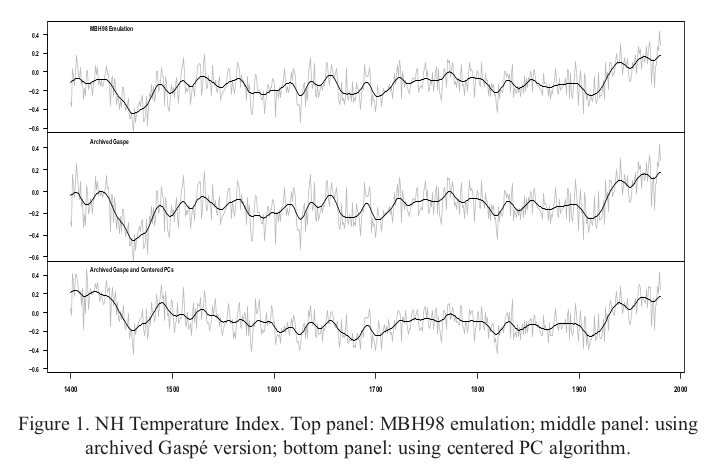
It isn’t surprising. It is standard science, which relies not on auditing but replication. People did their own similar studies, and generally got similar answers.
McIntyre’s audit result was not damning, although his language was. He claimed to find errors in the analysis. But when he re-did the analysis with the errors corrected, this is what he found (Fig 1):
The top panel is Mann’s. The bottom is what he got doing it his way. Some difference, but hardly “damning”. It still has the same essential features.
The top and bottom graphs don’t look like they have the same essential features to me. The top graph (Mann’s method) shows a hockey stick where about everything in the early record has a flat trend until the last 100 years, which steadily rises to the highest levels in the chart.
The centered PC version shows a U-shape where the present temperatures aren’t quite as high as what they were at the beginning of the chart. Given that McIntyre’s whole point was that Mann’s decentered technique mined for hockey stick shapes – something vociferously denied by Mann, this tends to show that McIntyre was right and Mann was wrong.
“Given that McIntyre’s whole point was that Mann’s decentered technique mined for hockey stick shapes”
That isn’t shown in these graphs. Your U needs the eye of faith, but it doesn’t change any hockey stick aspect.
In fact, McIntyre’s revisions are not valid. His removal of the Gaspe cedars was unjustified, and the PC difference is due to retaining too few PC’s in the recon. But even if accepted, the changes are very modest, and do not change any conclusions. The proxy analysis establishes the HS shaft. The blade comes from the instrumental record.
You’re missing the point. Mann’s graph was used to show that the present temperatures were the warmest in the record going back 1400 years. The bottom graph, which centers the PC analysis shows warmer temperatures than the present around 1400AD.
You tried to claim that these two graphs had the same essential features. Clearly they do not, whether you call the bottom graph U-shaped, a smiley face, or any other characterization.
And saying that “it doesn’t change any conclusions” is nonsense. It certainly changes Mann’s conclusion that the present temperatures were warmer than any in the last 1400 years.
“The proxy analysis establishes the HS shaft. The blade comes from the instrumental record.”
This also, does not appear to be accurate. The graph you posted above, which I believe comes from McIntyre and McIntrick’s 2005 paper, shows proxy data only – which extends to 1980. The top figure shows a hockey stick shape, and the bottom figure does not. Though MBH later spliced on the instrumental data on the end, this instrumental data isn’t reflected in the charts you posted.
Moreover, since McIntyre demonstrated that the MBH de-centered PC method mined for hockey stick shapes in the proxy record, finding hockey sticks from red noise – a point that both Wegman and North from the National Academy of Sciences agreed with in their oral testimony in Congress, this improper statistical technique erroneously created the “shaft” portion every bit as much as it created the “blade” portion. Trying to argue that the pre-1900 portion of Mann’s curve is somehow unaffected by the flawed statistical approach by Mann isn’t reasonable.
Also remember that MBH98 was used to assert that current temperatures were the warmest in the last 1400 years. Mann’s top graph shows this. The bottom graph shows that the Medieval Warm Period was warmer, followed by a Little Ice Age, then a recovery to present temperatures.
No. Mann’s proxy analysis ended in 1980. The assertion about recent decades being warmer was based on instrumental readings in recent decades.
Mann had to truncate and clip the trees at 1960 since his trees showed no net warming when used through to the 1990s.
Hansen’s 1981 paper suggested that as at 1980, the Northern Hemisphere was about 0.3 degC cooler than ~ 1940, and Mann’s tree ring data merely showed that by the early 1990s the Northern Hemisphere had recovered to about the same temperature as ~ 1940. Thus the tree ring data was unacceptable.
But of course, the land based thermometer data set had undergone quite some adjustments during the course of the 1980s/early/mid 1990s so that is what Mann chose to splice on to show the warming.
Mann’s finding, ie., the divergence between tree ring data and the adjusted thermometer record was a significant finding, and it would have been a worthy study. His paper ought to have concentrated on that divergence, and the reasons for it, and questioned whether the adjusted thermometer data set was sound, and whether the adjustments were apposite in the light of tree ring data. That would have been real science.
That’s irrelevant. The important characteristics are at the left of the graphs. In Mann’s case, when you splice on the instrumental record at the right, those temperatures are the warmest shown. In McIntyre’s chart, they are not. Thus, you can’t accurately say, as you tried to do earlier, that the two graphs have “the same essential features.”
(I was responding to Nick’s post, above)
Richard,
“Mann had to truncate and clip the trees at 1960 since his trees showed no net warming when used through to the 1990s.”
Mann’s finding, ie., the divergence between tree ring data and the adjusted thermometer record was a significant finding, and it would have been a worthy study.
I think you are thinking of Briffa, not Mann. Anyway, Mann’s analysis stopped in 1980.
Nick Stokes-
MBH98 contained “raw data”, either proxy or measurements from “1400 up to 1995” as shown here:
http://www.meteo.psu.edu/holocene/public_html/shared/articles/mbh98.pdf
It looks nothing like the top line of graph supplied by you that has a broken link and cannot be attributed to anyone atm.
Mann never released his MBH98 data did he? (You are aware of the lawsuits pending aren’t you?) So how could McIntyre reanalyze it?
The “blade” isn’t the problem. It’s the “stick”. Using very old trees to produce a stick….as if they are credible and accurate proxies…and then suddenly NOT using them (because these formerly old but accurate trees somehow inexplicably became UNRELIABLE in the 1960’s) and adding on another source of data for your “blade” is the problem.
Malcolm Hughes (the “H” in MBH) co-authored a paper in 2014 that demonstrated that approximately 60–80 meters of vertical elevation can be sufficient to create a change in the climate response of bristlecone pine, (and turn a “hockey-stick” and a non-hockey-stick).
http://iopscience.iop.org/article/10.1088/1748-9326/9/11/114007;jsessionid=73DA6F0BAF4EE83EBEB5A21AB98EAE9B.ip-10-40-1-105
“So how could McIntyre reanalyze it?”
Well, he did. I showed his graph of results.
The data was available – in fact, it isn’t Mann’s. He just analysed it and produced a reconstruction.
LOL!
Nick states, “It still has the same features”.
Golf hand clap for you Nick for being obtuse as usual, don’t wish to reflect on the damning sleight of hand by MANN in manipulating his chart? Or do you think Mann made a ‘mistake’?
Mann has a nice centenary Gleissberg around 1900, he may have exaggerated a bit.
One graph shows unprecedented warming. The other does not. Seems like an important “feature.”
now that was a dirty trick, nick
behold an honest comparison
http://imgur.com/lOq1M59
“now that was a dirty trick, nick”
I simply showed McIntyres diagram, verbatim. In fact the main difference around 1400 is not due to analysis method, but to McI’s unjustified exclusion of the Gaspe cedars, which were Mann’s main data set in this period. But none of it makes a major diference to the basic HS issue. The modern instrumental record shows a spike that is in complete contrast to the last 600 years.
The irony is that MBH98, which covered 1400-1980, was castigated for not showing a MWP. But then the MWP moved, and is generally reckoned to have finished about 1250AD, with 1400 now in the LIA.
“In fact the main difference around 1400 is not due to analysis method, but to McI’s unjustified exclusion of the Gaspe cedars, which were Mann’s main data set in this period. But none of it makes a major diference to the basic HS issue.”
I don’t see how this statement is consistent with the graphs you posted earlier, either. There is a little difference between (a) and (b) at the left (maybe shifting the 1400 temps up from -0.1 to 0 C and deepening the trough immediately thereafter, but that is insignificant compared to the effect that (c) shows where temperatures around 1400 spike up to about the 0.3C mark relative to (b).
I love how the number one tool for Pro AGW promoters is to make the Y Axis as small as possible so that differences when criticized about their data appear small. Gavin does this regularly when disputing Steve Goddard’s surface temp adjustments as well.
Nick you say there is “some difference” and “hardly damning”
However Mann’s start of this graph is 0.3 deg C cooler than McIntyre’s calculation and Mann’s shows a slow rising trend and McIntyre’s shows a cooling trend until the recent warming period. I would say that this is quite damning considering he used the same data and came up with a very different result. Not to mention the upside down proxy used in the Mann calculation. Shoddy science at best.
“the number one tool for Pro AGW promoters is to make the Y Axis as small “
McIntyre’s diagram, not mine.
…It isn’t surprising. It is standard science, which relies not on auditing but replication. People did their own similar studies, and generally got similar answers….
No, no and NO!!! Science does NOT depend on ‘replication’. If it did, errors would simply be multiplied. Science depends critically on examination of hypotheses for flaws. Read Popper. Read Kuhn. Read Roger Bacon. Read anyone you like, short of Aristotle.
I shall be charitable and assume that you have just said this as a debating point, rather than actually believing it. Because if science were to be run along that line you have suggested, progress would immediately cease…
Test
While the result of climate science may not be falsifiable they are certainly in the range where doubt is far far more appropriate then belief. Beyond reasonable doubt climate scientists are guilty of fraudulently overselling their case. Some have even openly admitted to having done so.
I would like to see the hypothesis of an equipment heat removal engineering specialist tested that most of the climate change we see is the result of using wind farms which reduce air circulation so the heat zones become more concentrated for example as now in Europe with the UK being relatively cold and wet as a result. He made this prediction a quarter of a century ago when wind farms were few and far between.
His computer model which having been tested in situations with a short time frame was refined to be very accurate showed the concentration was out of all proportion to the tiny reduction in circulation speed.
When I see Stokes and Mosher adding their comments, I’m once again reminded of the learned religious scholars debating how many angels can dance on the head of a pin, without establishing the existence of angels. No study I am aware of has refuted that temperature increases precede atmospheric CO2 increases. Or that temperature decreases preceded CO2 decreases. The physics is sound: warming water expels CO2, cooling water absorbs it. Further, recent CO2 levels are extremely low compared to past levels spanning millions of years, and runaway warming did not occur with levels ten times or more higher. The Earth has been warming for 300 years since the end of the Little Ice Age, and this current warm period (interglacial) is the coolest of the five of the past 10,000 years since the end of the glacial period. The warmest of the five, the Holocene Climate Optimum of 9,000 to 5,000 years ago, warmed rapidly when atmospheric CO2 was 280 ppm. Warming from 18,000 to 11,700 years ago that melted great ice sheets and raised sea level over 400 feet (over six feet per century) also featured CO2 at 280 ppm. Strangely, all this has been set aside because of the modest warming during the past 40 years that followed cooling from 1940 to 1980 as atmospheric CO2 rose steadily from ocean warming 1910 to 1940 – a period that in terms of length and rate of warming would be almost identical with 1980 to 2017 if it weren’t for the 1996 to 2016 pause. We are now in the coldest ten percent of the past 10,000 years and in a state of panic driven by our ignorance of climate change history. And multitudes of angels dance as we search haystacks for a pin.
“The physics is sound: warming water expels CO2, cooling water absorbs it.”
Yes, it does. And that has been the main cause of ice age fluctuations in CO2. But that says nothing about what will happen if you dig up an amount of carbon comparable with what is already in the air, and burn it over a few decades. That has never happened before, and it is what we need to know about.
It does not matter that it is burnt over just a few decades.
It is not the rate of change of CO2 that is important to the RGHE theory, but rather it is the quantitative amount of CO2 in the atmosphere that is important.
If we burnt all known fossil fuels we would still have almost an order of magnitude less CO2 in the atmosphere compared to historic highs which did not result in runaway warming.
So what you are saying is the AGW science is not settled then?
“If we burnt all known fossil fuels we would still have almost an order of magnitude less CO2 in the atmosphere”
People exaggerate past levels of CO2. From here:
You have to go back to Dinosaur times to get even to 2000 ppmv. There weren’t many mammals around then. It suited the dinosaurs – might not suit us.
“might not suit us” = speculation and science not settled.
So again Nick, can you please demonstrate through empirical evidence, the utter destruction and chaos seen by the evil molecule, CO2?
“so that’s what we need to know about.” That’s not a statement of a settled science, is it?
“confidence comes from the plausibility and legitimacy of the parameter values to which the modellers resorted in order to achieve the match.”
Confidence is a subjective term. Complex models contains a vast amount of possible errors. The only way models can be verified to correctly represent nature within claimed uncertainty and without systematic biases is by repeated, in this case long term, demonstration of correspondence between model predictions and observations.
Somebody should send this essay to da pope…
«If it were up to me, however, I’d accept the uncertainties and invoke the dreaded precautionary principle.»
The precautionary principle as formulated in Wikipedia is two sided:
«The precautionary principle (or precautionary approach) to risk management states that if an action or policy has a suspected risk of causing harm to the public, or to the environment, in the absence of scientific consensus (that the action or policy is not harmful), the burden of proof that it is not harmful falls on those taking an action that may or may not be a risk.»
As the policy propounded by United Nations has a suspected risk of causing harm to the public, it is un-sufficient to refer to the precautionary principle as an argument for the policy.
In the absence of scientific consensus? The gremlins are everywhere. Before global warming, it was in the absence of scientific evidence. I guess since the evidence is very slim in global warming, consensus was the only way to make action necessary and “scientific”, not precautionary. I love the new methodology—redefine terms and get whatever outcome you want.
That is an excellent observation. I think that, the idea of consensus is the punichment upon the public for not requiring of the scientific enterprices to define it´s principles. What, did we get from Karl Popper? Two things, ´a scientific concept must be falsifiable´ – fine. ´A scientific concept can never be proven´ – no good – because that lays the foundation for the idea of consensus. It can not be proven anyway so you have to trust us! That was not intended by Karl Popper, but it is the consequence of his perspective on truth.
The grand mistake of the scientific enterprices was to not define its principles. The grand mistake of the public was to not require of the scientific enterprices that it defined its principles: “The basic and particular principles that guide scientific research practices exist primarily in an unwritten code of ethics. Although some have proposed that these principles should be written down and formalised, the principles and traditions of science are, for the most part, conveyed to successive generations of scientists through example, discussion, and informal education.”
Ref.: Responsible Science, Volume I: Ensuring the Integrity of the Research Process; Panel on Scientific Responsibility and the Conduct of Research
I know that it works quite fine occasionally , but not for controversial issues.
Anyhow, It seems to me that you might find joy in this little piece: Principles of science and ethical guidelines for scientific conduct (v8.0). That is an attempt to demonstrate the scientific enterprices could have defined its principles.
If you like it, tell about it – if you don´t like it, tell me about it. 🙂
In past millennia earth has had atmospheric CO2 levels as high as 10,000 ppm and more but it didn’t go into “unstoppable global warming”, Temperatures fell and rose again within relatively constrained parameters through to the present day.
That alone is, in my mind, sufficient to disprove the belief that adding a little more CO2 to atmosphere over and above the current levels of 400 ppm will cause catastrophic global warming.
I’m always surprised that this is not a central plank of disproving the validity of climate models and the AGW religion. Nothing I have heard from the warmist community ‘explains away’ the lack of effect on global temperatures from those 25 times higher CO2 levels – perhaps I’ve missed it.
“Nothing I have heard from the warmist community ‘explains away’ the lack of effect on global temperatures from those 25 times higher CO2 levels”
That’s correct. The alarmists cannot explain away having greater amounts of CO2 in the atmosphere in the past which caused no runaway greenhouse effect, so they ignore it.
There is no evidence for a runaway greenhouse effect on Earth caused by “excessive” CO2 at any time in its past. Claiming we will have a runaway greenhouse effect with the amounts of CO2 humans can put in the atmosphere defies Earth’s history.
As one poster upstream said, if we burned every hydrocarbon on Earth humans couldn’t raise CO2 levels anywhere close to as high as they have been in the past on Earth, with no detrimental effects. So if that is the case, and CO2 has been much higher in the past with no runaway greenhouse effect, then there is no way the small amount of CO2 humans contribute will do any harm to the Earth or its inhabitants.
One thing that happened with science, is that the scientific institutions has failed to define clearly, in a manner available to the public, the basic principles of science. That failure facilitates the political mis-use of the the name of science. This is an attempt to demonstrate that it can be done: Principles of science and ethical guidelines for scientific conduct (v8.0)