Guest post by David Middleton

Here’s How Much One of Tesla’s Amazing Solar Roofs Actually Costs
Tesla’s price promises savings, but they won’t come immediately.
By Jack Crosbie on August 5, 2017
Filed Under Batteries, Electric Cars, Elon Musk, Money, Power & Solar Energy
The Tesla Solar Roof is here, and if company CEO Elon Musk has his way, there will be one on most houses within 15 years. But despite its energy efficiency and dazzling looks, clean power doesn’t come cheap — and Tesla’s listed price is a little hazy on some of the details. So how much will it actually cost?
Tesla offers one figure for the cost of its proprietary solar roof: $21.85 per square foot, on average. Musk has said the tiles will cost “less than a normal roof.” The problem is Tesla’s messaging and advertising for the roof all factor into 30 years of energy savings from going solar. That makes sense, given three decades is the typical lifetime for a roof, but those aren’t savings a buyer will see on day one, or even day 1,000. And the initial cost is steep.
[…]
What’s a Tesla Solar Roof Actually Going to Cost?
Here’s where it gets tricky. Tesla has a cost calculator on its website which looks at a home’s location, size, and power demands and offers a quote for how much it’s going to cost. The big factor, it seems, is how much of your roof needs to be solar. Something that isn’t readily apparent about Tesla’s roof tiles is that they’re not all solar. In fact, the company estimates that the average house will only need, or be able to accommodate, about 40 percent of the solar tiles — the rest will be identical looking but non-solar glass shingles. A non-solar tile costs $11 per square foot, but the solar-paneled ones are $42 per square foot.
I decided to try it for the same house: foothills of California, 1,800 square foot roof, 40 percent solar tiles.
Hold up, my solar roof is going to pay me money? That right there is the big sell. The final number on Tesla’s site is how much money a solar roof is going to make you over 30 years, which is the standard warranty for an asphalt shingle roof. Tesla’s warranty is “infinite,” Musk says. The numbers that aren’t so apparent, however, are the actual costs.
The calculations above show me that, including installation and materials and everything, the solar roof is going to cost me $52,100. Add in a Powerwall battery, which is necessary for the roof setup to work, and that’s an extra $7,000 to $59,100 right out of pocket. Part of Tesla’s selling point is the generous tax credits — until 2019, homeowners can deduct a full 30 percent of their purchase and installation costs for solar energy from their taxes.
[…]

Well, I entered my address into the Telsa solar roof calculator and never found a way to generate a positive return. At 40% solar, it said I needed 4 Powerwall batteries (big house) and yielded a 30-yr net cost of $24,400, including a $42,800 tax credit. The only way I got to break-even was to go 70% solar ($250k worth of solar roof & batteries).
However, Tesla’s solar roof calculator, does not factor in the “time value of money.” Spending $250k now to get $250k back over 30 years is a really stupid thing to do.
What is ‘Net Present Value – NPV’
Net Present Value (NPV) is the difference between the present value of cash inflows and the present value of cash outflows. NPV is used in capital budgeting to analyze the profitability of a projected investment or project.
The following is the formula for calculating NPV:
where
Ct = net cash inflow during the period t
Co = total initial investment costs
r = discount rate, and
t = number of time periods
A positive net present value indicates that the projected earnings generated by a project or investment (in present dollars) exceeds the anticipated costs (also in present dollars). Generally, an investment with a positive NPV will be a profitable one and one with a negative NPV will result in a net loss. This concept is the basis for the Net Present Value Rule, which dictates that the only investments that should be made are those with positive NPV values.
When the investment in question is an acquisition or a merger, one might also use the Discounted Cash Flow (DCF)metric.
Apart from the formula itself, net present value can often be calculated using tables, spreadsheets such as Microsoft Excel or Investopedia’s own NPV calculator.
[…]
Read more: Net Present Value (NPV)http://www.investopedia.com/terms/n/npv.asp#ixzz4pAZMi1OM
Follow us: Investopedia on Facebook

I calculated the NPV of the solar roof example in the Inverse article at a 2% discount rate:
| Gross | W/Tax Credit | |
| Ct = net cash inflow during the period t | $ 85,700 | $ 85,700 |
| Co = total initial investment costs | $ 59,100 | $ 45,800 |
| r = discount rate, and | 2% | 2% |
| t = number of time periods | 30 | 30 |
| NPV | $ (11,788) | $ 1,512 |
Without corporate welfare (gross) the NPV is -$11,788!!! With corporate welfare (tax credit), the NPV of the $59,100 “investment” is barely positive.
Businesses generally use a 7% discount rate.
| Gross | Subsidized | |
| Ct = net cash inflow during the period t | $ 85,700 | $ 85,700 |
| Co = total initial investment costs | $ 59,100 | $ 45,800 |
| r = discount rate, and | 7% | 7% |
| t = number of time periods | 30 | 30 |
| NPV | $ (47,842) | $ (34,542) |
Oil companies generally value the future revenue from proved oil reserves with a 10% discount rate (PV10).
| Gross | Subsidized | |
| Ct = net cash inflow during the period t | $ 85,700 | $ 85,700 |
| Co = total initial investment costs | $ 59,100 | $ 45,800 |
| r = discount rate, and | 10% | 10% |
| t = number of time periods | 30 | 30 |
| NPV | $ (54,189) | $ (40,889) |
Unless you think that buying your electricity from Tesla 30 years in advance is a “deal”… The solar wall is a definitive dud.
Featured image source: KAKE ABC TV
Addendum: Google Earth Project Sunroof
Enter your address and get the solar power potential of your roof.
The calculator said that I could save $17,000 over 20 years. Even with the tax credit, I would lose money on an 8 kW system… without applying a discount rate.
See how many solar arrays are in your community.
Of the 6,400 roofs in my zip code, there are 29 solar arrays.
Did anyone factor in the cost of mutable replacement batteries for those power walls over that 30 years?
OOO!! , Shiny!, Pretty!
Off to cut down all my shade trees now.
to store the energy for my house for 1 day at least a €30000 battery is needed. Without storage, solar panels are parasites of the grid. Green energy will bring back feudal times.
It is a parasite regardless, in that a customer is lost, yet grid costs remain unchanged.
Another thing to factor in is assumption about electricity prices.
Say electricity prices plummet in 15 years (perhaps because there is a massive solar breakthrough), then the negative NV increases even further, by virtue of your observation that this is just a scheme to buy 30 years of electricity in advance.
Perhaps we stop wasting money on wind and solar and start building reliable and cheap power stations again?
You need 3x as many Tesla battery walls, because you have to exchange them 3x over 30 years…
All money upfront and a payback > 15 years is probably a bad idea no matter what you’re buying.
There’s also the issue that most people won’t be in their current house 30 years from now, so unless solar tiles boost the sales price of the house, the future owners get most of the benefit. With the numbers Dave gave the net cash cost is $46,100. If you sell the house 10 years later, you’d need about a $30,000 premium in the sales price (net after selling costs) to get your investment back out.
Might be worth considering if: (1) you live in an area with higher than average electricity costs, (2) you have high confidence you will remain in the house for at least 20 years, and (3) you need to replace the roof anyway.
Once the subsidies end, the whole thing makes no economic sense. Which is why the new Greening is upperclass elitist: only those with excessive discretionary income can afford it.
When does planetary necessity replace narcissistic virtue signaling as a force for the Greening? When the emergency faces us clearly. Certainly not now. And the “best” scenarios say that “may” be in decades from now. Others, like me, say that will never happen. The weather will always be a local phenomenon and be dealt with locally. No government will, long-term, cripple itself to theoretically help a foreign nation.
But as I sit here a radio report says a paper out of Washington claims US temperatures are already much higher than in the 80s and extreme weather events are already attributable to anthropogenic climate change. Really?
We live in a time when one measurement can be claimed to have two values. How odd.
Those responsible for UK public housing put panels on the property they rent…
Those responsible for UK public housing aren’t spending their own money.
Taxpayer money right. Did they do a cost benefit analysis? In other words just followed the herd.
As they did on the Grenfell building, Griff? You recommend that?
And quite often in totally unsuitable locations – there’s a row of “public housing” not far from me, with solar panels covering the roofs, they even face South. But there’s one small problem – between the houses and the sun are a dozens of mature trees, which obscure the panels for a significant proportion of the day. But never mind – it’s only tax payers money, after all….
There is no way these solar panels will last 30 years. Large batteries only last 5-10 years and this is NOT figured in by the calculator. New batteries every 10 yrs completely blows up their calculations. Even if they did, their figures in the best case mean you won’t make a profit until 25 to 27 years in. No one wants to wait that long for an investment. Subsidies are great, but can be cut off at a moment’s notice when governments change their mind. What happens if Tesla goes bankrupt–what about their warranty then? If the entire roof has scattered solar on it, fire departments will not want to go on the roof in a fire. Soar is DC, very dangerous to firefighters.
And what of the middle class tax payer, how long before he makes a profit on his tax..
Oh ya, that’s right, 83 years from now it might be .000001 degrees cooler.
It’s funny. When I first read the analysis I mistook ‘Powerwall’ for ‘Powerball’ and it made perfect sense. Win the lottery and you can afford pay for this toy.
The odds of me winning the Powerball are far better than me buying a Powerwall and a solar roof.
+100
I dont want to subsidize this crap, just like I dont want to subsidize $100k electric cars. Elon is a selling snake oil.
I put my address in (this is in North Carolina) and it said that after 30 years I would generate $14,900 worth of electricity. But the cost, with tax credits, would be $17,500. So, after 30 years I would still lose money. What a deal. And North Carolina is still a southern state. Imagine how much worse it will be in a northern state.
Wake me up when the return on investment is 15 years, in Maine.
My total electricity costs over the year are only about $1500 on a 4 bedroom house. That comes to $45000 over 30 years. Even at $2000/yr, this only comes to $60,000 over 30 yrs but Tesla assumes $85,700 electricity costs (probably California prices). So the math fails without even doing NPV.
Most people intuitively use a several year payback for energy efficiency investments. For example, if you add insulation to your attic and it saves you $50/month and costs $1000, you have a 20 month break-even period which is good. If you tell someone their break-even date is month 300…..
I think their calculator uses your home’s location and size to estimate electricity costs. The only input it asks for is your address. It returned a fairly close estimate of my roof size and average monthly electricity bill. Google Earth has an application that will instantly tell you your roof’s solar power potential.
I have done some very similar analysis of the costs/benefits of a more conventional solar panel system. Shockingly, with very similar results.
Here are some of the factors that are generally overlooked:
* Time value of money. This is huge as the article demonstrates.
* Maintenance. It’s never zero or free. The cost of cleaning the panels/tiles once every two years is considerable.
* Risk. If any of the assumptions fail to work out as predicted, the homeowner who paid upfront is likely to be the one carrying the can. That becomes a certainty if the seller/installer goes out of business which is pretty common with new/immature industries.
“If the seller/installer goes out of business which is pretty common with new/immature industries”
Yep, my local paper lists (yet) another “Renewable” company, which has just been wound up, in today’s Business section…
Rechargeable batteries have a limited lifespan and will have to be replaced multiple times over three decades. Does the power wall warrantee last for thirty years?
The optimum charge/discharge cycle for LiIon batteries is from 90% full to 10% full. There is no chance that this optimum charge/discharge cycle will be followed for this type of use. So the odds of the battery lasting as long as the pampered “lab test” batteries is slim to none.
Only three decades as a typical lifespan for a roof?
I just had my (Edinburgh) house re-roofed completely, and the north-facing slate section was 95% original, at nearly 120 years old. The south-facing slope (gets the brunt of the heat and the wind/rain)was more knackered, and had been extensively repaired, only about half of the slates were original, so call it a 60 year lifespan.
Even on my father’s house, thrown up by shoddy builders in the 1970’s, the concrete tile roof was still intact at 43 years.
What are American roofs made of?
Most have asphalt tile shingles. Very cheap. Maybe last 10-15 years. Easily replaced.
I have Spanish-style cement roof tiles. Not cheap. Very durable. And so far, mostly impervious to hail damage.
Furthermore, replacement asphalt shingle roofing can be laid over existing shingles (up to 5 layers by some codes) thereby reducing the replacement costs.
Another consideration is the construction of the roof support structure (rafters, purlins, ridge beam, etc) necessary to support the weight of these tiles. In many areas of the country (where these things should work best) the roofs are not designed to support snow loads (there is no need). If your roof is not designed to add the extra weight you’ll need to beef it up.
Then there is the additional maintenance of other roof mounted systems. How sensitive are these shingles to foot traffic?
As we say in engineering regarding fads this is “A bad idea whose time has come.”
I think I’ll pass on this idea.
Here in the USA we have more extremes of weather and temperature. In Phoenix Arizona temperatures can reach 120F and in Minnesota it can go down to -50F.
Asphalt shingles may last only 10-20 years. Cement tile should be good for 50-100 years but the underlying felt and timbers will likely fail before that.
The 30 year average is probably about right. But it’s kind of meaningless — like computing the average weight of a mixture of grapes and bananas.
Ha. David. Last time you pretended that electric vehicles are not going anywhere by doing an obviously irrelevant linear extrapolation. Now you’re taking a 10% discount rate for a home improvement project. That’s not how science works. Youre supposed to make the most pessimistic assumptions (for your preferred outcome). But you are pretty obviously just weighing the scale towards what you want to see. Sad! You should do better. If only because it’s more fun that way.
Cheers,
Ben
My base case used a 2% discount rate. 2% is about what someone could earn in 5-10 year Treasury notes. The 30-yr Treasury is paying close to 3%.
This is not science. It’s economics. All business investment decisions are based on discounted present value and/or discounted cash flow. Most business investments use a 7% discount rate. Some use 10%.
Woops, was reading this on my phone and did some sloppy scrolling to skip the 2% part. Snarky comment retracted.
Hey when are you guys going to post something about the cancellation of those nuclear plants – purely for economic reasons? Or is the right wing blogosphere still pretending that nuclear is super cheap and being held up purely by ‘green lunatics’? Oh and let’s not forget those 25 GW of solar installed in China during 2017H1 😉
Snark is always appreciated by this author. When I get a chance, I’ll put the ChiCom solar GW into graphical perspective.
But we have it on good authority that interest on new US debt is only 1%. /sarc
Looking forward to it David.
Oh do compare it to the number of coal fired plants actually being built rather than those announced. In China the two are only marginally correlated.
Enviro’s due everything in their power to make nuclear expensive, then crow about how nuclear can’t compete with their government subsidized fantasies.
Just like communism, environmentalism is a revolt of the elites using false propaganda. That explains why nuclear is banned: it potentially generates enough energy to provide freedom for all. Solar and wind, by their scarce and unreliable nature, cut off power to the lower classes and will result in slave states.
MarkW, that’s just plain wrong. David, don’t you think you should correct some of the site regulars as well whey they say things that are wrong?
Hey, another interesting topic for an article: subsidies for fossil fuels!
https://cleantechnica.com/2017/08/09/global-fossil-fuel-subsidies-still-total-5-trillion-annually/
I did correct the error.
The greent@rds at the World Bank are adding in mythical numbers to come up with $5 T in subsidies.
Real numbers:
Using the EIA’s numbers…


Since the concept of NPV seems alien to you. The Inverse article cited an example of a solar roof installation: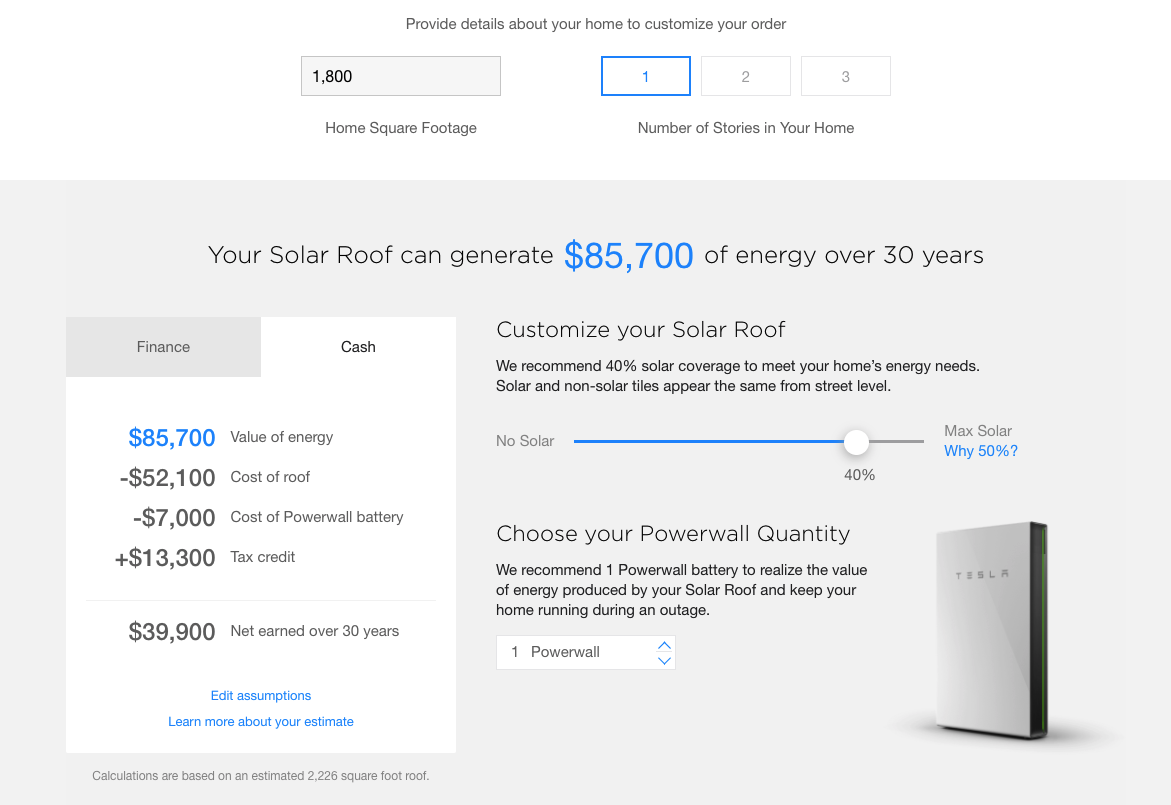
The homeowner would “invest” $52,100 into a solar roof and $7,000 into a Powerwall battery, a total of $59,100. He would get a $13,300 tax credit and (according to Tesla) save $85,700 on electricity over the next 30 years. A net “gain” of $39,900.
If that same homeowner invested his $59,100 in 30-yr Treasuries (3.0% yield), in 30 years he would have $143,451. Subtract $85,700 worth of electricity bills and he would have a net gain of $57,751.
Hence, the solar roof has a negative NPV.
Until someone presents some evidence that electric car sales are actually picking up, then a linear projection is just as valid as any other. Certainly more valid than a projection that assumes sales are about to take off.
As to the discount rate, David gave 3, 2% as used by Musk, 7% as used by most government rating agencies and 10% as used by oil industry.
He didn’t just give 10% as you so dishonestly claimed. Secondly, you failed to mention why 10% was wrong.
If this the best you can do, can I recommend reading up on the first rule of holes?
Correction… Musk’s numbers are undiscounted. I applied a 2% discount rate to Musk’s numbers because that’s what 5-10 yr treasuries yield. Since it’s a 30-yr time period and 30-yr treasuries are yielding 3%, I should have used a 3% discount rate for the homeowner.
Most businesses use 7%. Government often uses 3%. The oil industry generally uses 10% to value proved reserves.
Yes yes the solar roof does not seem to make economic sense. I think it’s commonly agreed upon (at least here in science land) that utility scale is the way to go for solar.
Petty cool engineering though.
Waaayy cool engineering… just like everything else Tesla does.
Utility scale solar only makes “sense” because you get utility scale subsidies, benny.
Oh those darn greenies and their subsidies… oh wait!
https://cleantechnica.com/2017/08/08/scott-walker-paul-ryan-saddle-wisconsin-voters-crushing-tax-burden-foxconn-factory/
No mention of where those (very large) tax credits come from. Last I checked, the Feds allow $6,000 total in tax credits , over a period of several years. That basically pays for the panels (6KW) Inverters run around the same price, depending upon type. The rest of the stuff required doesn’t cost a whole lot and if you do it yourself, figure on roughly $14,000 outlay, of which $6,000 can be taken as a tax credit. I don’t know what a company would charge to install the panels. Remember, that those panels need to be removed and reinstalled if the roof requires new shingles.
The tax credit is a full 30% of the roof’s installation cost through the end of 2019…
https://www.inverse.com/article/35106-tesla-solar-roof-actual-price
If you spent $50k on a solar roof in 2018, you would get a $15k tax credit.
Most attractive looking solar NPV or IRR models make an assumption of rising electricity costs, sometimes they are chosen to make the numbers work.
Most conventional panels will last 35+ years, with a 5% to 10% degradation in output primary because the glass front gets less transparent over time. Some early silicon panels are okay 50 years later, but the Tesla models are unproven and accelerated lifetime testing sometimes does not tell the whole story. The inverters are less reliable than the panels, IMHO MTBF 7 to 10 years, the batteries are even less reliable.
Overall results are very location dependent: if you live in Tempe, AZ where you have lots of clear sunny days and your primary energy use is for cooling, it can be a good deal. If you live in Seattle, it will never work out.
What your net metering deal is can make a huge difference – in most locations you pay retail for the electricity and get paid nothing or wholesale for what you send back onto the grid. If you have a peak dependent rate, using solar to shave peak demand may cut your bill. Having enough battery capacity to run your home off grid is very capital intensive.
Lighting, heating and cooling for homes and offices is by far the most economically feasible application for solar – supply and demand are relatively co-variant and minute to minute dispatch-ability is not required. Industrial and transportation use of solar will require that yet to be found efficient storage mechanism – much more efficient and much less expensive than current batteries.
EIA forecasts that the average annual rise in electricity rates from 2016-2050 will be 2.3%.
https://www.eia.gov/outlooks/aeo/data/browser/#/?id=10-aeo2017&cases=ref2017~ref_no_cpp&sourcekey=0
I can make 2.3% in 10-yr Treasuries.
https://www.bloomberg.com/markets/rates-bonds/government-bonds/us
Which is roughly the same as the inflation rate. Which is why I ignore inflation and costs increase for quick calculations and simply take net discount rate. Which still gives us -$43,080.
Max solar is around noon, max AC is closer to 5pm.
Not all that co-variant.
That’s a lot closer than most other applications – which illustrates how bad they are without storage. Solar irrigation pumps with no controller are the best – more sun = more water. You can actually ‘skew’ your solar array to make make peak output occur later in the afternoon, and the overall system works better for air conditioning. There was a grand plan to ship solar from 5 hours to the west for A/C in the east, but those pesky transmission lines were a problem!
The cost of batteries makes a bad deal even worse.
It’s amazing what ingenious ideas can be developed when the goobermint is subsidizing. (Another prime example of what happens when profit motive is not driving efficiency.)
I have been curious about how all those solar shingles are electrically connected to each other. Series or parallel? Individual wires for each shingle? How reliable are the connections, and how to you find and repair faults after the roof is installed? It seems like a nightmare to me.
Speaking as an electrical engineer who has done lots of work on location- excellent questions. Yes it is a reliability nightmare.
Does Musk use solar power for his factories and only buys wind generation for make up power?
He does use solar for his gigafactory:
https://cleantechnica.com/2017/01/16/gigafactory-feature-70-mw-solar-pv-system-document-teslas-recent-january-4-investor-event-reveals/
apparently producing as much energy as it uses:
https://www.treehugger.com/renewable-energy/teslas-gigafactory-will-produce-much-renewable-energy-it-uses-net-zero-energy.html
He doesn’t use or produce anything yet…
I’m surprised he hasn’t conned people into sending him $1,000 deposits for tours of the Gigafactory
whenif it becomes operational in 2020.Clotheslines are the only surefire economical solar project, if combined with intermittent wind.
batteries that last 30 years ? and panels that last 30 years ? ahhhh … no …
The glass encased panels may last 30 years, however they will lose about 1% capacity every year. And the batteries will definitely not last that long. You will be lucky to get 10 years out of one set, so that adds to the expense. The DC to AC inverters will probably not last 30 years either and will need replacement/refurbishment at least once during that interval. It’s difficult to see how this could ever make economic sense.
well Musk is the master of the long con …
By the time you realize you’ve been conned, he’s long gone.
+100
Tesla looks to $1.5bn bond offering to boost Model 3 production
“Tesla is to boost its cash reserves with another $1.5bn as it tries to stave off the liquidity pressures caused by its headlong rush to become a mass-market car producer.
The latest capital raising, a bond sale announced on Monday, marks the first time the company has turned to the markets for an issue of straight debt. It is set to lift the amount it has raised since the start of 2014 to $7.9bn, with Wall Street expecting further hefty cash calls to come.
https://www.ft.com/content/463e6db4-7b90-11e7-ab01-a13271d1ee9c
https://www.reuters.com/article/us-tesla-offering-idUSKBN1AN13I
Too fracking funny!
AAA used to be the ranking you would expect for a country.
On the other Exxon is probably worth more than a lot of countries, and is better run than almost all.
Indeed.
Nikola Tesla ended talking to pigeons because he didn’t care much about money.
Elon Musk who usurped Tesla’s name may end up talking to pigeons because he is too greedy.
Elon Musk – the new Junk Bond King
The original Junk Bond King, Mike Milken, ended up in jail after amassing $3 billion of other people’s money
Such junk bond issues are frequently the last resort of management when confronted by desperate liquidity crises.
Tesla will either “turn the corner” with the Model 3 or rapidly run out of OPM (other people’s money).
If they don’t generate positive cash flow next year, they will probably be seeking out a merger partner.