Guest post by David Middleton
Anatomy of a fake news story.
This article appeared in Forbes last week…

Trump’s New White House Communications Director Believes The Earth Is 5,500 Years Old
In a flurry of activity last week, Anthony Scaramucci became the White House communications director while President Trump accepted Sean Spicer’s resignation. In doing so, President Trump gave one of the biggest microphones in the world to someone who believes the Earth is 5,500 years old.
Scaramucci, one of many Wall Streeters who now influence the Trump Administration, is known for his business acumen as a salesman. Unfortunately, that does not translate into the realm of science, to which Scaramucci unfoundedly disagrees with basic conclusions of science.
In an interview on CNN in 2016 Scaramucci compared the consensus on climate change to the once held belief that the world is flat.
[…]
“You’re saying the scientific community knows, and I’m saying people have gotten things wrong throughout the 5,500-year history of our planet,” said Scaramucci in the interview.
[…]
https://www.forbes.com/sites/trevornace/2017/07/27/trumps-new-white-house-communications-director-believes-earth-5500-years-old/#1a70a92f35a0
Scaramucci never said anything about the age of the Earth in the CNN interview. Scaramucci was responding to Chris Cuomo’s repetition of the 97% consensus lie.
This lie has now been repeated by Live Science...
Sorry, Scaramucci, Earth Is MUCH Older Than 5,500 Years
The CNN interview has nothing at all to do with the age of the Earth. Scaramucci was discussing Trump’s position on climate change.
http://www.cnn.com/2016/12/14/politics/anthony-scaramucci-climate-change/index.html
Here we have a young geologist, writing for Forbes, with a Young Earth Creationist obsession, fabricating a story. This errant misquote is now being repeated as fact-based news on multiple Internet outlets… the anatomy of a fake news story.
Tomorrow, and tomorrow, and tomorrow,
Creeps in this petty pace from day to day,
To the last syllable of recorded time;
And all our yesterdays have lighted fools
The way to dusty death.
Macbeth Act v
Love’s not Time’s fool, though rosy lips and cheeks
Within his bending sickle’s compass come;
Love alters not with his brief hours and weeks,
But bears it out even to the edge of doom.
Sonnets 116
If it is people getting things they know wrong, and that is exactly what Scaramucci said, the statement is absolutely limited to recorded, human history.
How about 2600 to 2800 thousand, not 10 thousand? If you restrict the range to Homo sapiens only*, it’s still 200 to 250 thousand years. Forbes’ writer’s “10 thousand” is off by an unbelievable factor, and the weaselly qualifier “well over” is no protection from that much error.
.
*An artificial and racist distinction, the modern human lineage is mainly from Homo sapiens, but with Neanderthal and Denisovan contributions that would push the timeline back another 100 thousand years.
it’s way off even if you limit the discussion to symbolic representation. Cave and rock paintings and engraving date from 40,000 years ago in Europe and possibly earlier in Africa, Asia and Australia.
As for the first stone tools, it comes down to the definition of “human”. Genus Homo as now classified dates from about 2.7 Ma, but if usual definitions of “genus” were applied, not only Genus Australopithecus (maker of the stone tools from 3.3 Ma) would be considered “human”, but Genus Pan (chimps and bonobos) as well. Instead of human, we speak of hominin, hominid and hominoid forbears,
But humans are genetically closer to chimps than horses are to donkeys, so should be in the same genus, let alone our even closer relatives, the australopithecines.
Humans are genetically close to chimps? How sure are you of that?
In genetics (upper level biology) a central teaching is that DNA codons in all living creatures code for the same amino acids, whether talking about earth worms, trees or chimps. However, it was mentioned in class but without giving details, that some of the codons in humans code differently than in other living creatures. On a DNA level there’s a chasm between chimps and humans. A chasm that is greater than the differences between horses and donkeys.
Richard,
I’m positive. Yet again, you’re wrong.
Both in terms of coding and noncoding DNA, humans are closely related to chimps.
As you may know, “genes” code for proteins. Noncoding DNA is still important, however.
Naturally, with some five million years of separate evolution, certain areas of noncoding genetic material would show differences. That’s to be expected, since there are differences between chimps and humans. Certain areas of the genome are conserved, and others show rapid evolution.
This study might be the one which you have so fundamentally misunderstood.
http://journals.plos.org/plosgenetics/article?id=10.1371/journal.pgen.0020168
The “Human Accelerated Regions” (HARs) just show where human evolution has sped up relative to chimp evolution. There are also areas of accelerated chimp evolution.
Despite these HARs, we are still closer to chimps in both coding and noncoding than to any other group, to include gorillas. We do however share some blood groups with gorillas but not with chimps, due to divergence during chimp evolution that didn’t occur in human or gorilla.
Gloateus:
That article doesn’t even mention codons, and amino acids only once without referencing how DNA encodes for specific amino acids. In short, that article doesn’t reference what I mentioned.
That’s like me talking about apples, and you bring out an orange.
Richard,
It is exactly what you were talking about, if your unclear statement is to mean anything at all. You just don’t know enough about molecular biology to recognize that fact. All you think you know comes from paid professional liars.
Genes code for proteins, which are polymers of amino acids. A codon is a three-nucleobase sequence coding for a particular amino acid. The system is “degenerate”, in that the 64 possible three-nucleobase codons code for just 21 amino acids and the stop codon.
The paper I cited is about evolution in parts of human noncoding sequences differing from those in chimps, which is apparently to what you referred. If not, please restate it in clear molecular biological terms, with references.
As I said, both coding and noncoding parts of the chimp and human genome shows to be each others’ closest living relatives. As you’d expect, gorillas are closest to their fellow African great apes, the human and chimp group, and orangutans, ie Asian great apes, are closest to the African ape group. The great apes are closest to lesser apes, and the ape group is closest to the New World monkey clade. The group of apes and Old World monkeys is closest to New World monkeys, and the ape-monkey clade is closest to tarsiers, with whom we all share the inability to make vitamin C. The next closest clade, prosimians, ie lemurs and lorises, retain this capability.
Genomic relatedness is reflected in shared, derived anatomical, embryological, biochemical and all other traits.
The genetic code, and chromatin structure: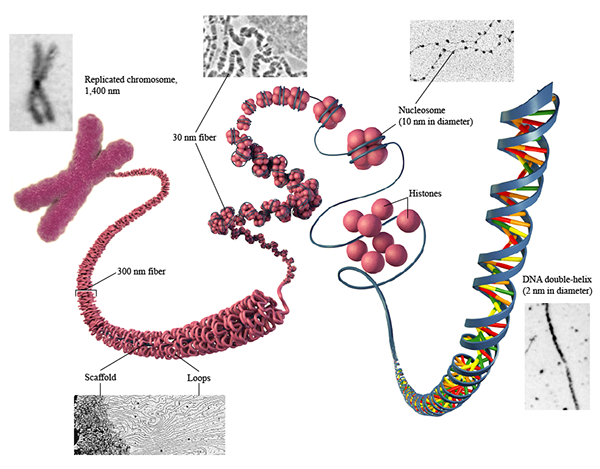

 ?oh=b3cf44509911cdb7a20ffc814020991e&oe=59FDB8AB
http://www.scientificlib.com/en/Biology/Molecular/images/GeneticCode21.jpg
Me,
Awesome graphics. Thanks.
Some codons code for a single amino acid. Other amino acids are coded by up to six codons. Often just the first two “letters” matter, so the third can be any one of the four nucleobases. Since we’re dealing with tRNA, the fourth base is uracil rather than thymine.
We know that human chromosome #2 resulted from the fusion of two smaller, standard great ape chromosomes, since its “centromere” is actually two fused telomeres and the real centromeres are in the arms above and below this end-on fusion. So humans have only 47 pairs of chromosomes rather than 48, as in chimps, gorillas and orangutans. This gross chromosomal mutation is associated with our bipedal gait.
Speaking of mutations, this breaking genetic news just in!
The mutation for blue eyes happened only once. All blue-eyed people descend from a common ancestor who lived not that long ago. Apropos of the “5500 year” meme, this happened between just 6000 and 10,000 years ago.
https://www.sciencedaily.com/releases/2008/01/080130170343.htm
“New research shows that people with blue eyes have a single, common ancestor. Scientists have tracked down a genetic mutation which took place 6,000-10,000 years ago and is the cause of the eye color of all blue-eyed humans alive on the planet today.”
OK, it’s not breaking news. The story is from 2008. But you have to love that it’s from Blue-Eyed Control Central, Copenhagen!
Has this topic been sufficiently flogged? Can we move on, folks?
Most of the flogging has been off the topic of this post.
The Mooch has resigned, I guess due to his outburst against Priebus.
RNA is a wonderful molecule, pregnant with life. And capable both of catalyzing key biochemical reactions and storing genetic information. And of course adding new information in every generation.
Out of place, but it has gotten hard to find the proper comment to which to respond.