Guest Post by Willis Eschenbach [See Update At End]
Well, Dr. James Hansen, the man who invented the global warming scam and our favorite failed serial doomcaster, recently addressed the cratering of a 30-year prediction he made in 1988.

Back then, he said the globe would warm up by one full degree by 2018 under the “business as usual” rubric … not. Here’s the story as written up in “Spin” magazine in 1988.

Since then we’ve had a continued expansion of fossil fuel use, as in his most alarmist scenario. Given that amount of CO2 emissions, his prediction was that by now, temperatures would have gone up by 1°C (note that the Spin article, as pointed out by Mosh and Tamino among others, is in error).
Obviously, nothing like that has happened. Despite the fact that millions of folks believed his prediction in 1988 and continue to listen to him today, the UAH MSU satellite data says that since 1988 it’s warmed by … well … about a third of a degree. Not one degree. A third of a degree. He was wrong by a factor of 3. So obviously, he needs an excuse for this failure.
Here’s the back story to Hansen’s excuse, published last week under the headline “Climate Scientists Move Global Meltdown from 2018 to 2168” …
And just last week [Hansen] addressed the prospect of further temperature increases during an interview with New York magazine. Keep in mind that Hansen predicted in a greenhouse model that there would be “an increase of from two to five degrees Fahrenheit” in global temperatures by 2018, as quoted from December 1988 edition of Spin magazine.
“I don’t think we’re going to get four or five degrees this century, because we get a cooling effect from the melting ice,” he said last week. “But the biggest effect will be that melting ice. In my opinion that’s the big thing – sea-level rise – because we have such a large fraction of people on coastlines, more than half of the large cities in the world are on coastlines.” [Hansen]
Amazing. He’s kicked the old threat of global warming under the bus. Now, it’s morphed into “Global warming won’t cause increased temperature because it just melts the ice but then the sea levels will rise and WE’RE ALL STILL DOOMED!” Once an alarmist, always an alarmist, I guess.
Now, that claim about ice melting had my numeric legend detector ringing like a fire alarm in a cheap whorehouse. It didn’t make any sense that melting that amount of ice would cool us that much, the amount seemed far too small. So I decided to see if that made sense. Sea ice is basically unchanged, so how much land ice is melting? The analysis of GRACE satellite puts it at 500 billion (500e+9) tonnes of ice per year.
Let me go through the calculations, so y’all can identify any mistakes I’ve made. I’m working in the computer language “R”, don’t worry about that, it will all be explained. Things following a hashmark (#) are comments. Lines that start with [1] are the computer output from that instruction above it. A semicolon separates two different instructions on one line.
In the first line below, I’ve created a variable called “latent” and set it to the latent heat of melting for water at zero salinity and zero pressure:. As the comment notes, this is in units of “J/kg”, which is joules per kilogram. Note that the second instruction, the one after the semicolon, “latent” by itself, just prints out the value of the variable “latent”.
> latent = gsw_latentheat_melting(0,0) ; latent # J/kg
[1] 333427
Next, I also create a variable named “ice_mass” and set it to the 500 billion tonnes of ice melted per year.
> ice_mass = 500e9 ; ice_mass # tonnes/year
[1] 5e+11
Then I start the actual calculations. The variable “heat_required” is the calculated number of joules required to melt 500 billion tonnes of ice in one year. As the comment notes, a factor of 1000 is needed to go from J/kg in “latent” to J/tonne to match the ice_mass.
> heat_required = ice_mass * latent * 1e3 ; heat_required # J/yr. “1e3” is to convert kg to tonnes
[1] 1.67e+20
Then I calculate the total joules in one year from a constant flux of one watt per square metre. Since a watt is one joule per second, this is the same as the number of seconds in a year. I use this value a lot so I already have a variable set to this, called “secsperyear”. If I didn’t, it’s just 365.24 days * 24 hrs/day * 60 mins/hr * 60 secs/min
> onewattperm2=secsperyear ; onewattperm2 #joules/m2/year. “secsperyear” is seconds per year
[1] 31556952
Next, I’ve converted joules per square meter per year into total global joules per year by multiplying by 5.11e14, the number of square metres of the earth’s surface.
> onewattglob=surfaream*onewattperm2 ; onewattglob #joules/yr/W. “surfaream” is global surface in square metres
[1] 1.61e+22
And finally, I am able to calculate the number of watts per square metre needed to melt 500 billion tonnes of ice per year … which turns out to be a flux of about one hundredth of a watt per square metre.
> watts_needed=heat_required/onewattglob ; watts_needed #W/m2
[1] 0.0103
Now, bear in mind that as a 24/7 global average, there is about half a kilowatt of total downwelling radiation at the surface (500 W/m2, made up of about 170 W/m2 of solar radiation plus about 330 W/m2 of longwave infrared radiation).
So the 0.01 W/m2 from the melting of the ice is equivalent to a 0.002% change in downwelling radiation. TWO THOUSANDTH OF ONE PERCENT CHANGE!
So what James Hansen is saying to excuse his laughable prediction is that reducing the 500 W/m2 of downwelling radiation to 499.99 W/m2 has reduced the earth’s temperature by two thirds of degrees in thirty years …
Say what? That’s so far off it’s not even wrong!
And even if the GRACE satellite ice-melt estimate is out by a factor of ten, the result is the same. The amount of cooling from even ten times that amount of ice per year would only give us a cooling of a tenth of a W/m2, so instead of 500 W/m2 at the surface, we’d have 499.9 W/m2 … be still, my beating heart …
So as my bad number detector indicated, Jame Hansen is just running his usual con job on the unscientific public. Make a bold prediction for thirty years out, wait twenty-nine years, wave your hands and prevaricate to explain the fact that the prediction has totally cratered … and then make a new prediction, that it’s still gonna happen … but not for a hundred and fifty years.
Hanson has learned something about making predictions, though … he won’t ever have to explain the probable cratering of his new prediction, no worries about that.
By the time that prediction is testable … he’ll be dead.
Maybe that’s some of the dying that Bill Nye the Skeevy Science Guy has been saying is needed to move climate science forwards …
Sometimes I think there will come a time when Jim Hansen runs out of excuses for his plethora of piss-poor predictions … but then I consider the distance from here to the nearest star, and the size of my gorgeous ex-fiancee’s heart, and the number of grains of sand on the beach, and I realize that there is no reason to think that the source of his excuses is any less limitless than those things …
Best of life to each of you,
w.
NOTE: As ever, I request that when you comment you QUOTE THE EXACT WORDS you are discussing, so we can all be clear on your subject.
[Update] As a number of folks pointed out, the Spin article was 100% wrong. Hansen’s model didn’t predict 3° warming by now … it predicted one degree warming. I’ve changed the post to reflect this.
And I was also 100% wrong, to believe a contemporary article rather than go back to the original paper. Mea maxima culpa, my thanks to Mosh, Tamino, and others who pointed it out.
However, this makes no difference to my point. His claims about melting ice are a wild exaggeration. The amount of cooling from the melting of ice is far, far too small to have the effect, whether by now or by the end of the century.
[Update II]
I note that Tamino has a post over at his website responding to my post here, entitled “Does Willis Eschenbach Have Any Honor”.
The answer from my perspective is obviously “Yes” … however, the oh-so-honorable Tamino banned me from his website about a decade ago, which means that he is mounting a cowardly attack on me in a place where I have no way to respond.
Here at WUWT, I made a mistake, which was picked up by Tamino. I corrected the mistake, and thanked him. And obviously, Tamino is free to comment on that here.
In response, Tammy has published a pusillanimous attack on me in a place where he has censored my voice entirely and I am unable to defend myself in even the slightest manner.
I leave it to the reader to determine which of us is honorable.
w.
Willis wrote, “[Update] As a number of folks pointed out, the Spin article was 100% wrong. Hansen’s model didn’t predict 3° warming by now … it predicted one degree warming. I’ve changed the post to reflect this.”
Here’s a rather badly OCR’d version of Hansen’s paper:
http://sealevel.info/hansen1988.pdf
Hansen predicted 1.5 °C of warming for his “Scenario A,” in which emissions increased by 1.5% per year, compounding to an increase of 47% in 26 years.
But <a href="“>CO2 emissions didn’t increase by 1.5% per year. They increased by an average of 1.97% per year, totaling 66% in 26 years
(66%/44%) = 1.4, i.e. 40% higher than Hansen’s Scenario A. So, if Hansen’s calculations for the effect of GHG emission levels on temperature had been correct, we’d have seen about 2°C of warming by now.
The actual increase was about 0.6 °C according to the WoodForTrees temperature index:
http://www.woodfortrees.org/plot/wti/plot/wti/trend
Or about 0.5 °C according to the satellites:
http://www.woodfortrees.org/plot/rss/plot/uah6/trend/offset:0.6/plot/uah6/offset:0.6/plot/rss/trend
Or about 0.6 °C to 1.3 °C according to GISS:
http://www.woodfortrees.org/plot/gistemp/plot/gistemp-dts/trend/offset:0.6/plot/gistemp-dts/offset:0.6/plot/gistemp/trend
http://sealevel.info/Cowtan_GISTEMP_1988-2016.png
Or about 0.5 to 0.8 °C according to HADCRUT:
http://www.woodfortrees.org/plot/hadcrut4gl/plot/hadcrut3vgl/trend/offset:0.6/plot/hadcrut3vgl/offset:0.6/plot/hadcrut4gl/trend
http://sealevel.info/Cowtan_HadCRUT4_1988-2016.png
“But CO2 emissions didn’t increase by 1.5% per year. They increased by an average of 1.97% per year, totaling 66% in 26 years”
Hansen didn’t work it out that way. He describes it in detail in his Appendix B:
He incremented the gas concentrations growth by 1.5%/year for scenario A, not the emissions, as he describes. That is because it is concentrations that his model actually uses. And in fact he didn’t have good actual emission data for CO2, and none for CH4 or other gases (we still don’t have measured emissions for CH4). The actual gas concentrations are given as described here. And the concentrations rose more slowly than scenario B (which in his paper H describes as “perhaps the most plausible”).
As shown in various graphs above, his predictions worked out well.
Dave,
Hansen predicted 1.5 °C of warming for his “Scenario A,” in which emissions increased by 1.5% per year
No, 1.5% increase of the increment rise in CO2 atmospheric concentration. Not emissions.
CO2 emission increase is about twice that of the increase in CO2 concentrations. The biosphere absorbs about half the emissions.
But CO2 emissions annual increment didn’t increase by 1.5% per year. They increased by an average of 1.97%[?] per year, totaling 66%[?] in 26 years
Trace gas scenarios were run from 1982 onwards. Scenario A 1.5% growth rate (atmospheric CO2 increase) starts in that year. That’s 35 years to Dec 2016.
From Appendix B on trace gas scenarios from the paper;
” Specifically in scenario A CO2 increases as observed by Keeling for the interval 1958 to 1981, and subsequently with 1.5% growth of the annual increment.”
Annual atmos CO2 growth rate data from 1959 is here.
It might be well to leave out 2015 and 2016 el Nino years, as el Ninos temporarily bump up CO2 concentrations.
barry July 23, 2017 at 6:00 am
No, emissions. Not concentration.
From Hansen’s paper, emphasis mine:
w.
Willis is right. In their paper Hansen et al repeatedly said it was emissions which were growing at 1.5% per year in Scenario A. Here’s another quote (p.9345, the 5th page in the paper):
The fact that in the Appendix they seem to be expect CO2 concentration to also increase by 1.5% per year in Scenario A simply demonstrates that they didn’t understand the difference. They assumed that if emissions went up by 1.5% per year then concentrations would also go up by 1.5% per year.
That is startlingly naive. That means they were clueless about the existence of strong negative feedbacks, like terrestrial CO2 fertilization / greening feedback, and calcifying coccolithophore feedback in the oceans, which drastically curtail the increase in CO2 concentrations, even as CO2 emissions accelerate.
Part of that naivety is understandable. The strong response of calcifying coccolithophores to CO2 was unknown in 1988. But there really is no excuse for them to not expect that CO2 fertilization & terrestrial greening would curtail the growth in CO2 levels. Wouldn’t you think that at least one of the seven authors would have realized that? It really does seem to be true that alarmist climatologists are no Einsteins.
But that foolishness is not the worst thing about that paper, IMO. The worst thing is that they repeatedly referred to computer model runs as “experiments.”
A computer model run is not an experiment, it is a calculation!
IMO, someone who doesn’t know the difference between an experiment and a calculation should not be allowed to call himself a scientist!
Willis,

“From Hansen’s paper, emphasis mine:”
In that same paper he spelt out the exact basis for his calculation, in Appendix B. His measure of emissions is the change in measured concentrations. For most GHG gases (eg CH4), that is still the only measure. The relevant part is:
His Fig 2 sets it out in terms of concentrations. No measure of CO2 emission other than gas concentration is cited anywhere, with good reason. There wasn’t much global available in 1988, especially land use change emission. In this post Steve McIntyre explains:
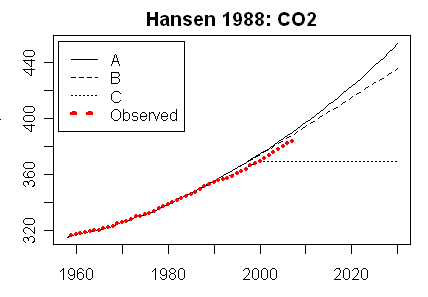
The same post links to the actual numbers for the scenarios; SM plots the various trace gases. Here is his CO2 plot of the scenarios and obs to 2008:
Nick, thank you for this info, especially the link to McIntyre’s article.
For those who, like me, were drawn into the fray by Climategate, and so missed out on those discussions, here are some links:
1. https://climateaudit.org/2008/01/16/thoughts-on-hansen-et-al-1988/
2. https://climateaudit.org/2008/01/17/hansen-scenarios-a-and-b/
3. https://climateaudit.org/2008/01/17/hansen-ghg-concentration-projections/ (McIntyre describes Hansen’s GHG calculations)
4. https://climateaudit.org/2008/01/18/hansen-scenarios-a-and-b-revised/
5. https://climateaudit.org/2008/01/21/radiative-forcing-1/
6. https://climateaudit.org/2008/01/24/hansen-1988-details-of-forcing-projections/ (CFCs dominate long-term forcing)
7. https://climateaudit.org/2008/01/18/publishing-nasa-data-at-realclimate/
and his script is here (for trying to figure out what GHG concentrations Hansen actually used, before that data was finally released on RC):
http://web.archive.org/web/20080130162653/https://climateaudit.org/scripts/hansen/collation.hansen_ghg.txt
I wrote a little python program to try to duplicate the calculations, and compare them with the CO2 values posted on RC. The numbers don’t match very well, but here’s the program:
http://sealevel.info/Hansen1988co2.py.txt
(The output is appended in a comment at the end.)
It is “interesting”† that:
1. Hansen and his six co-authors described a CO2 trend as being the product of a 1.5% annual increase in “emissions,” yet apparently didn’t understand that what they implemented in their code was something very different from that. In I.T. we call that a “bug.”
Or maybe they deliberately misrepresented what they had done, and called it “emissions” for political reasons, to help make the case for curbing “emissions.” (I think that possibility is even worse.)
2. McIntyre discovered that in Hansen’s “scenario A” in the long term the bulk of the forcing ended up coming from CFCs, not from CO2 — a result not useful for supporting a campaign to curb CO2 emissions, and so not mentioned in the paper. Scenario A preposterously projected enormous, endlessly continuing increases in atmospheric CFC levels, even though the Vienna Convention for the Protection of the Ozone Layer had been agreed upon in 1985, and the Montreal Protocol in 1987, to phase out CFCs.
Here’s CFC reality for 2014, in parts per billion (source http://cdiac.ornl.gov/oceans/new_atmCFC.html ):
CFC11: (233.55+231.97)/2/1000 = 0.2328 (a/k/a R11 or CCl3F)
CFC12: (523.36+521.08)/2/1000 = 0.5222 (a/k/a R12 or CCl2F2)
Hansen scenario A (“Potential effects of several other trace gases (such as O3, stratospheric H2O , and chlorine and fluorine compounds other than CCl3F and CCl2F2) are approximated by multiplying the CCl3F and CCl2F 2 amounts by 2”):
CFC11: 1.3495
CFC12: 2.3207
Hansen scenario B:
CFC11: 0.5929
CFC12: 1.0331
Hansen scenario C:
CFC11: 0.2647
CFC12: 0.5132
But Hansen et al wanted their readers to think that Scenario A (+0.5°C/decade) was the realistic one. They wrote [p.9345, the 5th page of the paper]:
And on p.9357 they again used “0.5°C per decade” (from scenario A) for the projection in their discussion:
† horrifying
daveburton July 24, 2017 at 9:27 am
2. McIntyre discovered that in Hansen’s “scenario A” in the long term the bulk of the forcing ended up coming from CFCs, not from CO2 — a result not useful for supporting a campaign to curb CO2 emissions, and so not mentioned in the paper.
And as I pointed out to him at the time, he was wrong!
The paper explicitly points out that CO2 and ‘Other Trace Gases’ (about a third of which was due to CFCs) contributes approximately equally through the 80’s (not the ‘bulk of the forcing’, that’s your exaggeration) and that’s what the model used. Up to then McIntyre hadn’t realized this, he rather grumpily posted that I should have pointed it out to him in an earlier post of his (one that I hadn’t participated in).
To see this you just have to look at Hansen’s Fig. 2 and Fig. B2.
Scenario A preposterously projected enormous, endlessly continuing increases in atmospheric CFC levels, even though the Vienna Convention for the Protection of the Ozone Layer had been agreed upon in 1985, and the Montreal Protocol in 1987, to phase out CFCs.
The work started in 1983, and Scenario A was intended to be an upper limit to the range: “These scenarios are designed to yield sensitivity experiments for a broad range of future greenhouse forcing. Scenario A ,….., must eventually be on the high side of reality….”
“Therefore our procedure has been to consider a broad range of trace gas scenarios”
“Scenario B is perhaps the most plausible of the three cases.”
Phil quoted me writing, “2. McIntyre discovered that in Hansen’s “scenario A” in the long term the bulk of the forcing ended up coming from CFCs, not from CO2…”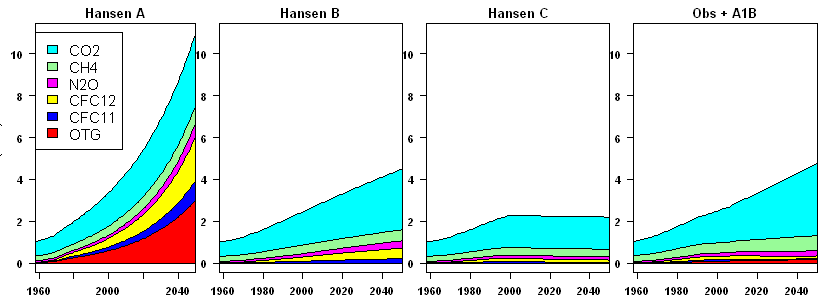
And Phil replied, “And as I pointed out to him at the time, he was wrong! The paper explicitly points out that CO2 and ‘Other Trace Gases’ (about a third of which was due to CFCs) contributes approximately equally through the 80’s (not the ‘bulk of the forcing’, that’s your exaggeration)…”
Phil, I think that you overlooked that I wrote “in the long term” (which I bolded, above). Yes?
Here’s McIntyre’s article:
https://climateaudit.org/2008/01/24/hansen-1988-details-of-forcing-projections/
From what I can see, your claim in 2008 that McIntyre was wrong was, itself, wrong. For instance, consider this graph, which McIntyre created to illustrate the relative “forcing” assumptions in Hansen’s three scenarios:
You (or someone calling himself “Phil”) complained that, “your [McIntyre’s] assessment appears to assume that all of the OTGs are CFCs in fact they are not, the largest forcing in that group is due to Ozone.”
However, for Scenario A Hansen et al approximated the forcings from OTGs [other trace gases] as being exactly equal to the sum of CFC11 + CFC12. (Quoting from the paper: “Potential effects of several other trace gases (such as O3, stratospheric H2O, and chlorine and fluorine compounds other than CCl3F and CCl2F2) are approximated by multiplying the CCl3F and CCl2F2 amounts by 2”.)
So, for the purposes of his calculations, they really were just CFCs.
That seems horribly crude. It’s the sort of very rough approximation that might be appropriate for very minor components of a much larger quantity. But, in this case, as you can see from McIntyre’s graph, those were not minor components. In fact, in scenario A by 2050 CFCs+OTGs (i.e., 2 x CFCs) were about twice as large of a forcing as CO2!
What a botch job that paper was! It is amazing that people still defend it.
Phil also quoted me writing, “Scenario A preposterously projected enormous, endlessly continuing increases in atmospheric CFC levels, even though the Vienna Convention for the Protection of the Ozone Layer had been agreed upon in 1985, and the Montreal Protocol in 1987, to phase out CFCs.”
And Phil replied, “The work started in 1983…”
That’s no excuse. It doesn’t matter when the work started. By the time they published it was clearly nonsense. There’s no excuse for them to have gone ahead and published what they must surely have known was nonsense.
And Phil continued, “…and Scenario A was intended to be an upper limit to the range: “These scenarios are designed to yield sensitivity experiments for a broad range of future greenhouse forcing. Scenario A ,….., must eventually be on the high side of reality…”
No, it wasn’t.
Hansen et al clearly wanted their readers to think that Scenario A (+0.5°C/decade) was the realistic one, for time scales of a few decades. They wrote on p.9345:
And on p.9357 they again used “0.5°C per decade” (from scenario A) for the projection in their discussion:
The key to resolving that apparent contradiction is in the word “eventually,” and the part of the quoted sentence which you elided. Here’s the full sentence; I’ve bolded the parts you skipped:
The parts you left out were their reasons for expecting that scenario A would “eventually” err on the high side, and as you can see the reasons they gave were things that would only constrain emissions on century-level timescales.
For shorter timescales (e.g., thirty to fifty years) they clearly wanted their readers to think that scenario A was the realistic one.
Daveburton,
” even though the Vienna Convention for the Protection of the Ozone Layer had been agreed upon in 1985, and the Montreal Protocol in 1987″
Scenario A was, as you’d expect, the first. Hansen says that the results were presented to a conference in 1984. In any case, you can’t just assume that talk of restricting CFCs will translate into effective action. You should have at least one scenario that covers the case where that doesn’t happen.
The Montreal Protocol wasn’t passed by the US Senate until Mar 14 1988 (after Hansen’s paper). You can’t take these things for granted, you know.
But I can’t see the point of your claim that Scen A overestimated CFCs. As Phil. says, it is exaggerated. But what counts for the success of prediction is the scenario that actually happened. And that is one more reason for discounting Scen A.
daveburton July 24, 2017 at 4:27 pm
Phil quoted me writing, “2. McIntyre discovered that in Hansen’s “scenario A” in the long term the bulk of the forcing ended up coming from CFCs, not from CO2…”
And Phil replied, “And as I pointed out to him at the time, he was wrong! The paper explicitly points out that CO2 and ‘Other Trace Gases’ (about a third of which was due to CFCs) contributes approximately equally through the 80’s (not the ‘bulk of the forcing’, that’s your exaggeration)…”
Phil, I think that you overlooked that I wrote “in the long term” (which I bolded, above). Yes?
No, McIntyre made the following claim: “Scenario A increases are dominated by CFC greenhouse effect. In Scenario A, the CFC contribution to the Earth’s greenhouse effect becomes nearly double the CO2 contribution during the projection period. This is not mentioned either in Hansen et al 1988 or in Schmidt (realclimate, 2007).” My quotation, which you truncated, refuted this statement, clearly it was mentioned. McIntyre didn’t discover anything, he failed to read the paper accurately.
From what I can see, your claim in 2008 that McIntyre was wrong was, itself, wrong. For instance, consider this graph, which McIntyre created to illustrate the relative “forcing” assumptions in Hansen’s three scenarios:
You (or someone calling himself “Phil”) complained that, “your [McIntyre’s] assessment appears to assume that all of the OTGs are CFCs in fact they are not, the largest forcing in that group is due to Ozone.”
However, for Scenario A Hansen et al approximated the forcings from OTGs [other trace gases] as being exactly equal to the sum of CFC11 + CFC12. (Quoting from the paper: “Potential effects of several other trace gases (such as O3, stratospheric H2O, and chlorine and fluorine compounds other than CCl3F and CCl2F2) are approximated by multiplying the CCl3F and CCl2F2 amounts by 2”.)
Again you’ve failed to read correctly, the graph McIntyre produced which you copied showed in red a quantity he referred to as OTG, these were the species referred to by Hansen as “speculative” and only included in Scenario A, (O3, stratospheric H2O, and Cl and F compounds other than F11 and F12). Over half of that forcing group was shown by Hansen to be due to O3 which is what I was referring to. McIntyre’s OTG are not the same as the ‘trace gases’ shown in Hansen’s Fig 2.
That seems horribly crude. It’s the sort of very rough approximation that might be appropriate for very minor components of a much larger quantity. But, in this case, as you can see from McIntyre’s graph, those were not minor components. In fact, in scenario A by 2050 CFCs+OTGs (i.e., 2 x CFCs) were about twice as large of a forcing as CO2!
Appropriate for ‘speculative trace gas changes’, which were only included in the scenario which was intended to describe an extreme upper bound!
Phil also quoted me writing, “Scenario A preposterously projected enormous, endlessly continuing increases in atmospheric CFC levels, even though the Vienna Convention for the Protection of the Ozone Layer had been agreed upon in 1985, and the Montreal Protocol in 1987, to phase out CFCs.”
And Phil replied, “The work started in 1983…”
That’s no excuse. It doesn’t matter when the work started. By the time they published it was clearly nonsense. There’s no excuse for them to have gone ahead and published what they must surely have known was nonsense.
The results for Scenario A were published in 1984, prior to the agreements mentioned. Also note that while the agreements resulted in the phase out of ODPs they were replaced by potent GHGs which would be components of McIntyre’s OTG. (HCFCs etc)
And Phil continued, “…and Scenario A was intended to be an upper limit to the range: “These scenarios are designed to yield sensitivity experiments for a broad range of future greenhouse forcing. Scenario A ,….., must eventually be on the high side of reality…”
No, it wasn’t.
It absolutely was, if they were trying to do what you suggest they certainly wouldn’t have emphasized the range of forcing, wouldn’t have said “Scenario B is perhaps the most plausible of the three cases”, or included in only Scenario A forcing they described several times as “hypothetical or crudely estimated” and “speculative”, or said “results obtained for our three scenarios provide an indication of the expected climate response for a very broad range of assumptions about trace gas trends”.
The parts you left out were their reasons for expecting that scenario A would “eventually” err on the high side, and as you can see the reasons they gave were things that would only constrain emissions on century-level timescales.
Really, that contradicts your earlier statement about the impending (in 1984-8) agreements to curtail what they showed to be a major Greenhouse contributor.
Yes, he used the word ’emissions’ in the main text, which has caught people out before. The actual forcing was based on concentration, as Steve McIntyre pointed out years ago. Appendix B on scenario A is the nitty gritty, beginning with the word “specifically.”
in other words barry, you are using the fact that Hansen was an extremly sloppy/poor paper writer as your excuse for why he was so wrong. ok. *shrug*
The appendix is unequivocal. The problem is sloppy reading.
Of course the forcing is based on cocentration, but you CANNOT get to the PROJECTED forcing WITHOUT assuming certain emissions. His worst case emission assumptions were abot 30 percent underestimated.
There were no observational emissions estimates in the paper. Nothing to base an analysis on.
All the scenario growth rates where the word “emissions” is in the sentence are exactly the same as the concentration growth rates, per the appendix. If any of the growth values referred to actual emissions, they would be different from the concentration growth values. Emissions –> concentration is not 1 for 1.
It’s a language thing. Though the term “emissions” appears a few times in the paper, it’s actually used (unlike now) as a property of concentrations.
I’d be glad to say I’m wrong if you can point to a CO2 emissions estimate in Gt or equivalent in the paper. There’s just no data for it – unlike CO2 concentration.
David A July 23, 2017 at 11:51 pm
Of course the forcing is based on cocentration, but you CANNOT get to the PROJECTED forcing WITHOUT assuming certain emissions. His worst case emission assumptions were abot 30 percent underestimated.
daveburton July 23, 2017 at 3:28 am
Hansen also got the resultant CO2 levels wildly wrong, because he didn’t understand the powerful negative feedbacks which have curbed the growth in CO2 levels levels.
The two Davids keep pushing this false idea that Hansen underestimated the future CO2 concentrations, in fact as Nick, barry and others have pointed out his projections were remarkably accurate!
Here are Hansen’s projections for the last few years:
A B
2014 400.6 396.7
2015 403.0 398.6
2016 405.4 400.5
According to the WMO the global average CO2 concentration was 400ppm in 2015 so Hansen’s assumption from 30 years ago that Scenario B was the most likely was very accurate.
The appendix is only unequivocal because its what you want to believe. Appropriately enough there are three scenarios:
1) Hansen used the term he meant to use thoughout the paper and botched the term in the appendix.
2) Hansen used the term he meant to use in the appendix but botched it throughout the rest of the paper
3) Hansen used the terms interchangeably having botched the differnce between them
None of those scenarios reflect well on Hansen and his abilities (perhaps if he spent less time as an activist and more time as a scientist, he wouldn’t have made the mistakes he did). But lacking any evidence as to which of the above scenarios Hansen meant, one has to take them as all equally likely, not that it matter, under and scenario he was wrong then, he’s wrong now. and no amount of excuse making on your part changes that.
Version 2, but the editorializing doesn’t account for the history.
The paper was written before states agreed to the UNFCCC protocols on GHG monitoring and inventorying. Estimates of annual global CO2 emissions prior to that were sketchy, but the concentration record from 1958 was very solid. This was the basis for the model forcings and the CO2 scenarios, and what “emissions” refers to.
Times have changed. We now have more solid inventories for emissions and better estimates of historical emissions as a result, and the meaning of the term has evolved.
Even if, for the sake of argument, emissions in that paper referred to anthropogenic output, claims that “Hansen was wrong” can’t be verified without knowing what Hansen believed annual anthro emissions to be at the time. If they were believed then to be different to historical estimates we have today, if the then perceived increment was different, then the 1.5% increase on that increment would have a different result *today*.
But there are no mentions of any emissions values, and no reference to such inventories in the reference list at the end of the paper. People above are using modern estimates of historical emission rates, which obviously, they didn’t have back then.
One could as well argue Carl Sagan was “wrong” for calling Pluto a planet.
Phil wrote, “The two Davids keep pushing this false idea that Hansen underestimated the future CO2 concentrations…”
You meant “overestimated,” but that’s okay, I knew what you meant.
You are correct that Hansen’s CO2 numbers (unlike his CFC numbers) were not far off. My mistake: I believed what he wrote in his paper, that his “scenario A” represented a 1.5% annual increase in emissions, when it was actually nothing at all like that.
barry wrote, “…the meaning of the term [“emissions”] has evolved.”
Haha, that’s rich! You must be in the Humpty Dumpty “living, breathing emanations and penumbras” school of scientific scholarship.
Kudos for admitting your mistake, Dave. Have you tried re-running your calculations with the correction?
It will still be impossible to verify if Hansen et al was right or wrong. There is no mention of CO2 emissions or emissions increment in the paper, on which to base an analysis. Had they had some number in mind, it could have been different to the information we have today. But they didn’t have an emissions estimate in the 1988 paper, and no reference to such in the study bibliography. ‘Emissions’ in that paper is a measure of concentration.
Here are my calculations, barry, for CO2 only (not other GHGs):
http://sealevel.info/Hansen1988co2.py
Here’s the output. “Actual” is the measured CO2 level at Mauna Loa. “Calc’d” is the calculated CO2 level according the the algorithm described in their Appendix. “RC” is the actual value which was used, as eventually (more than 15 years late) published on the RC blog. As you can see, in “scenario A” and “scenario B” the CO2 levels are very similar, and both are very similar to the eventual actual levels. The forcing difference is mostly due to other trace gases:
barry wrote, “There is no mention of CO2 emissions or emissions increment in the paper,…”,
Yes there is:
CO2 was one of the “trace gases.”
Of course, what Hansen et al wrote there was wrong. As Steve McIntyre pointed out, since the effect of additional CO2 is logarithmically diminishing, an exponentially increasing CO2 level does not cause forcing from CO2 to increase exponentially; it only increases linearly.
What a botch job that paper was!
That’s why CFCs eventually dominate the forcing in scenario A. The effect of CFCs is assumed to be linear, so as CFC levels increase exponentially so does forcing (unlike CO2). (Of course, if CFC levels were in the hundreds of parts per million, like CO2, rather than hundreds of parts per trillion, that assumption would be wrong, but in the very long term, scenario A becomes even sillier; e.g., the mass of the atmosphere doubles around year 2570.)
Given that amount of CO2 emissions, his prediction was that by now, temperatures would have gone up by 1°C
That’s scenario A. Actual CO2 rise is closer to scenario B (Steve McIntyre agrees – see upthread). CH4 rise is less steep than predicted.
Scenario B has about a 0.7C rise since 1988, give or take.
Despite the fact that millions of folks believed his prediction in 1988 and continue to listen to him today, the UAH MSU satellite data says that since 1988 it’s warmed by … well … about a third of a degree
The model was based on surface air temps. UAH is unable to provide that.
Hansen used GISTEMP surface data for the comparison back then, so using the same data set.
0.56 C rise in temps. A little short of the mark, but not by a factor of 3.
GISTEMP uses sea surface temperatures for the oceans, but the model output is based on global air temps, even over the oceans, which would be a little warmer.
Also worth noting that Hansen’s model had a climate sensitivity of 4.2 K per doubling CO2, a bit higher than the IPCC mean estimate of 3 K.
Might be an interesting exercise to see what climate sensitivity gives the best agreement for the 1988 model compared to air surface obs.
So the miss is an actual .56C surface temperature increase versus a predicted .7C? That seems quite good given the limited computing power available for modeling back in the mid to late 80s.
No, Hansen et al (1988) predicted 0.5 °C / decade for at least the next four decades. After almost three decades (i.e., predicted 1.5°C), we’ve seen only perhaps 0.5 or 0.6°C.
Don’t know if I buy the ice melt is helping cooling the earth off argument.
However is the Hansen predictions vs GISS graph being proffered showing to the peak of the 2016 El Niño? What will including the 2017 anomaly show?
Having asked that, GISS does currently show:
Global Mean Estimates based on Land Data only : An anomaly of 1.25 C for 2016
Global Mean Estimates based on Land and Ocean Data : An Anomaly of 0.99 C for 2016
https://data.giss.nasa.gov/gistemp/graphs/
So was his prediction for 2018 that bad after all?
This post seems to give short shrift to ice in the atmosphere, sea ice, ocean system described by the Stadium Wave Theory and favored by Judith Curry.
The main reason why is if you take a significant regional event, then spread-out the effect to a global average, the effect looks insignificant.
The energy required to melt Greenland’s annual ice sheet mass loss is
likely regionally significant (but I haven’t done any math).
Per the Stadium Wave Theory, energy is moving around the globe with a ~70-90 year cycle. The claim is the Stadium Wave has caused regional sea ice levels in the eurasian to be falling for the last 35 years, but the cycle has peaked and eurasian sea ice should be increasing for the next years.
If curious about the Stadium Wave, I put some current info in this Quora answer and comments:
https://www.quora.com/What-is-the-evidence-that-global-warming-is-caused-by-solar-or-ocean-changes-rather-than-atmospheric-changes/answer/Greg-Freemyer
He didn’t invent it, but he certainly popularized it.
Will not their predictions of increased sever storms actually take place after the climate cools due to the decrease in the output of the sun? If this is the case then should we not then start getting ready? I mean everybody knows how slow governments can be when it comes to actually fixing stuff.
It would be nice to make sure that all of these alarmist do not twist things around and somehow take credit for their predictions coming true also.
It discusses “Global climate changes as forecast by Goddard Institute for Space Studies three-dimensional model” by Hansen et el in Journal of Geophysical Research, 20 August 1988.
Willis,
Thanks for brining this to the public’s attention. You understate the importance of this news! Hansen’s 1988 prediction is one of the most-often cited predictions showing the forecasting skill of climate models.
On March 29 the House Science, Space, and Technology Committee held a hearing on “Climate Science: Assumptions, Policy Implications, and the Scientific Method“. The star witness was Michael Mann — who said this:
The supporting citation Mann gave to Congress is a ten year old blog post: “Hansen’s 1988 projections” by Gavin Schmidt, 15 May 2007. It discusses “Global climate changes as forecast by Goddard Institute for Space Studies three-dimensional model” by Hansen et el in Journal of Geophysical Research, 20 August 1988. But if the evidence for this prediction was strong, why has Hansen — or anybody — not published peer-reviewed confirmation. It would be headline news. Now you have explained why we haven’t seen a cover article in Science about this.
The only peer-reviewed articles about this I found is “Skill and uncertainty in climate models” by Julia C. Hargreaves, WIREs: Climate Change, July/Aug 2010 (ungated copy). She reported that “efforts to reproduce the original model runs have not yet been successful” (the dog ate my homework), so she examined results for the scenario that in 1988 Hansen “described as the most realistic”. How realistic she doesn’t say. There are no comparison of the scenarios vs. actual emissions. Nor can we know how the Hansen’s forecast would change using observations as inputs (i.e., actual hindcasting).
Two other blog posts discuss this forecast: “Evaluating Jim Hansen’s 1988 Climate Forecast” (Roger Pielke Jr, May 2006) and “A detailed look at Hansen’s 1988 projections” (Dana Nuccitelli, Skeptical Science, Sept 2010).
For peer-reviewed journals accepting a Star Wars sting, see http://blogs.discovermagazine.com/neuroskeptic/2017/07/22/predatory-journals-star-wars-sting/#.WXUGT4jytPZ
Who gives a flying fire truck what Mosh or Tamino says;
James Hansen, 2008;
“We’re toast if we don’t get on a very different path – this is the last chance”
He also said that in five to ten years (2008), the Arctic will be free of sea ice in the summer.
https://news.google.com/newspapers?nid=1988&dat=20080624&id=7mgiAAAAIBAJ&sjid=7qkFAAAAIBAJ&pg=5563,4123490
The criticism was that Willis got his news second-hand, via newspaper article, which led to errors. It should be quite evident that news media are a poor substitute for going to source. Hansen may have referred to other predictions in the interview, but here’s what he actually thinks in his own words, rather than a paraphrase from a journalist..
Hansen 2009: “Arctic sea ice will melt away in the summer season within the next few decades.”
http://www.regione.vda.it/energia/notiziario_ultime/allegati/allegato1187ita.pdf
errors that did not materially affect the results. Whether Hansen was off by a factor of ten or a factor of three is irrelevant. The fact remains Hansen was A) wrong and way off base in 1988, and B) wrong today with his melting ice excuse.
And the journalist didn’t paraphrase, he used a direct quote. So either the journalist lied or Hansen changed his tune or is simply inconsistent with his responses vis-a-vis when the ice will melt away in summer. Considering how he’s altered his statement about when a certain highway being flood will occur over the years, the later scenario wouldn’t be much of a surprise
A) Hansen wasn’t wrong. Scenario B, which he considered most plausible is a near perfect match for recent observed CO2 concentrations, and you can see in the graphs in the comments above that recent temperatures also lie close to scenario B.
B) Hard to tell if Hansen is right or wrong. He’s replying to a question about global temps of 4-5C by the end of the century.
Curious as to the precise cooling mechanisms Hansen was thinking of to re cooling, I consulted google scholar and found this 2016 paper.
And the journalist didn’t paraphrase, he used a direct quote
A direct quote from Hansen that ‘the Arctic will be free of sea ice in the summer… in five to ten years’?
Nope, the only direct Hansen quote on the Arctic in that article is about tipping points.
as has been pointed out numerous times in numerous places, he was completely wrong. CO2 is much higher that his worst case scenario and tempuratures (despite numerous modification to the datasets) are *below* his best case scenario. He was wrong then, he (and you) are wrong now.
As has been pointed out here (and by Steve McIntyre), CO2 concentrations follow scenario B most closely.
Possibly people have erroneously calculating growth rate from total annual concentration (emission), rather than 1.5% of the annual increment. The paper is quite clear:
“Specifically in scenario A CO2 increases as observed by Keeling for the interval 1958 to 1981, and subsequently with 1.5% growth of the annual increment.”
And if people are calculating from some base emission value (correctly, annual increment), it would be good if they could point to it in the paper. Had Hansen et al based their calculations on emissions – as in anthro output – they would have provided an estimate for the initial increment. But no such value exists in the paper. Hansen did not have access to annual emissions data in their present form.
(If he had some idea of what the initial value and increment of emissions would be, it might well have been different to what we have today – no claim that he was right or wrong about emissions trajectory can be made without these details, and they just don’t exist in the paper)
Could you kindly confirm that Hansen was not directly quoted in the article re summertime sea ice in ‘5 to 10 years’?
barry wrote, “Possibly people have erroneously calculating growth rate from total annual concentration (emission), rather than 1.5% of the annual increment.”
That’s gibberish. Words have meanings. “Emission” & “concentration” do not have overlapping meanings, and never have had, and there’s no such thing as “total annual concentration.”
You’re a smart man, you know better than that, barry. Stop twisting yourself into a pretzel, trying to excuse and defend the misstatements by James Hansen, Reto Ruedy, Fung, Lacis, Rind, Lebedeff, Russell & Stone in their paper. Twisting yourself into a pretzel is unhealthy.
Who cares about sea level in the middle of the ocean (except, maybe, submariners and the destroyers sailors that hunt them)? It is sea level along the coasts where you live that is important.
Exactly. I saw a fearmongering map showing what will be submerged by rising seas. In addition to the Statue of Liberty and Florida, it included the Dead Sea, the Death Valley, the Salton Sea, and the Afar Triangle. For some strange reason, not the Netherlands.
Shame it’s not including the Aral sea. That part of the world could do with some sea level rise. An example of man made climate change and nothing to do with CO2 BTW.
So in the NYT Magazine article, here is the question to James Hansen from the interviewer:
“To think for a minute at the scarier end of the spectrum. If we do end up four or five degrees warmer, within a relatively short period of time — that’s the IPCC’s RCP8.5 scenario, by the end of the century, and that’s not counting some of these dramatic feedback mechanisms, what would that do to the planet, in your mind? ”
And Hansen’s response:
“I don’t think we’re going to get four or five degrees this century, because we get a cooling effect from the melting ice…..”
Everyone who is criticizing WIllis and demanding that he retract the article has totally missed the point. Hansen made that “because we get a cooling effect from the melting ice” remark and Willis looked thoughtfully into the statement. All you people demanding the retraction and jumping on Willis, do you think Hansen is right? We won’t get 4-5 degrees warmer by the end of the century just because of the melting ice?
do you think Hansen is right? We won’t get 4-5 degrees warmer by the end of the century just because of the melting ice?
To be clear, Hansen is saying he doesn’t expect as much as 4-5C warming.
I haven’t missed the point, but Willis did. As you note, Hansen was talking about the end of this century, but Willis calculated the effect of ice melt *today*. 4-5C warming would cause a lot of ice melt.
Willis didn’t take the trouble to investigate what Hansen meant by his comment on melting ice moderating temperature rise by the end of the century – what physical processes he was thinking of. Rather, assumptions were made based on a quote in a music magazine.
So I got curious, went to google scholar, and found this in less than 2 minutes.
Hansen et al (2016)
barry July 24, 2017 at 4:45 am
Thanks, barry. In fact, as I pointed out above, even if ice melt rates were to increase by a factor of 100, which is extremely unlikely, this would only be equivalent to a 1W/m2 change in downwelling radiation … and per the modern climate sensitivity estimates, this would be less than half a degree of cooling.
And yes, any decent climastrologist can come up with a list of feared future climate catastrophes. Collapsing ice sheets, end of oceanic overturning, massive sea level rises of three metres by the end of the century, endless droughts, floods, cyclones … please tell me you don’t actually believe those Hollywood scenarios …
w.
Link is at the bottom of my post just above. Here it is below.
http://kanata-forum.ca/ice-melt.pdf
Hansen didn’t make any remarks in SPIN magazine
Quite right, my mistake – I didn’t pay attention to the fact the Spin Mag ref was within blockquotes.
You quoted him on 4-5C from The Independent (which quoted him from an interview in New York Magazine). I believe the paper he co-authored (at the link) spells out the physical processes he had in mind re his comment. There’s more to it than heat uptake from ice melt alone. For an overview read the section:
3.3 Simulated surface temperature and energy balance
on page 20079, and particularly page 20080.
Another Scott July 23, 2017 at 10:36 pm
Thanks, Scott. At least someone gets it.
w.
Willis, there is a section in that paper that describes the proposed physical processes from melting ice that have a cooling effect on the overall rise in temperature, including changes in AMOC, increased cloud cover, etc.
You have an opportunity to check your assumptions about what Hansen meant by his remark in Spin Magazine. Click on the link. Read the background. if you must skim, you can get an overview under the section:
3.3 Simulated surface temperature and energy balance
Thanks, barry. Unfortunately there is no link, and Hansen didn’t make any remarks in SPIN magazine.
w.
Link is at the bottom of my post just above. Here it is below.
http://kanata-forum.ca/ice-melt.pdf
Hansen didn’t make any remarks in SPIN magazine
Quite right, my mistake – I didn’t pay attention to the fact the Spin Mag ref was within blockquotes.
You quoted him on 4-5C from The Independent (which quoted him from an interview in New York Magazine). I believe the paper he co-authored (at the link) spells out the physical processes he had in mind re his comment. There’s more to it than heat uptake from ice melt alone. For an overview read the section:
3.3 Simulated surface temperature and energy balance
on page 20079, and particularly page 20080.
(I posted in this in the wrong sub-thread above, feel free to delete the one above, mod. And thanks for tending to posts so promptly)
OK, found it. Thanks for the link, barry. Sadly, like all this model-based mathturbation, they do not distinguish ModelWorld from the real world in their writings … so I’ve added that. With those additions, it says:
and a bizarre claim:
If we make the ocean colder, it provides more energy for ice melt? How does that work?
So once again it’s worse than we thought … why do these jokers never, ever seem to find negative feedbacks? Their claims are all about how fresh water will play havoc with the AMOC … I’m not seeing it.
Let’s look at a few numbers. He’s claiming that we will get up to 5 metres of sea level rise by 2100. That’s 83 years out, so he’s claiming an average fresh-water addition of about 60 mm per year.
Right now, the 500 billion tonnes of ice melted annually adds about 2 mm/year of fresh water. Assuming the growth in ice melt is roughly linear his claim is that in ModelWorld, by 2100 we will have SIXTY TIMES the ice melt we have now …
Or you could look at it this way. Five metres per century was the most extreme rate during the time we were coming out of the last Glacial. During the glacial, about two miles of ice covered Chicago and much of North America, which (obviously) all melted. And now, Hansen claims we’re going to see that rate of sea level rise again … but there is not any two miles of ice left to melt except in Modelworld.
And to top it off, he says:
Oh, you mean like how CO2 rose for the first 8,000 years or so of the Holocene, while global temperatures fell? Or like how in the geological past we’ve had low CO2 and high temperatures, and other times we’ve had the reverse? And how temperatures fell drastically during the Little Ice Age with no evidence of any change in the setting of the CO2 control knob to make the temperature go down? And how the temperatures then warmed for three centuries or so after the LIA, again with no visible change in the CO2 control knob? If that’s your control knob, it is badly broken.

The climate is one of the most complex systems we have ever studied. Let me be clear.
WE DO NOT KNOW if CO2 is the secret temperature control knob. We have no evidence to back up that claim, and plenty of evidence it’s not true. Now, we have evidence that increasing CO2 will increase downwelling forcing. But the idea that this is the only mechanism at play is a joke. The climate system RESPONDS to warming by increasing cloud cover, as the CERES data clearly shows. All over the tropics the cloud albedo is positively correlated with temperature.
And if the cloud albedo changes by one stinkin’ lousy percent, it would wipe out about 34W/m2 of warming …
Is Hansen guaranteeing that the cloud albedo will NOT change by 1% in response to warming? If he can’t guarantee that, then his whole “CO2 control knob” pile of cards collapses.
Claiming that an increase in downwelling forcing wil perforce cause the climate to warm is as dumb as claiming that an increase in the downwelling forcing on the human body will cause our body temperatures to warm. Complex systems … go figure.
To look at it another way, name me one other hugely complex natural system that is controlled by just one of the many variables that affect it. We have no evidence that all climate variables (of which there are hundreds) will somehow magically all cancel each other out, leaving CO2 as the only one left standing … and given the number of variables and mechanisms at play, that claim is bogus on the face of it.
Now, to me this kind of model-based extrapolation is a joke. The models are not tested, verified, or validated. They do a crappy job hindcasting anything but historical temperatures, like say rainfall. They cannot explain the Little Ice Age, or our emergence from the Little Ice Age. And as the last two decades have proven beyond doubt, they all run too hot.
And you think I should pay attention to them? Sure, you can extend a line for eighty years and claim it represents reality. But to me, that’s just flimflam. Where is the evidence?
Look, barry, if you want to believe this kind of handwaving which is unsupported by any modern data indicating any change in the AMOC or in the overall rate of ice melt, you’re welcome to do so. For me, this is a scam, and on some level Hansen knows it.
The only thing that paper proves is Willis’s Theory of Authorship, which states that the quality of a scientific study goes down by the inverse square of the number of listed authors …
I’m sorry, barry, but handwaving about the AMOC, about which we know very little, is science fiction and not science. Even when the ice was melting at a stupendous rate during the glacial transition, it didn’t drive the temperature down by 3°C or so as Hansen claims, AMOC or not … and if that didn’t kill the AMOC, why should a small rise in CO2 do so?
Finally, I object greatly to the use of the term “Anthropocene”. It has NOT been designated by that name. It is a political gesture that reveals the propagandistic nature of their enterprise. It has nothing to do with science.
Thanks for the paper, barry, but it’s just a polemical alarmist pile of reeking cow exhaust …
w.
do you think Hansen is right? We won’t get 4-5 degrees warmer by the end of the century just because of the melting ice?
It’s not just the heat reduction from the melting, Scott. It’s the flow on effects from ice melt that Hansen proposes will moderate overall warming. Willis’ worthy attempt to account for it is absent these processes, which together provide an estimated negative feedback to global warming.
Wow. So you base your post on an incorrect story from Spin magazine and then chastise Hansen for making a projection, using the knowledge of 30 years ago, which looks like it will be very close to the mark? And further chastise him for saying that temperatures are unlikely to have risen by 4-5C be the end of the century? That’s pretty weak. Seems like the post should be pulled to give you time to rethink what you were trying to say.
No, Mike, a projection that has proven to be way off base and getting further off base every year,
And, Mike, Don’t forget what his scenarios where. Scenario A was business as usually (which is what the world has been doing) Scenario B was growth being reduced (didn’t happen) and Scenario C was man basically goes cold turkey on fossil fuels (obviously hasn’t happened). So while emissions remain above Scenario A, temperatures are below scenario C – IE he got it all wrong.
So while emissions remain above Scenario A
This is based on a mistaken calculation, as acknowledged by daveburton.
You are correct that Hansen’s CO2 numbers (unlike his CFC numbers) were not far off. My mistake: I believed what he wrote in his paper, that his “scenario A” represented a 1.5% annual increase in emissions, when it was actually nothing at all like that.
daveburton has realized that 1.5% is the increase in the increment, not total (kudos to him). All calculations above making that error are void.
temperatures are below scenario C
Not according to the many graphs posted here by skeptics and others.
– IE he got it all wrong.
On current information that doesn’t seem to be the case.
For many reasons, the model/obs comparison is tricky. Eg,
* While CO2 scenario B matches observations most closely, CH4 and CFCs don’t. And the divergence is opposite in sign for both, so the impact is hard to judge.
* The 1988 model output surface air temps over the oceans, while modern global temperature records use SST measurements, rather than air temps above the water. The most appropriate data would be somewhere between the land only record and land/ocean.
* The 1988 model had a high sensitivity – 4.2 K per doubling CO2. It would be interesting to see the results with the mean IPCC estimate of 3 K. (Also to see which sensitivity best provides a match to scenario B)
/ hat tip to Steve McIntyre, who worked most of this out 10 years ago.
John Endicott July 24, 2017 at 7:35 am
And, Mike, Don’t forget what his scenarios where. Scenario A was business as usually (which is what the world has been doing) Scenario B was growth being reduced (didn’t happen) and Scenario C was man basically goes cold turkey on fossil fuels (obviously hasn’t happened). So while emissions remain above Scenario A, temperatures are below scenario C – IE he got it all wrong.
No you have it all wrong!
Scenario A was continued growth in all trace gases including CO2, his projection was that by now CO2 would account for about half of the temperature rise and the other gases the rest.
Scenario B was a reduction in all trace gases.
Scenario C was a reduction to zero growth in all trace gases by 2000.
In fact CO2 is close to Scenario B as shown by Nick’s graph above. The other trace gases have followed close to Scenario C.
As a result his temperature projection would be expected to be close to Scenario B, which it is as you can see from this other graph for Nick (last data point a bit high due to recent El Niño).
Thanks to Barry and Phil for injecting some reality into Willis’s unjustified (at least based on his post) attack on Hansen.
I note that Tamino has a post over at his website entitled “Does Willis Eschenbach Have Any Honor”.
The answer from my perspective is obviously “Yes” … however, the oh-so-honorable Tamino banned me from his website about a decade ago, which means that he is mounting a cowardly attack on me in a place where I have no way to respond.
Here at WUWT, I made a mistake, which was picked up by Tamino. I corrected the mistake, and thanked him. And obviously, Tamino is free to comment on that here.
In response, Tammy has published a pusillanimous attack on me in a place where he has censored my voice entirely and I am unable to defend myself in even the slightest manner.
I leave it to the reader to determine which of us is honorable.
w.
Tamino showed his true colors long ago.
I am having a rather difficult time ascribing good faith arguments to barry, Phil or Nick Stokes also however.
None have them have significantly addressed the main point of your post which is how far off base Hansen’s calculations were on the effect of melting ice.
Stokes I believe took a cursory stab at it but was easily rebutted by you.
So, unable to refute the main point of the article they continue to pounce on your error and seem to claim some refutation of you when even in their best case for Hansen they seem to come up with his only overestimating temp increase by about double, which of course is tangential to the whole point of your original comment anyway.
And they wonder why people are skeptical.
Nick Stokes and I have been discussing other matters people have brought up, not Willis’ global temp error. Willis acknowledged it and I moved on.
As to Willis’ comments regarding “Hansen’s excuse,” a link to a paper that details the cooling processes Hansen was referring to in his comment in Spin magazine has been provided. Willis’ calculations don’t encompass these processes, and he’s been invited to check his assumptions against it.
Note: Wilis has pointed out that the Hansen 4-5C quote wasn’t in Spin Magazine – it’s from originally from an interview in New York Magazine, re-quoted by The Independent linked in the OP.
seem to claim some refutation of you when even in their best case for Hansen they seem to come up with his only overestimating temp increase by about double
This was my estimate, caveats included.
In short, pretty close to the mark. There are graphs above that show that, too. Willis hasn’t commented much on that at present, so that part of the discussion with him hasn’t progressed much.
Thanks for this most educating and also entertaining conversation, I really enjoyed reading it all even though some arguments got a bit heated.
I laughed when I read daveburtons comment:
Not many people who have read Hansen’s paper think he is unable to calculate that.
I think Hansen came well out of this.
/Jan
Jan Kjetil Andersen, I don’t think you’re paying attention. Hansen’s “proposed cooling mechanism,” which Willis utterly demolished, was not from his 29yo paper. It was what he said in a recent interview, quoted here:
http://www.independent.co.uk/environment/earth-sea-levels-rising-nasa-climatechange-chief-jim-hansen-global-warming-melting-ice-antarctica-a7841026.html
No, Hansen didn’t come out well. What he said was idiotic. He obviously either didn’t bother, or perhaps didn’t even know how, to do the simple arithmetic to see whether his proposed cooling mechanism was possible.
If you can read that article without cringing, some self-examination is in order.
As I read it, the point of the article was that Hansen now used the cooing effect of melting ice as an excuse for having missed in his temperature forecast.
However, as Phil and several others have commented above, Hansen’s forecast was about right so he did not need any excuses.
He mentioned in the interview that if we get an eventual massive melting in the next 150 years, we will have a cooling effect from the melting ice, but he never used that as an excuse for anything.
/Jan
Hansen’s forecast wasn’t even close.
daveburton July 25, 2017 at 2:18 pm
As Gloateus said, Hansen’s forecast wasn’t even close.
And as shown multiple times above Gloateus is flat out wrong!
In actual fact Hansen’s forecast was extremely good.
He and his seven co-authors predicted 0.5 °C / decade for at least the next four decades. After almost three decades (i.e., predicted 1.5°C), the actual rate has been at most about 1/3 of that.
No he did not, Scenario A didn’t get up to 0.5ºC/decade until 2050, his ‘most plausible’ scenario (B) had a rate of ~0.1ºC/decade).
All three of their scenarios ended up being badly wrong in one way or another.
Scenario C was pretty close in its CFC projections, but completely wrong in its CO2 emission behavior and level projections.
Scenario B was quite close to correct for CO2 level projections, but way off in its CFC & CH4 projections, and completely wrong in its description of CO2 emission behavior.
Scenario A was only a little high for CO2 level projections, and low in its description of CO2 emission behavior, but it was completely wrong in its CFC, CH4 and temperature projections
Your reading comprehension is terrible, as stated in the paper the range of the scenarios was meant to cover the range of possible forcing: “results obtained for our three scenarios provide an indication of the expected climate response for a very broad range of assumptions about trace gas trends”
Worse, they also wrongly claimed that its “net greenhouse forcing increases exponentially,” which actually could never happen in the real world:
* It couldn’t happen because of exponentially increasing CO2 levels, because the logarithmically diminishing temperature forcing from rising CO2 concentration meant that an exponentially increasing CO2 level would only yield linearly increasing forcing.
* It couldn’t happen because of CFCs, because of the new ozone protection treaties, for lowering CFC levels, one of which had been signed in 1985, and the other of which was about to be signed, meant CFC levels would be going down instead of up.
* That left only very minor GHGs, like N2O, CH4 (which they couldn’t have known would plateau), and O3.
In their subsequent paper (1989) using the same data they showed that during the 80s CO2 contributed 57% to the total forcing, CFCs contributed 25%, CH4 12% and N2O 6%. Note that as I pointed out to you before CFCs were replaced by HCFCs and HFCs which are also potent GWGs, HCFCs currently exceed F-11 in the atmosphere.
The way they coded it, the only way to get exponentially increasing net greenhouse forcing In their scenario A was to let CFC levels increase to the point of dominating the net forcing.
With falling CFC levels, the only way to get exponentially increasing net greenhouse forcing would have been with preposterous, astronomical increases in very minor GHGs.
Which is why they said that Scenario B was the most plausible one, the 1989 paper addresses the decrease in CFCs due to restrictions imposed in the mid 70s.
https://pubs.giss.nasa.gov/docs/1989/1989_Hansen_ha04700p.pdf
“Thus, if the rate of release of CFCs to the atmosphere can be reduced, there is the potential for a major reduction in the rate of increase of the greenhouse effect. It should be noted that many of the proposed halocarbon substitutes for CFCs contain only fluorine, and, while posing no threat to the ozonelayer, they may still contribute to an increased greenhouse effect.”
Of course, reality was only about 1/3 of that estimate — maybe even less, depending on whose numbers you believe.
As shown reality for temperature is right in the range of their prediction!
As Gloateus said, Hansen’s forecast wasn’t even close.
He and his seven co-authors predicted 0.5 °C / decade for at least the next four decades. After almost three decades (i.e., predicted 1.5°C), the actual rate has been at most about 1/3 of that.
All three of their scenarios ended up being badly wrong in one way or another.
Scenario C was pretty close in its CFC projections, but completely wrong in its CO2 emission behavior and level projections.
Scenario B was quite close to correct for CO2 level projections, but way off in its CFC & CH4 projections, and completely wrong in its description of CO2 emission behavior.
Scenario A was only a little high for CO2 level projections, and low in its description of CO2 emission behavior, but it was completely wrong in its CFC, CH4 and temperature projections
Worse, they also wrongly claimed that its “net greenhouse forcing increases exponentially,” which actually could never happen in the real world:
* It couldn’t happen because of exponentially increasing CO2 levels, because the logarithmically diminishing temperature forcing from rising CO2 concentration meant that an exponentially increasing CO2 level would only yield linearly increasing forcing.
* It couldn’t happen because of CFCs, because of the new ozone protection treaties, for lowering CFC levels, one of which had been signed in 1985, and the other of which was about to be signed, meant CFC levels would be going down instead of up.
* That left only very minor GHGs, like N2O, CH4 (which they couldn’t have known would plateau), and O3.
The way they coded it, the only way to get exponentially increasing net greenhouse forcing In their scenario A was to let CFC levels increase to the point of dominating the net forcing.
With falling CFC levels, the only way to get exponentially increasing net greenhouse forcing would have been with preposterous, astronomical increases in very minor GHGs.
Do you think they knew that? Either they did or they didn’t. Either way is very bad.
Either Hansen and his seven co-authors knew that exponentially increasing net greenhouse forcing was impossible, yet left that nonsense about exponentially increasing net forcing in their paper anyhow, for propaganda purposes (= shocking fraud!), or else they didn’t understand it (= incredible incompetence!)
And that impossible scenario was the scenario they used in their discussions!
Although they admitted on p.9345 that Scenario A’s exponential growth “must eventually be on the high side of reality in view of finite resource constraints [etc.]… [so] Scenario B is perhaps the most plausible of the three cases,” elsewhere in the paper they assumed that scenario A’s projections were realistic for at least the next several decades (and A’s & B’s CO2 projections were similar in that time frame, anyhow).
What’s more, they wrote on p.9343 that, “Scenario B has decreasing trace gas growth rates,” which was wildly wrong for CO2. CO2 emissions actually increased very dramatically, and even the growth rate in CO2 levels continued to accelerate, though much less dramatically.
It is clear that their CO2 level projections for scenarios A & B were close to reality only because they “got lucky.” Although CO2 emissions accelerated faster than they anticipated, negative feedbacks like CO2-fertilization-driven “greening” removed the extra CO2.
On p.9345 they strongly suggested that scenario A was more realistic than scenario B through year 2030:
Likewise, on p.9357 they used “0.5°C per decade” (from scenario A) for the projection in their discussion:
Of course, reality was only about 1/3 of that estimate — maybe even less, depending on whose numbers you believe.
Thank you daveburton.
I think the plot provided by Phil and others above shows another story.
To get 1/3 of the estimate you have to start in 1988, not the 1950 -1980 average, as was Hansens base, and you have to use the satellite measurements of the lower troposphere, not surface measurments.
This has been sufficiently debated and answered by others above.
/Jan
Jan, I don’t know what you mean by “you have to start in 1988, not the 1950 -1980 average,” but here it is both ways.
I usually use WoodForTrees to generate temperature graphs, because it lets you hot-link to the graphs. But it doesn’t show the calculated trend, so this time I’m using screenshots from Kevin Cowtan’s tool.
He has thirteen temperature indices available for graphing. When starting in 1988, the Berkeley Earth index shows the highest rate of the thirteen: 0.201 °C/decade (or .180 °C/decade if you stop before the El Nino). Here’s the graph:
http://sealevel.info/berkley_since_1988_cowtan1.png
The seven non-satellite indices go back to 1950. The highest rate of the seven is 0.144 °C/decade, by GISTEMP. Here’s the graph:
http://sealevel.info/gistemp_since_1950_cowtan1.png
In 1988 Hansen predicted “a warming of 0.5°C per decade” if emissions were not curbed. I do not see how anyone can think prediction that has any resemblance to reality.
From Willis’s updated post:
Back then, he said the globe would warm up by one full degree by 2018 under the “business as usual” rubric … not.
What he said was that under Scenario A it would warm up by ~1.3ºC above the 1950-1981 average and ~1.1ºC under the ‘more plausible’ Scenario B. As of last year it shows ~1.3ºC which will be a bit high because of the El Niño so I don’t think your “…not” is justified.
proverb: pride goes (or comes) before a fall
meaning: if you’re too conceited or self-important, something will happen to make you look foolish.