
Guest essay by Eric Worrall
h/t JoNova – According to renowned Smithsonian Paleontologist Doug Erwin, people who claim we are in the midst of an anthropogenic mass extinction don’t have a clue what a mass extinction actually is.
Earth Is Not in the Midst of a Sixth Mass Extinction
“As scientists we have a responsibility to be accurate about such comparisons.”
NASA / Reuters
PETER BRANNEN JUN 13, 2017
At the annual meeting of the Geological Society of America, Smithsonian paleontologist Doug Erwin took the podium to address a ballroom full of geologists on the dynamics of mass extinctions and power grid failures—which, he claimed, unfold in the same way.
…
Erwin is one of the world’s experts on the End-Permian mass extinction, an unthinkable volcanic nightmare that nearly ended life on earth 252 million years ago. He proposed that earth’s great mass extinctions might unfold like these power grid failures: most of the losses may come, not from the initial shock—software glitches in the case of power grid failures, and asteroids and volcanoes in the case of ancient mass extinctions—but from the secondary cascade of failures that follow. These are devastating chain reactions that no one understands. Erwin thinks that most mass extinctions in earth’s history—global die-offs that killed the majority of animal life on earth—ultimately resulted, not from external shocks, but from the internal dynamics of food webs that faltered and failed catastrophically in unexpected ways, just as the darkening eastern seaboard did in 2003.
…
I had written to Erwin to get his take on the contemporary idea that there is currently a sixth mass extinction under way on our planet on par with the so-called Big Five mass extinctions in the history of animal life. Many popular science articles take this as a given, and indeed, there’s something emotionally satisfying about the idea that humans’ hubris and shortsightedness are so profound that we’re bringing down the whole planet with us.
…
Erwin says no. He thinks it’s junk science.
“Many of those making facile comparisons between the current situation and past mass extinctions don’t have a clue about the difference in the nature of the data, much less how truly awful the mass extinctions recorded in the marine fossil record actually were,” he wrote me in an email. “It is absolutely critical to recognize that I am NOT claiming that humans haven’t done great damage to marine and terrestrial [ecosystems], nor that many extinctions have not occurred and more will certainly occur in the near future. But I do think that as scientists we have a responsibility to be accurate about such comparisons.”
…
“People who claim we’re in the sixth mass extinction don’t understand enough about mass extinctions to understand the logical flaw in their argument,” he said. “To a certain extent they’re claiming it as a way of frightening people into action, when in fact, if it’s actually true we’re in a sixth mass extinction, then there’s no point in conservation biology.”
This is because by the time a mass extinction starts, the world would already be over.
“So if we really are in the middle of a mass extinction,” I started, “it wouldn’t be a matter of saving tigers and elephants—”
“Right, you probably have to worry about saving coyotes and rats.
…
“So you can ask, ‘Okay, well, how many geographically widespread, abundant, durably skeletonized marine taxa have gone extinct thus far?’ And the answer is, pretty close to zero,” Erwin pointed out. In fact, of the best-assessed groups of modern animals—like stony corals, amphibians, birds and mammals—somewhere between 0 and 1 percent of species have gone extinct in recent human history. By comparison, the hellscape of End-Permian mass extinction claimed upwards of 90 percent of all species on earth.
Read more: https://www.theatlantic.com/science/archive/2017/06/the-ends-of-the-world/529545/
Erwin does not rule out the possibility we might somehow trigger a mass extinction in the future. But killing off a few photogenic species simply doesn’t qualify.
Nothing we have done to the climate or the world in general comes anywhere close to the unimaginable circumstances of previous mass extinctions.
Picture previous mass extinctions; the sky darkened for months, maybe years by gigantic impacts or vast volcanic eruptions which lasted for thousands, even millions of years; Poisonous fumes spreading across the entire world, choking the life out of entire continents; A handful of animals and plants somehow scrounging warmth and food from an almost lifeless wasteland.
Compare this nightmarish hellscape to the slight wobble we may have helped introduce to global temperatures, a wobble so small it cannot be reliably differentiated from previous natural wobbles which occurred in the last few centuries. Add the measurable greening of the world which has occurred the last few decades.
This isn’t a mass extinction, this is a blossoming of life such as likely has not occurred for millions of years – all thanks to the fertilisation effect of Anthropogenic CO2.
This is exactly what I have been saying for years. We cannot talk about the future and we are inflicting a great damage to the environment and reducing wildlife populations drastically, but we are not in a sixth mass extinction.
From January 2016:
“If we talk about the future anybody can have an opinion and of course a mass extinction could take place. But if we talk about the past and the present, which are the realms of science, the evidence is not there. We don’t know the current rate of extinction so we cannot say if it is enough to sustain a mass extinction. We track almost every mammal and bird species and their rate of extinction is only about 0.2 per year. Most years no mammal or bird species go extinct. So it does not feel at all as a mass extinction. That is why most scientists don’t believe a mass extinction is taking place.
What is really shocking is the disconnect between science and the general public due to the negative influence of the MSM, even of things that anybody can check. Both the IUCN Red list and the CREO list can be queried by anybody. Go there and check by yourself how many mammal and bird species are we losing every year, and see if that rate can sustain a mass extinction.
I can do the calculations for you: 0.2/year = 20/century Number of mammals + birds species = 15372 Time to extinct 75% at current rate 15372 x 0.75 / 20 = 576 centuries It would take 57 thousand years to cause a mass extinction of mammals and birds at current rates. Obviously in that time you get new species.
This says nothing about the future, but it explains why most biologists don’t believe we are undergoing a mass extinction.
I agree with … the sorry state of marine ecosystems and the need to protect them, but the extinction issue is bogus.
Lets go to the IUCN Redlist query:
http://www.iucnredlist.org/search
It lists 65 fish (actinopterygii) as extinct in the last 500 years.
They list several orders with more than one species:
24 cypriniformes (freshwater)
14 Cyprinodontiformes (freshwater)
8 Perciformes (all aquatic ecosystems)
13 salmoniformes (all spawn in fresh water)
3 siluriformes (freshwater)
Do you start to see a theme? Let’s zoom into the 8 Perciformes species:
Ctenochromis pectoralis (freshwater, not extinct according to Wikipedia)
Etheostoma sellare (freshwater)
Ptychochromis onilahy (freshwater)
Ptychochromoides itasy (freshwater, not extinct according to Wikipedia)
Tristramella intermedia (freshwater)
Tristramella magdelainae (freshwater)
Tristramella sacra (freshwater)
Xystichromis bayoni (freshwater)
Ok so according to official data of the 65 species of fish that we know that have gone extinct at least 62 are freshwater species.
Zero marine fish extinctions known to us caused by man. Obviously the reality doesn’t sell newspapers.”
The extinction of freshwater fish species is mainly due to pollution. More strict regulations for river contamination can solve that problem.
Man “caused” (by declaration) the coelacanth to become extinct … until they found one.
Man does not know many, many things some pretend to know.
Many of the supposed species gone extinct are not species but at best subspecies. The Northern spotted owl and snail darter are examples. Isolated populations of species might be wiped out but no genetic information is lost, since other populations continue.
What gets me is how often these subspecies are used to hinder or stop progress.
https://en.wikipedia.org/wiki/Big_Darby_Creek
https://en.wikipedia.org/wiki/Scioto_madtom
https://en.wikipedia.org/wiki/Madtom
PS Madtoms are about the size of a tadpole.
Gunga,
Yup. All the time.
And also, fake species are used to inflate bureaucratic budgets, as with the USFWS and the supposed “red wolf”, which is a coyote.
Madtoms are the BEST smallmouth bait!
The so-called “red wolf” has been proven to be a complete joke/scam. But to get to the heart of the “red wolf” scam consider this. There were about 450 captured and about 30 – 40 used for breeding. After the capture by the USFWS they were declared extinct in the wild and placed on the endangered species list. What happened to the approx 400 that were not used for breeding??????
That program is on the sh*t list of all time scams!
This applies for instance to the “species” you list in genus Tristamella.
https://en.wikipedia.org/wiki/Tristramella
T. sacra may or may not be extinct. The species is threatened because of drawdown of the Sea of Galilee to provide water for Israel.
It’s easy to inflate “extinctions” by including subspecies or population extirpated in some localities. Even some “extirpations” are only because a species has moved to a more amenable habitat, as Jim Steele has shown.
Some river fish species are limited to a single basin and if extirpated go extinct. They have nowhere to go. Even more extreme is the case of some cave species that are limited to a single cave system. Species that have a very limited range are extremely sensitive to extinction.
Populations if isolated long enough become new species. It is called allopatric speciation.
That we are not in a six mass extinction doesn’t excuse us from protecting nature. Is there a particular reason why there should be more and more of us, and more and more of our domesticated animals and plants at the expense of all the rest of the species?
Yes. There is a reason. Because we can.
Evolution always has winners and losers. It doesn’t matter who wins or loses. Evolution has no ultimate goal. After the Permian extinction, one genus or maybe even species on synapsid covered practically the whole land area of earth, but eventually the diapsids like dinosaurs, pterosaurs, crocodilians, lizards, snakes, tuataras, turtles and marine reptiles won out.
Besides which, a great many species have benefited from the increase in human population.
That’s never been a reason to sensible people. Lots of things we can do and shouldn’t do.
Javier,
What’s the point in “saving” subspecies which might or might not be on their way to “species”? If it costs us nothing, then, maybe OK, but not building dams because of snail darters is absurd.
Cave fish are just blind and otherwise adapted surface fish. Unless they have evolved some useful chemical, what’s the point?
Eventually humans will leave earth or go extinct and the microbes will have it again. Unless we engineer the solar system, in which case we’ll be saving all life. If we don’t, then earth will return to unicellular life in another 500 million years or so, then will become lifeless.
So in the long or short run, there is no point.
Horses would be close to extinction now, like the rhinos, if not for humans. There are only three groups of perissodactyls left, equines, rhinos and tapirs. Clearly the artiodactyls are whipping their asses. They’re on their way out. We rescued horses, and probably donkeys as well. Zebras, not so much.
No matter how much we play god, the life forms that can’t cut it under changed conditions are doomed to go extinct. Unless for some reason we like them or can use them.
Is Man not “natural”?
At the root of your question is the assumption that preserving “Ma’ Gaia”, what is natural, should be Man’s goal at any cost … even at the expense and detriment of Man.
How many living perissodactyl species are there? 17? How many in 100 years? 10, 12?
All the rhinos and taiper are vulnerable. 25% extinguished in a few hundred years. Craps on the Permian event’s rate. Craps on any rate.
@ur momisugly Tony Mcleod…what an idiotic statement!
Tony,
I guess my suggestion that you’re not idiotic was premature.
There will probably be about the same number of perissodactyls in 100 years as now, thanks to human conservation efforts to save dwindling rhinos and equine species. Rhinos were headed for extinction long before people began poaching their horns. Humans haven’t accelerated the background rate of extinction noticeably since the Pleistocene/Holocene boundary. We might have contributed to the demise of the woolly rhino, however.
My point is that perissodactyls have been in decline for millions of years, naturally. Humans have lately slowed their rate of extinction, not accelerated it. Odd-toed ungulates simply can’t compete with the more modern even-toed ungulates, ie ruminants, given the spread of grasslands since at least the Miocene.
Extinction of groups like perissodactyls is natural. They were abundant in the first half of the Cenozoic, and included the largest of all land mammals, but have been on their way out for tens of millions of years.
To compare one group of outdated mammals with the global Permian mass extinction is simply indeed idiotic.
With our continued use of fossil fuels, CAGG (catastrophic anthropogenic global greening) is very possible.
We need to save the planet from this looming threat. Think of the children.
We might lose them in the fields of tall grass, right?
I was thinking more “feed me seymour” but yeah, that works.
did low co2 levels lead to the largest extinction event in the history of the earth?
http://www.breitbart.com/big-government/2017/06/16/america-first-climate/
MARKO, SOON, ET AL: To Put America First Is to Put Our Planet’s Climate First
Moreover, during the Paleozoic and Mesozoic eras, there were long periods during which the levels of CO2 were much higher than today, but the temperatures were far colder. We are not aware of any explanation that squares the man-made global warming theory with that fact.
https://en.wikipedia.org/wiki/Paleozoic
The Paleozoic Era ended with the largest extinction event in the history of Earth, the Permian–Triassic extinction event. The effects of this catastrophe were so devastating that it took life on land 30 million years into the Mesozoic Era to recover.[4] Recovery of life in the sea may have been much faster.[5]
http://www.biocab.org/Geological_Timescale_op_712x534.jpg
Your last statement, “This isn’t a mass extinction, this is a blossoming of life such as likely has not occurred for millions of years – all thanks to the fertilisation effect of Anthropogenic CO2.” has not been subject to peer reviewed quality research. It errors to the same degree that warmers say it is responsible for degradation.
Nor will it be researched because it goes against the political mantra. “Peer-reviewed” and “quality” research may not actually go together—peer-reviewed articles can be words generated by a computer and have no reality whatsoever.
I do agree that a conclusion is being drawn for which we have only observational evidence and a model in our mind of where that goes. The earth is far too complex to know what any separate part will do to the whole. Research may provide clues, but the whole picture is not available.
Pamela, the greening is an observation, rare in climate science! There is no question alarmy types are busy pumping out “peer reviewed” crapola about dangerous greening!
The wondrous science of geology is largely based on the principle of Uniformatarianism, “the present is the key to the past”. Think detective work, forensics. This stuff has been peer reviewed a million times. This works!
Now imagine the greening fringing the Sahel (and all other arid regions on the planet). The Sahel adds another fringe the following year and the first fringe made more robust all driven by rising CO2 and the plants grow quicker plus they need less water. Would you accept this is an exponential process? Would you also accept that this unexpected rapid sequestration of carbon (14% increase in forest area not to mention fattening of the existing ones) reduces the rate of growth of CO2 which would otherwise have been added to the atmosphere? Do we need to do a peer review to decide that the process is also endothermic (cooling) thereby reducing the rate of warming even of the IPCC rate? Now spread this phenomenon over the oceans with the same thing happening with phytoplankton and coccolithispores CaCO3. Think White Cliffs of Dover. It’s a bit of a biochemical Euclid we’re thinking here. You do know the Sahara was once green?
I’ve never ‘met’ this guy, don’t know who or what he is but, I like him.
Even Monckton could hardly have put it better
He’s nailed it in one. Because *that* is what’s being extincted – clues.
Nobody has them anymore. Clues are all dead and gone. Poor old clues
Here’s a recent article about the loss of rare Hawaiin plants, mostly due directly or indirectly to invasive species:
https://qz.com/1007400/the-botanists-last-stand-the-daring-work-of-saving-the-last-samples-of-dying-species/
I wonder. If you were to select a particular reasonably compact area on earth and ask “has the number of species in this location increased or decreased?”, that would be a better indicator of system health than the number of species plannetwide. My understanding is that the modern “extinction” is really more of a homogenization, with species taking advantage of human transport to spread to new habitats (and displacing the natives).
As usual, the experts are years behind WUWT. See here for my previous articles on this subject.
w.
What is particularly silly is not knowing how the number of species existing was estimated. The general procedure is using insecticide on rain-forest tree, and doing a census of the dead insects that fall out. One then estimates how many of the beasties are particular to that species of tree, and then one estimates just how many species of jungle tree there are, and then estimate . . . . There are enough extrapolations in the process that the estimates vary by at least an order of magnitude.
“This isn’t a mass extinction, this is a blossoming of life such as likely has not occurred for millions of years – all thanks to the fertilisation effect of Anthropogenic CO2.”
I thought that anthropogenic CO2 only represented 3% of the 220 PPM increase from the 180 PPM in the 1880’s to the 400 now. If so, how does man get credit for the CO2 greening when anthropogenic CO2 is only around 6.6 PPM out of the 220 PPM increase?
IMO you mean 120 ppm increase.
It is generally accepted, even by Skeptics that man is responsible for most of the 120 ppm rise in CO2, even though man’s yearly contribution constitutes only perhaps 3% of total yearly CO2 emissions. This is because natural sources and sinks generally balance each other out, at least over the time period under discussion.
I suppose that the “fifth mass extinction” was a cataclysmic event, but can we limit its claim to “90% of the fossil record”? The “consensus” is that microbes got a two billion year head start on the rest of us. I’m sure that the gazillions of microbe “species” were just fine with a little extra volcanic activity.
I don’t know why my comments about the Cambrian Explosion always go missing.
This blog prohibits me from commenting on evolutionary explosions, but maybe it will allow me to say that microbes got an over three billion year head start on multicellular fungi, animals and plants. The earliest evidence for life on earth dates from 3.8 to 4.2 billion years ago, while both rocks and molecular clocks agree that animals, at least, arose at most 0.8 to 1.2 billion years ago.
So some 70 to 80% of the history of life on our planet has been exclusively unicellular, although single-celled eukaryotes can be pretty large and complex.
It occurs to me that the greatest mass extinction event in earth history might not have been when cyanobacteria wiped out most anaerobic organisms, but when prokaryotes replaced their protocellular ancestors.
Many anaerobic organisms survived right down to today by hiding out from oxygen, while no protocells survived at all. Today only bacteria, archaea (and maybe viruses) survive from that first transition in the biological evolutionary history of our planet.
The next major transition of course was from prokaryotes to eukaryotes, then from eukaryotic unicells to multicellular organisms, ie fungi and animals in the heterotrophic group (opisthokonts), and plants in the autotrophic group.
Microbes also go extinct in MEEs, but don’t fossilize as easily as large organisms with hard body parts. Probably they are usually less affected, however.
Extinction expert Peter Ward thinks that microbes were little affected by the Permian mass extinction, and, with many others, believes that they might have caused it:
https://www.newscientist.com/article/mg19726421.900-mass-extinctions-the-microbes-strike-back/
I enjoyed that readable and interesting article (plus the link). Thank you Mr. Worrall.
Well this guy just put a target on his back. Maybe the crazies will be too busy flipping out over Trump to notice, though.
Keep in mind how much climate on earth has changed over just the last 400,000 years, never mind 250,000 million years ago. We are but not even a blip on a time-series graph of evolution. Get a perspective! Debating climate change is like debating how many angels can dance on the head of a pin.
http://imgur.com/a/kIdKJ
What size pin are we actually talking about here?
Doug Erwin also said “I think that if we keep things up long enough, we’ll get to a mass extinction, but we’re not in a mass extinction yet, and I think that’s an optimistic discovery because that means we actually have time to avoid Armageddon,”.
Armageddon in Revelations is the name of the place where the final battle between the forces of good and evil will take place and evil will be decisively defeated. We should not avoid Armageddon unless we are part of the forces of evil.
Yup. Har Megiddo in the Galilee, near the base of Legio VI Ferrata, which in 1st century Palestine would have been required to have been defeated for the Roman province to be liberated.
https://en.wikipedia.org/wiki/Legio_VI_Ferrata#In_Judea_and_Palaestina
You seem very confident of which side you are on, like ‘good’ and ‘evil’ are pure attributes that can be allocated to individuals so that each person is either one or the other but not both. This strikes me as an unexamined and, on the face of it, doubtful assumption given actual human experience and the record of history. For example,when the Christian crusaders took Jerusalem, they slaughtered the non-Christian inhabitants, but when Saladhin retook the city, he expelled the Christians and washed the city streets with rose petal waters. Both sides used violence to secure their ends. How would you judge them?
Really? They don’t have a clue? Gosh, I thought they were super smart. I’m going to have to carefully reexamine some of my most basic assumptions.
How many other man-made chemicals are out there in our biosphere, accumulating in our lungs, livers, lymph nodes, and the microorganisms at the base of all our food chains, and children’s future?
I’ve heard there are 90,000; free to combine and recombine with unintended, and unimaginal consequences. The most significant of which will be the extermination of most, if not all, species on this planet, including us homosapians, beginning NLT 2024, or earlier.
Could have been yesterday for all I know. I am fairly positive that tomorrow will never be quite as “good” as yesterday was. Knowing what the end game will be, “Why wait?” becomes a question I am very interested in your thoughts upon.
If I were you Don, I’d probably commit suicide
Cites provided for all that follows in parentheses. Google if you want to learn more. I highly recommend the Jesse Ausubel speech.
 )
)
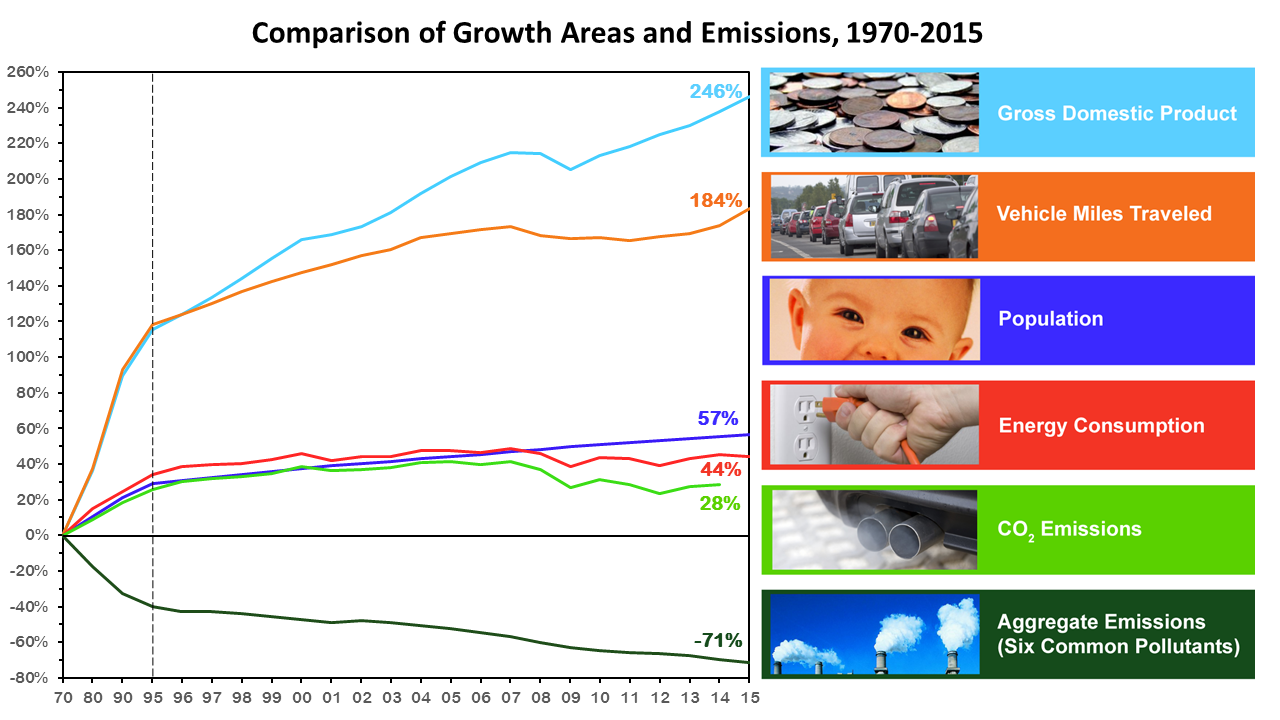
In the real world, according to the EPA emissions in the U.S. of six major pollutants have declined 71% since 1970 and CO2 emissions peaked in 2006. It is clear we are burning fossil fuels cleaner than we ever have, and at the same time the economy is “decoupling” from pollutant and CO2 emissions.
In the real world the planet is thriving. The land based biosphere is estimated to be adding 2 billion tons of mass PER YEAR, providing huge new habitat for biodiversity (Ausubel, Jesse H. 2015. “Nature Rebounds.” Page 7. Long Now Foundation Seminar, San Francisco, 13 January 2015.)
In the real world, North America has more trees today than it did in the year 1900. Remarkable considering the U.S. population was 76 million people then and it is about 320 million today. (NORTH AMERICAN FOREST COMMISSION, St. Andrews, New Brunswick, Canada, 12-16 June 2000)
In the real world, in the U.S. the white-tailed deer population increased from a low of about 350,000 in 1900 to about 15 million in 1984 and to over 28 million by 2010 (McCabe and McCabe 1997, VerCauteren et al. 2011, as cited in the FAA publication, “Wildlife Strikes to Civilian Aircraft in the United States 1990-2013”, July, 2014, page 2). Also in that FAA report, “the resident (nonmigratory) Canada goose population in the USA and Canada increased from about 0.5 million to 3.8 million from 1980 to 2013 (Dolbeer et al. 2014, U.S. Fish and Wildlife Service. 2013). During the same time period, the North American snow goose population increased from about 2.1 million to 6.6 million birds.”
And “Dolbeer and Begier (2013) examined the estimated population trends and numbers for the 21 species of birds in North America with mean body masses >4 lbs and at least 10 strikes with civil aircraft from 1990-2012. Of these 21 species, 17 had shown population increases from 1990-2012 with a net gain of 17 million birds.”
In the real world, the bear population in Massachusetts has increased 9x since 1980, going from 500 bears then to 4500 currently. Granted, the base was low in 1980. So look at nearby Maine. In Maine, the bear population increased from 20,000 to 30,000 in a decade (“Not everyone pleased about flourishing bear population”, Boston Globe, June 20, 2015).
It’s rarely talked about that large animal species at the top of the food chain like bears, deer, wolves, and the largest species of birds in America have greatly expanded their populations; that forest growth is larger than it’s been in a century; that the last breath you took, on average, was 71% cleaner than the breath you took in 1970; that economic output is rapidly decoupling from both pollutant and CO2 emissions. Crop yields either set new records every year or come close. We’ve never had a nationwide crop failure in my life. And of course, there are all the studies showing sea level isn’t rising very much faster than it’s done for hundreds of years; we’ve had the longest CAT-3 or higher hurricane drought since we started tracking their occurrences; the amount of forest and land area destroyed by wildfires annually is a tiny fraction of what it was a century ago, and so on.
The disconnect between what we can measure and observe in the real world today and the hysterical, highly speculative predictions about what may happen a century from now is astonishing. I read chapters from the book, “Extraordinary Mass Delusions and the Madness of Crowds” for a college course. I can’t help but recall it whenever the discussion turns to man made climate change.
+1
Scott, can you flesh this magnificent post out into a WUWT article about the greening and expansion of wildlife populations. Your fine comment is at the end of a thread and too few will have read it.
Besides white tail deer, populations of other weed species such as coyotes and rats have expanded since the European colonization of the Americas. Coyotes have also gotten bigger in the NE US in order to invade former wolf habitat and cities. In the West, they have even killed human children.
http://www.nature.com/news/rise-of-the-coyote-the-new-top-dog-1.10635
Picture previous mass extinctions; the sky darkened for months, maybe years by gigantic impacts or vast volcanic eruptions which lasted for thousands, even millions of years; Poisonous fumes spreading across the entire world, choking the life out of entire continents; A handful of animals and plants somehow scrounging warmth and food from an almost lifeless wasteland.
No that is not a correct characterisation of what Doug Erwin is saying. Mass extinctions are not 100% from environmental violence directly acting on organisms. Instead, the above article itself expresses Erwin’s much more plausible view (in view of the theory of nonlinear networks pertaining to ecosystems and their lifeforms):
“Erwin … proposed that earth’s great mass extinctions might unfold like these power grid failures: most of the losses may come, not from the initial shock—software glitches in the case of power grid failures, and asteroids and volcanoes in the case of ancient mass extinctions—but from the secondary cascade of failures that follow. These are devastating chain reactions that no one understands. Erwin thinks that most mass extinctions in earth’s history—global die-offs that killed the majority of animal life on earth—ultimately resulted, not from external shocks, but from the internal dynamics of food webs that faltered and failed catastrophically in unexpected ways …”
The commentary at the end is not a fair reflection on Erwin’s actual views on mass extinction.
After past mass extinctions, life has always recovered and gone on to evolve ever more complex ecosystems and biodiversity. However, in about 500 million more years, diversity will start declining, reversing the trend to become less diverse. That is, unless intelligence has increased by then to such an extent that earth and the solar system can be engineered to maintain complexity despite changes in the planet and sun.
How do you expect to entice people to read anything that doesn’t forecast or acknowledge catastrophic disaster at the hands of greedy anthropogenic influence? Get with the program man! Nobody wants to hear boring evidence that doom is not eminent.
Easy, pepper the articles with pictures of scantly clad models, or write article that claims AGW will enhance intimacy with their partner.
Doom is more likely to lie in entertaining these never ending neomarxbrothers assaults on civilization And the real environment. It is, in the minimum, a huge burdensome tax holding back economic development and prosperity for the world. We endeavour to turn off the funding for terrorists and they are a lesser threat than the rich environmental terrorist NGOs. Cut these suckers off. We are heading for peak population, 80+% there. We can hurry this blessed state by hurrying global prosperity. Killing the US and European economies is the biggest threat to us all and to the environment. It is deliberate to ensure the survival of these non productive stifles.
How do you expect to entice people to read anything that doesn’t forecast or acknowledge catastrophic disaster at the hands of greedy anthropogenic influence?
Nobody wants to hear boring evidence that doom is not eminent!
Like my Climatastrophologist says,
”90 percent, 1 percent, who’s countin?”
Erwin should stick to paleontology. His comparison with inching up to the event horizon of a black hole is silly and emotional. You would be pulled apart by gravity long before you got there