WASHINGTON, DC — One million miles from Earth, a NASA camera is capturing unexpected flashes of light reflecting off our planet.
The homeward-facing instrument on NOAA’s Deep Space Climate Observatory, or DSCOVR, launched in 2015, caught hundreds of these flashes over the span of a year. NASA’s Earth Polychromatic Imaging Camera (EPIC) instrument aboard DSCOVR is taking almost-hourly images of the sunlit planet from its spot between Earth and the sun. In a new study, scientists deciphered the tiny cause to the big reflections: high-altitude, horizontally oriented ice crystals.

“The source of the flashes is definitely not on the ground,” said Alexander Marshak, DSCOVR deputy project scientist at NASA’s Goddard Space Flight Center in Greenbelt, Maryland, and lead author of the new study in Geophysical Research Letters, a journal of the American Geophysical Union. “It’s definitely ice, and most likely solar reflection off of horizontally oriented particles.”
Detecting glints like this from much farther away could be used by other spacecraft to study exoplanets, Marshak said. He is now investigating how common these horizontal ice particles are and whether they’re common enough to have a measureable impact on how much sunlight passes through the atmosphere. If so, it’s a feature that could be incorporated into computer models of how much heat is reaching and leaving Earth, he said.
Spotting bright flashes
Marshak first noticed light flashes occasionally appearing over oceans as he looked through daily EPIC images. Investigating them further, Marshak and his colleagues found similar reflections from our pale blue dot caught the attention of astronomer Carl Sagan in 1993. Sagan was looking at images taken by the Galileo spacecraft, which launched in 1989 to study Jupiter and its moons. During one if its gravitational-assist swings around Earth, Galileo turned its instruments on this planet and collected data. Sagan and his colleagues used that to test a key question: whether spacecraft could detect signatures of life from afar.
“Large expanses of blue ocean and apparent coastlines are present, and close examination of the images shows a region of [mirror-like] reflection in ocean but not on land,” they wrote of the glints.
Flashes of light reflected off oceans – like those referenced by Sagan – could have a simple explanation, Marshak said: sunlight hits a smooth part of an ocean or lake, and reflects directly back to the sensor, like taking a flash-picture in a mirror.
But when the scientists took another look at the Galileo images, they saw something Sagan and his colleagues apparently missed – bright flashes of light over land as well. As the contact listed on the website that posts all EPIC images, Marshak started getting emails from people curious about what the flashes were.

“We found quite a few very bright flashes over land as well,” he said. “When I first saw it I thought maybe there was some water there, or a lake the sun reflects off of. But the glint is pretty big, so it wasn’t that.”
Instead, he and his colleagues thought of water elsewhere in the Earth system: ice particles high in the atmosphere. They then conducted a series of experiments to confirm the cause of the distant flashes.
First, they cataloged all prospective sunlight glints over land in images from the EPIC camera and found 866 bursts between DSCOVR’s launch in June 2015 and August 2016.
They reasoned that if these 866 flashes were caused by reflected sunlight, they would be limited to certain spots on the globe – spots where the angle between the sun and Earth is the same as the angle between the spacecraft and Earth. When they plotted the locations of the glints with those angles, given Earth’s tilt and the spacecraft’s location, the two matched.
This helped confirm that it wasn’t something like lightning causing the flashes. “Lightning doesn’t care about the sun and EPIC’s location,” Marshak said.
Another feature of the EPIC data helped confirm that the flashes were from a high altitude, not simply water on the ground. Two channels on the instrument are designed to measure the height of clouds, and when the scientists went to the data they found high cirrus clouds, 5 to 8 kilometers (3 to 5 miles) where the glints were located.
(Via NASA Goddard Spaceflight center)
Sun Dogs. Woof! Try monitoring full spectrum audio too. Infra to Ultra, you can hear them bark. Woof!
Space Junk???
A valid hypothesis.
Earth is gradually tuening into a star
Aluminum, barium, and strontium
Sunlight reflecting off of Algore’s ill-gotten pile of treasure?
There are small comets entering the earth’s atmosphere continually. They first were observed by Professor Louis Frank, University of Iowa, Space Physics, in 1981 using imaging equipment one the Dynamics Explorer Satellite. The small comet observations are so disruptive to so much settled science Frank’s observations have universally been panned as impossible. But they have never been refuted. Evidently the earth and probably all the planets travel through a flux of small comets. Huge amounts of water have been recently discovered on Pluto. There shouldn’t be water ice in vast quantities on Pluto’s surface. But there it is.
http://smallcomets.physics.uiowa.edu/news.html
Just wondering if small comets with CO2 on board could be causing some of the CO2 atmospheric rise that is observed?
I have no objection to small comets, but why shouldn’t water ice on Pluto’s surface be there? The New Horizons spacecraft found more than had been expected, not because water ice isn’t common in the Kuiber Belt and beyond, but because on Pluto it’s “bedrock” covered by other ices which hide it.
https://www.nasa.gov/image-feature/pluto-s-widespread-water-ice
Comets from the theoretical Oort Cloud, a thousand times or more farther away than the Kuiber Belt, contain water ice.
I understood the size of Pluto precluded it from having an ancient reservoir of water. Like the moon it should be gone if it was ever there. If it is there, it can’t have been there from the beginning, it must be recent.
What was interesting to me was the apparent chromatic aberration manifested with the color separation of the flashes.
Is this a camera defect or an atmospheric lensing effect ?
The first image shown in the video was so radically different than the still posted, that I assumed it was an illustration and not an actual photo. But if is a legit photo, that would be a rather severe lens inter-reflection. That example also shows what I was expecting from the still image – diffraction spikes. This would be a super-bright reflection, and not a dull spot in order to created diffraction spikes that are so prominent against the background. If this first image is legit, it means the secondary mirror spider probably has two tines suspending it. (It could be one tine, but I’m assuming two because the spikes are so clear and prominent.)
Given that the primary optics in this telescope are mirrors, I’d be shocked if those are from chromatic abberation. That would be some pretty nasty chromatic abberation for a reflecting scope. Instead, I would think that the blue flare at least is an inter-reflections from lens elements and has the different color due to the nature of the anti-reflection coatings on some particular lens element. Maybe the slight red edge to the yellow spike is chromatic abberation. But having that much CA from the center of a mirror optic would really surprise me. I’ve shot a lot of photos using a 1000mm f/10 Russian mirror lens and have never seen CA from sun reflections ever close to that bad. And I have to figure my optics are inferior to NASA’s.
Was the word “Climate” inserted in this program
A) so that it could be named with a really cool acronym,
B) because it’s the only way to get funding for anything,
C) since we’re off to find catastrophic climate change from SUV’s on other planets, or
D) because the probe is looking for a replacement planet with the perfect climate, now that we’ve trashed this one?
One million miles and counting seems to support the “deep space” mission, but heading toward the sun seems like a strange way to study the Earth’s climate.
Who said “and counting”. It is in stable position at a Lagrange point: L1.
Could it be birds being vaporized in a flash of light from solar power towers?
I would think that lightning’s strange relatives, Sprites, Elves, and Blue Jets may be possibly responsible.
Upper-atmospheric lightning or ionospheric lightning are terms sometimes used by researchers to refer to a family of short-lived electrical-breakdown phenomena that occur well above the altitudes of normal lightning and storm clouds. Upper-atmospheric lightning is believed to be electrically induced forms of luminous plasma. The preferred usage is transient luminous event (TLE), because the various types of electrical-discharge phenomena in the upper atmosphere lack several characteristics of the more familiar tropospheric lightning. Their cause is similar to that of sprites, occurring in response to a large, intense lightning strike in a thunderstorm below. The electromagnetic discharge rises up from the storm and spreads out like a ripple from a pebble, near the transition between the stratosphere and the ionosphere.
I remember seeing these before they were formerly named/discovered 25-30 years ago from the perspective of earth. On a clear cloudless night for hundreds of miles around, on a moonless night sometimes one would see flashes of light out of the corner of the eye well over the horizon hundreds of miles away. These intense energy bursts were connecting massive thunderclouds 300+ miles away to significant energy sources in what appears to be the upper stratosphere to the ionosphere They suggest that some of the energy in hyperactive thunderclouds originate and is derived from the ionosphere. Perhaps when the camera on the spacecraft and the source flash are in near perfect alignment, the photo capture is enhanced with the flash of light dead on. I am not sure the jury is in yet on all the details of this recently discovered electrical activity, but would be in the right department for this observation. Just my 2 cents worth…
https://en.wikipedia.org/wiki/Upper-atmospheric_lightning (I condensed part of the article above)
The flash in this picture is over the large Venezuelan lake where they have the huge frequent thunder storms. Maybe the answer is as simple as lighting high up in the atmosphere?
‘Sundogs from Space’
All we have to do is look for other planets that reflect these flashes back into space and presto, a habitable planet just like ours. The similarities would be too good to be true. Just need to shoot a couple hundred thousand more Galileo spacecraft out to locate.
Ok, more seriously, I’d go with the airplane wing reflection, especially since the altitude also works. I see them from the ground occasionally as planes peel out of DFW when the sun is low. The effect is startling, since the reflection is almost as bright as the sun, and visibly moving. Depending on the angles involved, can last 10-15 seconds.
I’m not buying aircraft reflections. The wings largest of the surfaces are not flat but convex so they diffuse not concentrate. As is the fuselage. For a plane to yield the kind of flash you see from them they need to be flying between you and the setting sun and be higher in the sky so you see the reflection off the bottom of the wings. While the underside is relatively flat-ish, planes at least commercial ones rarely fly upside down (at least never more than once).
Somebody using an old Polaroid camera.
Could this be those gamma ray flashes that have been reported from intense thunder storms?
https://en.wikipedia.org/wiki/Terrestrial_gamma-ray_flash
The gammas could ionize air molecules and emit visible light from plasma.
With billions of crystals randomly oriented of course there are sufficient at the right orientation for catching a reflection. Same principle in Xray Diffraction of ground up mineral particles to measure crystal cell dimensions for identification of minerals.
Three quarters of a lifetime ago I wondered if the random orientation of fine mineral crystal faces or cleavage faces in moon dust might show a faint reflection of the earth. Perhaps an image of earth could be teased out of earth shine on the moon. Or an image of the sun from the quarter moon position.
Sun dogs are of similar origin. Also, a field of grass beaded with dew returns a halo with the sun behind you with the shadow of your head at the centre. In some of the several cases in these two posts you have refraction or reflection (Diffraction in the XRD case).
In the mid-1960s, I was stationed in the Air Force at Glasgow AFB, Montana. In mid -winter we would experience ice crystals, where water in the air would sublimate directly into ice crystals, and settle slowly. Ice crystals would be most typical in clear skies with below-Zero F temperatures.
While driving at night, you could see the lights of another vehicle refracted straight up, almost like a vertically directed searchlight, visible from miles away, and rapidly changing direction when the road was curvy. My hypothesis was that the ice crystals were oriented so that the light from headlights was directed vertically, and if seen from above, likely to be as a bright light source below.
This image, http://oddstuffmagazine.com/wonderful-weather-pictures-with-lightning-snow-and-ice-20-pics.html/weather-14 shows an example of this phenomenon.
When this is observed in daylight, the term is “diamond dust.”
Since cirrus clouds are composed of ice crystals, perhaps this phenomenon is related to that which I observed in winter in Montana over 50 years ago.
ROBERT W. ENDLICH
I’m still having difficultly understanding how this could be so directional but “diamond dust” was suggested to me by Judith Curry as reason for this strange direct reflection I saw whilst flying over southern England last year: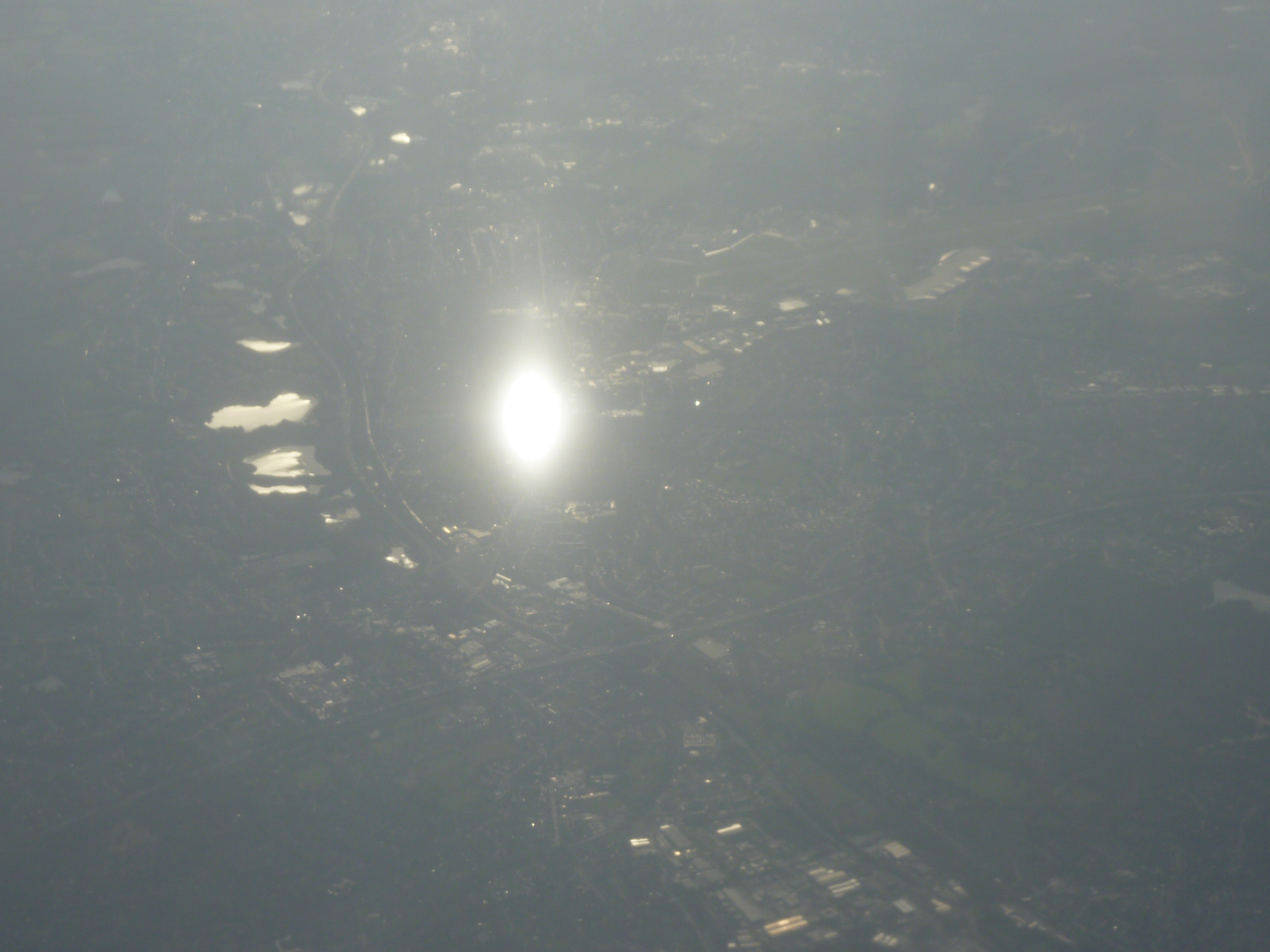
https://climategrog.wordpress.com/cloud_reflection_strong_173/
Can you help explain why light is only sent in one direction? That is the key ‘mystery’ here.
BTW the flihgt was at about 18000ft ( circa 6km ) at the time of the photo. Radiosonde data at mid-day from the nearest reporting station shows ice forming conditions between 2km and 6km altitude.
Greg, it isn’t just in one direction. Another observers a km away from you would see the same thing except it would be different light rays bouncing off slightly differently oriented crystals. You are getting your own personal image. Cool huh?
Ice crystals can act like the droplets that form a rainbow. Water droplets have a reflection-refraction angle of 40º. No doubt ice crystals have a similar set reflection-refraction angle.
The water droplet reflection-refraction angle.
I would say it’s ‘backscatter’ from cirrus clouds (those crystals are linear), you’d only see it when the sun is behind the satellite. Depending on the size of the particles relative to the wavelength the angle that it can be seem from will be quite tight. It seems likely that it’s the same sort of crystals that cause ‘sun dogs’, you see the ‘sun dogs’ when you look towards the sun, when you have the sun at your back you’d see the backscatter.
The image of the vertical refraction of the lights at night from Nebraska
http://oddstuffmagazine.com/wonderful-weather-pictures-with-lightning-snow-and-ice-20-pics.html/weather-14
shows this phenomenon. Near the center bottom there appears to be white auto headlights showing strong vertical refraction. Some of the streetlights show the vertical refraction, but the streetlight with the reflector does not.
I hope this helps.
ROBERT W. ENDLICH
I dont know but im sure it is apocalyptic and only Democrats can save us.
They need to start investigating what causes the flashes of light during earthquakes; They appear for miles around the epicenter of quakes, and nobody has any idea what causes them. This is far more important than reflections of sun off of ice crystals in the atmosphere:
[youtube=https://www.youtube.com/watch?v=Apa_Mh2Rw28&w=640&h=390]
Noctilucent clouds? These are mesospheric water.
Water in the mesosphere is more likely to arrive there from outside the atmosphere.
Exectly: Scientists have found, through extensive study, that the primary source of water in the mesosphere is meteors.
Maybe the primary source of water in the mesosphere is a flux of small comets the earth is constantly passing through as it orbits the sun. I am excited to think these new EPIC camera images are a confirmation of what Prof. Louis Frank observed over thirty years ago using the DISCOVERY’s cameras.
I believe and trust NASA about as much as I believe and Trust Obama!
Show me some more CGI please.
I don’t work for NASA and I can’t do CGI but I can give you another photo of specular reflection from low, ice cloud.
Ohh, sorry. I’m glad I was wrong about you!
when it comes to scattering, the light likes to intensify towards the 180 degree direction. Sometimes called cloud glory.
That was a UFO, beamin’ back at ya. Me and Eric Heisman was down in Mexico two weeks ago and we seen forty of ’em flying in formation. They’ve got bases all over the world now, you know. They’ve been coming here ever since nineteen forty-six – when the scientists first started bouncin’ radar beams off of the moon. And they have been livin’ and workin’ among us in vast quantities ever since. The government knows all about ’em. They are people, just like us – from within our own solar system. Except that their society is more highly evolved. I mean, they don’t have no wars, they got no monetary system, they don’t have any leaders, because, I mean, each man is a leader. I mean, each man – because of their technology, they are able to feed, clothe, house, and transport themselves equally – and with no effort…They don’t reveal themselves to us is because if they did it would cause a general panic. Now, I mean, we still have leaders upon whom we rely for the release of this information. These leaders have decided to repress this information because of the tremendous shock that it would cause to our antiquated systems. Now, the result of this has been that the Venutians have contacted people in all walks of life. Yes. It would be a devastatin’ blow to our antiquated systems – so now the Venutians are meeting with people in all walks of life – in an advisory capacity. For once man will have a god-like control over his own destiny. He will have a chance to transcend and to evolve with some equality for all.
I assume your comment is meant as sarcasm…
it’s definitely funny….