WASHINGTON, DC — One million miles from Earth, a NASA camera is capturing unexpected flashes of light reflecting off our planet.
The homeward-facing instrument on NOAA’s Deep Space Climate Observatory, or DSCOVR, launched in 2015, caught hundreds of these flashes over the span of a year. NASA’s Earth Polychromatic Imaging Camera (EPIC) instrument aboard DSCOVR is taking almost-hourly images of the sunlit planet from its spot between Earth and the sun. In a new study, scientists deciphered the tiny cause to the big reflections: high-altitude, horizontally oriented ice crystals.

“The source of the flashes is definitely not on the ground,” said Alexander Marshak, DSCOVR deputy project scientist at NASA’s Goddard Space Flight Center in Greenbelt, Maryland, and lead author of the new study in Geophysical Research Letters, a journal of the American Geophysical Union. “It’s definitely ice, and most likely solar reflection off of horizontally oriented particles.”
Detecting glints like this from much farther away could be used by other spacecraft to study exoplanets, Marshak said. He is now investigating how common these horizontal ice particles are and whether they’re common enough to have a measureable impact on how much sunlight passes through the atmosphere. If so, it’s a feature that could be incorporated into computer models of how much heat is reaching and leaving Earth, he said.
Spotting bright flashes
Marshak first noticed light flashes occasionally appearing over oceans as he looked through daily EPIC images. Investigating them further, Marshak and his colleagues found similar reflections from our pale blue dot caught the attention of astronomer Carl Sagan in 1993. Sagan was looking at images taken by the Galileo spacecraft, which launched in 1989 to study Jupiter and its moons. During one if its gravitational-assist swings around Earth, Galileo turned its instruments on this planet and collected data. Sagan and his colleagues used that to test a key question: whether spacecraft could detect signatures of life from afar.
“Large expanses of blue ocean and apparent coastlines are present, and close examination of the images shows a region of [mirror-like] reflection in ocean but not on land,” they wrote of the glints.
Flashes of light reflected off oceans – like those referenced by Sagan – could have a simple explanation, Marshak said: sunlight hits a smooth part of an ocean or lake, and reflects directly back to the sensor, like taking a flash-picture in a mirror.
But when the scientists took another look at the Galileo images, they saw something Sagan and his colleagues apparently missed – bright flashes of light over land as well. As the contact listed on the website that posts all EPIC images, Marshak started getting emails from people curious about what the flashes were.

“We found quite a few very bright flashes over land as well,” he said. “When I first saw it I thought maybe there was some water there, or a lake the sun reflects off of. But the glint is pretty big, so it wasn’t that.”
Instead, he and his colleagues thought of water elsewhere in the Earth system: ice particles high in the atmosphere. They then conducted a series of experiments to confirm the cause of the distant flashes.
First, they cataloged all prospective sunlight glints over land in images from the EPIC camera and found 866 bursts between DSCOVR’s launch in June 2015 and August 2016.
They reasoned that if these 866 flashes were caused by reflected sunlight, they would be limited to certain spots on the globe – spots where the angle between the sun and Earth is the same as the angle between the spacecraft and Earth. When they plotted the locations of the glints with those angles, given Earth’s tilt and the spacecraft’s location, the two matched.
This helped confirm that it wasn’t something like lightning causing the flashes. “Lightning doesn’t care about the sun and EPIC’s location,” Marshak said.
Another feature of the EPIC data helped confirm that the flashes were from a high altitude, not simply water on the ground. Two channels on the instrument are designed to measure the height of clouds, and when the scientists went to the data they found high cirrus clouds, 5 to 8 kilometers (3 to 5 miles) where the glints were located.
(Via NASA Goddard Spaceflight center)
I’m sorry, that was me getting another bright idea.
In a twinkling, I knew that was true.
Another flash in the pan.
Umm.
And the science is settled.
Or are we all wrong about that??
Surely whilst things are being found out, the ‘science is’ NOT ‘settled’.
My take – bum boatie only, of course.
Auto
Science is never settled. Ever.
I thought it was ET phoning home.
Science is never settled. Ever.
=====
interesting point. if climate science is settled, then there are no new significant discoveries to be made. otherwise, some new discovery could upset existing theories about climate.
so how do researchers know that there are no new important discoveries out there waiting to be found? how do they know how much it is that they don’t know? Or is the assumption that since we know a lot, there must not be anything important left to discover? what we don’t know isn’t worth knowing?
in which case, why are we funding climate science? if the science is settled, shouldn’t climate move from the scientists to the engineers?
If science is ever settled, then I will have to find another line of work.
My first hypothesis was Warmunist heads exploding. This is why you use the data in real science, not your hypothesis. No matter how much you want it to be true!
So from ice ? Not a hot flash ?
Phew ! So Mother Nature isn’t suffering from menopause ?
Man , they had me worried a little bit ! (;>))
There is no “mother” in nature. It’s just nature.
Some possible explanations:
Some swamp gas reflected the light of Venus
Invading Jovian Gasbag Aliens (sentient hydrogen gas bubbles that feed off the energy of the Big Red Spot) came to take over the Earth, but didn’t didn’t realize they’d spontaneously combust once they hit our atmosphere. Stupid Jovian Gasbag is as stupid Jovian Gasbag does.
Speaking of stupid gasbags, the exploding Jovian Gasbag aliens above aren’t too different from the plot of L. Ron Hubbard’s “Battlefield Earth.” Hmm makes you wonder…
Naomi Oreskes hit menopause with a vengeance aboard an airliner while simultaneously realizing for the first time, the irony of flying aboard a modern fossil fuel powered airplane to attend an international conference seeking to ban the use of fossil fuels
Those killer aboriginal tribes in the Amazon discovered a new killer tooth whitening product.
S.P.E.C.T.E.R. has a secret evil villian lair in the Amazon rain forest, and they’re testing their secret new super rail gun weapon with which they can blackmail the world’s governments for a MMMMILLLLION dollars.
Al Gore said this spot was the darkest spot on the surface of the planet.
It’s the rapture. And if so, and you’re reading this, or if you typed it, you’re what they call “left behind!”
/sarc
I( think it was Hillary signaling the mother ship to beam her up.
Yea they don’t want her either.
Have you ever heard of ‘Anvil clouds’ also called Cumulunimbus (Cb) ? Have you ever seen the top of a well developed anvil, where the ice crystals fan out by the wind, and where they probably fan out in harmony, with their flat sides facing upwards? This my suggestion for solving this mystery.
please…..
Would anyone bSelieve anything NASA would report. NASA is not going to admit anything.
[A bit harsh, is it not? Most of NASA works OK. Except for the parts that are broken by politics and bad engineering. Or bad programming. No budgets. Or bad long-range planning instructions from politicians. 8<) .mod]
How much area does this glint cover of it can be seen so far away?
Or is it just very bright?
Maybe they should compare the glints to the amount of sunlight radiated back to space whenever Gavin or Mann’s heads….er…..egos….go outside….
From the Abstract: “We construct a yearlong time series of flash latitudes, scattering angles and oxygen absorption to demonstrate conclusively that the flashes over land are specular reflections off tiny ice platelets floating in the air nearly horizontally.”
Y’all might need to understand just what is brightness as a function of distance, area. …
This may be like something I witnessed last year flying over southern England: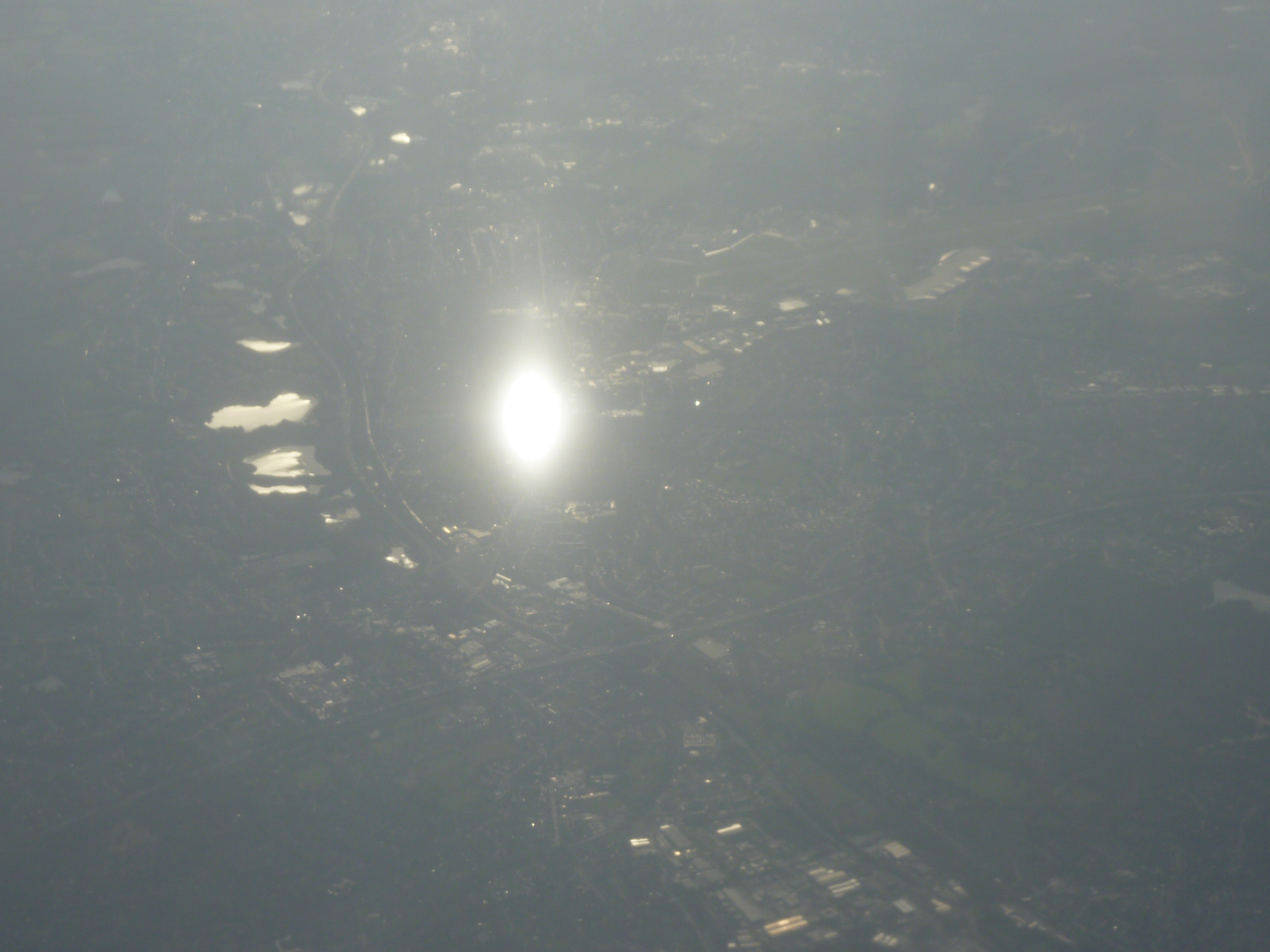
https://climategrog.wordpress.com/cloud_reflection_strong_173/
A very strong directional reflection of the sun. Judith Curry suggested that this may be “diamond dust”: fine ice particles.
I am not clear why the reflection only happens in one direction, but it clearly is very directional otherwise the image would be much broader. Now, presumably the ice crystals are randomly oriented, so what causes this strong reflection is a very sharply defined direction ?
This map shows the water reservoirs identifiable in the photo. It is not reflection from the water.
https://climategrog.wordpress.com/google_farnborough_green-2/
I don’t see any explanation from the DISCOVR team why they expect only horizontal reflections either.
Angled glass oval roof to an office building, or one of the lakes perfectly aligned to reflect the sun at you could do it. Flying northward in texas late afternoon, on a clear day hundreds of such reflextions are momentarily blinding out the port side.
Consider a reflection off a curved surface, it could easily reproduce such an elongated reflection from a round source.
This is a subsun. See Les Cowley’s Atmospheric Optics:
http://www.atoptics.co.uk/halo/subsun.htm
for an explanation.
Not bright enough to produce a flash imagd from a million miles away. Its not a laser, so the intensity will dissipate fairly rapidly.
robert g:
The site you cited (hope I got that right) appears to be the same phenomena as mentioned in the article. From deep space you’ll most likely see only horizontal particles. As the distance between observer and target approaches optical infinity the only reflection back to the observer will be from particles oriented perpendicular to the gravity vector (aka horizontal). Your site expertly demonstrates that the ice particles in cirrus clouds are indeed quite reflective. One might expect that they would reflect in a random directions without some underlying reason to cause them to cohesively align and not merely randomly tumble(my unproven hypothesis). However because the randomness will necessarily cause enough of them to be oriented (Gaussian distribution?) correctly for the observer to see some speculative return. Because we on earth are relatively close to these clouds we observe the occasional “halo” if it catches the sun just right. But the sun is shining on the other side of those clouds so we will only see what gets reflected down to us and we will also see partial refraction (icebows?).
I might expect that whatever portion of the energy that isn’t absorbed by the atmosphere gets glinted off into space. Lost to entropy forever.
Could it be the wind? Are the ice particles asymmetric?
Maybe if fractured, but snow flakes are hexagonally disposed. Wind direction is potentially a reason. One might suspect the drag to align the flakes perpendicularly to the flow. Big updrafts?
Rocketscientist,
I have some nice photos of a subsun and a subsun along with a faint left subparahelion (sundog) that I took on October 26, 2010 on a flight from Ireland to the U.S., but–frustratingly– I don’t know how to “paste” them here.
In any event, it seems to me that an observer from an airplane above the cirrus “sees” an effective “mirror” that occupies a rather small area compared to the “square miles of cirrus” that seem to be contributing to the glints seen in the DSCOVR images.
Perhaps the Ivanpah-like multiplication of “countless” mirrors help to overcome Ristvan’s concerns.
@ur momisugly robert_g, re: images. One option is to make an Imgur* account, upload your photos there and then “paste” links to them in your messages here.
*Imgur is a photo-sharing-for-fun type site – but very left-wing.
The ice crystals are located several miles up and usually require cirrus cloud formations. I doubt you are flying above them.
Or perhaps a glint off one the the layers of your airplane window? These have faked many pilots into thinking theyve just seen a UFO.
Reflection off a satellite or space junk which is in orbit
@robert_g : open a wordpress account is a simple option. Upload your images there then post a link to the image location here. It would be very interesting to see your images.
ristvan May 15, 2017 at 2:44 pm
Not convinced. If that satellite can get clear images of the Earth, sea and land from that distance, it can get an image of the specular reflection. You see in my photos that the “subsun” is much brighter than the land below it. Hubble gets images of stars billions of light years away. They are not coherent laser light either.
Canisdirus May 16, 2017 at 5:53 am
The flight WAS “several miles up” as are most flights at cruise altitude. I posted local radiosonde data showing that ice forming conditions were present in a large range of height below the aircraft. They were lower than “usual” but that is what counts: what actually happened, not what “usually” happens.
Possibly a confirmation of Louis Frank’s small comet observations in the 1980s. http://smallcomets.physics.uiowa.edu/
Clearly nonsense written by a science-denier.
Nonsense Frank was not a science-denier – you are very ignorant about Louis Frank’s work. This is your chance to come up to speed. What is nonsense about this seeking an explanation for the observations?
Mr Bamboo,
I suggest you replace the batteries in your sarcasm detector. 😉
Nah, you’re all wrong.
it’s E.T. phoning home.
(Just a bit careless with the laser carrier.)
Could they be like instantaneous aurorae created by momentary magnetic reconnections in the atmosphere?
http://www.animationmagazine.net/wordpress/wp-content/uploads/scooby-doo-mystery-inc.jpg
Dirty snowballs.
Grade school art projects using old AOL install discs.
“using old AOL install discs”
“Brilliant.”
You can not be cirrius
The gold recordable disks make a beautiful circular rainbow when in the sun, and the surface is angled into a dim area. Silver not so much. So pretty I made a mobile out of them.
Hang them in them garden to keep the birds away.
Well the dryer vent maybe. But the rainbows were stunning!
It’s Earth doing Morse Code. It’s saying “I’m in charge you idiots”.
It was another skeptic being born,
… or an angel getting its wings.
Robert….or a data set’s last burst of truth before being smothered by adjustments….
GISS actually doing space-related earth science? Will wonders never cease!
So they are actually not ‘mysterious’ anymore since it’s been determined what the cause is. Perhaps the headline should read ‘Mystery of Flashes of Light from Earth Solved’.
Well, the explanation seems tentative at best. They say that this is reflection from horizontally oriented ice crystals but fail to explain why only horizontal ones reflect and how they know whether they are horizontal or not.
Exactly. We all can understand why water in a lake or the ocean is oriented horizontally but a mass of tiny ice crystals? By what mechanism?
On another note, I imagine the DoD probably has studied the problem already in a classified study. Wouldn’t this sort of thing look a little like an early warning rocket launch in infrared?
Greg, see my above comment on your earlier thread.
A tumbling crystal would reflect a sweeping beam which would create a tiny momentary flash to an observer who was viewing from the correct angle. Imagine a shiny coin spinning on a table while being lit by a bright light to the side. People sitting around the table looking at the coin would each see a bright blinking reflection of the lamp. The coin in this example has a vertical axis of rotation.
Long ago I flipped some pennies off of a high bridge. The rate of spinning increased as they fell and each penny produced a reflection of the sun which appeared to brighten as the rotation rate increased. They were easily visible for several seconds as they fell into a deep gorge. I could see the sun reflecting off the flat faces of the pennies as I looked down at them because the axis of rotation of each coin was horizontal and the sun was high.
Now imagine billions of flat ice crystals buoyed by an updraft. Each crystal would tumble around a horizontal axis, sweeping the overhead sky with a reflection of the sun.From a single viewpoint the glint from each crystal would be puny and brief. An observer far above would see a continuous combined glint of millions of crystals as long as the angle of view was right. Such a reflection could be seen from aircraft for many minutes. For a spacecraft in orbit the viewing angle would be correct for only a brief moment. In the video above each flash could be seen to grow to max brightness, then fade rapidly after a brief moment of peak brightness.
SR
And an adjacent crystal would also provide a momentary glint towards the observer from a different position. This normal, diffused reflection from cloud and give a white blanket not a clear specular reflection.
It’s the sun glinting of Michael Mann’s head.
Lol 😆 at least Mikey is doing his bit to boost albedo. Other climate warriors should follow his lead and shave their heads in climate solidarity. Every little helps!
So that was the problem. Once the climate models are adjusted for these ice flashes, they’ll be perfect!
I hear their cirrus explanation, but dont buy it. Cirrus is near transparent to sunlight so not a lot of reflection –especially from a plane to the satellite. And the ice crystals are sparse, which is why cirrus is whispy. And themcirrusmice crystals have a variety of spiky shapes and spiky clusters. Goodle images has some samples. And these irregular ice crystals have a random orientation, no different than the random sparkles in fresh cold snow. So could not produce a sensor flash of observed concentrated intensity.
There is, however upward lightning above tstorms (previous recent WUWT post) over both land and sea. And those should appear brightest when the bolt’s path was directly toward the sun and so the intervening sensor, simply because the sensor would ‘see’ the entire propagation full on.
“Them cirrus mice 🐭 ”
Can you expand on this – an intriguing suggestion that high altitude flying mice are holding mirrors to reflect light directly at satellites?
Ptolemy2, don’t be silly. The type of mice that fly at such an alititude don’t have mirrors. However, they do have coats of silvery fur which, when wet or icy, has been shown to be quite reflective. Obviously this is the case, as the photos prove.
Shoild have added, there is a lot more lightning than being seen. Most would not satisfy their orientation test, and. Ould not be seen. But a dead on lightning bolt satisfies thenorientarion test while being brighter to the sensor than regular cloudtop lightning.
If it was lightning, then the satellite would be able to see these flashes even when the satellite isn’t directly between the earth and the sun. From the article it appears that the flashes are seen only when the satellite is lined up between the earth and the sun.
If these images are from cameras at L1 then the satellite is always between the sun and the earth.
High altitude emp test. Lol. If we haven’t observed this in the past it lends to something recently man made.
Aren’t plasmas pretty much opaque to light? I remember reading that it takes the average photon something like a million years to go from the sun’s core to the photoshpere.
I don’t buy the ice crystal explanation either, too random. Could a temperature layer cause a reflection (bend light) much like a mirage?
As your mirage photo shows, only happens at very at low angle of incidence. This is dead on 90 degrees, earth centered.
Could it be reflection off the solar panels of a low-altitude satelite (eg Iridium) passing beneath their satelite?
That is hugely sensitive equipment capturing a single ice crystal. Indeed, if it was that bright it would be seen from the ground with the sun at low insolation angles. It isn’t. However, what is seen are glints and flashes from aircraft surfaces, these can be very bright.
May I suggest that it is far more likely for a remote satellite to see glints off aircraft surfaces than it is to see glints off single ice crystals . William of Occam and all that. There are aircraft over most land areas and many ocean areas continually.
I doubt whether a single ice crystal could even be identified by a glint 100 miles away let alone thousands. A glint of an aircraft wing however is very likely to be seen.
Yes, the ice crystal explanation seems awfully weak to me given the apparent size of the flashes. Sure, glare in a lens can cause a bright spot to flare up and appear much larger than the source.
But a very bright light must reach the lens for that to happen. And given that this is an expensive Cassegrain (reflecting) telescope, I’d think that its refractive optics would have sophisticated, high-quality anti-reflective coatings that would make flares even less likely. But if the source is a direct reflection bright enough to cause flare, you might expect some indication of the signature diffration spikes from the telescope’s spider that mounts the secondary mirror. These spikes wouldn’t be as obvious as what we see in images of stars since we don’t have the deep dark background of a night sky, but you’d think the shape of the flare would be distorted by diffraction from the spider and we’d see that signature as a two, four or six sided pattern (depending on the number of spider tines) in the flare shape. But instead we see an asymmetric yellow blob. Which brings up another question – why is the flare’s color yellow? Wouldn’t a reflection bright enough to cause a flare that exaggerates it size be pretty much white? You would think that a direct reflection bright enough to cause a lens flare would also over-expose the sensor rather dramatically and be pure white.
I have no idea what these flares are. But the explanation given seems pretty weak. Maybe it is merely incomplete? But as it sits, planes seem about as good an explanation as do ice crystals – which isn’t to say that they seem like that good of an explanation either.
Wouldn’t a small comet (20 tons – house-size) disintegrating in the upper atmosphere provide enough ice crystals to reflect light with that specific signature? That is what they say they are observing, ice crystals.
Upon reflection (no pun) maybe the problem is with the use of the terms “sparkling”, “glints” and “flashes.” Are these “flashes” actually brighter than the surroundings? Given that they are yellow, and the clouds are white, it seems that they are actually darker. Calling them reflections may be misleading if they are actually transient areas of higher blue light absorption. Perhaps these are not really bright spots, but actually transient darker areas relative to the surrounding brighter clouds.
Sounds good.
Are these glints on flightpaths?
How about a whopping big cloud of ice crystals? Enough of them could be oriented sufficiently.
My guess is they are other satellites.
It’s just my Delorean when I forget to close the lid on the flux capacitor,
This is Trenberth’s missing energy??!!!
https://en.wikipedia.org/wiki/Desertec#/media
Solar power in north Africa? 😀
A MILLION miles away? 4 times as far away from Earth as the moon! Gotta kinda call bs on this as to why was it looking at Earth and not into deep space? Please.
No, not BS. It’s at the Lagrange point. Stable gravity point between Earth and Sun. Look it up. Or if you are too lazy, here’s a link
https://map.gsfc.nasa.gov/mission/observatory_l2.html
Well “stablish” as it is a meta stable point and without going into the physics suffice it to say that it requires very little energy to “halo about the true point. The James West Space Telescope will be parked in L2 another metastable point beyond Earth’s orbit in line with the sun forever being “eclipsed” by the Earth. But we deploy a sun shield to block what gets by.
Yeah…these things are faaaar away. Any scientist can calculate a number but it takes an engineer to tell you how big a sh*tload that is. Nobody is going out to correct a screwed up lens. That’s why we only get one chance to build and test these things and why it takes so gosh darn long to accomplish.
Sunlight glinting off clouds nearly started WWIII. Soviet satellites were looking for the hot, bright optical signature of rocket engines as a confirmation of launch. With US launches “confirmed”, retaliatory strikes were the standard order.
Luckily, more sceptical views prevailed, and it was soon realized that the bright, hot images of reflected sunlight were mimicking rocket motor signatures.
The article provides a useless video that doesn’t show a single photo or direct evidence of a flash or “reflection.” So very typical for websites that refuse to employ actual journalists and human beings. What’s the point of the article if you don’t visually show what the topic or click-bait headline states?
More internet garbage unfortunately…
Gosh, it’s from NASA, yet you blame me. I suggest you put your complaint there .By the way, I’ve spent over 25 years in radio and television, and I’m a real person. What have you done?
Pepe? Stop it and behave!
Perhaps something supernatural….
http://breadonthewater.co.za/2017/05/15/arise-my-love-the-grave-no-longer-has-a-hold-on-you/
No images, no artist impressions NASA is famous for?
Maybe we should use the “swamp gas” explanation, just as they use for Unidentified Flying Objects.
To me they look like Iridium Flares, I have only ever seen two, but they are predictable on this website:
http://www.heavens-above.com/ The Iridium Satellites are communication satellites in a low polar orbit (485 miles altitude. Every so often their solar cells catch sunlight and direct it groundwards. They can be very bright Mag -8 (by comparison Venus at its brightest is Mag -4).
Couldn’t any satellite with solar panels produce the same flare if they were in the right place at the right time?
That was my first thought – reflections off solar panels on satellites. Those Iridium flares were surprisingly bright for the small size of the solar panels. They were oriented so they would reflect sunlight down of course, but possibly other satellites could reflect light up.
My thoughts exactly. In the same way that we can see the tiny light reflected from satellites above the Earth at night as they spin while orbiting the Earth, the vastness of space probably sees the same kind of “sparkle” magnified by several times without an atmosphere to block it. Satellites (space debris?) reflecting light from the Earth, Sun or Moon.
They would have to be awfully big panels. The ISS (International Space Station) might return a speculative return, but those arrays are huge compared tho that of other systems. The solar arrays are for as much a practical oriented perpendicular to the sun so i would expect a majority of the energy gets reflected back at the sun. As expected these things get hot, so the back side of the arrays is as radiatively black as possible as that is where we place the radiators which are aligned perpendicular to the back side of the array because it would do us much good re-radiating back at the array. That being said you won’t get much reflection off the back side or a well designed array.
Now as satellites pass into shadow they will slew about their arrays to prepare them for “dawn”. Occasionally a terrestrial observer (I being one) will be tracking an satellite across the sky with the naked eye and see a bright flash as these armatures swivel and shine back at us as they prepare for the next cycle. But these glints are small and extremely transient and doubtfully observable from any device that requires any exposure time to capture enough light.
The flares are really cool to track, I have seen dozens of them but have not ever been in the full path of the reflection on the ground. Fun to track and show to your friends though. 🙂
This is about the best explanation so far.
… sun reflecting off a mobile phone, as a science marcher snaps a selfie.
… sun reflecting off a gold tooth, as someone gasps for air, laughing so hard at science marchers.
… the rare methane fart igniting.
And, of course, … another UFO denied by NASA.
That’s all I got. Time to get serious again.
Korean atom bomb tests?