Over the weekend, we reviewed the state of the solar data for March 2017. Now, there’s a two week straight lack of sunspots, the longest stretch since 2010.

Overview
The sun is currently blank with no visible sunspots and this is the 14th straight day with a blank look which is the longest such stretch since April 2010 according to spaceweather.com. Historically weak solar cycle 24 continues to transition away from its solar maximum phase and towards the next solar minimum. In April 2010 – the last time there was a two week stretch with no visible sunspots – the sun was emerging from the last solar minimum which was historically long and deep. There have already been 26 spotless days in 2017 (34% of the entire year) and this follows 32 spotless days last year which occurred primarily during the latter part of the year. The blank look to the sun will increase in frequency over the next couple of years leading up to the next solar minimum – probably to be reached in late 2019 or 2020. By one measure, the current solar cycle is the third weakest since record keeping began in 1755 and it continues a weakening trend since solar cycle 21 peaked in 1980. One of the impacts of low solar activity is the increase of cosmic rays that can penetrate into the Earth’s upper atmosphere and this has some important consequences.

Comparison of all solar cycles since 1755 in terms of accumulated sunspot number anomalies from the mean value at this stage of the solar cycle. Plot courtesy publication cited below, authors Frank Bosse and Fritz Vahrenholt
Third weakest solar cycle since 1755
A recent publication has analyzed the current solar cycle and has found that when sunspot anomalies are compared to the mean for the number of months after cycle start, there have been only two weaker cycles since observations began in 1755. Solar cycle 24 began in 2008 after a historically long and deep solar minimum which puts us more than eight years into the current cycle. The plot (above) shows accumulated sunspot anomalies from the mean value after cycle start (97 months ago) and only solar cycles 5 and 6 had lower levels going all the way back to 1755. The mean value is noted at zero and solar cycle 24 is running 3817 spots less than the mean. The seven cycles preceded by solar cycle 24 had more sunspots than the mean.

Daily observations of the number of sunspots since 1 January 1900 according to Solar Influences Data Analysis Center (SIDC). The thin blue line indicates the daily sunspot number, while the dark blue line indicates the running annual average. Last day shown: 28 February 2017. (Graph courtesy climate4you.com)
Read more at Paul Dorian’s Vencore Weather
No wonder it’s so cold here in the Pacific NW!
Based upon the weather is climate “reasoning” of consensus “climate science”.
“No wonder it’s so cold here in the Pacific NW!”
Yeah: a few years back trees were already blooming at the end of February. 2/3 of March is gone, and no blooms yet on the trees under my balcony.
Grew up there. Auburn Washington is were I’m from. The Pacific Northwest is heaven on Earth.
Oh, please, I remember winter weather in June as far back as 2005 in the NW (Washington/Idaho)
That matches the UK really well. A few years ago the Magnolia trees had started to bloom in the cutover week for Feb/March and they are only just beginning to flower now.
Peaches blooming here is SC! Some damaged in last weeks cold snap though.
Lack of sun spots has reduced propagation of radio waves.
Amateur radio operators are having a hard time of it.
World wide communications depend on skipping off the ionosphere several times to get half way around.
In the good times you could her yours self as the signal bounced all the way around.
In the SH leaves started to fall from the trees by the end of February 2017. Autumn temperatures started even in the beginning of March.
Andrew March 20, 2017 at 5:13 pm
It’s a lot less paradisaical now than in the mid-20th century, or at least from the time the Willamette was cleaned up enough for swimming.
Hordes of refugees from California and New York have ruined the PNW. They don’t get that they’re turning the region into the hell holes from which they so wanted to escape.
Hawthorne and Cherry are blooming….
… not Cherry, Plum.
Not where I live, but that’s in the interior, aka the “Inter-Mountain West”. We’ll be lucky if anything blossoms. However the crocuses have at long last appeared, along with the box elder beetles, so there is hope, which springs eternal.
OK, there are two flowers — one yellow, one red — which are out on the ground. The trees I’m talking of are gnarled ones, with moss & lichen on them. The buds are out, but no blooms.
However it is, my entirely non-scientific perception is that the last two winters were kinda cold around here.
I predict Winters will be kinda cold, forever.
Summers, not as cold. Forever.
I like Florida…really nice from October to May, with some chilly days and a few downright nippy nights.
And then hot as hell and brain meltingly humid from June through September, although it is pleasant during and after the near daily rains.
That is not going to change either.
Pick your spot.
To many stay where they are out of inertia.
People can get used to anything…and if you can get used to freezing your nuts off for six months, you can darn sure get used to laying in the sun next to your pool all Winter instead.
“The Leaves turned early in that year…”
https://youtu.be/0rIIIwvJyZA?t=8m27s
Another chance to get into the possible effects of sunspots on terrestrial weather. I used to think there was a connection, but the evidence is very unclear.
The Stanford Linear Accelerator Web Site used to have pages, with graphics, on how the connection works, but the powers that be forced SLAC to take it down some years ago. I wish I had saved at least the imagery.
Have you looked for it on the Wayback Machine at Internet Archive? I don’t know what timeframe you last saw it on or I’d check it myself. It’s at https://archive.org/web/
I have, thanks.
It’s thoroughly disappeared. SOP for the Carbonista Mafia.
This is similar to one of the SLAC Web site images, showing the muon cascade in secondary cosmic rays, leading to cloud condensation nuclei, but in a different context:
http://physicsopenlab.org/wp-content/uploads/2016/01/muoncascade.jpg
I suppose that Usoskin and Svensmark’s papers show similar graphics.
instead of supposing, go check it out. In any case Svensmark doesn’t matter as his hypothesis has failed.
Not sure why Isvalgaard feels that Svensmark’s work on Aerosol Nucleation is weak. I recall that they have several lab studies showing nucleation at 4-10nm and at >50nm.
That may be, but what is lacking is if that has any measurable effect on the climate.
See e.g.
http://www.leif.org/EOS/swsc120049-GCR-Climate.pdf
“it is clear that there is no robust evidence of a widespread link between the cosmic ray flux and clouds.”
Dr. S at 1:07,
Actually Svensmark’s hypothesis has been repeatedly confirmed:
https://wattsupwiththat.com/2013/09/04/svensmarks-cosmic-ray-theory-of-clouds-and-global-warming-looks-to-be-confirmed/
Actually Svensmark’s hypothesis has been repeatedly confirmed
No, what has been confirmed is that he can make aerosols in the laboratory:
“In experiments where ultraviolet light produces aerosols from trace amounts of ozone, sulfur dioxide,and water vapor, the relative increase in aerosols produced by ionization by gamma sources is constant from nucleation to diameters larger than 50 nm, appropriate for cloud condensation nuclei. ”
Not that that has any influence on the climate. In fact, when we put the hypothesis to the test and look for the effect on climate, there is none [as I have shown].
Dr. S,
The CACA hypothesis relies on lab measurements of the effect of CO2 on hypothetical warming, which has never been demonstrated in the climate system. So I don’t see how lab experiments of GCR effects in the lab can be ruled out for the climate system.
That you cannot see something does not mean that it can’t happen 🙂
More seriously: if the cosmic ray flux would have a strong influence [and if it is not strong, then we can ignore it, as it will be in the noise] then the temperature should show a clear solar cycle variation [as the cosmic ray flux does] as it did for the first cycle Svensmark had data for. Unfortunately, as time went on and we got data for three more cycles, the correlation broke down and the expected signal did not materialize. This is the usual fate of spurious correlations: when more data becomes available, the correlation disappears.
Dr. S, could the correlation of higher CGR flux to cooler temperatures be missing in the historical record? How accurate were cloud observations in the past when it came to types and altitudes of clouds? Was the range of cloud nucleation effects as well known during the Dalton minimum?
We don’t have any good cloud data before the satellite era.
But this cuts both ways. There is thus no direct evidence for such a connection before the satellite era. And the latest data shows that there is no correlation. So, it is hard to be enthusiastic about the Svensmark hypothesis when the evidence is against it.
Now, true zealots don’t need evidence so they can carry on regardless.
“The CACA hypothesis relies on lab measurements of the effect of CO2 on hypothetical warming, which has never been demonstrated in the climate system. So I don’t see how lab experiments of GCR effects in the lab can be ruled out for the climate system.”
In 1896 and again in 1938 the hypothesis was laid out that if C02 increased the temperature would in general go up. It has.
This evidence CONFIRMS the hypothesis. Now, you could argue that it MIGHT be something else, like unicorns causing the rise in temperature, but the evidence supports the hypothesis it does not contradict the hypothesis.
On the other hand GCR IN THE FIELD have yet to be connected with any rise or fall in temperature.
Why?
Its simple, left to its own devices the earth creates enough CCN to initiate the production of clouds.
So yes in the lab GCR can initiate a chain of reactions that could produce CCN, but in the field the added CCN are not sufficient to drive any observable change in coulds or temperatue.
FURTHER there is no secular TREND in SSN and so no trend in GCR and hence they cannot explain the trend we see in temperature.
lsvalgaard march 20 5:28pm
“if the cosmic ray flux would have a strong influence… …then the temperature should show a clear solar cycle variation”
Dr Roy W Spencer june 4, 2010
“I detrended both time series first since it is the 11 year cycle which should be a robust solar signature …any long term temperature trends in the data could potentially be due to many things, and so it should not be included in such an analysis.
I have done a 3-year smoothing of the temperature data to help smooth out El Nino and La Nina related variations, which usually occur in adjacent years. I also took out the post-Pinatubo cooling years…”
http://www.drroyspencer.com/wp-content/uploads/TSI-est-of-climate-sensitivity2.gif
It is well-known that the variation of TSI over the solar cycle will generate a temperature variation of the order of 0.1 degree, so Spencer’s result is in the right ballpark.
Steven Mosher March 20, 2017 at 6:40 pm
You keep forgetting that the climate cooled all during the postwar interval of rising CO2, from 1945 to 1977. Then it accidentally warmed up for about 20 years, as CO2 continued to rise. Then, since the 1990s, GASTA has at best stayed flat.
Thus there is no correlation between rising CO2 and global warming. Callendar himself recognized this in the bitterly cold 1960s, considering his 1938 hypothesis falsified.
Also bear in mind that both Arrhenius and Callendar thought AGW would be a good thing, if it happened, which if hasn’t.
Clearly, natural fluctuations cancel out AGW or it doesn’t happen at all in the complex climate system, due to negative feedbacks.
S. M.,
I should have said rising man-made CO2 postwar, to be more precise.
missed th echance for a Pun there
“I used to think there was a connection, but the evidence is cloudy”
Spotty . . the evidence is spotty ; )
Well, it appears that the evidence is not clouded enough to matter. Weather that makes it clear has yet to be seen.
The haze just leaves me in a daze.
https://wattsupwiththat.com/2013/11/06/cosmic-rays-and-climate-to-be-or-not-to-be/
Also CERN, although censored.
+Tom Halla – There are some solar physicists that say the cosmic ray cloud theory doesn’t work, because it should give an 11yr cloud-temp cycle but fails to.
I don’t think that that is any kind of refutation, given Svensmark didn’t point to any cycle – he just looked for cloud nucleation from cosmic rays. Other people have taken this and worked it up into a great big theory of global temperatures, but that wasn’t Svensmark’s theory.
that wasn’t Svensmark’s theory.
Have you read his papers? Apparently not.
Here is one of his Figures:
http://www.leif.org/research/Svensmark-Low-Clouds-GCRs.png
He points out that [based on that limited data] there is a good correlation between the amount of low clouds and the variation of cosmic rays during the solar cycle.
Has anybody ever produced an accurate assessment of cloudiness, let alone any subtile variation therein? I think not. In the absence of such accurate data no-one can claim that the “cloud theory doesn’t work”.
And no-one can claim that it does work.
But, yes, there are lots of data about clouds:
Google is your friend: try ‘cloud cover data’
Just to be clear, ’11yr cloud-temp cycle’ meaning in line with solar cycles, which are roughly 11yr. I didn’t mention Svensmark. Also the 22yr Hale cycle seems to correlate better with observed temperatures. Solar particles are about 300x cosmic rays.
“Has anybody ever produced an accurate assessment of cloudiness, let alone any subtile variation therein? I think not. In the absence of such accurate data no-one can claim that the “cloud theory doesn’t work”.
You forget how science works.
The hypothesis is that if GCR increase, low clouds will increase.
A while back I downloaded the AIRS cloud cover data. Years. at least 12 diferent pressure levels.
I then look for a increase or descrese in clouds that might be associated with GCR flux.
I looked high and low
East and west
North and south.
Hypothesis Busted.
One problem is this.
If it is Already very cloudy, then additional CCN can do nothing. its hard to get more than 100% cloudy
Second
If there is not enough water vapor in the air, no amount of addition CCN will help ( see cloud seeding)
So the labratory effect may be real but in the field there are so many other confounding variables that
it is hard to see any signal.
The only HINT of evidence I’ve seen in during certain rare events ( Forbush).
But clearly these transients cannot be the cause of a centuries long increase in temperature, at best they might explain a few wiggles on top of wiggles.. not the seculr trend we see
whatever creates the decline in sunspots is the cause of warmer weather,whatever creates the increase in sunspots causes colder weather 😉
OMG…man-made climate change is affecting sunspots now!!!! /sarc
Never mind that! It’s affecting computer data archives!
It’s also affecting the polar ice caps ON MARS !
Mike, could you give a link to that info please?
Clearly, an absence of sunspots is proof-positive of man-made climate change.
The paucity of Sunspots is caused by
Anthropogenic CO2 .
Be sure to wipe your shoes when you go inside, so you do not leave any Carbon Footprints.
/sarc
How were they taking and recording these observations in 1755? Thank God for human curiosity and imagination that we had solar nerds back then.
Watching sunspots then was very fashionable. There were even dedicated observers during the Maunder Minimum. Leif has lots to chime in with, but read these:
http://www.leif.org/EOS/0702-0702068.pdf
http://www.skyandtelescope.com/astronomy-news/seeing-sunspots-as-the-ancients-did/
(Ancients? Sigh.)
Good reasons.
The old fashioned way, a telescope, protective lenses, paper and pen(cil)
http://galileo.rice.edu/sci/observations/sunspot_drawings.html
http://galileo.rice.edu/images/things/sunspot_drawings/ss623-l.gif
Just to clarify, “Giug. D.” was not me when I was 23. 😎
Thanks for clearing that up.
And they still do it the old fashioned way now:
http://sidc.oma.be/DATA/uset/archdrawings/2017/03/usd201703220820.jpg
And for VERY goog reasons: to maintain a constant calibration [after some minor normalization]. We also use small telescopes as before.
Also, some old instruments are still in use, see https://wattsupwiththat.com/2013/01/04/counting-sunspots-and-sunspot-inflation/
The Farmers almanac uses sun spots for their model to predict weather.
Com’ on! Don’t let obvious facts interfere with your agenda.
http://i142.photobucket.com/albums/r103/HocusLocus_photos/GreatPumpkin.gif
Better with the sound effects – but I vote you today’s winner…
This is so funny! I laughed so hard my wife came into the room to see what she was missing! hehehehe
You must be a newlywed.
Laugh my A** off!!
Where did you find this?
A solar minimum with a Snoopy
sunspot!!
No sunspots? Trumps fault. A special prosecutor is needed.
The Russians did it
Zombie— Obviously, the Russians hacked the sun and will be releasing cooler global temp data for the next 70 years at Wikileaks…..
Grade A snark, loving it.
It’s the Russians, I tells ya!
Hillary Deleted them.
LOL
You mean with, like a rag?
Brilliant! and not so brilliant if you’re wearing sunglasses!
Winner
I am sure that this can all be corrected with a sunspot correction factor to document the warmth relative to other periods.
Lo and Behold — it is “the warmest March on record”
It’s damn cold where I am, so you’re probably right.
It is fairly warm here in Northern California lately, and rainy. That is due to the ssta warming off shore in the Pacific in the last 10 days. There is a medium size blob right off of the coast of California. The winds moving across that have warmed up points inland. As a result I have not had to turn on my heater much at all over the last week. Fruit trees in the area are blooming, which is a bit risky for this area as temps can drop quickly under the right circumstances.
Need to average one direct measurement with the estimated average of all the stars in our vicinity to get a griddable value.
Need to average one direct measurement with the estimated average of all the stars in our vicinity to get a griddable value.
Huh?
Hilarious!
Are you saying that the current sunspot numbers have not been “homogenized with its nearest neighbor”?
That is unclimate-sciencey!!!
China has been observing and recording sun spots for hundreds of years.
China has been observing and recording sunspots for thousands of years. The Chinese assigned the observation of sunspots to the belief that celestial crows were flying across the face of the sun. The number of crows corresponded with good luck and well being, so they kept track. The colors red and black used extensively in Chinese art are also directly attributable to the sun and crows belief, as well as the round windows used in construction.
So where is their data?
No point saying they observed sunspots, if they kept no lasting records.
Why do you assume there are no records?
There are lots, e.g.
http://www.leif.org/EOS/1612-03283-Chinese-Sunspots-581-960.pdf
The round windows are a throwback to the spaceships their ancients landed in.
It is all Bush’s fault. Opps Trump’s fault
14 days of a blank look…I think that is termed a “griff.”
Or a Kardashian.
LOL
or is that 14 days in which the weak sun is still not shown to have produce any drop in global temps?
“The seven cycles preceded by solar cycle 24 had more sunspots than the mean.”
I think you meant to say “The seven cycles preceding solar cycle 24 had more sunspots than the mean”.
Sorry, do not know why that posted there instead of at bottom.
What I was going to say to Mr. Griff is ” Gaia is waiting for a critical mass of warmistas to stick their necks out and say there will be no cooling, and then there will be rapid and unmistakable cooling.”
Just you wait!
Lets drop the talk about ‘cycles’ or we might get Ashley Judd joining the discussion with her Nasty Woman speech…
Griff,
Lag time….
There is a response lag associated with input in natural systems. The lag is not always the same … depends on intensity, volume, length (time), frequency (time break between input), and many other input variables.
Lag time Griff … when you and your friends are sitting around the table and Jordan tells a joke … all your friends begin to laugh … 10 seconds later your confused look turns to a smile. Lag time.
How’s that global warming going up north Griff .
“or is that 14 days in which the weak sun is still not shown to have produce any drop in global temps?”
Moronic even by your Olympic standards.
Real world test of Svensmark et al.
And they fail:
http://www.leif.org/research/GCR-Temps-Discord.png
Except that HadCRU and all its works are anti-science fantasy, not anything even remotely resembling scientific fact, ie observations of reality.
Nonsense.
What is nonsense is HadCRU’s fake temperature series.
Surely you’re aware that Jones lost the alleged “data” upon which the reconstruction is based. Therefore his garbage is meaningless mendacity. As you also know, to be science, results have to be repeatable. HadCRU’s pack of lies can’t be reproduced, since the dog ate their supposed data.
It is close enough to other real] data sets.
Not to mention unwarranted adjustments to data they do still have.
There are no real “data” sets of temperature reconstruction since AD 1850, or whenever. They all have problems at least as bad as the Hadley Center’s.
You should not repeat such nonsense without even caring to check it out. Here is a comparison between the HADSST3 and the UHA Satellite measurements. They match very well:
http://www.leif.org/research/Compare-HADSST3-and-UHA-Temps.png
Leif, you are as usual ignoring the solar wind bursts from coronal holes which have been inhibiting cooling/increase in cloud cover due to high GCR.
Solar wind bursts create a space charge differential in the ionosphere which removes cloud forming ions. As the electroscavenging mechanism removes ions even when GCR is high, electroscavenging can make it appear that GCR does not modulate planetary cloud if the electroscavenging mechanism is not taken into account.
The solar wind burst effect lasts from 2 to 5 days, so a large number of small solar wind bursts has more climatic effect than a single solar wind burst.
The solar wind bursts are primary caused by coronal holes, not by sunspots.
What causes coronal holes to appear on the sun where, when, how many times, the shape of the coronal hole, the area of the coronal hole, and strength of the coronal hole is not known and does not correlate with the number of sun spots or the time in the period of the sunspot.
http://sait.oat.ts.astro.it/MmSAI/76/PDF/969.pdf
See section 5a) Modulation of the global electrical circuit in this review paper, by solar wind bursts and the process electroscavenging.
http://gacc.nifc.gov/sacc/predictive/SOLAR_WEATHER-CLIMATE_STUDIES/GEC-Solar%20Effects%20on%20Global%20Electric%20Circuit%20on%20clouds%20and%20climate%20Tinsley%202007.pdf
http://www.albany.edu/~yfq/papers/TinsleyYuAGU_Monograph.pdf
Leif, you are as usual ignoring the solar wind bursts from coronal holes which have been inhibiting cooling/increase in cloud cover due to high GCR.
Apart from your comment being way off [as usual] there is no relationship between coronal holes, GCRs, and cloud cover.
There are large coronal holes on the declining phase of EVERY solar cycle. This cycle is not special.
lsvalgaard March 20, 2017 at 11:52 am
Satellite observations don’t extend back to AD 1850. HadCRU and its fellow unindicted co-conspirators in NASA, NOAA and Berkeley are constrained by satellite observations in the degree to which they can cook the temperature books, although NOAA recently broke free from that physical constraint in a flight of ideological fantasy. And GISS is cooked more than HadCRU.
Adjustments to pre-satellite “data” are what make it appear that the world has warmed more than it really has.
Even so, “surface data” have diverged markedly from satellite observations, as the corrupt gatekeepers get more desperate to please their political masters. And now RSS may join the Borg, leaving only UAH as a lonely outpost of scientific integrity.
Since 2014, the divergence has gotten even greater than shown here, ending in that year:
http://www.euanmearns.com/wp-content/uploads/2015/09/themvsat3.png
Your comment attacks a straw man. I was referring to observations since 1964 [Nothing about 1850] that show that the temperature has not followed the GCR counts the past 20+ years, thus falsifying the Svensmark Hypothesis. That is all.
Not a straw man.
First, the books have been cooked for 1964-78 as for prior intervals.
Second, as I showed, there is substantial divergence between satellite (and balloon) observations and the cooked book “surface” series, which of course really aren’t surface observations in any case. The land and sea are different for starters, and have gotten more divergent. The satellites, however, consistently observe the atmosphere.
HadCRU, GISS and NOAA are worse than worthless fakeries, useful only for showing that even cooked books still don’t match the GIGO models’ predictions.
The satellites, however, consistently observe the atmosphere.
The satellite data matches HADSST3 for the years of interest. So, your comment is a misrepresentation.
Making the same comparison with UAH would be meaningful. HadCRU and UAH diverge enough that they can’t be considered functionally equivalent.
With UAH, your point might still be valid. My objection was to the use of such thorough-going nonsense as the “surface data” sets.
You are not paying attention. Since HADSST3 and UHA agree, the comparison is automatically also made with UAH:
http://www.leif.org/research/Compare-HADSST3-and-UHA-Temps.png
None of the supposed “surface data” sets are fit for scientific consumption. RSS may be about to join them. There will be no science left in historical temperature series when and if the Carbonari manage to shut down UAH.
Of course they are. I just demonstrated that for you. As usual, one should use caution when interpreting the data. In the particular case under discussion, the First two sunspot cycles showed that GCR and Temperatures tracked each other, but that that has not been the case since. This is seen with both the HADSST3 data and the UAH data, so both are useful and cater for both sides of the debate about global warming [an extra bonus].
I already showed you how much they diverge. Significantly. Maybe you missed that.
Doesn’t matter for my purpose, as the divergence is much smaller than the effect I’m showing. Perhaps you missed that.
Wait. How did Svensmark get extended to climate? Wasnt the hypothesis that solar activity and cloud formation were linked? I thought we could not model the link between cloud cover and (climate) temperature.
How did Svensmark do it, regardless of the solar link stuff pans out.
He didn’t do it. He just did some curve fitting.
The divergence was already 33% in 2014 and has increased since then.
IMO it makes more sense just to use the UAH data for the comparison rather than the corrupt “surface” series.
Doesn’t matter which one is used. Both show that the hypothesis has failed. There is a bonus to using both series, because that also caters for the warmists who believe in the official AGW junk. And Svensmark did not compare with satellite data anyway.
Jean,
No need to model the connection among cosmic rays, clouds and climate. It can be observed, both in the lab and the wild:
https://www.researchgate.net/publication/228457277_Cosmic_rays_and_climate_forcing
The point is that there is no such link.
What Svensmark did or didn’t do doesn’t really signify.
But given the phoniness of “surface data”, why not make your comparison directly with UAH, which after all samples the atmosphere. You may well find that any correlation is insignificant, or no correlation at all. That would make your case stronger.
There is no correlation using either dataset. This is the strongest refutation possible: to show that the failure is not due to cherry picking the data.
As usual, commenter Chimp’s aggressivity perfectly matches his lack of knowledge.
Here is a chart showing, for one of the politically most disputed climate areas (the CONUS), the strong correlation between surface (GHCN unadjusted) and troposphere (UAH’s interpretation):
http://fs5.directupload.net/images/170320/xbeen24x.jpg
And GHCN unadjusted’s temperatures are quite a bit above both GISTEMP’s and NOAA’s homogenizations.
Bindion,
There is no statistically significant correlation globally, which is what matters.
In the CONUS raw data, there has been now warming since the 1930s.
Your lack of knowledge is exceeded only by your cherry picking.
As for aggressivity, please see CACA adherents and consensus “climate scientists” who advocate jailing and killing climate realists.
Leif said:
William,
In reply to Leif’s above quoted comment that coronal holes in earth affecting positions (low latitude as opposed to the polar coronal holes) always appear at the end of a solar cycle which is not correct.
http://onlinelibrary.wiley.com/doi/10.1029/2009JA014342/abstract
In reply to Leif’s above quoted comment that coronal holes in earth affecting positions (low latitude as opposed to the polar coronal holes) always appear at the end of a solar cycle which is not correct.
You should not uncritically believe everything you pick up from the internet. In coronal holes the speed is high and they tend to recur as the sun rotates. So, high speed in the ecliptic and recurrence tendency are signatures of low-latitude coronal holes.
This is well-known. Here is some information about that:
http://www.leif.org/research/Coronal-Holes-Before-Every-Minimum.png
that should make all of this clear.
You don’t know anything about the sun cosmic rays do influence cloud cover it is proven you are spewing out mis information
[and Dr. Svalgaard proves Bryan to be an idiot in 3….2….1 -mod]
He pretty much did that himself…
Chimp on March 20, 2017 at 2:36 pm
There is no statistically significant correlation globally, which is what matters.
I show you the exact contrary using GISTEMP, HadCRUT, JMA and RSS3.3 TLT temperature time series during the satellite era:
http://fs5.directupload.net/images/170321/xu6vnfyj.jpg
but I know in advance that you will find some pseudoargument, e.g. against 36 month running means which tell us much more than the OLS stuff.
Nevertheless some linear trend estimates for 1979-2016, in °C / decade:
– RSS3.3 TLT globe: 0.135
– JMA globe: 0.140
– HadCRUT4.5: 0.172
– GISTEMP: 0.174
If you have some real knowledge about temperature measurements, you will easily understand why Japan’s surface record differs so much from the two others.
But here is a chart showing a zoom in JMA’s 5° grid record near the North Pole you can easily download from Tokio’s Climate Center:
http://fs5.directupload.net/images/170321/d8g3jfsp.jpg
Linear trend estimates for 1954-2016, in °C / decade:
80-85N: 1.082
75-80N: 0.648
70-75N: 0.412
65-70N: 0.407
60-65N: 0.363
Maybe you think a bit when trying to understand the message. But my humble guess is that you will as usual prefer to bark a it like a bulldog, feel free to do 🙂
… who advocate jailing and killing climate realists.
This, Chimp, is simply crank. It is half a galaxy away from sound skepticism (that kind I appreciate).
Be sure I’ll manage to keep off commenting your paranoid comments in the future.
“Surely you’re aware that Jones lost the alleged “data” upon which the reconstruction is based. Therefore his garbage is meaningless mendacity. As you also know, to be science, results have to be repeatable. HadCRU’s pack of lies can’t be reproduced, since the dog ate their supposed data.”
Wrong.
There were two issues in climategate
A) Jones did not have ALL the raw data from NWS. 95% of his data was in GHCN Raw. 5% was direct from NWS.
B) Jones did a UHI study of china. The metadata and some other data was not archived.
Replicating HADCRUt result is easy. I did it years ago. basically I coded up their methods and used
DIFFERENT data sources than those used by Jones. He uses about4-5K stations. I used only stations
NOT in his database.
Answer?
Same answer.
This Myth of the lost data has been refuted many times, and in fact Hadcrut has moved on to an different dataset from the one they used during climategate.
If the red curve is HASCRUT 3, it has been so corrupted that it totally worthless. If you plot UAH, RSS, and weather balloon data you will see slight global cooling since about 2000-2004, which is what you would expect.
Doesn’t make any difference as to whether the temperature is correlated with the GCR flux [it is not].
Do us all a favor and follow the thread on this.
Here is the comparison with UHA and HADCRU:
slight global cooling since about 2000-2004, which is what you would expect.
Not at all:
http://www.drroyspencer.com/wp-content/uploads/UAH_LT_1979_thru_February_2017_v6-550×317.jpg
No such cooling.
Steven,
Lots more went missing than that. Jones couldn’t satisfy the FOIA request because his records, or lack thereof, were such a mess.
http://www.dailymail.co.uk/news/article-1250872/Climategate-U-turn-Astonishment-scientist-centre-global-warming-email-row-admits-data-organised.html
He also admitted that there was no warming from 1995 to 2010 and that both the 1930s and the Medieval WP were warmer than 2010.
How you can reproduce HadCRU without all the data is one of those “climate science” mysteries. Or maybe not a mystery, when you consider that making stuff up is SOP.
Don Easterbrook on March 20, 2017 at 7:26 pm
If you plot UAH, RSS, and weather balloon data you will see slight global cooling since about 2000-2004, which is what you would expect.
Is this Easterbrook the same as in https://en.wikipedia.org/wiki/Don_Easterbrook ?
I can’t imagine a professor in geology (even if 82 old) writing such nonsense. A simple, trivial look at RSS3.3 TLT’s linear OLS estimate for jan 2000 – dec 2004 shows in WFT like this
http://fs5.directupload.net/images/170322/t772aiul.png
and therefore is enough for clear contradiction. RSS’ linear estimate for the period is
0.261 ± 0.112 °C / decade.
Yes yes: slight global cooling!
I think what he meant was that SINCE about 2000-2004 [but what a vague point] there has been a slight cooling, which is BTW even more wrong.
Some people seem to blinded by their own brilliance…
Well Leif: maybe Easterbrook means in fact 2000-2014!
http://fs5.directupload.net/images/170322/vkr9repc.png
In that case he would be right, wouldn’t he?
But I don’t trust in persons speaking all the time about datasets being corrupted just because these datasets do no fit into what they expect.
maybe Easterbrook means in fact 2000-2014!
No, then he would not say “about 2000-2004”.
And in any case he should use 1976-2017 during which time solar activity has decreased while temperatures have increased.
But I don’t trust in persons speaking all the time about datasets being corrupted just because these datasets do no fit into what they expect.
So, you don’t trust Easterbrook. Neither do I. Welcome to the club.
lsvalgaard
March 20, 2017 at 12:57 pm
Maybe too late on the day, but please allow me to express my position and my point in all this, for whatever it could be worth of..
Thank you for your extraordinary effort, and your excellent work.
Hopefully many, here, do consider it and appreciate it in the same.
Thank you very much. Really extraordinary…
cheers
+1
+2
I’m sure the Dems will call it “settled science” that this lack of sunspot activity has to do with man’s activities on earth … only additional taxes can save us now.
The Planets are currently in an interesting configuration. If this config is involved with the missing sunspots, and that link is Mercury, they should start back in a week or two.
In case anyone want to play with a solar system model
http://www.brightonastronomy.com/solarsystem.html
+10 and thanks!
Thanks for the link. Looks interesting.
This is the Sun’s way of telling Algore and his snowflake army to STFU.
There are spots on the backside of the sun. Should rotate into view in a few days: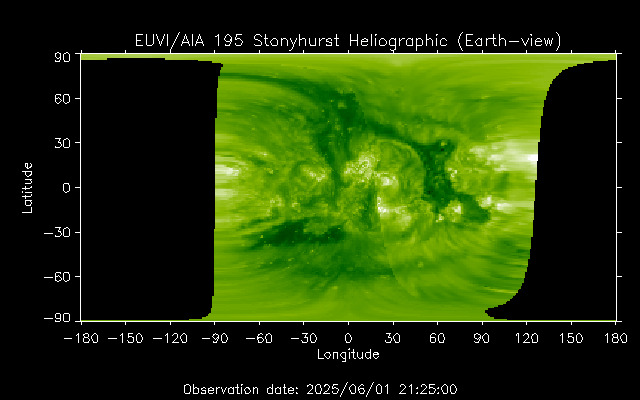
http://farside.nso.edu/
There is no accumulation of magnetic field on the far surface
http://farside.nso.edu/oQR/fqj/201703/mrfqj170317/mrfqj170317t1200.jpg
Coming up in the next day or two …
http://www.solarham.net/farside.htm
lsvalgaard on March 20, 2017 at 11:08 am and ff.
Thanks Leif for your comments, accurate info as usual.
Isvalgaard: Look like returning ones , do they get new numbers?
Yes.
I don’t know why these climate guys can’t figure out the solution. The US should just nationalize the sun and then pass some laws, concerning the minimum/maximum amount of sunspots. Problem solved!
Do we have data from a satellite measuring Earth’s cloud cover? Is it too soon to expect the increased cosmic rays to have an effect? If I have not got this entirely wrong then increased cloud would be the clue that the solar minimum was going to change our climate.
yes several satellites measure clouds. None of these datasets show any measurable effect from increases and decreases in GCR
Clouds dont correlate and temperature doesnt correlate.
the changes in the sun ( on sort term ) causes wiggles.. about a .1C wiggle in temperature. The thing we want to explain is the trend in temperature. Sun’s got nothing to do with that.
How do we know it’s not going crazy on the side we can’t see? It rotates every 24 days or so.
See above:
lsvalgaard March 20, 2017 at 11:08 am
lsvalgaard. If you treated other contributors with respect, the credibility of your argumentation would be enhanced. Your assertions seem to be constructed on <0.1°C precision of average global air temperatures over centuries. Not very solid foundation from metrological standpoint.
Respect has to be earned, and many commenters fail in that department. On the other hand, I answer questions and offer explanations freely and extensively. That is a form of respect in the interest of public education which I consider to be of utmost importance.
Sorry Chimp. I don’t know why Worldpress posted my comment here.
We can see the backside.\1) we have a spacecraft on the other side of the Sun
2) we can see through the Sun suing the same technique as used for oil exploration.
Here is the backside view:
http://www.leif.org/research/Stereo-A.png
Thanks, I appreciate the info
Isvalgaard you keep dismissing the effect of cosmic rays and you deny there is a lag between temperatures and solar cycles you keep persisting with this disinformation
You are welcome to produce evidence for your assertion to prove that you are not an idiot.
“How do we know it’s not going crazy on the side we can’t see?”
Because it’s dark on the other side, of course, otherwise we wouldn’t get nights.
An old “Rabbi of Chelm” Joke:
Student: “Rabbi Rabbi Whats more important the sun or the moon?”
Rabbi: “The moon, because the sun shines during the day, when its light out…the moon however shines at night when we need the light.”
The last two weeks here in upstate NY is as cold as the coldest January. The ground is buried in snow and icicles are three to five feet long from the north eaves. The sun controls temperature more than anything.
It’s been “unseasonably” warm here in Minnesota this Winter, and I sure am enjoying it!
Yup, that Sun is definitely what makes it Winter.
Or is it the Earth tilting away as it rotates?
In any case, I think it is safe to say that regarding short term variations in the weather, when it is colder than average in one region, there is somewhere else where the jet stream is carrying warm air north and those places are warmer than average.
With minor variations of course.
Because the average of the whole Earth (if you believe there is such a thing) does not change by very much from month to month, or even when it is Winter in the Northern hemisphere, does it?
Certainly not enough to account for temps 20 degrees or more lower than average.
That’s just weather.
As cold as the coldest January? How cold was the coldest January? How about February 1934 (and 2015)?
emsnews on March 20, 2017 at 11:40 am
The last two weeks here in upstate NY is as cold as the coldest January.
As Ric Werme told you, emsnews, here is Feb 2017…
http://fs5.directupload.net/images/170321/xm8hni4m.png
… followed by Feb 1934…
http://fs5.directupload.net/images/170321/jj8yzu6x.png
… and last not least, by Feb 2015:
http://fs5.directupload.net/images/170321/9j8cgsjf.png
Do you see the dark points over Northern America, emsnews? Look at the scale on the right.
Has there been an observed trend in the number, strength, or duration of aurora events since 1980 and within the current solar cycle?
Another ugly result of climate change.
Those interested in this subject will find a daily video broadcast of news related to solar activity and Earth-Sun interactions at Suspicious Observers: http://www.suspicious0bservers.org/
“The seven cycles preceded by solar cycle 24 had more sunspots than the mean.”
I think you meant to say “The seven cycles preceding solar cycle 24 had more sunspots than the mean”.