To get to the other side…
Guest post by David Middleton

“There has long been a controversy about the timing of bison arrival in North America,” said Shapiro. Bison arrival in North America marks the beginning of what geologists call the “Rancholabrean Land Mammal Age,” which is used to discriminate between different ecological periods in the continent’s history. “Until recently, the fossil records from different parts of North America disagreed with each other, with a few fossil localities suggesting that bison arrived millions of years ago, but most old fossil sites showing no evidence of bison at all,” Shapiro said. As new methods to date fossil localities emerged, the ages of the sites in North America with purportedly very old fossil bison have all been questioned, leaving the timing of bison arrival a mystery.
The new study explored fossil locations in Northern North America — the entry point for bison into the continent — and extracted DNA from two of the oldest bison fossils known on the continent. One from Ch’ijee’s Bluff in the Vuntut Gwitchin First Nation in northern Yukon, and another from Snowmass, Colorado.
“Bison used what is called the Bering Land Bridge — a vast connection of land between Asia and North America — to cross from Asia into North America. The land bridge forms during ice ages, when much of the water on the planet becomes part of growing continental glaciers, making the sea level much lower than it is today,” explained Shapiro. “After they arrived in Alaska, they spread quickly across the continent, taking advantage of the rich grassland resources that were part of the ice age ecosystem.”
While bison were not introduced by humans to North America, their rapid spread and diversification are hallmarks of an invasive species — and part of what make bison’s role in the Great Plains ecosystem so significant. “Bison arrived in North America and quickly came to dominate a grazing ecosystem that was previously reigned over by horses and mammoths for one million years,” said Shapiro.
[…]
So… These guys were actually doing the right thing by trying to wipe out an invasive species…

It’s fascinating how extreme climate changes and intercontinental migrations of invasive species could have routinely happened before humans discovered fire and invented capitalism… Fascinating.

The paper is paywalled; here’s the abstract…
Fossil and genomic evidence constrains the timing of bison arrival in North America
Duane Froesea,1, Mathias Stillerb,c, Peter D. Heintzmanb, Alberto V. Reyesa, Grant D. Zazulad, André E. R. Soaresb, Matthias Meyere, Elizabeth Halld, Britta J. L. Jensena,f, Lee J. Arnoldg, Ross D. E. MacPheeh, and Beth Shapirob,i,1
Author Affiliations
Edited by Donald K. Grayson, University of Washington, Seattle, WA, and approved February 3, 2017 (received for review December 20, 2016)
Significance
The appearance of bison in North America is both ecologically and paleontologically significant. We analyzed mitochondrial DNA from the oldest known North American bison fossils to reveal that bison were present in northern North America by 195–135 thousand y ago, having entered from Asia via the Bering Land Bridge. After their arrival, bison quickly colonized much of the rest of the continent, where they rapidly diversified phenotypically, producing, for example, the giant long-horned morphotype Bison latifrons during the last interglaciation.
Abstract
The arrival of bison in North America marks one of the most successful large-mammal dispersals from Asia within the last million years, yet the timing and nature of this event remain poorly determined. Here, we used a combined paleontological and paleogenomic approach to provide a robust timeline for the entry and subsequent evolution of bison within North America. We characterized two fossil-rich localities in Canada’s Yukon and identified the oldest well-constrained bison fossil in North America, a 130,000-y-old steppe bison, Bison cf. priscus. We extracted and sequenced mitochondrial genomes from both this bison and from the remains of a recently discovered, ∼120,000-y-old giant long-horned bison, Bison latifrons, from Snowmass, Colorado. We analyzed these and 44 other bison mitogenomes with ages that span the Late Pleistocene, and identified two waves of bison dispersal into North America from Asia, the earliest of which occurred ∼195–135 thousand y ago and preceded the morphological diversification of North American bison, and the second of which occurred during the Late Pleistocene, ∼45–21 thousand y ago. This chronological arc establishes that bison first entered North America during the sea level lowstand accompanying marine isotope stage 6, rejecting earlier records of bison in North America. After their invasion, bison rapidly colonized North America during the last interglaciation, spreading from Alaska through continental North America; they have been continuously resident since then.
The Rancholabrean Land Mammal Age is the little sliver at the top of this stratigraphic column. It’s labeled “RLB”…

More than you ever wanted to know about the Rancholabrean Land Mammal Age.
Useless Bison Triva
- American buffalo aren’t buffalo. They are bison.
- Buffalo wings aren’t made from buffalo or bison. They actually do taste like chicken.
- The Buffalo Bisons is either a redundant or an oxymoronic name for a minor league baseball team.
- Bison once ranged from Alaska to the U.S. east coast, perhaps even in present day Buffalo NY.

During glaciations sealevel drops by 100 to 200 meters. The average depth of the oceans is 2.8km. Thus between 4% and 7% of all water on the planet is locked in land ice. In the grand scheme of things this is not “much”.
Yet land ice makes a big difference in sea level. So does ocean temperature.
During the last glacial maximum, sea level was about 400 feet lower than today. Glaciers and ice sheets then covered almost a third of the land, of which there was more area, thanks to lower MSL, versus only a little less than 10% today (of a smaller area).
During the last interglacial, the Eemian, some 125,000 years ago, MSL was about 18 feet higher than now (without benefit of a Neanderthal industrial age). During the Pliocene, c. three million years ago, it might have been up to 165 feet higher. During previous even warmer epochs and periods, it was higher still, as during the Cretaceous, when the Arctic Ocean and Gulf of Mexico were connected by a seaway across the middle of North America.
I know what caused the high sea level in the Sangamonian (Eemian)…
Sauropod flatulence?
http://o.aolcdn.com/dims-shared/dims3/GLOB/legacy_thumbnail/800×450/format/jpg/quality/85/http://www.blogcdn.com/www.autoblog.com/media/2012/07/flintstonesmobilegermany.jpg
They’re ruminants so they can obviously swim but does anyone know what the range for a swimming bison is?
Island hopping isn’t as silly as it sounds.
They can cross fairly sizeable rivers if the current isn’t too swift.
Except that there was no need for bison to swim from Siberia to Alaska during glacial phases.
But it widens the time window if they could travel between green islands rather than walking along a grassless isthmus.
M,
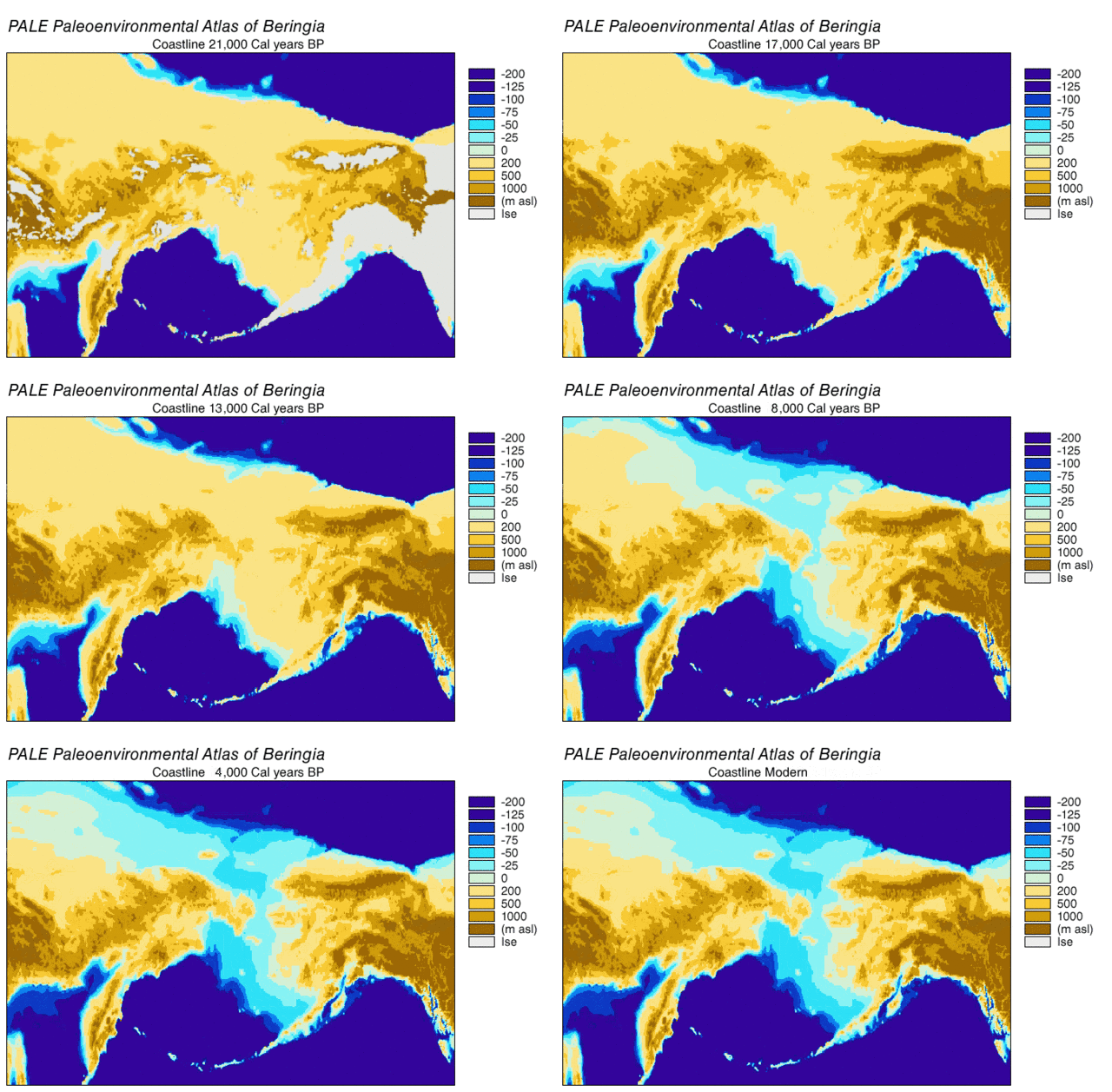
The isthmus wasn’t grassless and it wasn’t an isthmus. It was a vast subcontinent the size of the Indian plate, a thousand miles by more than that.
Its southern and northern plains are submerged, and its center. The north was polar desert, but the south, like the Yukon Valley, was lush steppe-tundra, verdant in summer.
Some Berignian imagery:

PS:
The Bering Strait is shallow, like the English Channel, although there is a sunken lake at its deepest part, which isn’t very profound.
The Diomede Islands, which stick up out of it, would have made great lookout points for spotting the herds of mammoth, horse, bison, antelope, etc, which migrated across the steppe-tundra landscape.
Of course, today people and animals can and do still walk to Siberia from Alaska across the winter sea ice.
Yupik Eskimos live on both sides of the Strait.
Chimp, Interesting.
Thank you.
M,
You’re most welcome.
Asian immigrants like mastodons, mammoths, bison, elk and moose didn’t need to swim to make the trip to North America. Ditto for rhinos, horses and camels headed in the opposite direction. For most of the past three million years, the continents have been connected by dry (maybe boggy) land. Bison might well have crossed some pretty big rivers, however.
Just to point out, that for American Bison, the word American Buffalo or Buffalo is acceptable, and was used first. So, there can’t be any correction using Bison or Buffalo, both are accepted.
Per Wikipedia:
The term “buffalo” is sometimes considered to be a misnomer for this animal, and could be confused with “true” buffalos, the Asian water buffalo and the African buffalo. However, “bison” is a Greek word meaning ox-like animal, while “buffalo” originated with the French fur trappers who called these massive beasts bœufs, meaning ox or bullock—so both names, “bison” and “buffalo”, have a similar meaning. The name “buffalo” is listed in many dictionaries as an acceptable name for American buffalo or bison. In reference to this animal, the term “buffalo” dates to 1625 in North American usage when the term was first recorded for the American mammal.[11] It thus has a much longer history than the term “bison”, which was first recorded in 1774.[citation needed] The American bison is very closely related to the wisent or European bison.
English “buffalo” entered our language from Spanish, Portuguese or French, from a Latin original. The scientific generic name Bubalus however is from Greek.
“Bison” is also from a different Latin original, cognate with the Germanic original of “wisent”, the European bison. The modern American bison is Bison bison in Linnaean binomial nomenclature.
“Why did the buffalo cross the land bridge?”
To prove to the possum it could be done.
I’ll be here all week – don’t forget to tip your waitress. 😀
Our waitress:
https://encrypted-tbn0.gstatic.com/images?q=tbn:ANd9GcRd1HeYO1G3wx6PQAAiz-hgRwGHOeE8zqeSoT78H9Dgk8P8PC-v
question: did any of these animals ever walk back?
Gary,
All the time. To them, NE Siberia and NW America were same, same.
I believe horses evolved in North America, but became extinct until European colonisation.
That’s right. Camels, llamas and rhinos also evolved here but survived on other continents to which they had migrated.
Why?
To get to the good grass that mammoths and horses weren’t using.
Just as on the Serengeti Plain today, there was a grazing and browsing succession on the steppe-tundra. Ruminants like bison and saiga antelope could use forage not fully utilized by horses and mammoths. There were also the Ice Age equivalent of gazelles.
While it may be more taxonomically correct to call buffalo bison,you taxonomic purests can go on and call them bison; to the rest of us, they are buffalo.
The main purpose of taxonomy is purism.
No “may” about it.
Bison and buffalo belong to different genera in the bovine subfamily. Bison can hybridize with cattle and yaks, so are closer to the genus Bos than is genus Bubalus. Water buffalo.and domestic cattle cannot hybridize. In laboratory experiments, the embryos fail around the eight-cell stage. The African buffalo has been placed in its own genus, Syncerus, reflecting its grown-together horns.
If in common parlance, you want to call bison buffalo, of course you’re free to be incorrect. I didn’t object when people called our bison buffalo. Neither did the bison.
So if I get the theory right, the Bison (aka Buffalo) came across the land bridge. If that is true, how come there were no tigers (the guys with stripes) in North America.?????
It’s not a theory. It’s an observation.
Tigers are woodland creatures, adapted to hunting in forests, whether boreal or tropical (and formerly temperate, but the Caspian tiger was driven to extinction by the Roman thirst for bloody games). Their habitat doesn’t exist in Beringia during glacial intervals, although it does in interglacials, but not continuously on land and of course there’s the Bering Strait.
Some speculated that the cave lion might have been more closely related to tigers than modern lions, but genetics, anatomy and even art work have shown this conjecture to be false.
Not to mention frozen feline remains.
Why aren’t there any bison in Siberia?
Canadian bison have been introduced to Siberia, but no living descendants exist there of the primordial bison which lived in the region thousands of years ago. They went extinct with the Siberian mammoths and other megaherbivores.
Lots of frozen remains have been found, however:
http://www.livescience.com/48645-bison-mummy-photos.html
And their kin the wisent still live in Eastern Europe, where they barely managed to survive.
https://en.wikipedia.org/wiki/European_bison#Genetic_history
Wisent are apparently hybrids of steppe bison and aurochs, the extinct ancient wild ox, ancestral to European domestic cattle breeds.
There are no indigenous bison left in Alaska, either. The Pleistocene species died out. The environment of Alaska is also no longer suitable for bison. During the Holocene, it’s either too woody or tundra-like. The grassy steppe-tundra which they favored is extinct in Alaska and most of the world, yet was the world’s largest biome during the last glaciation.
So, maybe the American Indian as we know them are not the original immigrants to this continent. Can we figure out what group were the first? Do we have any information on the Clovis people and who might have killed them off?
It’s hard to get the needed DNA data because American Indian groups resist testing.
Finding out what groups were first is also difficult since if there were any people south of the ice sheets before they started melting, they were few and far between. Discovering their remains is a matter of luck and guess work.
However evidence for people more than 30,000 years ago has been claimed for some sites in both Americas. Archaeological material can’t always elucidate ethnicity however.
Some archaeologists suppose that people might have been in North America south of Alaska as long ago as 45,000 years. IMO this is improbable but can’t be ruled out. Evidence is emerging for the occupation of Beringia by at least 25,000 years ago, however.
A well-preserved mammoth killed and butchered, presumably by modern humans, not Neanderthals or Denisovans, excavated in 2012 at 72 degrees North on Siberia’s Yenisei Gulf has now been reliably dated to 45,000 years ago. Its excavators assumed it to be only around 30,000 years old.
http://www.sciencemag.org/news/2016/01/grisly-find-suggests-humans-inhabited-arctic-45000-years-ago
If people were on the Taymyr Peninsula 45,000 years ago, then there is no reason why they couldn’t have survived in Beringia, unless the short-faced bear kept them out. There might have been too few of them and too much space however for them to have gotten that far.
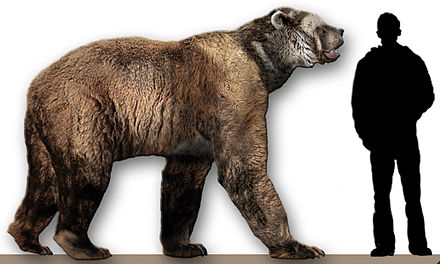
I mean too few people, not bears. The short-faced bear was limited to the Americas, while woolly rhinos and cave hyenas were restricted to western Beringia and beyond, ie Eurasia.