From the CAMBRIDGE UNIVERSITY PRESS and the “those who don’t pay attention to history are condemned to repeat it” department. See the money quote about kerosene below, bold mine.


Liquid hydrogen may be way forward for sustainable air travel
Professor Hermans from Leiden University’s famous Huygen’s Laboratory acknowledges that oil-based liquid fuels such as gasoline, diesel and kerosene will be hard to beat when it comes to how much energy they pack in relation to their volume and weight–not to mention the sheer convenience of using them to get from A to B.
The author of popular books such as Physics is Fun (2012) and Energy Survival Guide (2011) acknowledges that achieving sustainable transport in the post-fossil fuel era will be a huge challenge–but finds that liquid hydrogen could offer a potential solution for future air travel.
“Given the severe weight limitations for fuel in aircraft, liquid hydrogen may be a viable alternative in the long run,” he argues:
- First, handling of liquid hydrogen would be carried out by professionals, which reduces the safety issues involved with liquid hydrogen to the same level of risk involved in handling kerosene.
- Second, liquid hydrogen itself is very light (in fact, it is in a gaseous state at ordinary temperatures), which is an important advantage for air travel.
- Third, the disadvantages of “boil off” (created by the low boiling point of liquid hydrogen) would be reduced in air travel because of the low outside temperature at cruising altitudes.
Hermans discounts the use of solar power for air travel without revolutionary changes in the airplane concept, but concludes that it seems wise to extend the availability of oil products as long as possible. However, he argues that the low cost of kerosene is a huge disincentive in this respect:
“It is a defect that kerosene is so irrationally cheap, which triggers much unnecessary air travel,” he writes. “A worldwide tax on kerosene–if at all politically possible–should be something to pursue.”
For road transport, Hermans argues that liquid hydrogen is not a viable option due to safety issues around handling it. He finds that electric vehicles offer the most promising solution. However, the challenge is to improve the performance of batteries to prolong the driving time for electric cars, as well as improving the performance of supercapacitors for more rapid charging of the batteries, he argues.
Direct driving using solar power is difficult, Hermans finds, even under a clear sky. However, students from Eindhoven University of Technology are among those that have taken up the challenge; they built a four-seater solar-powered family car that can be driven indefinitely under clear skies at a speed of about 43km/h. The only drawback is that the car is just over 1m tall and is not very comfortable. Hermans concludes that solar family cars will be feasible in future if consumers are willing to sacrifice on comfort.
Alternatively, Hermans writes, the most efficient way for us to reduce energy use in future is to reduce our mobility, for example, by having shorter distances between the workplace and home. “In other words, urban planning provides an important key,” he concludes.
###
MRS E&S, a journal of the Materials Research Society and Cambridge University Press, encourages contributions that provide viewpoints and perspectives on the all-important issue of how humankind can work towards, and build, a sustainable future.
The contents of this press release refer to the following article which is freely available
The challenge of energy-efficient transportation, by Professor Jo Hermans
“…students from Eindhoven University of Technology are among those that have taken up the challenge; they built a four-seater solar-powered family car that can be driven indefinitely under clear skies at a speed of about 43km/h. The only drawback is that the car is just over 1m tall and is not very comfortable.”
I can see that in broad daylight in a solar powered family car that speed of 26 mph can be reached, but I do not need to build it to find this out. Going down hill, gravity will accomplish this, but it will take all four people to put their boots down to stop the momentum.
And so with all Broken Window schemes in economics, you loose the enjoyment of a pair of shoes. In this case, four pairs of shoes.
a speed
a
speedslow trot🙂
Pshaw. We’ve had a solar powered vehicle available for thousands of years that’s faster than this.
It’s called a horse.
The problem with horses in a city is the vehicle needs a large tank to capture the exhaust. One of the main reasons horses fell out of favor was the manure clogged the streets. I once read that if the current traffic in New York city was hauled by horses the manure would be 10 ft deep every day. Perhaps that would be a good way to discourage the wanky professors, such as the one that wrote this article, from living in cities or working at universities.
It’s called a horse.
=============
What more could you ask. A solar powered vehicle with a battery that lasts 20+ years; and can find its way home when the driver is drunk.
And fully recyclable, at least in France.
1m tall.
A sardine can would feel roomier.
“…just over 1m tall and is not very comfortable…” does not sound like a “four-seater solar-powered family car.” The Toyota Carolla is 57 inches tall, or 1.45m.
Here is the latest version, apparently… https://solarteameindhoven.nl/stella-lux/
Fred Flintstone — powered family car! 🙂
Yabba, dabba, DOOOO! (<– and that language is just ol' Herman's speed)
Well. Kids can now look forward to bragging to their grandchildren about walking a mile to school. And pedalling the bicycle in the living room to keep the lights on so they could read their history lesson off of their chalk slate.
The Netherlands is noted for being flat – no hills to challenge battery/solar driven vehicles.
It is also why bicycles are popular there.
“eminent physicist Jo Hermans ”
With Ideas like that he’ll go far…rapidly & in small pieces.
He should re-learn physics from the bottom… start with cleaning toilets.
History, indeed….
(http://www.history.com/topics/hindenburg )
Crash of The Hindenburg — live commentary
(youtube)
And I’ll bet you could sit P. Hermans down in front of that video and he would swivel around in his chair, eyes wide, and breathlessly exclaim:
**************************************************************8
(as others have already pointed out)
That guy is mixed up coming
and going
Pitiful.
Janice:
Just finished watching some of the Hindenburg disaster videos on Youtube. The Nat Geo documentary said the Hindenburg disaster was caused by hydrogen leaking from one of the hydrogen gas cells that was ignited by the static electricity which was building up on the cotton linen skin of the ship. The ship was flying into headwinds all the way across the Atlantic from Germany, and there were thunderstorms in the areas around the Lakehurst Naval Air Base in NJ that day where it was landing.
Hydrogen burns invisibly, so the orange flame in the old news reels was the skin of the ship burning. Anybody who still thinks hydrogen is a good alternative to fossil fuels for air and surface transportation needs to watch those old Hindenburg videos from 1937. Ignorance can be deadly.
The documentary concluded by saying that helium is used for airships today—it does not burn. It said that the U.S. is the world’s only source for helium and that we would not sell it to Germany after the disaster because of the world’s growing opposition to the Nazi regime at the time.
Oh the humanity indeed.
Yes, the orange flame from the fire is the aluminum from the paint on the linen skin. Most of the hydrogen was gone in seconds – too volatile and too buoyant. Aluminum, however, also makes an excellent flame. It is the main fuel component in solid rocket fuel.
Actually 2 out of 3 people on the Hindenburg survived. As did 14000 pieces of mail on board. As we’ve been discussing hydrogen is light, when it was released from that aircraft it went up and away from the people. You can imagine a big tank of gasoline rupturing and burning. There would be a burning lake of gasoline.
Hydrogen is very dangerous if it is contained in a room or other container, but so is methane or a whole long list of other gasses. So the problem with hydrogen is that it makes a poor substitute for high density fuels not that it is insanely dangerous.
BTW the Hindenburg used hydrogen because the US has a monopoly on Helium and refused to let the Germans buy it.
Yes, because at the time, the Germans were bad.
How nice, Mr. Kramer. If you are correct (and I think you probably are), only about 33 people died. No big deal, then.
*****************
Re: U.S. monopoly being the controlling
— According to the article I read, this is why Hydrogen was used for that flight (Mike is right):
(Source: http://www.history.com/topics/hindenburg )
Your comment while factually correct, creates the false impression that the U.S. was simply at fault. The ultimate blame lies on the thugs across the Atlantic.
Nothing to do with Germany being nazi at that time. Wiemar Republic wouldn’t be allowed, either, helium and Zeppelins being considered a weapon.
Ammonia is a good way to use hydrogen as a transport fuel. It’s even been used in aircraft. link
If fossil fuel becomes prohibitively expensive, ammonia generated by nuclear, solar, or even wind, is an already existing proven alternative. Do I think that will happen? Once the CAGW scare is put to bed, we won’t have to worry about it for a long time.
…. and I think …. nano-tech/synthetic chemistry (and tech, in general) jeeeehst maaaayybe…… will advance over the next few decades…. (eye roll)
(not contradicting you, cBob — attempt at supplementing)
(and if my comment did not make sense — that happens a lot with me — I meant that by the time fossil fuel supply is low enough that a cost-effective alternative is needed to keep the price of fuel reasonable….
aaaaaaaaaaaaaaaa, I am NOT going to explain that simple idea! I’ll just wait for someone to say, “Janice: What good does future nano-tech do us now?” Heh.
JM, please check out Siluria Technologies. It is catalytic nanotech combined with automated high throughput screening borrowed from drug screening. Result is novel catalysts for OCM and ETL that solve ALL the problems encountered in the 1970’s when OCM was first invented. Gives a two step path from natural gas to gasoline, diesel, and kerosene (jet fuel). Could be transformatory. Then look who is investing–bechtel and Aramco. The big boys.
Makes this Hydrogen nonsense even more pathetic.
OCM? – Other Chicken Mines?
ETL? – Extra Thoughtful Lettuce?
http://www.sfgate.com/business/article/Natural-gas-to-1-gasoline-5701521.php
Link for ristvan.
ammonia has issues, too. Being toxic being one. Mixing with water, an other.
Don Lancaster looked at hydrogen back in 2002 and beat it to the ground and stole its lunch money. Here is his PDF on Energy Fundamentals:
http://www.tinaja.com/glib/energfun.pdf
Actually, he takes apart renewable energy too. Is Don the ultimate realist? Maybe.
Don’s web site is well worth visiting. link He focuses on finding real opportunities and rejecting the ones (like renewable energy) that won’t work.
Don included something I designed in one of his articles. A high point in my career.
“…a new study published by eminent physicist Jo Hermans…”
Please, PLEASE tell me this person is not really an “eminent physicist”…what’s that quote from some famous guy from the distant past about seeing further only because he was standing on the shoulders of giants? This perfesser’s view is blocked even by midgets.
Isaac Newton said that or something like it.
Forgot to add this general index of Hydrogen links:
http://www.tinaja.com/h2gas01.shtml
It is a sign of the times, I suppose. This is all recycled garbage. This “Hydrogen Everything” idea was beaten to death in the 1970s, partly in response to the Arab Oil Embargoes. The numbers did not add up then, and they still do not add up.
So people like this prof. do 2 things.
1) Unable to come up with original garbage of their own, they endlessly recycle old garbage dredged up from the past.
2) They lead their students to believe that this is some new and futuristic solution and all they have to do is make it work.
I think deliberately misleading students who do not know better is the most troubling. There used to be ethical issues with professors doing things like this.
TonyL The professor is in the enviable place to get brand new students ( that know very little and in no position to fight back) every year while he sits on his throne of incompetence and gets away with this BS every semester. These students just don’t hang around long enough or go the their next year and just dismiss him. And if they don’t? I doubt they get through their first job application.
Forget all those nasty practicalities. From a pure energy perspective, also makes no sense. I explored the car version of this nonsense in essay Hydrogen Hype in ebook Blowing Smoke. Answer, you want energy efficiency, buy a Toyota Prius.
I would, except Toyota has been foot dragging on the Prius plug-in battery size and type for so long I gave up considering it. And with each successive model getting uglier leading to the pinnacle of ugly strategy with their hydrogen model, I finally concluded they are out to stop or slow new sales with a combination ugly strategy and battery excuse list. The hydrogen car is a tip off to this strategy where they lose money on each model so making it as ugly as possible limits cost exposure. It’s smart in the case of the hydrogen car but dumb for the plug-in Prius.
I just flew in from Ulaanbaatar. If you want to see the highest Prius population per capita anywhere in the world, go there. Every second-hand Japanese Prius heads to Mongolia. Also, if you are interested in reclaiming the largest pile of Prius batteries on the planet, ditto. That is where they go to die.
“…by having shorter distances between the workplace and home. “In other words, urban planning provides an important key,” he concludes.” Another useful idiot pushing Agenda21.
Right there we have an insight into the level of lunacy of these people!
Do they really not understand the concept of energy density? Again, just by using incorrect terms they reveal their ignorance of basic physics!
So we have ignorant lunatics trying to tell us what to do. I guess that’s par for the course.
OK, there’s the money shot, right there.
Aaaaaaannnnnd there’s the political agenda, right there. Agenda 21 / 2030 in all it’s naked glory.
So not only do we have ignorant lunatics tellig us how to fly, they also want all our money, and to tell us how to live. How much more blatant do they have to get before people wake up to this?
Seems to me, Jer0me, you can only expect people with fully functional amygdalae (conservatives) to wake up to it. The rest (liberals) actually want to be told how to live, and to give away all their money, and cosy up to tyrants in an effort to appease them. It is the “r” psychology, and it is genetic, and biological. And there are a lot of them. Asking them to “wake up” is futile… but if we could stimulate their amygdalae to finish developing to its adult form and function, we might have a chance. Apparently that takes a large fear stimulus. Possibly repeated. I am not sure what to use though. It can’t be the same things we fear (destruction of civilization, chaos, socialist collapse, etc.) because those are already their deep-seated goals. Their prime fear should be the rise of a K-style civilization, which is what Trump is trying to create. I am not sure whether the subconscious fear of genetic obsolescence would be enough to stimulate the development of the amygdala, or whether it requires a more immediate personal fear to do that…
“First, handling of liquid hydrogen would be carried out by professionals, which reduces the safety issues involved with liquid hydrogen to the same level of risk involved in handling kerosene.”
This is why some greens like nuclear too. By contrast to the risk and high tech of a nuclear plant, the fuel for a coal plant sits in perfectly harmless piles until you need it, and a plant can be run by locals in the community. Not nearly as expensive or regulated.
People who claim LEDs are the only reasonable choice for future lighting — and will inevitably replace the incandescent light bulb — sound only slightly less mad than Prof Hermans to me. Sorry. I try to understand that even intelligent and witty commenters at WUWT have their own little weak points and idiosyncracies. (:
A bulb that uses 1/10th the energy and lasts 10 times longer, will never, ever replace incandescents?
Really?
There is video footage of an airship crash that tells an interesting story about human conduct and loyalty.
The ship was having trouble docking. A long rope from the nose was grabbed by one, then more ground staff as the nose bobbed lower for some seconds. The rope was pulled down to give a length on the ground.
Then, the nose lifted. More people ran to hold the rope, but the weight of a person was puny. As the nose lifted ever higher, those loyal souls who first grabbed the rope were lifted highest above the ground and had to hang on for the longest time.
They started to fal to their deaths, from earliest and most loyal first.
There is a philosophical point about life in this footage.
Perhaps it is already known to people in the armed services who are said to advise “Never be the first to volunteer.”
They weren’t volunteering. Their job was to grab the rope and haul the airship to it’s hanger.
April 1st has come early this year, right? Just like the pear trees are already blossoming.
They do not like to run with the rest of their herd. Strong on the dodgy CAGW part, no show on their proposed CAGW solutions, cause all are nuts. Discuss renewable intermittancy–nope. Hydrogen nonsense, nope. Biofuel catastrophy, nope.
The trolls and luke-trolls only show up in great numbers if a post really pokes a big hole in AGW “science.”
Wrong again jorge.
That has to hurt.
I tend to post only in the areas where I know the material where you might concievably benefit from my dissent. I don’t know or care about crazy plans to fuel aircraft differently. There is no point in me agreeing with folks here and no basis for me to think you might possibly benefit from my comment.
I think this.
A. We over regulate nuclear…and good libertarian principles would suggest that we change that. It would also abate climate risk.
B. Subsidizing rich democrat to live by a ocean that may rise is foolish given libertarian principles and concerns over climate risks.
C. Clean air is good. Exporting our pollution to china is economically stupid because it essential ly is also exporting our jobs. It also increases climate risk.
D. A refundable carbon tax is worth considering as hypocrites like gore would get gored. But only if you swap it for other taxes. If that puts me in agreement with George Schultz. .well I’ve been in worse company.
*Unmanned* Liquid hydrogen aircraft already exist. See https://en.wikipedia.org/wiki/Boeing_Phantom_Eye
From experimental to museum piece. It seems to have bypassed the commercial stage for good reason – 33 degrees above absolute zero
“From experimental to museum piece. It seems to have bypassed the commercial stage . . .” The same could be said of the Wright Flyer.
The point needed to be made (that such aircraft actually existed and have actually flown) because up until this point in the the ‘debate’, comments had ranged from incredulity to outright ‘ROFL’. A few key facts were missing.
You might also want to check out https://en.wikipedia.org/wiki/Tupolev_Tu-155
“The Tu-155 first flew on 15 April 1988. It used hydrogen fuel and later liquified natural gas (LNG). It flew until the fall of the Soviet Union and it is currently stored in the Ramenskoye Airport near Zhukovskiy”
The Flyer didn’t use liquid hydrogen that’s why 10 years later they had aerial dogfights. 29 years after Tu-155, your airplane is still experimental or museum piece.
Less comfort, less mobility, higher taxes. Nice view from the ivory tower. We have and will continue to develop appropriate useful forms of energy. Unless of course people disconected from our lives get to dictate otherwise.
Meanwhile down under in South Australia, thrir green energy fiasco is becoming a real disaster for the state as both Holden and now Coca Cola close factories due to unreliable electricity:
https://www.theguardian.com/australia-news/2017/feb/22/coca-cola-to-close-south-australia-factory-with-loss-of-nearly-200-jobs
And reported in the Guardian – straight – without an AGW twist, interesting and commendable on their part.
“And reported in the Guardian – straight – without an AGW twist, interesting and commendable on their part.” Nothing more than self preservation IMO. The media is being called out as biased and political for good reason and needs to get back to reporting…. not editorializing… to survive.
More efficient and safer
From an engineering perspective, liquid hydrogen is actually a very sensible fuel for long haul aircraft because it has 36% the mass of jet fuel. NASA M and many others have seriously studied for at least four decades. Compared to jet fuel with its very “hot” radiant flame, hydrogen is actually much safer as a fuel because it generates little radiation. e.g., See
LIQUID HYDROGEN AS A JET FUEL FOR HIGH-ALTITUDE AIRCRAFT 1955, declassified 1962.
HYDROGEN AS AVIATION FUEL: A COMPARISON WITH HYDROCARBON FUELS 1997.
With finite quantities of hydrocarbons, sooner or later we will need to transition to alternate fuels generated by sustainable or long lasting energy sources.
“alternate fuels generated by sustainable or long lasting energy sources.” What energy sources do you have in mind? Hydrogen is not a source; it is a carrier that needs a source to be created.
dan – sustainable/renewable energy sources – its an issue of long term costs.
e.g. Hydropower is usually cheapest. “In the U.S., hydropower is produced for an average of 0.85 cents per kilowatt-hour (kwh). ”
Nuclear fission is widely used. Wind and solar are becoming more cost effective.
(e.g., Bids for 350 MW solar PV to Dubai dropped to 2.45 c/kWh in 2016).
(While not here yet, Fusion and Low Energy Nuclear Reaction (LENR) are being developed.)
LENR? Is probably fantasy. Currently net energy (not counting manufacture and pre-conditioning) is right at the edge of experimental error.
More likely is Polywell Fusion. https://www.spartareport.com/2016/05/polywell-fusion/
We now get cheap hydrogen from natural gas. When we ran out of fossil fuels, we can get hydrogen from pyrolysis of biomass. But syngas has to undergo the Fischer-Tropsch process to convert it to liquid hydrocarbon fuel. It’s an old technology, the Nazis were doing it during WW2
Mass is only half the equation. The other half is energy density, which hydrogen does not have. Read the comments above.
Hang on, the LHV of Hydrogen is 120 MJ/kg, How is that not energy dense? Kerosene is about 44.
MarkW Volume is a very simple aeroengineering task to increase wing area 25% and engine size by 50%, given the overriding 35% advantage in takeoff weight. See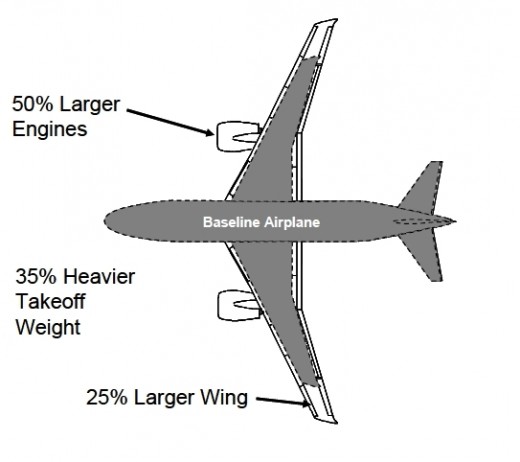 See also https://www.quora.com/If-we-do-run-out-of-fossil-fuels-how-do-we-plan-to-fly-airplanes The biggest challenge is the chicken/egg problem of providing sufficient cheap supply of liquid supply for each of the hubs.
“The biggest challenge is the chicken/egg problem of providing sufficient cheap supply of liquid supply for each of the hubs.
H2 is quite cheap, but LH2 is different: very impractical, so not cheap.
Fuel accounts for 10-20 % of planes weight at take-off, so it makes sense to try to use a lighter one, but it much be cheap and practical. Even military, that don’t really care about cost, don’t use LH2, because it not being practical.
Take off is an issue. Gliders are now winch-launched, and i know this solution is considered for planes, too. Planes engines are quite efficient in flight, while they are most needed at take-off when they are pretty inefficient. That seems a much better solution to save engine power, fuel, and weight, than installing cryogenics to use LH2 as a fuel.
“Second, liquid hydrogen itself is very light (in fact, it is in a gaseous state at ordinary temperatures), which is an important advantage for air travel.”
The word gaseous did come to mind while I was reading this.
You go first, and keep it off the list of behavioral modification tax credits.
More efficient and safer
From an engineering perspective, liquid hydrogen is actually a very sensible fuel for long haul aircraft because it has 36% the mass of jet fuel. NASA, DOD and many others have seriously studied for at least four decades – well before “global warming” became an issue. Compared to jet fuel with its very “hot” radiant flame, hydrogen is actually much safer as a fuel because it rises rapidly and generates little radiation. e.g., See:
Liquid hydrogen as a jet fuel for high-altitude aircraft DTIC 1955
Liquid Hydrogen as a Propulsion Fuel, 1945-1959 NASA SP4404, 1978 341 pp
HYDROGEN AS AVIATION FUEL: A COMPARISON WITH HYDROCARBON FUELS 1997.
Alternate Fuels and their potential impact on Aviation NASA 2006
With finite amounts of hydrocarbon fuels, sooner or later we will need to transition to alternate fuels made from sustainable energy sources.
Mr. Hagen: Several other comments in this thread make the point that hydrogen may be possible (from an engineering perspective), however, it is prohibitively expensive.
Further, (is this YOU, Mr. Hagen?? “sustainable” — gag (that term has a pretty shoddy, non-scientific, connotation, now))
the EROEI of hydrogen is currently, apparently, negative.
Surely, by the time, over 50 years at the LEAST, fossil fuels are depleted, synthetic/nano-tech fuels with as good as or better EROEI as and safer than hydrogen will be on the market. And, maybe not, but:
why are you, essentially, pushing hydrogen so strongly today?
Just curious.
Janice Moore – What life will your grandchildren have? I have a life long focus on sustainable fuels needed first to break OPEC’s coercion, and then to sustainable fuel as demand outstrips fossil fuel supply. See: Methanol: its synthesis, use as a fuel, economics, and hazards 646 ref.. PhD in ME on energy storage. Developing ways to make sustainable fuels cheaper than gas or coal.
Janice Moore
What fuel will your grandchildren use to keep their economy moving? Global conventional crude oil production has been about flat since 2005. How long with “tight” oil from fracking shale keep up with growing demand? Have you compared hydrogen from hydro or Dubai’s 2.45 c/kWh PV compared with declining oil availability? Study what will be needed for prosperous economy for the next 1000 years! http://crudeoilpeak.info/wp-content/uploads/2014/08/World_without_US_shale_oil_Jan2001_Mar2014.jpg
“hydrogen is actually much safer as a fuel because it rises rapidly and generates little radiation”
I don’t believe it was a Radiation issue or Rising slowly that ended the Challenger…
Hey, Dems Certainly R Dcvrs 🙂
Just wanted to say, I SURE AM GLAD YOU ARE COMMENTING this evening. Well done!
I manage to fire off a small pistol here and there — you step up with one big high-calibre rifle blast after another! 🙂
BZ – I am trained to fight shipboard/aviation fires. Certainly radiative heat is serious issue.
No need to worry about hear with a hydrogen detonation. Fire fighters, crews, and passengers are all dead.
Ventilation systems with the potential of hydrogen detonation must have blow out panels directing the damage to an area away from people.
Correct. It was an cold O-ring not designed for the colder weather at launch as simply explained by Nobel Laureate Richard Feynman https://www.youtube.com/watch?v=6Rwcbsn19c0
The “professionals” who fuel planes are about as professional as the gas station attendants of old. I see no reason why that would make it safer.
If we want plentiful energy well into the future it would probably be time and money better spent looking at ways of getting a Thorium fuel cycle working with Liquid Fluoride Thorium Reactors…. Work out a way of doing that and electrical generation is solved for the entire existence of human kind.