From the University of Reading:
Britain may lose the magic of the Northern Lights by the middle of the century due to major shifts in solar activity, scientists have discovered.
Space scientists at the University of Reading conclude that plummeting solar activity will shrink the overall size of the sun’s ‘atmosphere’ by a third and weaken its protective influence on the Earth.
This could make the Earth more vulnerable to technology-destroying solar blasts and cancer-causing cosmic radiation, as well as making the aurora less common away from the north and south polar regions for 50 years or more.
Dr Mathew Owens, from the University of Reading’s Meteorology department, led the research. He said: “The magnetic activity of the sun ebbs and flows in predictable cycles, but there is also evidence that it is due to plummet, possibly by the largest amount for 300 years.
“If so, the Northern Lights phenomenon would become a natural show exclusive to the polar regions, due to a lack of solar wind forces that often make it visible at lower latitudes.
“As the sun becomes less active, sunspots and coronal ejections will become less frequent. However, if a mass ejection did hit the Earth, it could be even more damaging to the electronic devices on which society is now so dependent.”
The study, ‘Global solar wind variations over the last four centuries’, published in Scientific Reports, shows how sunspot records can be used to reconstruct what happened the last time the Earth experienced such a dramatic dip in solar activity more than three centuries ago. Combined with updated models and contemporary reports, the researchers were able to predict what could happen during a similar event, likely to occur in the next few decades.
‘PROTECTIVE BUBBLE’
The scientists believe the coming ‘grand minimum’ could be similar to the Maunder Minimum of the 17thcentury, when sun spot activity almost stopped – another symptom of a less active sun.
Solar wind, made up of electrically charged particles from the sun, travels at around a million miles per hour.
A reduction in solar wind would see the heliosphere – the ‘bubble’ around the solar system maintained by particles emitted by the sun – shrink significantly.
This protective bubble helps shield the Earth from harmful radiation from outer space, but has weakened since the 1950s.
“If the decline in sunspots continues at this rate, we could see these changes occurring as early as the next few decades.” – Professor Mike Lockwood FRS, University of Reading
The scientists predict a rapid reduction in the bubble’s size by around the middle of the 21st century. The Earth’s own magnetic field deflects some of this radiation, but areas close to the north and south poles are more vulnerable where the Earth’s magnetic field is weakest.
Co-author Professor Mike Lockwood FRS, University of Reading, said: “If the decline in sunspots continues at this rate, and data from the past suggests that it will, we could see these changes occurring as early as the next few decades.
“The Maunder Minimum in solar activity of the 17th century is sometimes mistakenly thought to be the cause of the so-called Little Ice Age, when winter temperatures in Europe, and elsewhere in the world, were lower than average.
“But the Little Ice Age began before the Maunder Minimum and ended after it, and our previous work with the Met Office has shown that the coming solar minimum will do little to offset the far more significant global heating effects of greenhouse gas emissions.”
Full reference: (open source)
M.J. Owens, M. Lockwood, P. Riley (2017). ‘Global solar wind variations over the last four centuries’. Scientific Reports. DOI: 10.1038/srep41548
h/t to Dr. Leif Svalgaard
Abstract:
The most recent “grand minimum” of solar activity, the Maunder minimum (MM, 1650–1710), is of great interest both for understanding the solar dynamo and providing insight into possible future heliospheric conditions. Here, we use nearly 30 years of output from a data-constrained magnetohydrodynamic model of the solar corona to calibrate heliospheric reconstructions based solely on sunspot observations. Using these empirical relations, we produce the first quantitative estimate of global solar wind variations over the last 400 years. Relative to the modern era, the MM shows a factor 2 reduction in near-Earth heliospheric magnetic field strength and solar wind speed, and up to a factor 4 increase in solar wind Mach number. Thus solar wind energy input into the Earth’s magnetosphere was reduced, resulting in a more Jupiter-like system, in agreement with the dearth of auroral reports from the time. The global heliosphere was both smaller and more symmetric under MM conditions, which has implications for the interpretation of cosmogenic radionuclide data and resulting total solar irradiance estimates during grand minima.
From the conclusions section of the paper:
Firstly, we consider the terrestrial implications. Space weather is primarily the result of rapid changes in the space environment, rather than annual variations reconstructed in this study. Nevertheless, the equilibrium state of the terrestrial magnetospheric system is expected to be very different under MM than modern conditions. This, in turn, will mean a different response to a space weather driver, such as a fast coronal mass ejection. Future work will use a global MHD model of the coupled magnetosphere-ionosphere-thermosphere system to quantitatively investigate this. But even without a numerical model it is possible to draw some qualitative conclusions. The lower PDYN during the MM would increase the average stand-off distance of the dayside magnetopause43. The width of the far magnetospheric tail, however, is controlled by the solar wind static pressure, PSTA = npkTSW + B2/(2μo). As the higher np and TP have a larger effect on PSTA than the reduction in B, the tail would, on average, be somewhat thinner during the MM than in modern times. Thus the magnetosphere would have presented a smaller cross-sectional area to the solar wind, reducing the electric field placed across it by the solar wind and the total solar wind energy that it intersects. A reduction in VSW and B would mean a reduction in the solar wind electric field, which in turn would combine with the smaller diameter of the magnetosphere to reduce the trans-polar cap potential and polar cap area44. Thus the Earth’s magnetosphere would have been somewhat more Jupiter-like, with the part driven by solar wind-driven convection smaller in extent, and the part driven by internal dynamics and co-rotation larger in volume. In addition to an expected reduction in both recurrent and non-recurrent geomagnetic storms during the MM, the expected poleward motion of the nominal auroral oval position may further help explain the dearth of auroral reports from that period for all but the most northerly locations15. Beyond the magnetopause, the enhanced MA suggests that the bow shock strength would be enhanced, resulting in more efficient energetic particle acceleration, while the bow shock stand-off distance would be increased on average, resulting in a thicker magnetosheath45.
Secondly, we consider the implications for the global heliosphere. Again, a future study will use the reconstructed solar wind parameters with a MHD model of the global heliosphere, but here we consider the first-order implications. Most obviously, a drop in PDYN will result in an overall smaller heliosphere, though the contribution of pick-up ions to the total solar wind momentum budget46 means the PDYN decrease at large heliocentric distances will be lower than the factor 2 between modern and MM 1-AU values. Any calculation of the heliopause distance under grand solar minima conditions will also need to account for the change in pick-up ion acceleration under the MM reduction in B, particularly out of the ecliptic plane. The shape of the heliosphere is also likely change under MM conditions. For the modern era, PDYN has been ~2–3 higher at the poles than the solar equator47, which results in latitudinal asymmetry in the heliopause stand-off distance and termination shock location48. During much of the MM, however, PDYNbecomes almost uniform with latitude for a greater period of time, suggesting a more spherical heliosphere and termination shock.
In turn, there will also be a number of implications for cosmic ray intensity in near-Earth space, with potential knock-on effects for long-term heliospheric reconstructions on the basis of cosmogenic radionuclide records in ice cores and tree trunks23,49,50. The relative abundance of radioisotopes such as 10Be and 14C can be used to determine the effective shielding of heliosphere from the interstellar cosmic ray spectrum, referred to as the heliospheric modulation potential. Interpreting the modulation potential in terms of heliospheric parameters, such as OSF, necessitates a number of assumptions about the size of the heliosphere, the solar wind speed and the scaling of cosmic ray scattering centers with the HMF intensity20. During grand minima, all of these properties will change, to some degree. As already discussed, we expect a smaller heliosphere, with lower and more symmetric solar wind speeds. The lack of latitudinal solar wind speed structure suggests reduced corotating interaction region formation and hence reduced cosmic ray scattering (even for the same OSF). Furthermore, we note that enhanced VA during the MM would increase the termination shock strength and may affect the efficiency of anomalous cosmic ray acceleration46. While the effect of changing size/shape of the heliosphere is expected to be small on GeV (and greater) energy particles which are largely responsible for cosmogenic isotope production, and hence radionuclide reconstructions of the heliosphere and total solar irradiance51, it needs to be fully quantified via a galactic cosmic ray transport model and a cosmogenic isotope production model.
‘…the coming solar minimum will do little to offset the far more significant global heating effects of greenhouse gas emissions.”’
Well there you go. Just had to sneak the usual grab of alarmist baloney in. Keeps the grant money on tap.
Yep …. carbon driven global warming is the money line for all research these days. In fact, we are strongly considering tagging it on the end of our paper on new strategies for preventing b-amyloid plaque formation associated with Alzhiemer’s disease.
Start by checking for a plaque minimum during the little ice-age.
It’s too late. Debate (and science) have ended by order of the Sierra Club and NRDC. Fake consensus is actually more destructive than fake news.
A Sierra Club representative (not sure title) was on Tucker Carlson’s program tonight, clearly an empty suit and not focused on Environmentalism as noted by Tucker. They have adopted every left wing cause including abortion and claimed some environmental benefit for each cause.regardless of how ridiculous.
The kow tow to climate science is pathetic. It also demonstrates the group-think which climate change dogma has infected science in general with. This is political science also known as Lysenkoism. These poor fellows are so cowed and weak minded that they can’t publish without covering their behinds politically. We need more brave scientists badly.
Another interesting paper tainted by gratuitous pro forma non sequitur.
Yes, there certainly is a cosmogenic mouth full going on here…
““The Maunder Minimum in solar activity of the 17th century is sometimes mistakenly thought to be the cause of the so-called Little Ice Age, when winter temperatures in Europe, and elsewhere in the world, were lower than average.
“But the Little Ice Age began before the Maunder Minimum and ended after it, and our previous work with the Met Office has shown that the coming solar minimum will do little to offset the far more significant global heating effects of greenhouse gas emissions.””
The ever present “money phrase.” They had to give obedience to the global warming god to make sure they do not get defunded or marginalized by the government.
It is clear that the Earth would be cooling as it went into the Maunder Minimum, as cold during the minimum, and only warmed up afterwards. They imply that the Maunder Minimum was the trigger for cooling rather than the minimum of an energy input system that was already declining, and thus the Earth cooled.
Their pandering to politics is SO TRANSPARENT, it’s sickening. Sign.
I have to say this: solar stuff, CO2 stuff, etc., all must be sexy. Oceans? Borrrring. Yet it is the ocean alone that has the capacity to hold onto or expel heat over very long periods of time. But that doesn’t sell stories on the 6:00 news.
I was actually wondering, in response to lsvalgaard’s comment that solar activity has been declining for the past century and yet temperatures have not, if the oceans might be a factor in that. Then there is the jet stream, which certainly seems implicated in decadal variations in temperature. Add all that to the fact that by definition, more or less, climate changes slowly, and it seems like we have a recipe for a lot of uncertainty about climate past, present, and future.
Very well said. However I think physics can be used here, as in liquid/gas thermodynamic theory. Much has been learned on a smaller scale, and I think an engineer may be able to unravel this, by creating a model of a world 75% covered with a circulating variously evaporating large body of water, similar to Earth, overlaid with various degrees of water vapor, exposed to a constant heat source. By changing the dials, the body of water would slowly heat. By changing dials the other way, the body of water would slowly cool. And because the body of water can be essentially held at a constant volume, it conceivable could switch on its own, being saturated, from net warming to net cooling, creating a seesaw pattern over time.
“They imply that the Maunder Minimum was the trigger for cooling”
Hmm. Not according to your quotes. Pandering and sickening might be just a rumour.
Whew! Good thing the sun is running on idle… now that the earth’s magnetic field is flipping. What exquisite timing!
Paul? Are you implying that there could be a connection? i don’t know but when was the last “flip”? This is an honest question btw not a ” dig” I thought these type of ” flip ” events happened every 25,000 years or so?
?? sarc !!
They last flip happened 781,000 years ago. There have been about 170 flips in the last 100 million years.
That works out to an average of 1 every 600,000 years or so, allowing for rounding error.
https://www.nasa.gov/topics/earth/features/2012-poleReversal.html
“…..Reversals are the rule, not the exception. Earth has settled in the last 20 million years into a pattern of a pole reversal about every 200,000 to 300,000 years, although it has been more than twice that long since the last reversal. A reversal happens over hundreds or thousands of years, and it is not exactly a clean back flip. Magnetic fields morph and push and pull at one another, with multiple poles emerging at odd latitudes throughout the process. Scientists estimate reversals have happened at least hundreds of times over the past three billion years. And while reversals have happened more frequently in “recent” years, when dinosaurs walked Earth a reversal was more likely to happen only about every one million years……
Another doomsday hypothesis about a geomagnetic flip plays up fears about incoming solar activity. This suggestion mistakenly assumes that a pole reversal would momentarily leave Earth without the magnetic field that protects us from solar flares and coronal mass ejections from the sun. But, while Earth’s magnetic field can indeed weaken and strengthen over time, there is no indication that it has ever disappeared completely. A weaker field would certainly lead to a small increase in solar radiation on Earth – as well as a beautiful display of aurora at lower latitudes – but nothing deadly. Moreover, even with a weakened magnetic field, Earth’s thick atmosphere also offers protection against the sun’s incoming particles.”
Declining intensity of the Earth’s magnetic field will have serious consequences for the satellite communications (military and civil) long before any significant effect on the surface systems is even noticeable.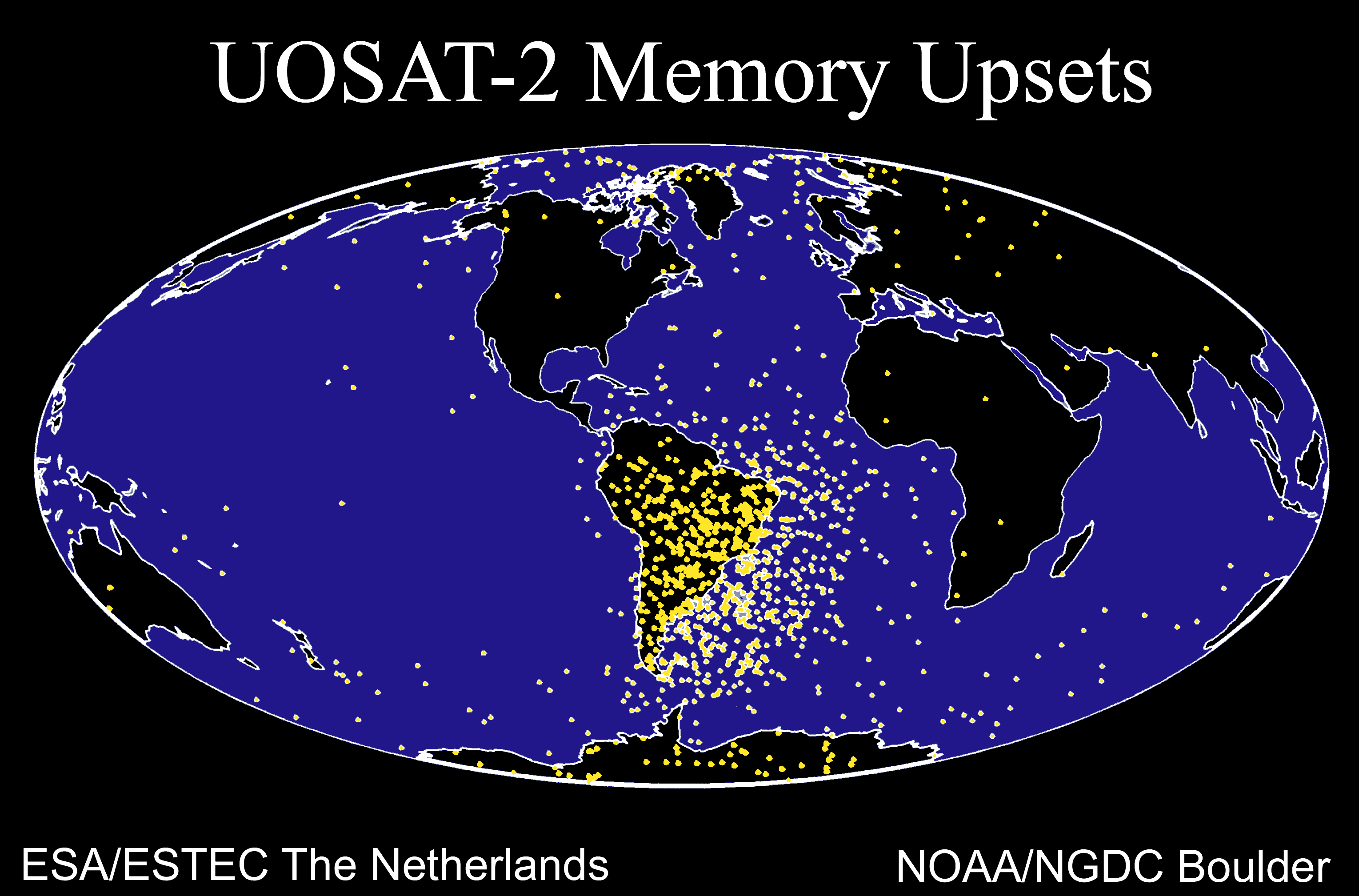
This map gives an idea what might happen worldwide
click on to enlarge
Satellite memory has built in circuitry that can detect and correct 1 bit errors. It’s only when 2 of more bits are changed in any one byte that data is lost.
It’s the CO2 wot dunnit, m’Lord!!!
“Children won’t know what Northern lights are anymore!”
” if we extrapolate the trend”
“Major Disasters will happen”
Sounds familiar?
Now practising for the NYT ‘bonfire for sinners’-quiz:
Sun and atmosphere are homogenous and constant. Climate would be too, if the carbon-based lifeforms realised their social cost, preyed for winter, burned their food for warmth and ate their young.
The human race survived the Maunder minimum , so maybe we should not worry too much about the suppression of a dipole earth field. A quadrupole field will likely remain.
We rarely saw the Northern lights from the island which is my home in the Irish sea, but over the last few years they seem to have made a much more regular appearance. I know this is personal observation and subjective, but i have seen nothing which indicates increased sold activity over that time.
That should be :
increased SOLAR activity. Mrs.Phillips ensures that there is plenty of “sold” activity in our local shops 🙂
Ha! more alarmism….
Poor Griffie, he’s like a little dog who’s convinced that the plastic toy he’s been tossed is a real bone.
Poor Griffie’s shadow, keeps bravely yapping into his keyboard.
Poor McClod, with his boot in his gob, fresh from treading in a cow-pat.
There is no such evidence.
Few scientists believe that. There is no coming grand minimum. Solar grand minima take place mainly in clusters at specific times in the ~ 1000 and ~ 2400 year solar cycles. None is due, so the chances of a grand solar minimum are really small. The expected solar activity from solar cycles is:
http://i.imgur.com/j2hbCiv.png
Note that the millennial high is expected around the end of the century. There won’t be significant cooling from solar activity for at least a couple of centuries.
By pure chance there was a cluster of strong volcanic eruptions right before the Wolf minimum, and another right after the Dalton minimum. The Little Ice Age went from that first cluster to the last, but low solar activity is still the best explanation for the Little Ice Age
http://i.imgur.com/QWfrKaI.png
Figure 15. The effect of LIA climate changes on human societies of Europe. From top to bottom: (a) Solar activity reconstruction by Steinhilber et al., 2012 (in black), shows the Wolf, Spører, Maunder, and Dalton grand solar minima. (b) Volcanic activity reconstruction by Sigl et al., 2015, (in magenta), with dates for the three major eruptions. (c) Northern Hemisphere temperature reconstruction (in red), by Christiansen & Ljungqvist, 2012. (d) Wheat price in Dutch guilders per 100 kg (Lamb, 1995; inverted, in blue), for France (continuous), England (dashed) and Germany (dotted). (e) Three main crops of grain net yield per acre in England, with annual data in pink, and long term trend in brown (Campbell & Ó Gráda, 2011). (f) Northern Hemisphere population growth in % (Zhang et al., 2010; in orange). (g) Northern Hemisphere famine index in events per decade (Zhang et al., 2010; in green). (h) Major famine events (green boxes) and major epidemic and pandemic events (brown boxes). Main historical periods of crisis are shown in boxes at the bottom. Grey vertical lines link multiyear crop failures in (e) with major famines in (h). Light blue boxes are periods of climate deterioration defined in figure 13.
https://judithcurry.com/2016/09/20/impact-of-the-2400-yr-solar-cycle-on-climate-and-human-societies/
This article has a chapter on the Little Ice Age.
Javier, looking at your first figure it would seem that the two previous centennial lows had 3 low periods in a row before rising. It would appear that cycle 25 and 26 could well be much lower that you predict.
One cannot just look at previous cycles and extrapolate repetitions. The sun doesn’t work like that. The only way to predict the next cycle is to actually observe the polar fields during the declining phase of the current cycle from which the new cycle will be generated.
Asybot,
Two centennial lows ago was the Dalton minimum. The last one was the 1900’s cold period. Clearly the intensity of the centennial lows is related to how close they are to the millennial low or the millennial high. Now we should get a centennial low that is significantly warmer than the 1900’s. A couple of below average solar cycles (24 & 25) is probably all we should expect. This projection is in sharp contrast to the many people (relatively speaking) that predict a solar grand minimum like the Maunder.
Back in 1977 the sunspot cycles were graphed as follows. The ‘Fallacy of repeating patterns’ is shown by the red boxes. Guess what the cycle marked by the big question mark would look like [pretty small, one would guess]:
http://www.leif.org/research/Fallacy-Repeating-Patterns,png
The pattern [big, small, small] was supposed to repeat every 83 years.
As we all know by now, it didn’t. Herein lies the cautionary tale.
http://www.leif.org/research/Fallacy-Repeating-Patterns.png
http://www.leif.org/research/Fallacy-Repeating-Pattern.png
An hypothesis is proposed based on observations. The hypothesis makes a prediction. The prediction does not come to pass. The hypothesis is rejected.
The great majority of hypotheses are wrong. The problem comes when after the prediction fails the hypothesis is not rejected, but modified to accommodate new observations whichever they are and at the same time observations are adjusted to fit the hypothesis. That is the real cautionary tale as a failed hypothesis that is anyway upheld delays the acquisition of knowledge.
That is the real cautionary tale as a failed hypothesis that is anyway upheld delays the acquisition of knowledge
That is your problem: clinging to a failed hypothesis.
Again a matter of opinion. The hypothesis that the Sun’s variability displays cycles is supported by a lot of evidence based on observations, and makes predictions easy to test.
A centennial cycle low was expected at SC24, and a centennial cycle low is taking place.
Here is a prediction for SC 24 based on cycles that nailed it (marked in red in the first figure of my post above).
Tan, B. (2011). Multi-timescale solar cycles and the possible implications. Astrophysics and Space Science, 332(1), 65-72.
SC29 and SC31 should also be lower than the cycle immediately before as they belong to a half centennial low and a de Vries low respectively.
Is your opinion contrary to the existence of solar cycles? That’s fine. You can also be wrong.
lsvalgaard, February 2, 2017 at 11:34 pm
“The problem is that solar activity has generally dropped the last half-century, yet temperatures have increased.”
========================
“But how can you stop people remembering things and feeling cold?” cried Winston.
From the Memory Hole…
* * * * * * * * * *
Study Finds Increasing Solar Trend That Can Change Climate
NASA, Mar. 20, 2003
Since the late 1970s, the amount of solar radiation the sun emits, during times of quiet sunspot activity, has increased by nearly .05 percent per decade, according to a NASA funded study.
“This trend is important because, if sustained over many decades, it could cause significant climate change,” said Richard Willson, a researcher affiliated with NASA’s Goddard Institute for Space Studies and Columbia University’s Earth Institute, New York. He is the lead author of the study recently published in Geophysical Research Letters.
“Historical records of solar activity indicate that solar radiation has been increasing since the late 19th century. If a trend, comparable to the one found in this study, persisted throughout the 20th century, it would have provided a significant component of the global warming the Intergovernmental Panel on Climate Change reports to have occurred over the past 100 years,” he said.
* * * * * * * * * * *
Scientists blame sun for global warming
BBC, Friday, February 13, 1998
image 1: “The Sun is more active than it has ever been in the last 300 years”
image 2: “Ancient trees reveal most warm spells are caused by the sun”
[…]
“The researchers point out that much of the half-a-degree rise in global temperature over the last 120 years occurred before 1940 – earlier than the biggest rise in greenhouse gas emissions.”
* * * * * * * * * * *
Spotless Sun: Blankest Year of the Space Age
NASA, Sept 30, 2008
* * * * * * * * * *
The Planet Gets Cooler in ’08. Say What?
Time, Dec 16, 2008
* * * * * * * * * *
The Alps have best snow conditions ‘in a generation’
Telegraph UK, Dec 19, 2008
* * * * * * * * * * *
Snow falls on Baghdad for first time in memory
Reuters, Jan 11, 2008
* * * * * * * * * * *
China battles “coldest winter in 100 years”
Reuters, Feb 4, 2008
* * * * * * * * * * *
Arctic blast brings London earliest snow for 70 years
EveningStandard UK, October 2008
* * * * * * * * * * *
Flights axed as Las Vegas hit by rare snowstorm
USA Today, Dec 19, 2008
* * * * * * * * * * *
The world has never seen such freezing heat
Christopher Booker, Telegraph UK, November 2008
* * * * * *
Nice find, Khwarizmi.
What a good job it is and we are so lucky that the climate ‘scientists’ have all the answers and can lead us to salvation. /s
If we demand that an open mind be maintained on CO2 and climate, we must do the same for solar activity.
Claims that CO2 drives global temperature are abundantly refuted by the paleo record of temperature and CO2.
Claims that sunspots and solar cycles drive climate are repeatedly refuted by Leif, Willis and others since the data don’t show it.
Right now we are half a precession cycle into the current interglacial which is already tailing off to cooler temperatures toward inevitable glacial inception with a few centuries. By Milankovich forcing. That’s the only real climate issue.
“since the data don’t show it.”
====
It depends what you mean by “data”
The atmosphere is made up of molecules https://www.youtube.com/watch?v=zRw0O782o2k of positive and negative charges, when the charged solar wind collides with these molecules they emit a photon of light .
Can humans really feel temperature. https://www.youtube.com/watch?v=yXT012us9ng
Misconceptions About Temperature. https://www.youtube.com/watch?annotation_id=annotation_622525&feature=iv&src_vid=yXT012us9ng&v=vqDbMEdLiCs
How Hot Can It Get? https://www.youtube.com/watch?v=4fuHzC9aTik
There seems to be a high correlation between reduced solar activity and increased CO2. Ergo, we need to stop emitting CO2 if we want to live.
How do they keep forgetting? Horse first – THEN cart. Auroras need solar wind, magnetosphere, and atmosphere. Sunspots are telling us the solar wind has been fading, and the other two components are fine right where they are.
Magnetosphere has been dropping for the last century or so.
The authors claim: “But the Little Ice Age began before the Maunder Minimum …..”.
According to Wikipedia: “The Maunder Minimum, also known as the “prolonged sunspot minimum”, is the name used for the period starting in about 1645 … “.
Also according to Wikipedia, with respect to the Little Ice Age: “The NASA Earth Observatory notes three particularly cold intervals: one beginning about 1650, another about 1770, and the last in 1850 … ”
It seems to me that the authors’ claim is a distortion of the truth, to put it mildly.
Or (and brace yourself here), it could be that the Wikipedia entry is incorrect because it’s not peer-reviewed and literally anyone can edit it.
Why not take a look at the data for yourself?
http://www.nature.com/nature/journal/v536/n7617/fig_tab/nature19082_F2.html
Firstly, you’ll see that the “Little Ice Age” is very hard to spot, because it wasn’t an ice age at all, little or otherwise. Secondly, you’ll see that the small temperature decline starts well before 1650.
Oh yes it was a Little Ice Age if you happened to study glaciers, as they reached their maximum extent during the Holocene at that time.
Mann-made facts
And then the cosmic radiation will increase the sky haze which will decrease the amount of light reaching the surface and blah blah blah…..
Solar wind transports the Earth’s oxygen to the moon
“Because the moon is protected from the solar wind by the Earth when the increase in oxygen ions was recorded, the researchers are confident they come from the Earth….
Data from Kaguya now suggests that some of those ions are oxygen. The researchers found that approximately 26,000 oxygen ions per second hit every square centimeter of the moon’s surface during the deluge.
More details here