Guest post by David Middleton

One of the big mysteries in the scientific world is how the ice sheets of Antarctica formed so rapidly about 34 million years ago, at the boundary between the Eocene and Oligocene epochs.
There are 2 competing theories:
The first explanation is based on global climate change: Scientists have shown that atmospheric carbon dioxide levels declined steadily since the beginning of the Cenozoic Era, 66 million years ago. Once CO2 dropped below a critical threshold, cooler global temperatures allowed the ice sheets of Antarctica to form.
The second theory focuses on dramatic changes in the patterns of ocean circulation. The theory is that when the Drake Passage (which lies between the southern tip of South America and Antarctica) deepened dramatically about 35 million years ago, it triggered a complete reorganization in ocean circulation. The argument is that the increased separation of the Antarctic land mass from South America led to the creation of the powerful Antarctic Circumpolar Current which acted as a kind of water barrier and effectively blocked the warmer, less salty waters from the North Atlantic and Central Pacific from moving southwards towards the Antarctic land mass leading to the isolation of the Antarctic land mass and lowered temperatures which allowed the ice sheets to form.
No one has thought to link these two competing explanations before
A group of researchers, led by scientists in McGill University’s Dept. of Earth and Planetary Sciences now suggest that the best way to understand the creation of this phenomenon is, in fact, by linking the two explanations.
In a paper published on the subject in Nature Geoscience earlier this week they argue that:
- The deepening of the Drake Passage resulted in a change in ocean circulation that resulted in warm waters being directed northwards in circulation patterns like those found in the Gulf Stream that currently warms northwestern Europe.
- That this shift in ocean currents, as the warmer waters were forced northward, lead to an increase in rainfall, which resulted, beginning about 35 million years ago to reduced carbon dioxide levels in the atmosphere. Eventually, as the levels of carbon dioxide in the atmosphere dropped, as a result of a process known as silicate weathering (whereby silica-bearing rocks are slowly worn away by rainfall leading the carbon dioxide from the atmosphere to eventually becomes trapped in limestone) there was such a significant drop in CO2 in the atmosphere that it reached a threshold where ice sheets could form rapidly in Antarctica.
[…]
To read “Enhanced weathering and CO2 drawdown caused by latest Eocene strengthening of the Atlantic meridional overturning circulation,” by Geneviève Elsworth, et al in Nature Geoscience: http://www.nature.com/ngeo/journal/vaop/ncurrent/full/ngeo2888.html
doi:10.1038/ngeo2888
[…]
Meet the new theory
Same as the old theory
My apologies to Pete Townsend for borrowing his lyrics… But this doesn’t sound “new” to me. The only thing that appears to be “new” is the competing “theory” that a drop in atmospheric CO2 triggered the rapid formation of the Antarctic ice sheet. The tectonics-driven disruption of oceanic circulation has been the generally accepted theory for as long as I can remember.
The Earth’s climate rapidly cooled about 34 million years ago. This cooling marks the transition from the Eocene to the Oligocene…

Whereas atmospheric CO2 appears to have remained elevated for about 2 million years after the sudden drop in temperature…

My apologies for the different x-axes. I made these graphs several years ago and don’t recall where I saved the Excel files.
Otherwise, the press release is very well-written. The paper, which is behind a paywall, also looks to be very well done…
Enhanced weathering and CO2 drawdown caused by latest Eocene strengthening of the Atlantic meridional overturning circulation
Geneviève Elsworth, Eric Galbraith, Galen Halverson & Simon Yang
Nature Geoscience (2017) doi:10.1038/ngeo2888
Received 14 October 2016 | Accepted 03 January 2017 | Published online 30 January 2017
Abstract
On timescales significantly greater than 105 years, atmospheric pCO2 is controlled by the rate of mantle outgassing relative to the set-point of the silicate weathering feedback. The weathering set-point has been shown to depend on the distribution and characteristics of rocks exposed at the Earth’s surface, vegetation types and topography. Here we argue that large-scale climate impacts caused by changes in ocean circulation can also modify the weathering set-point and show evidence suggesting that this played a role in the establishment of the Antarctic ice sheet at the Eocene–Oligocene boundary. In our simulations, tectonic deepening of the Drake Passage causes freshening and stratification of the Southern Ocean, strengthening the Atlantic meridional overturning circulation and consequently raising temperatures and intensifying rainfall over land. These simulated changes are consistent with late Eocene tectonic reconstructions that show Drake Passage deepening, and with sediment records that reveal Southern Ocean stratification, the emergence of North Atlantic Deep Water, and a hemispherically asymmetric temperature change. These factors would have driven intensified silicate weathering and can thereby explain the drawdown of carbon dioxide that has been linked with Antarctic ice sheet growth. We suggest that this mechanism illustrates another way in which ocean–atmosphere climate dynamics can introduce nonlinear threshold behaviour through interaction with the geologic carbon cycle.
This has been a deeply educational thread. Thanks to all our “usual suspects” / resident experts.
Striking snowplow drivers.
Erm. The paper is well done – it is in English. I have no idea what the news release was written in, but certainly not quite English. I would be embarrassed by the very poor writing exhibited in that piece.
I am interested in the Eocene/Oligocene freefall as a possible inflection point between the Neogene regime where CO2 and temperature are correlated, but CO2 is the slave of temperature; and the prior Phanerozoic regime where CO2 and temperature do not seem related at all.
They were related at times in the Paleozoic, Mesozoic and Cenozoic Eras. CO2 fell to near present levels during the Carboniferous-Permian glaciation, and were generally high during the warm Mesozoic and early Cenoszoic.
In the latter case, there is a causation-correlation problem however. Volcanism associated with the breakup of Pangaea both warmed the seas and released copious quantities of CO2.
I suspect you are referring to Royer (2009) Geocarbsulf (cough) VOLC+Solar evolution +CO2 [radiative forcing only] for your conclusion that CO2 was low during the Carbo-Permian glaciation. I believe Scotese has graphics that agree, but I have never seen the sources.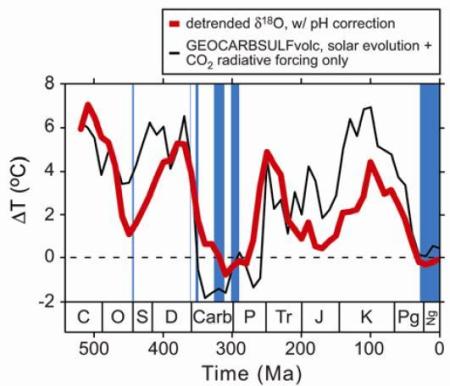

I mean, rully, Royer’s CO2 series is a litany of compounded uncertainties, adding sulfur, volcanic, our sun’s status as a main sequence star, and supposed but unproven radiative forcing from CO2; to the already low resolution direct CO2 proxy data.
This is what I get with simple proxies:
Estimated average CO2 level over each period (with the mean sometimes masking large swings):
Cambrian: 4500 ppm (7000 ppm early)
Ordovician: 4200 ppm (including a glacial phase)
Silurian: 4500 ppm
Devonian: 2200 ppm (evolution of large land plants possibly drawing down CO2)
Carboniferous: 800 ppm
Permian: 900 ppm
Triassic: 1750 ppm
Jurassic: 1950 ppm
Cretaceous: 1700 ppm
Paleogene: 500 ppm
Neogene: 280 ppm (almost certainly too low an estimate).
The Miocene Epoch (23 to 5 Ma) was by far the longest of the Neogene Period, during which epoch CO2 averaged around 400 ppm. The Pliocene, Pleistocene and Holocene, with generally lower CO2, have lasted only about five million years.
http://people.earth.yale.edu/sites/default/files/resize/images/Zhang-400×280.jpg
Higher Mesozoic CO2 perhaps thanks to break up of Pangaea, although that didn’t real start until the Triassic/Jurassic boundary.
Aren’t we still in the Pleistocene era? I was under the impression that Holocene is used to describe our current interglacial, not a new geological era.
Maybe it’s because cold always sinks to the bottom, and Antarctica sits at the “bottom” of the world.😁
What I want to know is WHY GREENLAND WAS ICED 3 MILLION YEARS AGO.?
http://www.livescience.com/2801-mystery-greenland-ice-lingers-sheet-shrinks.html
Surely we have new info since 2008. Science now says there is evidence of Sol doing unusual things https://phys.org/news/2017-02-analysis-tree-reveals-highly-abnormal.html
5430 BC.