Americans believe climate change connected to location and local weather
Researchers found local experiences and temperatures drive belief or non-belief in climate change

A new study finds local weather may play an important role in Americans’ belief in climate change. The study, published on Monday, found that Americans’ belief that the earth is warming is related to the frequency of weather-related events they experience, suggesting that local changes in their climate influence their acceptance of this worldwide phenomenon.
“One of the greatest challenges to communicating scientific findings about climate change is the cognitive disconnect between local and global events,” said Michael Mann, associate professor of geography at George Washington University and co-author of the paper. “It is easy to assume that what you experience at home must be happening elsewhere.”
The researchers found that Americans who experience more record highs than lows in temperature are more likely to believe the earth is warming. Conversely, Americans who live in areas that have experienced record low temperatures, such as southern portions of Ohio and the Mississippi River basins, are more skeptical that the earth is warming.
The study notes that part of this dichotomy may be because of the early terminology used to describe climate change that suggested the earth was simply warming – not changing in innumerable but measurable ways. This might have led residents living in areas that experienced an unusually cold winter to doubt that climate change is occurring.
“Who do Americans trust about climate change; scientists or themselves?” said Robert Kaufmann, professor in the department of geography and the Center for Energy & Environmental Studies at Boston University and lead author of the paper. “For many Americans, the answer seems to be themselves.”
The researchers also found that a recent period of lower-than-average temperatures offset the effect of a long warming period, further supporting their findings that people’s belief in climate change is local and experiential.
The scientists note the importance of differentiating between weather, the temperatures of a relatively short period of time such as a season, and climate, the average temperatures over a period of 25 or 30 years. Emphasizing the difference between weather and climate may help scientists more effectively communicate about climate change.
The paper, “The Spatial Heterogeneity of Climate Change: An Experiential Basis for Skepticism,” was published in Proceedings National Academy of Sciences.
http://www.pnas.org/content/early/2016/12/13/1607032113.abstract
###
Abstract
We postulate that skepticism about climate change is partially caused by the spatial heterogeneity of climate change, which exposes experiential learners to climate heuristics that differ from the global average. This hypothesis is tested by formalizing an index that measures local changes in climate using station data and comparing this index with survey-based model estimates of county-level opinion about whether global warming is happening. Results indicate that more stations exhibit cooling and warming than predicted by random chance and that spatial variations in these changes can account for spatial variations in the percentage of the population that believes that “global warming is happening.” This effect is diminished in areas that have experienced more record low temperatures than record highs since 2005. Together, these results suggest that skepticism about climate change is driven partially by personal experiences; an accurate heuristic for local changes in climate identifies obstacles to communicating ongoing changes in climate to the public and how these communications might be improved.
Significance
We develop a simple heuristic to measure local changes in climate based on the timing of record high and low temperatures. The metric shows local cooling and warming in the United States and captures two aspects of experiential learning that influence how the public perceives a change in climate: recency weighting and an emphasis on extreme events. We find that skepticism about whether the Earth is warming is greater in areas exhibiting cooling relative to areas that have warmed and that recent cooling can offset historical warming. This experiential basis for skepticism of climate change identifies obstacles to communicating ongoing changes in climate to the public and how these communications might be improved.
Anthony comments:
So I’ve read the study, and it’s got one clear problem that I can see, which is obvious from their map – they didn’t account for local media exposure and political bias. Below is a map of how counties voted in the 2012 election, compared to Mann’s climate belief system map. Reds are right leaning (Republican), Blues are left leaning (Democratic). I’ve used this map, because it’s closer to the timeframe of the polling data from Mann’s study, IMO.

If you compare the grey areas, where belief in global warming due to weather events is high, you’ll note an obvious pattern: The darkest areas in Mann’s map match many of the bluest areas of the voting map. Places like San Francisco, Portland, Seattle, Miami, New York, New Hampshire, Vermont, Maine, Washington, DC and Chicago all have strong correlations with voting records.
This suggests that Mann’s study is pure bunk, and is more related to political leanings and media outlets for those areas pushing the AGW meme, than it has to do with weather.
Another Manntastic fantastic claim, shot to hell.
UPDATE/CORRECTION: Well, I’ve made a mistake. The Michael Mann listed as author of the paper is not the Michael E. Mann, of Penn State, but a person of the same first and last names of George Washington University. The headline and last sentence have been corrected to fix that misidentification. (h/t to Roman M in comments) -Anthony
“…. freak snowfall in the Sahara Desert, believed to be first time it has fallen on the unforgiving red dunes in almost 40 years. Amateur photographer Karim Bouchetata says he took the incredible pictures of snow covering the sand in the small Saharan desert town of Ain Sefra, Algeria, on December 19.”
http://www.telegraph.co.uk/content/dam/news/2016/12/20/116484514-Rare-snow-in-sahara-desert-large_trans_NvBQzQNjv4BqqVzuuqpFlyLIwiB6NTmJwfSVWeZ_vEN7c6bHu2jJnT8.jpg
It looks a bit ‘f a k e’, is the event verifiable? Number of similar photos are published in the Telegraph
There are multiple sources reporting this, though most seem to be using the same amateur photographer’s photos. It happened in the past, so it’s quite possible it’s true. Photos of rare events often look “f a k e d” because it’s not what one expects to see.
Acclimatization theory:
Quite simply this theory recognizes the individual response to whatever the weather is and how it is interpreted at the time and then projected to onto climate awareness.
A simple example.
Air conditioning is more prevalent now than in the past. Mid 20th century folks moved in and out of vehicles, homes, offices, without air conditioning and as a result experienced less temperature transition shock when doing so.
Now in the early 21st century the transition from home, office, vehicle, involves a temperature transition on the order of 10 to 30 degrees F. This creates an apprehension of hotter weather due to sensory exaggeration because of the lack of acclimatization to the hotter weather because the individual is experiencing greater isolation from the real world when predominantly residing in a climate controlled environment.
Hence modern man is more amenable to the apprehension that climate change as Global Warming is occurring.
Just sayin’
One of the biggest problems I have with Sociology/Social Sciences/Social Psychology, etc., aside from the obviously biased tilt/unquestioning acceptance of the reality of “climate change”, is that they spend a lot of grant money doing useless studies that they publish with unintelligible language that basically confirms what anyone with a little common sense and experience already knows. When I was younger (a lot younger), I used to work a summer job as a delivery driver for a small, family owned auto parts store. the store was air conditioned and the trucks were air conditioned. When it got hot in the summertime, it really sucked leaving the AC’d store, getting into the AC’d truck, then getting out in the heat to make the delivery. I used to drive around with the AC off and the window down just to “acclimatize”, though I didn’t know what they called it at the time and didn’t need to read an unintelligible social/behavioral science paper to figure that out. What a waste of a college education.
I do the same thing heading for the golf course.
I want to be used to the heat.
The reality is that extreme weather events and sea level rise are part of the Earth’s current global climate. Even if we could cause climate change to stop, extreme weather events and sea level rise would continue unabated. A climate under which extreme weather events would not happen has yet to be discovered. So even if we could control climate change we would not know how to change it so as to stop extreme weather events. Plunging the Earth into another ice age will cause sea levels to lower at the cost of new ice sheets developing where there are currently none. If Nature has its way, there will be another ice age but it may be several thousand years in our future.
Richard is correct on the fact that the belief data comes from the Howe paper that he refers to. If anyone wishes to look further at this aspect, the paper can be found at http://www.nature.com/nclimate/journal/v5/n6/full/nclimate2583.html
Although the paper itself is behind a paywall, the Supplementary material provides good information along with Excel files containing their results not only for the question of whether it is warming but also for a number of questions including whether humans are causing it, scientific consensus, etc. A pre-publication working copy of the paper itself is available at http://papers.ssrn.com/abstract=2515649
The ‘global warming question as used in Howe et al reads:
Here is how the cobbled-up beliefs by county fare against the vote for Obama in 2012 (red lines are placed at the medians of the two variables):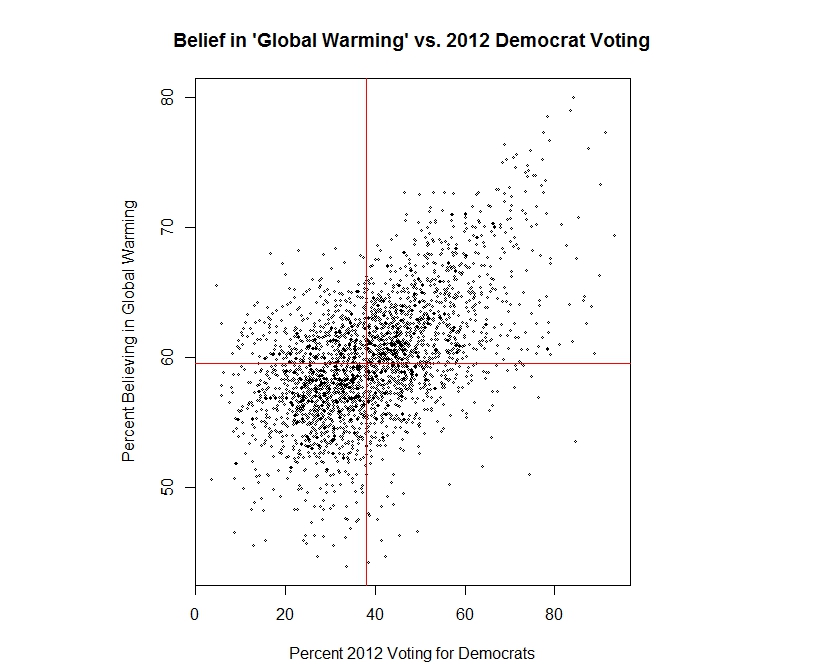
Thank you for the “UPDATE/CORRECTION: Well, I’ve made a mistake……”
We’re all still waiting for the other Mann (et al) to man up and admit he was wrong about about anything.
Integrity matters.
+1. Integrity does matter.
+ a gazillion.
A parallel:
The government says there is an obesity crisis.
Person sees an obese person at Walmart, and thinks, “Oh, yeah, now I see. There IS and obesity crisis.”
Why are the densely populated areas generally democrat and generally fall for this climate change scam? Is it that they are breathing in so much C and CO2 from all the car exhaust their brains lack the oxygen to think strait? Maybe it’s the result of living too long in those heat islands?
“Local experiences?” My local experiences say nothing of global warming or climate change. The concept has to be introduced externally.
It is common in belief systems, for a correlation between two beliefs. For instance, Democrat voters tend to believe in global warming. Republican voters tend to disbelieve. I haven’t read the paper, but does it make any effort to compensate for that effect?
Well you only have to look outside your tent to see global warming going on-
http://www.msn.com/en-au/news/world/snow-falls-in-sahara-desert-for-only-second-time-in-living-memory/ar-BBxoYzH?
“The Sahara covers most of northern Africa and has gone through shifts in temperature and moisture over the past few hundred thousand years.
The desert is one of the hottest and driest areas of the world today, although it is expected to become green again in about 15,000 years.”
Well blow me down, I’ll bet the locals never knew that.
I re-read this post, scrutinizing the two maps, and I am not seeing political leaning as a clearly dominate factor to call the study “pure bunk”. In fact, I would suspect that local weather perceptions are the strongest factor, since many people think politics is “pure bunk”.
I suspect that a combination of local perceptions and media/political alignment sets a person’s attitude towards climate change. The media can certainly amplify the local perceptions, and, in this sense, I think the study might ignore this sort of media amplification (as opposed to the sort of “amplification” we are accustomed to seeing in climate discussions).
The media, in other words, probably dictate HOW people judge their perceptions of local weather. And political alignment probably dictates how the media relate local weather. Judgements about the weather do not exist in a vacuum, and so now I guess I am saying that the study is somewhat bunk.
This makes the same point as the paper, only more succinctly:
https://xkcd.com/1321/
Looks like another case of Fallacy of Accident arising from assuming a causation from an apparent correlation. In this case there is a common cause to the liberal leanings and the belief in climate change – a deficiency of critical thinking.
I don’t see how Gilmore’s map can be used to quantitatively correlate anything.
Forget snow in the Sahara—National news (ABC) actually found out Casper, Wyoming exists! (And not even in conjunction with the solar eclipse in 2017) There was a 5 second video about the 60 mph winds wreaking havoc on driving. There were 80 mph gusts and semi tractor-trailers blown over.
This not really “extreme” in Wyoming, but to national news, I’m sure it looked that way!
I count 24 US states with a more recent absolute cold record than hot one. As there are only 50 states this suggests that any warming trend is a small one. Interestingly the colder states are much more likely to be in this group. It’s awful difficult to tamper with these records using standard homogonisation procedures, local patriots are apt to blow yer darn head off if you attempt remove Landslide, Wyoming’s all time low. So Hansen and Co leave them in their pristine state. And if the state cold extreme was recorded within recent memory but the hot one in 1936 it’s hardly surprising if the locals are skeptical.
Looking at the shaded version of the map, I would hypothesize that belief in climate change is significantly governed by recent or current drought.