Studies refute hypothesis on what caused abrupt climate change thousands of years ago
Two new studies in the Journal of Quaternary Science refute the hypothesis that one or more comets/bolides struck North America approximately 12,900 years ago triggering rapid climate change and the start of the Younger Dryas period.
Prior to the Younger Dryas, the climate had gradually warmed from glacial conditions to near modern temperatures, and the massive ice sheets in North America were in full retreat; however, approximately 12,900 years ago, temperatures rapidly plummeted and returned to glacial conditions for about a 1200 year long period. Also about this time, the mammoths and mastodons became extinct in North America.
The two papers challenge two lines of evidence reported and used by others to support the impact theory. One is the report of elevated concentrations of nanometer-sized diamonds in sediments deposited at the onset of the Younger Dryas. It is claimed that these diamonds were formed during an impact. The other is the interpretation that paleofire evidence at a key archaeological site demonstrates massive wildfires at the beginning of the Younger Dryas. It is claimed that the impact caused wildfires that spanned the continent.
Each paper shows that the evidence and interpretations supporting these two lines of arguments do not stack up.
“Impact proponents report the rare form of diamond, lonsdaleite, that is usually associated with shock processing; however, we show that they misidentified polycrystalline aggregates of graphene and graphane as lonsdaleite,” said Dr. Tyrone Daulton, lead author of one of the papers. “Further, we show that the nanodiamond concentration measurements reported by impact proponents are critically flawed. There is no evidence for a spike in the nanodiamond concentration at the onset of the Younger Dryas to suggest that an impact event occurred.”
Prof. Andrew Scott, lead author of the second paper said, “The idea of a Younger Dryas impact was an interesting one that has drawn much attention; however, increasingly methodological research over the past few years has failed to corroborate that story. Our research has shown that many of the markers for such an event have been misinterpreted or misidentified.”
###
Studies: http://onlinelibrary.wiley.com/doi/10.1002/jqs.2892/full
http://onlinelibrary.wiley.com/doi/10.1002/jqs.2914/full
The case of the missing diamonds
Unproved, Washington U. sleuth says of Younger Dryas impact
It all began innocently enough. Tyrone Daulton, a physicist with the Institute for Materials Science and Engineering at Washington University in St. Louis, was studying stardust, tiny specks of heat-resistant minerals thought to have condensed from the gases exhaled by dying stars. Among the minerals that make up stardust are tiny diamonds.
In 2007, Richard Kerr, a writer for the journal Science, knowing Daulton’s expertise, called to ask whether nanodiamonds found in sediments could be evidence of an ancient impact.
Daulton said it was possible the heat and pressure of such a cataclysm could convert carbon in Earth’s crust to diamond, but asked to see the paper, which had been published in Science.
The Science paper argued that a shower of exploding comet fragments over the North American ice sheet had triggered a sudden climate reversal called the Younger Dryas. Having read the paper, Daulton told the reporter, “It looks interesting, [but] there’s not enough information in this paper to say whether they found diamonds.”
Since then, Daulton has periodically been asked to evaluate Younger Dryas sediments for nanodiamonds. In the issue of the Journal of Quaternary Science released online Dec.19, he reviews the accumulated evidence and reports on his own analysis of new samples from California and Belgium.
For the second time in 10 years, Daulton has carefully reviewed the evidence, and found no evidence for a spike in nanodiamond concentration in Younger Dryas sediments. Since nanodiamonds are the strongest piece of evidence for the impact hypothesis, their absence effectively discredits it.
And so a great idea apparently has been brought low by the humblest of evidence.
What went wrong?
Nanodiamonds, it bears emphasizing, are tiny — smaller than bacteria. Impact supporters often claim to find them inside small spheres of carbon, and those spheres are about the size of the period at the end of this sentence.
Even so, how is it possible for some scientists to find diamonds in samples and others to find none? One answer is that carbon atoms can arrange themselves in many different configurations. These arrangements, which make the difference between pencil lead and diamond, can be confused with one another.
Impact supporters often claim to have found lonsdaleite, a rare form of diamond that has a hexagonal rather than the common, cubic atomic structure. “Lonsdaleite is usually reported in the literature associated with impact sites or in meteorites that were shock processed,” Daulton said. “It can also be formed by detonation in the laboratory, so the presence of lonsdaleite to me would be a strong suggestion of an impact.”
But when he examined Younger Dryas samples reported to contain lonsdaleite, Daulton couldn’t find it. Instead, he found aggregates of single-atom-thick sheets of carbon atoms (graphene) and sheets of carbon atoms with attached hydrogen atoms (graphane) that looked “very, very similar to lonsdaleite.” So the claim of lonsdaleite was based on a misidentification: Daulton published this result in 2010.
End of story? Not so fast.
In 2014, a group of researchers reported that they had found a nanodiamond-rich sediment layer that spanned three continents. While claiming to find cubic and hexagonal diamond, they also claimed to find much more abundant n-diamond, a controversial form of diamond characterized by electron diffraction patterns similar to diamond, but with extra “forbidden” reflections that diamond does not exhibit.
Pulled back into the controversy, Daulton again found no diamond or n-diamond in the samples from the Younger Dryas horizon. What he found instead was nanocrystalline copper, which produces diffraction patterns just like the controversial n-diamond.
Daulton also attempted to reproduce the analyses that found a spike in the concentration of nanodiamonds at the Younger Dryas but found flaws in the methodology that invalidated the result.
Paradoxically it was Daulton’s experience finding nanodiamonds in stardust that prepared him not to find them in sediments.
###
The pictures suggest whatever caused these oval shapes was a process that happened over a period of time, rather then a sudden impact.
Maybe everything that sparkles isn’t diamond….It might just be space bling 🙂
There has never been a case for an impact causing these events, unless anybody thought they had occurred so rarely, maybe could they have been missed? Frequent significant changes even larger than shown below, have occurred so often it would be very foolish to think impacts would occur frequent enough to just be responsible for even just a few of them.
http://i772.photobucket.com/albums/yy8/SciMattG/younger_dryas_zpst01vrmwh.jpg
This is a graph I created and published that illustrates my comments below.
>>This is a graph I created and published
But if you use the CH4 temperature record, there is no Older Dryas or Inter Alleroid. There is just a catastrophic Younger Dryas cooling.
http://oi66.tinypic.com/x6d94y.jpg
The CH4 plots on the top graph are from Antarctica (blue) and Greenland (orange), demonstrating good hemispheric consistency and agreement. The ice-core CH4 readings are obviously reliable.
Extracted from Lemieux, “Consistent dating for Antarctic and Greenland ice cores”.
R
I thought you did, hope you don’t mind showing it here.
Hide from me this lonsdaelite which I shall not see. 😉 all your climate changes belong to co2, according to the ministry of truth.
The Younger Dryas is only one of many climate reversals during the late Pleistocene. As I have posted here several times earlier, a meteor or comet impact is a single event whereas there were many late glacial warm/cool phases. During the late Pleistocene 15,000 to 11,500 years ago, there were three cooling periods,(the YD, Older Dryas, and Oldest Dryas) and two warm periods (Allerod, and Bolling). For details, see ‘Late Pleistocene Abrupt Climate Changes’ (pages 141-143 in “Evidence-based Climate Science” by Elsevier).
Also, the YD began with an incredibly abrupt cooling (~20 F/century), lasted for ~1000 years, then warmed up abruptly (~20F / century). The effects of a meteor or comet can’t last for 1000 years, then warm so abruptly. Whatever caused the YD was not a single event.
Could there have been some sort of solar obstruction between the Earth and Sun to cause such a rapid change over a long term? Orbiting cloud of debris/ice etc.?
There is no such thing as a “climate reversal” there is however various climes that vary overtime, even on a planetary scale.
There are document impacts that have occurred on earth.
There is no evidence that links an Impact large enough to cause a planetary scale glaciation, equally, that same thing can be argued for an interglacial.
Can glaciation happen without an impact?
Did such a hypothetical impact, cause such a catastrophe through a planetary scale glaciation and slowly kill off species who were not adaptable?
Where are the bodies?
“The effects of a meteor or comet can’t last for 1000 years”
Meteor’s burn up in the atmosphere. Impacts come from Comets and asteroids.
ralfellis, aren’t there more recent Impacts visible on earth that swamp those you have shown as evidence above in comparison? what did they cause? A singularity?
Don’t get me started lol 😀
Hi Don: If you believe in the thesis as laid out by Dr. William Napier and other such scientists including Dr. Duncan Steel, that the type of comet encounter were “comet showers” then the theory is plausible. Please note that there was a warming to some extent part way into the Younger Dryas, This was then followed by a return to cold. before it once again warmed up at the start of the Holocene.
It’s more than that–take a look at my graph in MattG above.
Hi again Don: yes i see the level of detail you show in your graph. Your graph may even reinforce the idea as Dr. William Napier suggests, that the Earth was bombarded my “comet showers that could extend over a considerable length of time. They are not constant and after several years they stop, but begin again as we again pass through tail of the comet once again. your graph indicates to me that overall the Younger Dryas was colder, (note that even the upward oxygen isotope spikes fall below the deviations from both the Allerod/Bolling and Holocene intervals. Did you actually interpret the ice core data yourself, because i have never seen the level of detail you present here. Excellent!
>>The Younger Dryas is only one of many climate
>>reversals during the late Pleistocene.
But the Dansgaard-Oeshger events (D-O) were warming events associated with conflagration products, followed by a slower cooling period. The YD is clearly a catastrophic cooling, not associated with conflagration products (and a rapid recovery). They are demonstrably different events.
http://www.nature.com/ngeo/journal/v8/n9/images/ngeo2495-f2.jpg
Sorry, the lower purple plot represents the conflagration products, linked with D-O warming periods.
See: Fischer. ‘Millennial changes in North American wildfire and soil activity over the last glacial cycle’
R
The Great Lakes have no relationship to impact craters–they were carved out by lobes of the late Pleistocene Laurentide ice sheet, as shown by concentric glacial moraines around their margins.
>>The Great Lakes were carved out by lobes of the
>>late Pleistocene Laurentide ice sheet.
Ice sheet lobes that were closely following the deep fissures, created by the impact on the ice sheet above…
R
The moraines were formed by Laurentide Ice Sheet during its maximum advance in the Wisconsin glaciation. Proglacial lakes formed behind them during the retreat of the LIS. No non-existent fissures need apply: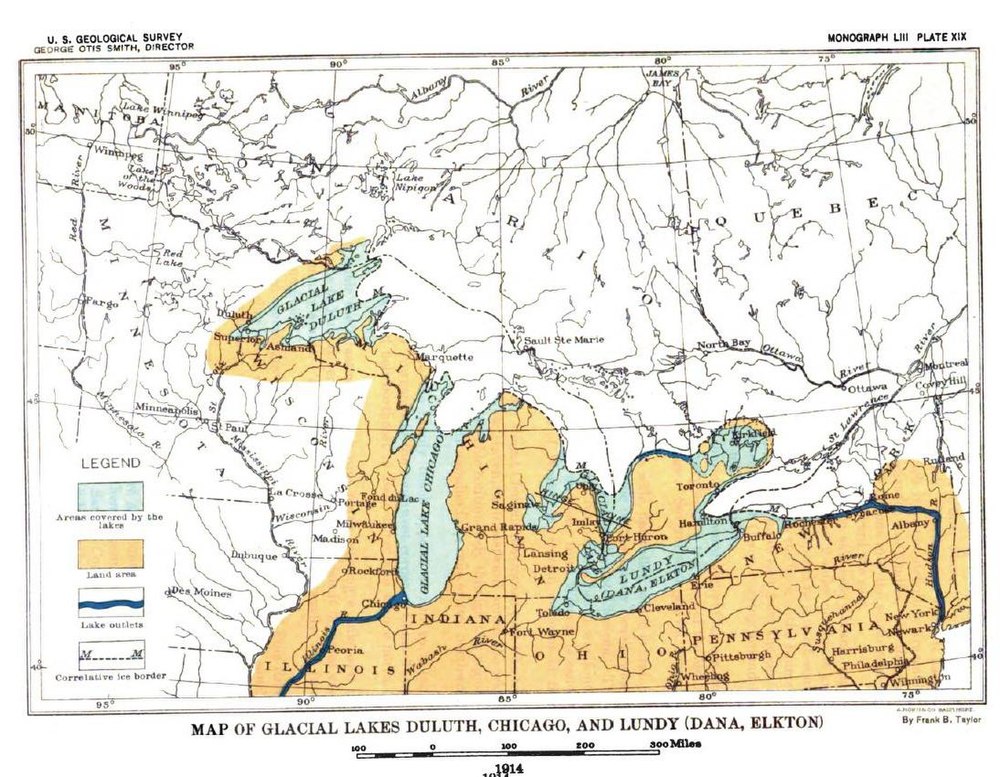
If you want to see what an Earth-skimming meteor looks like, the 1972 fireball is probably the best example. This meteor pops out of a cloud, which places it at about 5,000 ft altitude, from my large aviation experience. Just a whisker lower, and it would have created a nice graze and butterfly impact crater, and still had enough energy to skip back out into space.
Fast forward to 0:30 seconds
>>Don
>>The Great Lakes have no relationship to impact craters.
That may be so. But there does appear to have been an impact in that very location, as triangulated from the orientations of the 1/2 million Carolina Bay formations. And this is something that has been ignored, rather than considered and investigated. And that to me is bad science. If the Laurentide impact theory is to be discounted, there should be a valid reason for its dismissal.
The Carolina Bays and the Destruction of North America.
https://www.academia.edu/20051868/The_Carolina_Bays_and_the_destruction_of_North_America
BTW. As Michael Davias said, the primary impact in the Great Lakes region is likely to have been at a low-angle. This would result in a shallow ‘butterfly impact’ crater on the ice sheet (and underlying rock formations(?)), and it is possible that much of the original bolide may have skipped back out into space.
R
If the Laurentide impact theory is to be discounted, there should be a valid reason for its dismissal.
It works the other way: If the Laurentide impact theory is to be accepted, there should be a valid reason for the acceptance. And there really isn’t any.
The valid reason for its dismissal is that it has not a shred of valid evidence in its favor.
The Carolina Bays are oriented in line with the prevailing winds during the Wisconsin glaciation, as shown by every other possible source of evidence and, yes, even models of atmospheric circulation around the ice sheets based upon that evidence. Their origin is tens of thousands of years before the YD and even most of their modifications precede it.
The impact conjecture is not science. Whatever predictions it makes are easily shown false and have been done over and over again for at least a decade. Much longer if you count the original suggestion in the 1950s that the bays might be from impacts.
At this point, it’s science fiction, nay fantasy, which has become an industry for its few diehard advocates who refuse to accept objective reality either out of pure faith, stubbornness or career interest. Kennet had a good reputation until he hitched himself to this falling star. The others, not so much. To say the least.
>>Leif
>>If the Laurentide impact theory is to be accepted
>>There should be a valid reason for the acceptance.
>>And there really isn’t any.
So you turn a blind eye to the evidence presented here, and in the various linked websites and articles, and say “I see no evidence”. What is your middle name – Leif Nelson Svalgaard?
I ask you again. If there was no impact scenario, how did samples of vitrified carbon (tree wood) end up in the Carolina Bays? Clovis man’s laser experimentation?
R
If there was no impact scenario, how did samples of vitrified carbon (tree wood) end up in the Carolina Bays
There is no evidence that that wood was due to an impact on the ice. Not many trees up there…
And some claimed ‘evidence’ does not hold water and deserves to be ignored. Perhaps you also believe in Velikovsky? Or do you turn a blind eye to his ‘evidence’?
My science is likely a bit antiquated, perhaps, on the events concerning the outflow from Lake Agassiz, but having been born on the floor of this lake it was natural to have been exposed to research work and on scientific tours of the lake features. The various raised beaches and shifted sandy deltas of rivers record the drawdown
and shrinking.
My own discoveries related to this were accidental in the course doing groundwater hydrology in SW Manitoba and mapping Precambrian geology in the middle – north part. In the first case, I discovered a tributary of the ancient Missouri River at a well depth of about 300′. The tan quartz gravel contained petrified wood and opalized wood that had earlier been found in in a borehole in south central Saskatchewan. Apparently the river made an unexpected sharp bend eastward into Manitoba. This was back when the old Missouri drained north to Hudson’s Bay in the previous interglacial. The headwaters of the river was subsequently captured by the present Missouri and flow went to the Mississippi while it’s northern part was buried in glacial lake clays.
I believe a large volume of Agassiz went down the Mississippi while the northern ice dam was in place. Mapping Precambrian for the Geological Survey of Manitoba in 1961, I came upon a shore strand line that had not been mapped previously. It was in the middle of a nice jackpine ‘parkland’ and there in the middle of forest was a magnificent barchan sand dune that looked like it belonged in Saudi Arabia – crescent shaped with fairly sharp ridge about 20′ or so high showing that the prevailing wind was from the east. I believe this strand line to have been the last stage of the lake before it rushed out into Hudson Bay. I’m not convinced the lake sent much water east to the St Lawrence.
Oh and Don Easterbrook, Lake Superior ‘s deeps are about 200m below sea level so I don’t think that would support your idea of glacial carving. I have to like ralfelis’ s impact theory.
Gary,
You missed Don’s explanation about the rift zone, which accounts for the depth of Superior. This is firmly established. The shallower lakes were gouged out by the glaciers, but over Superior they just removed the overburden and exposed the preexisting crack in the earth. The rifting almost tore North America apart, as is happening now in the Rift Valley in Africa and as happened between Africa and North America when Pangaea started splitting up at the Triassic/Jurassic boundary.
Some reading on the rift zone:
http://www.lakesuperior.com/the-lake/natural-world/243-lake-superior-basin-fiery-beginning/
At the time of glaciation, sea level was about 120 m below what it is now, leaving only about 80 m to be accounted for. The fjords of Norway are deeper than that by far.
From the article comment,
This is incorrect and based exclusively on Greenland ice cores which shows the dangers of depending on a single regional proxy.
Neither interglacial conditions had been reached prior to the Younger Dryas, nor there was a return to glacial conditions.
While on the warming towards interglacial conditions there was a cold relapse, but the Younger Dryas was significantly warmer than the glacial maximum of a few thousand years earlier. This is indicated by nearly every proxy record in the World, showing that there is problem with Greenland ice cores at this time.
That the Younger Dryas was a return to glacial conditions is a popular myth that refuses to die.
Let’s see for example sea levels, a quite good indicator of global temperatures.
http://i.imgur.com/Z0j6Uok.png
From: Lambeck, Kurt, et al. “Sea level and global ice volumes from the Last Glacial Maximum to the Holocene.” Proceedings of the National Academy of Sciences 111.43 (2014): 15296-15303.
YD is barely noticeable in sea levels. Clearly not a return to glacial conditions as there was no decrease in sea levels.
Javier
You are falling into the trap Shakun fell into bu ignoring the bipolar seesaw. Reciprocity between the hemispheres was quite prominent during the whole glacial termination. Antarctica first started warming ~20kya. Then 14.6 kya there was the abrupt NH warming of the Bolling-Allerod. While this happened the SH oceans reverted to cooling – this is the well-known “Antarctic Reversal”. Then came the YD where the B-A warming was abruptly reversed. However, following the bipolar seesaw, the SH oceans switched back to warming during the YD.
There is more ocean water in the SH than the NH. That is why CO2 that was outgassing from the warming southern oceans, continued to increase during the NH cool interval of the YD.
Greenland is a correct and accurate isotope record of NH warming and cooling related to the switching on and off of the AMOC (caused by its nonlinear instability resulting from the salinity-downwelling positive feedback). Greenland cores agree in this respect with other oceanic sediment isotope records. However they don’t agree with the army of very poor biological proxies like pollen and midges that Shakun uses. Some of these scarcely resolve the Holocene at all. Shakun uses such proxies to smear the Holocene into a smooth blob and iron out the BA and YD entirely, all in aid of his ulterior and only purpose of fudging a story of CO2 causation of glacial termination.
Warming southern oceans were also the reason that sea level rise – related to average global ocean temperatures – continued during the NH cold snap of the YD.
Shakun didn’t fall into any trap. He committed scientific fraud. He hid that the variability of his data invalidated the main conclusion of his article.
And I am not falling into any trap nor ignoring the bipolar see-saw. Quite the contrary I was talking about it when I said:
“The temperature difference between Antarctica and Greenland during Heinrich events indicates they are oceanic coupled.”
You are the one that is confusing that we are talking about the effect of the Younger Dryas in the World, not in a certain area of the Northern Hemisphere. The global ocean situation is a better representation than any of the poles, as it is integrative. therefore its use is much more accurate than any of the ice core proxies.
And you are the one that apparently ignores the problems that many of Greenland cores display, that include altitude adjustment problems, as Bo Vinther showed with the Agassiz and Renland ice cores. Buizert et al., 2014 have shown with four different reconstructions that contrary to the traditional δ18O interpretation, the Younger Dryas period was 4.5±2°C warmer than the Oldest Dryas.
Buizert, Christo, et al. “Greenland temperature response to climate forcing during the last deglaciation.” Science 345.6201 (2014): 1177-1180.
http://ir.library.oregonstate.edu/xmlui/bitstream/handle/1957/54628/BuizertChristoCEOASGreenlandTemperatureResponse.pdf
And on top of that we have confirmation from China loess deposits and speleothems
http://i.imgur.com/KgGJB1i.gif
There is a problem with Greenland records. When corrected they agree with other proxies in that YD was warmer than OD, and although it supposed a serious cooling in the Northern Hemisphere, it was not a return to glacial conditions, and globally it had little impact on the deglaciation, as sea levels clearly show,
Myth busted.
Javier
I worded my reply badly – what I mainly meant was that your sea level figure implies the YD is a non-entity, whole the reciprocal SH temperature trend accounts for this impression. However in no way did I suggest that the YD represented a full return to glacial maximum, an impossibility in the face of ongoing Antarctic warming.
Also you are right about Shakun, his conjuring trick with proxies is indeed dishonest. Your wording was better than mine in that respect.
The China speleothem figure you show is an important part of the picture regarding the YD.
No, it’s not based solely on the Greenland isotope data. It was first discovered from pollen changes in Europe and has since been confirmed by advance of glaciers all over the world and from many other proxies.
Younger Drys is real. What is not real is that it constituted a return to glacial conditions. It was simply a cold period within a warming trend, and it was warmer than the prior Older Dryas. That it was centered in the North Atlantic region is one more indication that it was analog to a Heinrich event.
Yes, this is true. And although the records from New Zealand and Antarctica show a mixed single, I think that in the case of New Zealand, a reliance upon primarily glacial studies could be the problem, as glaciers are known to respond in various ways to different climates. Further to this, they also may be responding to internal dynamics within the glaciers themselves. And from Antarctica, the Taylor Dome ice core is in a region of higher snowfall,and here the climate response within the ice shows a cooling, just like most of the rest of the world. Whereas, other than Taylor Dome, the other Antarctic cores are of low to very low resolution (low snowfall rate), so they may not be depicting relatively short-term climate changes like the Younger Dryas at all..
A long time ago the YD was also confirmed by fossilised beetles that had lived in England. Can’t remember the scientist that studied them and he found Arctic beetles in southern England around this time by dating the soil/rock layers.
The Younger Dryas appears to be part of a cycle of cooling periods at about 6000-7000 years apart, called Heinrich events. The YD is called H0 by some authors to indicate that it is more recent than the H1 Heinrich event.
http://i.imgur.com/oumF89c.png
From: Bond, Gerard C., and Rusty Lotti. “Iceberg discharges into the North Atlantic on millennial time scales during the last glaciation.” Science 267.5200 (1995): 1005.
Heinrich events are identified by detrital deposition in the North Atlantic. They are best seen in detrital carbonate, but also basaltic glass, and Hematite stained glass. They are clearly different from Dansgaard-Oeschger events, but appear to fit in their distribution.
Heinrich events are characterized by a long period of cooling in the Northern Hemisphere and warming in Antarctica, accompanied by an increase in CO2. They end in a Dansgaard-Oeschger event type of abrupt warming in the Northern Hemisphere. The Younger Dryas is quite similar except for being shorter than most Heinrich events and not as cold.
The temperature difference between Antarctica and Greenland during Heinrich events indicates they are oceanic coupled, and oceanic currents must play a very important role in Heinrich events. It is inconceivable that they are caused by meteorite impacts. it cannot be discarded that solar variability plays an important role, but at the moment we don’t have good evidence for that.
Heinrich events are also clearly identified in the salt levels variability in Greenland ice cores. Paul Mayewski has studied this feature by obtaining a derivative of multiple salts that he calls Polar Circulation Index (PCI) He defends that PCI presents a cyclical signal of 6100 years that he identifies with the Heinrich cycle.
In this figure it is the purple cyclicity and some of the peaks correspond to Heinrich events, including YD:
http://climatechange.umaine.edu/Research/MaineClimate/images/PCI.jpg
Source: http://climatechange.umaine.edu/Research/MaineClimate/SysPerspective.html
“Prior to the Younger Dryas, the climate had gradually warmed from glacial conditions to near modern temperatures, and the massive ice sheets in North America were in full.”
Did I read that right? I was under the impression that pre Younger Dryas temperatures (coming out of the ice age) was greater than modern day temperatures.
You might be thinking of insolation rather than temperature.
Actually pre-Younger Dryas temperatures (14,000-13,000 yr BP) were intermediate between Glacial Maximum conditions (coldest, 18,000 yr BP) and Holocene Climatic Optimum, or Hypsithermal (warmest, 7,800 yr BP). Most probably colder than the Little Ice Age but a great improvement from the Glacial Maximum.
15,000 years ago, the Ice Age was in full swing. The about 14,500 years ago, temperatures abrupt soared to slightly below present-day temps, then just as abruptly plummeted back to full glacial conditions (the YD) for about 1000 years, then soared once again to the early Holocene maximum. These abrupt changes in temp, both warming and cooling, occurred in about a century.
No they did not. They did not return back to full glacial conditions. Not even in Greenland. Much less in the rest of the world. The Younger Dryas was 4.5 ± 2 °C warmer in Greenland than the Older Dryas.
Buizert, Christo, et al. “Greenland temperature response to climate forcing during the last deglaciation.” Science 345.6201 (2014): 1177-1180.
http://ir.library.oregonstate.edu/xmlui/bitstream/handle/1957/54628/BuizertChristoCEOASGreenlandTemperatureResponse.pdf
That during Younger Dryas temperatures returned to full glacial conditions is a myth not supported by evidence.
And to think that 14,500 years ago temperatures in the World where slightly below present-day is just as risible. Great parts of the Northern Hemisphere were covered in huge ice sheets at that time. You are making huge mistakes in your interpretation of pre-Holocene climate. The biggest of all is to rely on problematic Greenland ice cores as if they were the bible for global climate.
>> What sort of impact pressures and shock waves would be transmitted through 3 km of ice, onto the rock strata below?
Sounds like a possible college project. Maybe cross-discipline (Computer Science, Math, Physics (Material Sciences, Geology)). Fun!
Fascinating, educations are to be had here. As a historical note Armstrong Price, an early 20th century field geologist working with early mapping suggested a “ Continental Wheelround of dune-making and wave-forming winds of glacial times.” He included Carolina Bays in a clockwise system for the northern hemisphere, anti- for the southern. He was a resident and mainly a student of the windy, relatively dry south Texas region and discounted meteorite scars, partly based on magnetometer surveys and other work. He had a broad area of interest, well respected in all scientific areas he intersected. Unfortunately, his archives apparently did not survive but there are a few left that knew him. I suspect all here would find this worth reading and maybe someone here knows about its history.
Price, W. A. 1958. Sedimentology and Quaternary geomorphology of South Texas; Supplementary to Field Trip Manual “Sedimentology of South Texas,” Corpus Christi Geological Society Field Trip. pp. 41-75.
A great geologist with a long and productive career in academia, industry and government work. Price lived almost a century, 1889-1987.
He spent part of his youth and graduated from college in NC, with a PhD from Johns Hopkins.
IMO, he solved the supposed “mystery” of the Carolina bays and similar formations in the middle of the last century.
An underappreciated far-seer who in my book ranks right up there with his contemporary prophets without honor the great (and even longer-lived) Harlan Bretz (1882 to 1981), who survived to enjoy vindication, and Alfred Wegener (1880 to 1930), whose life was sadly cut short by his exertions on behalf of science.
That is high praise, right up there with Harlan Bretz. Although I do not know that much about the Carolina Bays, and even though I believe in multiple small impacts as cause for the Younger Dryas, I am inclined to believe Dr. Prices’s assessment
H. D. Hoese:
Thanks for the tip.
Here is the link Price, W. A. 1958
Just curious, does a comet slamming into a 2 mile thick ice sheet make nano-diamonds? I was under the impression the comet had to hit rock or sand or dirt to make them.
“however, approximately 12,900 years ago, temperatures rapidly plummeted and returned to glacial conditions for about a 1200 year long period. Also about this time, the mammoths and mastodons became extinct in North America.”
It’s obvious, isn’t it? Those were big animals, and they breathed out a lot of CO2, and emitted a lot of methane as well. When they became extinct, the level of greenhouse gases in the atmosphere dropped, and the Earth cooled down.
Please send money for further research.
And think of all the CO2 taken up by the plants not eaten by the then vanished megafauna!
Too bad that the magic words “climate change” may have lost their magic under the Trump Administration.
You coulda been a contendah in the Michael Mann Memorial Trough Feeding Frenzy.
Not that the YD actually was responsible for the Pleistocene megafaunal extinctions, of course. The mighty beasts had survived many such climate flips.
The difference with the YD was the advent of human hunters in North America. On isolated Caribbean islands, the megafauna survived the YD, only to go extinct when the first boat people arrived.
The Bering Sea is not in the Caribbean, but still of interest
http://www.gi.alaska.edu/alaska-science-forum/tight-evidence-what-killed-st-paul-mammoths
The official “NZ Willy theory of the Younger Dryas” is that the Arctic Ocean was solid ice in the ice age up to then, and the world was warming but the Arctic still frozen solid, but then an under-ice channel finally opened up which allowed a high-volume ocean stream to run from the Atlantic to the Pacific under the Arctic ice cap. This huge cold water influx dropped the global ocean temperature by 5C average, so plunging the planet back to frigid conditions, i.e., the Younger Dryas. It wasn’t until the Arctic Ocean melted out completely that global warming could continue. So how long does it take to melt out a frozen-solid Arctic Ocean? 1200 years sounds about right.
We still don’t account for those things that we don’t know about. Discussions above discuss rapid temperature changes, up and down, over long term time scales. There is much in space out there and we certainly could have encountered a mass that obstructed the energy from the Sun, think of a moving Nebula of matter over a long term exposure, that made a difference that we have no accounting of on earth aside from what we think happened. Just sayin, we only know what we know, and don’t know what we don’t. So far, nobody has that explaination for the changes we know of…….. so there ya have it! 😛
“Paradoxically it was Daulton’s experience finding nanodiamonds in stardust that prepared him not to find them in sediments.”
v’ !
Chimp restates the idea that it took humans to wipe out the megafauna in North America and I am absolutely not saying he is wrong, but I honestly struggle with this frequently used explanation. It isn’t just that the range of the megafauna is so much greater than mammoths or mastodons, it’s all the dozens of other forms that go out so dramatically. You can understand the giant sloths disappearing, probably specially targeted by early green hominids worried about their methane emissions and general ugliness, but all the other species: dire wolves, elks, etc. And the early horse in a continent absolutely suited to their needs.
It just seems a very long stretch to believe that the vanishingly small numbers of early humans in North America went on such a spectacular frenzy of animal killing that despite lacking sophisticated (modern ) weapon they sent everything extinct in short order when by comparison modern Americans with repeating rifles, modern horses, railroad backup and huge financial incentives still just failed to kill all the bison. Why would hunter gatherers kill everything when they had no need to do so? It goes against the way early people behave anyway.
Of course, climate change would have helped things along, but it is the range and relative suddenness of the mega fauna extinction that seems so striking. Having read the contributions I’m less inclined to believe this particular impact thesis but in general impacts do provide a dramatic explanation for sudden extinctions and we probably underestimate the number of these events. I understand why,, but I do think there is a dislike amongst many earth scientists for impacts which predisposes rejection. I do wonder though whether we are seeing “alignments” in the bays where none might really exist. Make a series of random dots on a bit of paper and you can quickly find “significant” alignments.
You forget the amount of time at their disposal. They had thousands of years to do it and were very focused on animal hunting as they were no farmers.
But you are right in that it is a complex issue and some were no doubt exterminated by humans, as the coincidence in human arrival to the Americas and Oceania is just too good, while others were no doubt finished by other factors. As usual a mixture of natural and anthropogenic causes is necessary to explain the megafaunal extinction phenomenon, as it is to explain climate change.
For those of you asking “where is the crater”:
This link is a re-post from the last time this subject came up here. For those who haven’t seen it yet….
The author does a very good job of fleshing out his theory in regards to where and how the comet impacted. Comets impact differently than say an iron-nickle meteor.
He also cover the impact theory in regards to Carolina Bays (already covered in the comments earlier).
https://cometstorm.wordpress.com/
The Bolling-Allerod (Northern hemisphere warming at 14,600 yrs ago) and Younger Dryas (subsequent 1000 yr cold interval) were features of the last deglaciation driven by oceanographic processes. Over the deglaciation starting as early as 22yrs ago the general picture is one of steady changes in Antarctica contrasting with unstable fluctuations in the NH driven by the Atlantic Meridional Overturning Circulation (AMOC).
The root cause of this is an instability in the AMOC arising from a positive feedback which it possesses. Cold water formation and downwelling in the Norwegian sea drives the gulf stream – reactive flow of Carribean warm and – critically – saline water across the Atlantic to north west Europe. This gulf stream water has high salinity, and this makes the cold water formed in the Norwegian sea even more dense than would result from its temperature alone. So this cold and saline water sinks all the way to the Atlantic floor and is one of the principal drivers of the global thermo haline circulation (THC). This “deep water formation” at the Norwegian sea speeds up the gulf stream – something has to replace all that sinking cold super-salty water. Thus the positive feedback.
Where you have a positive feedback in an open dissipative far-from-equilibrium system you have the conditions for nonlinear oscillation. This is directly analogous to the ENSO in the Pacific, the positive feedback of the Bjerknes mechanism (cold upwelling strengthens trade winds strengthening cold upwelling etc.) giving rise to the ENSO nonlinear oscillator, although the AMOC operates over much longer – century and millenial – timescales than ENSO (decadal).
So a basic oceanographic feature comparing the NH with the SH in the palaeo record is more fluctuation and instability in the NH and more stable, gradual changes in the SH. The nonlinear instability of the AMOC is the root of this. Also, there is a clear signature of interhemispheric bipolar seesawing, whereby when the NH moves in one direction, the SH moves in another. This is not universal however – sometimes at the moments of biggest transition, NH and SH move together.
About 22 kYa (thousand years ago) Antarctica started warming. The NH at the same time slightly cooled. However at about 14 kYa the “Bolling-Allerod” (BA) happened, i.e. the NH abruptly warmed, as evidenced by Greenland cores. This caused a reciprocal pause and slight reversal in the (already long established) gradual Antarctic warming – the bipolar seesaw again. This episode is referred to as the “Antarctic reversal”.
At the time of the BA there was a sharp rise in global sea level – 20 meters in 500 years. Weaver et al 2003 (link below) show that this was caused by a collapse of the gradually warming Antarctic ice sheet. The pulse of fresh meltwater from Antarctica had the effect of speeding up the AMOC and the gulf stream in the NH, bringing rapid warming to the NH and the BA.
The bipolar seesaw continued – as the NH became sharply warmer, there followed in the SH the Antarctic reversal where temperatures went slightly into decline.
However down in the deep ocean, ongoing century-scale interactions between the SH and NH caused – about a thousand years later – an abrupt stoppage of the AMOC and the gulf stream. In fact the cuplrit was Antarctic Intermediate water (AAIW) – see again Weaver et al. With the interruption of the gulf stream the NH went cold again – the Younger Dryas. In response – by now you get the picture – the Antarctic returned to gradual warming.
Eventually, after about 1000 years of NH cold with no gulf stream (the YD) the after-effects of the huge Antarctic ice sheet collapse finally subsided allowing the AMOC and the gulf stream to resume. Now followed an exception to the bipolar seesaw – both NH and SH warmed together, around 12 kYa. This marked the final end of the last glacial and the Beginning of the Holocene.
http://science.sciencemag.org/content/299/5613/1709
http://epic.awi.de/15280/1/Lam2004a.pdf
http://onlinelibrary.wiley.com/doi/10.1029/97GL02658/full