Guest post by David Middleton

The U.S. Geological Survey has made its largest discovery of recoverable crude ever under parts of West Texas, the federal agency announced Tuesday.
A recent assessment found the “Wolfcamp shale” geologic formation in the Midland area holds an estimated 20 billion barrels of accessible oil along with 16 trillion cubic feet of natural gas and 1.6 billion barrels of natural gas liquids. That’s three times higher than the amount of recoverable crude the agency found in the Bakken-Three Forks region in the upper midwest in 2013, making it “the largest estimated continuous oil accumulation that USGS has assessed in the United States to date,” according to a statement.
“The fact that this is the largest assessment of continuous oil we have ever done just goes to show that, even in areas that have produced billions of barrels of oil, there is still the potential to find billions more,” said Walter Guidroz, program coordinator for the USGS Energy Resources Program.
Guidroz attributed that potential to “changes in technology” — i.e., the advent and perfection of hydraulic fracturing and horizontal drilling. Such advances “can have significant effects on what resources are technically recoverable,” he said.
[…]

While I take issue with describing this as a “discovery” and with crediting the USGS for the “discovery,” this should not be surprising. Past history shows us that government agencies always grossly underestimate what the oil industry will find and produce. Alaska’s North Slope has already produced 16 billion barrels of petroleum liquids. Currently developed areas will ultimately produce a total of about 30 billion barrels. The government’s original forecast for the North Slope’s total production was 10 billion barrels. The current USGS estimate for undiscovered oil in the Bakken play of Montana & North Dakota is 25 times larger than the same agency’s 1995 estimate. In 1987, the MMS (now the BOEM)undiscovered resource estimate for the Gulf of Mexico was 9 billion barrels. Today it is 45 billion barrels.
The MMS increased the estimate of undiscovered oil in the Gulf of Mexico from 9 billion barrels in 1987 to the current 45 billion barrels because we discovered a helluva a lot more than 9 billion barrels in the Gulf over the last 20 years. Almost all of the large US fields discovered since 1988 were discovered in the deepwater of the Gulf of Mexico. In 1988, it was unclear whether or not the deepwater plays would prove to be economic.
Based on the government’s track record, the estimated 116 billion barrels of undiscovered oil under Federal lands is more likely to be 680 billion barrels. That’s close to 100 years worth of current US consumption – And that’s just the undiscovered oil under Federal mineral leases.
When you factor in unconventional oil plays, the numbers become staggering. “Peak Oil,” if it exists, won’t be reached for hundreds of years if the government would just get the Hell out of the way.
It’s just a matter of economics and technology. There will be periods of economic expansion in which demand out-paces supply and there will be periods of supply out-pacing demand… Like the past couple of years.
Technology improves economics. Smaller and smaller oil accumulations can be found and economically recovered even in an environment of stable inflation-adjusted prices because technology is continuously improving… And large discoveries continue to be made in plays that weren’t envisioned just a few years ago. Eventually, we will reach a point where the diminishing returns of technology can’t keep up with oil-related energy demand. But a properly functioning free market will already be delivering economical alternatives as oil begins to price itself out of the market.
Going back to the Gulf of Mexico, two of the eleven largest oil fields in the Gulf’s history (since 1947) were discovered in the late 1980’s and brought on production in the mid-1990’s. There have been several potentially huge discoveries made in the last 5-10 years in the ultra-deepwater Lower Tertiary play. These are currently being brought on to production.
The largest field in the Gulf, Shell’s Mars Field, was discovered in 1989. Prior to the Mars discovery, no one seriously believed that Miocene-aged and older reservoirs existed that far away from the established Miocene plays on the shelf. Since, the Mars discovery, many very large Miocene discoveries have been made in deepwater. The recent discoveries of even older, Lower Tertiary reservoirs in even deeper water was a huge surprise. These reservoirs were thought to have “petered out” even closer to shore than the Miocene reservoirs.
If we’re still finding “giant” fields in the Gulf of Mexico now, in plays that we couldn’t even imagine 30 years ago… What will we find in the 85% of the US Outer Continental Shelf that has never been explored? The handful of discoveries offshore California were made long before modern technology was available. The very few exploratory wells that were allowed in the 1970’s in the Atlantic’s Baltimore Canyon were drilled long before 3d seismic reflection data were available.
Technology also enables us to steadily improve the efficiency of oil recovery from reservoirs. The Bakken formation is thought to have over 40 billion barrels of oil in place. The trick is in recovery techniques. The USGS assumes that 10% is the maximum recovery factor. Twenty years ago, few people thought that Bakken recovery factors could exceed 1%.

Hubbert’s Peak Oil Theory is mathematically sound; however it is dependent upon the total recoverable resource potential. Hubbert’s “Peak Oil” prediction was based on the assumption that the total recoverable reserves in the US and our OCS (offshore) were only 150-200 billion barrels. The current DOE estimate is 400 billion barrels – And that estimate was before 2006 and the shale boom and it didn’t include unconventional resource potential (which dwarfs the conventional potential). Shale oil like the Bakken and Eagle Ford is not unconventional oil. It is plain old crude oil. The recovery is unconventional because it’s different than the prior norm; hence they are described as unconventional resources. Oil shale (Green River Formation) and tar sands (Athabasca oil sands) are unconventional oils because they are respectively bituminous kerogen and bitumen – essentially incompletely formed and degraded crude oil .
The Malthusian record of failed predictions is perfect. Every single Malthusian prediction in recorded history has turned out to be wrong… 
Great moments in failed predictions
Posted on January 19, 2013 by Anthony Watts
While searching for something else, I came across this entertaining collection of grand predictive failures related to resources and climate change, along with some of the biggest predictive failures of Paul Ehrlich. I thought it worth sharing.
Exhaustion of Resources
“Indeed it is certain, it is clear to see, that the earth itself is currently more cultivated and developed than in earlier times. Now all places are accessible, all are documented, all are full of business. The most charming farms obliterate empty places, ploughed fields vanquish forests, herds drive out wild beasts, sandy places are planted with crops, stones are fixed, swamps drained, and there are such great cities where formerly hardly a hut… everywhere there is a dwelling, everywhere a multitude, everywhere a government, everywhere there is life. The greatest evidence of the large number of people: we are burdensome to the world, the resources are scarcely adequate to us; and our needs straiten us and complaints are everywhere while already nature does not sustain us.”
■In 1865, Stanley Jevons (one of the most recognized 19th century economists) predicted that England would run out of coal by 1900, and that England’s factories would grind to a standstill.
■In 1885, the US Geological Survey announced that there was “little or no chance” of oil being discovered in California.
■In 1891, it said the same thing about Kansas and Texas. (See Osterfeld, David. Prosperity Versus Planning : How Government Stifles Economic Growth. New York : Oxford University Press, 1992.)
■In 1939 the US Department of the Interior said that American oil supplies would last only another 13 years.
■1944 federal government review predicted that by now the US would have exhausted its reserves of 21 of 41 commodities it examined. Among them were tin, nickel, zinc, lead and manganese.
■In 1949 the Secretary of the Interior announced that the end of US oil was in sight.
[…]
UPDATE: reader Dennis Wingo writes in with this table:
Great article. I went into this myself in my book “Moonrush“, I took all of the predictions for the depletion of resources from the book and marked in red the deadlines that had already passed. All of the predictions failed.

Resources are infinite, because human ingenuity is: “The Ultimate Resource 2”, a book I highly recommend, by economist interested in population numbers, resources & the environment, Julian Simon, who won a 10 year bet against Paul Ehrlich & his sidekick John Holdren.
John Doran.
The “bear” is always just out of sight in the woods. For centuries, Malthusians have trotted out one invisible bogeyman after another (Malthusians pre-date Malthus by at least a few thousand years). The disaster is just over the horizon, just around the corner or lurking in the woods.
The Earth is finite; but humans have barely tapped its resources… We will still barely be tapping the Earth’s resources when we hit the 10 billion mark about 90 years down the road… And the Malthusians will still be warning us about the bear in the woods.
The only thing the world has a genuine shortage of is honest and competent people in gov’t. Almost all of our problems are due to political interference with market forces.
Indeed. Zubrin’s book I reco’d above makes the point, convincingly IMHO, that nuclear fusion power would open up the solar system, galaxy & universe to us. Simon’s book makes the point, convincingly IMHO, that human ingenuity will always find a solution to whatever problem faces us, & that, historically, larger populations correlate exactly to, & are a driver of human progress.
Mucho reco’d.
John Doran.
David Middleton, thank you for a great article and your great comments. Your depth and breath of knowledge of these areas if very, very impressive. Your data and knowledge are presented in a clear and pleasant way. I appreciate this, as the crude and unpleasant back and forth of some writers and commenters is tiresome and unnecessary.
Peak oil Indefinitely Postponed is a misleading statement based on this announcement. America uses 19 million barrels of crude oil per day. This find provides enough new oil for 1,053 days or 2.9 years (rounded ^.)
The title was meant to be “tongue-in-cheek”… However…
This Wolcamp one formation in one basin and it’s not new oil. The USGS just underestimated how much oil could be recovered in it. There are dozens of oil reservoirs in the Permian Basin…
http://www.rkingco.com/wp-content/uploads/2014/12/PermianBasinStratChart.jpg
The Permian Basin is just one of many sedimentary basins in the US…
And the world…
http://energy.usgs.gov/portals/0/Rooms/geochemistry_research/images/world_sed_basins.gif
The odds are that the USGS underestimated the recoverable oil in most, if not all, of the the reservoirs they assessed.
Maybe. But I’m in the oil business, and a little map showing basins doesn’t cut it with me. I look at this with anal detail because I can get rich if we do find something. And I’m not seeing much out there. Nor do I see companies bidding up acreage or working it actively in all those brown spots in your map. And if we in the business don’t invest in it, then it’s mpnot ready for prime time. And please don’t tell me you are selling a shale lease on the North Slope.
$40 oil tends to do that.
Indefinite does not mean not-going-to-happen. It means “uncertain.” My doctor looked at me earlier this week and claims my death is indefinitely postponed. My response was, I was thinking of buying a young African Grey Parrot. Not a good idea he said, you are going to die, we just don’t know when.
My favorite:
Peak Copper at Wikipedia
Concern about the copper supply is not new. In 1924, noted geologist and copper-mining expert Ira Joralemon warned:
“… the age of electricity and of copper will be short. At the intense rate of production that must come, the copper supply of the world will last hardly a score of years. … Our civilization based on electrical power will dwindle and die.”[3]
some here need to consider this reality……ONE person stood alone against the accepted science on stomach ulcers……he was mocked but in the end he was CORRECT and the rest were WRONG.
The odds are that he presented evidence for his stomach ulcer theory.
and hydrocarbons elsewhere in our solar system are PROOF of abiotic generation
It’s evidence of inorganically sourced methane and associated simple hydrocarbons. Methane and traces of other hydrocarbons don’t prove anything about how oil forms on Earth or whether it formed elsewhere in the Universe.
Inorganically formed methane is extremely abundant. Methane is not oil.
Oil is a blend of parafins, napthenes, aromatics and asphaltines.
Proof of abiogenic oil would consist of the discovery of a significant volume of abiogenic oil. So far, the closest thing to evidence has been the recovery of an “asphaltenic-type material removed from the drillstem at 5945 m [19,505 ft] in Well Gravberg-1 from the Precambrian granite, Siljan, Sweden.”
“No evidence for an indigenous or deep source for the hydrocarbons could be justified.”
The evidence is that the hydrocarbons were likely introduced contaminants arising from the drilling process itself.
I once analyzed a sample from the Siljan well for helium isotopes. Helium isotope ratios are the most variable known. Interplanetary He3/He4 ratios are about 0.25 (as found in superficial moon rock samples), and geological He3/He4 runs about 0.000002, plus or minus. Tommy Gold’s idea was that deep geological methane (and other gases) was ‘primordial’, having been captured when the earth formed and trapped. He expected the same of the helium, but the He3/He4 ratio did not support his idea.
All the chemical data on the composition of petroleum is consistent with the anaerobic pyrolysis of biological materials under heat and pressure, but in the absence of oxygen. This biological material originally consisted of mainly algae. The association with ‘dinosaurs’ is something I attribute to the marketing gimmicks of Sinclair Oil Company.
Bill,
I’ll put it more succinctly than David. Sparse, simple hydrocarbons are not the same thing as crude oil!
Bill Taylor – why don’t you go and get a geology degree and then spend 30 or 40 years in the oil industry and then come back and discuss the provenance of oil deposits with us! I can’t believe someone so ignorant can be so pigheaded. Bill did you ever take a science course at school?
As one of my old bosses used to joke you are someone “who couldn’t find oil at Walmart”.
stewart TY for the personal insult……nothing could be gained by further discussion with you……the FACT remains abiotic hydrocarbons are plentiful elsewhere in our own solar system which to a thinking person means they indeed can and do form without life involved.
Correction: “Oil shale (Green River Formation) and tar sands (Athabasca oil sands) are unconventional oils because they are bituminous kerogen – essentially incompletely formed crude oil”.
You are correct to say the Green River Formation is kerogen, an unformed or incompletely formed oil but the Athabasca tar sands are not kerogen. The oil in the Athabasca sands is completely formed oil that has since become a degraded oil, or tar, with the tar a remnant from oil once formed beneath a wide swathe and considerable thickness of oil source rock of the Rocky Mountain Front, near Calgary, Alberta which has migrated eastward to a location where due to its viscosity it has “frozen” in place by process of degrading. It has been degraded by loss of volatile components and by water washing of soluble components by near surface aquifers. The original oil formed has been estimated to be immensely larger in volume that the volume of tar in the tar sands that remains as estimated today, an amazing statement as to the efficiency of the thermogenesis of the kerogen, the time required to accomplish this feat, and the original volume of the original organic matter in rock beneath the Rocky Mountain Front to form such gigantic quantities of oil. The processing of the tar sands to form marketable oil is also less costly than to make oil from the kerogen of the Green River Formation, with three major differences in cost, according to an early plan, being a need to mine the kerogen shale and transport it to a process plant and then heat the kerogen to thermogenically “crack” or convert the kerogen into oil that requires a considerable more cost of the high temperature needed to accomplish this task and then dispose of the “spent” shale. In-situ thermogenesis processing of the kerogen has been considered.
You are correct. I should have written:
Oil shale (Green River Formation) and tar sands (Athabasca oil sands) are unconventional oils because the former is bituminous kerogen and the latter is bitumen.
Post edited.
I would classify oil shale to be a shade above or similar to coal if it can be surface mined. When I look at the whole process I think a coal to oil plant in Wyoming is a better bet than shale oil. We can take methane to make hydrogen and use a heavy oil and coal mix to feed the process, hydrogenate it, and make a really nice syncrude.
Additionally, many of the Paleozoic limestones and dolostones in the Midwest are so rich in organics that when they are hit with a hammer they give off a sickening odor. One quarry operator told me that the DOE acquired a test load of his rock but apparently weren’t impressed with what they could get out of it by heating. However, with global warming, perhaps solar stills will make the material economical in the future. 🙂
There will likely be no peak oil and there certainly will be no peak ‘natural’ gas.
Fracking helps in the recovery and will certainly delay ‘peak oil’.
To determine how much hydrocarbon reservoirs there are and where to look for the new reservoirs however requires answering the following deeper questions:
1) What is the source of ‘natural’ gas and liquid petroleum?
2) Question 2 is directly related to question 1. Where to look for more hydrocarbons (why are there now massive natural gas reservoirs being found in super deep locations (20,000 feet)? and how much is ultimately recoverable?
We are not going to run out of non-oxidized hydrocarbons to burn, as the source of most of the hydrocarbons in the crust and the reason why 70% of the earth’s surface is covered by water, is that liquid super high pressure CH4 is extruded from the earth’s liquid core as the liquid core solidifies.
It is astonishing how long zombie theories persist.
The trick to solving pure science problems is to look for paradoxes and anomalies, which is a sign that are multiple fundamental errors in the base theory. There is typically an old half formed competing theory which no one looks at which is at least on the correct page, that provides a guide to find the anomalies and paradoxes.
The paradoxes and anomalies are not included in text books which explains why most of the specialists are ignorant concerning the paradoxes and anomalies and have hence never looked at a competing theory.
There is a physical explanation for everything that has or will happen. Incorrect theories generate paradoxes and anomalies. There are now more than a 100 paradoxes and anomalies associated with the formation of ‘natural’ gas and liquid petroleum. (I found a dozen or so in the 1979 API publication of papers “What is the Origin of Crude Oil?)
A few of the hundred or so, basic paradoxes and anomalies concerning the formation of ‘natural’ gas and liquid petroleum:
1. Why is there helium in natural gas and liquid petroleum reservoirs? (William: The helium problem is a paradox, not an anomaly for the fossil theory of the origin of natural gas and liquid petroleum.)
2. Why are there super large deposits of ‘natural’ gas and liquid petroleum?
For example Qatar: Wikipedia
3. Why is there evidence of some oil and natural gas fields refilling?
4. Why are there 1000s and 1000s of methane seeps on the ocean floor?
5. Why is there such a large variance of C13 in ‘natural’ gas reservoirs?
6. Why is the upper ocean saturated with CH4?
7. Why are there super deep deposits of natural gas (20,000 feet). This explains why the Russian have developed super deep drilling techniques.
P.S. The standard theory for the origin of oil and natural gas in Russia and the Ukraine (The old Soviet Union) is the deep earth theory. The Ukraine institute of science alleged Thomas Gold of plagiarism, as there are more than 1000 Soviet era papers supporting the abiogenic origin of oil and natural gas, that were published prior to the Gold’s first paper.
http://www.gasresources.net/VAKreplytBriggs.htm
More anomalies and paradoxes from Thomas Gold’s book.
http://www.offshore-mag.com/articles/print/volume-55/issue-4/news/general-interest/middle-east-geology-why-the-middle-east-fields-may-produce-oil-forever.html
MIDDLE EAST GEOLOGY Why the Middle East fields may produce oil forever
http://www.rense.com/general63/refil.htm
Comment:
CH4 is constantly released from the earth at specific plate boundaries in the ocean. The deep earth released CH4 is the primary source of CO2 in the atmosphere, not volcanic eruptions. In the upper atmosphere, ultra violet light breaks the CH4 bond and CO2 and H2O forms from the disassociated CH4.
The super high pressure liquid CH4 that is extruded from the liquid core is the force that drives tectonic plate movement and is the cause of mountain formation on the earth.
Comment:
There are also roughly 50 paradoxes associated with trying to explain the formation of mountains and trying to explain what moves the tectonic plates.
The liquid core started to solidify roughly a billion years ago, which correlates with the sudden explosion of new life on the planet as the continents started to rise above the ocean driven by the liquid CH4 and the oceans increased in volume.
At high pressures the liquid CH4 forms longer chain hydrocarbons.
The deep earth CH4 explains why there is helium gas associated with both ‘natural’ gas deposits and liquid petroleum. Heavy metals dissolve in the super high pressure liquid CH4 that moves through the crust. At specific pressures, some of the metals drop out which explains why there are concentrations of metals in the earth’s crust that are a million times concentrated.
The helium gas is formed from radioactive decay of uranium and thorium. The deep earth CH4 theory explains why there are uranium and thorium deposits below all CH4 and liquid petroleum deposits. In some locations, the super high pressure liquid CH4 and liquid hydrocarbons continues to be pushed up from the core breaking the mantel, providing a path way for the helium gas that is released from the decaying uranium and thorium to flow into the near surface CH4 and liquid petroleum deposits.
The late astrophysics Thomas Gold provides includes his 1998 published book a detailed explanation of roughly 50 observations to support the deep earth CH4 hypothesis. There are now dozens and dozens of new observations that support Gold’s deep earth CH4 hypothesis.
The following is an excerpt (another comment) from Thomas Gold’s book the “Deep Hot Biosphere: The Myth of Fossil Fuels’ which that outlines some of the observations which supports an abiogenic origin (non-biological, primeval origin), for petroleum and natural gas.
http://www.springer.com/gp/book/9780387952536
This demonstrates nothing other than total ignorance of the conventional theory of hydrocarbon formation and accumulation…
Oil is generally trapped by structural features, commonly fault systems. Structural trends tend to follow linear and arc-like patterns…
http://www.webpages.uidaho.edu/~simkat/geol345_files/growth_faults_GOM1.jpg
This is just plain ignorance. The conventional theory of oil formation and accumulation doesn’t state that oil forms in situ. It forms in deeper sedimentary rocks and migrates upwards to accumulate in structural and stratigraphic traps… In other words, “an invasion of an area by hydrocarbon fluids from below.”
http://petroleumsupport.com/wp-content/uploads/2011/03/petroleum-system-.jpg
“Hydrocarbon-rich areas tend to be hydrocarbon-rich at many different levels” because structural deformation creates traps at many levels and the oil migrates into them from below.
http://assets.geoexpro.com/uploads/7894ac10-b11b-4955-9549-7982d5cbae6b/section1_1130x600.jpg
Abject nonsense.
The methane straw man. No one has argued against inorganically sourced methane.
This is because the source rocks are “independent of the varied composition or the geological ages of the formations in which” the oil has been tapped.
Hi David,
Excellent discussion on fracking. I notice your above comment concerning the non-fossil origin of oil, gas, and black coal, does not address the fact that helium is found in oil and natural gas deposits.
The source of helium gas in oil and natural gas deposit must be from uranium and thorium deposits below the reservoirs.
Paradox 1: How did the uranium and thorium become concentrated below the oil and natural gas deposits.
Paradox 2: How does the helium gas travel through the crust to get to oil and gas reservoirs.
The deep earth super high pressure CH4 hypothesis explains both. The super high pressure liquid CH4 that is extruded from the liquid core as it solidifies picks up metals in solution. At specific pressures the metals that were in solution in the super high pressure liquid CH4 drop out. The super high pressure liquid CH4 flows through the same pathway for likely millions of years which concentrates the metals at specific depths in the pathway which explains why there is uranium and thorium deposits below oil and gas reservoirs. The super high pressure CH4 continues to flow breaking the mantel to provide a path for the helium to flow into the natural gas and crude oil deposits.
I notice you also did not address the how the metals get into the oil.
You note that you do not dispute the assertion that CH4, natural gas could be or is from non biological sources. The question is how much?
As most are aware, the earth was struck by a Mars size object roughly 100 million years after formation. That impact removed almost all of the volatile elements from the mantel.
There are two theories to explains how the earth became 70% covered with water:
1) The late veneer theory where comets or another source strike the earth after the big splat.
2) The deep earth hypothesis where liquid CH4 is gradually released from the core.
Do you know anything about core research? The core of the earth is roughly the size of the moon. It is a fact that there is a significant amount of a light element(s) in the liquid core (determined by measuring the speed of disturbances that travel through the earth) and that from the physics of solids, that the light element would be extruded when the core solidifies.
There is no question that there is tectonic plate motion. The problem is what causes the plates to move. The lack of mechanism to move the plates is the reason why it took 20 years for the tectonic plate theory to be accepted.
Your cartoon pictures have a source which is conveniently near the reservoir. It is a fact that there are major reservoirs where there is no source rock.
More on your cartoon pictures verses geological reality for the middle east.
This author who has an extensive background in the middle-east petroleum geology lists issue after issue that cannot be explained by a fossil theory.
http://www.offshore-mag.com/articles/print/volume-55/issue-4/news/general-interest/middle-east-geology-why-the-middle-east-fields-may-produce-oil-forever.html
P.S. The origin of CH4 is particularly important. A large source of CH4 that is continuously released in the biosphere is a game changer for AGW. As noted the CH4 is quickly disassociated by ultra violet light and the resultants form water vapour and CO2. Also as noted the upper ocean is saturated with CH4. A large continuous source of CH4 into the atmosphere, reduces the relative importance of the anthropogenic CO2 and requires that that there are larger natural sinks of CO2 in the atmosphere.
William both paradoxes are due to your insufficient knowledge of geology.
1) Uranium et al is found everywhere. Yes there are places where they are concentrated, but they exist everywhere. If you doubt me take a Geiger counter to any granite countertop.
2) Helium migrates through the rock the same way that oil and natural gas migrate through the rocks.
I don’t have time today to address every bizarre point….
Helium is a product of radioactive decay. It gets into natural gas reservoirs in the same manner as natural gas, sulfur dioxide, carbon dioxide and all of the other gases that are often associated with natural gas reservoirs and the same manner in which radon gas gets trapped in basements.
This person is simply totally ignorant of everything related to oil fields and basic geology…
Oil fields are “concentrated in porous-permeable beds” because oil can freely move through porous and permeable beds. The shale boom has demonstrated that permeability isn’t always necessary. Texas, the North Sea, North Dakota and a whole lot of other major oil producing regions are nowhere near subduction zones. Many sedimentary basins start out as rift systems, which created accommodation space for deposition.
Proved reserves has a specific legal definition. Publicly traded US oil companies have to “book” proved reserves according to very strict SEC rules. Schematic cross section of an oil-bearing sandstone trapped on the up-thrown side of a normal fault, up-dip to a dry hole with an oil show (lowest known oil, LKO).[/caption]
 Schematic cross section of an oil-bearing sandstone up-dip to a wet well with no oil show (highest known water, HKW).[/caption]
Here’s a very simplistic example of proved reserves (1P):
[caption id="attachment_149700" align="alignnone" width="799"]
Since the well was drilled up-dip to a dry hole with an oil show, the entire volume can be booked as proved because the down-dip well has an oil-water contact.
Here’s a very simplistic example of proved plus probable reserves(2P)
[caption id="attachment_149710" align="alignnone" width="799"]
In this scenario, the down-dip well has no oil show, just a wet sandstone. If there is geological or geophysical evidence (e.g. seismic hydrocarbon indicator) demonstrating that the hydrocarbon column extends down-dip, the volume below the lowest known oil can be booked as probable reserves. Otherwise, it would have to be categorized as possible reserves.
Production data from the well, pressure decline, water cut, etc. enables the company to increase the booked reserves simply based on well performance.
Furthermore, fields are continuously developed. Additional drilling and well recompletions add new reserves to old fields.
Proved reserves are also increased through new discoveries.
All private sector oil companies have to strive to grow their proved reserves sufficiently to more than replace their production.
They are located “in favorable structures (anticlines, domes, reefs)” because oil is less dense than water and it accumulates there. Most oil fields aren’t “in or near the subduction and rift zones.”
Because the rocks were porous and permeable and adjacent to organically rich source rocks.
The same reason that hydrocarbons are found in Texas, North Dakota, the Gulf of Mexico and many other places nowhere near subduction zones.
The same place that the same trace metals in kerogen originate.
Pyrolysis is the thermochemical decomposition of organic matter in the absence of oxygen or other halogens. The question doesn’t make any sense,
They are also found in the Pliocene and Pleistocene. This is simply more total ignorance of the conventional theory of hydrocarbon formation and accumulation. Some basins have one or two source rock formations. Some, like the Gulf of Mexico, have multiple source rock formations of varying ages…
http://assets.geoexpro.com/legacy-files/2009%20-%20Vol%206/No%203/Gulf%20of%20Mexico%20A%20Mega%20Province/galloway-2.jpeg
Hydrocarbon Systems Analysis of the Northern Gulf of Mexico: Delineation of Hydrocarbon Migration Pathways Using Seeps and Seismic Imaging
After the nonsense about helium, I stopped reading.
Formations that can trap natural gas can also trap helium, which is a byproduct of radioactive decay which occurs throughout the crust.
I have a headache because I didn’t stop reading after “anomalies and paradoxes.” The anomalies and paradoxes are a series of red herrings and straw men built around total ignorance of the conventional theory of hydrocarbon formation and accumulation.
Condolences. You apparently have way more patience than I do.
So you completely lack any ability to consider simultaneously two competing theories.
Helium of course is a gas and cannot just travel through solid rock. The amount of helium concentration in the oil and gas is hundreds of times higher than natural.
Explain the concentrations of heavy metals in the oil.
No we both get frustrated at people who keep pushing theories that have been completely discredited.
You seem to be completely ignorant of the fact that heavy metals exist everywhere, even in rock.
As the oil/gas migrates through rock that has heavy metals in them, some of those heavy metals will leach into the oil/gas.
You seem to be ignorant of the fact that if natural gas can more through rock, helium can even more easily since it’s a smaller molecule.
And, when one drills into capped formations that have no natural gas or oil there is no helium.
It is a fact that helium is found with natural gas and oil reservoirs and that fact is one of the commercial methods that is used to find the look for oil and gas. i.e. They look for helium released in the area.
Many explanations. Not all capped formations are completely impermeable.
The area below the capped formation may be impermeable.
The fact that helium is a lot more mobile than either oil or gas is also a factor.
Helium is not “one of the commercial methods that is used to find the look for oil and gas.” Helium is the product of radioactive decay of granite and other basement rocks. Most gas reservoirs have at least a trace of helium because all sedimentary basins are underlain by crustal basement rocks. Since helium has such a tiny atomic radius, only the most impermeable rocks can trap significant volumes of it. The highest helium concentrations are found in gas fields underlain by granitoid rocks, rich in uranium and/or thorium and capped by very impermeable seals, like halite or anhydrite.
http://geology.com/articles/helium/
@William Howard Astley
William, I really enjoyed reading your debate here with David concerning the possible origins of our “fossil Fuels”. You bring up many interesting points that deserve further thought and study and expand the conversation. It is disappointing when someone like MarkW would ‘seemingly’ rather shut down any debate and condescend to you than debate with a positive response to your points. Thank you for bringing your points to the front.
@William Howard Astley
Ps. One thing I would like to add is that it seems to me that many oil fields are located at or near what once were old river beds leading out to seas or lakes where a great amount of sediments would have been deposited over great timespans. You mentioned that many of the oil deposits have been found at or near the continental plate boundaries. Perhaps the runoff sediments from the rivers into the seas / oceans (and past inland seas) are why this occurs.
My being a novice only inspires my interest in the subject, but, to me, it seems that if oil is organic, these river runoff areas from the continents would be the places where oil would be found. OTOH, your ideas are very interesting for consideration because there are, perhaps, many more things happening at plate boundaries from inside the Earth, beneath the mantel, than we are aware of. It sounds like the subject hasn’t been fully ‘put to rest’ yet. So, again, thanks for putting in your two cents. And to heck with the naysayers
As David has shown, William does not know what he is talking about.
I may be having a senior moment here, but I do not understand the following calculation of MPGe, the EPS’s number for gasoline equivalent energy for electric cars. It’s supposed to be “well to wheel”.
———————————————————————————-
Eg = gasoline-equivalent energy content of electricity = (Tg * Tt * C) / Tp ?? equation
where:
Tg = U.S. average fossil-fuel electricity generation efficiency = 0.328
Tt = U.S. average electricity transmission efficiency = 0.924
Tp = Petroleum refining and distribution efficiency = 0.830
C = Watt-hours of energy per gallon of gasoline conversion factor = 33,705 Wh/gal
Eg = (0.328 * 0.924 * 33705)/0.830 = 12,307 Wh/gal
PEF = Eg * 1/0.15 * AF * DPF = 12,307 Wh/gal/0.15 * AF * DPF
PEF = 82,049 Wh/gal * AF * DPF
————————————————————————————-
Starting at the well it looks to me like it should be:
Tp*Tg*Tt*C=Wh/gal Each step in the process reduces the amount of energy delivered from a gallon of oil.
I can’t see why the refining efficiency is used as a divisor, increasing the Wh/gal. 12307 vs 8478 Wh/effective gallon, an increase of about 45%.
It’s also not clear whether or not the electricity used in the refinery is included.
I don’t see any factor for conversion losses from wallplug to wheel. AC to DC, electrical to chemical, chemical to electrical and finally the motor control and the motor itself.
whoops, EPA’s number
Where I live, Peak Oil is very much real! https://peakoil.co.uk/
World wide peak oil was always going to be different times for different regions.
As technology improves, there can even be multiple peak oils for individual places or even fields.
Fusion is coming fast, Energy supplies are then infinite essentially, as is any material shortage in other raw material.
Isn’t it wonderful the CAGWbscam/hoax is going the way of Lysenkoism ,another left wing “Science”
I will concede, there is enough oil in the US and Canada to keep those two countries working for the foreseeable future. Peak oil has been postponed.
Nobody has ever denied that peak oil will happen someday (except for the abiotic crowd). The contention has been on the belief that it has already happened or is about to happen.
It is of course possible to determine using chemical thermal dynamic analysis to determine whether a chemical reaction will or will not occur, at a specific temperature and pressure (see this attached peer reviewed paper for the analysis).
Plant residue will not change to liquid petroleum at the temperature and pressures where the liquid petroleum is found. The fact there is no natural reaction that will convert biological residue to liquid petroleum in the conditions where the liquid petroleum is found is show stopper number one for the biogenic hypothesis for the origin of oil.
The biogenic supporters will not discuss biogenic show stopper number 1 as there is no solution. Perhaps show stopper number 2 would be trying to explain the super, super, large middle east, Alberta, and Venezuela petroleum deposits.
As this paper notes chemical thermal dynamic analysis shows that long chain carbon molecules will not spontaneously be formed, except at great pressures (at pressures that occur at roughly 100 km below the surface of the earth.
To provide added support for their assertion they perform an experiment that produces long chain hydrocarbons from CH4 using a diamond anvil that can recreate the pressure at great depths.
The following are excerpts from this paper.
http://www.pnas.org/cgi/reprint/99/17/10976
There are dozens of other paradoxes and anomalies with biogenic hypothesis.
See API’s collection of papers in published the book ‘Origin of Crude Oil’ in for a partial list. The solution to a reaction that will not occur is addressed in a API paper by stating the solution is ‘time’ where time is in bold and in italics.
Another anomaly discussed is the lack of biological material left on ocean floors. The ocean biological systems are highly efficient in consuming all dead biological material so there is minimal amounts of biological material deposited on the ocean floor, yet there are massive liquid petroleum deposits on the continental shelves.
The explanation as to why there are massive liquid petroleum deposits on the continental shelves is that deep source CH4 moves up with ocean floor crust and is deposited on under the continental shelves. The deep CH4 movement also explains the formation of mountains on the side of the continents and explains the crustal motion itself. The continents float on the mantel.
Sheesh, the ignorance is almost unbearable.
As has been pointed out time and again, oil can and does migrate from where it is formed to where it is found.
Beyond that the belief that the temperatures where oil is found is always too low for oil to form is completely wrong.
All of your so called paradoxes have been explained away.
Good fracking grief!
Oil isn’t derived from plant residue. While plant residue (vitronite, etc.) is present in oil, it is formed primarily from algae. It doesn’t form where it is found.
Every step of the process has been observed in nature and the process has been repeated many times under laboratory conditions. The only part of the process which cannot be replicated is time.
This bit is pure nonsense…
The volume of organic carbon-rich sediment in the Earth’s crust is massively large. The Gulf of Mexico has accumulated more than 60,000′ of sedimentary column over the last 200 million years. The Cenozoic section, alone, is more than 40,000′ thick in places. The Quaternary can be more than 30,000′ thick in some locations. Most ot the sedimentary column is composed of thick, organic-rich shale.
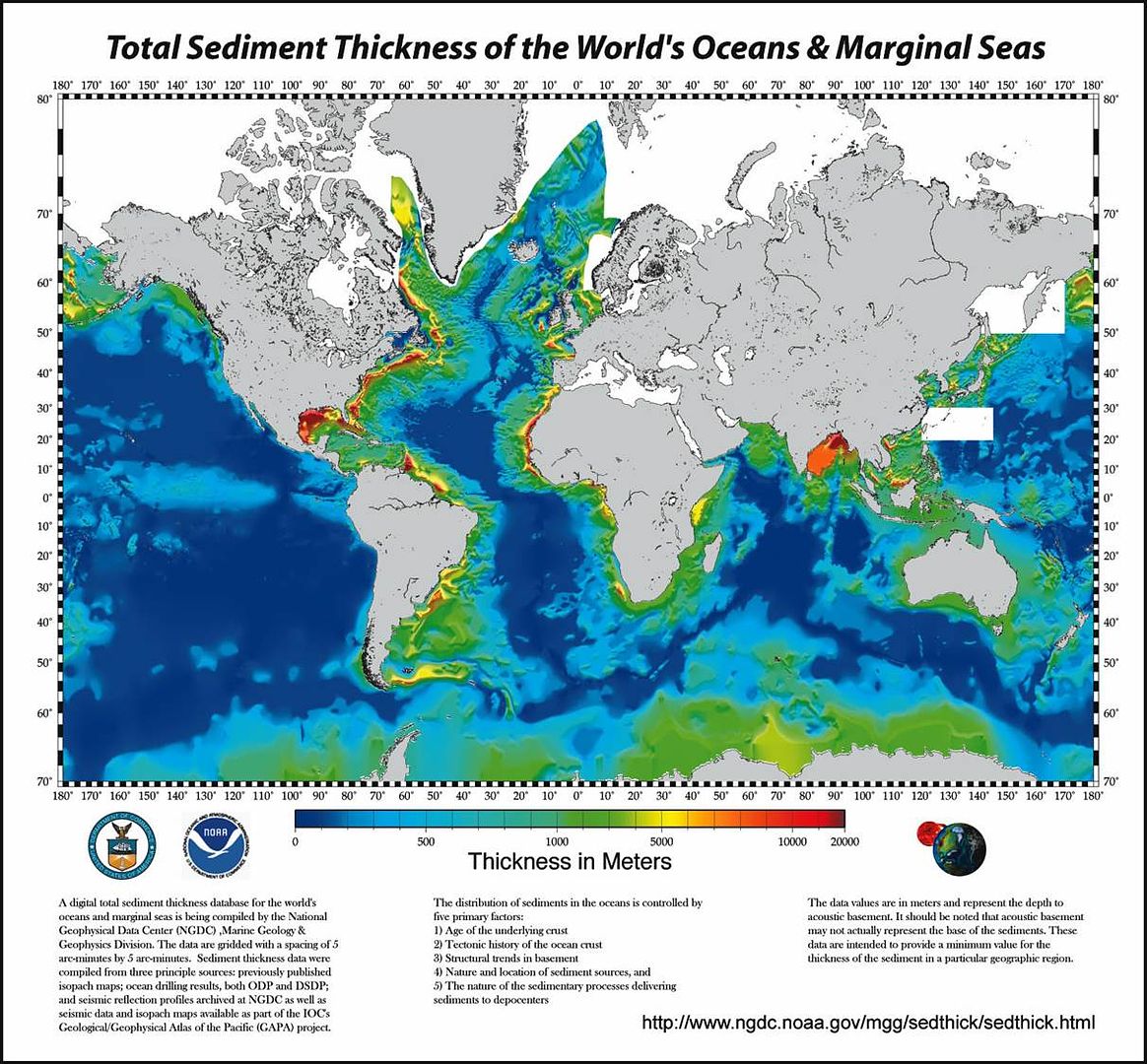
Oil is still being formed and migrating from source to reservoir rocks in the Gulf of Mexico. The Pleistocene reservoirs are less than 2.5 million years old and many have only been charged over the last 275,000 years. The reservoirs simply aren’t being charged as quickly as we are producing them.
Red areas indicate ~20,000 meter sediment thickness.
Oceanic Sedimentary Isopach Map
Marine black shales, deposited under anoxic conditions are loaded with the stuff that oil is made of…
Total organic carbon (TOC) averaged 10% by weight.
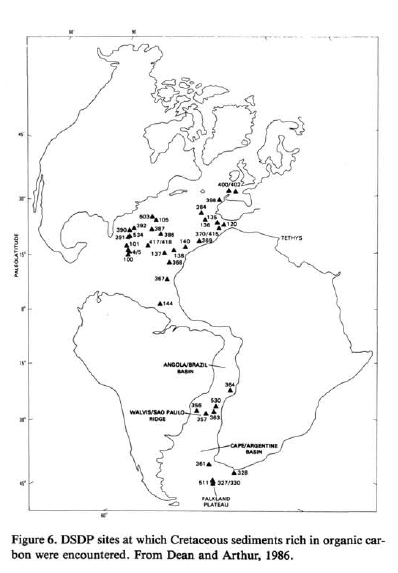
The Cretaceous, in particular, was a hydrocarbon “kitchen.” Marine conditions couldn’t have been more favorable for the deposition of source rocks even if they had been designed for such a purpose…
“DSDP sites at which Cretaceous sediments rich in organic matter were encountered. From Dean and Arthur, 1986.”
Cretaceous Proto-Atlantic
The Lower Tertiary Eocene was also a hydrocarbon kitchen (up to 21% TOC).
There is no shortage of organic matter in the sedimentary basins of the Earth’s crust.
Did you say “algae”?
http://www.forbes.com/sites/christopherhelman/2013/12/23/green-oil-scientists-turn-algae-into-petroleum-in-30-minutes/#48b324e97245
I’ve got a copy of Limits to Growth. One of the most hilarious books one could ever read.
Not to poke the abiotic vs biogenic oil origin bear, but aren’t there moons around Jupiter and Saturn with oceans of liquid methane? To be of biogenic origin then life would have to exist now or in the past there, other wise an abioitic origin is the only logical conclusion. Am I missing something?
You are missing a lot. But I’m going to take my nap.
wow, this just posted. I typed it before the exhaustive discussion between Mr. Middleton and Mr. Astley. Thanks for sharing your knowledge.
Methane isn’t oil… Not even close. For the 300th time in this thread, inorganically sourced methane is abundant. Evidence for inorganically sourced crude oil is as close to nonexistent as it can get. The fact that the process is possible doesn’t provide evidence for inorganically sourced crude oil.
That said, the issue is 100% academic.
Yes there is lots of abiotic methane in the solar system. Not on Earth given its hot rocky formation (Moon and all that). There is some newish, mostly in methane clathrate in the Framm Strait owing to unusual geological seafloor spreading circumstances there and iron catalysis. There is NO abiotic oil. Sweden was a contamination mistake. Ukraine was a gross geological,overthrust mistake, and this can be proven using C12/C13 ratios based on known photosynthesis pathway preferences.
I don’t think what they call crude oil in those figures you see are “crude oil” as we usually refer to it. The government agencies make a mess of the statistics, a lot of that “crude oil” isn’t refinery feed. When you look up figures try to find something called “crude oil and condensate” “C&C”.
That 20 billion probably includes non C&C liquids, so both the national consumption and usgs figures are inflated.
Been travelling today; Wisconsin dairy deer season opens Sat. But spent a couple of hours reading about this new USGS report before coming here. Much BS out there. Two years ago the Wolfcamp minor operators were hyping 3.5% recovery factors. (Bakken is ~1.5). Seemed credible, since some of the 4 Wolfcamp shale members have porosity as high as 4%. (Conventional oil is >5%.)
But postponing peak oil by decades?!?. Not. Fact. When Saudi Arabia finished reworking the southernmost section of Ghawar with water flood (7million barrels/day) in 2010, Aramco estimated remaining recoverable Ghawar reserves at 65Bbbl. Lasting until ~ 2035 at declining production rates. Wolfcamp hyped is 1/3 of Ghawar alone. In 2012, Ghawar provided 6% of the world’s oil.
Ya ever wonder if the Earth makes oil and natural gas like a maple tree makes sap?
Thank you David.
The reader also needs to be reminded that the USGS and IEA do not have some large drilling and testing budget for backing up these projections. They rely heavily on the private sector to produce the data in the first place and delineate the resource and the technical innovations and rate of efficiency gain to unlock the marginal resource. Any suggestion or claim of special knowledge by official agencies or expertise beyond that is patently false.
David, Thanks for the link to the nature paper. That is the first paper that I have seen concerning the formation of crude oil from biological material, that claims partial success at creating material from biological matter at a temperature of 400C that has some similarity to crude oil.
As Gold notes there are Isomers of aromatic hydrocarbons in crude oil which have been demonstrated to have a formation temperature of between 700 and 1,100C. He also notes the biological crude origin theory has problems explaining nickel and vanadium prophyrins.
As Gold also notes the deep earth non biological origin of oil is a not new theory. It is the standard theory in the old Soviet Union and is the theory that the Russians have used to become the largest oil and natural gas producer in the world.
This is good summary of Gold’s other logical pillars if you are interested.
http://origeminorganicadopetroleo.blogspot.ca/2011/01/thomas-gold-professional-papers.html
William,
The inorganic sourcing of petroleum is not impossible. However, the incessant repetition of its possibility is not evidence that it occurs in any significant manner and the total ignorance of the conventional theory and basic geology doesn’t help whatever case you think you are making.
David, Thanks for the above thoughtful comments. I have read everything you have written and checked your links. Regards, William.
I am of course presenting evidence to support the assertion that super high pressure liquid CH4 is extruded from the earth’s liquid core as it solidifies and that the extruded super high pressure liquid CH4 migrates up through the mantel. A portion of the extruded CH4 is asserted to form natural gas reservoirs and liquid crude reservoirs.
The assertion that CH4 (CH4 is one of the possibilities based on density) is in the liquid core is consistent with measurements of the transit time of deep earth disturbances. Theoretical studies indicate the CH4 would be extruded when the core solidifies.
Estimates of the CH4 content of the liquid core is roughly 5%. The liquid and solid core of the earth is roughly the size of the moon. The liquid core of the planet is believed to have started to solidify roughly a billion years ago.
I am not just stating an assertion is or is not correct. Evidence is presented to support the assertion. Other researchers are following a road that leads to same theory.
If a theory is correct in most cases in a generation or two the problem will be worked out, as researchers die or retire and new people enter the field looking for unresolved problems.
The internet may speed up the process as will the consequences of what is currently happening to the sun.
https://www.sciencedaily.com/releases/2009/09/090910084259.htm
http://www.nature.com/ngeo/journal/v2/n8/full/ngeo591.html
https://www.sciencedaily.com/releases/2016/10/161020103858.htm
William… You keep repeating the argument that inorganically sourced petroleum is chemically possible. I agree with this. However, the possibility of something is not evidence for its existence.
And we even wasted millions of dollars drilling one deep well in Sweden to prove that point and they still dredge up the topic. How wrongheadedness and outliers get funding is a more interesting topic that has been very relevant in recent years.
https://en.wikipedia.org/wiki/Thomas_Gold
The fossil fable violates the 2nd law of thermodynamics.
That’s a fact that people David Middleton and Fernado and Doug refuse to acknowledge – simply because it’s not a profitable fact.
===============
The spontaneous genesis of hydrocarbons that comprise natural petroleum have been analyzed by chemical thermodynamic-stability theory. The constraints imposed on chemical evolution by the second law of thermodynamics are briefly reviewed, and the effective prohibition of transformation, in the regime of temperatures and pressures characteristic of the near-surface crust of the Earth, of biological molecules into hydrocarbon molecules heavier than methane is recognized.
http://www.pnas.org/content/99/17/10976.long
===========================
You can’t can’t convert decaying slime into petroleum without a source of energy. Petroleum has more energy than dead stuff. You can push sh*t uphill without a source of energy.
What is the balanced chemical equation that converts lipids, triglycerides, carbohydrates and proteins into hydrocarbon species?
I can tell you the equation for photosynthesis.
Why can’t fossil proponents do the same for petroleum?
Why must we have faith?
Verbage about alleged “biomarkers” and how kerogen equal biological (even though Comet Haley is 1/3 kerogen) has been debunked as many times at has been repeated. But religious people never let facts undermine the basis of their cult.
* * * *
“The capital fact to note is that petroleum was born in the depths of the earth, and it is only there that we must seek its origin.”
–Dmitri Ivanovitch Mendeléev, 1877
* * * *
Petroleum is a crucial feedstock for autotrophs that infest the planet from sediment to surface, from pole to pole…
========
“…methane is the primary food source for most microorganisms thriving in the ocean floor. ”
–Methane Devourer Discovered In The Arctic, ScienceDaily (Oct. 20, 2006)
========
A chemotrophic ecosystem found beneath Antarctic Ice Shelf
AMERICAN GEOPHYSICAL UNION, VOL. 86, NO. 29, PAGE 269, 2005
========
“The input from natural marine oil seeps alone would be enough to cover all of the world’s oceans in a layer of oil 20 molecules thick. That the globe is not swamped with oil is testament to the efficiency and versatility of the networks of microorganisms that degrade hydrocarbons,”
-Marine microorganisms make a meal of oil (Jones DM, Röling WF, 2006)
========
Life comes from petroleum – not vice versa:
http://living-petrol.blogspot.com
The biosphere is doomed when it runs out of petrol.
Every step of the process has been observed in nature and the process has been repeated many times under laboratory conditions. The only part of the process which cannot be replicated is time.
You can’t can’t convert decaying slime into petroleum without a source of energy.
How about 20,000psi?
It’s not “decaying slime”. The trick is to bury it before it decays. Our friend forgot the planet gets hotter as we go down, pressures increase, and it’s fairly easy to turn fresh moose meat into oil, if we shred it, mix it with salt water and clay, add a pinch of Tabasco, and cook it slowly at 300 F and 15000 psi for 1 million years.
Yep. While the geothermal gradient can be quite variable, the deeper something is buried, the hotter it gets…
Putting 20B barrels of oil in perspective, globally we use around 85M barrels per day and so 20B barrels represents 235 days of oil consumption. That’s not exactly cause for “Indefinitely Postponed” celebrations.
No, democracy is postponed in Venezuela. How much oil does it have under rational investment and development conditions?
What does this to do with the find of 20B barrels?
Political strife is very real and impacts oil production. You cant just wave it away unless you’re prepared to take the oil by force.
“You heard me, I would take the oil, I would not leave Iraq and let Iran take the oil.” – Donald Trump.
Is this the future of oil?
Gotta watch Venezuela. China may have it’s eyes on that little parcel of the Americas. The Monroe Doctrine still has some weight, doesn’t it?
I watch Venezuela. The outside power controlling Venezuela is Cuba. This is an inconvenient truth the USA media doesn’t care to discuss. I suppose because they don’t want to rile up Obama’s move to get friendly with Raúl Castro. I’m still trying to figure out why the GOP neocons decided to hand over 40 million into slavery in Cuba and Venezuela. Maybe they are too focused on their Arab terrorism wackamole problems and think communists are ok dudes?
The resource is in Venezuela but not tapped. That is the relevant issue for global Peak Oil theory and discussion. The same could be said of offshore oil in the Gulf of Mexico on the Mexican side of international line extending into deep water but not drilled or tested.
Indefinite does not mean permanent. A better synonym would be indeterminate.
Geoff the Geo, Brisbane
As a sceptical geologist this post by David Middleton and the comments generated makes the heart and mind soar to stellar levels. Hydrocarbons also have a role to play in base metal generation. At the Century zinc deposit, the second largest Zn deposit in the world 250km N of Mt Isa, open pit mining since 1990 has now exhausted this amazing deposit. The mineralised shale containing fine-grained grey sphalerite (ZnFe sulphide) and some Pb and Ag is highly laminated and looks like it formed on the seafloor.
However, it actually formed at depths from 500m to a km or so below the surface, as heated basinal brines rich in chlorides and base metals migrated up fault zones into a subsurface basin containing organic-rich shales. The warm hydrothermal fluids raised rock temperatures to the ‘oil window’ and generated hydrocarbons in the shale, which then migrated out of the source area, leaving significant permeability in the buried strata sufficient for the zinc and Pb and Ag to be deposited in its place, as the oxidised ore fluid was reduced by the carbon-rich shales. The deposit so formed contained 120 million tonnes @ur momisugly 10% Zn, 1.5% Pb and 36g/t Ag, and although now closed, its legacy has been enormous wealth creation, infrastructure and skills development in a remote part of northern Australia.
Geology is so cool!
Technology has speeded up depletion rates but found ways to get access to 20x more of the thin layer of oil. But since 1859 we have found oil to be located in very narrow layer due to “cooking” recipe that makes sludge vs oil vs gas. Cost goes up as “conventional” oil reserves are depleted of course. Hubbert was right about conventional oil using existing technology and peak conventional production in US did peak in 1970s using known technology.
Horizontal drillng plus high pressure fracing have us another half century of moderate cost oil…say $35 per barrel at current dollar value. And unconventional oil from offshore or shales is great extender but at $60 or more. So at $150 a barrel another half century perhaps. Its all about costs vs market demand.
But as alternative energy sources become cheaper (and many are already very cheap) oil like coal may not be sought just as whale oil is no longer sought. I am only 80 and the entire oil industry so far is less than 200 years old while humans have tried to keep warm or cook food for at least 10 or 100 centuries while oil was forming for 1000 or more centuries. Sssslllooowwww.
But why should WE worry. Life is short.
20 billion barrels equals about 235 days of global consumption. That’s a strange definition of “indefinite.”
Not when you grasp the fact that the Wolfcamp is just one reservoir out of dozens in the Permian Basin, which is just one of dozens of major sedimentary basins in the world, that this is the single largest resource assessment ever issued by the USGS, the USGS has a nearly perfect record of underestimating resource potential and that Peak Oil was already indefinitely postponed prior to this announcement and that I have a penchant for sarcasm.
You’re speculating David.
I’ll be pleased of we dont hit peak oil anytime soon but just because we find another years worth isn’t cause to believe we’re out of the woods.
Thing is we can’t find many wolf camps or bakkens or uticas elsewhere. The Monterrey shale was a huge failure, the Polish shales were no good, you won’t find any quality shales to develop in the Gulf of Mexico, there’s nothing viable so far in Australia, the Bazhenov is still being tested, and on and on. The same way Saudi Arabia lucked into Ghawar the USA has lucked into a fairly large family if drillable shales, and an industry able to scrape by drilling these shales thanks to generous banker sugar daddies.
@TimTheToolMan,
Peak oil is dependent on the size of the recoverable resource. Every barrel added to the total recoverable resource pushes peak oil further into the future.
David says
Peak oil is related to the size of the recoverable resource but is entirely dependent on whether it can be produced at the rate needed globally (currently about 85M barrels per day)
In this case we’ve potentially pushed peak oil out 235 days. And the important thing about this article is that the USGS says “this is the largest assessment of continuous oil we have ever done”
Well someone needs to do that every 235 days to put peak oil off indefinitely.