From RICE UNIVERSITY: Earth’s carbon points to planetary smashup
Element ratios suggest Earth collided with Mercury-like planet

CREDIT A. Passwaters/Rice University based on original courtesy of NASA/JPL-Caltech at http://www.nasa.gov/multimedia/imagegallery/image_feature_1454.html
HOUSTON — (Sept. 5, 2016) — Research by Rice University Earth scientists suggests that virtually all of Earth’s life-giving carbon could have come from a collision about 4.4 billion years ago between Earth and an embryonic planet similar to Mercury.
In a new study this week in Nature Geoscience, Rice petrologist Rajdeep Dasgupta and colleagues offer a new answer to a long-debated geological question: How did carbon-based life develop on Earth, given that most of the planet’s carbon should have either boiled away in the planet’s earliest days or become locked in Earth’s core?
“The challenge is to explain the origin of the volatile elements like carbon that remain outside the core in the mantle portion of our planet,” said Dasgupta, who co-authored the study with lead author and Rice postdoctoral researcher Yuan Li, Rice research scientist Kyusei Tsuno and Woods Hole Oceanographic Institute colleagues Brian Monteleone and Nobumichi Shimizu.
Dasgupta’s lab specializes in recreating the high-pressure and high-temperature conditions that exist deep inside Earth and other rocky planets. His team squeezes rocks in hydraulic presses that can simulate conditions about 250 miles below Earth’s surface or at the core-mantle boundary of smaller planets like Mercury.
“Even before this paper, we had published several studies that showed that even if carbon did not vaporize into space when the planet was largely molten, it would end up in the metallic core of our planet, because the iron-rich alloys there have a strong affinity for carbon,” Dasgupta said.
Earth’s core, which is mostly iron, makes up about one-third of the planet’s mass. Earth’s silicate mantle accounts for the other two-thirds and extends more than 1,500 miles below Earth’s surface. Earth’s crust and atmosphere are so thin that they account for less than 1 percent of the planet’s mass. The mantle, atmosphere and crust constantly exchange elements, including the volatile elements needed for life.
If Earth’s initial allotment of carbon boiled away into space or got stuck in the core, where did the carbon in the mantle and biosphere come from?
“One popular idea has been that volatile elements like carbon, sulfur, nitrogen and hydrogen were added after Earth’s core finished forming,” said Li, who is now a staff scientist at Guangzhou Institute of Geochemistry, Chinese Academy of Sciences. “Any of those elements that fell to Earth in meteorites and comets more than about 100 million years after the solar system formed could have avoided the intense heat of the magma ocean that covered Earth up to that point.
“The problem with that idea is that while it can account for the abundance of many of these elements, there are no known meteorites that would produce the ratio of volatile elements in the silicate portion of our planet,” Li said.
In late 2013, Dasgupta’s team began thinking about unconventional ways to address the issue of volatiles and core composition, and they decided to conduct experiments to gauge how sulfur or silicon might alter the affinity of iron for carbon. The idea didn’t come from Earth studies, but from some of Earth’s planetary neighbors.

“We thought we definitely needed to break away from the conventional core composition of just iron and nickel and carbon,” Dasgupta recalled. “So we began exploring very sulfur-rich and silicon-rich alloys, in part because the core of Mars is thought to be sulfur-rich and the core of Mercury is thought to be relatively silicon-rich.
“It was a compositional spectrum that seemed relevant, if not for our own planet, then definitely in the scheme of all the terrestrial planetary bodies that we have in our solar system,” he said.
The experiments revealed that carbon could be excluded from the core — and relegated to the silicate mantle — if the iron alloys in the core were rich in either silicon or sulfur.
“The key data revealed how the partitioning of carbon between the metallic and silicate portions of terrestrial planets varies as a function of the variables like temperature, pressure and sulfur or silicon content,” Li said.
The team mapped out the relative concentrations of carbon that would arise under various levels of sulfur and silicon enrichment, and the researchers compared those concentrations to the known volatiles in Earth’s silicate mantle.
“One scenario that explains the carbon-to-sulfur ratio and carbon abundance is that an embryonic planet like Mercury, which had already formed a silicon-rich core, collided with and was absorbed by Earth,” Dasgupta said. “Because it’s a massive body, the dynamics could work in a way that the core of that planet would go directly to the core of our planet, and the carbon-rich mantle would mix with Earth’s mantle.
“In this paper, we focused on carbon and sulfur,” he said. “Much more work will need to be done to reconcile all of the volatile elements, but at least in terms of the carbon-sulfur abundances and the carbon-sulfur ratio, we find this scenario could explain Earth’s present carbon and sulfur budgets.”
###
The research was supported by NASA and the National Science Foundation.
If only this collision hadn’t happened, we wouldn’t have that terrible “carbon pollution” that environmentalists wail about today.
There are male and female planets??
Seems so 🙂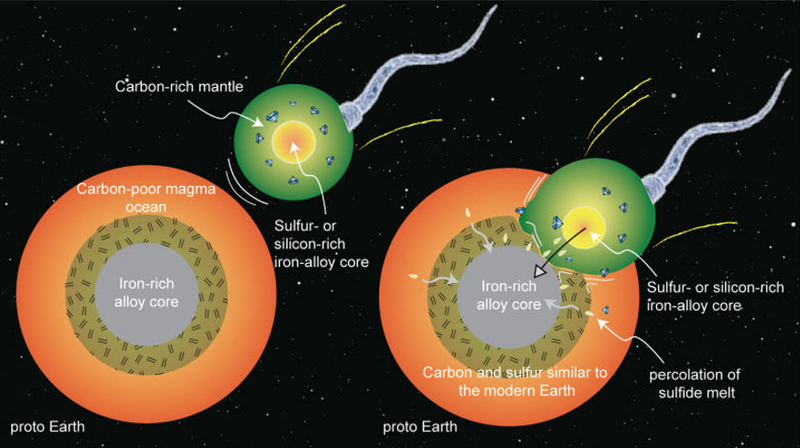
HAHAHAHA
+1 + 1 = 2!
The illustration seems to indicate 2 = 1.
Gabro September 6, 2016 at 4:16 pm It would seem the illustration indicaters 2 = 1.
…and life begins.
What’s that tail made of?
Of course. Why else do we say mother earth?
So just how do we tell which of the two bodies was Earth and which was Carbonistan ??
g
The egg is bigger than the sperm. The resulting body is what is now mother Earth,
According to the write up, the colliding planet was about the size of Mercury, and since Mercury is a lot smaller than the Earth …
Because the planets are women in the harem of Sol?
A carbon rich planet is one where the amount of carbon exceeds oxygen.
Otherwise they tend to be silicate based, noting that carbon and oxygen can transmute into silicate which can then transmute into iron.
But I would have gone with a collision of a carbon based planet with Venus – which is also a silicate based planet like Earth and Mars – since it’s spinning the opposite direction as the other planets in the solar system – and has the highest concentration of carbon on the surface.
At least there some physical evidence the Moon may have collide with the Earth – for instance it’s currently moving away from the Earth at roughly on the order of a couple of cm per year.
Maybe all it took was for the Earth and Mars to be down wind of Venus.
The upside is I don’t need 3 collisions of carbon based planets with silicate based planets to explain the presence of carbon on the surface.
The answer to your question is yes.
The Earth would be female (normal spin) and Venus would be male (abnormal spin) with carbon being the interplanetary sperm.
Silicate can commute to iron? What are we, alchemists?
If the Earth had collided with Venus, one of the two planets would no longer exist.
There is no evidence that the Moon ever collided with the Earth. The Moon is moving away from the earth as a result of tidal action. The Earth’s rotation is slowing down, for exactly the same reason.
So do these researchers have any idea just what the boiling point of Carbon is ??
So primordial Earth’s carbon just boiled away, and WE are worried about maybe a one degree F change over 150 years in some mathematical global average of a few Temperature measurements.
Speaking of which:
The most general statement of the Nyquist criterion for sampled data systems, says that :
Any band limited (B) continuous function can be EXACTLY represented by a data set of 2B INDEPENDENT , INSTANTANEOUS samples of that continuous function, per second.
Alternatively: any time sequence of a band limited (B) continuous function over a time interval (t) can be EXACTLY represented by a total of 2Bt INDEPENDENT, INSTANTANEOUS samples of that continuous function during the time (t).
The original continuous function can be recovered EXACTLY for ANY instant of time in that observation interval (t); not just for the sampled data points.
Anything less than Bt independent samples during the time (t) or less that a rate of B independent samples per second, will result in NO accurate AVERAGE for that continuous function being calculable by any means.
So much for the validity of all these GISSTEMPS and HADCRUDs.
G
The hypothesis isn’t that C boiled away, but that it sank along with iron and other elements into the core and/or mantle, out of the crust.
Is the boiling point of carbon higher or lower than the melting point of rock?
“””””….. given that most of the planet’s carbon should have either boiled away in the planet’s earliest days …..”””””
Sorry Gabro, the hypothesis is exactly that, or something else, and they don’t weight the various options with any sort of probability.
Anybody who suggests boiling carbon off a planet surface, even in jest. is just not a rational person.
G
So carbon evaporates at 5,000 K or something huge like that, and some smaller body than earth can retain that; but earth couldn’t, and the moon is really made of green cheese.
g
There ya go again, …. george e., ….. talking common sense and logical reasoning.
But not so with those authors of that research commentary, such as, to wit:
Quoting article:
I don’t believe there is any factual evidence that proves that the earth was mostly, largely molted from the “git-go” of its formation ……. any more than the Moon was mostly molten from the “git-go”.
A smaller body would cool a lot faster.
Well it seems then that the earth’s core must be high carbon steel. Oh but steel melts at a million degrees C which is the earth’s core Temperature.
Who new seems like somebody ought to mine it, instead of buying it from China.
g
Flyoverbob
September 6, 2016 at 4:48 pm
The Plus 1 indicated approval, and then some.
But you’re right in terms of reproductive biology. However we’re talking “climate science” here, so whatever arithmetic is most alarming is the correct answer.
Well one thing that I have learned from global warming alarmists is that carbon can do *anything*, so certainly it made the planet collide on Earth!
Seems like the often used, but seldom cited, idea of Velikosky’s that a planet collided with earth.
You’d better reread the book, the title is misleading. He did not postulate a collision with Earth merely two close flyby’s (Venus started at Jupiter as a comet). But he did “Blame” Venus for our current glut of “oil”.
The higher proportion of iron in the Earth’s core and relative absence in the Moon are also good indicators.
That is a very good point.
The moon is mainly made of earth’s crust, spun off apparently in a collision with a planetoid larger than the one imagined here.
Oh, yeah? Then how did the dairy products get there? 🙂
Green cheese is rich in crust. Must be the copper.
“You’ll never catch me, copper!”
I cannot remember that far back in time…
Herbal teas can help with that.
I remember this scenario of a collision coming up years ago when the composition of the moon was determined in the late 1960’s, that the moon was once part of Earth rather than forming independently and being captured.
I still think it is possible the “moon” was a planet that collided with the Earth and became captive as Earth’s moon.
Things are just too complex, and at the same time ordered, to have not invovled intelligent design. I beleive that’s close to a quote by Dr. Spencer, and I generally concur. Just the mathmatic part of me asks: If you start to have individual hypothesis that invovle accidents, (random events), and each one is unlikely on its own, then how the heck do things end up so nicely arranged?
“If you start to have individual hypothesis that invovle accidents, (random events), and each one is unlikely on its own, then how the heck do things end up so nicely arranged?”
You mean like crystal formation?
Snowflakes prove the existence of Zeus!
There needs to be a selection process from random occurrences. Done naturally, preferably.
Jon,
Thunder proves the existence of Thor and the rainbow proves the existence of Yahweh!
And that Bifröst leads to Himinbjörg.
Looking at the situation today, it is unwise to calculate a different outcome. For the same reason you always find something in the last place you looked. If you kept looking your an idiot. Or a climatologist.
The rainbow proves the existence of 57 genders; or is it 97.
Well plus Hermaphrodite, which is not one of the 57 known ones.
g
Crystal formation is not normally a catastrophic encounter.
Some dismiss god as unnecessary or redundant. If a natural process can explain the world, then why bother adding an unnecessary layer of complexity by involving a creator?
They invoke the principle of parsimony, and use Occams razor to shred notions of faith. And it makes sense to say that the simplest explanation is often the most correct.
But then when it comes to issues such as this where the earth must have gone through very complex processes that are almost impossibly rare, they don’t rule them out. They don’t look at the theory of evolution, which requires the accumulation of countless impossibly rare mutations, one after the next with incredulity.
Occams razor gets folded away while any fanciful combination of rare events becomes unassailable as the obvious explanation for our world.
“They don’t look at the theory of evolution, which requires the accumulation of countless impossibly rare mutations, one after the next with incredulity.”
This is plausible if there is a mechanism that tends to preserve the useful mutations and reject the destructive mutations.
And there is. It’s called natural selection.
Hear, hear! (Flame suit donned?)
Collisions in the early solar system weren’t rare at all.
There is debate as to how rare, but it’s evident that Earth and other planets formed by accretion with other bodies in their orbits. There is still debate about the late heavy bombardment, for instance.
Evolution doesn’t work as you imagine it does. Mutations aren’t rare at all. They happen in every multicellular individual (or population of microbes) in every generation. You and I both carry a few. Some mutations are lethal, others just deleterious, some neutral and some beneficial.
Mutations formerly lethal can become beneficial under altered circumstances. The single point mutation that changes sugar-eating bacteria into nylon-eating bacteria occurred countless times before humans introduced nylon into the microbial environment. Before nylon, it was deadly to the microbes; after nylon, it opened up a whole new world for them to exploit.
Evolution and common descent are scientific facts, ie observations, with an ever-developing body of theory to explain them. Same as with the heliocentric, gravitational, atomic, disease germ, relativity and quantum theories.
“…processes that are almost impossibly rare…”
I was going to respond that, “What can we really say about the “rarity” of early solar system events?”
But Gabro said it better.
“There are only two ways to live your life. One is as though nothing is a miracle. The other is as though everything is a miracle.” Albert Einstein
When you see bacteria that contain a toxin-antitoxin system that acts as a lock and key, without the toxin the antitoxin provides no benefit, without the antitoxin the toxin is lethal. When you see squid with specialized organs that filter out the one-in-a-million bacteria that engage in quorum sensing to generate light. These are miraculous characteristics that leave people in awe.
People use their creative intelligence to make new organisms with characteristics that have never before existed. Green fluorescent mice, for example. Yet if that mouse escaped and a mankind was wiped from the earth, a visiting alien would think it’s just another mysterious product of natural selection and evolution.
KTM,
While such systems in nature are wonderful and marvelous, even awe-inspiring, the proper scientific response is to ask how they came to be, not to regard them as inexplicable miracles.
And when exploring them in this light, wonder can be increased along with understanding, and useful answers obtained.
There is in fact no miracle behind toxin-antitoxin systems. Just the wonderful working of evolution.
We have actual evidence that intelligent design occurs. We intelligently design new life forms, like those GFP mice. But if you think we can explain them by putting on our scientific thinking caps and restricting our available explanations to something involving evolution and natural selection, be my guest. You might even come up with something semi-plausible about cross-species reproduction between a mammal and a jellyfish. But we all know that your creator-less explanation would be wrong, no matter how elegant it could turn out sounding.
Despite spending decades trying to recreate an abiotic spark of life, or decades rapidly expanding bacteria in culture media to accelerate evolution and natural selection, we have never sparked life and we have never turned bacteria into anything other than bacteria. We can radically change life through intelligent design, accelerated evolution has achieved nothing resembling the diversity of life we see around us.
KTM,
Your instincts are correct. Biologist NEVER do the maths. They have no fundamental comprehension of reaction kinetics or probabilities. What they have is a learned bias and thou shalt not encroach upon the learned bias. So they disregard math.
My whole life, until recently (1993 ish) I was told, taught and brow-beaten that, the now discredited Haeckel embryo diagrams, were evidence of evolution during embryonic development. I never accepted the phony diagrams and I was right to object.
I was also told that mutations were just random events caused by chemical or radiation mutagens. If you do the math…there just isn’t enough time in the universe to explain the simplest form of life assuming you have 20 Amino acids to begin with.
Modern evolutionary microbiology is just chock full of block heads who can’t use a pencil and paper. and understand the implication of math. So they show up here and rant and rant and rant. Scroll up and down and bear witness to the utter panic that you might have an uncomfortable question. Read the panic, the obsessive tone, the inevitable snark. “Scientism”
KTM and Paul,
Genetically modified organisms is not intelligent design. it’s bioengineering. Not the same thing. ID says that whole organisms and structures which clearly evolved didn’t but were created de novo by a Designer, for which there is zero evidence.
We can insert genetic sequences into genomes using viruses, but that’s not the same as creating the whole genome de novo. Only evolution can do that in the field. But we’re working on it and soon my colleagues and I will indeed be capable of intelligent design of simple, totally new organisms.
How can someone who has never read a single paper on origin of life research claim that no progress has been made toward artificial life? When protocells are made in the lab, where will you try to find your sky godfather then? It’s coming, and soon.
Whole branches of mathematics have arisen out of biology, specifically population genetics and evolution.
It is your blockhead philosophers who can’t grasp science. Their “math” is without any physical reality. That evolution occurs is a scientific observation, ie a fact. It can be modeled mathematically and accurately hindcast.
A key tool in origin of life research is in fact evolution. We select for traits in proteins and let artificial selection find them for us. It’s called synthetic biology and has led to breakthrough after breakthrough.
Here’s a recent one:
http://www.astrobio.net/also-in-news/scientists-take-big-step-toward-recreating-primordial-rna-world-four-billion-years-ago/
No proteins need apply. RNA alone was capable both of storing and replicating genetic instructions and of conducting metabolism, ie acting as an enzyme, called a ribozyme.
Later, DNA replaced RNA as the information storage mechanism and proteins as metabolic catalysts, but RNA remained in the transfer and messenger functions, and lies at the heart of the ribosome, the protein factory.
With this major advance, the creation of artificial life in the lab, resembling the earliest proto-cell, moves a step closer. The cell membrane problem has already been solved by Nobel winner Szostak’s lab at Harvard.
Last year, Japanese researchers went beyond Szostak’s Harvard team to achieve cycles of protocell division:
http://www.nature.com/ncomms/2015/150929/ncomms9352/full/ncomms9352.html
Every year we get closer to artificial life, the evolution of which will be under human control. For thousands of years, we’ve made new species and genera, but soon we’ll be able to cook up entirely new living things from scratch.
Recent research is bringing together formerly competing origin of life hypotheses, ie “RNA World”, “Peptide World”, “Metabolism First”, etc:
https://www.sciencenews.org/article/cook-life-just-add-citrate
Note that the ubiquitous citric acid (Krebs) metabolic cycle begins with the transfer of a two-carbon acetyl group from acetyl-CoA to the four-carbon acceptor compound (oxaloacetate) to form the six-carbon compound citrate. Also, ATP (adenosine triphosphate), the molecule essential to the Krebs cycle, is essentially a fragment of RNA, consisting of the nucleoside adenosine (the nucleobase adenine attached to a ribose sugar molecule) and three phosphate groups (triphosphate).
But in the earliest protocells, as the paper suggests, simple peptides (amino acid chains shorter than polypeptides, ie proteins) could have served the same function as citrate in this experiment.
This guy predicts fully artificial life within a generation:
http://singularityhub.com/2014/12/02/should-scientists-attempt-to-create-artificial-life/
If that mean 20-30 years, then IMO, it will happen sooner. Maybe not within a decade, as some problems still need to be overcome, but likely within 10-20 years. Depends upon the amount of money available. Evolution machines are pricey at present.
This recent experimental result also supports the convergence of “Lipid World” with RNA and Peptide Worlds, of metabolism with replication:
http://www.ncbi.nlm.nih.gov/pmc/articles/PMC4600236/
Given the centillions upon centillions of reactions among self-assembled nucleobases, phosphate groups, sugars, lipids and amino acids during 100 million years of early earth history, how could life not have arisen here?
Or for that matter over even longer intervals on asteroids in space?
And for fans of the clay hypothesis, here we learn the importance of silica beads:
http://www.nature.com/nchem/journal/v8/n2/abs/nchem.2414.html#affil-auth
Could have been significant in the development of life even before bilayer lipid membranes.
Gabro, you’re exhibiting two classic behaviors of someone losing an argument. The first is the laundry list approach, where you don’t feel comfortable staying on topic so you post a flurry of tangential information. The second is the appeal to authority, citing you and your colleagues, wrongly assuming that others have no scientific training or don’t read scientific literature, etc. If that helps you sleep at night, good for you.
One big problem that Paul mentioned has to do with information. Even if you have a self-replicating RNA, how to you get it to grow to accommodate all the information necessary to form life? Scientists have tried to take the simplest extant life forms and further reduce their genetic composition to see the bare minimum number of genes necessary for life. It’s ~150 distinct genes and associated functions. How do you go from one self-replicating RNA to 150, all with distinct functions? And at the same time exclude any others that would inhibit the function of any of those 150?
And if you can get the one to expand, how to you get it to stop at the goldilocks size? And then how to you take a bare sequence of RNA and interchange the bases in such a way that it now encodes for something meaningful?
And how do you go from this primordial soup to something like the core sequence of Ribosomal RNA, which is so flawless in composition that it can’t tolerate a single mutation in any life form know to exist?
How do you trace back the evolution of a molecule that has no variation? You don’t and you can’t. But as long as you have a long enough list of plausible hand-waves at hand, you can ignore the disqualifying problems and sleep at night.
KTM,
There is no argument. Evolution is a fact. Deal with it.
I’m merely trying to educate people who presume to comment upon topics about which they are entirely ignorant.
But if you don’t want to learn, I can’t make you confront reality.
Seriously, though, when in five or ten years my colleagues produce artificial life, where will you hide your sky fairy godfather then?
However, I will make one last attempt to educate you, in hope that you will actually read some science rather than listening to the professional liars who have captured your brain.
The simplest possible living thing is remarkably simple. All living things alive today, which doesn’t include viruses, are highly complex. They’re the result of at least hundreds of millions of years of evolution.
Had you bothered to read even one of the links I provided, you’d have learned that science is very close to recreating the original, simply life forms. The Scripps team has shown that even small peptides aren’t needed, just RNA. But other teams have showed how oligomers of amino acids might have served as early enzymes.
The first living thing might have had only a single gene. It could have been an RNA oligomer only five nucleobases long. Probably it was longer, but the fact remains that the supposedly mathematical calculations of the liars whom you chose to believe out of religious faith rather than the scientists with the evidence have it all wrong. They are ignoramuses, apparently intentionally so.
KTM,
I still haven’t given up on you. You wrote:
“Despite spending decades trying to recreate an abiotic spark of life, or decades rapidly expanding bacteria in culture media to accelerate evolution and natural selection, we have never sparked life and we have never turned bacteria into anything other than bacteria. We can radically change life through intelligent design, accelerated evolution has achieved nothing resembling the diversity of life we see around us.”
You could not possibly be more wrong. It is the height of presumption, which Christianity warns against, to preach upon subjects about which you’re totally ignorant.
What has been observed in the wild and recreated in the lab is repeatedly turning species of bacteria into new bacterial species, as in the example I gave of sugar-to-nylon-eating bacteria. We have also observed and recreated turning nectar-eating flies into blood-eating flies. The fact of speciation and the creation of new genera from existing species and genera has been observed and created over and over again.
What you apparently have trouble with is the fact of bacteria evolving into multicellular organisms. But this too has been observed, in that there is no other possible inference to explain the fact that the eukaryotic cells of multicellular organisms such as fungi, plants and animals arose from endosymbiosis of archeans with bacteria. Hence our mitochondria and the chloroplasts of plants.
Going farther back, there is no special “spark of life”. Life is simply biochemistry. The energy to drive its processes is obtained through normal chemical reactions. The first living things used RNA both as a store of genetic information and as an enzyme to catalyze their simple chemical reactions.
No fairy godfather in the sky need apply. Life is chemistry, based upon physics. It’s nothing special. This has been known since the early 19th century.
You really ought to study biology before presuming to comment upon it. And that goes double for biochemistry and microbiology. Today in labs around the world, we’re recreating the chemical evolution that led to biochemistry and life.
Watch this space. The end of your 5000 year-old pre-scientific world view is coming. First there was Copernicus. Then Darwin. Next will come the coup de grace from Scripps or Yale or London or Harvard or Tokyo. And in your lifetime.
ID has been thoroughly discredited. The favorite ID example of irreducible complexity, the modern eye, has been thoroughly discredited. It involves a gross misdefinition of evolutionary functional complexity applying todays standard to the Cambrian explosion. And, ignores the biological evidence that modern eyes evolved three times, and in three different ways: compound eye (insects), sensors illogically behind retina blood vessels (vertebrates, cause of macular degeneration), sensors in front of blood vessels (Cephalopod true eyes with focusing cornea, and nautilus pinhole camera design). Or that all sensor cells in all three basic types use rhodopsins, which are also found in the light/dark sensing spot of dark seeking planarian flatworms and diurnal jellyfish. Or that the master control gene ‘eyeless’ controls all three eye types, an example of evolutionary conservation. All discussed as an example in The Arts of Truth, with footnotes.
“Intelligent Design” advocate Behe’s favorite “example” of “ID” is the bacterial flagellum, of which there is more than one “design”. According to him, it’s “irreducibly complex”, except that it isn’t, or they aren’t.
ID is anti-scientific because it advocates giving up trying to understand how, for example, flagella developed. But research into the evolution of bacterial flagella since Behe gave up on them have produced results valuable in fighting pathogens.
Behe himself was forced to admit that evolution is a fact during his testimony in the Dover case, which also hilariously showed that supposed ID was simply old creationism in a new bottle, concocted to get around prior court cases.
Besides which, organisms are not intelligently designed. They’re intensely stupidly designed, since our structures result from evolution working on available material. The human foot is a good example. Originally “designed” for grasping, it has been badly co-opted for bipedal walking, with the result that even after millions of years many people, like me, suffer from flat feet.
Only an Idiotic Designer would order gonads to develop in mammalian embryos where they do in fish, then have to descend through the body and migrate into external sacks, leaving behind holes which easily become herniated.
The list of such moronic “design” flaws is as large as all outdoors.
Too close to centre of our Galaxy any living cells would be quickly destroyed by incessant deadly radiation, even within the spiral arms further out there is far too much of stellar activity for the life’s liking.
It is our luck that the solar system is tucked away between two spiral arms, for billions of years unperturbed by any outsiders, allowing a relatively tranquil existence to its planets, so at least one out of eight evolved living cells. In cosmological terms 12.5% must be a way out extremely high probability.
Vuc,
IMO in our region of the galaxy, planets and moons with microbes are probably not uncommon.
Multicellular life however is likely rare and “intelligent” life virtually non-existent. Not sure whether to include Earth in that virtuality or not.
“Besides which, organisms are not intelligently designed. They’re intensely stupidly designed…”
See Oolon Colluphid’s brilliant trilogy, Where God Went Wrong, Some More of God’s Greatest Mistakes, and Who is this God Person Anyway?:
http://hitchhikers.wikia.com/wiki/Where_God_Went_Wrong
Let us not forget that images come through our eye upside down and our brain has to learn to make the correction. Not a very intelligent way to make an eye.
Gary,
The opinion more often voiced is that God goofed almightily when He, She or It created men rather than women.
Sex has its evolutionary advantages, to be sure, but are they worth the cost of producing all of us drones with nothing better to do than fertilize ova and fight each other for the right to do so? Plus the heavy lifting of course, but machines are replacing us in that role.
Tom in Florida
September 6, 2016 at 6:44 pm
Good point.
Nothing in nature reflects Intelligent Design. Everything reflects Idiotic Design. By contrast, nothing in nature makes sense except in the light of evolution.
https://en.wikipedia.org/wiki/Nothing_in_Biology_Makes_Sense_Except_in_the_Light_of_Evolution
ristvan,
“ID has been thoroughly discredited.”
Because someone can imagine otherwise? That ain’t scientific thinking.
“… sensors illogically behind retina blood vessels …”
Then why was that design “selected”? Could it have something to do with ultra violate light being rather destructive? Of course, and it would make a fine evo-story . . for even with that “safety” measure, if you stare into the sun, that radiation destroys, huh? . . but, that evo-story would leave you with no accusation against a potential Designer, so it’s treated as “illogical” without serious question, it seems to me.
In fact, the whole idea was simply accepted with no actual evidence that any beneficial mutations ever occurred . . and no explanation for how life began. Was it scientific to accept it under those circumstances?
(In a pig’s ass ; )
John,
ID was born discredited. It’s a laughable attempt blatantly to repackage anti-scientific creationism. There is not a shred of evidence whatsoever in its favor and all the evidence in the world against it.
As I showed, organisms aren’t intelligently designed. If there is a Designer, It’s an Idiot.
You fail to grasp the import of Ristvan’s accurate statements about the evolution of eyes and light detection. Apparently intentionally so, out of willful ignorance.
Far from presenting a problem for the fact of evolution, the development of sight and light detection in organisms is a prime example of descent with modification and natural selection, now that so much more is known about the origin of this sense.
Wiki has a surprisingly good discussion on the question of whether vertebrate and cephalpod eyes are an example of convergent or parallel evolution. The preponderance of evidence favors convergence.
https://en.wikipedia.org/wiki/Cephalopod_eye
One thing of which we can be sure is that a father creator sky spirit had nothing to do with the development of either eye.
“””””…..
Tom in Florida
September 6, 2016 at 6:44 pm
Let us not forget that images come through our eye upside down …..”””””
And just WHO are you to declare our eye images to be upside down ??
When I look down, I see my feet down there on the ground just like they are supposed to be; not hanging from the clouds, with all my pens falling out of my shirt pocket protector.
Next you will be trying to convince us that electrons are really positively charged.
Phooey !!
g
George,
That’s because your brain turns the image it receives right side up or down.
Gabro,
Strange as this might sound, Creationism IS ID. Someone proposing ID without a supernatural Creator, does nothing to change that. That you even speak as though that is not blatantly obvious, is indicative of very poor reasoning to me.
“Wiki has a surprisingly good discussion on the question of whether vertebrate and cephalpod eyes are an example of convergent or parallel evolution. The preponderance of evidence favors convergence.”
What s surprise that one or the other won that “contest” . . ; )
What happened to the other blatantly obvious potential? ; )
I know, smart guys decided there is no God, and told you that if you didn’t agree then you were not smart . . just like the CAGW ; )
PS~
“As I showed, organisms aren’t intelligently designed. If there is a Designer, It’s an Idiot.”
What in the world are you talking about? Anything that can survive on this planet HAS to be extremely well designed, regardless of how it came to be that way . . THAT’S the whole basis of Evolution theory, sir . . Nothing less than far more sophisticated/well designed than anything humans (including you) have ever designed, would stand a chance of making it in reality-land. You imagining fanciful “better” designed critters is just someone farting around with images . .
JK, the issue of how life began and ID are quite separate. As for the former, I prefer the Cairns-Smith clay hypothesis to ‘magic’ or ‘panspermia’. As for the latter, I prefer my published book debunking of the modern eye as one prominent example of ID’s misrepresentation of evolution.
risvan,
“JK, the issue of how life began and ID are quite separate.”
If there is no Creator, and therefore it is circular reasoning to presume they are separate issues . . basic logical reasoning. You leaving out the “I believe” does not make it something other than your belief, right?
“As for the former, I prefer the Cairns-Smith clay hypothesis to ‘magic’ or ‘panspermia’.”
A Creator explanation would not be a form of magic anything, anymore than a human who creates a computer generated “world” and introduces things into it is performing magic . . it might appear to be magic, to those with no such skills . . (isn’t there an oft repeated saying along those lines? ; )
That’s the sort of God I believe exists . . one totally out of our league, such that to us His handiwork appears as if magical . .
~ For my thoughts are not your thoughts, neither are your ways my ways, saith the Lord.
For as the heavens are higher than the earth, so are my ways higher than your ways, and my thoughts than your thoughts. ~
The concept does involve quite a . . demotion, in terms of us being top dog, so to speak, but one can surely imagine critters like us eventually, on Evolution, becoming something we of today would see as if gods of some sort, right? And, eventually being able to design living things ourselves, so even ruling out the possibility that ultra advanced non-gods designed/created life around here is somewhat presumptive, it seems to me. Why did you?
“Intelligent design has been thoroughly discredited.” said the scientist
“Oooh noooo ! “ said the baby loggerhead turtle.
http://www.telegraph.co.uk/content/dam/news/2016/09/07/107752717_turtle-large_trans++eo_i_u9APj8RuoebjoAHt0k9u7HhRJvuo-ZLenGRumA.jpg
Gabro… I generally agree with your points and will tell you can start a lot of bar fights using the term semi-intelligent design.
If it were possible I would like to start paleo-microbiology. 30 years ago when cells were just blobs in the textbooks you could squint and convince yourself that a little blob could evolve into another blob but these years later looking at the transport mechanisms and the beauty of DNA reproduction it seems a near impossible to get to the first cell. Maybe prehistoric cells were bigger 🙂
JohnKnight
September 6, 2016 at 8:46 pm
Many things survive on earth without being intelligently designed. Those the least well adapted become extinct, either through a changed environment or competition with better adapted organisms.
I’ve given you example after example of how idiotically organisms are “designed”. You still can’t tell me how it’s smart to have mammalian gonads start out in the fish position, ie in the chest, then migrate through the abdomen, hence outside it into sacks, leaving holes behind.
The reason our embryos have their gonads in their chests is because that’s where our fish ancestors have them.
Would an intelligent designer make the human foot as it is, or did it evolve its idiotic “design” from a foot adapted to grasping, like our hands?
Why do tarsiers, monkeys and apes like us lack the ability to make vitamin C, hence suffer the risk of scurvy, while other primates, lorises and lemurs, retain this capability, along with most of the rest of mammals?
But you’re right. So-called “ID” is creationism. There is zero evidence in favor of creation and all the evidence in the world against it and for the fact of evolution.
taz1999
September 7, 2016 at 10:53 am
Labs around the world are working on origin of life research, solving problem after problem. Dunno how old you are, but artificial life is probable in your lifetime.
The first cells were tiny. Life predates complex cells such as we have today.
The first protocells used RNA as both genetic info storage and metabolic enzymes, called ribozymes. The structures in modern cells are vestiges of this RNA World. The functional parts of ribosomes, the protein factories of all cells, consist of RNA. This rRNA has recently been shown to consist of transfer RNA segments. Thus, rRNA evolved from tRNA.
In a protocell, RNA, as noted served both to store info and to catalyze reactions. Recent experiments have shown that a short oligomer of RNA (only five nucelobases long) has enzymatic function.
Later DNA took over the storage function from RNA in modern cells, although some viruses still use RNA. Lacking a single oxygen atom allows DNA to form stable double helices. But RNA continued to be used as a messenger carrying protein-coding sequences to the ribosome and as a transport mechanism to bring amino acids from the cytoplasm of a cell to a ribosome. (Proteins are polymers of amino acids.) This process is a throwback to the system in the earliest protocells.
RNA also lies at the heart of key metabolic processes shared by all living things, such as the Krebs Cycle.
So, far from showing abiogenesis impossible, the present DNA-RNA-protein system strongly argues in favor of the RNA World which preceded our DNA World.
I should point out that short strands of RNA spontaneously assembles in certain environmental conditions sure to have existed on earth and in asteroids, such as the eutectic phase of water ice and clay substrates.
A recent paper producing powerful evidence in support of the hypothesis that ribosomal RNA is not just a structural scaffold for proteins, but the vestigial remnant of a primordial genome that may have encoded a self-organizing, self-replicating, auto-catalytic intermediary between macromolecules and cellular life.
http://www.sciencedirect.com/science/article/pii/S0022519314006778
Compelling and convincing marshaling of the evidence.
Though large molecules, rRNA is intermediate in size between biological macromolecules and cells, which contain from thousands to tens of thousands (bacteria) to ten million (mammals) ribosomes.
Gabro,
“You still can’t tell me how it’s smart to have mammalian gonads start out in the fish position, ie in the chest, then migrate through the abdomen, hence outside it into sacks, leaving holes behind.”
Why in the world would me not knowing everything about embryonic development be indicative of anything other than my ignorance? Can you tell me why, if such an arrangement is really a big problem, it hasn’t evolved to be less problematic in hundreds of millions of years? (you know, like fins ostensibly evolved into your legs). If I said you not being able to tell me that particular “failure” of evolution somehow demonstrates ID, would you consider that a reasonable argument? I sure as hell wouldn’t . .
From the Wiki; Fish Developement
“The fate of the first cells, called blastomeres, is determined by its location. This contrasts with the situation in some other animals, such as mammals, in which each blastomere can develop into any part of the organism”
Well isn’t that strange . . the process is fundamentally different from the get go . . but you seem to think any given similarity must be due to retained details. Why?
Gabro, wow, thanks for that one.
That’s why i’d like to see the morphology from proto to more modern cells, it would clarify quite a bit. btw I take no particular stand on either side here. There’s no reason that an ID would not allow adapation and proably have good reason to include. There’s also no reason to believe that for all the improbabilities that evolution wins. There’s always someone on top of the king of the hill.
Tom in Florida September 6, 2016 at 6:44 pm
“…our brain has to learn to make the correction.”
That’s right Tom. I installed my hard disk upside down and now the screen display is inverted.
But who/what designed this intelligence? It’s too complex etc to have occurred naturally so it must have been designed by a precursor being.
Pre-god!
All hail the Pre-god! Damnation to the goddists!
Jon,
Clearly a pre-god is called for by Genesis 1, in which the spirit of then-god was hovering over the waters, which somebody or something had obviously already created.
In Greek mythology the gods of Olympus were preceded by the Titans, who themselves descended from the primordial deities. Three divine generations sounds about right. Even Genesis 6 has “giants in the earth”, presumably fossils of large animals.
“Clearly a pre-god is called for by Genesis 1, in which the spirit of then-god was hovering over the waters, which somebody or something had obviously already created.”
Not so, it clearly states;
~ In the beginning God created the heaven and the earth. ~
JohnKnight
September 6, 2016 at 9:51 pm
You left out the bit about the spirit moving over the waters. So who made the waters? The spirit thingy gets credit for the land and the sky, but not the waters.
‘Things are just too complex, and at the same time ordered, to have not invovled intelligent design.’
Argument from incredulity.
‘I beleive that’s close to a quote by Dr. Spencer, and I generally concur.’
Argumentum ad Verecundiam.
Dr. Spencer is a meteorologist – and a very fine one. He has no standing in biology.
People believe stuff and no amount of argument or evidence will change that. Humans are very odd creatures in that way. ID/Creationism/ Panspermia etc. aren’t explanations they just move the debate a bit further out.
What do we suppose designed the Creator or do we simply accept the dogma of pretty much all religions . . .
“I am the Lord thy God, I was, am and always will be world without end”.
The trouble with that is it stops all questioning, all advancement while answering absolutely nothing. The idea of evolution always invites further questioning, a bit like Newtonian mechanics led to Relativity and on to Quantum theory etc.
Perhaps the religious folk should just accept evolution as being part of God’s great plan instead of getting all gnarled up with ID. Too logical perhaps?
Keitho,
~ I am the Lord thy God, I was, am and always will be world without end ~
“The trouble with that is it stops all questioning, all advancement while answering absolutely nothing.”
Why would that true? Science as we now think/speak of it, was the product of Christian intellectuals who most certainly did not stop all questioning . .
Imagination can be a wonderful thing, but don’t go believing every little image it happens to generate, I suggest ; )
Gamecock,
“Argument from incredulity.”
What other kind is there? Blind faith is “experts”? . . No thanks ; )
Not so nicely arranged for life forms that didn’t make it, which could have been us and we’re no more special than the rest of the Universe.
The scientific evidence is that life on earth is unique. Unless I missed a headline.
There is some dead life on the moon for I know a man who deliberately broke protocol during the Apollo missions and placed his thumb print on a piece of hardware that was to remain on the moon. Aside from that, life is unique to earth.
True, Paul, but our sample is very limited.
Look at the Milky Way in Perseus to get an idea of how limited our sample is.
Mark, its not just all the coincidental accidents in our solar system. I suppose you could explain that away by the argument that there are an enormous number of solar systems in the universe.
But you’ve still got that pesky little fine tuning problem in the heart of physics. The fine tuning problem is a two part problem the second part of which is often ignored. The first part is how is it that the universal constants line up just right to make intelligent life possible? The second part is harder is explain. The second part is how is basically how is it even possible that there is any combination at all of universal constants that would permit a viable universe? There could just as easily be no possible combination of values for the univeral constants that would result in a viable universe.
And then of course you’ve still got that aggravating problem of why is there anything at all instead of nothing? Presumably nothing is simpler than what we’ve got. I know some people argue that the universe was a fluctuation in a quantum vacuum. But hey, a quantum vacuum ain’t chopped liver.
Sorry to be long winded. But its dam obvious to me the universe is a created place.
Marty,
That our universe was created is a defensible argument, but still not scientific, because you can’t make falsifiable predictions on its basis.
The odds against a universe with the laws ours follows, in which elements heavier than H are possible, hence stars, galaxies, planets and life, are prohibitive.
The ways around this which cosmologists pursue now are to try to look back before the Big Bang and for evidence of multiverses beyond our own. If there be an infinity of universes, then ours is bound to happen.
But even allowing for a created universe (designed by whom or what?) doesn’t mean that life was created by some agency. Quite the opposite. In a universe obeying the rules of ours, life is inevitable. It solves problems in chemistry and physics arising under certain conditions. No creator need apply.
Gabro,
“In a universe obeying the rules of ours, life is inevitable. ”
Says who? You? Mr. Dawkin’s? . . You’re a riot . .
” If there be an infinity of universes, then ours is bound to happen.”
Pretty big if there, don’t ya think? (I mean if Mr. Dawkins doesn’t say it’s true ; )
John,
That multiple universes exist is essentially at this point a metaphysical rather than a physical hypothesis, although both cosmologists and astrophysicists think there is evidence of the physical reality of the concept.
In any case, even a metaphysical concept is infinitely superior scientifically to a spiritual belief without any evidence at all and incapable of being shown false or “true”, ie the existence of an imaginary supreme being.
As for the inevitability of life, we know with 100% certainty that under the conditions on earth four billion years ago life developed, unless it arrived here from space along with its constituent chemical compound parts kit. There is thus no reason to suppose that it would not happen under similar conditions elsewhere in the universe.
A number of researchers have come to the conclusion that life is inevitable, for good physical reasons:
http://phys.org/news/2012-12-life-inevitable-paper-pieces-metabolism.html
MIT prof Jeremy England’s work reported in British English:
http://www.dailymail.co.uk/sciencetech/article-2875874/Life-Earth-wasn-t-luck-development-inevitable-rocks-rolling-hill-claims-physicist.html
“Dr England’s idea is based around entropy; namely, energy spreads out or dissipates over time. For example, a cup of coffee left in a room will eventually reach the same temperature as the room itself.
“Energy will always seek the path of least resistance if left to its own devices, which is why things in the universe – including the universe itself – tend to ‘spread out’, also known as an increase in entropy.
“Based on this, Dr England suggests that when atoms are supplied with energy, in certain conditions they will always eventually give rise to life.
“‘You start with a random clump of atoms, and if you shine light on it for long enough, it should not be so surprising that you get a plant,’ he said.
“The reason for this, and the underlying aspect of his theory, is that while all matter – from rocks to plants – absorbs and dissipates energy, life is much better at redistributing it.
“This means that, taking the coffee cup example but this time using molecules swimming in an ocean, the atoms will reorganise themselves into life because it is better at dissipating the energy in the water.”
Gabro,
I’m a scientific thinker, so double-talk like this is just double-talk;
“That multiple universes exist is essentially at this point a metaphysical rather than a physical hypothesis, although both cosmologists and astrophysicists think there is evidence of the physical reality of the concept.”
There is no actual observed evidence that “strings” exist, let alone the gazillions of universes some dorks believe they might spawn . . necessary to reduce the improbability of the the only observable one being so incredibly conducive to our existence to; plausibly just lucky.
And strange as this might sound, I KNOW zealous atheists have no alternative but to believe this fanciful stuff, so I don’t take it seriously that many do.
The earth is way more special than some would ever admit.
And way more ordinary than others would admit 🙂
The human brain is far less special than some would like to admit.
An entity that the brain finds hard is not, therefore, rare or special.
Geoff
So if you flip a coin ten times and get hhhhhhhhhh ; izzat special ??
What about hththththt ; izzat special ??
And httthththht ; izzat special ??
There’s no difference in specialtiness between any one of those ten flip possibilities; or any other one you might flip if you try it.
So don’t try to read stuff into where nothing special exists.
g
And why there is so much carbon (and sulfur) in Venus atmosphere?
Same for Mars. link
So that quoted claim must be wrong.
This is the first time I hear that claim. Was it a long debated geological question, as the article says?
@urederra
Never heard that one before. One has to ask, if it is true then how could the smaller planet have a carbon rich mantle? Surely it too would have boiled off the smaller planet?
There is 63,000 ppm Iron in the crust and 1,800 ppm Carbon. If there is a strong affinity between iron and carbon is it really a puzzle why there is the amount of carbon in the crust that there is?
Most of the crust is formed from volcanic activity, ocean spreading. This is the constantly churning mantle coming to the surface as basalts which are high in iron and carbon content.
I don’t get why C should ‘boil away’ or become ‘locked’ in Earth’s core, when N (similar weight) didn’t.
There is even less N in the earth’s crust than C. Abundances:
Carbon 0.18%
Nitrogen 0.002%
Clearly there is no random element at work here. It was not necessarily a single mercury-like planet. It was a stream of millions of carbon compounds teleported to proto-earth by aliens as suggested by Richard Dawkins.
The whole thing was a planned terra-forming panspermaic exercise by super beings.
Ok. We all know that Richard Duhkins was wrong about that but could not it have been many particles? Why one collision?
You still misrepresent what Dawkins has said. He called alien engineering of life a possibility, just as he can’t rule out the existence of some kind of creator god, although he finds both possibilities far less likely (a god being less so) than the origin of life on earth from complex organic chemical compounds which arrived here on meteorites or developed here from simpler compounds.
The fact is that all the constituents in the parts kit of life did arrive here on meteorites, and still do. Also lots of other organic compounds not used by living things here.
https://en.wikipedia.org/wiki/Murchison_meteorite#Organic_compounds
But you’re right that this large impact hypothesis is but one possible explanation for the abundance of carbon in earth’s crust. More frequent impacts with smaller objects, ie carbonaceous meteorites of various sizes, could IMO just as well explain this observation.
That’s it…We need drilling missions to Europa, Callisto, Ganymede, and Enceladus to probe their possible respective oceans. Want to find life???Follow the water
Wonderful thing about Europa is that drilling might not be required, as its water geysers erupt through its icy crust.
Although they recently appeared to have stopped:
http://www.space.com/27037-jupiter-moon-europa-geysers-mystery.html
Saturn’s moon Enceladus also has geysers.
Bryan A September 6, 2016 at 2:45 pm
“That’s it…We need drilling missions to Europa, Callisto, Ganymede, and Enceladus to probe their possible respective oceans. …”
Hold on now, haven’t we been warned already that Europa is off limits.
Duh kins… in his very own words.
Time Stamp 0:50 to 1:20
What part of “possibility” don’t you understand?
The part about it not being possible, Mr. ID was born discredited ; )
That was earth’s collision with Theia, who became our moon. https://www.youtube.com/watch?v=57merteLsBc
Or so Theia-ologists would have you believe
Since you use the pronoun ‘who’, you are saying that Theia was a being, rather than an object. Evidence for this anywhere?
How is it that this paper does not test the hypothesis with Venus? Venus has large amounts of Carbon in it’s atmosphere. Thousands of times more than does Earth’s atmosphere.
An Earth-bolide collision is an accepted theory for the formation of Earth’s relatively large Moon. Venus has no equivalent, so either it didn’t experience such a collision or did in such a way that a Moon either did not form or ultimately escaped. Given Venus’s slow rotation, even it’s retrograde rotation, a bolide collision in it’s past is to me quite likely. So it is possible to speculate that Earth and Venus got their carbon the same way. What is different is that life on Earth has worked to turn carbon into rock.
I don’t think collision here or elsewhere is necessary for the abundance of carbon.
Carbon is the fourth most abundant element in known the universe (after hydrogen, helium and oxygen), therefore, carbon should be present everywhere in one form or another.
Vuc,
The issue is why didn’t C in Earth’s crust all settle into the core.
As for the atmospheres of Venus, Earth and Mars, we once also had a CO2-rich atmosphere, although probably never over 95% like our neighbor planets now. Mars’ atmosphere of course is a fraction as dense as ours, while Venus’ is many times more massive.
Here is a perhaps somewhat dated guess as to the evolution of our atmosphere:
http://universe-review.ca/I11-02-atmocompo.jpg
The old (possibly outdated) description of atmosphere 1 was that it was around 90 bar, mostly carbon dioxide and nitrogen, and formed by out-gassing, volcanic and otherwise. Magma transports carbon dioxide, water and minerals from the top of the mantle to the top of the crust. The initial load of carbon dioxide became sequestered by combining with calcium and magnesium in solution, laying down carbonate rocks.
Larry,
The early atmosphere must have been lot denser than now, which is why earth had liquid water oceans above the boiling point. This high pressure atmosphere however was rapidly (in geologic time) lost to space. Dunno what current estimate of pressure was, though. Ninety bar might well still represent current thinking.
As to chemical composition rather than mass, however, there’s this:
http://www.astrobio.net/topic/solar-system/earth/geology/earths-early-atmosphere/
Our very earliest atmosphere would however have consisted of rock vapor. This wouldn’t have lasted long, however. Maybe a couple of thousand years before cooling and “raining” out.
https://en.wikipedia.org/wiki/Hadean#Atmosphere_and_oceans
Gabro, I do not put any stock in that diagram for it assumes total atmospheric pressure is constant or irrelevant over 4 billion years. You also do not provide a source.
You must look at the partial pressures of the constituent gasses.
Consider that much of the total amount of carbon that constitute kerogens and carbonates amounts to 100,000 times the CO2 currently in our atmosphere. Carbon, in what is now rock, was mostly converted into rock from gaseous CO2 by life over the history of this planet. Atmospheric press
ure almost had to be much higher in the early Earth’s history.
Ouch, that will leave a mark.
Bombardment by carbonaceous chondrites after the crust formed is another good guess.
Now That is what I call Beautiful Science ! Awesome….Thanks..
Maybe it did leave a mark inside the core.
https://www.sciencedaily.com/releases/2016/06/160624155000.htm
How ironic. Velikovsky anyone?
Velikovsky was off by about 4 billion years. 🙂
Only if you want to look like a fool.
“points to” … “suggests that” … “could have” … blah, blah, blah.
Science is so rigorous.
Cosmology has a much lower level of rigor due to the much lower avaialability of evidence. If we required engineering-quality evidence, we’d never conclude anything. The thing is that we need to treat this for what it is, a hypothesis. Problems only occur if you try to treat a hypothesis as a theory or a hard conclusion..
I would be interesting in hearing how this plays against the evidence. It does seem to align with theories of lunar formation.
The Moon is supposed to have formed when a body much larger than this little beastie hit the Earth knocking off a big chunk of the crust. In this hypothesis the crust hasn’t formed yet. Which would mean that we were hit twice.
Mars vs. Mercury. The crust didn’t necessarily have to have been formed, just that the heavy and light elements had already started to distribute themselves. Heavy down, light up.
Next they’ll start using computer models!
Oh, hang on …
Ofcourse a dwarfplanet hit earth early when it was formed. If not, Earth would have been a dry planet with just little water. I think a waterrich dwarf planet similar to Ganymedes hit earth in its youth. Thats how most of the water got to earth in the inner solar system that is a dry place. Comets can not explain the water, it would requrie earth getting hit by a crazy amount of comets.
Somehow matching the volume of the ocean basins?
Hydrogen isotope analyses suggest that the main source of Earth’s water was from asteroids rather than comets or other similar bodies:
http://science.sciencemag.org/content/347/6220/1261952
Time to offer my Conjecture. The geological water cycle (subduction and percolation down into the asthenosphere, traveling through to a volcano or spreading plate boundary) filters deuterium selectively because it is heaver than protium (hydrogen1). Thus deuterium is concentrated in minerals under the lithosphere, and depleted in surface water.
Why don’t we just ask Tim Flannery, he is the expert on the disappearance and reappearance of water.
Why? why couldn’t Earth have water without being hit? What data say it could not?
Tom,
During its molten phase, most of earth’s water would have boiled off.
@Gabro
Even with a strong magnetic field?
Eric,
Our magnetic field owes to our iron-nickel core, which hadn’t formed yet.
But in my inexpert opinion, I’d say that even if we had had a strong magnetic field then, yes, the oxygen and hydrogen would have boiled off. Especially the light H.
@Gabro
These guys think it had. Depends on how soon it got magnetic I guess and how strong the UV output from the early sun was.
Venus had a smaller magnetic field but a stronger electric field.
http://thescienceexplorer.com/universe/venus-used-have-oceans-where-did-water-go
Eric,
I could be wrong or I could be relying on less than up to date sources, but IMO Mars lacks our magnetic field because it lacks a core like ours. Specifically, our field is generated by a geodynamo, ie the motion of molten iron alloys in Earth’s outer core.
A planet’s magnetic field is supposed to result from convection. Within the core, molten iron rises, cools and sinks. Such convection induces a magnetic field, in a system called a dynamo.
It’s thought that Mars used to have a stronger magnetic field.
From what I have read, the sun had already boiled off most of the water from the inner solar system by the time the planets started to form. According to this theory water had to arrive after the earth formed. General attributed to the late heavy bombardment period.
Mars, being a smaller planet, cooled faster. It’s dynamo shut down because the core stopped being fluid enough.
If the theory regarding the earth being hit by a Mars sized planet is right, it would explain why the Earth has an outsized core.
There are a crazy amount of comets available. Not to mention billions of years.
Just one tiny complication, such an impact would have knocked us out of our orbit. Definition of a planet from Nasa…First, it must orbit the Sun. Second, it must be big enough for gravity to squash it into a round ball. And third, it must have cleared other objects out of the way in its orbital neighborhood. To clear an orbit, a planet must be big enough to pull neighboring objects into the planet itself or sling-shot them around the planet and shoot them off into outer space.
Given the sheer amount of crap in space they should be looking at the asteroid belt to see what raw components the planet had the chance to absorb while it cleared its path instead of ‘thinking outside the box’ and out of the realm of reality.
Hypotheses like this and the moon-formation incident stem from the fact that early in solar system history the planets had not yet cleared the regions of their orbits of all other bodies, large and small. Planetisimals, planetoids and even planet-sized bodies still existed in the path of earth, until they had all been ejected, as you say, or had collided with the bodies that would become the stable planets.
could such an impact have knocked us into our orbit?
Our orbit results from gravitation between the sun and the earth-moon system.
Changes in mass could change the orbit, but the momentum from a single force event, dunno.
No, changes in mass of the earth would have almost no impact on the orbit.
If the earth were to triple in size (without changing orbital velocity) the gravitational attraction between the earth and the sun would increase, but since the sun is 100’s of thousands of times more massive, the increase in the mutual gravitational pull would be difficult to measure.
Speeding up or slowing down the earth, as the result of a collision would definitely change the earth’s orbit.
I realized that right after commenting. Should have corrected myself right away. You’re right that the mass difference is too great.
We could be farther out or closer in but move at a different speed in the new orbit. Being farther out would probably also make our orbit more elliptical.
I was thinking about our moving farther out after the sun goes red giant, but that would result from the sun losing a lot of mass.
How do you know that the impact didn’t knock the proto-earth out of the orbit it was in, into the orbit it is now?
From what I’ve read, the other planet was in a similar orbit to the earth’s.
https://www.utdallas.edu/~mikepeng/documents/CV201101_ResearchStream.pdf
Hey if you get it all figured out in your first paper, you won’t be able to say “additional research is needed” in your conclusion. Then you’re going to have to start working on a different topic to get more grant money. That “research stream” would killed off.
The new research topic would likely require an extensive literature search to get the 10 good references you need for the grant application, which will need to written almost from the ground up instead of being largely recycled from your previous applications. Plus you may need 20-40 new references to get the paper on a new topic published.
Sounds like bad news for life and certainly intelligent life, elsewhere.
Looks like it is “just us”.
So our job is to bring life and intelligence to the rest of a vast universe.
I can live with that.
For ET microbes, at least, this isn’t bad news, if valid.
Many worlds out there are rich in carbon, along with water or other liquids to support the development and evolution of life, whether as we know it or not.
Saturn’s largest moon Titan for instance has hydrocarbon lakes, although its surface is too cold for LAWKI. It might however harbor liquid water oceans under all its surface ice, similar to Europa and presumably other moons of Jupiter and to its little Saturnian fellow Enceladus.
How do you know that our ‘job’ is not to save the universe from pollution with such ‘intelligence’ and life? Maybe our job is to self-destruct and protect the rest of the universe.
Working on it now …
I am amazed nobody has brought up Velokovsky’s name ( sorry if I misspelled his name.).
It was brought up – at ” Kiwi Heretic September 6, 2016 at 1:37 pm”
But everyone quietly & politely ignored it – with good reason.
Which “good reason”?
http://www.dailymotion.com/video/x3n75wo
Watched this last year and it is quite informative. Worth watching.
Perhaps someone could explain why carbon would evaporate, as it has a boiling point of 3825K and many other common elements with a lower boiling point are still here? Iron and nickel for example boil at 1000K lower temperature. Also, why would it collect in the core? It’s far less dense than the iron and nickel there. Indeed, there is far less carbon in the core than would form a stable alloy preferentially to carbon flakes.
As methane. But not on protoearth.
The speculation is interesting but not very convincing.
Based on Milky Way spectra, sulfur is tenth most abundant, silicon is 8th, Iron is 6th, Carbon is 4th, Oxygen is 3rd most abundant element in the galaxy. (Hydrogen is 1, helium is 2). This has to do with main sequence star nucleosynthesis and supernova sequelae. Carbon only ‘boils off’ as methane, but methane plus heat and especially plus water causes it to decompose and form compounds that don’t. So the iron core could be saturated with silica and sulfur as well as carbon (S and Si would tend to push the core carbon into the mantel if this papers chemistry is correct, with plenty of carbon left over for the eventual crust in the form of protoearth gravitationally bound atmospheric CO2. We know that there is plenty of carbon in the deep mantel– diamonds are the proof. We know there is plenty of carbon in the shallow mantel- CO2 associated with basaltic eruptions is proof. (Basaltic eruptions are very different than andesic eruptions from recycled crustal carbonates in subduction zones). And we know from the great rusting that early life formed free oxygen plus sequestered crustal carbon (stromatlite fossil evidence), and after unbound crustal iron had all been converted to Fe2O3, O2 began to build up in the atmosphere to roughly the levels present today.
Interesting high pressure chemistry, but not very good astronomy or geology IMO. There is no crustal carbon mystery to be explained.
Also, atmospheric CO2 got incorporated into Earth’s crust as carbonates.
Not to mention living things.