Guest essay by Andy May
In previous posts (here and here), I’ve compared historical events to the Alley and Kobashi
GISP2 Central Greenland Temperature reconstructions for the past 4,000 years. Unfortunately, these two reconstructions are very different. Recently Steve McIntyre has suggested a third reconstruction by Bo Vinther. Vinther’s data can be found here. Unfortunately, Vinther is often significantly different from the other two. The Alley data has been smoothed, but the details of the smoothing algorithm are unknown. So the other datasets have been smoothed so they visually have the same resolution as the Alley dataset. Both datasets (Kobashi and Vinther) were first smoothed with a 100 year moving average filter. Then 20 year averages of the smoothed data were taken from the one year Kobashi dataset to match the Vinther 20 year samples. The Alley data is irregularly sampled, but I manually averaged 20 year averages where the data existed. If a gap greater than 20 years was found that sample was skipped (given a null value).
All three reconstructions are shown in Figure 1. There is no reason to prefer one of the three reconstructions over the other two, so I simply averaged them. The average is the blue line. I’m not presenting this average as a new or better reconstruction, it is merely a vehicle for comparing the three reconstructions to one another and to other temperature reconstructions. This is an attempt to display the variability in common temperature reconstructions for the past 2,000 to 4,000 years.
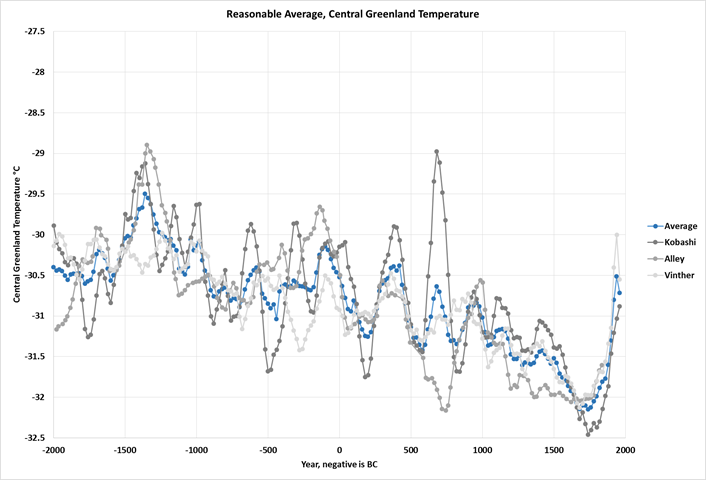
Figure 1
There are some notable outliers apparent in the comparison. In particular, we see the odd 700AD Kobashi spike, the scatter in the interval from 700BC to 100BC, and the Minoan Warm Period is completely missing in the Vinther reconstruction. The estimates agree better from 900 AD to the present than they do prior to 900 AD. Perhaps as the ice gets older accuracy and repeatability are lost. Figure 2 shows the same average and the maximum and minimum value for each 20 year sample.

Figure 2
The average temperature for the 4,000 year period is -30.8°C. The average minimum and maximum suggest this value is plus or minus 0.3°C. Perhaps we are simply seeing the error in these methods and nothing more. For those who want to see the messy details of the average temperature calculation the spreadsheet can be downloaded here. As noted in my previous post, the error in the time axis is probably at least +-50 years. Loehle has suggested a time error of +-100 years based on 14C laboratory errors. These give us some perspective in interpreting the reconstructions. Below is a comparison of the average to the same historical events we have used before.
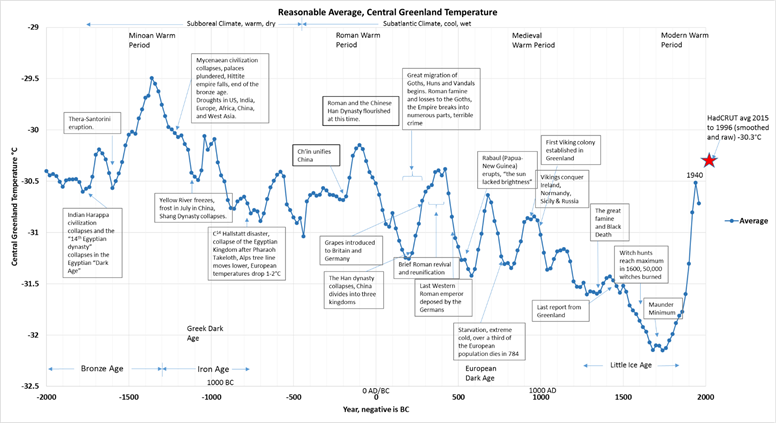
Figure 3, click on the image to download a high resolution pdf
This average temperature reconstruction shows a steady decline in temperature since the Minoan Warm Period, interrupted by +-120 year cycles of warm and cold. Don’t take the apparent 120 year cyclicity too seriously all of the data was smoothed with a 100 year moving average filter. After the end of the coldest period, the Little Ice Age, the Modern Warm Period begins and temperatures rise to those seen in the Roman Warm Period. The Modern Warm Period is equivalent to the Medieval Warm Period within the margin of error. We need to be careful because we are comparing actual measurements to averaged proxies. When proxies are averaged all high and low temperatures are dampened. In particular, the Medieval Warm Period is somewhat smeared and dampened due to the Vinther record. The Vinther Medieval Warm Period peak is earlier than the Kobashi and Alley peaks. Major volcanic eruptions fit this timeline reasonably well. Rabaul is noted at 540AD. Others are Thera-Santorini in 1600 BC and Tambora in 1815. TheHadCRUT 4.4 point shown with a red star is an average of several HADCRUT4 surface temperature grid points in the Greenland area thought to be comparable to the Greenland average temperature.
Comparisons to broader temperature reconstructions
Dr. Craig Loehle published a global composite temperature reconstruction in 2007 and a corrected version of the reconstruction in 2008. This reconstruction has been widely reviewed and appears to have stood the test of time. Subsequent work seems to support the reconstruction. In Figure 4 we show his global reconstruction compared to the Greenland average and the recent reconstruction of temperature in the extratropical (90° to 30°N) northern hemisphere by Ljungqvist. The graph in Figure 4 shows temperatures as anomalies since each line represents a different area.
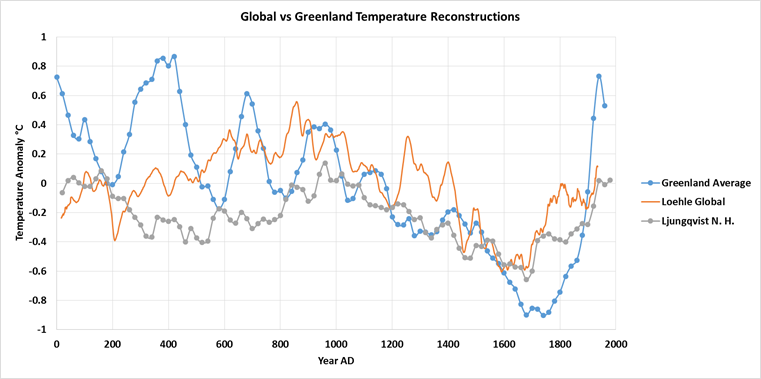
Figure 4
All of the reconstructions show a trend of decreasing temperature to the Little Ice Age, roughly from 1400 to 1880 AD. They also show a temperature peak around 1000 AD. The most striking thing about Figure 4 is that the temperature swings seen in the Greenland Average are larger than in the broader reconstructions. Is this because they average more proxies? Or because temperature changes are amplified in the Arctic and Antarctic as suggested by Flannery, et al? Probably a combination of both. Finally Figure 5 shows the Greenland average compared to two Arctic reconstructions. One is the ice core component of the Arctic reconstruction by Kaufman, 2009 (data here) and the other is the Sunqvist, 2014 “PAGES2K” arctic reconstruction (data can be found here). In Figure 5, the Arctic and PAGES2K temperature anomalies have been shifted to the average central Greenland temperature for the period for comparison purposes.
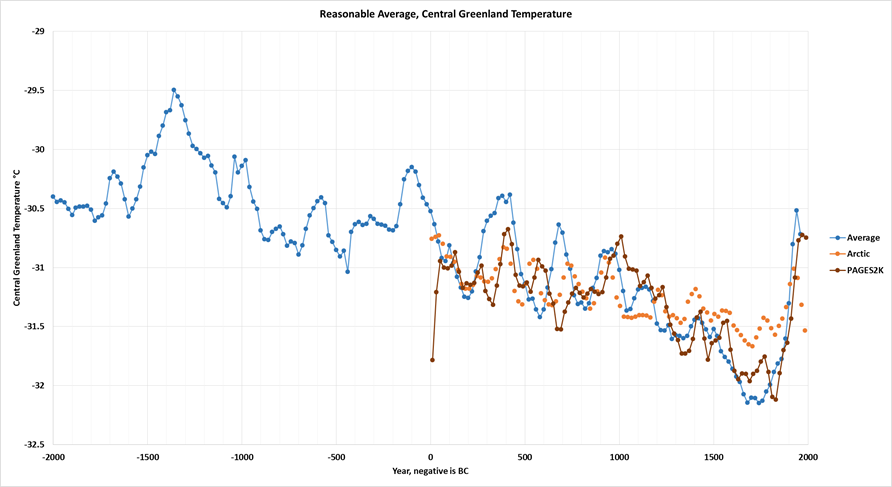
Figure 5
These two multi-proxy Arctic reconstructions agree fairly well with the Greenland average if we assume a +-0.3°C temperature error and +-50 year time error. It is interesting that the peak about 400AD is seen in the Arctic and Greenland reconstructions but not in the global reconstructions plotted in Figure 4. The Sunqvist, 2014 reconstruction was used as presented in his paper, it seemed to be carefully constructed. Sunqvist,et al. did include some tree ring data (fewer than 1% of the proxies), but they used it carefully and his reconstruction was not dominated by tree ring data.
Kaufman’s Arctic reconstruction used a lot of tree ring data (4 of 23 proxy records) as can be seen in his Figure 3 and in his dataset. Tree ring data does provide an accurate chronology, but it provides a poor temperature proxy due primarily to what has been called the “divergence” problem. Tree rings may correlate well to temperatures in a “training” period, but show little correlation to temperature longer term. This is probably because forests adapt to long term climatic changes by adjusting tree density and tree size. Tree ring widths can reflect summer temperatures, precipitation and many other factors, but extracting the average air temperature from them is problematic. Loehle discusses this problem and other problems with tree ring data here and here. For this reason, only the ice core records (seven proxy records of 23) from Kaufman’s reconstruction were used to plot the “Arctic” line in Figure 5. Figure 6 compares Kaufman’s “All proxies” reconstruction to his ice core, sediment (and lake varves) and tree ring proxies. The ice core, sediment and tree ring proxies only agree reasonably well for the last 500 years, before that the tree ring proxies diverge dramatically downwards. The lake and marine sediment proxies (12 of the 23) are lower than the ice core proxies also, but not so dramatically. We all know of another paleoclimatologist who took advantage of this divergence.

Figure 6
When all of the proxies are used the earlier temperatures are much lower and the modern warm period has a higher peak. The recent peak in the graph is the twenty year average around 1945. The proxy reconstruction then drops, the last point is centered on 1985. I didn’t bother to “hide the decline.” Except for the sharp drop from 1945 to 1985 Kaufman’s ice core proxies fit the rest of the reconstructions shown here reasonably well.
Discussion
There are many Greenland area temperature reconstructions, they use ice core data, lake and marine sediment core data and other proxies, mainly tree rings. They are not perfect and contain errors in the temperature estimates and errors on the time scale. The exact error is unknown, but by comparing reconstructions we can see that they generally, except for the tree ring proxies, agree to within 0.3°C and in time to within 50 years or so. Why is this important? Natural climate cycles are poorly understood. Some like the ENSO cycle (La Nina and El Nino) we can identify, but because they are irregular and the cause is unknown we cannot model them. The same is true of the Atlantic Multidecadal Oscillation (AMO) and the Pacific Decadal Oscillation (PDO). These events affect the weather and climate all over the world, but they are not accurately included in the GCM’s (General Circulation Models) used by the IPCC and other organizations to compute man’s influence on climate. Thus, some portion of the Modern Warm Period attributed to man may, in fact, be attributable to these or other natural climate cycles.
During the 1980’s and 1990’s the PDO was mostly positive (warming). From the mid 1990’s to today the AMO has been mostly positive and undoubtedly contributing to warming. There have been numerous attempts to see a pattern in these multidecadal natural climate cycles. Most notably, Wyatt and Curry identified a low-frequency natural climate signal that they call a “stadium wave.” This model is based on a statistical analysis of observed events (especially the AMO) and not on the physical origins of these long term climate cycles. But, it does allow predictions to be made and the veracity and accuracy of the stadium wave hypothesis can and will be tested in the future.
Another recent paper by Craig Loehle discusses how the AMO signal can be removed from recent warming, leaving a residual warming trend that may be related to carbon dioxide. He notes that when the AMO pattern is removed from the Hadley Center HADCRUT4 surface temperature data the oscillations are dampened and a more linear increase in temperature is seen. This trend compares better to the increase in carbon dioxide in the atmosphere and allows the computation of the effect of carbon dioxide on temperature. The calculation results in an increase of 0.83°C per century. This is roughly half of the observed increase of 1.63°C. Loehle suggests that the AMO may be the best indicator of natural trends. If this is true then half of recent warming is natural and half is man-made. It also suggests that the equilibrium climate sensitivity to carbon dioxide is about 1.5°C per doubling of CO2. This is the lower end of the range suggested by the IPCC. This value also compares well to other recent research.
Conclusions
The use of temperature proxies to determine surface air temperatures prior to the instrument era is very important. This is the only way to determine natural long term climate cycles. Currently, in the instrument record, we can see shorter cycles like the PDO, AMO, and ENSO. When these are incorporated into models we see that half or more of recent warming is likely natural, belying the IPCC idea that “most” of recent warming is man-made. Yet, these shorter cycles are clearly not the only cycles. When we look at longer temperature reconstructions we see 100,000 year glacial periods interrupted by brief 20,000 year interglacial periods. These longer periods will probably only be fully understood with more accurate reconstructions. Intermediate ~1500 year cycles, called “Bond events” have also been identified.
Tree ring proxies older than 500 years and younger than 100 years are anomalous. This anomaly is large enough to cast doubt on any temperature reconstruction that uses tree rings. Between lake and marine sediment proxies and ice core proxies it is harder to tell which is more likely to be closer to the truth. They agree well enough to be within expected error. All of the proxies diverge from the mean with age, none appear to be very accurate (or more precisely in good agreement) prior to 1100 AD. It does appear that all of the proxies except the tree ring proxies, could be used for analytical work back to 1100 AD; this is encouraging.
The other very important use for temperature reconstructions is to study the impact of climate changes on man and the Earth at large. Historical events are often known to the day and hour, only when we have reconstructions with more accurate time scales can we properly match them to major events in history. In addition, this work made it clear that combining multiple proxies causes severe dampening of the temperature response because the time scale error causes peaks and valleys in the average record to be reduced. Multiple proxy reconstructions show less temperature variation than actually occurred. Ideally, we need a very accurate time scale on all proxies so they can be combined properly. But, achieving more accuracy than 50-100 years will be difficult given current dating technology. Tree rings are more accurate than this, but they are a poor indicator of temperature. There is a lot of work needed in this area.
A teensy-weensy point about Fig. 3. I had thought that the witch hysteria peaked in 1650 rather than 1600, but I may well be wrong. I will check my references.
I would say it is continuing. Just look at the recent attempt by the AGs and NGOs to sue Exxon.
50 000 witches burned? Even that many executed might be an overestimate.
A lot of these cases are local lore and not recorded.
The Witch of Monzie” has caused endless discussion and argument; no authentic record of her death appears, but it was impossible in the district of Crieff for the enquirer to go into a house or cottage (even thirty years ago) and ask, “Have you ever heard of the Witch of Monzie,” without receiving the reply in the affirmative; then there is Kate M’Niven’s Cave, where, when haunted from her home in the Kirktown of Monzie, she took refuge, living there comfortably enough while many sought her in secret, for her cures and so-called charms.
Whatever the number of witches it was a lot, and many more than were killed were abused and ostracized. There were gentlemen aptly named “pricks” whose job it was to go around and prick birthmarks. If the pricked birthmark didn’t bleed…men were also witches.
Today Carbon is the witch, and the pricks go around looking for footprints.
I’ve mentioned it before. If you go through the actual documented stories, the reaction might have been wrong but it was a reaction to a drug problem.
More observations from this data:
1) HadCRUT starts about 1870 and goes to the present. CO2 went from about 290 to 400 over that same time period.
2) Temperature increased a full 1.75°C between 1870 and 1940. CO2 went from 290 to 312, an increase of 22 ppm. 75 years 1.75°C 22 ppm.
3) Temperature dropped a full 0.75°C between 1940 and 1970. CO2 increased about 15 ppm. 30 years, 15 ppm, -0.75°C.
4) CO2 increased a full 1.0°C between 1970 and 2015. CO2 went from 330 to 400 ppm, or 70 ppm.
5) Back in 1500 BC, temperatures increased 1.75°C over 250 years, with an assumed no increase in CO2.
6) The 750 year Manoan warming resulted in 2.5°C.
7) Temperatures fell a full 2.5°C in 250 years to end the Minoan warming.
8) Temperatures fell 1.75° in 100 years to end the Roman Warming.
9) After a bit or warming the temperatures fell another 2.00°C over 250 years ending in the bottom of the Dark Ages.
10) The entire cooling period after the Roman Warming resulted in a drop of 2.75°C over almost 1,000 years.
11) The Medieval warming lasted about 200 years and increased 2.0°C.
12) The little ice age dropped 1.5°C in 100 years and stayed low for another 500 years.
13) The eventual warming resulted in the Industrial age, not vise versa. Warmer temperatures freed men up to invent machines to process all the new food and fibers that needed to be processed to feed and cloth the growing population.
Bottom line, the last 150 years are nothing extraordinary when the complete picture is considered, especially considering we are rebounding from the lowest temperatures of the Holocene. Once again, we are at record high CO2 and no where near record high temperatures. Even is CO2 is the cause, there is absolutely nothing we can do to stop the increase in CO2, short of population control, and China’s experiment with that didn’t do anything either to slow the increase in CO2.
https://andymaypetrophysicist.files.wordpress.com/2016/06/central_greenland_temperature_since-4000bp.pdf
This proxy data should be looked at in conjunction with these proxies of ENSO:
https://wattsupwiththat.com/2016/06/10/rainfall-and-el-nino/
In particular the recent very good quality Flores ENSO proxy from Indonesia.
It is not very clear what the post 1950 temperatures are based on. One spike at the end is marked as Hadcru but you simply cannot splice modern data onto ice core data. Even it you compared d18O of recent snow it could not be used because the process by which the ice cores form takes many decades or in Antarctica probably centuries to form.
Let me give you an example from Antarctica. Lake Vanda and the glaciers in the Dry Valleys of Antarctica were intensively studied by Trevor Chin over a period > 20 years. His work showed th at the lake level and the Upper right Glacier dropped by ~300 mm every winter due to sublimation from the surface.
The ice in the ice cores has formed over decades of accretion (water vapour precipitating on cold surfaces) and snowfall on one hand, and ablation on the other. It is a dynamic process of loss and gain until such time as the snow is buried deep enough to become isolated from the daily exchange with the atmosphere.
Any sample from an ice core then is a multi decade measure and for this reason it is simply wrong to compare such data to modern temperature measures taken on shorter time frames.
That is really really really bad news for Michael Mann and the IPCC. Your explanation may explain why all over inter-glacial periods are spikes in Al Gore’s chart, and the recent Holocene period has a plateau. From your explanation, would that also impact the variability of the temperatures. If it does, what good are proxies if they don’t provide any real information regarding the variable they are intended to imitate?
That’s my gut-feeling as a non-scientist, no matter how good the proxy is in faithfully recording the past temperature for say the Holocene, decadal and centurial detail fluctuations are necessarily lost the further back in time one goes, analogous to looking at a landscape through powerful binoculars or space through optical telescopes.
As others have said, the smoothing of the data points that necessarily results because of that lost detail makes splicing of the alleged thermometer record, particularly when carried beyond the formal endpoint, specious.
co2islife
Thanks for your comments and data which correctly describe the essence of this palaeo data. More that anything ekse it is the palaeo climate data that exposes the nakedness of the CAGW emperor.
I agree with your suggestion of a simple test of standard deviation of the temperature record to assess whether or not recent fluctuation is exceptional or not. I would add to that a test of fractal dimension to see if the character and frequency of temperature variation has changed. Or not.
Odd how shy everyone is about such a simple and obvious test.
The CAGW story was invented in the complete absence of any consideration of – or even awareness of the existence of – palaeo climate data from the past. Thus the new field of CAGW palaeo-apologetics is an ungainly bolt-on to the CAGW diatribe. At its heart lies the frequency trick, as exemplified by the likes of Mann, Shakun, Marcott etc. Basically, recent data both palaeo and instrumental is more precise (less blurring with time) and thus represents higher frequency data. With increasing time in the past the precision and frequency decreases. This fact by itself will give the 19-20th century warming exaggerated amplitude and make it look exceptional. A perfect result of course for the CAGW dystopian class-warriors. But fraud nonetheless.
A more correct approach to compensate for this would be to smooth the recent data and / or sharpen the palaeo data (increasing fluctuation amplitude) increasingly with increasing time in the past. This would make palaeo reconstructions running up to the present more realistic. Of course the message such a reconstruction would give about the complete ordinariness of recent warming would not be politically kosher.
“This would make palaeo reconstructions running up to the present more realistic. Of course the message such a reconstruction would give about the complete ordinariness of recent warming would not be politically kosher.”
Yes, a temperature chart that actually represented reality would show the alarmists hockey stick chart to be a false representation. The alarmists have fooled a lot of people with that hockey stick chart.
I want to see a chart based on Climategate.
A chart that puts the 1910’s, the 1930’s, 1998, and 2016 all on an equal level (the same horizontal line on the chart). That kind of temperature profile would show that instead of the world experiencing unusual warming, with the temperature chart steadily heading up at a 45 degree angle, we have really been experincing a series of equal ups and downs during that period, ending up back at the trendline in 2016. And now trending down, at least for the moment. Nothing unusual here. The Hockey Stick chart is a trick meant to scare people. We need a chart we can point to as being more representative of reality.
That’s hard to do when the historic surface temperature data has already been hijacked by the alamists, but we do have the Climate Change Gurus word, in their Climategate emails, that the 1930’s was hotter than 1998, and that ought to be all we need to draw a chart representing a closer version of reality.
And actually, I think the chart should show the 1930’s as hotter than both 1998 and 2016. We don’t know how much hotter the 1930’s was, because the Climate Change Gurus have not given the exact figures to us (are are keeping it the themselves), but I think we have to assume that the 1930’s was at least 1C above today’s temperature and maybe 2C.
The reason I say that is because the alarmists predict extremely adverse weather for us in the future if the temperature goes up about 2C, and the dire consequences they describe sound just like what happened in the 1930’s. Those dire consequences are not happening today (the “hottest year evah!”), so it must have been much hotter then in the 1930’s, than now.
We all know the weather was much more extreme during the 1930’s than it is today. So I think the high temperature of the 1930’s chart should be considerably higher than 1998, or 2016, and that gives the Climategate chart a “longterm” downtrend from the 1930’s to today, which Feb 2016 broke by one-tenth of a degree, but has now fallen below the downtrend line again.
I want to see a chart like that.
So what if the Climategate chart is just dreamed up out of circumstantial evidence, it is still more descriptive of reality than the official Hockey Stick charts.
Look kids, this is what the temperature chart *really* looks like! Nothing to fear here. Throw those Hockey Stick charts in the trash.
Yep. Seems like there is always controversy when Proxy reconstructions are involved.
“Another recent paper by Craig Loehle discusses how the AMO signal can be removed from recent warming, leaving a residual warming trend that may be related to carbon dioxide.”
Rising CO2 according to the IPCC models will increase positive North Atlantic Oscillation conditions, that will cool the AMO (and Arctic).
The increase in negative NAO since the mid 1990’s that drove the AMO warming, shows how little that rising CO2 is forcing the climate.