Distant history of the North Atlantic region contributes to the present-day ice loss

From the GFZ German Research Centre for Geosciences
To understand Greenland’s ice of today researchers have to go far back into Earth’s history. The island’s lithosphere has hot depths which originate in its distant geological past and cause Greenland’s ice to rapidly flow and melt from below. An anomaly zone crosses Greenland from west to east where present-day flow of heat from the Earth’s interior is elevated. With this anomaly, an international team of geoscientists led by Irina Rogozhina and Alexey Petrunin from the GFZ German Research Centre for Geosciences could explain observations from radar and ice core drilling data that indicate a widespread melting beneath the ice sheet and increased sliding at the base of the ice that drives the rapid ice flow over a distance of 750 kilometres from the summit area of the Greenland ice sheet to the North Atlantic Ocean.
The North Atlantic Ocean is an area of active plate tectonics. Between 80 and 35 million years ago tectonic processes moved Greenland over an area of abnormally hot mantle material that still today is responsible for the volcanic activity of Iceland. The mantle material heated and thinned Greenland at depth producing a strong geothermal anomaly that spans a quarter of the land area of Greenland. This ancient and long-lived source of heat has created a region where subglacial meltwater is abundant, lubricating the base of the ice and making it flow rapidly. The study indicates that about a half of the ice in north-central Greenland is resting on a thawed bed and that the meltwater is routed to the ocean through a dense hydrological network beneath the ice.
The team of geoscientists has now, for the first time, been able to prove strong coupling between processes deep in the Earth’s interior with the flow dynamics and subglacial hydrology of large ice sheets: “The geothermal anomaly which resulted from the Icelandic mantle-plume tens of millions of years ago is an important motor for today’s hydrology under the ice sheet and for the high flow-rate of the ice” explains Irina Rogozhina. “This, in turn, broadly influences the dynamic behaviour of ice masses and must be included in studies of the future response to climate change.”

These secrets of Greenland’s past have been hidden by the 3 km thick ice sheet covering the landmass and are now revealed by the researchers using an innovative combination of computer models and data sets from seismology, gravity measurements, ice core drilling campaigns, radar sounding, as well as both airborne, satellite and ground-based measurements on the thickness of the ice cover. The location and orientation of the zone of elevated geothermal heat flow shows where Greenland moved over the Iceland mantle plume.
This unexpected link between hotspot history and ice sheet behaviour shows that the influences on ice sheets span a huge range of timescales from the month by month changes of the ice cover to the multi-million year epochs over which the Earth’s mantle and tectonic plates evolve. Besides this, the results of the study provide an independent test for models of the opening of the North Atlantic which after a three-decade-long debate still is not fully understood.
###
Irina Rogozhina, Alexey G. Petrunin, Alan P. M. Vaughan, Bernhard Steinberger, Jesse V. Johnson, Mikhail K. Kaban, Reinhard Calov, Florian Rickers, Maik Thomas and Ivan Koulakov: “Melting at the base of the Greenland ice sheet explained by Iceland hotspot history”, NATURE GEOSCIENCE, Advance Online Publication, 04 April 2016, DOI: 10.1038/NGEO2689 http://dx.doi.org/10.1038/NGEO2689
Every now and then a very interesting explanation for phenomena comes along. You just have to recognise it when it arrives. This is one of tem. Thanks go to Irina Rogozhina, Alexey G. Petrunin, Alan P. M. Vaughan, Bernhard Steinberger, Jesse V. Johnson, Mikhail K. Kaban, Reinhard Calov, Florian Rickers, Maik Thomas and Ivan Koulakov
Jules Verne knew all about this in 1864!!!
All you need is a bit of Latin written backwards and we can crack all of Earth’s mysteries.
Sounds like a good opportunity to do some real honest research. Bore a hole through the ice/snow on Greenland to the land/dirt surface. Measure the temperature gradient of the ice. Then bore through the earth surface (same hole) several thousand feet. Check that temperature gradient. Compare with temp gradients elsewhere ( e.g. oil drilling). Useful data could be collected.
At least the temp gradient in the ice/ice hole could offer a more reliable source of data than from water and air which is subject to conditions in constant flux. That could begin to offer some insight as to how much heat is actually transmitted from land and undersea surfaces. This would not even begin to cover open fissures but would be a start. Just stop pissing research $$$ away on CO2.
The weight of the ice sheet has also isostatically depressed the crust below, so the crust has thinned from below via crustal extension (moving apart in rifting), and also from above, via isostatic depression of the lower crustal hot rocks, deforming plastically and squishing and flow-deforming horizontally, away from the area under the ice.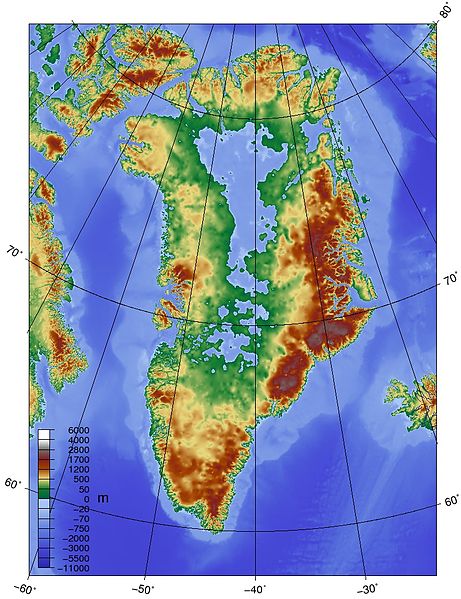
Hence the margins of Greenland are relatively uplifted, trapping both the ice sheet, and the warmer water below it, within a deeper central basin’s depression).
And hot shallow thinned rock over an elevated mantle often exhibits extensive hydrothermal systems exhaling super-heated water (black smoker like, or even geyser like, in an extending crustal basin) either from water re-circulation through crust and/or via ‘juvenile’ water from upper mantle melts dehydrating their waters as the melt cools and solidifies, donating it to the surface hydrosphere in the process.
The processes of earth are much more complicated than can justifiably be generalized into pat alleged ‘settled’-science narratives of suited clowns in Capital buildings and their out-houses.
Note: the Greenland lake is ~ the same shape & size of Britain inverted.
Not so long ago to their amazement the gurus of the standard model of the universe found 95% of it missing.
What is missing is dark energy, the energy that powers the universe and is the creative force, it circulates through the sun and the planets and keeps us warm from the inside. 4.5 billion years and the earth is not a solid dead rock but oozing with heat from the inside, this is our heat, the variations of this give us our warm periods, cold periods and ice ages because of variations in our relative position of our big planets and our place in our galaxy. This is a better explanation than CO2.
This shouldn’t come as a surprise. I dimly recall reading something long ago about a team that had rigged up all these cool remote sensing devices. They intended to toss them into a crevasse in the ice and hope to find some later to get readings on Greenland melt water. Their shipment of remote sensors got lost and their opportunity to get something into the melt water was slipping away so someone on the team bought a box full of rubber duckies. They threw them in. Some time later they were actually able to recover some and they had been melted.
Did they write a paper about this?
Dunno. Perhaps you could google “Greenland rubber ducky” and find out.
Meanwhile, gotta love them sea ice bridges they get some winters. Icelanders don’t like it too much, though … Polar Bears take their vacations on the comparatively balmy Icelandic shores! 🙂
This is another fascinating study that will unfortunately be ignored by the mainstream media.