This is a guest essay by Mike Jonas, part 1 of 4
Introduction
The aim of this article is to provide simple mathematical formulae that can be used to calculate the carbon dioxide (CO2) contribution to global temperature change, as represented in the computer climate models.
This article is the first in a series of four articles. Its purpose is to establish and verify the formulae, so unfortunately it is quite long and there’s a fair amount of maths in it. Parts 2 and 3 simply apply the formulae established in Part 1, and hopefully will be a lot easier to follow. Part 4 enters into further discussion. All workings and data are supplied in spreadsheets. In fact one aim is to allow users to play with the formulae in the spreadsheets.
Please note : In this article, all temperatures referred to are deg C anomalies unless otherwise stated.
Global Temperature Prediction
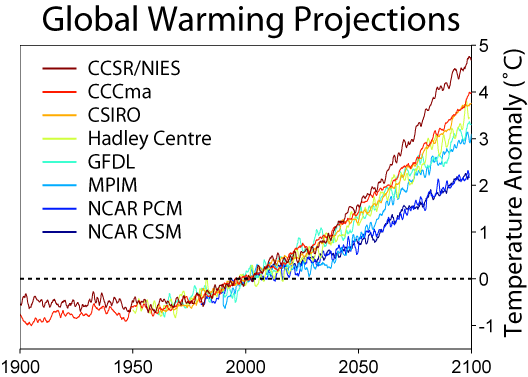
The climate model predictions of global temperature show on average a very slightly accelerating increase between +2 and +5 deg C by 2100:

We can be confident that all of this predicted temperature increase in the models is caused by CO2, because Skeptical Science (SkS) [6], following a discussion of CO2 radiative forcing, says :
Humans cause numerous other radiative forcings, both positive (e.g. other greenhouse gases) and negative (e.g. sulfate aerosols which block sunlight). Fortunately, the negative and positive forcings are roughly equal and cancel each other out, and the natural forcings over the past half century have also been approximately zero (Meehl 2004), so the radiative forcing from CO2 alone gives us a good estimate as to how much we expect to see the Earth’s surface temperature change.
[my emphasis]
So, if we can identify how much of the global temperature change over the years from 1850 to present was contributed by CO2, then we can deduce how much of the temperature change was not. ie,
T = Tc + Tn
where
T is temperature.
Tc is the cumulative net contribution to temperature from CO2. “CO2” refers to all CO2, there is no distinction between man-made and natural CO2.
Tn is the non-CO2 temperature contribution.
Obviously, all feedbacks to CO2 warming (changes which occur because the CO2 warmed) must be included in Tc.
CO2 Data
The Denning Research Group [4] helpfully provide an emissions calculator, which shows CO2 levels and the estimated future temperature change that it causes under “Business as usual” (zero emission cuts) :

Cross-checking the future warming in this graph against Figure 1, the CO2 warming from 2020-2100 is just under 3.5 deg C compared with about 3.25 deg C model average in Figure 1. That seems close enough for reliable use here. But data going back to at least 1850 is still needed.
There is World Resources Institute (WRI) CO2 data from 1750 to present [3], and CO2 data measured at Mauna Loa from 1960 to present [5]. Together with the Denning “Business as usual” CO2 predictions above, the CO2 concentration from 1750 to 2100 is as follows :

For dates covered by more than one series, the Mauna Loa measured data will be preferred, then the WRI data.
Because the “pre-industrial” CO2 is put at 280ppm [6], and the data points in the above graph before 1800 are all very close to 280ppm, a constant level of 280ppm will be assumed before 1800.
CO2 Contribution
The only information still needed is the CO2-caused warming before about 1990.
A method for calculating the temperature contribution by CO2 is given by SkS in [6] :
dF = 5.35 ln(C/Co)
Where ‘dF’ is the radiative forcing in Watts per square meter, ‘C’ is the concentration of atmospheric CO2, and ‘Co’ is the reference CO2 concentration. Normally the value of Co is chosen at the pre-industrial concentration of 280 ppmv.
dT = λ*dF
Where ‘dT’ is the change in the Earth’s average surface temperature, ‘λ’ is the climate sensitivity, usually with units in Kelvin or degrees Celsius per Watts per square meter (°C/[W/m2]), and ‘dF’ is the radiative forcing.
So now to calculate the change in temperature, we just need to know the climate sensitivity. Studies have given a possible range of values of 2-4.5°C warming for a doubling of CO2 (IPCC 2007). Using these values it’s a simple task to put the climate sensitivity into the units we need, using the formulas above:
λ = dT/dF = dT/(5.35 * ln[2])= [2 to 4.5°C]/3.7 = 0.54 to 1.2°C/(W/m2)
Using this range of possible climate sensitivity values, we can plug λ into the formulas above and calculate the expected temperature change. The atmospheric CO2 concentration as of 2010 is about 390 ppmv. This gives us the value for ‘C’, and for ‘Co’ we’ll use the pre-industrial value of 280 ppmv.
dT = λ*dF = λ * 5.35 * ln(390/280) = 1.8 * λ
Plugging in our possible climate sensitivity values, this gives us an expected surface temperature change of about 1–2.2°C of global warming, with a most likely value of 1.4°C. However, this tells us the equilibrium temperature. In reality it takes a long time to heat up the oceans due to their thermal inertia. For this reason there is currently a planetary energy imbalance, and the surface has only warmed about 0.8°C. In other words, even if we were to immediately stop adding CO2 to the atmosphere, the planet would warm another ~0.6°C until it reached this new equilibrium state (confirmed by Hansen 2005). This is referred to as the ‘warming in the pipeline’.
Unfortunately, not enough exact parameters are given to allow the temperature contribution by CO2 to be calculated completely, because the effect of ocean thermal inertia has not been fully quantified. But it should be reasonable to derive the actual CO2 contribution by fitting the above formulae to the known data and to the climate model predictions.
The net radiation caused by CO2 is the downward infra-red radiation (IR) as described by SkS, less the upward IR from the CO2 warming already in the system (CWIS). This upward IR will be proportional to the fourth power of the absolute (deg K) value of CWIS [9]. The net effect of CO2 on IR is therefore given by :
Rcy = 5.35 * ln(Cy/C0) – j * ((T0+Tcy-1)^4 – T0^4)
where
Rcy is the net downward IR from CO2 in year y.
Cy is the ppm CO2 concentration (C) in year y.
C0 is the pre-industrial CO2 concentration, ie. 280ppm.
j is a factor to be determined.
T0 is the base temperature (deg K) associated with C0.
Tcy is the cumulative CO2 contribution to temperature (Tc) at end year y, ie, CWIS.
SkS [6] says “it takes a long time to heat up the oceans due to their thermal inertia”. On this basis, CWIS is presumably in some ocean upper layer.
For a doubling of CO2, in the absence of other natural factors, the equilibrium temperature increase using the SkS formula is 5.35 * ln(2) * λ where λ = 3.2/3.7 (assuming a mid-range equilibrium climate sensitivity (ECS) of 3.2).
At equilibrium, Rc = 0. For ECS = 3.2, j can therefore be determined from
0 = 5.35 * ln(2) – j * ((T0+3.2)^4 – T0^4)
hence
j = (5.35 * ln(2)) / ((T0+3.2)^4 – T0^4)
Because “the natural forcings over the past half century have also been approximately zero” [6], the SST should be a reasonably good guide to CWIS. The global average SST 1981 to 2006 was 291.76 deg K [8]. Subtracting the year 1993 Tc of 0.7 (from the Denning data [4]) gives T0=291 deg K. Hence j = (5.35 * ln(2)) / ((291+3.2)^4 – 291^4) = 1.16E-8 (ie. 1.16 * 10^-8, or 0.0000000116).
Using the formula
δTcy = k * Rcy
where
δTcy is the increase (deg C) in CWIS in year y.
k is the one-year impact on temperature per unit of net downward IR.
the value of k can be found which gives a future temperature increase matching that of the climate models, ie. 3.25 deg C from 2020 to 2100. A reasonability check is that the result should closely match but be slightly lower than the Denning warming calculation in Figure 2 (lower graph) (slightly lower because target is 3.25 deg C not 3.5) …..

….. it does, for k = 0.02611 (the graph for 3.5 deg C is also shown in [7]). [Note that the calculated warming is “anchored” at 1750 T=0, and that the shape is determined only by the formula so there is no guarantee that the 2020 and 2100 temperatures will be close to the Denning temperatures. ie, this is a genuine test.].
Note: At this rate, global temperature takes 52 years to get 80% of the way to equilibrium (as in “equilibrium climate sensitivity”), 75 years to reach 90%, 97 years to reach 95%, 148 years to reach 99%.
The above formula can therefore reliably be used for CO2’s contribution to global temperature since 1750.
1850 to 2100
The above formulae can now be applied to the period 1850 – 2100, to see how much has been and will be contributed to temperature by CO2.
For temperature data 1850 to present, Hadcrut4 global temperature [1] is used. For future temperatures, the formula warming (as in Figure 4) is used.

Applying the above formulae shows the contributions to temperature by CO2 and by other factors :

As expected,
· the dominant contribution is from CO2,
· other factors contribute the inter-annual “wiggles” and virtually nothing else.
Note : The contribution to global temperature by CO2 is only man-made to the extent that the CO2 is man-made. As stated earlier, no distinction is made between man-made CO2 and natural CO2. Obviously, all pre-industrial CO2 was in fact natural. Similarly, for the non-CO2 contribution, no distinction is made between natural factors and non-CO2 man-made factors (such as land-clearing, for example), but the non-CO2 factors are thought to be predominantly natural. The feedbacks from the CO2 warming as claimed by the IPCC (eg. water vapour, clouds) are included in the CO2 contribution above.
Conclusion
The picture of global temperature and its drivers as presented by the IPCC and the computer models is one in which CO2 has been the dominant factor since the start of the industrial age, and natural factors have had minimal impact.
This picture is endorsed by organisations such as SkS and Denning. Using formulae derived from SkS, Denning and normal physics, this picture is now represented here using simple mathematical formulae that can be incorporated into a normal spreadsheet.
Anyone with access to a spreadsheet will be able to work with these formulae. It has been demonstrated above that the picture they paint is a reasonable representation of the CO2 calculations in the computer models.
The next articles in this series will look at applications of these formulae.
Footnote
It is important to recognise that the formulae used here represent the internal workings of the climate models. There is no “climate denial” here, because the whole series of articles is based on the premise that the climate computer models are correct, using the mid-range ECS of 3.2.
See spreadsheet “Part1” [7] for the above calculations.
Mike Jonas (MA Maths Oxford UK) retired some years ago after nearly 40 years in I.T.
References
[1] Hadley Centre Hadcrut4 Global Temperature data http://www.metoffice.gov.uk/hadobs/hadcrut4/data/current/time_series/HadCRUT.4.3.0.0.annual_ns_avg.txt (Downloaded 20/5/2015)
[2] Climate model predictions from http://upload.wikimedia.org/wikipedia/commons/a/aa/Global_Warming_Predictions.png (Downloaded 20/5/2015) Note: Wikipedia is an unreliable source for contentious issues, but for factual information such as the output of computer models, and in the context for which it is being used here, it should be OK.
[3] CO2 data from 1750 to date is from World Resources Institute http://powerpoints.wri.org/climate/sld001.htm (Downloaded 20/5/2015. Digitised using xyExtract v5.1 (2011) by Wilton P Silva)
[4] Emissions calculator from Denning Research Group at Colorado State University http://biocycle.atmos.colostate.edu/shiny/emissions/ using no emissions cuts, ie, “Business as usual”. (Downloaded 20/5/2015. Digitised using xyExtract v5.1 (2011) by Wilton P Silva)
[5] Mauna Loa CO2 data from http://scrippsco2.ucsd.edu/data/flask_co2_and_isotopic/monthly_co2/monthly_mlf.csv (Downloaded 27/2/2012)
[6] Skeptical Science 3 Sep 2010 http://www.skepticalscience.com/Quantifying-the-human-contribution-to-global-warming.html (As accessed 20/5/2012).
[7] Spreadsheet “Part1” with all data and workings . Part1 (Excel .xlsx spreadsheet)
[8] Spreadsheet “SST” SST (Excel .xlsx spreadsheet)
[9] Stefan-Boltzmann law. See http://hyperphysics.phy-astr.gsu.edu/hbase/thermo/stefan.html
Abbreviations
AR4 – (Fourth IPCC report)
AR5 – (Fifth IPCC report)
CO2 – Carbon Dioxide
CWIS – CO2 warming already in the system
ECS – Equilibrium Climate Sensitivity
IPCC – Intergovernmental Panel on Climate Change
IR – Infra-red (Radiation)
LIA – Little Ice Age
MWP – Medieval Warming Period
SKS – Skeptical Science (skepticalscience.com)
WRI – World Resources Institute
All evidence points otherwise. Nights over deserts show extreme variances from the daytime high temperatures. Areas with humid atmospheres show a very narrow range of diurnal temperature change. Antarctica shows extreme temperature variation from the wet coastal region to the dry inland region, and the temperature decay follows the loss of humidity. Bottom line, all climates have CO2 at 400ppm so CO2 can’t be the cause of the differences between humid and dry climates.
It looks like H2O can reduce the earth’s radiance by 288-200=88°K. CO2 is a constant, and doesn’t change. Only H2O can shift the IR spectrum, and vary the amount of heat trapped. CO2 can’t.
http://www.scielo.br/img/revistas/rbg/v21n1/a05fig03.gif
T = Tc + Tn. (Formula #1)
———–
To be clear temperature is not additive nor are the equivalents.
Heat in the atmosphere follows H2O, not CO2.
http://www.spectralcalc.com/atmosphere_browser/plots/guest547112018.png
http://www.spectralcalc.com/atmosphere_browser/plots/guest825527203.png
http://www.spectralcalc.com/atmosphere_browser/plots/guest122871090.png
I look forward to reading the series, as well as the “vigorous” debate that will no doubt accompany it.
My only comment so far is this. It is far easier to understand the GHE if one completely avoids looking at the Earth-Atmosphere-Ocean interface — the actual surface — and try to tally up things like back radiation, mostly because back radiation is mixed with conduction and convection and latent heat transfers and lateral heat transfers to the point where everything is both dubious and arguable. We cannot solve the coupled Navier-Stokes equations in our heads, nor can we solve them at adequate resolution from reasonably well known initial conditions with our best computers — manifestly, as co2islife’s reproduction of Roy Spencer’s figure above conclusively (IMO) demonstrates.
It is a lot easier to understand the GHE from spectrographs and from contemplation of the Earth as a system that is warmed at some rate by the sun through an atmosphere that is largely transparent to or reflective of direct sunlight (not terribly absorptive of, in other words). To remain at an approximate dynamical equilibrium temperature it has to radiate all of this power away so that ins equal outs, via radiation alone.
Some of the outgoing radiation comes directly from the surface and can be closely and reasonably associated with the blackbody curve for the temperature of the radiating surface. Some of that outgoing radiation is absorbed by the atmosphere, which is basically completely opaque at ground level to in-band LWIR in the absorption bands of greenhouse gas molecules. Note well — I do not reference back radiation, forward radiation, latent heat, what happens at the ocean’s surface to IR, whether or not convection is important — none of this matters. The surface does indeed lose energy to the near-surface atmosphere and pick energy up from the near-surface atmosphere in many, often complex ways, but the only thing that matters is that outgoing LWIR is almost instantly absorbed by the atmosphere in certain bands.
Way up at the top of the troposphere (at a variable, not terribly sharp height) the atmosphere becomes tenuous enough for radiation in the greenhouse gas bands to escape. Greenhouse gas molecules in thermal equilibrium with the general atmosphere at that height and above have around a 50% or better chance of radiating energy away from one of their in-band levels and having the photon make it out to “infinity”. Top of atmosphere spectrographs show that this energy is radiated away roughly consistently with a blackbody radiation curve in the absorption band of the relevant species at the temperature associated with that height.
Because of the (approximately adiabatic) lapse rate, the atmosphere at the height where transparency is achieved is usually much colder than the surface underneath.
The total radiation from any patch of the surface is thus (in very crude terms):
P = A * S + B * G
where A is the fraction of unblocked radiation, S is the power from the surface, B is the fraction of blocked radiation (at the surface) and G is the power coming from the greenhouse gases.
P must on average equal the incoming power from the sun for the earth to be in dynamic equilibrium. If it is smaller, the Earth accumulates energy from the difference and warms until S increases enough to rebalance the rates. If it is larger, the Earth loses energy from the difference and cools until the reduced S once again balances things.
Greenhouse gas concentrations and details in the quantum mechanics that dictate absorption make A, B and G all three somewhat variable on greenhouse gas concentration. The simplest way to understand the variation is that if one increases (say) CO_2 concentration, then the height where the atmosphere becomes sufficiently transparent for radiation in the CO_2 band to escape increases, as it depends on the mean free path of the in-band photons and whether or not they are likely to encounter another absorber molecule on the way out of the atmosphere. Increased height means colder from the lapse rate, which means that G goes down a hair. S has to go up a hair to compensate.
Note that this effect quite literally has nothing to do with what goes on near the surface. Surface energy can be transferred to the atmosphere by radiation, conduction, convection, latent heat, and by tiny pink unicorns that carry hot water bottles on their backs, as long as those unicorns don’t fly out of the atmosphere with the heat but allow it to escape via radiation. Increased concentration may or may not increase back radiation and this may or may not be interpreted as the “cause” of additional surface warming but it is a terrible way to tally it up because of the confounding stuff.
At the TOA it is simple. Detailed balance must be maintained, and to the extent that it is not the Earth warms or cools.
Note well that the Earth warms and cools much more than the CO_2-linked portion of this effect on a 1 to 5 year basis. IMO this means that it is never very far from true dynamical equilbrium, and I am deeply skeptical of any large amount of “uncommitted warming”. One gets a rather excellent fit to the data with a CO_2 driven warming model with no lag — temperature directly fit by a log of the concentration, with a warming per doubling of concentration of around 1.8 C. That doesn’t prove that there is no lag, but one does at the vary least have to show that a lagged, integrated model (that is of course much more complex) both fits the data and satisfies the fluctuation dissipation theorem when analyzing the laplace decomposition of the short time temperature fluctuations. I very much doubt that they are going to leave much room for a 100 year residual of any significant size.
rgb
“The simplest way to understand the variation is that if one increases (say) CO_2 concentration, then the height where the atmosphere becomes sufficiently transparent for radiation in the CO_2 band to escape increases, as it depends on the mean free path of the in-band photons and whether or not they are likely to encounter another absorber molecule on the way out of the atmosphere. Increased height means colder from the lapse rate, which means that G goes down a hair. S has to go up a hair to compensate.”
The geopotential height of the ERL is set by “triangulating” atmospheric center of mass, the fixed 255K equilibrium temperature with the Sun, and the tropospheric lapse rate, a function of gravity and Cp only. The ERL height is not affected by concentration of CO2 (other than a negligible effect of a tiny increase of Cp, which is *invesely* related to dT).
Again I have to disagree with you hockeyschtick. The top of the CO2 column, the level where radiation to space can occur, is in the lower stratosphere. The stratosphere exhibits temperature inversion ie: it gets hotter as you go up. By the time one gets to near the top of the stratosphere the temperature is back to about 280K so if the emission altitude rose it would reduce the warming effect. Alas of course things are not quite so simple.
However there is a MUCH (and I do mean MUCH) simpler way to prove CAGW false. The whole thesis of CAGW is that rising CO2 acts as a blanket reducing Earth’s energy loss to space so that with constant energy input there is an imbalance causing Earth to warm. Energy loss to space is measured as outgoing long wave radiation or OLR and this has indeed been measured since the late 1970’s. Thus for CAGW to be correct CAGW should have been falling during this time but unfortunately it has been rising. Opps!!!! Of course one could argue that OLR would rise as Earth’s temperature rises but then the rise in OLR would be the rise due to Earth’s warming minus the fall due to increasing CO2 ie: the rise would be very significantly less than predicted by warming alone. Ahh but unfortunately the rise in OLR is GREATER than would be predicted by the temperature rise alone. That means Earth is finding it easier to lose energy to space not more difficult and as far as I am concerned that falsifies CAGW beyond redemption.
Michael Hammer says, “However there is a MUCH (and I do mean MUCH) simpler way to prove CAGW false. The whole thesis of CAGW is that rising CO2 acts as a blanket reducing Earth’s energy loss to space so that with constant energy input there is an imbalance causing Earth to warm. Energy loss to space is measured as outgoing long wave radiation or OLR and this has indeed been measured since the late 1970’s. Thus for CAGW to be correct CAGW should have been falling during this time but unfortunately it has been rising. Opps!!!!”
Agreed, Dr. Nor van Andel’s posts on by blog have been pointing that out for years
http://3.bp.blogspot.com/_nOY5jaKJXHM/TI-1aWFUoFI/AAAAAAAABRs/tf6HawUmjC0/s400/Fullscreen+capture+9142010+104234+AM.jpg
http://hockeyschtick.blogspot.com/2014/10/analysis-shows-missing-heat-has-gone-to.html
“Again I have to disagree with you hockeyschtick. The top of the CO2 column, the level where radiation to space can occur, is in the lower stratosphere. The stratosphere exhibits temperature inversion ie: it gets hotter as you go up.”
No, radiation emission/absorption from CO2 occurs at all levels of the atmosphere from 0-80km+
For P < 0.1 atm, CO2 preferentially transfers energy via collision with the remaining 99.9% of the troposphere, which increases convective cooling. Nonetheless, CO2 does also absorb and emit ~15um/193K LWIR photons from 0-80+km, cooling the stratosphere, mesosphere, thermosphere.
What the warmists themselves cannot agree upon is how to explain why those 193K CO2 photos allegedly warm the much warmer troposphere, while simultaneously cooling just as warm or warmer stratosphere. No coherent answer to this exists, since it is unphysical.
The ERL is not in the stratosphere, it is in the mid-troposphere exactly at the center of mass of the atmosphere ~5.5km geopotential height.
“The ERL height is not affected by concentration of CO2”
wrong.
Typo above: “For P > 0.1 atm, CO2 preferentially transfers energy via collision with the remaining 99.9% of the troposphere, which increases convective cooling….”
” Increased height means colder from the lapse rate, which means that G goes down a hair. S has to go up a hair to compensate.”
Only if you hold the lapse rate, and temperature at ERL, constant. TOA is not so simple, after all.
“One gets a rather excellent fit to the data with a CO_2 driven warming model with no lag — temperature directly fit by a log of the concentration, with a warming per doubling of concentration of around 1.8 C. “
It’s a meaningless fit using 5 parameters. You could fit Von Neumann’s elephant with that.
Temperature of the ERL is fixed at the equilibrium temperature with the Sun = 255K
Height of the ERL is also fixed at the center of mass of the atmosphere at ~5.5km geopotential altitude.
Thus, both T and h of the ERL are essentially constants which are not a function of GHG radiative forcing
You are referring to the wrong curve. I’m talking about the two parameter fit to no-feedback, CO_2 only warming, precisely the model this article is examining. If you take the forcing model to be (as given above and many places elsewhere)


 in this is basically irrelevant — it is just matching up the two curves, and the zero of the anomaly is after all arbitrary — this fit has for all practical purposes one degree of freedom (but call it two if you like, as long as you recognize that one of them is just moving the whole curve up and down to get the best match). That is, I get
  .
. (or better yet, forget
  and shoot directly for the 2.62 as being all that matters even if the 5.35 itself is not precisely known as well).
 will end up larger when “uncommitted warming” resolves, although I am very skeptical about our knowledge of or ability to resolve long time scale relaxation and see little need provided by some failure of the fit itself to include a lag (and one would have to show that the convolution of the formula above with a lagged kernel would still lead to a log fit, not at all clear). And there is a very definite probability that it is smaller than 0.5, given the probability that HadCRUT4 has been at least somewhat inflated by selective “adjustments” that are at least unlikely (in the strict sense of the term) to have been as monotonic and systematic as they have turned out to be.
 than acknowledged by the modelled studies above.
then, to be precise, the fit is:
Since the
This is just under the low end of the estimate discussed in the top article, and is the result of directly fitting the algebraically predicted functional form to the unlagged data. It produces an excellent fit to the data trend. The sinusoid is — as you know perfectly well if you actually read what I say any time I post this figure — an amusement, not something to take seriously. It has been pointed out, correctly, that the temperature has an apparent periodic cycle superimposed on top of a general warming. I just for grins fitted this to show that this is true, that the fit improves (maximally) if you assume an amplitude of around 0.1 C and a period of 67 years. That isn’t suggesting that this variation is predictive in any way — I do not do so as I have no idea why it is there (and neither, frankly, does anybody else, although some will claim that they do). It could be, and perhaps even probably is, purely spurious, the result of a transient chaotic cycle. Some fraction of the overall warming could be this as well. I’m not addressing that.
What I do say is that it is not the case that the simple, basic model of CO_2 driven warming fails to describe the HadCRUT4 reported temperature anomaly from 1850 to the present. It does not. It fits the data remarkably well, although with a much lower climate sensitivity than the GCMs or the IPCC would have you believe. It provides little incentive to go much further and search for complex volcanic or anthropogenic aerosol or PDO/ENSO linked effects. It actually works as a single relevant parameter predictor of the entire climate series within 0.1 C or so, and is not fitting a random function I just made up, it is fitting the function one expects to find from the physics.
This means that if you want to assert that CO_2 does not cause any (significant) global warming, the onus of proof is very much on you to prove that it does not, given that a very sound physical theory predicts it and the prediction is in very good agreement with 165 years of observations. Even if the observations themselves have been tweaked — and I freely recognize that possibility, as well as show the error bars HadCRUT4 acknowledges in the fit curve and criticize them as being obviously too small for most of the past and inconsistent with things like the difference between HadCRUT4 and GISS in the present — it seems to me at least pretty likely that the empirical connection between CO_2 and warming is far from refuted by this agreement and that most reasonable people would agree that it is in fact supported by the last 165 years worth of data, with what are probably fairly substantial error bars on
It could be that there is indeed a lag and that
But please, Bart, do not attribute to me things that I have not stated or asserted. I clearly explained this almost every time I’ve posted this curve — the sinusoid is for grins, not because it should be taken seriously at least until there is a creditable explanation for it. The thing that is not for grins is not fitting an elephant. Not at all. It is rather proof of the simple fact that a log dependence on CO_2 concentration fits the last 165 years of (possibly adjusted) data remarkably well, if with a smaller
I like direct fits over GCMs, personally. The GCMs fail in multiple ways, and have countless assumptions. The fit above has one — Carbon Dioxide concentration is logarithmically related to the dynamic equilibrium temperature of the Earth’s climate. Turns out this assumption is pretty good.
rgb
It is also all too convenient that a starting point for temperature series is AFTER the Dalton Minimum, in the long more linear recovery period.
” It fits the data remarkably well, although with a much lower climate ”
I “worry” that the reason they fit so well is that a log function is baked into the temperature series itself, because one can argue I don’t know what I’m doing with the temp data I’m using, but those measurements don’t have the same rising curve.
Nine physical reasons why increased CO2 does not increase the ERL height or decrease the fixed temperature of the ERL = 255K = equilibrium temperature with the Sun:
http://hockeyschtick.blogspot.com/2014/11/why-global-warming-is-not-explained-by.html
Dr. Brown, please kindly have a look at Kimoto’s published paper e.g p 1061 finding why the no-feedback Planck response is exaggerated due to the false assumption of constant effective emissivity of the atmosphere.
http://hockeyschtick.blogspot.com/2015/07/collapse-of-agw-theory-of-ipcc-most.html
other questions for Dr. Brown, if I may:
1. The line-emission bands of CO2 in the LWIR is centered at ~15um, regardless of concentration, correct? (& even if the bands are slightly widened by increase concentration, the center of the bands remains ~15um, correct?)
2. If CO2 was a true blackbody (even though it is a mere-line emitter), what is the peak/maximum emitting temperature of a blackbody with peak emission at ~15um?
3. Can radiation from a true blackbody with peak emission at 15um be thermalized and transfer heat energy to a true blackbody with a peak emission at 5um?
I’m not certain what your thrust is here. Look directly at the outgoing spectra. I don’t care what causes the bites in the CO_2, water, and ozone bands. It could be invisible fairies or pink unicorns, or it could be precisely what it appears to be — radiation from greenhouse gases in the upper troposphere where the temperature is correspondingly reduced by the lapse rate. There are many of these spectrographs out there — I have Grant Petty’s book sitting about three feet away from me and he presents several in it taken looking down at very different kinds of terrain at different latitudes — and in each case this is a very sensible, quantitative interpretation of the spectra.
Ultimately, all that matters is that a) ins have to equal outs for the Earth to be in equilibrium, as opposed to warming or cooling if ins exceed outs or vice versa; b) there being some functional variation of the transparency of the atmosphere in the greenhouse bands with concentration.
Again, the latter isn’t really open to “discussion”, because water vapor varies tremendously and we have plenty of spectra showing what happens to radiation as it does. If you make the atmosphere substantially more opaque by increasing water vapor content, you drop the emission temperature in the water absorption band. Are you going to try to assert that if we increase CO_2 we aren’t going to drop the emission temperature in the CO_2 absorption band by driving its emitted radiation level up? Or are you going to assert that the lapse rate will increase at exactly the same rate to compensate (as Bart and several others seem to want to imply without substantiating how, or why, this would happen just for CO_2 where it does not happen for water).
Water is, of course, more complicated than CO_2 — this isn’t intended to say that water feedback is strong and positive as my own fits to the data suggest nothing of the sort and perhaps imply the opposite (depending on how much you believe “the models”). But in my opinion — take it for what it is worth — it is extremely unreasonable to expect the average all conditions lapse rate to exactly compensate for increased CO_2, if it compensates at all. If a temperature-driven increase in lapse alone compensated for temperature increases, it would be very difficult to explain a warming climate ever, and outside of that, why would it pick on CO_2? The atmosphere radiates (thermally) from a bunch of molecules, sometimes at different ERL. OTOH, it is very reasonable to expect ERL from CO_2 (again, however the energy being radiated gets there) to increase with CO_2 concentration simply because the mean free path is a simple function of concentration. Double the concentration, you reduce the MFP by 2^-1/3 = 0.8, you have to go up further in the exponentially decreasing atmospheric density to reach a MFP that can reach infinity for upward directed in-band photons, and it will almos certainly be colder up there unless “a miracle happens”.
So sure (to reply to Bart as well) — I could be wrong, the model could be wrong, the papers that compute the expected warming from CO_2 in line by line computations could be wrong, evvybody could be wrong, but — damn, the basic model that results from the line by line computations and simple averages fits the data doesn’t it…
Could it fit back to 1000 CE, or 10,000 BCE? I doubt it. But at some point there is some slowly varying climate stuff involving orbital cycles that at the very least slowly shifts the all-things equal equilibrium, and there may well be natural stuff with substantial amplitude and periods or time constants order of centuries as well. The climate is not a stationary process even without varying CO_2. You don’t have to point it out, I know it perfectly well. So we have some unknown amount of natural variation mixed in with any CO_2 driven effect. Maybe half the warming was natural, and only half was due to CO_2 increases. Maybe total feedback is strongly negative. Even so, I personally would be very, very surprised if the partial derivative of “average equilibrium temperature” (if one could ever reasonably define such a thing) with CO_2 concentration was, averaged over all confounding variables in the neighborhood of the present, not positive.
And even if some of the recent warming is natural, that doesn’t alter the simple empirical fact that it is damn well fit by a log of CO_2 concentration with a sensitivity very close to the theoretical no-feedback estimate.
rgb
To be a bit more precise in my response below (and to appeal to outside authority of what surely is obvious anyway):
http://www.aos.wisc.edu/~aos121br/radn/radn/tsld015.htm
to quote:
So none of the assertions you make are correct. It isn’t fixed at some temperature. It isn’t fixed at some height. It isn’t the same for all wavelengths. It isn’t constant in time. It isn’t constant with respect to variation of greenhouse gas concentrations. It is not constant.
All of which you would know if you bothered to look at a single TOA spectrograph. Look, co2islife posted one above (although he doesn’t seem to understand how serious an argument it is against his desired conclusions). Go take a peek at it. By a copy of Petty’s book. Peek at a few more. Look up some papers with still more. It isn’t that hard to understand.
rgb
rgb says “you would know if you bothered to look at a single TOA spectrograph. ”
Please be nice, I’ve been looking at them for several years and have a degree in physical chemistry. In my reply below I posted an image of a TOA spectrograph that I put annotations on more than one year ago, explaining why the ~15um “hole” in the center “corresponds” to a true blackbody with a maximum peak emission temperature of ~215-220K. Even though GHG line-emitters are not true BBs, assuming they are, a BB emitting photons at ~15um/215-200K cannot be thermalized by a warmer BB in which all of those lower-E microstates are already saturated.
“It produces an excellent fit to the data trend.”
It’s not an impressive fit. It doesn’t match any of the variations. It just sort of hugs the middle. Well, the hugging the middle is low information. You could make a fit with just about any low order polynomial.
It’s not anything like being able to fit everything, across the entire frequency spread, as the temperature anomaly fits the rate of change of CO2.
“…given that a very sound physical theory predicts it…”
No, it does not. It is just one possible outcome of one influence. It’s like saying that there is a very sound physical theory which predicts that, since gravity pulls one object towards another, the objects will eventually collide.
However, that completely ignores the role of energy and angular momentum in maintaining an orbit. Just so, other influences which have been ignored can prevent the seemingly ineluctable conclusion that has been drawn on the effect of increasing CO2 in the atmosphere.
rgbatduke writes “At the TOA it is simple. Detailed balance must be maintained, and to the extent that it is not the Earth warms or cools.”
It would be more accurate to say the Earth accumulates energy rather than “warms” or “cools” because it is feasible that atmospheric processes could warm or cool above the surface. The physical requirement to retain equilibrium is that the ERL temperature change. This could happen through a change to the lapse rate for example.
“The physical requirement to retain equilibrium is that the ERL temperature change. This could happen through a change to the lapse rate for example.”
Yes exactly, well illustrated in Kimoto’s new paper Fig 2 (and the unphysical fixed lapse rate assumption of the IPCC et al shown in Fig 1 for comparison).
rgbatduke:
You conclude saying
Me too, especially when the so-called committed warming which is ‘projected’ to now exist has vanished as I explain in my above post.
Richard
Yeah, there are a lot of reasons to doubt this, aren’t there, the ability of the “pause” to override a supposed long term imbalance among them. At the very least one needs a pretty sophisticated new theory to explain Trenberth’s missing heat problem with oceanic uptake and perhaps a bit of black magic.

 , and might well be compensated for in the bias build into HadCRUT4 and GISS, neither of which are (IMO) particularly trustworthy given the pattern of “adjustments” and how they correlate with CO_2 concentration.
OTOH, I don’t know what to make of the CERES data that seems to show an average 0.5 W/m^2 or so imbalance in the first place. That’s such a small number it seems as though ANY sort of systematic error in the apparatus would be enough to make it pure noise, and I don’t quite see how they could calibrate the apparatus to that degree of precision — they are basically integrating over all wavelengths both the incoming and the outgoing radiative flux over the entire surface, and since this fluctuates substantially and involves integrating over all angles, even a small systematic error looks like it would be plenty to make this meaningless. Yet there is is, and I don’t have any good reason to consider it anything but a good faith result. If valid, then the Earth is indeed lagging by a hair.
How much of a hair? Well, a back of the envelope estimate of the hair seems as though it would be:
Or (assuming my arithmetic does not suck, always a bit question) a bit less than 0.1 C. That is if we have a radiative imbalance of 0.5 W/m^2, and the Earth is at 288 C, Stefan-Boltzmann suggests that it would only have to warm by another 0.1 C to be in balance. So maybe the fact that SB has to be adjusted for the GHE makes it 0.2 C. That’s chump change in
So I’d believe in up to 0.2 C of “uncommitted warming”, but find it very difficult to justify any larger number in either data lag or SB plus CERES data, and suspect that the baseline 0.08-0.09 C is a better estimate. Indeed, since a lot of the heat is coming out at the equator where it is much warmer than the 288 average, even this might be an overestimate. If 1/3 of the surface area is over 300 K on average (probably fair enough) the 0.08 C estimate is probably fairer. This is about a 5 to 10 year lag of “uncommitted warming”, and since I eyeball an autocorrelation time in HadCRUT4 (allowing for non-stationary data) of around 5 years, that is far from crazy. By one decade, two full cycles of warming and cooling in natural fluctuations have typically occurred, and a year like this one with a big El Nino (finally!) will probably make outgoing radiation exceed the temperature for a year or two as it dumps heat into the upper troposphere and stratosphere where it can radiate away comparatively rapidly.
rgb
“That is if we have a radiative imbalance of 0.5 W/m^2, and the Earth is at 288 C, Stefan-Boltzmann suggests that it would only have to warm by another 0.1 C to be in balance. ”
Assumes:
1. Stefan-Boltzmann law is applicable to GHG line-emitters, which are not true blackbodies and for which emissivity decreases with T
2. Assumes effective emissivity of atmosphere is a constant; εeff is not a constant but a complicated function of Ts and the internal variables Ij as shown in Kimoto 2009, thus exaggerating the Planck feedback parameter
3. Assumes non-radiative heat transfer from convection/evapo-transpiration, which dominate ~92% of tropospheric heat transfer, cannot easily overcome & extinguish a small radiative imbalance.
That’s why we call them “back of envelope calculations” and why I offer up that it could easily be off by a factor of two or even more either way.
You keep bringing up SB vs GHG’s, which is all lovely but instead of pointing out that emission from them is “complicated” — line by line computations are indeed complicated, and there are line by line computations out there that give results in at least rough agreement with the simple log model, which is why people still pay attention to the simple log model — why not just look at the spectra and see what they say?
They say that emission from the GHGs is in fact much lower in intensity in their emission bands than blackbody radiation directly from the surface would be. And that’s all that the greenhouse effect depends on!
Note well that it doesn’t make a damn bit of difference how the heat is transferred from the surface up to the top of the atmosphere. All that matters is how bright the outoing radiation given off by the atmosphere itself is up at the top of the atmosphere, because this is the only way the heat/internal energy can actually leave the system from the atmosphere at all, keeping the top cool, permitting convection, and driving the ALR in the first place. And to the extent that integrated power doesn’t leave the earth system at the top via atmospheric radiation, one way or another the system will have to warm until the surface brightness (and further adjustments to the atmospheric brightness) compensates.
That’s why I don’t like all of the bizarre pictures people make up of radiation and latent heat going up and going down as forward or backward radiation, or convection, or whatever. WHO CARES? To understand the GHE it suffices to know ONLY that the atmosphere is lapsed and opaque to radiation from the atmosphere itself until the density of each GHG species is reduced to where photons it emits upward are no longer reabsorbed before they escape. That’s it, end of story. All incoming radiation has to be lost in equilibrium by outgoing radiation. If the intensity of radiation from the GHGs is greatly reduced compared to the ground, you have a GHE. Spectroscopy strongly suggests that one can radiate from different heights from different GHG species as each one can have its own ERL (where the absorption bands don’t overlap).
I also don’t understand why you keep asserting that the ERL is “fixed” by this or that. The ERL isn’t even a sharp height. It varies day to day for water vapor in particular, because water vapor concentration is highly variable through the troposphere. It also varies with things like pressure (and by implication, local density) day to day, hour to hour. It is different for water vapor and for CO_2 (the latter being nearly constant except where it has band overlap with other GHGs, where water vapor itself varies even where it DOES have overlap with other GHGs). It is completely unreasonable to assert that ERL won’t vary at all with CO_2 concentration as the distance between CO2 molecules reduces (with a doubling) by a factor of 0.8. Why bother even trying to understand why CO_2 is opaque, mean free path and so on, if you’re going to make that big a mistake and just say it doesn’t matter right where it matters the most?
rgb
rgb says, “You keep bringing up SB vs GHG’s, which is all lovely but instead of pointing out that emission from them is “complicated” — line by line computations are indeed complicated, and there are line by line computations out there that give results in at least rough agreement with the simple log model, which is why people still pay attention to the simple log model — why not just look at the spectra and see what they say?”
Please have a look at this new paper, which uses 2 state-of-the-art line-by-line radiative codes (including that used by IPCC models) and states countless times that at the current Ts=288K, GHG LWIR is causing *cooling* of the surface:
http://hockeyschtick.blogspot.com/2015/07/new-paper-finds-greenhouse-gases.html
In addition, Manabe’s models and subsequent models Hansen et al show CO2 photons, limited to a peak BB emitting temperature of 193K & corresponding to a peak BB wavelength of ~15um falsely emitting radiation at up to 330K/8.8um. This is physically impossible for molecular line-emitter CO2 which only emits ~15um in the LWIR.
Regarding the ERL height/T it is of course a theoretical concept, and of course emission of LWIR occurs at all levels of the atmosphere. However, the Earth temperature seen from space is 255K, which also is exactly the same as the T of a BB at Earth’s distance from the Sun = 255K.
Countless references, including one I already linked to, say Te=Terl=T(seen from space)=255K. Do you not agree with this?
What does this even mean? Are you trying to assert that all the radiation is coming from a layer 5+ km up at a temperature of 255K? Or are you just stating the obvious, the energy has to be (approximately) conserved? for some processes at some point in the past. It isn’t that hard for a simple model like this.
So no, I do not agree with this. There are many ways of defining the average temperature of the Earth. One of them is the fourth root mean fourth power averaged over the surface. Another is the simple average over the surface. Neither of them will precisely correspond to transforming the average outgoing radiation into a temperature, because the Earth doesn’t radiate from a single surface at a single temperature in a perfect blackbody curve. It arguably radiates from a piecewise continuous set of blackbody curves associated with both the mostly transparent band(s) and the completely absorbed bands. And those bands can at least reasonably be associated with the temperature of their ERL, which might be different from other parts even of the bands of the same molecule and are likely to be different for different molecules with different concentrations.
I have to say that I was amused by the continuing effort (in some of the linked papers on your site) to make all of the warming of the Earth due to the ALR — “gravity done it” — without ever worrying about how the atmosphere cools at the top. Cools as in actually loses energy. Words fail me. Talk about violating the first law…
Well, no they don’t, but I’m tired and this is an old discussion that was silly the first three or four times I engaged in it. The ALR is without any doubt an important component of the GHE. But so is the cooling of the atmosphere from the top with IR-coupled gases that the atmosphere in general is opaque to.
The other papers you linked appear to be making claims that — to me at least — are either directly contradicted by reality or simply compute the warming produced by the greenhouse effect differently distributed but still net warming. Greenhouse gases are net cooling at the poles and net strong feedback warming at the equator? Because that appears to be the breakpoint of the temperatures given, doesn’t it? So either the papers predict more warming than cooling (and hence agree with the global average temperature data from 1850 to the present, that there is a net positive global warming due to the GHE (concentrated at the tropics, in spite of cooling at the poles) that seems inconsistent with the distribution of the observational data in the NH, at least, or else they predict global cooling through 400 ppm in which case they are directly contradicted by the data. Either way, I got no beef with them — I don’t try to predict how or where the upper atmosphere loses energy, only that ERL is modulated by concentration in band in any given greenhouse gas species and that depressing emissions in any band has to increase them everywhere else, including the surface, to remain in detailed balance.
Again, it isn’t that complicated. There is no doubt that atmospheric mass and density and the lapse rate are relevant to the overall GHE, but it is also simply not true that there is a single “ERL”. The atmosphere cools from a thick slab of heights, via radiation from greenhouse gases and not because of “gravity” (which is a conservative force after all). Greenhouse gases are one of the major factors that establish the tropopause, because you cannot sustain convection without cooling the top of the gas column. They call it adiabatic cooling for a reason!
But I should probably grade papers instead of walk through all of this — again — instead of commenting on all of the other things on your site that are just plain wrong, such as the assertion that any aspect of the GHE violates the second law and so on. They just make me tired-er. If you have a degree in physical chemistry you should know better. Seriously.
One last time. Buy a copy of Grant Petty’s book, simply to give yourself a fair shot at understanding this stuff, don’t just look for somebody that says something you want to agree with and that sounds like they are saying physics-y stuff. Look at the single layer model that he lays out in chapter 6. We can all argue about whether or not this model is a fair representation of the dynamics of the real atmosphere. I don’t think so, and I don’t think Petty thinks so. It is a single layer model and the real climate system is much more complex. But it is bone simple to walk through this physically valid model and observe that the laws of physics are satisfied by the elements in the model, and that the model is the first law of thermodynamics turned into a differential equation and used to find the stationary state, and that the heat transfers in the model do not, I repeat not, violate the second law of thermodynamics. Again, you must have had to compute
That should eliminate, once and for all, the notion that anything about the greenhouse effect per se violates first or second laws, that cold can’t heat hot and all that bullshit (none of which is relevant to the problem or a description of what is going on). Gravity can’t heat anything that isn’t collapsing, for that matter, because it is a conservative force and does no net work on any atmosphere with a density profile that is, on average, constant — and we do love the first law of thermodynamics, with its term involving external work. But surely you know that, right?
rgb
After a bit of reflection (and a trip to the CERES website to look) it doesn’t look like CERES instrumentation is capable of resolving 2 W/m^2 imbalances either way, let alone 0.5 W/m^2. I’m not certain where I read that it did — maybe in one of WIllis’ posts? He’s looked at the CERES data (I found it difficult to even see HOW to find and download usable CERES data, I hate the way they distribute this stuff, with link after link instead of just putting up a downloads directory with an index and some READMEs). But the one page I did find going through the CERES site more or less stated that CERES instrumentation has an unknown bias and is not suitable for computing net radiative imbalance at the TOA. In which case I have no idea where any such numbers come from. They are certainly bandied about often enough; I’ve probably been too uncritical.
rgb
” it doesn’t look like CERES instrumentation is capable of resolving 2 W/m^2 imbalances either way, let alone 0.5 W/m^2. ”
What I’ve read is that they are precise, but not accurate, so they do what they do everywhere else, they decide based on their model it should be about 0.5W/m^2, and then just adjust the measurements.
hockeyschtick July 26, 2015 at 4:12 pm
In addition, Manabe’s models and subsequent models Hansen et al show CO2 photons, limited to a peak BB emitting temperature of 193K & corresponding to a peak BB wavelength of ~15um falsely emitting radiation at up to 330K/8.8um. This is physically impossible for molecular line-emitter CO2 which only emits ~15um in the LWIR.
Yet again your mistakes, there is no ‘peak BB emitting temperature corresponding to a peak BB wavelength of ~15um’ . Black bodies of any temperature will emit at 15 micron.
Black Bodies are broadband emitters of EM, so of course they emit at 15u for a wide range of temperatures, but at 193K, the peak wavelength is 15u, do you agree with that?
If you had a vacuum dewar with a single Co2 molecule chilled to ~0K, what would happen if you fired a single 14u, a single 15u, and then a single 16u photon at it in 3 unique test? And what would the temperature be of the molecule be after the photon was sent if it was captured but not emitted?
Here’s the spectral radiance for a BB emitting at 15micron:
190K, 1.01
193K, 1.10
250K, 3.46
290K, 5.96
300K, 6.68
330K, 9.07
The last time this topic (photon temp) came up I pointed out this link on Co2 Lasers.
http://www.laserk.com/newsletters/whiteCO.html
Lasers are line emitters, and in the case of this Co2 laser (@10u), they do comment on photon temperate.
Now full disclosure, I have 10u temp as about 289K (62F), 5 times room temp would be ~7.5u some ~450K (~350F), it’s possible when the photon temp was calculated he mixed the two up, as the 10u 289K is numerically close to 7u’s 285F.
To further go along with this though he says this (the next sentence after the line quoted above).
350F should not need cryogenically cooled photoconductors, where they might be useful if the temp from the laser being measured was 62F.
micro6500 July 27, 2015 at 8:12 am
“Yet again your mistakes, there is no ‘peak BB emitting temperature corresponding to a peak BB wavelength of ~15um’ . Black bodies of any temperature will emit at 15 micron.”
Black Bodies are broadband emitters of EM, so of course they emit at 15u for a wide range of temperatures, but at 193K, the peak wavelength is 15u, do you agree with that?
Yes I have no problem with that but hockeyschtick is asserting that CO2 (or a black body) is incapable of emitting at temperature in excess of 193K. A misinterpretation of Wien’s law, claiming that 193K is the maximum temperature at which a 15 micron photon can be emitted!
“Climate scientists/modelers ever since Manabe et al have falsely assumed CO2 can radiate at emitting temperatures >193K and their papers show CO2 falsely emitting at temps up to 330K. This is physically impossible.
Frankly total BS!
micro6500 July 27, 2015 at 8:59 am
The last time this topic (photon temp) came up I pointed out this link on Co2 Lasers.
“Many applications have been suggested for CO2 lasers, but only a few of these have been given serious consideration and analysis. This is partly because little engineering has been done at 10 microns. Photon energy of about 0.1 eV is only about five times room temperature.”
http://www.laserk.com/newsletters/whiteCO.html
Lasers are line emitters, and in the case of this Co2 laser (@10u), they do comment on photon temperate.
Yes and CO2 lasers at 10.6 micron are used to melt steel!
According to the ‘schtick’ its photons correspond to 273K and shouldn’t be able to heat steel at 300K!
According to him he has a degree in Physical Chemistry, he must have slept through the lectures on spectroscopy.
Might I suggest this is a misunderstanding, I think, he’s saying the Photon can not be more than 193K, not that the Co2 Molecule can’t be over 193K, or that it can’t be over 193K and still emit a 193k (15u) photon.
Again I’ll plead misunderstanding, that Co2 laser emitting 10u cold photons, can emit a lot of them, and if they are thermalized in steel in a small enough area they will melt steel. But if they are not thermalized, I don’t think it will do any warming. In the case of steel it’s the flux rate not that wavelength that transferring enough energy to melt steel.
micro6500 July 27, 2015 at 9:57 am
“but hockeyschtick is asserting that CO2 (or a black body) is incapable of emitting at temperature in excess of 193K.”
Might I suggest this is a misunderstanding, I think, he’s saying the Photon can not be more than 193K, not that the Co2 Molecule can’t be over 193K, or that it can’t be over 193K and still emit a 193k (15u) photon.
Yes it’s a misunderstanding by him. For a start a photon doesn’t have a temperature, secondly he says:
“Climate scientists/modelers ever since Manabe et al have falsely assumed CO2 can radiate at emitting temperatures >193K and their papers show CO2 falsely emitting at temps up to 330K. This is physically impossible.
There’s no room for ambiguity in what he says and it’s flat out wrong!
“Yes and CO2 lasers at 10.6 micron are used to melt steel!
According to the ‘schtick’ its photons correspond to 273K and shouldn’t be able to heat steel at 300K!”
Again I’ll plead misunderstanding, that Co2 laser emitting 10u cold photons, can emit a lot of them, and if they are thermalized in steel in a small enough area they will melt steel. But if they are not thermalized, I don’t think it will do any warming. In the case of steel it’s the flux rate not that wavelength that transferring enough energy to melt steel.
According to ‘the schtick’s’ crazy theory a 10 micron photon represents a temperature of 273K and can’t thermalize a warmer body, like a 300K piece of steel. What one can’t do neither can a million etc., but yet I can focus a 10.6 micron laser bean and cut through steel with it. Of course it’s the flux rate that’s important not the wavelength, but that’s not what ‘the schtick’ says, he says it’s all about the wavelength.
rgb re HS: “Countless references, including one I already linked to, say Te=Terl=T(seen from space)=255K. Do you not agree with this?”
rgb: “What does this even mean? Are you trying to assert that all the radiation is coming from a layer 5+ km up at a temperature of 255K? Or are you just stating the obvious, the energy has to be (approximately) conserved?
So no, I do not agree with this.”
I do mean Ein = Eout, conservation of Energy, and I absolutely don’t mean ” all the radiation is coming from a layer 5+ km up at a temperature of 255K.” Radiation is absorbed/emitted at every single level 0-100km in the atmosphere. I am simply using the artificial construct of most climate scientists in referring to a so-called ERL where the T=255K at a particular geopotential height (annual average).
Do you agree:
1. Temperature of Earth seen from space = 255K?
2. Equilibrium temperature of Earth with the Sun = 255K?
3. Therefore Ein = Eout, energy is conserved?
4. Per the 1976 US Std Atmosphere, the geopotential altitude where T~=255K (annual average) is located in the mid-troposphere ~5.5km, and not in the upper troposphere, tropopause, or stratosphere that countless folks on this site variously claim?
5. Therefore, the theoretical construct ERL height where T=255K is at ~5.5 geopotential height?
Please let me know which of the above statements you “do not agree with”
Next, rgb says “I have to say that I was amused by the continuing effort (in some of the linked papers on your site) to make all of the warming of the Earth due to the ALR — “gravity done it” — without ever worrying about how the atmosphere cools at the top. Cools as in actually loses energy. Words fail me. Talk about violating the first law…”
Well, crackpots who apparently violate the 1st LoT like Maxwell, Clausius, and Carnot, i.e. the physics giants on the topics of radiation and heat, all wrote that the temperature gradient is solely a function of gravity/mass/pressure/density, and specifically not radiation or radiative forcing (other than from the Sun obviously).
Here’s excerpts from Maxwell’s 1872 book Theory of Heat, who was apparently the first to explain the gravito-thermal GHE as a function of pressure & specific heats:
http://hockeyschtick.blogspot.com/2014/05/maxwell-established-that-gravity.html
As I’ve explained, the wet adiabatic lapse rate is 1/2 of the dry, because water vapor can greatly increase Cp, which is *inversely* related to dT, thus water vapor causes cooling of the surface of up to 25C, not warming from “radiative forcing” from the the 13-17um/223-170K photons from CO2 + H2O.
Lapse rate + dT/dh = -g/Cp is solely dependent upon gravity and heat capacity Cp, neither of which are affected by GHG radiative forcing.
to be continued…
rgb says, “That should eliminate, once and for all, the notion that anything about the greenhouse effect per se violates first or second laws, that cold can’t heat hot and all that bullshit (none of which is relevant to the problem or a description of what is going on). Gravity can’t heat anything that isn’t collapsing, for that matter, because it is a conservative force and does no net work on any atmosphere with a density profile that is, on average, constant — and we do love the first law of thermodynamics, with its term involving external work. But surely you know that, right?”
1. rgb apparently believes “cold can heat hot” & it’s BS to suggest otherwise
Are you aware that for cold to transfer heat energy to a hotter body requires a continuous decrease of entropy, violating the 2nd law which states entropy must stay the same or increase?
Are you aware that all of the lower frequency/Energy microstates of of a warmer body are already completely saturated, that lower frequency/energy/temperature photons from colder bodies cannot be thermalized, i.e. transfer heat energy to the warmer body? (I’m not talking about radiative transfer here, which is bidirectional, but heat transfer which is one way only hot to cold).
rgb says gravity is a conservative force, which is true, and that therefore it cannot do work upon air parcels continuously moving up and down in this atmosphere. This latter part has been known to be false since the barometric formulae for adiabatic processes were developed in the 1800’s. Maxwell was apparently the first ‘crackpot’ to think gravity does do the work upon the atmospheric mass to create the atmospheric (tropospheric) temperature gradient we now know to be ~68K (not 33C as commonly misbelieved).
Here’s a basic thermodynamics lecture slides that clearly prove, via the 1st law of thermodynamics, that the conservative force (F=ma=mg) gravity does in fact do thermodynamic Work upon the atmosphere, counteracting the inflation of the atmosphere from the kinetic energy derived from the Sun only. So, rgb, how do you propose the gravito-thermal GHE violates the 1st Law & 2nd law?
Only the Maxwell gravito-thermal 33C GHE OR the Arrhenius 33C GHE can be the correct explanation, otherwise the surface would be 33C higher than 15C and the total GHE 66C.
Phil. claims because CO2 lasers can cut steel, that means CO2 absorbing/emitting 15um IR from the Earth could theoretically, if the atmosphere was a laser with say a 10,000 W source, melt steel.
Seriously?
1. LWIR from Earth is in the low-energy ~13-17um bands, and in those bands the only CO2 bands of interest are centered at ~15um.
2. CO2 lasers emit much higher-energy bands at ~9 and 10um, not relevant for Earth LWIR.
3. Lasers are stimulated emission of radiation, which is different and much larger than Kirchhoff absorption=emission, stimulated emission adds potential intensity. Please readup, including “Unlike absorption, stimulated emission adds to the intensity of the incident light” in a CO2 laser:
http://chemwiki.ucdavis.edu/Analytical_Chemistry/Instrumental_Analysis/Lasers
and why ordinary absorption/emission is associated with fixed emitting temperatures/wavelengths/energy levels, are you not aware energy of photons E=hv?
Sure hope you’re not teaching your grad students all of the fundamental misrepresentations
More total rubbish from ‘the schtick’!
hockeyschtick July 27, 2015 at 1:28 pm
Phil. claims because CO2 lasers can cut steel, that means CO2 absorbing/emitting 15um IR from the Earth could theoretically, if the atmosphere was a laser with say a 10,000 W source, melt steel.
CO2 lasers of 150W output are used to cut steel. According to your crazy theory a CO2 laser would not be able to cut steel.
Seriously?
1. LWIR from Earth is in the low-energy ~13-17um bands, and in those bands the only CO2 bands of interest are centered at ~15um.
LWIR from the earth peaks at a wavelength around 10 micron, the only reason you can’t focus it sufficiently is because it is a diffuse source.
2. CO2 lasers emit much higher-energy bands at ~9 and 10um, not relevant for Earth LWIR.
Wrong yet again.
3. Lasers are stimulated emission of radiation, which is different and much larger than Kirchhoff absorption=emission, stimulated emission adds potential intensity.
Utter trash, stimulated emission adds nothing other than generating a coherent, monochromatic, directional beam of photons. Which renders it able to be very tightly focussed, a fact I made much use of many times in my laser research laboratory.
Please readup, including “Unlike absorption, stimulated emission adds to the intensity of the incident light” in a CO2 laser:
http://chemwiki.ucdavis.edu/Analytical_Chemistry/Instrumental_Analysis/Lasers
A search for that phrase yielded no result, just as well I’d hate to think that UCDavis was promulgating such nonsense.
and why ordinary absorption/emission is associated with fixed emitting temperatures/wavelengths/energy levels, are you not aware energy of photons E=hv?
Yes and there is no such thing as a fixed emitting temperature for a photon. In the case of the bending mode of CO2, which we are talking about here, the first vibrational excited states is 667 cm-1 above the ground state, regardless of the temperature. All that is required for a 667cm-1 photon to be emitted is for the molecule to radiatively decay back to the vacant ground state, it doesn’t matter what the translational temperature of the molecule is.
Sure hope you’re not teaching your grad students all of the fundamental misrepresentations
No I’ve taught them the correct Physical Chemistry unlike the rubbish you picked up.
Here’s the energy level diagram of the CO2 bending mode, the energy of the photon depends on the difference between the two levels for which the transition occurs, it is not related to the translational temperature of the molecule.
http://www.barrettbellamyclimate.com/userimages/PQRCO2.jpg
For the most part I agree with your post, except
That isn’t what he’s saying (well I don’t think it is), and it’s not what I’ve said in the past, and if that’s what you think I said, that explains in part the disagreement.
While technically a photon has no temps, it does have an energy based on it’s wavelength, the shorter the wave length the higher it’s energy is, and through the Wien Displacement law the wavelength is related to a temperature. Not a broadband source, but a monochromatic source. I now know this isn’t “commonly” used this way, and maybe it shouldn’t be at all, but it does seem to me that for just exactly a conversation such as this it is applicable. See after the questions.
I asked a few questions
You answered part of it, then complained about schtick.
For a single Co2 molecule at say 190K, in isolation that molecule can not emit a 10u photon, and while at 194K it’s possible, but it might not because 194K might be more favorable than 1K.
Phil says re my statement “CO2 lasers emit much higher-energy bands at ~9 and 10um, not relevant for Earth LWIR.”
Phil says “Wrong yet again.” providing no links or information, such as this fig illustrating 9.6um and 10.6um laser transitions, just like I said:
http://stwww.weizmann.ac.il/lasers/laserweb/Ch-6/6-6.gif
Phil claims I made up this quote from UC Davis analytical chem site, and it’s nonsense anyway:
“Unlike absorption, stimulated emission adds to the intensity of the incident light” in a CO2 laser:
http://chemwiki.ucdavis.edu/Analytical_Chemistry/Instrumental_Analysis/Lasers
Here’s an even larger quote, please see if you can now find it:
“Unlike absorption, stimulated emission adds to the intensity of the incident light. The rate for stimulated emission is similar to the rate of absorption, except that it uses the population of the higher energy level:
W21=σ21F Like absorption the probability of the transition is related to the photon flux of the incident light through the equation”
Phil, “For a blackbody radiator, the temperature can be found from the wavelength at which the radiation curve peaks.”
http://hyperphysics.phy-astr.gsu.edu/hbase/wien.html
CO2 peak emission ~15um thus corresponds (IF CO2 was a perfect blackbody emitter) to a peak temperature of ~193K by Wein’s/Planck’s Laws.
micro says regarding another absolutely false twisted straw man from Phil.:”but hockeyschtick is asserting that CO2 (or a black body) is incapable of emitting at temperature in excess of 193K.”
micro says, “Might I suggest this is a misunderstanding, I think, he’s saying the Photon can not be more than 193K, not that the Co2 Molecule can’t be over 193K, or that it can’t be over 193K and still emit a 193k (15u) photon.”
Yes, micro and I are on the exact same wavelength, unlike Phil’s ridiculous mistatement/misunderstanding/any clue about what I’ve repeatedly stated.
Phil. says “Yes and CO2 lasers at 10.6 micron are used to melt steel!
According to the ‘schtick’ its photons correspond to 273K and shouldn’t be able to heat steel at 300K!”
micro says “Again I’ll plead misunderstanding, that Co2 laser emitting 10u cold photons, can emit a lot of them, and if they are thermalized in steel in a small enough area they will melt steel. But if they are not thermalized, I don’t think it will do any warming. In the case of steel it’s the flux rate not that wavelength that transferring enough energy to melt steel.”
micro is correct again, and also the stimulated emission of the much higher-energy wavelengths at 9.6 & 10.6um in the CO2 lase, plus the very high flux and concentration are what allows the laswer to cut steel.
Hey Phil., since you’re the expert on melting steel with CO2, please explain how CO2 or any other GHGs on Uranus amplify the incoming ~2W/m2 solar insolation to 2800F huge storms seen at the TOA on Uranus, hot enough to melt steel. Is the answer:
a) GHGs amplify the incoming solar insolation energy by a factor of 158X
OR
b) the Maxwell/Clausius/Carnot gravito-thermal greenhouse effect?
rgbatduke:
Thankyou for your reply to my response to your comment.
You say
I agree with you about this, too. Indeed, in my opinion the entire AGW-scare is built on use of data sets which lack sufficient accuracy, precision and reliabiliity for them to be useful for their adopted purposes.
You and I seem to be engaged in posting agreements in this thread. It is from exploration of disagreement that knowledge can grow. So, I thank you for your superb posts in this thread and ‘leave the field’ to you.
Richard
They assert on the website that it is supposed to be used the other way around — to compare its precise but inaccurate measurements to models to validate the models regarding changes (as always, when you have no idea what absolute numbers are why not look at the deltas, the anomalies?). In fact they explicitly state that it is not suitable for use to support any given net imbalance, I’m pretty sure (at least not in any actual publication).
But either way, claiming it to be 0.5 W/m^2 is, as I show above, a particularly “inconvenient” result as far as uncommitted warming is concerned, because it is equivalent to around 0.1 C if you assume that it all has to come DIRECTLY from surface warming. Split into the different channels, it still cannot be more than about a decade’s worth of warming no matter how you dice it up. So Hansen and other’s argument for decades of warming to catch up to already released CO_2 are simply wrong. For them to be correct the TOA imbalance would have to be much greater, indeed almost precisely characteristic of the uncommitted warming associated with the current well-mixed CO_2 level. There is no lag in the well-mixed CO2 radiative imbalance, only in the time required for the surface to warm to match it. Even if it did take decades (lagged by the entire ocean, say) the absolute magnitude of the remainder is capped at around 0.1 C. Or even (what the heck, live dangerously!) 0.2 C. A decade’s worth of warming, even by HadCRUT4 standards, no more.
If I ever have time I’ll try integrating the log forcing with an exponential kernel to see if I still get a log temperature curve (but with a different sensitivity). At the moment, though, a) this seems unlikely; and b) the unlagged curve fits well AND 0.5 W/m^2, if true, is nothing to worry about. And it could be zero W/m^2 if the “inaccuracy” of CERES precise numbers is large enough.
rgb
“A method for calculating the temperature contribution by CO2 is given by SkS in [6] :
dF = 5.35 ln(C/Co)”.
In [6] the work of G. Myhre 1998 “New estimates of radiative forcing due to well mixed green house gases” is quoted for this formula. But in this work this simple formula is not derived but compared with more sophisticated calculations. So my question is : in which publication can I find a derivation of this formula?
Derrek J. Wilson and Julio Gea-Banacloche, AJP, Am. J. Phys. 80 (4), April 2012, p 306, and references therein. Actually this is a very nice paper that walks through the derivation in a fairly easy to follow manner. Another good resource is Grant Petty’s book, “A first course in atmospheric radiation”, although he doesn’t really derive this formula directly. To do it “right” probably involves the line by line approach of Modtran, which doesn’t derive this simplified formula, it does the brute force computation subject to fairly narrowly specifiable conditions, but again read this paper and work through its references as needed. It does seem more than adequate for showing that one expects the effect to be logarithmic in temperature.
It is also worth noting that this paper derives a total sensitivity of only 1.3 C per doubling — they suggest a value “around 1 C per doubling” with (obviously) a fair amount of room for error as they neglect things like the narrowing of the lines with height (and consequent bleed through of radiation from the entire atmospheric column, not just from the top, although this is a weak second order effect it would reduce the GHE a bit).
As the paper makes clear, the effect is (after a lot of work to compute the radiance of the CO_2 near the tropopause) summarized in figure 3. CO_2 bites a hole out of the blackbody curve of surface radiation and reduces it to temperatures consistent with its emission height. The area under the curve has to be conserved (presumed fixed ins have to equal outs). This forces the temperature of the baseline blackbody curve to shift up so that the area with the hole matches.
This simple model doesn’t take a lot of things into account — the Earth’s curvature, water vapor feedback or lack thereof, differences expected between the water-rich tropics (where CO_2 is a smaller fraction of the total GHE) and the drier extratropical zone where it is larger (but still never more than maybe 1/3 of it). But they carefully and honestly take note of the approximations and limitations of the result. They also carefully note that the model assumes radiative-convective equilibrium that to some extent relies on things like latent heat and differential heating and which limit the CO_2 only GHE compared to pure single layer computations that they present earlier in the same paper.
It is actually one of the reasons I went ahead and built a direct fit to the temperature data. It made it clear that there were pretty good reasons to not believe in a doubling of the total CO_2 only GHE and that this effect all by itself was likely to be only 1-2 C per doubling. I wanted to see what the data said that it actually was, as we’ve experienced an increase of 290 to 400 ppm in the time frame covered by HadCRUT4. I got a surprisingly good fit (once I figured out how to map CO_2 to date, not trivial all by itself) for 1.8C per doubling, and the error bars on HadCRUT4 are large enough that this has pretty good sized error bars — it could easily be 1 C per doubling.
As I posted above somewhere I think (or maybe on another thread, I’ve been active today) CERES seems to be limiting the “uncommitted warming” associated with CO_2 to around 0.1 C and around a decade to reach equilibrium, making my no-lag fit look even better. This is not evidence for an impending catastrophe, at the same time it is pretty good evidence for the model reviewed in this paper being at least close to right.
rgb
“To do it “right” probably involves the line by line approach of Modtran, ”
MODTRAN is BAND MODEL not a LBL model.
I’m guessing HITRAN was what was meant.
You are looking for the source of 3.7Wm-2 RF for doubled CO2. (5.35 = 3.708/ln(2)). You may be able to find it via TAR:
“The IPCC TAR adopted the value of 3.7 W/m2 for the direct CO2 forcing, and I could not find an updated value from the AR4. This forcing translates into 1C of surface temperature change. These numbers do not seem to be disputed, even by most skeptics. Well, perhaps they should be disputed.”
http://judithcurry.com/2010/12/11/co2-no-feedback-sensitivity/
Thanks for your reply Dr. Brown,
1. I’m very aware of the spectra seen from space, and show in this marked-up version why they support a gravito-thermal GHE rather than a radiative GHE,
http://3.bp.blogspot.com/-70jSecyxJIE/VIYNXE3AqFI/AAAAAAAAG74/jQvLk0q68-8/s1600/spectra%2BGHGs%2BAnnotated%2BFinal%2BLapse%2BRate%2B4.jpg
and why the Arrhenius 33C radiative GHE confuses the cause (atmospheric mass/gravity/pressure/density gravito-thermal 33C GHE) with the effect (radiation from GHGs corresponding to the gravito-thermal GHE)
On a global annual average the ERL temperature must equal the equilibrium temperature with the Sun = 255K = the temperature of the Earth seen from space. This is stated in countless references, including this paper:
http://onlinelibrary.wiley.com/doi/10.1002/qj.49712253202/abstract
Do you agree?
Using the well known barometric formulae, the temperature where T=Te=255K is located at the exact center of mass of the atmosphere where P=0.5 atm after density correction. This was shown by the derivation of the HS ‘greenhouse equation,’ which precisely reproduces the 1976 US Std Atm mathematical model knowing only the Te=255K, & atmospheric mass/density/gravity/pressure. Also, the US and International Std Models based upon the same barometric formulae completely exclude trace CO2 from their mathematical models, and neither use one single radiative transfer equation for any GHG. They compute the gravito-thermal greenhouse temperature gradient without any regard to “radiative forcing” or one single use of the Stefan-Boltzmann equation or any other radiative calculations. Why? Because the radiation from GHGs is the effect and not the cause of the (gravito-thermal) 33C GHE.
This is clearly seen in the spectra seen from space. The “hole” from CO2/H2O in the center is shown to approximate a blackbody radiating at ~215-200K. A blackbody radiating photons at a peak temperature of 220K can not be thermalized or increase the temperature of a higher frequency/temperature/energy blackbody at a peak emission T of > 220K since all of the lower-E microstates of the higher frequency blackbody are already saturated.
The lapse rate dT/dh is strictly a function of -g/Cp, and dT is inversely related to Cp.
CO2 slightly increases Cp to cause slight cooling. However, water vapor greatly increases Cp, which decreases the dry to wet adiabatic lapse rates by 1/2, cooling the surface by up to 25C.
In the marked up spectra above, I show the GHGs emissions exactly correspond to the average LR of the troposphere of ~6.5K, and which is a function of gravity and Cp only, not ‘radiative forcing.’
Here’s why a pure N2 atmosphere Boltzmann Distribution would establish a tropospheric temperature gradient/lapse rate slightly higher than our present atmosphere:
http://hockeyschtick.blogspot.com/2014/11/why-greenhouse-gases-dont-affect.html
p.s. I am not a member of the so-called “skydragons” and fully agree that there is a ~33C GHE, but am simply showing (as did Maxwell/Clausius/Carnot) that it is due to mass/gravity/pressure/density rather than radiative forcing.
Of course not. As I stated before, and as is obvious from the emission physics, ERL is both a fuzzy concept and varies literally line by line (and with density and time). And as I also stated, talking about the “equilibrium temperature” of the Earth requires a careful specification of what you are referring to. The usual way 255 is referred to is that it is the greybody temperature of the Earth, where average insolation is balanced by average loss, but both of these specifications are nearly useless. I don’t waste a lot of time worrying about the attribution of the 33 degrees to this or that specific element, as it is all mixed together.
As Stanley Stupid once said, “Thank the Lloyd!”…(joke, movie reference, not insult…;-)
In that case we probably have little to argue about, because it is all chicken and egg, and because I think that the “radiative forcing” argument is weak, even though yes, one can measure downwelling radiation and yes, it does form part of the surface energy budget in a single layer model. But this wouldn’t suffice to make a greenhouse effect without the ALR, and the ALR is obviously important to computing its magnitude as it sets the temperature scale for the emission heights of the greenhouse species and lines. Outside of that, the GHE is due to the ALR, which is due in part to gravity, but which also requires convection, which requires bottom of the atmosphere warming and top of atmosphere cooling, which requires IR-active species in the atmosphere to help establish a high tropopause where the atmosphere becomes approximately transparent to LWIR, which establishes the ALR brought about by gravity and convection, which helps establish the GHE, and so on around again.
The one thing we might argue about is whether or not there is a marginal variation of this 33 C with CO_2 or water vapor concentration (but the same general atmospheric mass). Would we have the same ALR, the same tropopause, etc. with a different atmospheric chemistry (say, in the total absence of water vapor or CO_2)? Personally I think absolutely not, because gravity or not, one still requires detailed balance in the radiation and the mean free path still matters for in-band radiation to escape. The fact that the dry and wet ALR are different also seems to be more or less direct evidence that concentration matters (as do lots of things — the ALR isn’t “constant”, any more than air pressure or density are on any given day).
If we both agree that there is probably some marginal increase in surface temperature with increasing CO_2, then there is nothing more to argue about, because then we both agree with the data and while we might break down the energy flow differently or compute the effect or feedback differently, there is plenty of room for this in ANY simple model for something that is really pretty complex.
If you want to assert that CO_2 cools the atmosphere, I gotta say, dude, look at the data. If nothing else, its a ballsy position to take, given that it is directly contradicted by 165 years of at least direct instrumental data as well as line by line computer codes in e.g. Modtran that do not do the computation sloppily or constitute an unsolvable global model — they just predict what will happen locally given an assumed atmospheric composition and the physics. I’ll wish you good luck with it as it would be lovely if true, but I gotta say it doesn’t look like it is true.
rgb
RGB says: “…I think that the “radiative forcing” argument is weak,…”
——
Again agree. Weak to nonexistent.
Not nonexistent, because there is indeed downward directed atmospheric radiation at the surface. The problem is that it is just one of four processes that transfer energy between surface and atmosphere there. Conduction, convection, radiation, and latent heat all play a role in conveying energy back and forth between the surface and the atmosphere in the immediate vicinity of the surface. It is beyond any doubt that energy is transferred downwards by radiation that becomes part of the total energy budget of the surface, but computing this is a) very difficult; and b) has no obvious relation with the local GHG concentration in the overall GHE. It is therefore nearly impossible to use this as part of a meaningful computational model. It is there, it is one factor that makes the surface warmer due to GHGs, but it is not the only, or the critical, part of the overall process.
That’s why I don’t like it. It is so easy for people to fight over how big it is, whether we know it, all the crap about “cool heating warm” (none of which is relevant) — where overall the GHE is just the big bite taken out of outward directed surface radiation in the greenhouse absorption bands (the depth of which is determined by both the ALR and the well mixed concentration of the GHG in question), which forces the surface temperature to be higher than it would be otherwise because the whole system has to remain in radiative balance with a nearly independent incoming radiation budget.
rgb
I agree with almost everything write, but that doesn’t stop the “warmists” from using these half baked ideas to try and overturn modern society into what they think it should become.
I have a problem with this. I don’t have a problem with string theory, dark matter nor dark energy, because they aren’t being used to remake the world.
If we, whether me, or smarter people like you don’t explained these flaws to the public, they will convince the public that these half baked ideas are true, and we have to remake society to the cost of tens or hundreds of trillion dollars.
I was really curious about the actual measurements as compared to the published temp series, so right or wrong I got involved, if the public buys the BS, all that money gets wasted, where there are a lot of things it could be better spent on.
As Jonathan Gruber said, the public is gullible, and it seem many in power who think they know better have no compunction lying to us to do what they want.
(“The aim of this article is to provide simple mathematical formulae that can be used to calculate the carbon dioxide (CO2) contribution to global temperature change,
as represented in the computer climate models.”
“So, if we can
identify how much of the global temperature change over the years from 1850 to present
was contributed by CO2, then we can deduce how much of the temperature change was not.”)
comment
“as represented in the computer climate models.”?” “If we can?” What a science to relate temperature rise to CO2!!!
Yeah, good point, I missed this. Can this be done without begging the question any better than is done in e.g. Derrek J. Wilson and Julio Gea-Banacloche or in line by line computations in Modtran? It seems dubious. And the former, at least computes a climate sensitivity even lower than I find fitting the data. Does that mean that if we assume TCS of 1.3 C per doubling (according to this work) which predicts 0.6 C as CO_2 increases from 290 to 400 ppm, that 0.2 is due to — oh wait, how to we attribute it? To “feedback”? To “neglected natural warming”? To “fudging the temperature data”?


The IPCC computes TCS of 3.2 C per doubling, including feedback. When we use this number to compute the expected warming as CO_2 goes from 290 to 400 ppm, we get 1.5C give or take a hair. But we only observe 0.8 C. Does that mean that feedbacks are negative and equal to -0.7C? That the data hasn’t been fudged enough (yet)? That there is 0.7 C “uncommitted warming”? Or just that the computation of 3.2 C per doubling is wrong!
One cannot make any deductions without making assumptions that make the deductions little better than begging not one, but several questions, the first of which is “we can identify how much of the warming from 1850 to the present is contributed by CO_2”, the second of which is that “we can identify the warming from 1850 to the present itself, at all. There is a spread of over 0.1 C in contemporary computations of the anomaly (not the actual temperature that everybody knows we cannot compute at all accurately) in the present. HadCRUT4 acknowledges 0.1 C as its 95% confidence limit in 2014 (making e.g. GISS right at the HadCRUT4 margin, amusingly enough). HadCRUT4 acknowledges less than 0.3 C 95% confidence error in 1850, which is absurdly small compared to the present, but lets go with it. In that case easily half the warming observed could be nothing but observational error, and this isn’t even that improbable (especially given the nearly monotonic adjustments of HadCRUT and the other major anomalies). If one re-guestimates the error in 1850 in some sane way, it probably directly overlaps the present or very nearly so.
How can we resolve a temperature attribution using an imprecise model with multiple assumptions and no better than a guess (obviously a rather mobile guess) for TCS that is smaller than the combined errors of the end points?
I’d say we cannot. So this part of the program is piffle.
But fitting the presumed form to the actual data is not. Neither is comparing e.g.
to the 0.8C we’ve actually observed. OTOH,
and corresponds to a TCS of 1.7 C. This is actual, useful information. It tells us that TCS for CO_2 only is either small or else net feedbacks are quite negative, which amounts to the same thing as far as predicting future temperatures are concerned, and nothing will let us extract the “natural” variation from the “CO2 forced” variation from the “fudged” variation from the “error” in the reported variation from the “feedback” part of the variation. They are mixed. They no longer come with a label.
rgb
Oops, forget the 3.7 line of this. That was supposed to be 5.3 ln 400/290 corresponding to the assumption of or 3.7 degrees warming per doubling. Still is 1.7C compared to 0.8, though.
rgb
[This edit isn’t clear. Do you want to “cut and paste” the old reply (with the edit in place the new text) and re-submit it; and then we can delete the old, incorrect reply? .mod]
rgb writes “a big El Nino will probably make outgoing radiation exceed temp. for a year or two”. Ouch! Why wouldn’t the equilibrium temp go up a little bit?
rgb. That last paragraph is priceless.
What is “equilibrium”? The Earth manifestly warms and cools by up to a few tenths of a degree C almost monthly, and can easily go up or down by 0.5 C over as little as a couple of years. Is this a moving “equilibrium”, or is this merely ripples in the way heat chuffs into and out of the system as weather systems evolve, basically noise moving things around some equilibrium, sometimes above it and sometimes below it? A climate equilibrium point is not likely to be the same as some fake rabbit being chased by the weather greyhound sometimes speeding up, sometimes slowing down — it should be more like the track that confines the chase to some neighborhood and keeps the dog from running away.
So then, does ENSO force the climate or is it the result of the a radiative imbalance in the general climate’s evolution that periodically manifests itself as pacific ocean heating? Could we even tell (either way)? From what I understand, during ENSO a huge bolus of heat leaves the ocean and heads up into the sky. Heat high up in the sky is heat that can radiate away, and if ENSO lifts the temperatures anywhere over the effective radiation level for the greenhouse gases, they are perfectly happy to dump that heat to space comparatively quickly. This process also cools the water underneath, and generates a lot of water vapor that turns into clouds. So will it make the Earth in general brighten just a bit and maybe dump more heat than it absorbs until it cools down some? Maybe. Or maybe it warms the Earth up. It isn’t easy to see why it stays warmed up, though, unless it was slightly out of balance at the beginning and it kicked it back into balance, at least for a while.
ENSO could be the way the Earth avoids an Uncommitted Warming lag. It periodically overshoots equilibribum with an ENSO warm fluctuation and then sticks.
Or not. I can’t solve the Navier Stokes equations for the Earth, the atmosphere, and the oceans in MY head either…;-)
rgb
Forget about the models – they are an outrageous fraud on the public. There is no carbon dioxide warming in nature, This follows simply from the existence of the hiatus. During the hiatus atmospheric carbon dioxide is still rising and this should create warming according to the greenhouse theory of IPCC. But it does not. This is a wrong prediction, and the Arrhenius greenhouse theory they use now belongs in the waste basket of history. The only greenhouse theory that does correctly predicts what happens is MGT, the Miskolczi greenhouse theory. According to MGT, carbon dioxide and water vapor, both greenhouse gases, form a joint optimal absorption window in the infrared whose optical thickness is 1.87. This value comes from analyzing radiosonde observations,. Miskolczi [E&E (21)4 (2010) 243-252)] has proven the stability of the optical thickness of the earth. If you now add carbon dioxide to the atmosphere it will start to absorb in the IR just as the Arrhenius theory says. But this will increase the optical thickness. And as soon as it happens water vapor will begin to diminish and rain out, the original optical thickness is restored, and no warming can be observed. And this is precisely what we do observe during a hiatus. As far as the existence of the hiatus goes, it is not the only one known. There was one in the eighties and nineties that was over-written with fake warming by warmist hooligans.You can see what it looks like in figure 15 of my book “What Warming?”
Or, you could note that the temperature of the last 165 years is remarkably well fit by the assertion of CO_2 driven greenhouse warming, and that the “hiatus” is nothing more than a probable natural fluctuation around the overall rising curve, one that does in fact show that the sensitivity has been dramatically overestimated but nothing like sufficient to show that there is no greenhouse effect.
So for a failed theory, damn does it fit the data nicely. Nicely enough that it would be very difficult indeed to claim that the data disproves the theory.
rgb
“So for a failed theory, damn does it fit the data nicely. Nicely enough that it would be very difficult indeed to claim that the data disproves the theory.”
Disagree. The correlation of CO2 and temperature is ~0.37.
The correlation of temperature vs. sunspot integral + ocean oscillations is ~.97
http://1.bp.blogspot.com/_nOY5jaKJXHM/S1vF1X3GdLI/AAAAAAAAAs0/okk6loUxm_o/s400/Fullscreen+capture+1232010+75750+PM.jpg
In addition, CO2 levels lag temperature on short, medium, and long-term timescales. As Bart has proven time and again, the Effect does not lead the Cause.
Which theory do you think is better?
For the recent past, CO_2 hands down, because a) it fits the data damn well, allowing for the fact that the climate is multivariate, non-Markovian, etc etc; and b) because it is backed by a sound theory. . Lower even than my best fit — I fit
  (with substantial and probably asymmetric error bars), say as low as
  to as high as
  . Their result is probably “shaky” in that ERBE and CERES data is still too inaccurate to really resolve the ins and outs at the TOA AFAICT (and may not even resolve trends) but L&C are backed at least to some extent by soundings and other data that similarly limit TCS to considerably less than 1. Recent mainstream work has substantially reduced the probable contribution of aerosols to cooling, consistent with my inability to fit volcanism to any substantial modulation model of the temperature (that I’ve tried), and Willis’ independent failure ditto. (Which incidentally weakens the sunspot case still further, if any such thing is necessary or possible, as the proposed Svenmark action is an aerosol-like effect on cloud nucleation, and what seems to be emerging is that aerosols per se have little global effect on this at least compared to the natural feedback mechansims already in place that turn surface water into reflective clouds every day, but that’s another story.)
The AMO and PDO, OTOH, are themselves not predictable or periodic — they are more like Pirate Rules, kind of a “suggestion”, something we name or identify after the fact. I’ve tried adding PDO data — not theory — as an additional component of my fit (as I’ve tried adding volcanoes and a few other things) and for one thing the PDO is not a nice pretty smooth periodic function, for another it didn’t do much for the fit. Obviously didn’t, it was no surprise. The AMO is even worse. We don’t even have good data on these things back to 1850 — so for a lot of the fit interval, one is fitting one thing (a global temperature anomaly) that is more of an inspired guess than something one can claim to have “measured” worldwide with another that wasn’t measured at all. ENSO, for example, wasn’t even named until almost 1900. Then there is the dearth of theory as to why they exist at all, what sets their time scale, and whether they act as cause or effect (as you put it) or just plain “natural noise”, natural stuff modulating CO_2 driven changes in the recent warming.
As for sunspots — I reserve judgment. The proposed mechanisms are weak and unproven, and as Lief will point out (repeatedly, and pretty authoritatively and with the sound backing of multiple measuremens) the sunspot numbers themselves are both indifferent measures of solar activity and were not consistently recorded for the last couple of centuries. The one thing one can say is that sunspots don’t seem to act quickly to do anything to the climate. Maybe the cosmic ray connection is valid and they regulate albedo. Maybe this effect is larger than noise — there is probably already albedo feedback. But if we are indeed approachng a Maunder style minimum with no sunspots to speak of at all in solar max, well, we’ll have a pretty good test of that hypothesis in 20 to 40 years, won’t we?
Please understand — I fully do understand that the climate is not only highly multivariate, but highly nonlinear and chaotic. I understand Prigogene’s idea of self-organized critical dissipation (conceptually — it is not exactly “proven” but rather a semi-empirical organizing principle) and believe that it applies to both weather and climate. I understand all too well that there have probably been enough thumbs on the global anomaly scales that we are all fitting (at least in part) things like miscomputed UHI in the case of GISS, UHI that manages to warm the present almost as much as it manages to cool it for almost no net effect, a whole series of corrections that collectively have a strong correlation themselves with CO_2 level. We cannot separate out the natural and the manmade from the temperature anomaly even if it is perfectly accurate and utterly unbiased, and honest error bars on the numbers are so large that one could drive a metaphorical truck through any attempt to “explain” a paltry 165 years (or 200+ if you believe BEST back before 1850 or low frequency, highly smeared, poorly resolved proxy results grafted on before that).
I also understand that e.g. Lindzen and Choi (and a few others) have used empirical data (ERBE in the case of L&C) to place far lower limits on the total climate sensitivity than the IMO ridiculous (and systematically decreasing) central figure in ARx, with their best guess ending up something like
So sure, CO_2 could easily be responsible for only part of the observed variation in the global anomaly, with other parts coming from natural oscillations, volcanism, sunspots, human manipulation of the data, long term chaotic non-Markovian dynamics, and a kitchen sink of unknown and even unnamed possible determinants — small shifts in ocean currents with big long term effects, fluctuations in the TOA circulation patterns, the Will of God, magic, space alien death rays, dark matter falling into the sun and earth. Oh, and I forgot Jupiter and Saturn, and “gravity” (one of my favorites, gravity, given that it is a conservative force incapable of warming anything that is in a approximately stable pressure/density profile).
That still does not alter the fact that HadCRUT4 clearly has a shape that — curiously enough — can be described by the double map of CO_2 concentration to date, and anomaly to the log of the CO_2 concentration. Note well that this is a highly nonlinear function, and not one that IMO is likely to hold within some mix of natural stuff by chance for century time scales (where not likely does not mean impossible or anything close to it, note well). This particular form — of all of the other causes you propose above and that I list after — has a sound physical basis and a computable single-variable effect from first principles, within a certain amount of approximation/idealization slop not unreasonable to this sort of theoretical computation. It is directly supported by TOA spectroscopic data that make it really pretty certain that it is at least part of what is going on.
So you can say that CO_2 doesn’t work, but:
http://www.phy.duke.edu/~rgb/Toft-CO2-vs-MME.jpg
it does, better as a two parameter theoretically supported fit (one of which simply matches the arbitrary zero of the anomaly scale) than the MME multivariate nonlinear chaotic averaged result. It explains almost all of the variation in the data, making R very happy. The rest of the variation can be explained pretty well by an arbitrary sinusoid, where I make it perfectly clear that the sinusoid is pure numerology as I have no good explanation for it and it could very easily be spurious, but it is at least numerically descriptiive and again, makes R just happy as a clam, given the error bars.
This is not a failed fit. This is a good fit. This is not fitting a thing that “exists” only in our imagination as a term to describe what is itself just a pattern of the climate as a cause of the climate, it is fitting multiply confirmed physics to the data. This is not fitting an elephant (where you aren’t even fitting an elephant with five parameters when you fit PDO+AMO+lagged integral of sunspots, you are fitting an elephant and then sort of squinting at the data). It is fitting a single meaningful parameter that controls a highly nonlinear function that theoretically should describe the data and obviously does.
So sure, maybe it is wrong. Maybe TCS is only 0.9 C/doubling, and L&C are right. Maybe some of the even more exotic claims of TCS of only 0.4 C/doubling are right, although I personally think those are out there at the point where they are as inconsistent with the data as 3.2 C/doubling. But I have to say that I think that claims of 0 C doubling — no effect at all — are very difficult to sell, given the data. Sure, they could be right. The climate’s variation could be completely natural. Complex internal feedbacks could magically and precisely cancel any variation in the effect of CO_2 as it produces the absolutely empirically certain and well-understood bites out of the TOA outgoing LWIR that balances incoming mostly SW solar energy to produce the dynamic equilibrium temperature of the Earth. But the data talks, and bullshit walks, or should, and right now the data is saying, quite clearly, that increasing CO_2 is at the very least contributing to an overall warming of the planet, with a contribution as large as “all of it” and with a TCS that I think will end up being somewhere between L&C’s result and my own from the fit to manipulated data.
As always well done.
Is there anything I can do, or look for that I’m not doing with the surface records what would cause you to pause?
rgb says, “gravity” (one of my favorites, gravity, given that it is a conservative force incapable of warming anything that is in a approximately stable pressure/density profile).”
Sure, gravity is a conservative force F=ma=mg, but it has been known since the 1800’s and Maxwell’s 1872 book Theory of Heat that the (now known to be 68K) atmospheric temperature gradient is due to gravity/mass/pressure/density/heat capacities alone and that gravity does indeed do thermodynamic Work upon the atmospheric parcels constantly rising/expanding and an equal quantity of air parcels constantly descending/compressing. This is all very basic atmospheric physics that Maxwell & Carnot extensively discussed in their books. For energy to be conserved and the ideal gas law to hold, this MUST be the case as elementary calculations using the barometric formulae, Newton’s 2nd law, and the 1st LoT demonstrate:
http://hockeyschtick.blogspot.com/2014/12/how-gravity-continuously-does-work-on.html
rgb, do you seriously believe that gravity doesn’t do any Work upon a given air parcel that rises/cools/expands and then descends/warms/compresses? Even though say a given air parcel ends up in the same spot near the surface say, thus, gravity is a ‘conservative force,’ that most definitely does not mean that gravity does not do any Work upon continuously rising/falling expanding/compressing air parcels.
rgbatduke July 27, 2015 at 11:18 am says:
“Or, you could note that the temperature of the last 165 years is remarkably well fit by the assertion of CO_2 driven greenhouse warming…”
You must be blind to utter such rubbish. There is no fit whatsoever. Compare the Keeling curve and its extension with temperature history since 1850 and there is not one place where they run parallel. The Keeling curve is smooth but temperature is irregular, rises and falls, and crosses over the Keeling curve in several places. But in case you really cannot see this for yourself, hockeyschtick on July 27, 2015 at 12:05 pm has done the statistics for you. But instead of responding to him you babble on about multivariate, Markovian, AMO, PDO, and OTOH, none of which justify your own ignorant opinion.
RGB – yours is a lousy fit of low information data. The relationship between CO2 and temperature is here
http://i1136.photobucket.com/albums/n488/Bartemis/temp-CO2_zpsnp6z3jnq.jpg
No hand waving about other processes needed. No simple, low polynomial order which is easily coincidental – it fits across all frequency components with very minor discrepancies.
You cannot have both. That would result in an unstabilizable, positive feedback system. Yours is wrong.
Here’s the day to day change in min temp for 72 million daily samples, a pretty good match to RSS, no filtering other than only including stations with a full year of samples.
I posted this earlier in the thread but thought I would repost here since it probably wont be seen where it was.
There is a simple way to prove CAGW false. The whole thesis of CAGW is that rising CO2 acts as a blanket reducing Earth’s energy loss to space so that with constant energy input there is an imbalance causing Earth to warm. Energy loss to space is measured as outgoing long wave radiation or OLR and this has indeed been measured since the late 1970’s. Thus for CAGW to be correct OLR should have been falling during this time but unfortunately it has been rising. Of course one could argue that OLR would rise as Earth’s temperature rises but then the rise in OLR would be the rise due to Earth’s warming minus the fall due to increasing CO2 ie: the rise would be very significantly less than predicted by warming alone. Unfortunately the rise in OLR is GREATER than would be predicted by the temperature rise alone. That means Earth is finding it easier to lose energy to space not more difficult and as far as I am concerned that falsifies CAGW beyond redemption.
I accept that CO2 is a green house gas and that increasing its concentration will increase energy retention. However there is world of difference between “theoretically correct” and “significant in practice”. CAGW claims the effect is not only significant but the dominant driver of climate. The empirical evidence does not agree.
This is the thing that is bothering me. Yes, from a purely radiative perspective, increasing CO2 should increase the surface temperature. But, radiative transfer is not the only way surface heat can get to the radiating levels. It can also convect there, and that convection short circuits the radiative heat flow.
Given that convection is usually more powerful than radiation in transfering heat, it seems to make sense to me that the convective transfer can easily overwhelm the radiative transfer. And, in that case, the addition of CO2 should essentially be like putting a bigger radiator, with more surface area, in your car – it would tend to cool, rather than heat, the surface. A temperature increase, for whatever reason, would convect more heat to the radiating levels, and OLR would increase.
This seems consistent with your observation. Is there any flaw in my reasoning?
All that matters is that ins equal outs, Bart. Some radiation is given off by the surface. Some of that is blocked by the atmosphere and only gets out near the tropopause, where it is radiated at a much cooler temperature. If the Earth were truly receiving a constant input, and were in dynamic equilibrium, you could only transiently create a dynamical imbalance in OLR while the system was warming (more in than out) or cooling (more out than in). With a constant solar input, increasing GHG concentration “should” modulate the part of radiation that is blocked by CO2 so that it is radiated a bit higher up in the ALR. It “should” be slightly cooler there. This “should” drop the intensity of OLR in this band, which again “should” create an imbalance that exists until the surface warms enough for the unblocked radiation plus any increase in the scale height of the ALR brings the system into dynamic balance again.
It makes no difference how heat makes it to the upper atmosphere. What matters is how it leaves (in particular, the temperature at which the atmosphere becomes transparent enough to it that the radiation escapes to infinity if it goes in the right direction).
That’s why the “back radiation” picture is pointless. All that stuff goes on at the bottom of the atmosphere, and modulates, sure, the rate of net heat transfer to the atmosphere. But that rate is irrelevant, because the atmosphere cannot cool until it becomes transparent to LWIR, usually around 5 to 6 km up where it is much colder (by the lapse rate). You can “short circuit” energy delivery up there all you like, but there is a choke point that prevents it from getting out to infinity until the density is low enough, and while there is probably some dynamic response, it isn’t going to magically increase the mean free path of photons in the absorption bands relative to the density determined distance between molecules that can absorb them.
rgb
Agreed with Bart, non-radiative cooling by convection & WV condensation to the upper troposphere constitutes ~92% of heat transfer in the troposphere, thus easily dominating and “short-circuiting” radiative “forcing” from the passive IR line-emitters/non-blackbodies CO2 & H2O which absorb & emit ~13-17um/223-170K photons only. All of the troposphere is > 223K, and even if H2O was a true BB with a peak 17um/223K emission, those 223K photons cannot be thermalized/increase the temperature of the remaining 99.9% of the atmosphere at > 223K.
Here are two published papers illustrating with circuit analogies why convection short-circuits RF:
http://hockeyschtick.blogspot.com/2014/11/modeling-of-earths-planetary-heat.html
Your first paragraph is just reiteration of how the radiative GHE works. Perhaps you have confused me with people who consider this impossible. I am very aware of the role of radiative impedance, however, and very congnizant of its successful application in technology, e.g., here.
“It makes no difference how heat makes it to the upper atmosphere. “
Could you say the same about a car and its radiator? It makes no difference if the heat gets to the radiator by radiation or by coolant convection. Ergo, all that plumbing is unnecessary. Just plop that hunk of metal in front of the engine and you have no worries.
It does make a difference, because it impacts the rate at which energy is transferred to the radiating elements. And, as you say, when the outgoing energy flux equals the incoming, then you have a balance. It’s all about balance rates.
“…because the atmosphere cannot cool until it becomes transparent to LWIR…”
Only if the heat is being dispersed radiatively though the atmospheric layers. But, convected heat is not blocked by IR absorbing gases. It gets to TOA (or, at least, top of the troposphere) regardless. That is what I meant by “that convection short circuits the radiative heat flow.”
rgb says, “With a constant solar input, increasing GHG concentration “should” modulate the part of radiation that is blocked by CO2 so that it is radiated a bit higher up in the ALR. It “should” be slightly cooler there.”
1. CO2 does not “block” radiation. It absorbs/emits it within microseconds (or in troposphere transfers to the other 99.9% of atmosphere via collisions, which increases convective cooling). The 193K photons emitted from CO2 bouncing all around delay the ultimate transmission to space by a few milliseconds and thus cannot cause a continuous heat buildup in the troposphere.
2. The “effective” radiating level seen from space is located in the mid-troposphere where T = 255K = temperature seen from space = equilibrium temperature with the Sun. The OLR spectra clearly showing CO2 + H2O overlap hole is centered at ~13-14um which if they were true BBs would have a peak emitting temperature photons of ~220K. Lo and behold, the minimum temperature of the tropopause/troposphere IS ~220K. Do you think that’s a coincidence? And if CO2 photons can be emitted at 330K as you and Phil. claim, how come the OLR spectra clearly show they are being emitted at 15um/193K at all heights in the atmosphere, never > 193K or < ~14um?
And then how does it get out to infinity from there, Bart, at what rate and at what temperature?
That’s what I meant by “it does not matter how it gets to the TOA” because the rate limiting “impedance” in the circuit is how fast the TOA can cool via greenhouse gases at the height where the atmosphere becomes sufficiently transparent to radiate away to infinity at all.
To put it another way (one you might like better) the top of the troposphere only admits a narrow range of outgoing current in the GHG IR channels. You can short circuit the ground to top of troposphere all you like, but all the current still has to go out through a bottleneck that has its temperature and radiance determined by its transparency height.
To put it in terms of your radiator example, suppose that your radiator is kept at a fixed temperature. It is going to radiate energy at the rate dictated by that temperature because it is maintained by multiple processes — change transfer rates in one (latent heat transfer) and another (convection) will change to maintain the balance. It simply cannot radiate at any large range of temperatures, only within a small range of one.
Then your car’s engine does indeed lose heat only two ways. One is through the radiator, but the radiator only gets rid of a small fraction of the total heat and is constrained by the ALR and radiation optics to pretty much have a single temperature. The other is that the engine does indeed have to lose the energy directly, by radiating it away itself.
You have no control over the water pump or fan — they set themselves to maintain the temperature of the radiator. You can add silver wire to the engine and connect it to the radiator and it will just cause the water pump to slow down to compensate. But if you do something that actually alters the temperature of the radiator, the temperature of the engine block will change.
So what changes the temperature of the radiator? Well, altering gravity or the total mass of the atmosphere might do it, but they are sadly constant to within a very small hair. Altering the temperature of the surrounding Universe would do it, but this too seems pretty unlikely. There is indeed some room for the ALR to be modulated, but it’s not easy — wet vs dry has some room, but that involves altering the mix of a greenhouse gases, and the tropopause is remarkably stable. Wait, I know! Let’s alter the chemical composition of the atmosphere to change its radiative properties!
That way we can alter the operating temperature of the radiator directly without changing the ALR. And we can do it with a trace gas, one that doesn’t alter the average density profile or operating properties of the utterly automatic systems that carry energy from the surface to the radiator in the first place at whatever rate suffices to keep the radiator at a pretty constant temperature.
Is this oversimplified? Sure. But the point is that your analogy is strained. You talk about a short circuit, but there is no short circuit to ground, if ground is 3 K space. The only way for energy to escape is via GHGs, and the mechanism of loss is largely independent of your “water pump” from the engine to the top of the atmosphere. And you have the analogy completely backwards. The engine does warm up if you monkey with the radiator so it works less efficiently. The internal thermostat already cannot get rid of most of the heat from the engine through the radiator even if it is wide open, so that well over half of it is lost directly already.
rgb
OK, now you’re getting all silly on me, when you contradict yourself in a single paragraph. Does it absorb it and transfer it to the 99.9% of the rest of the atmosphere, which most of us would call “causing a continuous heating of the troposphere” that is ultimately balanced by radiation from the top? When photons from the ground in LWIR bands are absorbed by CO_2, transferred to the atmosphere, and then completely different photons arising from completely distinct processes are eventually emitted at the top of the atmosphere, that doesn’t count as “blocking” radiation?
A fullback on a soccer team does a restart from their goal box and the kick is picked off by the other team who immediately scores, and then after forty minutes of play during which time the ball is passed and intercepted, and kicked out and thrown in and two more goals are scored by the other team, finally the fullback’s team scores (but loses the match). The coach comes up to the fullback and says “If only the other team hadn’t blocked your kick on that first restart”. The fullback puffs up and says “But coach, the other team didn’t “block” my kick. It was absorbed by the other team within seconds, and then was transferred around between their team and ours, speeding up all the players on both teams during the play. Eventually we scored on a penalty kick at the other end of the field. That’s proof that my kick was not blocked and in fact, went into the goal! This is proof that the other team could not have scored in the meantime, because my kick (eventually) went into the goal.”
And even this doesn’t do it justice, because the ball that was eventually kicked into the goal isn’t even the same ball that was blocked a few feet from the kicker in the very first kick.
Right.
rgb
Robert, Oy! You are arguing that automobile radiators do not cool the engine now? You are arguing that a radiator with more surface area cools less than one with less? You are standing on your head. Why are you going through these contortions?
The top of the tropsphere is where the lapse rate is set, and CO2 abundance starts to fall off rapidly. If you bypass the optical filter of the atmosphere to transport the heat there directly, you are not going to increase the ERL.
“So what changes the temperature of the radiator?”
Increasing radiator surface area is one way. Increasing the flow rate is another.
Increasing CO2 at the ERL is effectively increasing the surface area of the radiator. Increased temperature would increase convective overturning, effectively increasing the flow rate as a negative feedback mechanism.
As I said before, the toy GHE model is just one possible outcome of one immediate influence. There is no sound physical theory that says increasing GHG must increase surface temperatures. It’s like saying that there is a very sound physical theory which predicts that, since gravity pulls one object towards another, the objects will eventually collide. Give me a little English on one of them, though, and I can show that they will never collide while the universe endures.
Just so, give me enough convective overturning, and the toy GHE vanishes.
Increasing CO_2 at the ERL shifts the ERL. You refer to the ERL as if it is a sharp layer, instead of simply the height where — per species, per line — the density of greenhouse gas species becomes low enough to let photons through instead of being (mostly) reabsorbed.
If you double the CO_2 concentration, you reduce the distance between CO_2 molecules at all heights. One has to go higher in the troposphere to reach the density where the CO_2 becomes transparent enough to its own radiation that it can start to reach space directly.
Higher in the troposphere is not increasing area in any significant way. I have no idea what you even mean or could be thinking when you say that increasing CO_2 at the ERL is effectively increasing the surface area of the radiator. Would you care to make that statement quantitative in some way, and explain just what you imagine the ERL to be? According to HS, it is a nice sharp boundary with a nice sharp temperature (or that’s what it sounds like as he keeps asking me if I agree that this is what it is). I (as I hope you realize) actually respect your generally civil tone and effort to work out the science, so when I say that I assume you realize both of these things are false, which is why I haven’t any idea what you could be thinking.
I also don’t fully understand your position and am not sure we even fundamentally disagree. From what you are saying about “increasing temperature increasing convective overturning” it sounds like you agree that CO_2 increases temperature, but that there are feedbacks that may limit the warming. Since this is also my opinion (although I am less certain about their nature, their magnitude, and their sign since all of these are determined by a lot of complex, arguable, and difficult to measure stuff and I’m happy enough to wait and see) we might have no disagreement at all except that you are certain you understand an enormously complex system quantitatively enough to predict its behavior and I am not. Or, you could wish to claim that there is no greenhouse effect at all, or that there is no variation of the greenhouse effect with concentration at all, or that there is no chance that humans have contributed to atmospheric concentration at all (three distinct claims) in which case I’d strongly disagree, disagree, and weakly disagree respectively. I’m pretty sure the latter is your strong opinion, and there we do disagree.
The one last question I’d have for you is this. I’m sure you are familiar with TOA spectroscopy. If you take a TOA spectrograph looking down nearly anywhere, you see a characteristic curve that can be describe at least approximately as direct BB radiation from the surface at its temperature, unblocked by any atmospheric lines, less “bites” taken out by greenhouse gases where the curve is lowered to be approximately a BB curve segment at the density (hence height and temperature) that the atmosphere becomes transparent to the GHG in question, at its concentration in the atmosphere.
The integral of this curve is the rate that the surface in question is losing energy. The integral over the whole surface is the rate that the Earth is losing energy. This has to balance the related integral representing the rate that it gains energy.
What do you think happens to the shape of this curve (on average, directed at any given part of the surface) as you double, triple, octuple CO_2 concentration? I say octuple deliberately because that reduces the distance between CO_2 molecules by a factor of 2, which seems like a nice place to discuss the effect. Obviously it won’t make the already opaque atmosphere any “more opaque” inside the troposphere, so it won’t lead to any more net heating or cooling effect within the atmosphere itself. The only places I can see that it will have an effect are in the immediate vicinity of the tropopause, where the atmospheric radiative CO_2 “opens up” and emissions start to reach space instead of being reabsorbed with zero net heating or cooling effect. There increasing the CO_2 content seems to me as though it ought to increase the opacity and delay the onset of significant radiation to space, raising the scale height of the emissions at all wavelengths in the band.
And here is where I am indeed uncertain, because there are several competing processes and there is the structure of the atmosphere to consider. Raising the scale height in the troposphere ought to produce first order warming (by reducing emissions in band). Raising the scale height in the stratosphere, however, should have a neutral to net negative effect, because the thermal profile of the stratosphere is inverted and warms (very slowly) with height, close to net neutral. Going up in height also reduces the pressure, which very clearly allows the individual lines in the band to emerge from the pressure broadened lower atmosphere absorption band, which means that as one is going up one is bleeding out energy around the higher/sharper lines as one rises, which again makes the issue complicated because it is part of what makes emissions to space not at all happen at a “single height” so that a simple argument suffices. If the bulk if the losses occur in the troposphere or at the tropopause, CO_2 likely is net warming. If the bulk of the losses occur in the stratosphere, though, it is a lot less clear.
The main reason I think it is net warming is twofold. One is that the equations one obtains if one works through the line by line computations (which really do implement the physics pretty well, and in considerable detail) compute net warming that agrees well enough with the simple log model; and the other is that simple log model agrees well with the data. Of the two, the latter is most important. However, we are a long ways away from having the kind of agreement with the kind of data I’d like to be certain. Here my inclination is to trust people like Lindzen and Choi, who do a semi-empirical analysis of the satellite data, and others that use soundings for the same purpose. The problem is that in the computation of the transmittance and net heating and/or cooling of the atmosphere, one has to make a small pile of assumptions in order to convert e.g. microwave soundings into a temperature profile, and some of them very nearly beg certain questions unless they are supported and adjusted with balloon soundings that can give the intermediate results. If you have Petty’s book — and I would hope that you do, if you are serious about this — some of this is gone over in some detail in chapters 7 through 10 or 11.
I do find it interesting that Petty very carefully abstains from stating any sort of conclusion about whether or not CO2 concentration changes (significantly) warm or cool or have no effect on the atmosphere from pure radiative physics. He walks through every set of equations needed to prove one or the other, and then punts:
(boldface my own). I’ve worked through the physics in Petty several times now, and it is very clear and carefully laid out (it is a textbook, after all — this stuff is all “known” as far as the physics itself is concerned). Figure 10.8 is very interesting indeed, although it is easy to take out of context — it represents the heating or cooling effects of different species on the atmosphere (note well NOT the surface) where nearly everything is net cooling across the troposphere — only CO_2 swaps to become net warming around the tropopause, and Ozone is a major factor heating the stratosphere.
CO_2 in particular has a very small cooling effect at all heights until close to the tropopause. It is the shifting of this curve with concentration that would represent any change in net cooling due to CO_2. Less cooling due to CO2 ought to increase the temperature profile of the entire atmosphere to the extent that negative feedbacks do not partially cancel it.
It’s little wonder that Petty punts. As I’ve said before and will say again, understanding what really happens requires solving a practically unsolvable problem in physics — the coupled Navier-Stokes equations at an absurd resolution and with a knowledge of initial conditions we will never ever obtain. Second best is a simpler examination of the sort we are discussing where one throws nearly everything away and hope to be able to guess the local derivative as it affects an ill-defined dynamic equilibrium temperature that one imagines all local dynamics leading to. But there are excellent reasons to believe that this temperature is truly a myth, that the climate is multimodal and chaotic, and it becomes absurdly difficult to determine how the local derivative affects all the modes.
Still, given the profile, given the radiative physics, it is pretty clear that the derivative ought to be positive, a monotonic increase in local dynamic equilibrium, unless/until the whole system reorganizes, and in the new system one expects a slight increase still over what one might have had. And this fits the data reasonably well, allowing for all sorts of other dynamics moving the system around. The climate system is absolutely not stationary with or without CO_2 variation, and I don’t just mean temperature. There are many climate minicycles moving flood and drought and the decadal oscillations, and just plain chaos — random blocking highs — that can alter the weather for a year or more and which cumulate like a random walk until negative feedbacks kick in — if they kick in at all — to limit drift. There is a reasonable amount of evidence that they do kick in, but they certainly don’t do so rapidly in the large (length and time) scale dynamics, and hence the climate appears to follow Hurst-Kolmogorov dynamics of punctuated equilibria in a highly multimodal distribution of modes, possibly with some weak forcing favoring one direction over the other.
rgb
rgbatduke @ur momisugly July 29, 2015 at 6:14 am
“I have no idea what you even mean or could be thinking when you say that increasing CO_2 at the ERL is effectively increasing the surface area of the radiator.”
The surface area of an automobile radiator is not the width times the height of the unit. It is the total surface area of the fins, which is much greater.
Just so. A layer of CO2 is not a solid object. The number of available outlets for radiating heat away is the number of molecules.
“…it sounds like you agree that CO_2 increases temperature, but that there are feedbacks that may limit the warming.”
Yes, there is a feedback, in increased convection to the radiating layers resulting in cooling. But, there is also a feed-forward, in the increase in effective radiating area per the above.
This conceptualization does not threaten the standard GHE. If the air were still, you would get warming in accordance with the theory. Once the winds start up, though, convection of heat provides a way to bypass the optical filter of the GHG at lower altitudes, so there is a point of diminishing returns.
“…except that you are certain you understand an enormously complex system quantitatively enough…”
My point is simply that it is not a given that increased GHG density will necessarily result in an increase in surface temperature. Therefore, when you say things like “a very sound physical theory predicts it”, you are begging the question.
“What do you think happens to the shape of this curve (on average, directed at any given part of the surface) as you double, triple, octuple CO_2 concentration?”
We do not know. That is the point I have been trying to make. At first glance, we would expect the gap to deepen. But, with enough convective transport of heat to the ERL, it may actually recede.
Recall that the beginning of this thread is the post from Michael Hammer, in which he makes the claim that “Unfortunately the rise in OLR is GREATER than would be predicted by the temperature rise alone.”
If that is indeed the case, then it tells me that heat is finding a way out past the optical stopband. I think this convective bypass I am positing is a viable candidate for how that may come about.
rbg says “According to HS, it [ERL] is a nice sharp boundary with a nice sharp temperature (or that’s what it sounds like as he keeps asking me if I agree that this is what it is.”
Dr Brown, I clarified what I said for you above two days ago, including 7/27/15 at 11:31am, so I repeat it here again:
————————————————————–
I do mean Ein = Eout, conservation of Energy, and I absolutely don’t mean ” all the radiation is coming from a layer 5+ km up at a temperature of 255K.” Radiation is absorbed/emitted at every single level 0-100km in the atmosphere. I am simply using the artificial construct of most climate scientists in referring to a so-called ERL where the T=255K=equilibrium temperature with the Sun at a particular geopotential height (annual average).
Do you agree:
1. Temperature of Earth seen from space = 255K?
2. Equilibrium temperature of Earth with the Sun = 255K?
3. Therefore Ein = Eout, energy is conserved?
4. Per the 1976 US Std Atmosphere, the geopotential altitude where T~=255K (annual average) is located in the mid-troposphere ~5.5km, and not in the upper troposphere, tropopause, or stratosphere that countless folks on this site variously claim?
5. Therefore, the theoretical construct ERL height where T=255K is at ~5.5 geopotential height?
Please let me know which of the above statements you “do not agree with”
—————————————————————————
Dr. Brown, it would be much appreciated if you tell me specifically which of the above statements you agree or disagree with, since I’m trying to understand what you are saying wrt the “ERL”.
rgb says, “Figure 10.8 is very interesting indeed, although it is easy to take out of context — it represents the heating or cooling effects of different species on the atmosphere (note well NOT the surface) where nearly everything is net cooling across the troposphere — only CO_2 swaps to become net warming around the tropopause, and Ozone is a major factor heating the stratosphere.
CO_2 in particular has a very small cooling effect at all heights until close to the tropopause. It is the shifting of this curve with concentration that would represent any change in net cooling due to CO_2. Less cooling due to CO2 ought to increase the temperature profile of the entire atmosphere to the extent that negative feedbacks do not partially cancel it.
It’s little wonder that Petty punts. As I’ve said before and will say again, understanding what really happens requires solving a practically unsolvable problem in physics — the coupled Navier-Stokes equations at an absurd resolution and with a knowledge of initial conditions we will never ever obtain.”
Feynman, Maxwell, Clausius, Carnot, the US and International Std Atmospheres, Chilingar, Anderson, HS ‘greenhouse equation’, et al have all shown with the basic physics of atmospheric mass/gravity/pressure/density/heat capacities the temperature profile of the atmosphere (annual average) is easily solved and does not require any radiative forcing calculations, line-by-line GHG radiative transfer calculations, greenhouse gas concentrations, etc., in fact most of these including the international atmospheres completely exclude consideration of trace CO2. Dr. Brown, why do you say that the conservative force gravity cannot do thermodynamic Work upon the atmosphere to establish the 68K tropospheric temperature gradient (whereas Feynman Chapter 40, et al, does)?
As shown by the OLR spectra, the ~15um CO2+H2O “hole” emission/absorption is “comparable” to a true blackbody at ~217K, which is colder than any part of the troposphere, tropopause, or stratosphere. Thus, how can gaseous bodies radiating at ~217K/15um warm/be thermalized/transfer heat energy the surrounding atmospheric levels all at temperatures > 217K?
“I accept that CO2 is a green house gas and that increasing its concentration will increase energy retention. ”
wrong.
[I’M GETTING TIRED OF THIS MR. MOSHER. STOP SOUNDING LIKE THE McLAUGHLIN GROUP PARODY ON SNL AND TELL THE PERSON WHY IT IS WRONG INSTEAD OF DOING THESE DRIVE BY OPINION SHOOTINGS – Anthony]
You’re asking the impossible, Anthony. Mosher doesn’t know why. He just knows.
one will never know whether these anomaly predictions are correct unless one was born yesterday.
An increase in atmospheric CO2 concentration for whatever reason does not mean that more IR will be absorbed because the relevant bands are absorbed to extinction in a relatively short distance anyway. The only effect that I can anticipate with an increase in concentration is a negligible increase in retention time.
The current retention time by GHGs in the atmosphere is on the order of a few milliseconds. Increased CO2 would hardly affect this, and in addition, increased GHGs increase the radiative surface area to space, which helps to cool, not warm the Earth. It’s just like putting a larger heat sink on your microprocessor which increases convection & radiative heat losses, lowering the temperature of the microprocessor.
Exactly we are one on this.
How much additional energy pools at the surface in those milliseconds? A heckuva lot, because the Sun is very powerful. That is how much additional energy will be retained, raising the temperature. It stops rising after that millisecond has passed, but that is why it does, theoretically, in a radiative transfer only environment, raise the temperature.
With all due respect, HS, I do not agree with you as to the fundamental impossibility of the GHE, and I wish you had not gone out on such a limb. I absolutely, positively know that radiation impeding materials can raise the temperature of the enclosed volume when there is a constant, source of heat which has to be dissipated. I’ve seen it work with this stuff.
I think the theory, as applied to the planet, is oversimplified and, from the evidence, inapplicable. But, it is a more difficult problem than you appear to believe IMO.
“How much additional energy pools at the surface in those milliseconds? A heckuva lot, because the Sun is very powerful. That is how much additional energy will be retained, raising the temperature. It stops rising after that millisecond has passed, but that is why it does, theoretically, in a radiative transfer only environment, raise the temperature.”
Sure, the energy pools during the day due to a delay of a few milliseconds, and that extra pool of energy is lost to space at night. Obviously, “extra” IR can’t bounce around enough for 12 hours to overcome a few millisecond delay on it’s ultimate transfer to space.
“With all due respect, HS, I do not agree with you as to the fundamental impossibility of the GHE, and I wish you had not gone out on such a limb.”
Bart, you’ve misunderstood. On the contrary, I show the 33C GHE from the 255K ERL to surface is due to the gravito-thermal GHE, as is the even larger negative 35C anti-greenhouse effect from the 255K ERL to the 220K top of the troposphere.
And I show why the ERL is located at 255K, ~5.5km, and thus even if it did move up, the temperature at that new height will still greatly exceed the emitting temperature of CO2 photons at 193K, therefore the line-emitter CO2 will continue to absorb/emit as many 15um photons as it possibly can whether the atmospheric level is 220K-288K tropopause to surface.
In the papers above and others I’ve shown, convection dominates radiative-convective equilibrium, known since Maxwell 1872, and is the cause of the ALR/temperature gradient/GHE.
I really don’t want to argue with you, HS. I enjoy your site too much, and I really appreciate all the wonderful information you link to, as well as the times you have graciously reposted some of my thoughts.
But, as I am trying to get through to RGB, everything depends on the rates of exchange, because that determines where the balance will end up. OK, so you lose the pooled energy at night. But, you’re starting out with a larger pool, and you’ve only got 8 hours to lose it. If you start with a higher level, you will end with a higher level. Moreover, due to the impedance of the GHGs, in a purely radiative response, you lose that energy slower.
I do not know how you derive your ERL. Will have to read up on what you have written when I find the time.
But, some of the things you say are… well, just wrong. Photons do not have a temperature, they have energy. More of them have more energy. If you aim them at an absorbing material, the more you send, the higher the temperature will get. There is no upper limit, at least until the material breaks down and stops absorbing them, or blasts apart out of the field of fire. It is quite possible for lower temperature material to affect the gradient of temperature in a continuous medium in which the temperature is higher at another point. It isn’t the material that is causing the warming, it is the source that created the gradient in the first place, so there is no 2nd Law violation.
As I said, I absolutely know this works, because I have worked with the fellows who design the thermal control systems on satellites, and if a region is going to get too cold, they slap some MLI over it to slow the heat dissipation. But, that is in a radiation only (with negligible conduction and no convection) environment. Conversely, when an area gets too hot, they lay in a heat pipe to channel the heat to a radiating surface. By bypassing the outward radiation path, they cool the area. And, that is why I believe convection can essentially render the GHE null and void at a particular operating point of the system.
That last is important. It says that the GHE may very well exist, and be responsible for the ~33K increase, but that does not necessarily mean that an incremental change in GHG will produce an incremental increase in the temperature beyond that.
Bart, thanks for your kind words, and I believe we agree on the vast majority of the GH issues.
However, for a true blackbody radiator, the temperature can be found from the wavelength at which the radiation curve peaks, via Wein’s/Planck’s Laws.
http://hyperphysics.phy-astr.gsu.edu/hbase/wien.html
For a non-blackbody molecular-line-emitter like CO2, the maximum emitting temperature is limited to that of a true blackbody with peak emission at ~15um, which is ~193K. The maximum emitting temp of CO2 photons, and thus their corresponding wavelength/frequency/energy cannot exceed that of a perfect absorber/emitter/true blackbody with a peak emission temp of 193K.
If you believe, as some of the folks on this thread, that the molecular-line-emitter CO2 emits LWIR photons at an equiv BB temp of 300K/9.9um, then please provide me with a reference and explain why that 9.9 CO2 emission clearly does not show up in OLR spectra.
The reason why low-E photons from a cold body cannot be thermalized/cause increased temperature of a warmer body is that all of those low-E microstates in the warmer body are already completely saturated. The only way to increase the temperature of a warmer body is to provide higher-E photons than are already being emitted by the warmer body, ie from an even warmer body.
“The reason why low-E photons from a cold body cannot be thermalized/cause increased temperature of a warmer body is that all of those low-E microstates in the warmer body are already completely saturated. The only way to increase the temperature of a warmer body is to provide higher-E photons than are already being emitted by the warmer body, ie from an even warmer body.”
OK, that is a somewhat seductive argument, but I think there is a flaw in saying that all of those states are “saturated”.
I went back up to where Phil triumphantly proclaimed that you were saying a CO2 laser could not melt steel, and thought about that a bit. But, there is a difference: A CO2 laser is an active source. No matter how hot the steel gets, the CO2 laser is going to continue sending the same number of photons out. The net balance of photons is always going to be positive towards the metal, until such a time as the metal gets hot enough to balance it. If the laser is powerful enough, that can be a high temperature, indeed.
Now, if you had two passive objects exchanging photons at a particular wavelength, the equilibrium point will be where both objects are at the same temperature – the hotter object will get cooler and vice versa. The cooler object cannot heat the hotter object.
But, we are not dealing with two passive objects, either – both the surface and the CO2 layer are being heated by an active Sun.
So, the actual situation falls somewhere between fully active and fully passive. I think you would need to do some actual math to determine, from this point of view, how things actually fall out.
Or, you can just bypass that, and reason simply that, if the CO2 layer is keeping a chunk of the Earthly emissions from getting out, then that is decreasing the emissivity of the Earth. In order to achieve equilibrium, the temperature of the surface, prior to where the chunk is being taken out, must go up.
BUT, that does not mean that increasing the concentration of the gas will necessarily result in warming. In order to further decrease emissivity, it must take out a bigger chunk of that outgoing spectrum. Two ways in which it may fail to do so are
1) if it is already taking out as much as it can
2) if convective overturning bypasses the radiative exchange, and actually reduces the chunk that is being taken out
My money’s on #2.
Other possibilities:
3) if cloud cover increases in response
4) other feedback response unaccounted for
Bart and hockeyschtick,
Most enjoyable and enlightening discussion between you two. I seem to come down closer to hockeyschtick’s position. The importance of convection aside, the primary area of disagreement is at the tropopause and whether or not more CO2 reduces emissions which might possibly require increasing surface temperature to compensate. As has been pointed out, passive energy exchange between the CO2 layer and the surface does not prevent emissions from getting out, only detours them via convection etc. Assuming Bart and Dr. Brown are correct that increasing the concentration of CO2 takes “a bigger chunk of that outgoing spectrum” and decreases emissivity, I propose another reason why warming may not be necessary. Hockeyschtick stated that emissivity of H2O and CO2 decreases with increasing temperature. Therefore if increasing CO2 moves the ERL to cooler temperatures, couldn’t the increase in emissivity/molecule compensate for the loss of total emission due to the fewer number of molecules in an excited state.
More of the same rubbish by ‘the schtick’!
hockeyschtick July 27, 2015 at 3:01 pm
Bart, thanks for your kind words, and I believe we agree on the vast majority of the GH issues.
However, for a true blackbody radiator, the temperature can be found from the wavelength at which the radiation curve peaks, via Wein’s/Planck’s Laws.
Yes.
For a non-blackbody molecular-line-emitter like CO2, the maximum emitting temperature is limited to that of a true blackbody with peak emission at ~15um, which is ~193K.
No it is not, this is a total perversion of the correct physics!
The maximum emitting temp of CO2 photons, and thus their corresponding wavelength/frequency/energy cannot exceed that of a perfect absorber/emitter/true blackbody with a peak emission temp of 193K.
Absolutely not true, there is no maximum emitting temperature for CO2 photons.
If you believe, as some of the folks on this thread, that the molecular-line-emitter CO2 emits LWIR photons at an equiv BB temp of 300K/9.9um, then please provide me with a reference and explain why that 9.9 CO2 emission clearly does not show up in OLR spectra.
The translational temperature of the CO2 has no effect on the wavelength of the emitted photon, that only depends on the difference between the rotational/vibrational states involved in the transition. A transition between the first excited state and the ground state with no change in rotational quantum number (Q-branch) emits a photon of 667.5 cm-1, whether the temperature is 190, 250, 300…..
Thus CO2 at T=300K emits photons of 667.5cm-1 (~15 microns) not 9.9 microns. Your backwards application of Wien’s law is seriously flawed.
The reason why low-E photons from a cold body cannot be thermalized/cause increased temperature of a warmer body is that all of those low-E microstates in the warmer body are already completely saturated. The only way to increase the temperature of a warmer body is to provide higher-E photons than are already being emitted by the warmer body, ie from an even warmer body.
Not true, as the melting of steel by 10.6 micron IR illustrates.
Where on earth did you learn this nonsense?
“whether the temperature is 190,”
Phil, it would be nice of you to answer my questions, a single CO2 molecule at 190K shouldn’t be able to emit a 15u photon, as it lacks the energy, and has nothing to borrow the remainder from.
micro6500 July 27, 2015 at 8:24 pm
“whether the temperature is 190,”
Phil, it would be nice of you to answer my questions, a single CO2 molecule at 190K shouldn’t be able to emit a 15u photon, as it lacks the energy, and has nothing to borrow the remainder from.
How do you know that ‘it lacks the energy’, the temperature only tells you what the translational energy is and nothing about what the vibrational/rotational energy is, which is the source of the photon emission.
” How do you know that ‘it lacks the energy’, the temperature only tells you what the translational energy is and nothing about what the vibrational/rotational energy is, which is the source of the photon emission.”
Because of the spectrum. Which is mapped with thermal energy.
Now maybe I’m wrong, but it would seem to me that someone who teaches this at a graduate level ought to know that.
“…the temperature only tells you what the translational energy is and nothing about what the vibrational/rotational energy is…”
Not entirely true, because of equipartition.
Bart July 27, 2015 at 4:20 pm
BUT, that does not mean that increasing the concentration of the gas will necessarily result in warming. In order to further decrease emissivity, it must take out a bigger chunk of that outgoing spectrum. Two ways in which it may fail to do so are
1) if it is already taking out as much as it can
2) if convective overturning bypasses the radiative exchange, and actually reduces the chunk that is being taken out
My money’s on #2.
How can the convective overturning ‘bypass the radiative exchange’? The column average concentration of the GHG will remain the same.
Because convection is not blocked by the optical filter of that GHG column, and it can deliver the heat to the elements which radiate it away at the top of the column. It’s like having a spillway that bypasses the dam.
Think of it from the point of view of that chunk of the TOA spectrum taken out by the GHG column. Convective overturning allows radiation within that gap to increase, resulting in an increase in TOA emissivity, and a consequent lowering of surface temperatures.
micro6500 July 27, 2015 at 8:24 pm
“whether the temperature is 190,”
Phil, it would be nice of you to answer my questions, a single CO2 molecule at 190K shouldn’t be able to emit a 15u photon, as it lacks the energy, and has nothing to borrow the remainder from.
We appear to be talking at cross purposes, I’m not clear based on your response exactly what you are asking. Care to clarify?
These are the questions I posed
These where the questions, I’ll add this
Bart July 28, 2015 at 11:18 am
Because convection is not blocked by the optical filter of that GHG column, and it can deliver the heat to the elements which radiate it away at the top of the column. It’s like having a spillway that bypasses the dam.
Not really, you have a volume containing GHGs which is rising convectively as it rises it continuously absorbs photons emitted by the surface. In the lower atmosphere it exchanges much of that energy with the predominantly non-GHG components of the atmosphere. You’d have to transport the volume to the upper atmosphere in the order of millisec to have the effect you describe.
“…the temperature only tells you what the translational energy is and nothing about what the vibrational/rotational energy is…”
Not entirely true, because of equipartition.
Not really effective for vibrational levels at the temperatures we’re talking about, moreso for rotational levels.
“Not really, you have a…”
Nonsense. If temperatures at the surface rise, convected air will be hotter when it reaches the radiating levels.
“Not really effective for…”
Which part of “equi” in “equipartition” did you not understand?
Phil once again twists what I’ve said to the exact opposite, and then uses that false straw man to attack me! This is only 1 of countless times on this thread alone:
Phil says “Thus CO2 at T=300K emits photons of 667.5cm-1 (~15 microns) not 9.9 microns. Your backwards application of Wien’s law is seriously flawed.”
That is NOT what I’m saying – I’m simply poking fun at YOUR self-contradictions.
The fact is no matter what the kinetic energy /temperature of CO2 is (assuming it is > 193K), the wavelength of the emission in the LWIR from CO2 will always be centered at ~15um, whether or not the kinetic energy/temperature of CO2 is 193K, 255K, 288K, 300K, 330K, 5000K etc.
The Planck’s/Wein’s laws equate BB frequency (v) and Temperature (T)
But even though CO2 is a mere molecular-line-emitter, not a true blackbody & much less than a true blackbody which has a Planck curve, bizarrely, Phil. somehow imagines CO2 is a magic super-blackbody with emissivity > 1, and which does not decline with temperature as observations have clearly shown.
In addition, in the OLR spectra I posted above you can see that at the ~15um CO2+H2O “hole”, the corresponding blackbody curve is that of a ~215-220K true BB, NOT a 280K, 288K, 300K, 330K blackbody, absolutely proving that I am correct and you Phil are absolutely incorrect.
For Phil:
Bart, rgb, et al:
I’ve reblogged physicist Charles Anderson PhD new post today which I believe may be compatible with both the arguments for GHG radiative forcing/warming and radiative cooling (at present concentrations). It makes some corrections to the recent Chilingar et al paper I posted, but comes to an even stronger conclusion that I believe unites both radiative and gravito-thermal theories. I’d really appreciate your opinions and if you agree:
http://hockeyschtick.blogspot.com/2015/07/greenhouse-gases-warmed-earth-somewhat.html
micro6500 July 28, 2015 at 12:08 pm
These are the questions I posed
If you had a vacuum dewar with a single Co2 molecule chilled to ~0K in it
1 What would happen if you fired a single 13u, a single 15u, and then a single 17u photon at it in 3 unique test? (I changed this a little to make it less ambigious)
2 What would the temperature of the molecule be after the photon was sent if it was captured but not emitted?
OK, so you have a stationary CO2 molecule vibrating in its ground state.
I will assume that the 17μm photon corresponds to a transition in the P-branch, the 15μm photon to the Q-branch and the 13μm photon to the R-branch, otherwise nothing happens. 🙂
Only for the Q-branch (due to selection rules), the appropriate rotational/vibrational mode will be excited without any translation and therefore no change in temperature. After a certain delay, order msec, you’d expect an emission of a photon, absent any collisions I’m not sure if any radiationless decay can take place, I’d guess microwave emission due to rotational decay might be possible. I’d have to check the exact energy levels for the P and R branch transitions but I’m pretty certain this is right.
HS – it appears to be generally consistent with my view of things.
I’ve been pounding on that theme for I don’t know how long. Assuming the GHE is real, and responsible for warming the globe that extra 33K, that still does not establish in any way that it is monotonic, i.e., that once it has worked its magic to a particular level, an incremental positive change in GHG will necessarily lead to an incremental positive change in temperature.
Once you get convection going and clouds being formed and so forth, you may well reach a point of rapidly diminishing returns. And, that appears to be the case, given the evidence of the past couple of decades.
Bart July 28, 2015 at 12:33 pm
“Not really, you have a…”
Nonsense. If temperatures at the surface rise, convected air will be hotter when it reaches the radiating levels.
But a higher concentration of GHGs will still result in more absorption even by the convectively rising gases.
“Not really effective for…”
Which part of “equi” in “equipartition” did you not understand?
Very droll Bart. I guess you didn’t remember that it doesn’t apply to the vibrational modes at room temperature?
“Equipartition theorem requires that each degree of freedom that appears only quadratically in the total energy has an average energy of ½kBT in thermal equilibrium and, thus, contributes ½kB to the system’s heat capacity. Thus the three translational degrees of freedom each contribute ½R to (3/2 R). The contribution of rotational kinetic energy will be R for the linear, and 3/2R for the nonlinear molecules. For the vibration, an oscillator has quadratic kinetic and potential terms, making the contribution of each vibrational mode R. However, kBT has to be much greater than the spacing between the quantum energy levels. If this is not satisfied, the heat capacity will be reduced and which drop to zero at low temperatures. The corresponding degree of freedom is said to be frozen out; this is the situation for the vibrational degrees of freedom at room temperature and that is why the usual assumption is that they will not contribute.”
“The corresponding degree of freedom is said to be frozen out; this is the situation for the vibrational degrees of freedom at room temperature and that is why the usual assumption is that they will not contribute.”
Then explain the spectrum, to get the 15u spike that vibration mode has to be allowed at 193K.
micro6500 July 29, 2015 at 4:23 am
“The corresponding degree of freedom is said to be frozen out; this is the situation for the vibrational degrees of freedom at room temperature and that is why the usual assumption is that they will not contribute.”
Then explain the spectrum, to get the 15u spike that vibration mode has to be allowed at 193K.
In the context of equipartition as was being discussed above, the vibrational modes don’t ‘fill up’ and therefore are usually ignored to estimate heat capacity and the principle of equipartition doesn’t apply to them. That does not mean that the first excited state can’t be occupied, as indeed it is periodically, hence the spectrum, it has nothing to do with 193K though, that’s a red herring.
There’s little to no radiation at 17u and 13u, so I presume that eliminates the P and R branch.
Doesn’t a microwave induce vibration mode in water?
If you have a chamber of Co2, isn’t it going to start radiating at 15u as the cloud nears 193K(where some molecules can steal energy from the cloud to gain enough energy to start emitting at 15u)?
Phil. July 29, 2015 at 2:33 am
“But a higher concentration of GHGs will still result in more absorption even by the convectively rising gases.”
Which means they have even more energy to release at the radiating levels. You are arguing against one of the most fundamental truths in physics: if you provide a pathway for energy to escape, it will take it. Systems, in general, will always tend to their minimum energy state. Convection of heated air is a pathway that bypasses the optical stopband. Hence, there is no imperative that increasing GHG must heat the surface.
I’m not going to argue this anymore with you. You are flailing for objections, and I’m not interested.
As for the other, you said temperature tells nothing about rovibrational states. I pointed out that was not entirely correct. micro6500 is asking you how the molecule emits at 190K, and you are basically telling him it doesn’t. I think you’ve lost the thread of your argument. You’re coming down on his side.
micro6500 July 29, 2015 at 9:18 am
“I will assume that the 17μm photon corresponds to a transition in the P-branch, the 15μm photon to the Q-branch and the 13μm photon to the R-branch, otherwise nothing happens. :-)”
There’s little to no radiation at 17u and 13u, so I presume that eliminates the P and R branch.
No there are some lines out there. The point is by defining the temperature to be 0K the CO2 molecule is in the state: v=0, J=0 so the only allowed transitions are Δv=+1 and ΔJ=0,±1. That leaves the Q-branch at Δv=+1, ΔJ=0.
it has nothing to do with 193K though, that’s a red herring
If you have a chamber of Co2, isn’t it going to start radiating at 15u as the cloud nears 193K(where some molecules can steal energy from the cloud to gain enough energy to start emitting at 15u)?
No, first of all what cloud? Second, it will start radiating before 193K due to the Boltzmann distribution of molecular energies in the chamber.
Doesn’t that mean the there isn’t energy available to emit at 17u and 13u, exactly what I said?
Now I will note the spectrum I linked does show a slight probability of emission at 17u and 13u, but it surely isn’t the Q-Branch, which is the vibration mode.
The cloud of Co2 in the chamber I started my sentence with, then you disagree with me, and then describe exactly what I said would happen, for exactly the same reason I said it would. Now not being versed in the language I didn’t use the proper terminology, but I did exactly describe exactly what you wrote.
(Jeeze…)
rgb posts video of CO2 laser cutting steel & says “jeeze”
Proves absolutely nothing regarding the GHE. Proves that Light Amplified Stimulated Emission of Radiation of CO2 at higher-energy wavelengths at 9.6 & 10.6um and high enough flux and concentration can melt steel. See the quote above from UC Davis analytical website:
“Unlike absorption [ie in our atmosphere], stimulated emission adds to the intensity of the incident light” in a CO2 laser:
http://chemwiki.ucdavis.edu/Analytical_Chemistry/Instrumental_Analysis/Lasers
Speaking of melting steel with greenhouse gases, Phil. has carefully avoided answering my question above with far more relevance to “the greenhouse effect” on all planets in our solar system with thick atmospheres:
Please explain how CO2 or any other GHGs on Uranus amplify the incoming ~2W/m2 solar insolation to 2800F huge storms seen at the TOA on Uranus, hot enough to melt steel. Is the answer:
a) GHGs amplify the incoming solar insolation energy by a factor of 158X
OR
b) the Maxwell/Clausius/Carnot gravito-thermal greenhouse effect?
Feynman explains the gravito-thermal, not radiative, greenhouse effect and how the ‘conservative force’ gravity does indeed perform continuous thermodynamic Work upon the atmosphere, which rgb claims doesn’t happen:
http://hockeyschtick.blogspot.com/2015/07/feynman-explains-how-gravitational.html
Bart July 29, 2015 at 9:15 am
Phil. July 29, 2015 at 2:33 am
“But a higher concentration of GHGs will still result in more absorption even by the convectively rising gases.”
Which means they have even more energy to release at the radiating levels. You are arguing against one of the most fundamental truths in physics: if you provide a pathway for energy to escape, it will take it. Systems, in general, will always tend to their minimum energy state. Convection of heated air is a pathway that bypasses the optical stopband. Hence, there is no imperative that increasing GHG must heat the surface.
What you said was:“BUT, that does not mean that increasing the concentration of the gas will necessarily result in warming. In order to further decrease emissivity, it must take out a bigger chunk of that outgoing spectrum. Two ways in which it may fail to do so are
1) if it is already taking out as much as it can
2) if convective overturning bypasses the radiative exchange, and actually reduces the chunk that is being taken out
My money’s on #2.
My point is that if you increase the amount of GHG in the column it must ‘increase the chunk that is being taken out’, ((1) doesn’t apply). I did not say that ‘it must heat the surface’, as you infer above.
As for the other, you said temperature tells nothing about rovibrational states. I pointed out that was not entirely correct.
It does not, as pointed out your appeal to equipartition was flawed.
micro6500 is asking you how the molecule emits at 190K, and you are basically telling him it doesn’t.
He’s asked lots of questions but I don’t recall that one, in fact I recall explaining that a CO2 molecule at 0K could emit, given his scenario. As I have pointed out many time above, the CO2 molecule emits 15 micron photons at temperatures both below and above 193K. ‘The schtick’s’ concept of a maximum emission temperature for a 15micron temperature is nonsense.
And you’d be wrong, I said it started at ~0k, and then absorbed a 15u photon, which would raise it’s vibrational energy to where it could emit a 15u photon, depending on the quantum probability for such an even.
I think that should equal 193K, but I still have to determine if that’s correct or not.
Phil obviously has no clue of the difference between kinetic temperature of gases and blackbody radiative emitting temperature, and says, “As I have pointed out many time above, the CO2 molecule emits 15 micron photons at temperatures both below and above 193K. ‘The schtick’s’ concept of a maximum emission temperature for a 15micron temperature is nonsense.”

Totally wrong. As I have stated, the fact is no matter what the kinetic energy/temperature of CO2 is (assuming it is > 193K), the wavelength of the emission in the LWIR from CO2 will always be centered at ~15um, whether or not the kinetic energy/temperature of CO2 is 193K, 255K, 288K, 300K, 330K, 5000K etc.
The Planck’s/Wein’s laws equate BB frequency (v) and Temperature (T)
But even though CO2 is a mere molecular-line-emitter, not a true blackbody & much less than a true blackbody which has a Planck curve, bizarrely, Phil. somehow imagines CO2 is a magic super-blackbody with emissivity > 1, and which does not decline with temperature as observations have clearly shown. Phil even more bizarrely, claims CO2 can emit 15um radiation at absolute zero 0K!!!
Jeeeeeeeze! Phil is hopeless.
In addition, in the OLR spectra I posted above you can see that at the ~15um CO2+H2O “hole”, the corresponding blackbody curve is that of a ~215-220K true BB, NOT a 280K, 288K, 300K, 330K blackbody, absolutely proving that I am correct and you Phil are absolutely incorrect:
http://lasp.colorado.edu/~bagenal/1010/graphics/earth_ir_emission.gif
For Phil for the dozenth+ time:
And read why Feynman says you’re up the creek:
http://hockeyschtick.blogspot.com/2015/07/feynman-explains-how-gravitational.html
micro6500 July 29, 2015 at 1:04 pm
“There’s little to no radiation at 17u and 13u, so I presume that eliminates the P and R branch.”
No there are some lines out there. The point is by defining the temperature to be 0K the CO2 molecule is in the state: v=0, J=0 so the only allowed transitions are Δv=+1 and ΔJ=0,±1. That leaves the Q-branch at Δv=+1, ΔJ=0.
Doesn’t that mean the there isn’t energy available to emit at 17u and 13u, exactly what I said?
The scenario you asked about was illuminating a single CO2 molecule, so first of all we’re talking about absorption not emission. By definition the energy exists, however two of the wavelengths can not be absorbed because of the selection rules. I’m guessing you don’t know what a ‘selection rule’ is so some explanation is in order.
By defining the temperature of the molecule as 0K you have said that the molecule is in its rotational and vibrational ground state. That is defined by the the two quantum numbers v and J, i.e. v=0, J=0. In order to increase its energy the molecule must absorb a photon, however it can’t be promoted to any energy level only those that are allowed by the selection rules, which in this case are Δv=+1 and ΔJ=0,±1.
So the only states that are accessible from 0,0 are 1,0 and 1,1, the transition to 1,0 is part of the Q-branch and can be excited by the 15 μm photon, the transition to 1,1 can not be excited by either 17 or 13 μm. No matter how much of each wavelength is ‘available’ it can’t happen.
Now I will note the spectrum I linked does show a slight probability of emission at 17u and 13u, but it surely isn’t the Q-Branch, which is the vibration mode.
The whole spectrum is the vibrational spectrum, P, Q and R branches, the Q branch is the central ‘spike’.
“If you have a chamber of Co2, isn’t it going to start radiating at 15u as the cloud nears 193K(where some molecules can steal energy from the cloud to gain enough energy to start emitting at 15u)?”
No, first of all what cloud? Second, it will start radiating before 193K due to the Boltzmann distribution of molecular energies in the chamber.
First of all you switched from a single isolated molecule to a ‘cloud’, hence my question. Secondly, as far as emission is concerned 193K has no significance, it’s the temperature at which the most likely wavelength emitted by a blackbody is 15 μm. Any molecule that has enough energy in the vibrational modes can emit. This can happen due to absorption of a photon or by collisional activation, it is the latter where the Boltzmann distribution comes in to it.
http://3.bp.blogspot.com/-tqdkqW97hCI/TcaBMPtJtAI/AAAAAAAAAA8/FJ6HaaAeSSs/s1600/Untitled.png
As you can see from the diagram, the hotter the gas, the more likely is a molecule to acquire sufficient energy by collision to achieve the excited vibrational state, again nothing to do with 193K.
hockeyschtick July 29, 2015 at 11:39 am
rgb posts video of CO2 laser cutting steel & says “jeeze”
Proves absolutely nothing regarding the GHE. Proves that Light Amplified Stimulated Emission of Radiation of CO2 at higher-energy wavelengths at 9.6 & 10.6um and high enough flux and concentration can melt steel.
You have apparently forgotten that earlier you made this claim, and repeated it several times.
“For example, for CO2 ~15 micron line-emission, the maximum possible emitting temperature is 193K by Planck’s/Wein’s Laws. 193K CO2 photons cannot transfer heat or be thermalized/warm any body at more than 193K.”
For the 10.6 micron wavelength of the CO2 laser the corresponding Wien law temperature is 273K, so such photons, according to you, “cannot transfer heat or be thermalized/warm any body at more than 273K.” Yet as I have said and rgb has illustrated that they can raise the temperature of a target to above the melting point of steel. There is no difference between 10.6 micron photons no matter however they are created. This proves your theory to be flawed.
Speaking of melting steel with greenhouse gases, Phil. has carefully avoided answering my question above with far more relevance to “the greenhouse effect” on all planets in our solar system with thick atmospheres:
Please explain how CO2 or any other GHGs on Uranus amplify the incoming ~2W/m2 solar insolation to 2800F huge storms seen at the TOA on Uranus, hot enough to melt steel. Is the answer:
a) GHGs amplify the incoming solar insolation energy by a factor of 158X
OR
b) the Maxwell/Clausius/Carnot gravito-thermal greenhouse effect?
The maximum temperature of the uranian troposphere is about 300K, so can you reference your claim of 2880F?
wrong. the ERL is raised
Remind me again what is ERL exactly?
Steven Mosher: We’ve already been over this several times:
Nine physical reasons why the ERL is essentially at fixed h~5.5km and T=255K:
http://hockeyschtick.blogspot.com/2014/11/why-global-warming-is-not-explained-by.html
Phil. desperately tries to recycle his dead CO2 lASEr argument once again, defeated multiple times including here, excerpt:
It’s “a false analogy between ordinary Kirchhoff emission/absorption by CO2 at ~15um in our atmosphere [not amplified, stimulated, & coherent emission as in a light AMPLIFIED STIMULATED EMISSION of radiation LASER] . I’ve already explained several times on this thread why this is a completely irrelevant, false analogy and linked to the UC Davis Analytical Chem site which clearly explains why ““Unlike absorption, stimulated emission adds to the intensity of the incident light” in a CO2 laser:
http://chemwiki.ucdavis.edu/Analytical_Chemistry/Instrumental_Analysis/Lasers
The reason why a CO2 laser can melt steel is:
1. Stimulated emission increases intensity far beyond Kirchhoff absorption, which in our atmosphere = emission
2. The CO2 laser much shorter and much higher energy wavelengths of laser transitions in a CO2 laser are 9.6 & 10.6um as I showed in a diagram on this tread twice, irrelevant to the LWIR Earth bands centered around ~15um.
3. Stimulated emission from a laser makes use of a populations inversion of metastable states which many more electrons in the excited state than the ground state, which allows a very high intensity of coherent photons to be emitted.
4. Coherent waves from a laser are of much higher intensity since there is no destructive interference at the target
5. Not only is the beam very intense and coherent, it is also very thin, with little divergence, and very highly concentrated upon a small spot.
6. etc etc clearly demonstrating none of the above have any relevance whatsoever.”
http://wattsupwiththat.com/2015/07/25/the-mathematics-of-carbon-dioxide-part-1/#comment-1997081
And Phil. asks for a reference regarding the huge 2800F storms (recently observed by the Keck telescope) at the TOA of Uranus. Here you go:
http://hockeyschtick.blogspot.com/2014/11/how-can-uranus-have-storms-hot-enough.html
hockeyschtick July 31, 2015 at 2:09 pm
Phil. desperately tries to recycle his dead CO2 lASEr argument once again, defeated multiple times including here, excerpt:
What a load of nonsense from ‘the schtick’ again, he doesn’t have a clue but keeps on spouting the same stuff.
He claims: “For example, for CO2 ~15 micron line-emission, the maximum possible emitting temperature is 193K by Planck’s/Wein’s Laws. 193K CO2 photons cannot transfer heat or be thermalized/warm any body at more than 193K.”
The role which he ascribes to the Wien temperature has no basis in physics, there is no ‘maximum possible emitting temperature’ for a 15 micron line emission. In fact a plot of Planck’s law clearly illustrates this. By analogy, the Wien temperature for 10.6 micron emission is 273K, that is the emission of a black body at a temperature of 273K peaks at a wavelength of 10.6 micron. Applying ‘the schtick’s’ faulty reasoning would lead one to conclude that 10.6 micron photons cannot warm any body at more than 273K. As shown above by both rgb and myself this is not true since 10.6 photos can melt steel. All photons at 10.6 are identical, they don’t ‘know’ how they were created, a laser just allows more of the photons to be brought to a focus in a small area thus achieving a higher temperature.
2. The CO2 laser much shorter and much higher energy wavelengths of laser transitions in a CO2 laser are 9.6 & 10.6um as I showed in a diagram on this tread twice, irrelevant to the LWIR Earth bands centered around ~15um.
As I showed above this is false since 10 micron wavelength lies in the middle of the LWIR from the Earth, close to where O3 absorbs!
3. Stimulated emission from a laser makes use of a populations inversion of metastable states which many more electrons in the excited state than the ground state, which allows a very high intensity of coherent photons to be emitted.
CO2 lasers are based on vibrational transitions, electrons have nothing to do with it.
And Phil. asks for a reference regarding the huge 2800F storms (recently observed by the Keck telescope) at the TOA of Uranus. Here you go:
http://hockeyschtick.blogspot.com/2014/11/how-can-uranus-have-storms-hot-enough.html
Thank you, the ‘2800F storm’ is a figment of ‘the Schtick’s’ imagination, it is not mentioned at all in the reports of the Keck observation. Instead they refer to reflection of 2.2 micron light by methane ice clouds near the tropopause at a temperature of 55K, (note methane ice clouds wouldn’t exist at 2800F!) The problem with ‘the schtick’s’ thinking is that the existence of 2.2 micron radiation means to him that there has to be a temperature of 2800F, his perversion of Wien’s law again!
” CO2 lasers are based on vibrational transitions, electrons have nothing to do with it.”
Actually electrons have everything to do with it.
Photons are generated by moving charge.
micro6500 August 3, 2015 at 2:56 pm
” CO2 lasers are based on vibrational transitions, electrons have nothing to do with it.”
Actually electrons have everything to do with it.
Photons are generated by moving charge.
Nothing to do with electrons, the CO2 laser is a result of the asymmetrical stretch mode of the bonds (dipole).
” Nothing to do with electrons, the CO2 laser is a result of the asymmetrical stretch mode of the bonds (dipole).”
EM emission requires moving (or accelerating ) charge, there are many different ways to cause that charge to move, but it’s moving charge that generates photons.
” So, you mean that when electrons flow (move) in a wire under DC voltage, they generate photons?”
It’s generating the M field, and when you stop the current I’m pretty sure a photon is generated.
When the output of a digital chip turns on or off a photon is emitted, those are DC voltages. So your wire has to have a voltage applied, as an excuse I did indicate an accelerating charge.
Radio antenna have an appropriate timed alternating current, molecules and atoms emit a photon when they drop from a higher energy level or vibration, apply a DC current to an inductor and then turn it off, they all cause a photon to be emitted, and in most cases when a photon of the proper length hit them can absorb the photon and cause an electron (or group of electrons) to move.
and in most cases when a photon of the proper length hit them can absorb the photon and cause an electron (or group of electrons) to move.
Or in the case of vibrational excitation such as in CO2 cause the nuclei to move.
Phil has no idea of the difference between AMPLIFIED STIMULATED EMISSION in the artificial environment of a laser and which does not occur naturally in the atmosphere, the population state inversion, the Einstein photoelectron effect, laser transitions, much higher energy of shorter wavelengths, time between photon emission (i.e. flux) from CO2 many orders of magnitude higher in a lASEr, and that a lASEr is not a blackbody and thus DOES NOT follow Kirchhoff/Planck/Wein’s laws!
Please read up on all of these matters in this popular textbook:
http://hockeyschtick.blogspot.com/2015/08/why-pauli-exclusion-principle-of.html
According to Phil, Wein’s displacement law apparently cannot be applied to any blackbody, including the blackbody radiation from the top of the atmosphere on Uranus!
LOL. Clueless.
According to Phil, Wein’s displacement law apparently cannot be applied to any blackbody, including the blackbody radiation from the top of the atmosphere on Uranus!
It certainly can’t be applied in the bizarre way you try to apply it! Including the following excerpt from that link.
“Since the emitting temperature of ~15um photons from atmospheric CO2 is -80C by Wein’s & Planck’s Laws”
Wein’s law does not say that. All Wein’s law says is that the light distribution from a blackbody will peak at a wavelength given by 0.00289777/T, that’s it.
The light that was observed by the Keck was not blackbody radiation from Uranus it was reflected solar radiation.
Phil says “Wein’s law does not say that. All Wein’s law says is that the light distribution from a blackbody will peak at a wavelength given by 0.00289777/T, that’s it.”
It’s a reciprocal relationship obviously, “For a blackbody radiator, the temperature can be found from the wavelength at which the radiation curve peaks. ”
http://hyperphysics.phy-astr.gsu.edu/hbase/wien.html
CO2 is a molecular line emitter, far less than a true blackbody perfect emitter, therefore the peak emitting temperature if CO2 was a true blackbody is 193K OR LESS.
Phil fabricates another false claim: “The light that was observed by the Keck was not blackbody radiation from Uranus it was reflected solar radiation.”
BS the solar insolation to Uranus is 3.71 W/m2 so even if the atmosphere was a mirror. the maximum it could reflect is limited to 3.71 W/m2, NOT 610,143 W/m2 radiated by a blackbody at 1,538C with peak emission at 1.6 microns, an amplification of outgoing radiation to space over incoming radiation from the Sun by a factor of 83,596 times!!
hockeyschtick August 5, 2015 at 2:41 pm
Phil says “Wein’s law does not say that. All Wein’s law says is that the light distribution from a blackbody will peak at a wavelength given by 0.00289777/T, that’s it.”
It’s a reciprocal relationship obviously, “For a blackbody radiator, the temperature can be found from the wavelength at which the radiation curve peaks. ”
Yes.
CO2 is a molecular line emitter, far less than a true blackbody perfect emitter, therefore the peak emitting temperature if CO2 was a true blackbody is 193K OR LESS.
No ‘therefore’ about it, there is no such thing as a ‘peak emitting temperature’.
Phil fabricates another false claim: “The light that was observed by the Keck was not blackbody radiation from Uranus it was reflected solar radiation.”
BS the solar insolation to Uranus is 3.71 W/m2 so even if the atmosphere was a mirror. the maximum it could reflect is limited to 3.71 W/m2, NOT 610,143 W/m2 radiated by a blackbody at 1,538C with peak emission at 1.6 microns, an amplification of outgoing radiation to space over incoming radiation from the Sun by a factor of 83,596 times!!
No fabrication, that’s from the researchers at the Keck who made the measurements.
“In all, de Pater, Hammel and their team detected eight large storms on Uranus’s northern hemisphere when observing the planet with the Keck Observatory on August 5 and 6. One was the brightest storm ever seen on Uranus at 2.2 microns, a wavelength that senses clouds just below the tropopause, where the pressure ranges from about 300 to 500 mbar, or half the pressure at Earth’s surface. The storm accounted for 30 percent of all light reflected by the rest of the planet at this wavelength.”
“De Pater and her colleagues have been following Uranus for more than a decade, charting the weather on the planet, including bands of circulating clouds, massive swirling storms and convective features at its north pole. Bright clouds are probably caused by gases such as methane rising in the atmosphere and condensing into highly reflective clouds of methane ice.”
The fabrication is your statement claiming that the light comes from a hot storm with a peak emission at 1.6 microns, nowhere is that reported, in fact the signal is attributed to scattering from methane-ice clouds at about 50K.
I’ve been reading climate articles since discovering SEPP.org in 1997.
I even have a blog to summarize useful points from those articles, and help explain climate change to the average guy — complex math is not required, because climate change is mainly politics, not science: http://www.elOnionBloggle.blogspot.com
This article is irrelevant — the worst waste of bandwidth at a “denier / skeptic / real science” website I’ve ever seen.
The purpose of the article is to explain / simplify the climate models, starting with the assumption the models are correct.
But the climate models are nonsense — they don’t need explaining — they need ignoring.
Climate models are not data — and there is no science without data — they are merely the opinions of climate modelers who are paid by governments, with grants and salaries, to predict a coming climate change catastrophe, which the governments want people to believe, so they can react by seizing more power over the private sector.
The climate change boogeyman replaced the hole in the ozone layer boogeyman, which replaced the acid rain boogeyman, which replaced the DDT boogeyman — when one boogeyman stops scaring people it is discarded and leftists “invent” another one !
The climate models have no track record of accurate predictions in past decades to even suggest the current predictions are better than flipping a coin.
I have to assume this website was very short of new material, so had very low standards when deciding to accept this article — the thought that there may be three more installments is frightening — I urge the website owners to stop after one installment.
(1) Predictions of the future climate are a waste of time and money.
Yet most of the article concerns predictions of the future climate.
The most important climate skeptic point to make, after saying “Earth’s climate is always changing”, is that the future climate can not be predicted.
There have been bad predictions for over 40 years — why do we need more?
.
(2) CO2 is not an important factor in determining the climate.
Yet the article assumes CO2 is the ‘climate controller’.
We have 4.5 billion years of climate change with no known CO2 – average temperature correlation, EXCEPT ice cores show CO2 peaks FOLLOW temperature peaks.
Even if you dismiss all climate proxy studies, in 4.5 billion years we have just a short period, from 1976 to 1998, when manmade CO2 and average temperature appeared correlated (probably just a coincidence, since the two variables were not correlated from 1940 to 1976, just before that period, and were not correlated from 1998 to 2015, just after that period).
.
Articles like this would be welcome at coming climate change catastrophe cult websites.
.
So why is it here?
.
The purpose of this website, I thought, was to discuss climate science, not to worship climate astrology (climate models) as this article does, intentionally or unintentionally.
Richard Greene:
You are the latest in a series of people who have failed to understand the above article and then have failed to read this thread but post have posed this question
Mike Jonas wrote the article and in this thread he has repeatedly answered your question in a series of different ways in response to others with the same failings as yourself. His responses in this thread to your question are here and here and here.
Also, the “purpose of this website” is decided by our host and by nobody else which is as it should be.
Richard
The Jonas article celebrated the climate models and their predictions of the future climate based on the theory that CO2 is the “climate controller”, by treating them seriously, explaining them, and summarizing them with a formula.
There is not one word in the article even suggesting the climate models have been making incorrect predictions for 40 years, or that the poor correlation of average temperature and CO2 levels since 1940 tells us CO2 is NOT the “climate controller”.
Any article that discusses the climate models with great respect they have not earned, is in reality telling us the opinions of a small subset of “scientists” who call themselves climate modelers, and are usually on government payrolls, should be used to make important public policies.
After all, climate models are nothing more than opinions of the scientists who control the models — and the models have no predictive ability because the primary assumption that CO2 is the “climate controller” is obviously wrong.
I try very hard not to insult people on-line, but do give myself a “budget” of one insult every six months because I’m unable to be polite 100% of the time. So far in 2015 I have not insulted anyone on-line. That changes today. Mike Jonas is a “useful idiot” for giving climate models great respect they don’t deserve in his tedious post, and you appear to be his lapdog, smugly barking at, and insulting, anyone who doesn’t “understand” poor Mikey. You have shamed the great name : “Richard”.
The comments following the article, which I did read before making my first post, are so much more useful than the article that I would recommend the owners of this website delete the article, and keep the comments.
Climate models are not respected at my blog, for goos reasons:
http://www.elOnionBloggle.blogspot.com
Richard Greene:
Oh! So you were trying to promote your blog.
Sorry I misunderstood that and I took your question at face value.
Richard
Message to rgbatduke:
It bothers me that you seem to be proceeding on the assumption that there is reason to believe that, as you put it above, “a very sound physical theory predicts” that increasing CO2 will increase surface temperatures. I want to reiterate my comment above, in case you missed it:
There is no “sound physical theory” predicting a warming world from added CO2. There is only a conjecture based on a partial reading of the physics, and a spurious correlation with low order polynomial (i.e., low-information) similarity.
I have to disagree, especially on the partial reading of the physics. The prediction might be wrong, but if it is wrong it isn’t obviously wrong. In fact, it is “obviously” right, at least until you get to the point where you are invoking the miracle of nonlinear noncomputable phenomena that might confound the obvious prediction.
It is by far the horse to beat. Or if you prefer my wife’s adage from the practice of medicine, when you hear hoofbeats, think horses, not zebras. It’s not that it might not be a zebra. It’s just less likely.
Bayesian reasoning made metaphorical, BTW. There are good reasons to go this way, and you haven’t come close to beating the simple and obvious “the warming of the last 165 years is at least partially from the increase in CO_2” that results from discovering that the simplest physical model fits the data pretty darned well.
rgb
As a non-scientist here, although I do have a BS degree, I have to judge whether or not commenters here should be taken seriously.
I judge you as an excellent commenter — in fact I think your comments following this article are far better than the article itself.
But I think It makes no sense for you to speculate about CO2, which you do too often.
The difference between a good scientist and a bad scientist could be as little as one scientist makes predictions of the future while the other says “I don’t know”.
I wonder if it is good science when you cherry-pick less than 0.001% of Earth’s history, from 1880 to 2015, and declare the theory that CO2 is the climate controller “fits the data pretty darned well”.
That seems to be exactly what the IPCC does, except they say “95%”, rather than “pretty darn well”.
Both you and the IPCC seem to ignore 90,000 Pettenkofer real-time chemical measurements of CO2 from the early 1800’s to 1960, that are completely different than the suspiciously smooth line derived from ice core proxy data from 1880 to 1959.
Infra-red spectroscopy measurements of CO2, made at Mauna Loa, Hawaii since 1959, shows CO2 levels today that are similar to the 1935 to 1945 CO2 levels from Pettenkofer measurements.
.
The IPCC makes no attempt to explain this difference, or why they ignore real-time CO2 measurements, in favor of inaccurate proxy measurements … and ignore weather satellite data, in favor of less accurate and non-global surface measurements.
What about the other 99.999% of Earth’s history, where the only CO2 – average temperature relationship seems to be natural warming of the oceans causes them to release CO2 with a 500 to 1,000 year lag?
What about the greenhouse gas warming “signatures” of maximum warming at the poles, much less warming in the tropics, and warming increasing with elevation over the tropics, with peak warming at about six miles up?
A majority of these “CO2 signatures” are NOT seen in the data:
(1) Antarctica is NOT having the predicted warming, and
(2) The temperature does not rise with elevation over the tropics.
So, we have two of three greenhouse signatures not being confirmed by actual data, meaning anyone who believes in CO2 as the “climate controller” is merely stating an unproven opinion based on shaky science !
The stock market has gone up since1880.
Therefore, I submit, the rising stock market indexes caused global warming.
Correlation is not causation, you say?
I say the same thing about CO2 and average temperature, in the absence of scientific proof that CO2 is the “climate controller”.
If you want to improve your data mining, I suggest you don’t focus on 1880 to 2015 — better to focus on 1976 to 1998 — the only years in 4.5 billion years of Earth’s history when manmade CO2 and average temperature BOTH rose at the same time, based on the most accurate average temperature measurements available.
Based on those 22 years, and nothing else, it is obvious CO2 is the “climate controller”, and all skeptics should shut up and go home.
Of course you will say one should not focus on only 22 years, out of 4.5 billion years — that’s not real science.
Is your a focus on 135 years, out of 4.5 billion years, when making statements supporting the ‘CO2 is the climate controller’ theory in your posts, much better science than a focus on 22 years ???
“the natural forcings over the past half century have also been approximately zero”
What made the last half century so special? And if, for the sake of argument, that this statement were actually true and there was no net natural warming/cooling forcings during the 50 year period; does this model predict when the natural forces will resume from their slumber, or the magnitude of their effects? Of course not. The entire concept is conveniently omitted from the model, leaving CO2 to account for 100% of observed changes. As shown in Figure 6, natural forces are assumed to be zero in perpetuity.
Of what use is a model when it assumes such a simplified linear relationship between T and Co2?. This relationship is refuted by simple common sense combined with looking at what happens in the real world.
The hilarious equation given in the article T = Tc + Tn, reduces to T = Tc, or “100% of the temperature change is due to CO2 forcing”. OF COURSE Co2 will be the dominant factor in the model output, actually the ONLY factor, as that is part of the logic fundamental to your model. Why bother taking us through this grade school exercise?
“Willful omission of natural forces in climate models inflates observed CO2 sensitivity. Inflated CO2 sensitivity causes inflated warming predictions”. This would be a more appropriate title.
Holy sacred cow BATMAN, boy everybody is still defending this “Radiative GHE” conjecture with all kinds of “xplaing”.
A model is not proof of anything, ever.
Observations are the proof/disproof. In this case accurate temperature data that shows a warming would suffice, no such data exists. The temperature datasets are a hopelessly mangled mess at this point.
It has not warmed as predicted by this “GHE” conjecture, it ceased being a hypothesis when all of the ways to “prove it” continued to morph.
It (the radiative Greenhouse Effect) is a hoax, it is unfortunate that many clearly smart folks have fallen for it.
Notes;
There is no such thing as a “real” blackbody. A “blackbody” is a theoretical construct, the Sun is not a perfect blackbody. Some experimental setups approach a true blackbody over limited wavelength ranges.
A laser (HeNe, semiconductor diode, CO2) does not behave like a blackbody. You cannot predict the energy coming out of it with the traditional Planck/Wien Laws. In fact a “larger” laser with a bigger volume of CO2 gas and a more powerful voltage supply will emit more energy at 10.6 microns than a smaller one. Applying blackbody temperatures to laser sources is a fundamental mistake,
The only way to “trap” electromagnetic radiation is with a Faraday Cage, a conductive shell around a body that converts electromagnetic radiation to conducted currents in the shell. Gases in the atmosphere are not acting as a Faraday Cage. All of Maxwell’s equations that predict this clearly observed phenomena at “electrical frequencies, ie MHz and GHz” apply across all frequencies including LWIR (TeraHertz)
The “Radiative Greenhouse Effect” merely delays the transit of energy (alternating as Visible, thermal and then LWIR) through the Sun/Earth/Atmosphere system, This delay (on the order of tens of milliseconds) is not long enough to affect the temperature of the Earth. This is exactly what happens in an optical integrating sphere. In fact it is possible to write an equation that details this delay time.
The “Radiative Greenhouse Effect” is a RESULT of the presence of IR absorbing gases in an atmosphere with a gravity induced temperature profile, NOT THE CAUSE of the temperature profile.
Cheers, KevinK
Amen, brother! Cheers to KevinK
I have downloaded your Excel files and had a look at it. I don’t think that you can use the formula
Rcy = 5.35 * ln(Cy/C0) – j * ((T0+Tcy-1)^4 – T0^4)
for temperature projections to 2100. When the CO2-concentration increases you will get more collisions with N2,O2 and H2O and more clustering. So the IR absorption spectra in the dense atmosphere will change.
An increase in atmospheric CO2 concentration for whatever reason does not mean that more IR will be absorbed because the relevant bands are absorbed to extinction in a relatively short distance anyway. The only effect that I can anticipate with an increase in concentration is a negligible increase in retention time.
The small increase in retention time would be due the reduction in absorption distance with >[CO2]. Applying a Poisson distribution to secondary and tertiary photon emissions and reabsorptions together with mean beam lengths would show this to be negligible. Raising ERL would have little effect on the net absorption of outgoing LWIR or overall exit heat balance despite reabsorptions.
Hockey’s thick and Chic: IMO, Feynman distinguishes between a real atmosphere without GHGs – with bulk motion esp convection – and a theoretical construct – an atmosphere in thermal equilibrium with no bulk motion. The later is isothermal and exhibits fractionation by MW. The former has an adiabatic lapse rate and probably has no or diminished fractionation by MW. IMO, confusion arises from not properly distinguishing between these two situations. If you start out homogeneous with an adiabatic lapse rate and stop all bulk motion: a) heat will flow from hot to cold by conduction yielding isothermal at equilibrium. b) equipartition of energy will cause the heavier molecules to sink (I think). This will cause volume to change, but the volume of an atmosphere (and cylinders with unconstrained pistons) is free to change. If you make other assumptions, you will arrive at a different conclusion.
Frank, to be honest I haven’t read Feynman’s analysis. I have read similar discussions on this argument of whether or not a closed atmospheric column will be isothermal or not. The argument goes that if there is a gradient and you connect a tube between the more energetic molecules at the bottom to the cooler slower ones at the top, it will set up some kind of perpetual motion. This would not happen. As soon as the new equilibrium in the tube matches that in the main column the motion stops, but the gradient remains because it is generated by g/Cp. Bulk motion need not apply. Brownian motion/conduction already has the job done.
Chic says, “The argument goes that if there is a gradient and you connect a tube between the more energetic molecules at the bottom to the cooler slower ones at the top, it will set up some kind of perpetual motion. This would not happen. As soon as the new equilibrium in the tube matches that in the main column the motion stops, but the gradient remains because it is generated by g/Cp. Bulk motion need not apply. Brownian motion/conduction already has the job done.”
Right, and the tube analogy you mentioned is shown in Feynman’s Fig 40-1, and Feynman clearly demonstrates the temperature gradient is due to gravity/mass/pressure/density/heat capacities, i.e. the Maxwell gravito-thermal GHE, and makes not one single mention of radiation or IR-active GHGs, radiative transfer, CO2, Arrhenius, etc etc. because radiation from passive IR radiator GHGs is the EFFECT, not the CAUSE, of the 33C gravito-thermal GHE.
Thus, we now have 4 of the greatest physicists in history: Maxwell/Clausius/Carnot/Feynman all proving with basic atmospheric physics that the Arrhenius radiative GHE is a myth, and the gravito-thermal GHE is the source of the tropospheric temperature gradient.
First, let me say I am not sure if gravity is the reason the surface is as warm as it is or not. But…
“it will set up some kind of perpetual motion. This would not happen.”
It’s not perpetual motion, but wind does work, and it’s driven substantial by convection because on many nights it stops until the Sun comes up.
Chic: The Feynman Lectures on Physics (the textbook written from the lectures he gave to first and second year students at CIT in the early 1960s) are now available for free online. So we all have an authoritative source we can share.
A temperature gradient is generated if there is bulk motion inside the cylinder. “Packets” of rising air expand and cool and packets of sinking air compress and warm. That produces an adiabatic lapse rate (that depends on g because pressure depends on g). Now what happens if the bulk motion stops. Heat will certainly flow from hot to cold by conduction. The 2LoT says a isothermal cylinder can’t spontaneously develop a temperature gradient (unless some work is done).
Some argue that kinetic energy is converted to potential energy as a molecule rises and therefore a temperature gradient must develop. This is correct for individual molecules, but new behavior emerges when many rapidly colliding molecules are constrained in a container. Kinetic energy of a single molecule is not temperature; only the mean kinetic energy of a large group of rapidly colliding molecules is temperature.
Consider gas in a cylinder with a piston. If we move the piston and increase the volume, we all know that the temperature of the game will drop. If we put just one (or a few) molecule inside the cylinder and increase the volume, conservation of energy demands that their mean kinetic energy remain the same. Why do many molecules behave differently from one or a few? The field of statistical mechanics was created to explain how the laws of quantum mechanic applied to a large group of individual molecules produces the behavior of bulk materials – thermodynamics (entropy, temperature, pressure, etc).
The same over-simplified thinking that predicts that expanding gases don’t cool also predicts that rising gas molecules must cool because their kinetic energy is being converted to potential energy. In a gas, heat is actually transferred upwards much faster by collisions than by the vertical motion of individual molecules. Given a mean free path of a few um between collisions, changes in potential energy by movement are vastly smaller than the energy redistributed by each collision. Heat is transferred upward in solids ONLY by collisions, there is no net movement of molecules.
There is an online program that simulates the behavior of a two dimension gas at the link below. With a little fiddling, you can watch a few or many gas molecules change as the volume of their container increases. You can watch a few or many gas molecules fall as gravity is turned on. The falling gas molecules do heat up in the bottom of the container, but that temperature gradient is rapidly dissipated by collisions. You can watch translational energy changed into rotational and vibrational energy by collisions.
http://physics.weber.edu/schroeder/md/InteractiveMD.html
Frank,
If you took an insulated 15 km long cylinder of gas parallel to the ground and flipped it vertically, would you expect the thermal gradient to remain isothermal?
“There is an online program that simulates the behavior of a two dimension gas….”
Yes, and there are many GCMs out there simulating climate change. If models or programs can’t be verified by experiment, they can’t be relied on (loosely interpreted from something Feynman once said).
I’ll see you at scienceofdoom.
You could use two different tubes with two different gases hydrogen and argon per example. Gravitation would maintain two different temperature gradients in the different tubes according to g/cp.
Therefore you get a temperature difference between the top of the two tubes.
With this temperature difference maintained by gravity only you could run a perpetual motion machine.
This simple, but decisive argument was put forward by James Clerk Maxwell over hundred years ago.
Therefore an isothermal state is the equilibrium for an isolated gas in an gravitational field. However, molecular diffusion and collisions would take awhile to reach it if we start out with a gradient.
If we start out isothermal in contact with a heat bath and isolate the system afterwards, the system stays isothermal .
Dear Mike Jonas (and a note for the attention Anthony),
Your entire “guest essay” is POINTLESS.
Whilst it may contain interesting mathematics, or not, its’ very first graph appears to be taken from the dreaded source called “wikepedia”. (Not a good start).
In any event, your essay is merely a long-winded observation of the so-called “computer climate models”; such “models” are also pointless. They cannot predict the past, let alone the future of our planet’s climate.
* There is no such thing as one single global climate and measuring the heat flux of the entire Earth is no simple matter.
* Solar heat varies cyclically at different frequencies, from the decades to the hundreds of thousands of years. Atmospheric CO2 concentrations and temperature are linked but rather than the former driving the latter, it is the other way around and there is a nearly thousand-year lag in the response.
** The inability of current computer hardware to cope with a realistic climate model projection was put in perspective by Dr. Willie Soon of the Harvard Smithsonian Institute who calculated that to run a 40 year projection using all variables across all spatial scales would required 10 to the power 34 years of supercomputer time. This is 10 to the power 24 times longer than the age of the Universe.
Sources
*
A CLIMATE SCIENCE BRIEF by Lord Christopher Monckton of Brenchley, Science and Public Policy Institute.
**
MANKIND HAS AN INSIGNIFICANT IMPACT ON THE CLIMATE OF PLANET EARTH By Jay Lehr, Ph.D. Science Director of The Heartland Institute, U.S.A..
Note to Anthony
I appreciate that the writer is very well qualified in mathematics but the entire essay does appear to be a waste of wise words.
Regards,
WL
To limit heat loss process pipework is lagged. If the lagging is too thick the controlling variable in Q=U*A*LMTD becmes A leading to a greater heat loss than an unlagged pipe. It seems to me that by raising the REL the surface area of our radiating sphere increases thereby increasing the overall heat loss Q
Reblogged this on Storm Warning and commented:
Here is some real mathematics about ‘Climate Sensitivity’ – the key number for an understanding of ‘Global Warming’ as opposed to the hype that is so often found in the MSM.
Reblogged this on Climate Collections and commented:
Cogent series in four parts discussing CO2’s role in climate.
Part 1
Executive Summary:
Conclusion
The picture of global temperature and its drivers as presented by the IPCC and the computer models is one in which CO2 has been the dominant factor since the start of the industrial age, and natural factors have had minimal impact.
This picture is endorsed by organisations such as SkS and Denning. Using formulae derived from SkS, Denning and normal physics, this picture is now represented here using simple mathematical formulae that can be incorporated into a normal spreadsheet.
Anyone with access to a spreadsheet will be able to work with these formulae. It has been demonstrated above that the picture they paint is a reasonable representation of the CO2 calculations in the computer models.
The next articles in this series will look at applications of these formulae.
Footnote
It is important to recognise that the formulae used here represent the internal workings of the climate models. There is no “climate denial” here, because the whole series of articles is based on the premise that the climate computer models are correct, using the mid-range ECS of 3.2.