High in the sky where the cirrus ice crystal clouds form, jet contrails draw their crisscross patterns. Now researchers have found that these elevated ice cloud trails can influence temperatures on the ground and affect local climate, according to a team of Penn State geographers. Video follows.

“Research done regarding September 2001, during the three days following 9-11 when no commercial jets were in the sky, suggested that contrails had an effect,” said Andrew M. Carleton, professor of geography. “But that was only three days. We needed to look longer, while jets were in the air, to determine the real impact of contrails on temperature and in terms of climate.”
“Certain regions of the U.S. have more favorable atmospheric conditions for contrails than others, “
said Jase Bernhardt, graduate student in geography.
For contrails to form, the atmosphere at the level the jet is flying must be cold enough that the moisture from the jet exhaust freezes into ice crystals. There also must be enough moisture in the air that the clouds that form remain in the sky for at least a few hours as persisting contrails.
Bernhardt and Carleton looked at temperature observations made at weather station sites in two areas of the U.S., one in the South in January and the other in the Midwest in April. They paired daily temperature data at each contrail site with a non-contrail site that broadly matched in land use-land cover, soil moisture and air mass conditions. The contrail data, derived from satellite imagery, were of persisting contrail outbreaks. The researchers reported their results in a recent issue of the International Journal of Climatology.
They found that contrails depress the difference between daytime and nighttime temperatures, typically decreasing the maximum temperature and raising the minimum temperature. In this respect, the contrail clouds mimic the effect of ordinary clouds.
The researchers report that the “diurnal temperature range was statistically significantly reduced at outbreak stations versus non-outbreak stations.” In the South, this amounted to about a 6 degree Fahrenheit reduction in daily temperature range, while in the Midwest, there was about a 5 degree Fahrenheit reduction. Temperatures the days before and after the outbreaks did not show this effect, indicating that the lower temperatures were due to the contrail outbreaks.
“Weather forecasting of daytime highs and lows do not include contrails,” said Carleton. “If they were included in areas of contrail outbreaks, they would improve the temperature forecasts.”
###
The National Science Foundation supported this work.
ADMONITION: Any mention of “chemtrails” in comments will be immediately sent to the bit bucket, as per our blog policy
Great
A whole new set of adjustments!
+1
-1
I have tried to find associated information on contrail persistance and the relative humidity change measured over the last 30 years. I know many are worried about ‘Chemtrails’ and I believe that at the altitudes most contrails occur this change in relative humidity may induce a longer persistance than what occured several decades ago. Does any data or chart show the relative humidity at the altitudes of 25 to 40 thousand feet over the last 30 to 40 years?
They persist because of the added particulates in the fuel. Although they used to require specific conditions to form, now they form routinely. The net effect is to raise evening temperature minimums sending a bias signal into temperature records.
JB. I think there are less particulates, not more. The specific conditions remain the same and I don’t see contrails routinely. Right now over the UK I can see one short contrail that is dissipating within seconds (4 to be precise). Engine technology keeps improving as it always has done and so it is rare these days to see a smoke trail behind an airliner. Please see the difference between the first photo taken in 1972 and the second taken during the 2000s:
(1972) http://www.airliners.net/photo/Delta-Air-Lines/Convair-880-(22-2)/0004413/L/&sid=5c8c1d7fc20e6cead4cf8aff8171b757
(circa 2000) http://cdn-www.airliners.net/aviation-photos/photos/3/5/8/0640853.jpg
I used to watch planes back in the 60s and 70s and although the 1972 photo above is extreme there was a discernible smoke trail behind most jets, but so to was the case for cars and trains. Diesel trains are still smokey although by default trains are supposed to be better than planes,, See this video of a diesel train in India today:
http://www.dailymotion.com/video/x2mwrtq
I have been fortunate enough to have been in the air around London and the brown smudge that you will get over London (especially during high pressures) was completely absent over Heathrow, Gatwick and Stansted.
@Stephen Fisher Skinner.
That 1972 airliner pic was pretty good. I mean artistically. First rate, really. IMHO.
Jeff:
Yes, it seems that RH in the upper troposphere has increased…..
http://www.pnas.org/content/111/32/11636.full
Thank you Toneb! ,,,, Exactly what I was looking for…..
CAGW’s professed ignorance of the net climate effect of cloud cover and CAGW models’ complete unskillfulness in cloud cover projections/formation is their get-out-of-jail-free card….
When the CAGW hypothesis is inevitably disconfirmed, CAGW hacks will ultimately blame their cloud-cover “misunderstanding” for why CAGW crashed and burned so spectacularly, and will point to various IPCC reports and peer-reviewed papers proclaiming said “ignorance” as cover when testifying before the imminent Congressional and Senate hearings held to determine WHY the US and other countries blew $10’s of TRILLIONS on CO2 abatement and destroyed their economies for absolutely no reason whatsoever….
And so it goes…..until it doesn’t…
Yet another example of National Science Foundation supported research that is hidden behind a paywall.
That image, I originally saw in this NASA paper/article/news release http://www.nasa.gov/centers/langley/news/releases/2004/04-140.html
micro6500 6:30 am
Interesting, and this was over 10 years ago and talks about contrails possibly accounting for all surface warming in the USA between 1975 and 1994. A very precise assertion even though the vapour trails in the photos look awfully white and reflective.
The heading photo by NASA showing contrails is without reference. By inference it will appear that this is a 24/7/365 day occurrence. What time of day and month was this and what were the atmospheric conditions?When the Icelandic volcano with the unpronounceable name (Eyjafjallajökull) erupted and grounded all planes in Europe some stated that we would witness clear blue skies which like snow would never be seen again. Well, when flights resumed there were, and still are, clear blue sky days, in fact apart from the cumulus clouds there is one right now here in southern UK.
The first IPCC report on aviation said how contrails will ‘heat’ the surface of the earth. So now there is acknowledgement that contrails, which are artificially created clouds, behave just like clouds. No s**t Sherlock!
Stephen:
” Right now over the UK I can see one short contrail that is dissipating within seconds (4 to be precise). Engine technology keeps improving as it always has done and so it is rare these days to see a smoke trail behind an airliner.”
They are not “smoke” trails. They are vapour trails. Comprising WV from the burning of aviation fuel. The WV condenses onto hydrophilic nuclei and form ice crystals -and will persist if the level that the plane is flying at is a) cold enough (~ MS40 ) AND b) the atmosphere is moist enough such that they don’t quickly sublimate/evaporate.
I too have been observing this since the 70’s and later forecast them as an employee with the UKMO.
Toneb:
Sorry as I may not have been clear. Yes I know they are vapour trails.The example about smoke trails was to indicate that there should be less particulates coming out of modern engines evidences by the photos. Of course that doesn’t exclude microscopic particles. I was also trying to say (but didn’t) that it is not just particulates or the water in the jet exhaust, but that the overriding importance is the moisture in the air, otherwise the vapour trails would be there everyday and they aren’t. There are many more photos like the following showing a vapour trail created by the plane’s wing:
http://www.airliners.net/photo/Etihad-Airways/Boeing-777-3FX-ER/2347152/L/&sid=43577b406c6a7355570404b0b01cb07b
If a wing can do this then sending cold damp air through an engine where the pressure and temperature changes will be extreme will mean that you don’t need added particulates to make cloud.
Toneb:
This is a better picture:
http://www.airliners.net/photo/Cathay-Pacific-Airways/Boeing-777-267/2213426/L/&sid=43577b406c6a7355570404b0b01cb07b
By the way I have used the UKMO short range charts over the years and they have been extremely helpful.
Professor WOL predicted this years ago.
http://www.clarewind.org.uk/events-1.php?event=39
Enjoy 😉
That is great
“They found that contrails depress the difference between daytime and nighttime temperatures, typically decreasing the maximum temperature and raising the minimum temperature. In this respect, the contrail clouds mimic the effect of ordinary clouds.”
This story agrees with John Christy’s prior studies on irrigation in the San Joaquin Valley.
Daytime temperatures go down, nighttime temperatures go up, average temperatures go up, and the
climate becomes more moderate, less extreme.
http://wattsupwiththat.com/2010/09/12/christy-on-irrigation-and-regional-temperature-effects/
It’s common sense that water reduces temperature variation. I live in a desert. The high yesterday was 95 F, low 68 F. That’s 27 F variation. Near the ocean, the temperature variation is less. Yet we need studies to get people to believe the obvious! No wonder people believe in CAGW. They lack common sense.
I thought this older study would have been mentioned by now, but way back in 1980, scientists from the University of Illinois submitted to the NSF their report:
EFFECT OF CONTRAIL CIRRUS ON SURFACE WEATHER CONDITIONS IN THE MIDWEST – PHASE I
Stanley A. Changnon, Jr., Richard G. Semonin and Wayne M. Wendland
ABSTRACT
The effect of aircraft contrails on surface climate was assessed by first determining the density of jet traffic across a ten state area of the Upper Midwest, and comparing that distribution with observed changes of various meteorological parameters of the past 50 years […]
Cirriform clouds increased in frequency from 1951 to 1978 according to standard surface meteorological observations. Frequency of clear days decreased over the 26 years at 10 of the 12 first order stations studied. The greatest decline occurred from Chicago to southern Iowa and from Chicago to southern Illinois.
http://www.isws.illinois.edu/pubdoc/CR/ISWSCR-236.pdf
(my bold)
lol I was going to make a tongue in cheek joke about the trail that cannot be mentioned but will stay off that trail 🙂
“Research done regarding September 2001, during the three days following 9-11 when no commercial jets were in the sky, suggested that contrails had an effect,”
It’s good that the three day period in question was merely taken by this research team as “suggestive” and that they did a more extensive study, because in fact the apparent effect observed during that period was essentially spurious:
http://www.int-res.com/articles/cr2004/26/c026p001.pdf
“Several investigators have suggested that the airline shutdown following the 9/11
terrorist attacks led to a reduction of jet contrails and an increase in the diurnal temperature range
(DTR) across the US. Here, we use an air-mass approach to control for weather conditions across the
country following 9/11 in order to more accurately assess the observed patterns in the temperature
range. We indeed find a higher-than-average DTR shortly after the attacks, but we find that the
unusually clear weather across the US more than accounts for the observed DTR.”
Hmmmm, Contrails or Persistent Contrails or Chemtrails … OK , here is my question regarding the satellite image at head of this article, tell me now how long is a “normal” contrail at jet liner cruising altitudes? I understand them to usually extend about 2 miles behind a normal conventional jet liner or military jet. That said, when looking at the satellite image at the top of this post , tell me how long are those “contrails” as shown in the photo? Looks to me like they are hundreds of miles long. Explain how that is? Is this photo a time lapse over some 3 hrs or so? Or is it a snap shot of a few tenth’s of a second? If indeed it is a snapshot of less than a second , then those “contrails” are formed and visible for hundreds of miles, and just what kind of contrail does that? 2 miles long as visible contrail or 200 miles long? Why do some planes turn the contrails “on” and “off” as I have repeatedly observed for ten years now? Have fun ! Looking forward to some answers.
The effect over germany during WWII was particularly dramatic, bombing missions had to be changed because of their persistence.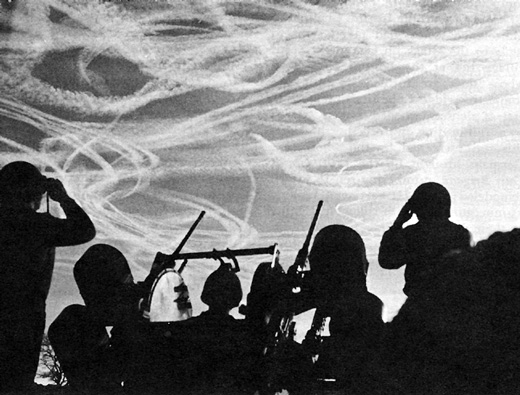
I’ve never seen them turned on and off. I do see that depending on the temp some days we have lots of them, other days none.
And I live under one of the heavily traveled east-west corridors.
They don’t turn them on and off. The planes pass through waves in the atmosphere, and these waves exhibit differing R.H. and dew points, so it only appears that they are turning the contrails on and off.
So it’s not the CO2 we should be worried about, it is the anthopogenic water!
HEY DUMMY THOSE ARE CHEMTRAILS NOT CONTRAILS!!!
Instead of this look at contrails, we should be also looking at whole atmosphere by altitude and other natural cycles. No doubt variance in solar irradiance and cloud cover impact lower troposphere temperatures more than CO2. IPCC idiots discounted the 11 year solar cycle since variance in radiation being W/m² hitting earth was too small. However we know low sun spot activity is associated with cold temperatures by Maunder Minimum 1645-1715, and Dalton Minimum 1790-1830, yet we have millenniums of data by isotopes going back before telescopes looking at sun by Vostok ice core for data the same. We are in solar cycle 24 which is half solar cycle 22, sun at low for normal turnover of poles. http://www.solen.info/solar/images/comparison_recent_cycles.png
yet W/m² is not enough, but more weak magnetosphere of our sun shields us less and allows more cosmic radiation in from rest of space. This then reacts with things like sulfides in atmosphere seeding clouds, same effect cooling if volcano like Pinatubo, but on other end. CERN is doing interesting research. But if more cosmic radiation let in to earth by a weaker sun, then will seed more clouds, colder troposphere. If true, could only hope for some global warming by CO2, but that is a myth. I am waiting for “climate change” to morph into yet now better understood global cooling/ice age scare of 70s, yet warming would benefit humans more than cooling despite. Clouds-solar cycle link are more important than contrails.
http://icecap.us/index.php/go/new-and-cool/cosmic_rays_hit_space_age_high/
JPinBalt :
Solar minima, whilst the only lowering the TSI by 0.1-0.2%, lowers the UV end of the solar spectrum by up to 30%.
UV is intercepted by O3 in the Strat. In doing this it warms. In doing this it sets up a DeltaT between the Earth’s equator at pole in the NH winter. Weaker UV makes the strat colder over the equator. The stratospheric polar night jet is therefor weaker around the polar vortex. A weaker jet is a more meandering one. This allows the PV to more easily distrupted, and down-well winds to the Troposphere where a -ve AO (high pressure) is encouraged. This then pushes arctic air south in favoured areas -vis E US and Europe. There you have you LIA and Dalton Minimum. Couple the LIA longevity to the feedback of causing ocean currents to alter also.
Why are they brown now? They used to be white. The sky is completely brown from contrails where I live.