Guest Post by Bob Tisdale
Dr. Roy Spencer introduced the updated and much corrected UAH atmospheric temperature data in his blog post Version 6.0 of the UAH Temperature Dataset Released: New LT Trend = +0.11 C/decade. The new temperature anomaly data for the lower troposphere, mid troposphere and lower stratosphere are presently in beta form for comment. That is, they’re not official…yet. I suspect the update will not go over well with the catastrophic-anthropogenic-global-warming crowd. Links to the version 6.0 beta data are at the bottom of Roy’s post, which also contains a detailed discussion of the updates. So if you have questions, please ask them at Roy Spencer’s blog through the above link. This post is a simple data presentation.
The version 6.0 beta temperature anomaly data for the lower troposphere used in this post are here.
In this post, we’ll take a quick look at the new UAH version 6.0 beta lower troposphere temperature anomaly data, comparing it to:
- the current UAH version 5.6 data
- the RSS lower troposphere temperature data.
But first…
BASED ON LINEAR TRENDS, THE NEW UAH LOWER TROPOSPHERE TEMPERATURE DATA SHOW NO WARMING FOR 18+ YEARS, LIKE RSS
For Figure 1, I’ve extended the new UAH version 6.0 beta and the RSS lower troposphere temperature anomaly data as far back in time as they could go while showing no warming based on their linear trends. The new UAH data show no warming for 219 months, and for the RSS data, it’s 220 months.

Figure 1
A QUICK OVERVIEW OF LOWER TROPOSPHERE TEMPERATURE DATA
The following is a reprint of the initial discussion of lower troposphere temperature data from the monthly updates. The most recent update is here.
Special sensors (microwave sounding units) aboard satellites have orbited the Earth since the late 1970s, allowing scientists to calculate the temperatures of the atmosphere at various heights above sea level. The level nearest to the surface of the Earth is the lower troposphere. The lower troposphere temperature data include the altitudes of zero to about 12,500 meters, but are most heavily weighted to the altitudes of less than 3000 meters. See the left-hand cell of the illustration here. The lower troposphere temperature data are calculated from a series of satellites with overlapping operation periods, not from a single satellite. The monthly UAH lower troposphere temperature data is the product of the Earth System Science Center of the University of Alabama in Huntsville (UAH). UAH provides the data broken down into numerous subsets. See the webpage here [version 5.6 data]. The UAH lower troposphere temperature data are supported by Christy et al. (2000) MSU Tropospheric Temperatures: Dataset Construction and Radiosonde Comparisons. Additionally, Dr. Roy Spencer of UAH presents at his blog the monthly UAH TLT data updates a few days before the release at the UAH website. Those posts are also cross posted at WattsUpWithThat. UAH uses the base years of 1981-2010 for anomalies. The UAH lower troposphere temperature data are for the latitudes of 85S to 85N, which represent more than 99% of the surface of the globe.
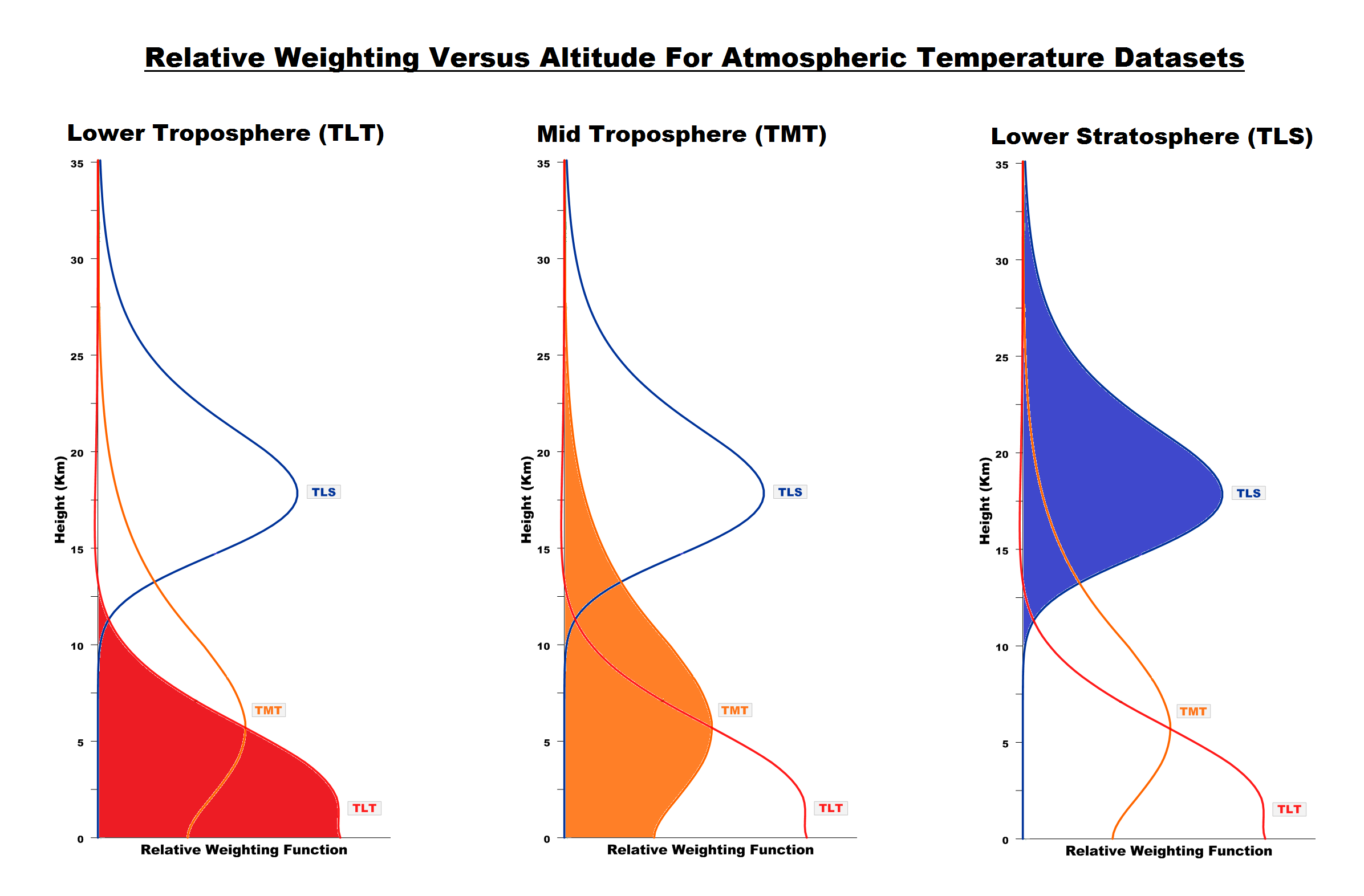
UAH VERSION 5.6 VERSUS UAH VERSION 6.0 BETA
Figure 2 compares the current version 5.6 UAH lower troposphere temperature anomaly data to the recently released version 6.0 beta. The comparisons start in the Januarys of 1979, 1998 and 2001 and run through March 2015. The first full year of the UAH lower troposphere temperature data is 1979, while 1998 and 2001 are commonly used as start years during discussions of the recent slowdown in global surface and global lower troposphere temperatures. They are the same time periods we present in the monthly surface and lower troposphere temperature anomaly updates. See the most recent update here.

Figure 2
Since 1979, the new version (v6.0 beta) of the UAH lower troposphere temperature data show a noticeably lower warming rate than current version 5.6 data. For the periods starting in 1998 and 2001, the new beta version data show cooling of the lower troposphere based on the linear trends, while the current 5.6 version data show warming.
RSS VERSUS UAH VERSION 6.0 BETA
The warming rate since 1979 for the new UAH data is slightly less than (basically the same as) the lower troposphere temperature anomaly data from RSS. The shorter term cooling rates since 1998 and 2001 are also comparable. See the graphs in Figure 3.

Figure 3
CLOSING
The RSS lower troposphere temperature data used to be an outlier, showing much lower trends than the surface temperature data and the UAH lower troposphere data. That will no longer be the case with the new UAH version 6.0 data.
SOURCES
The UAH version 6.0 beta lower troposphere temperature anomaly data are here.
The UAH version 5.6 lower troposphere temperature anomaly data are here.
The RSS lower troposphere temperature anomaly data are here.
Harrytwinotter, are you really this stupid or being deliberately dense? You’ve never contributed anything with the remotest shade of intelligence in all your posts in all threads. Why do you even come here and post, with every post confirming your inteliggence, or rather lack of it?
Ventor. Do you really think insults work? You are not able to respond intelligently to my points either.
So the guy who’s posts are nothing but insults is objecting to insults.
Now that thar is funny.
Yes to both questions.
As the IPCC and governments that rely upon the IPCC’s assessments attach significance to the slope of a linear trend line, it is interesting that the slope of this line is nil when it is fit to data from the UAH time series over the period of 18 years just completed. However, evidence presented by the author does not support his conclusion that the “warming” has been nil for this usage of “warming” implies that the change of the vertical axis along the trend line is the “warming” but this usage is faulty.
After spending 20 years and 200 billion US dollars on global warming research, after lobbying incessantly for actions by governments to combat the “warming” and after cripplingly expensive actions have been taken by some of these governments to combat the “warming,” professional climatologists have yet to tell us what they mean by “warming.” Attempts at drawing a meaningful definition from the context in which the term appears prove fruitless. However, at least one conclusion can be reached: the “warming” is not the change in the vertical axis along the trend line for this usage conflicts with a precept of the mathematical theory of measure aka measure theory.
This conclusion can be reached because the amount of “warming” we have suffered in the past 18 years depends upon the time at the start of of the interval from which the global temperature data are selected for use in establishing the slope of the line. If this time is 18 years ago, the slope is nil. If this time is more than 18 years ago, the slope is non-nil. The slope, then, is a variable rather than being a constant.
As it is a variable, the “warming” is not a “measure” for it is not a mathematical function that maps the sum of the incremental warmings in a specified interval of time to a non-negative real number. However, the term “warming” implies quantity which, like a temperature change, is an example of a measure.
They measure temperature ‘anomaly’. When that anomaly is positive, that is warming. When negative, it is cooling. The UAH has adequately defined temperature anomaly. To argue otherwise is dumb.
James Carson
Your argument is of the form of the fallacy of argument by assertion. That doesn’t work.
James Carson:
The anomaly has the properties of a measure and is not at issue. At issue is whether the “warming” in the title of the article that is under discussion has the properties of a measure. The “warming” and the anomaly are defined differently with the result that the former lacks the properties of a measure while the former possesses them. If you’d like I’ll provide a proof of the assertion that the “warming” lacks these properties.
You are nuts. It’s that simple.
If you look at the first two average temperature charts in the mirror, you will see the hockey stick.
.
Any average temperature chart that does not look like a hockey stock must be wrong, according to climate scientists, whose level of confidence in that statement is 105% (meaning 5% could change their mind and as a group they would still be 100% confident, or perhaps that means 5% of the scientists voted twice on their confidence level).
.
Of course we all know that there is no doubt at a 95% confidence level or higher, so a few extra points of confidence are just icing on the climate cake.
.
For climate charts: To find the hockey stick you may need a mirror, or view the chart while standing on your head, perhaps standing on your head with a mirror … but with the right viewing angle the hockey stick shape will be there.
If there is no hockey stick shape, the numbers on a climate chart are obviously made up by a random number generator somewhere. I am 95.8% confident that last statement is true.
Climate info for non-scientists:
http://www.elOnionBloggle.blogspot.com
.
Let me amplify your point. Going back to the BEGINNING of the UAH dataset, there has never been statistically significant warming. Here is my recently posted analysis.
http://greenheretic.com/has-warming-been-statistically-significant/
….
This article examines lower troposphere temperature anomalies in conjunction with carbon dioxide levels using classical regression methods. These techniques are accessible to anyone with no more than a minor in undergraduate statistics. The technical question to be asked and answered is, has the observed warming to date been statistically significant?
Conclusion. At first blush, the empirical evidence appears to support the assertion that there has been warming. However, after conventional model diagnostics and reformulation, the statistical significance disappears completely and we must conclude that the observed warming does not meet any reasonable criterion of statistical significance. The observed warming could easily be the result of simple chance.
Also, the “warming” is an undefined concept.
“Warming” is a well defined concept. (see item number 1 in following link)
..
http://www.macmillandictionary.com/dictionary/british/warming_2
In the dictionary from which you quote, the “warming” is the change in temperature. However, in the phrase “global warming” this is not the definition.
You may argue that it is “ill-defined”, but “undefined”? No.
Please share with us a citation to the definition or definitions.
Yes the definition I posted did not mention “global”
..
Neither did your post.
..
You posted: Also, the “warming” is an undefined concept.
…
Therefore your post lacks a clear referent.
..
PS since “temperature” is an operationally defined concept, you are on thin ice if you claim that “global temperature” is not defined.
.
http://en.wikipedia.org/wiki/Operational_definition#Temperature
Ollie:
I do not claim either that “temperature” is an undefined concept or that “global temperature is an undefined concept. I do claim that “warming” is an undefined concept in the context of the phrase “global warming,” In this context the “warming” is NOT the difference between two temperatures. Thus, the dictionary definition is inapplicable.
I’m aware of two definitions of the “warming” that are in common use in global warming climatology. In each case, the “warming” has the shortcoming that, unlike the difference between two temperatures the “warming” is not measurable… In the first the “warming” is the change in the global temperature at equilibrium. In the second the “warming” is the change in the value of the Y-axis when a straight line is fit to data that are drawn from a specified global temperature time series and in a specified interval in time.
Look up the definition of anomaly then we can discuss the differences
I’m familiar with the definition of “anomaly.” Go ahead.
Ollie:
“The measured anomaly” is a misnomer as this “measure” lacks properties of a measure defined in the mathematical theory of measure aka measure theory. If unfamiliar with it please brush up on elementary measure theory before continuing with our discussion..
Your argument over semantics is trivial and annoying.
You’ve erected a strawman and knocked it down.
Ollie:
If the “measure” is not a measure then nothing is being measured. This is my claim. That my claim is true follows from the properties of a measure in measure theory.
Terry Oldberg commented
I went and looked at the wiki page, just what specifically is your complaint about the “measure”?
That the several definitions of “global warming” in common use lack the properties of a measure.
Terry Oldberg commented
Can you be more specific about what properties?
And I too have figured out “warming” can mean a lot of different things, and maybe this is what you’re talking about, but I don’t know.
micro6500
Thanks for giving me an opportunity to clarify.
A “measure” is a non-negative real valued function on a class of sets with the property of “additivity”: the measure of the union of disjoint sets is the sum of the measure of the individual sets. A temperature is an example of a measure. A temperature change is another example. Let dT designate an incremental change in temperature at a space point in a solid block of matter. Because a temperature satisfies additivity, the integral of dT between T1 and T2 is T2 – T1.
I’m aware of two definitions for “global warming” aka “warming” in the climatological literature. In one of these, the “warming” is the change in the spatially averaged surface air temperature at equilibrium. Under this definition of it the “warming” it is insusceptible to being measured: as the Earth spins on its axis and orbits the Sun, the spatially averaged surface air temperature fluctuates. For proof, see for example the UAH time series.
In Mr. Tisdale’s article, the definition of “warming” differs from the one given above. The “warming” is the change along a straight line when this line is fit to observed global temperature vs time data from a specified time series and in a selected interval of time. Let t1 designate the time at the beginning of this interval and let t2 designate the time at the end of the interval. Suppose we wish to compute the “warming” in an interval in time that begins at time t3 and ends at time t4 where t3 and t4 share the property of being greater than t1 and less than t2. In other words, the second interval ( the one between t3 and t4 ) lies within the first interval ( the one between t1 and t2 ). We hold t2, t3 and t4 constant but vary t1. The equation describing the straight line is T = a * t + b . As t1 varies we recompute the values for a and b that minimize the squared error. In this way, we find that a is not a constant but rather is a variable. The computed “warming” is a * (t4 – t3) and though t4 and t3 are constants, a is a variable. Thus, the “warming” in the interval between t3 and t4 varies with t1. For it to vary violates additivity.
.
Terry Oldberg commented
So, if I understand this (and I followed this much more than the wiki page, thank you) because a (slope) changes as you move t1 compared to the reference points t2, t3 and t4, right?
micro6500
You left the verb out of your sentence but I think you understand me correctly.
What utter nonsense. You don’t understand where those numbers come from.
There is no such “fitted line” at all. The anomaly is computed as the deviation from a constant that is determined as the average over an arbitrary period. In your function, the coefficient ‘a’ equals zero and ‘b’ equals that average.
[Snip. This commenter is a sockpuppet. ~mod.]
[Snip. ~mod.]
I’m not so sure.


Here is the average daily change plotted by year showing US stations going from maximum daily cooling, to maximum daily warming.
Each line is the linear trend of the rate of daily temperature change. I developed code to measure this slope, then then plotted the slope for both the warming and cooling changes, for the entire world.
This is the global slope of the daily average temperature change plotted by year.
Now, one would expect under climate change, that this should change, which it does (even though it looks like an inflection point) even when this
shows max daily temps to not have changed much over the year at all, I think this shows it’s the rate of change through out the year that’s showing up as warming in the global temp average.
Without digging too deeply into your methodology, it looks to me like it is too broad-brush. Here is a link to some work I did in 2004 for a colloquium at the U-MN Institute for Mathematics and its Applications. Click on the pdf by my name.
http://www.ima.umn.edu/talks/workshops/3-8-13.2004/
What you will find is a modeling methodology for local weather that uses a sine wave. This method would be extremely sensitive to warming trends. Because of the way it operates, it would act to bring warming into high relief if it were present. I have used the method to develop simulation models on something like a dozen locations. BOS, MSP, CVG, IAH, PHL, etc.
What I’ve done is create a set of reporting functions based on a daily and yearly product extracted by lat and longer over a set of selected. The winter slope chart was done by hand, I wrote a function to write it out for all daily products.
I’ve also done 1×1 °, 10×10°, 10° lat bands, approximate Contintents, as well as 60°×20° boxes(many are on SourceForge).
I’m in the process of adding the applied solar forcing for each station lat.
So yes, it is a sine wave in the extra tropics, and I shouldn’t mix hemispheres.
James Carson commented
If I can interpret(helps me know if I understand), the anomaly fit’s the theory of measurement (though I prefer to use the prior day’s station value than some average), if is the trend that is not a “measurement”, since the value of the “trend” is dependent on the start and stop points.
I didn’t get to clarify if the “trend” would just be a calculation or what.
I, too, would prefer to have the original value rather than the anomaly. Nevertheless, if you look up what they used as the average to estimate the anomaly, you can revert the data back. In statistical terms, you could argue that, by starting with an anomaly rather than the raw observation, that you’ve lost one degree of freedom. I could argue both sides of that issue. That might matter if we were talking about <50 observations, say 3-4 years. However, we are using many more obs than that. So, that argument would be pointless.
Oh, the process I came up with uses an anomaly, it’s just not some average, I use the prior day’s value. I care about the evolution of the stations temperature, not how that compares to some made up field.
James Carson ( May 1, 2015 at 1:43 pm):
For the command of social skills thus far exhibited in our exchange of ideas I’ll rate you at 0%. For the command of logic thus far exhibited I’ll rate you at 0%. For skills at defamation thus far exhibited I’ll rate you at 100%.
With a response to your latest insult out of the way, I’ll get on with the issue that was under discussion before you high jacked it with illogical babble.. The anomaly was not the topic of discussion. The topic was the fitted line whose non-existence you assert but do not prove.
As the value of the anomaly fluctuates continuously it is obviously not this value that has not changed in 18+ years. It is the Y value along the fitted line that has not changed. The change in this value is the “global warming” of the title of Mr.Tisdale’s article.
The onus is on YOU to show us any such fitted line.
Here is a link that shows what I am talking about.
http://catalog.data.gov/dataset/noaa-climate-data-record-cdr-of-msu-and-amsu-a-mean-layer-temperatures-uah-version-5-4
“Anomalies are deviations from 1981-2010 mean.”
Duh….
James Carson:
I followed your link but found no support for your position in the evidence that was provided there. Your quote that “Anomalies are deviations from the 1981-2010 mean” may be accurate but is irrelevant as the magnitudes of anomalies are not at issue. The “Duh…” that you appended to your commentary is an example of an illogical ad hominem argument. The logical onus is on you to shape up or ship out.
I gave you a definitive answer that you don’t like. Now it is time for YOU take the time to dig up information that shows that there is some sort of fitted line in there somewhere’s.
And telling me to “ship out” just makes you look dumb.
James Carson:
A citation to “some sort of fitted line in there somewhere’s” follows per your request:
http://wattsupwiththat.com/2013/06/13/no-significant-warming-for-17-years-4-months/. By the way, the construction of the phrase “some sort of fitted line in there somewhere’s” is ungrammatical and inconsistent with your being a university-trained statistician. Do you claim to be one?
Ollie:
I am in receipt of a message that is dated April 30, 2015 at 7:12 pm that is addressed to James Carson and that is from you. If this message is meant for me please inform me of same.
This is to note for the record that olliebourque continues to evade the issue of whether “this ‘measure’ lacks properties of a measure as defined in measure theory.” Instead Bourque erects the strawman that I “persist in playing games with words.” Mr. Bourque: your argument has been disproved. Under this circumstance, the decent thing for you to do is to capitulate. Do you capitulate? If not, what is your argument?
The only thing he is evading is an argument with a nut-job.
James Carson
To issue a disparaging characterization of one’s opponent is an illogical “ad hominem argument.” Have you run through your repertoire of faulty arguments yet?
If by that you mean, have you run through your repertoire of amusing insults, I am just getting warmed up.
Terry Oldberg,
“olliebourque” is a fake sockpuppet, I think. I recognize his juvenile nonsense.
Reblogged this on The GOLDEN RULE and commented:
A large title, full of meaning, inspires yet another CAGW related post. (If you are a follower or frequenter of my blog, or more importantly, WUWT, you will know that CAGW stands for “Catastrophic Anthropogenic Global Warming” or, in other words, “climate change due to man’s increases in atmospheric CO2 that seriously threaten our future well-being”.
A large issue with enormous global ramifications, not necessarily even global temperature-related. This WUWT post offers important scientific information, I stress scientific because so much of the information thrust onto, and believed by the public, is so far removed from scientific reality that it is is often beyond comprehension.
So we “know” the earth is warming because that is what we are told, or is it? We “know” that this warming is caused by increases in CO2 due to man’s industrial by-product generation, or do we? There is much to consider.
This post deals with an aspect of how we calculate the “warming”. This particular article, shows that the atmosphere above us is in fact not warming at the moment and has not since 1998.
We are told that the global warming is due to a green-house effect, predominately due to CO2, which is increasing at a linear rate because of industrial activities. In 1998, a huge positive spike added a substantial increase in the average global temperature, due to an ‘El-Nino’ ocean current effect that certainly was independent of CO2 generation. (Why that created a net global effect is not clear as the heating effect in some areas might have been balanced by cooling elsewhere, but apparently not?).
Prior to 1998, the UAH temperature remained relatively flat for the preceding 8 years, possibly about +0.02 degC/decade. After 1998 there is arguably a cooling trend of about -0.1 degC, certainly not statistically warming. The 1998 positive spike injected a boost of about +0.2 degC.
These values are accepted by the warmist, but their conclusions are that CO2 has created an average trend of +0.12 degC/decade. In simple terms, two relatively flat periods plus a spike which no-one associates with industrial activity, have no correlation to a linearly increasing CO2 .
More importantly, we are currently experiencing a slight cooling at the same time as CO2 levels are still increasing, therefore a reverse relationship. The atmospheric temperature is elevated compared to pre-1998 and this may tend to increase the earth’s heat content slowly, but, not because of increasing CO2 levels!
In other words, the whole thing sounds illogical to me! Nothing simple about the whole issue, my attempt to simplify might not be valid, but that’s the way I see it!
I just hope I live long enough to experience the next decade in order to establish whether ‘The global warming threat is indeed the “world’s greatest ever scam” ‘, and thousands of so-called “deniers” are proven to be scientifically and logically sound analysts, or “vice-versa”.
The high magnetic activity of the sun does not cause temperature fluctuations in the stratosphere over the polar circle.
http://www.cpc.ncep.noaa.gov/products/stratosphere/strat-trop/gif_files/time_pres_TEMP_ANOM_JFM_SH_2015.gif
http://www.bartol.udel.edu/~pyle/thespnplot2.gif
A whole website made to discuss if an increasing trend is infact an increasing trend.
.
Just because a graph shows an increasing trend does not, in fact, mean that there is an increasing trend. Statisticians have tests to determine whether what we see is in fact true. In the case of the global warming data published by the UAH, the apparent warming trend is illusory. It is NOT statistically significant, not even remotely close.
http://greenheretic.com/has-warming-been-statistically-significant/
It was interesting to see the new April global temperature anomaly is 0.07C on the UAH site. Every time these temperatures don’t increase we are all winners. I’m also glad the UAH and RSS came into general agreement. Before UAH showed the highest trend over the past 18 years of all the data sets and RSS was the lowest. This was actually quite disturbing.
Given that the agreement uah/rss/balloons is now so small it can be disregarded, the spotlight now falls on the difference between troposphere and near surface measurements. It is readily conceded that they measure different physical effects, like the microwave emissions from oxygen in the air versus the length of an expanding fluid in a tube. However, scientists tend to choose one or the other as an index of global temperature change, so the differences between the two groups of two sets needs explanation.
The explanation for surface temperatures can extend back in time past the late 70s when satellites became available.
In Australia, people like Jo Nova have started to publicise comparisons between constructions of land surface temperature sets. Others above, working from different starting points, have several times found a somewhat quizzical difference of about 0.3 deg C, with ‘official’ sets being warmer than their reconstructions.
Here, we can see only 0.3 to 0.5 deg C of warming by our private analyses, compared with 0.9-1 deg C of official warming.
We note that Steven Mosher defends the BEST reconstruction, which is in better agreement than our with official. However, Steven’s type of analysis is susceptible to the inclusion of inputs that were modified before he even saw them. Ours, at this link, are not so affected.
We simply took the best quality records we could find in official publications pre-1950s and compared temperatures to the averaged 2000-2014 years. This goes back further in time than the official record that starts in 1910.
As I said, we found only about 0.4 deg C of warming since our reliable records began. Other people in other countries might benefit from this approach with their overlooked historical official records.
http://joannenova.com.au/2015/04/two-thirds-of-australias-warming-due-to-adjustments-according-to-84-historic-stations/
Naturally, we unofficial Australian scientists will be analysing the recent UAH data above Australian land over the next few months. Our computers are more modest.
Geoff Sherrington,
Very good points. I trust your numbers over government numbers, which are self-serving.
Reblogged this on OCCUPYMELBOURNE.NET and commented:
Still no global warming.
I think they got it wrong. The hockey stick blade goes on the right side of the graph, not the left. Someone should call a hockey stick repairmann.
This latest data is irrelevant to the global warming alarmists. They have made up their minds that catastrophic man-made global warming is happening. Their adjusted temperature data tells them it is happening. They can feel it happening. They can see its consequences. They have magical computer models that tell them the future. And that’s really all that matters to them. They believe in all of this because they are determined to have a successful outcome in Paris, come December, and they long for an international agreement to be signed controlling fossil fuel energy use.
Mervyn:
That the magical computer models tell them the future is a politically successful deception that was created through repeated applications of the equivocation fallacy I reach this conclusion by the peer-reviewed argument at http://wmbriggs.com/post/7923/ .
In my post of April 30 at 7:07 I erred in claiming that “measured anomaly” is a misnomer. That the “measured warming” is a misnomer is correct.
I followed your link, Terry Oldberg, but only found an extensive discussion. WHERE is your point there?
Yes, I am a university trained statistician. 1970s.
James Carson:
In your post of May 1 at 8:58 pm you demanded that I “take the time to dig up information that shows that there is some sort of fitted line in there somewhere’s.” I responded with the citation. With less effort you can scroll up to Figure 2 of Mr Tisdale’s article and view two fitted straight lines. One is colored red; it is fitted to the red colored time series. The other is colored purple; it is fitted to the purple colored time series.
What do those fitted lines have to do with your point? Nothing. Your point was that the definition of warming somehow depends on them. That is not true. Those are just trend lines. I repeat, warming is an increasing anomaly.
James Carson:
The title of the article is “New UAH Lower Troposphere Temperature Data Show No Global Warming for More Than 18 Years.” If the “warming” is the change in the anomaly there has repeatedly been warming in the past 18 years contrary to the title. If the “warming” is the change in the anomaly along the trend line then there has been no change in the warming in the past 18 years consistent with the title. Thus, the title defines the “warming” as the change in the anomaly along the trend line.
QED
The April anomaly was only .07. Doesn’t look like its getting warmer. Is climate change still a thing? Or are we still in the “pause”.
Where is Mr Mann when you need him?!? We have a broken hockey stick here in need of repair….