This post updates the data for the three primary suppliers of global land+ocean surface temperature data—GISS through May 2014 and HADCRUT4 and NCDC through April 2014—and of the two suppliers of satellite-based global lower troposphere temperature data (RSS and UAH) through May 2014.
Initial Notes: To make this post as timely as possible, only GISS LOTI and the two lower troposphere temperature datasets are for the most current month. The NCDC and HADCRUT4 data lag one month.
This post contains graphs of running trends in global surface temperature anomalies for periods of 13+ and 17 years using GISS global (land+ocean) surface temperature data. They indicate that we have not seen a warming halt (based on 13 years+ trends) this long since the mid-1970s or a warming slowdown (based on 17-years trends) since about 1980. I used to rotate the data suppliers for this portion of the update, also using NCDC and HADCRUT. With the data from those two suppliers lagging by a month in the updates, I’ve standardized on GISS for this portion.
Much of the following text is boilerplate. It is intended for those new to the presentation of global surface temperature anomaly data.
Most of the update graphs in the following start in 1979. That’s a commonly used start year for global temperature products because many of the satellite-based temperature datasets start then.
We discussed why the three suppliers of surface temperature data use different base years for anomalies in the post Why Aren’t Global Surface Temperature Data Produced in Absolute Form?
GISS LAND OCEAN TEMPERATURE INDEX (LOTI)
Introduction: The GISS Land Ocean Temperature Index (LOTI) data is a product of the Goddard Institute for Space Studies. Starting with their January 2013 update, GISS LOTI uses NCDC ERSST.v3b sea surface temperature data. The impact of the recent change in sea surface temperature datasets is discussed here. GISS adjusts GHCN and other land surface temperature data via a number of methods and infills missing data using 1200km smoothing. Refer to the GISS description here. Unlike the UK Met Office and NCDC products, GISS masks sea surface temperature data at the poles where seasonal sea ice exists, and they extend land surface temperature data out over the oceans in those locations. Refer to the discussions here and here. GISS uses the base years of 1951-1980 as the reference period for anomalies. The data source is here.
Update: The May 2014 GISS global temperature anomaly is +0.76 deg C. It warmed slightly (an increase of about 0.03 deg C) since April 2014.

Figure 1 – GISS Land-Ocean Temperature Index
NCDC GLOBAL SURFACE TEMPERATURE ANOMALIES (LAGS ONE MONTH)
Introduction: The NOAA Global (Land and Ocean) Surface Temperature Anomaly dataset is a product of the National Climatic Data Center (NCDC). NCDC merges their Extended Reconstructed Sea Surface Temperature version 3b (ERSST.v3b) with the Global Historical Climatology Network-Monthly (GHCN-M) version 3.2.0 for land surface air temperatures. NOAA infills missing data for both land and sea surface temperature datasets using methods presented in Smith et al (2008). Keep in mind, when reading Smith et al (2008), that the NCDC removed the satellite-based sea surface temperature data because it changed the annual global temperature rankings. Since most of Smith et al (2008) was about the satellite-based data and the benefits of incorporating it into the reconstruction, one might consider that the NCDC temperature product is no longer supported by a peer-reviewed paper.
The NCDC data source is usually here. NCDC uses 1901 to 2000 for the base years for anomalies. (Note: the NCDC has been slow with updating the normal data source webpage, so I’ve been using the values available through their Global Surface Temperature Anomalies webpage. Click on the link to Anomalies and Index Data.)
Update (Lags One Month): The April 2014 NCDC global land plus sea surface temperature anomaly was +0.72 deg C. See Figure 2. It showed a rise (an increase of +0.05 deg C) since March 2014.

Figure 2 – NCDC Global (Land and Ocean) Surface Temperature Anomalies
UK MET OFFICE HADCRUT4 (LAGS ONE MONTH)
Introduction: The UK Met Office HADCRUT4 dataset merges CRUTEM4 land-surface air temperature dataset and the HadSST3 sea-surface temperature (SST) dataset. CRUTEM4 is the product of the combined efforts of the Met Office Hadley Centre and the Climatic Research Unit at the University of East Anglia. And HadSST3 is a product of the Hadley Centre. Unlike the GISS and NCDC products, missing data is not infilled in the HADCRUT4 product. That is, if a 5-deg latitude by 5-deg longitude grid does not have a temperature anomaly value in a given month, it is not included in the global average value of HADCRUT4. The HADCRUT4 dataset is described in the Morice et al (2012) paper here. The CRUTEM4 data is described in Jones et al (2012) here. And the HadSST3 data is presented in the 2-part Kennedy et al (2012) paper here and here. The UKMO uses the base years of 1961-1990 for anomalies. The data source is here.
Update (Lags One Month): The April 2013 HADCRUT4 global temperature anomaly is +0.64 deg C. See Figure 3. It increased (about +0.10 deg C) since March 2014.

Figure 3 – HADCRUT4
UAH Lower Troposphere Temperature (TLT) Anomaly Data
Special sensors (microwave sounding units) aboard satellites have orbited the Earth since the late 1970s, allowing scientists to calculate the temperatures of the atmosphere at various heights above sea level. The level nearest to the surface of the Earth is the lower troposphere. The lower troposphere temperature data include the altitudes of zero to about 12,500 meters, but are most heavily weighted to the altitudes of less than 3000 meters. See the left-hand cell of the illustration here. The lower troposphere temperature data are calculated from a series of satellites with overlapping operation periods, not from a single satellite. The monthly UAH lower troposphere temperature data is the product of the Earth System Science Center of the University of Alabama in Huntsville (UAH). UAH provides the data broken down into numerous subsets. See the webpage here. The UAH lower troposphere temperature data are supported by Christy et al. (2000) MSU Tropospheric Temperatures: Dataset Construction and Radiosonde Comparisons. Additionally, Dr. Roy Spencer of UAH presents at his blog the monthly UAH TLT data updates a few days before the release at the UAH website. Those posts are also cross posted at WattsUpWithThat. UAH uses the base years of 1981-2010 for anomalies. The UAH lower troposphere temperature data are for the latitudes of 85S to 85N, which represent more than 99% of the surface of the globe.
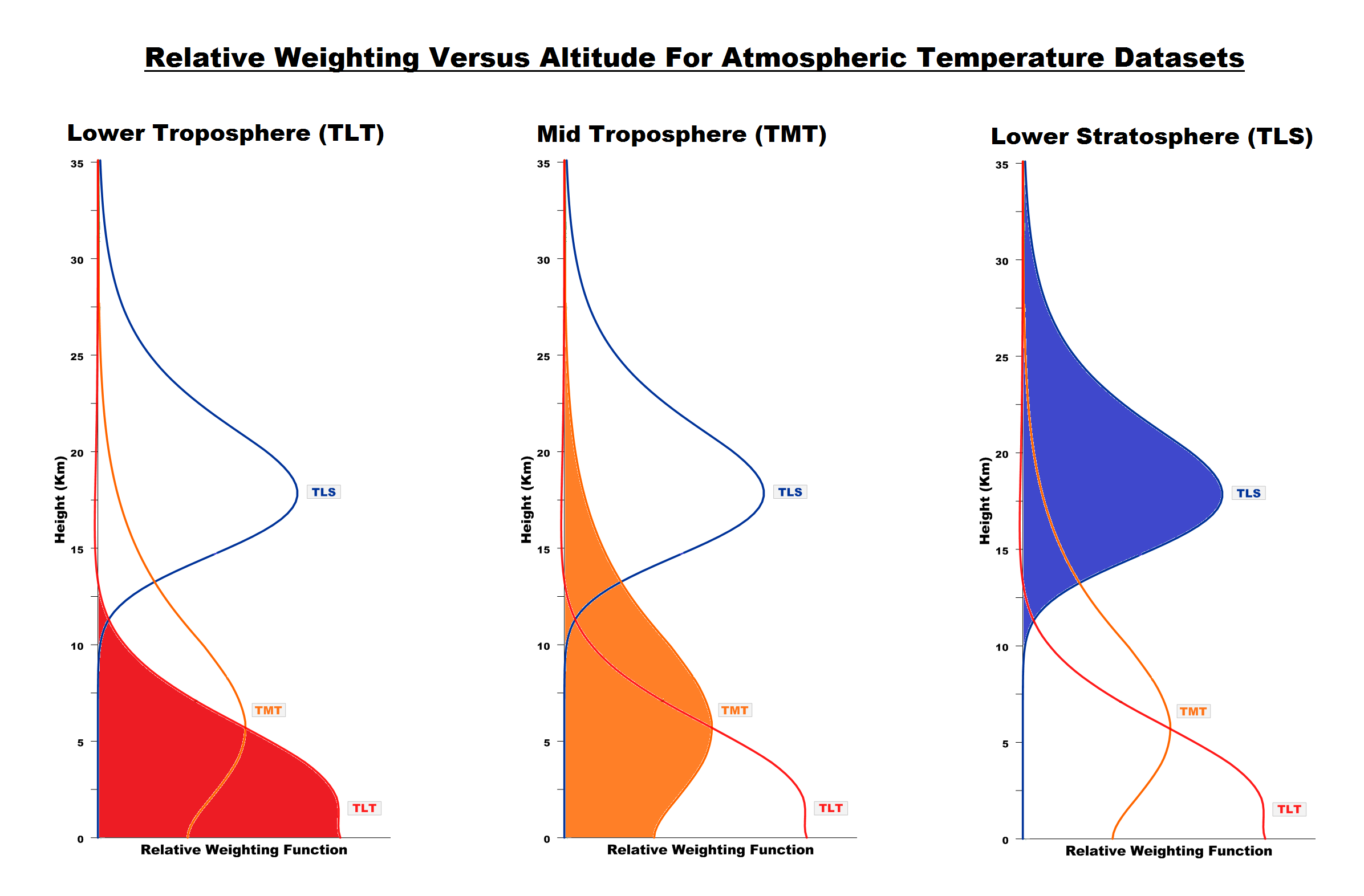
Update: The May 2014 UAH lower troposphere temperature anomaly is +0.33 deg C. It is rose sharply (an increase of about +0.14 deg C) since April 2014.

Figure 4 – UAH Lower Troposphere Temperature (TLT) Anomaly Data
RSS Lower Troposphere Temperature (TLT) Anomaly Data
Like the UAH lower troposphere temperature data, Remote Sensing Systems (RSS) calculates lower troposphere temperature anomalies from microwave sounding units aboard a series of NOAA satellites. RSS describes their data at the Upper Air Temperature webpage. The RSS data are supported by Mears and Wentz (2009) Construction of the Remote Sensing Systems V3.2 Atmospheric Temperature Records from the MSU and AMSU Microwave Sounders. RSS also presents their lower troposphere temperature data in various subsets. The land+ocean TLT data are here. Curiously, on that webpage, RSS lists the data as extending from 82.5S to 82.5N, while on their Upper Air Temperature webpage linked above, they state:
We do not provide monthly means poleward of 82.5 degrees (or south of 70S for TLT) due to difficulties in merging measurements in these regions.
Also see the RSS MSU & AMSU Time Series Trend Browse Tool. RSS uses the base years of 1979 to 1998 for anomalies.
Update: The May 2014 RSS lower troposphere temperature anomaly is +0.29 deg C. It rose (an increase of about +0.04 deg C) since April 2014.

Figure 5 – RSS Lower Troposphere Temperature (TLT) Anomaly Data
A Quick Note about the Difference between RSS and UAH TLT data
There is a noticeable difference between the RSS and UAH lower troposphere temperature anomaly data. Dr. Roy Spencer discussed this in his July 2011 blog post On the Divergence Between the UAH and RSS Global Temperature Records. In summary, John Christy and Roy Spencer believe the divergence is caused by the use of data from different satellites. UAH has used the NASA Aqua AMSU satellite in recent years, while as Dr. Spencer writes:
…RSS is still using the old NOAA-15 satellite which has a decaying orbit, to which they are then applying a diurnal cycle drift correction based upon a climate model, which does not quite match reality.
I updated the graphs in Roy Spencer’s post in On the Differences and Similarities between Global Surface Temperature and Lower Troposphere Temperature Anomaly Datasets.
While the two lower troposphere temperature datasets are different in recent years, UAH believes their data are correct, and, likewise, RSS believes their TLT data are correct. Does the UAH data have a warming bias in recent years or does the RSS data have cooling bias? Until the two suppliers can account for and agree on the differences, both are available for presentation.
In a more recent blog post, Roy Spencer has advised that the UAH lower troposphere Version 6 will be released soon and that it will reduce the difference between the UAH and RSS data.
13-YEAR+ (161-MONTH) RUNNING TRENDS
As noted in my post Open Letter to the Royal Meteorological Society Regarding Dr. Trenberth’s Article “Has Global Warming Stalled?”, Kevin Trenberth of NCAR presented 10-year period-averaged temperatures in his article for the Royal Meteorological Society. He was attempting to show that the recent halt in global warming since 2001 was not unusual. Kevin Trenberth conveniently overlooked the fact that, based on his selected start year of 2001, the halt at that time had lasted 12+ years, not 10.
The period from January 2001 to April 2014 is now 161-months long—more than 13 years. Refer to the following graph of running 161-month trends from January 1880 to April 2014, using the GISS LOTI global temperature anomaly product.
An explanation of what’s being presented in Figure 6: The last data point in the graph is the linear trend (in deg C per decade) from January 2001 to May 2014. It is basically zero (about 0.02 deg C/Decade). That, of course, indicates global surface temperatures have not warmed to any great extent during the most recent 160-month period. Working back in time, the data point immediately before the last one represents the linear trend for the 161-month period of December 2000 to April 2014, and the data point before it shows the trend in deg C per decade for November 2000 to March 2014, and so on.

Figure 6 – 161-Month Linear Trends
The highest recent rate of warming based on its linear trend occurred during the 160-month period that ended about 2004, but warming trends have dropped drastically since then. There was a similar drop in the 1940s, and as you’ll recall, global surface temperatures remained relatively flat from the mid-1940s to the mid-1970s. Also note that the mid-1970s was the last time there had been a 161-month period without global warming—before recently.
17-YEAR (204-Month) RUNNING TRENDS
In his RMS article, Kevin Trenberth also conveniently overlooked the fact that the discussions about the warming halt are now for a time period of about 16 years, not 10 years—ever since David Rose’s DailyMail article titled “Global warming stopped 16 years ago, reveals Met Office report quietly released… and here is the chart to prove it”. In my response to Trenberth’s article, I updated David Rose’s graph, noting that surface temperatures in April 2013 were basically the same as they were in June 1997. We’ll use June 1997 as the start month for the running 17-year trends. The period is now 204-months long. The following graph is similar to the one above, except that it’s presenting running trends for 204-month periods.
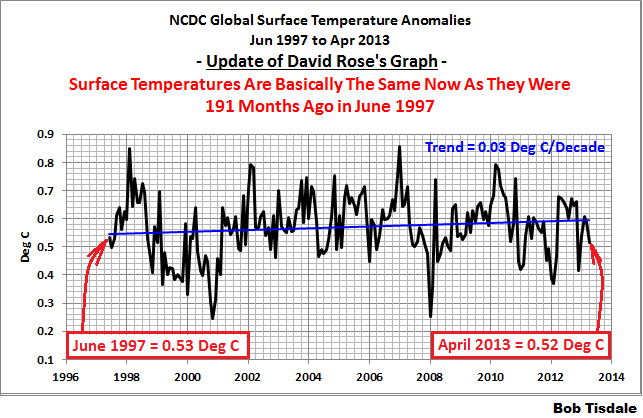

Figure 7 – 204-Month Linear Trends
The last time global surface temperatures warmed at this low a rate for a 204-month period was the late 1970s, or about 1980. Also note that the sharp decline is similar to the drop in the 1940s, and, again, as you’ll recall, global surface temperatures remained relatively flat from the mid-1940s to the mid-1970s.
The most widely used metric of global warming—global surface temperatures—indicates that the rate of global warming has slowed drastically and that the duration of the halt in global warming is unusual during a period when global surface temperatures are allegedly being warmed from the hypothetical impacts of manmade greenhouse gases.
A NOTE ABOUT THE RUNNING-TREND GRAPHS
There is very little difference in the end point trends of 13+ year and 16+ year running trends if HADCRUT4 or NCDC or GISS data are used. The major difference in the graphs is with the HADCRUT4 data and it can be seen in a graph of the 13+ year trends. I suspect this is caused by the updates to the HADSST3 data that have not been applied to the ERSST.v3b sea surface temperature data used by GISS and NCDC.
COMPARISONS
The GISS, HADCRUT4 and NCDC global surface temperature anomalies and the RSS and UAH lower troposphere temperature anomalies are compared in the next three time-series graphs. Figure 8 compares the five global temperature anomaly products starting in 1979. Again, due to the timing of this post, the HADCRUT4 and NCDC data lag the UAH, RSS and GISS products by a month. The graph also includes the linear trends. Because the three surface temperature datasets share common source data, (GISS and NCDC also use the same sea surface temperature data) it should come as no surprise that they are so similar. For those wanting a closer look at the more recent wiggles and trends, Figure 9 starts in 1998, which was the start year used by von Storch et al (2013) Can climate models explain the recent stagnation in global warming? They, of course found that the CMIP3 (IPCC AR4) and CMIP5 (IPCC AR5) models could NOT explain the recent halt in warming.
Figure 10 starts in 2001, which was the year Kevin Trenberth chose for the start of the warming halt in his RMS article Has Global Warming Stalled?
Because the suppliers all use different base years for calculating anomalies, I’ve referenced them to a common 30-year period: 1981 to 2010. Referring to their discussion under FAQ 9 here, according to NOAA:
This period is used in order to comply with a recommended World Meteorological Organization (WMO) Policy, which suggests using the latest decade for the 30-year average.

Figure 8 – Comparison Starting in 1979
###########

Figure 9 – Comparison Starting in 1998
###########

Figure 10 – Comparison Starting in 2001
AVERAGE
Figure 11 presents the average of the GISS, HADCRUT and NCDC land plus sea surface temperature anomaly products and the average of the RSS and UAH lower troposphere temperature data. Again because the HADCRUT4 and NCDC data lag one month in this update, the most current average only includes the GISS products.

Figure 11 – Average of Global Land+Sea Surface Temperature Anomaly Products
The flatness of the data since 2001 is very obvious, as is the fact that surface temperatures have rarely risen above those created by the 1997/98 El Niño in the surface temperature data. There is a very simple reason for this: the 1997/98 El Niño released enough sunlight-created warm water from beneath the surface of the tropical Pacific to permanently raise the temperature of about 66% of the surface of the global oceans by almost 0.2 deg C. Sea surface temperatures for that portion of the global oceans remained relatively flat until the El Niño of 2009/10, when the surface temperatures of the portion of the global oceans shifted slightly higher again. Prior to that, it was the 1986/87/88 El Niño that caused surface temperatures to shift upwards. If these naturally occurring upward shifts in surface temperatures are new to you, please see the illustrated essay “The Manmade Global Warming Challenge” (42mb) for an introduction.
MONTHLY SEA SURFACE TEMPERATURE UPDATE
The most recent sea surface temperature update can be found here. The satellite-enhanced sea surface temperature data (Reynolds OI.2) are presented in global, hemispheric and ocean-basin bases.
TABLE OF CONTENTS OF UPCOMING BOOK
I linked a copy to the post here of the Table of Contents for my upcoming book about global warming, climate change and skepticism. Please take a look to see if there are topics I’ve missed that you believe should be covered. I’ve already removed the introductory chapters for climate models from Section 1, and provided a separate section for those model discussions. Section 1 now only includes the chapters that introduce global warming and climate change topics. (Thanks, Gary.) Please also post any comments you have on that thread at my blog. Otherwise, I might miss them.
Thanks
Bob Tisdale
Simon:
At June 23, 2014 at 1:22 pm you assert and ask
Firstly, they are only “record setting months” according to doctored time series.
As wbrozek explained to you in a post you have studiously ignored at June 21, 2014 at 2:47 pm
I add that GISS is an outlier because it has been altered to extreme degree; see this.
Two high months in dubious outlier data indicate nothing and require no explanation.
Richard
FYI
[I believe] only if you anyone of you can somehow figure out what this graph
http://ice-period.com/wp-content/uploads/2013/03/sun2013.png
will look like in the next 46 years, will you be able to correctly predict the weather and the cooling and warming patterns.
FYI
we have a very cold June here in the SH (Pretoria, RSA, -30 degrees )
My solar panels froze up and broke down.
I hope the insurance is going to pay for it…
Simon,
After responding and answering questions, it is still your turn to answer one. You have been ignoring and avoiding my question. I asked you:
Explain how the Null Hypothesis can support the runaway global warming conjecture. If it cannot, then the CAGW conjecture fails. It is as simple as that.
The ball is still in your court. Explain, please.
dbstealey
To be honest I think there are far more interesting things to discuss than the NH. Like what will happen with or with out this possible El Ninio? You seem to be holding out for an answer on this one, but it is not an area of interest of knowledge for me, and if nothing else I know my limitations. So…. I will respectfully decline on this one through fear of fallingeven further(if that is possible ) in your level of respect. Hey but on a positive note, the weather here in my little end of the world is much warmer than usual, which despite the possibility of AGW is always good in the winter.
richardscourtney says:
June 23, 2014 at 12:23 pm
Phil.:
re your post at June 23, 2014 at 11:32 am.
I see that for thge second time in this thread you have returned to using your usual troll tactic of disingenuous distraction.
I pointed out that you had done precisely what I predicted.
You were wrong, and trying to smokescreen it with what M&W wrote four decades before the matter under discussion is what I predicted you would do.
Since that is what I have said all along that’s not much of a prediction. Stratospheric cooling due to increased CO2 was predicted by the seminal work of Manabe et al in the 60’s and has been well known ever since. It was not some later extrapolation as asserted by Stealey.
I have no intention of thickening your smokescreen by discussing the irrelevance of what M&W wrote.
Of course not, a troll like you wouldn’t deign to actually discuss the matter in hand.
You wrongly claimed dbstealy made an error when he rightly said the stratospheric cooling was a fallback position adopted when the predicted tropospheric hotspot failed to occur. He was right, you were wrong, and you cannot disguise that he was right and you were wrong with your attempts to deflect discussion onto a paper published four decades earlier.
He was wrong in all his statements on the subject, he however didn’t say what you wrote above, why have you switched from quoting what he actually said to inaccurate paraphrasing? What he actually said was: “As for a cooling stratosphere, that was a later fallback position, predicted after the failure of the supposed tropospheric hot spot
Simon,
I answered your questions, and I explained thing s for your benefit. In return, I have only asked you to explain one thing:
Explain how the Null Hypothesis can support the runaway global warming conjecture. If it cannot, then the CAGW conjecture fails. It is as simple as that.
Your response:
“…I think there are far more interesting things to discuss than the NH. Like what will happen with or with out this possible El Ninio?” [I left out the “To be honest” part, since it doesn’t apply].
Whether you find “El Ninio” to be more interesting is not the point. The point is that I have answered your questions, and explained the Null Hypothesis per your own request. RC did so, too.
Now either explain how the Null Hypothesis can support the cAGW conjecture, or you lose the debate. Trying to avoid answering does not let you off the hook.
We all know the reason you are ducking the issue: it is because you have no credible answer. The Null Hypothesis shows conclusively that your catastrophic AGW nonsense is a false alarm.
You keeep wanting to be treated with respect here, but you show no respect when it is your turn to put up or shut up. You can try to move the goal posts again, but I’m here to hold your feet to the fire. The Null Hypothesis makes your belief incredible. That’s the only reason you tuck tail and run, rather than discussing it. The ball is still in your court.
dbstealey
You keeep wanting to be treated with respect here, but you show no respect when it is your turn to put up or shut up. You can try to move the goal posts again, but I’m here to hold your feet to the fire. The Null Hypothesis makes your belief incredible. That’s the only reason you tuck tail and run, rather than discussing it. The ball is still in your court.
——————————-
Actually I don’t think confessing this is not something I know a lot about is ducking anything. AGW has so many facets to it, one cannot possibly know or be competent in them all. You clearly are a legend on the NH thing and for that I absolutely salute and congratulate you. It will just be a fairly boring discussion coz I have nothing to contribute.
I guess you will be running around the room arms raised now, telling anyone who will listen, that the war is over, and that you have once again triumphed over evil. And in this tiny fraction of the ever expanding debate that is AGW you have. I shake your hand (if you will allow it), tip my cap and roll over asking you to scratch my stomach……. Meanwhile the planet warms and we pump ever more of the greenhouse gas that is CO2 into the atmosphere, compounding the warming. NH or no NH……
Simon says:
Actually I don’t think confessing this is not something I know a lot about is ducking anything. AGW has so many facets to it, one cannot possibly know or be competent in them all.
Well then, let’s get you up to speed on the Null. I am willing to teach. Otherwise, you are asserting an opinion based on ignorance, no? You need to think for yourself, instead of letting others think for you.
Meanwhile the planet warms and we pump ever more of the greenhouse gas that is CO2 into the atmosphere, compounding the warming.
You do understand, do you not, that the real world falsifies that religious True Belief? As we add more harmless, beneficial CO2 to the biosphere, global temperatures are declining.
Freedom is Slavery
Ignorance is Strength
CO2 causes Global Warming…
Are you ready for your Null Hypothesis lesson? Or do you prefer a state of ignorance? The choice is yours alone.
Phil.:
At June 23, 2014 at 7:47 pm you have the temerity to write saying to me
As an example of deliberate psychological projection that cannot be excelled.
You are trying to switch the discussion from the subject at hand (i.e. that warmunists used stratospheric cooling as a fallback position when the tropospheric hotspot failed to occur) and onto an irrelevant issue (i.e. contents of a paper from four decades earlier) which you raised.
I am refusing to bite that ‘red herring’.
And as a method to wave your red herring you are misrepresenting what dbstealey said. There can be no doubt that your misrepresentation is deliberate and egregious because you are exploiting an ambiguity in his statement which he later clarified. I dealt with that in my post to you at June 23, 2014 at 8:13 am but – as you always do – you ignore reality and iterate a lie of your own construction.
To save onlookers need to find the clarification, I repeat that matter by repeating it from my post at June 23, 2014 at 8:13 am.
dbstealey had written
it was the “fallback position” which he said was “predicted after the failure of the supposed tropospheric hot spot”.
You have repeatedly tried to say he was wrong about the “fallback position” because the tropospheric cooling was known prior to failure of the hot spot to occur. You are trying to claim that dbstealey was talking about stratospheric cooling prior to its having occurred so his prediction was a claim that it would occur. Indeed, you have yet again repeated that falsehood in your post I am answering.
There can be no possibility of excuse for that misrepresentation – it is another of your lies – because dbstealey clarified the matter at June 20, 2014 at 8:23 am when he wrote
Clearly, he was talking about the “fallback position” (which predicted continued stratospheric cooling) being based on events happening then. He was NOT talking about the paper by M&W from decades before nor contents any other paper which he had not mentioned.
Impartial onlookers will acknowledge that this is the third time your misrepresentation has been spelled out to you in this thread, and they will assess your behaviour for themselves.
Richard
Please tell me why you think we are cooling? Is it a reference to the Woodfortrees graph?…. If it is, I up you (as in cards) with with figure 8. Next card please….. This is fun.
dbstealey
Sorry that last one was for you.
—————————————
Please tell me why you think we are cooling? Is it a reference to the Woodfortrees graph?…. If it is, I up you (as in cards) with with figure 8. Next card please….. This is fun.
Simon:
re your most recent two posts.
The graph of the recent past shows global cooling while atmospheric CO2 is rising.
If you are incapable of reading a graph then perhaps you should consider going away and learning how to assess information before further embarrassing yourself?
Richard
Simon:
You provide yet another ridiculous excuse to evade a direct question in your post at June 23, 2014 at 4:03 pm where you write to dbstealey saying
Please answer the issue put to you by both dbstealey and myself. As he has replied to you
And I add that your excuse is not only ridiculous, it is also blatantly untrue.
If you really thought “El Ninio” (sic) is “far more interesting” then you would be discussing it in the active thread devoted to that subject. It is here and is titled The 2014-15 El Nino – part 11 – Is-the El Nino dying?. But you are proclaiming your ignorance here and not there.
Please address the point put to you.
Richard
dbstealey
On consideration I am thinking the purpose of your graph was to show the relationship between CO2 and temp increase, or the lack of it. While you would think the two should hold hands if AGW were to be correct, the truth is that is far to simplistic. It is an easy trap to fall into and many do, but you wont find a climate scientist alive on the planet who wold agree with that view. There are too many variables that affect the temp short term. El Ninio being one. 1998 was an extraordinary one and the impact of that we all know. Volcanic eruptions and La Nina for example cool the climate. SKS did an excellent graphic that smoothed out these variables and what was left was an easy to see incline.
I will concede though that the rate of warming has slowed in the atmosphere/on land, but if the scientists are to be believed and most of the warming has gone into the oceans, then the air will soon reflect that energy in our temp readings.
The other thing to appreciate as this graph shows
http://en.wikipedia.org/wiki/Global_warming#mediaviewer/File:Global_Temperature_Anomaly.svg
is that there have been other longer periods of no minimal atmospheric warming (early 40’s to mid 70’s), in fact a decline even, but as you will see the temp bounced back to steeply curve up again.
So to conclude, the recent slowdown proves very little in the big scheme of things and the fact CO2 has continued to rise, means we (it is highly likely) will have warming ahead of us. The only real questions as I have said is how much higher and how much damage?
Hope that helps.
Simon
Simon:
I see you continue to reject science and to proclaim superstitious belief with your daft post at June 24, 2014 at 1:02 am.
The natural rise from the Little Ice Age (LIA) was not continuous: it included periods of no discernible rise. The present period of no discernible change in global temperature (at 95% confidence) will end. Then, either the global temperature will continue to rise towards the temperature of the Medieval Warm Period (MWP) or fall towards the temperature of the LIA.
But the present period of no global temperature change is important in terms of assessing the climate models. The US National Oceanic and Atmospheric Atmospheric Administration (NOAA) reported in 2008
The present nearly 18-year period of no discernible change in global temperature (at 95% confidence) shows the climate models are wrong. And those models emulate the understandings of climate which produce the projections of AGW.
Any data can be tortured to show anything, and you are plain wrong when you write
That is gob-smackingly gullible. There has been no significant volcanic cooling recently and aerosols have an unquantifiable effect. SkS removed cooling which they imagined and said, “See we have shown warming”. That is pure fantasy and only the extremely gullible could fall for it when the cessation to global warming proves beyond any possibility of reasonable doubt that understandings of climate as emulated by climate models are wrong.
“Scientists” do not claim – as you assert – that “most of the warming has gone into the oceans”. Indeed, that assertion is why we know the cessation of global warming is so important. The heat-gone-in-the-oceans is the “committed warming” predicted in the IPCC AR4 which has not happened and is conveniently ‘forgotten’ in the AR5.
The explanation for this is in IPCC AR4 (2007) Chapter 10.7 which can be read at
http://www.ipcc.ch/publications_and_data/ar4/wg1/en/ch10s10-7.html
It says there
In other words, it was expected that global temperature would rise at an average rate of “0.2°C per decade” over the first two decades of this century with half of this rise being due to atmospheric GHG emissions which were already in the system.
This assertion of “committed warming” should have had large uncertainty because the Report was published in 2007 and there was then no indication of any global temperature rise over the previous 7 years. There has still not been any rise and we are now way past the half-way mark of the “first two decades of the 21st century”.
So, if this “committed warming” is to occur such as to provide a rise of 0.2°C per decade by 2020 then global temperature would need to rise over the next 7 years by about 0.4°C. And this assumes the “average” rise over the two decades is the difference between the temperatures at 2000 and 2020. If the average rise of each of the two decades is assumed to be the “average” (i.e. linear trend) over those two decades then global temperature now needs to rise before 2020 by more than it rose over the entire twentieth century. It only rose ~0.8°C over the entire twentieth century.
Simply, the “committed warming” has disappeared (perhaps it has eloped with Trenberth’s ‘missing heat’?).
This disappearance of the “committed warming” is – of itself – sufficient to falsify the AGW hypothesis as emulated by climate models. If we reach 2020 without any detection of the “committed warming” then it will be 100% certain that all projections of global warming are complete bunkum.
Richard
richard says
This disappearance of the “committed warming” is – of itself – sufficient to falsify the AGW hypothesis as emulated by climate models. If we reach 2020 without any detection of the “committed warming” then it will be 100% certain that all projections of global warming are complete bunkum.
henry@richard
there is no need to wait until 2020
The proposed mechanism implies that more GHG would cause a delay in radiation being able to escape from earth, which then causes a delay in cooling, from earth to space, resulting in a warming effect.
It follows naturally, that if more carbon dioxide (CO2) or more water (H2O) or more other GHG’s were to be blamed for extra warming we should see minimum temperatures (minima) rising faster, pushing up the average temperature (means) on earth.
I subsequently took a sample of 54 weather stations, 27 from each HS, balanced by latitude and 70%/30% @sea/inland and analysed all daily data. Longitude does not matter as long as you look at the average change from the average per annum.
Note the results I obtained for minima:
last 40 years (from 1974) 0.004K/annum
last 34 years (from 1980) 0.007K/annum
last 24 years (from 1990) 0.004K/annum
last 14 years (from 2000) -0.009K/annum
Setting the speed of warming/cooling out against time you get acceleration, or in this case deceleration. It (the results for minima) then forms a perfect curve, a binomial, like somebody throwing a ball. The relevant quadratic equation equation gives 100% correlation.
If you think I played around “to somehow get” these figures I can you show the tables where these results come from. So my point is, that if there were any AGW, we should see at least some noise/chaos exhibited by a correlation coefficient of [somewhat] less than 1. The binomial for the above results gives me a correlation coefficient of exactly 1.0000.
That means there is only natural warming followed by natural cooling.
There is no “pause”.
It either globally warming or globally cooling.
[of course the amounts of global warming/cooling is so small that my wife still laughs at me arguing about it. It is less than the difference in the temps. within the rooms of house. Nevertheless, I do think that these small changes do affect the weather, somewhat.]
HenryP:
As you know, there is much you say that I do not agree, so it gives me great pleasure to agree something in your post at June 24, 2014 at 5:15 am.
I wrote
You say as comment on that
Yes, I agree.
But I point out that there would be no possibility of argument that the projections of AGW are complete bunkum if we reach 2020 without any detection of the “committed warming”.
Richard
@richard
I don’t think you got that [message], actually.
Stats and maths are probably not your strong point.
HenryP:
Your offensive message at June 24, 2014 at 8:54 am says in total
Say what!?
Where the Dickens does that come from, and why?
Perhaps it is a hangover from the past where I chastised you for your not knowing (and certainly not understanding) what is (and what is not) a “random sample”?
Richard
Richard says
http://wattsupwiththat.com/2014/06/18/may-2014-global-surface-landocean-and-lower-troposphere-temperature-anomaly-update/#comment-1668403
Henry says
right,
that must be the reason why you do not “get” it
let us just say that [I know] that my data sets are more properly balanced than most other sets.
It also includes the relevant information about maxima and minima which [most] other data sets do not have.
Simon says:
There are too many variables that affect the temp short term. El Ninio being one.
I wonder if you know how foolish you sound?
Once again: if you would like to learn about the climate Null Hypothesis as you said earlier, say the word and I will teach you. Because whatever you’re getting from SS, it is clearly misinformation.
I’ve answered your questions, yet you continue trolling here. Instead, let’s discuss the Null Hypothesis. Because as you certainly know by now, that unfalsified hypothesis absolutely debunks the CAGW nonsense that has colonized your mind. Your avoidance of discussing the Null Hypothesis indicates fear on your part. You need to man-up and get over that.
Finally, your baseless assertion that…
…the recent slowdown proves very little in the big scheme of things and the fact CO2 has continued to rise, means we (it is highly likely) will have warming ahead of us. The only real questions as I have said is how much higher and how much damage?
…has no basis in reality. It is a swivel-eyed statement worthy of Chicken Little. There has been no global damage observed due to the rise in CO2. None at all. Global warming has stopped. And as I constantly beat you over the head with it, this chart shows conclusively that T is in decline, even as CO2 continues its steady rise.
Finally, your constant cherry-picking of time scales is tedious, and misrepresents the situation. This chart uses data collated by Phil Jones. It goes back to 1880, and it shows conclusively that the same step changes that happened before CO2 began to rise happened later — thus, CO2 does not have the claimed effect.
You are obviously trolling, and your simple minded arguments are easy to debunk. I don’t respoind to set you straight, that is not possible. I write to make sure others are not taken in by your self-professed ignorance.
Run along now back to SS. You beed some new talking points, because the ones you are using are worn out and busted.
@dbstealey
H0 = there is no man made climate change
H1= there is man made climate change
Looking at my results for minima, as explained before, here I agree with you on H0
next
H0 = there is no climate change
H1 = there is some climate change
looking at my results for means
last 40 years (from 1974) 0.012K/annum
last 34 years (from 1980) 0.011K/annum
last 24 years (from 1990) 0.008K/annum
last 14 years (from 2000) -0.014K/annum
I’d be interested what hypothesis do you chose?
HenryP says:
June 24, 2014 at 5:15 am
I subsequently took a sample of 54 weather stations, 27 from each HS, balanced by latitude and 70%/30% @sea/inland and analysed all daily data. Longitude does not matter as long as you look at the average change from the average per annum.
Note the results I obtained for minima:
last 40 years (from 1974) 0.004K/annum
last 34 years (from 1980) 0.007K/annum
last 24 years (from 1990) 0.004K/annum
last 14 years (from 2000) -0.009K/annum
Setting the speed of warming/cooling out against time you get acceleration, or in this case deceleration. It (the results for minima) then forms a perfect curve, a binomial, like somebody throwing a ball. The relevant quadratic equation equation gives 100% correlation.
Do you mean a binomial or did you actually use a quadratic? With 4 data points such a goodness of fit is to be expected.
Troll posting as Phil.:
I see that at June 24, 2014 at 12:17 pm you acknowledge your misrepresentation of the “fallback” issue has failed because you attempt to again move the goal posts. Now you try to argue about the ‘hotspot’ instead of stratospheric cooling.
The IPCC AR4 said the tropospheric hot spot was an effect of warming by GHGs.
You say it is an effect of warming from any cause.
THE HOTSPOT HAS NOT HAPPENED.
If the IPCC AR4 is right that means there has been no global warming from GHGs.
And
If you are right that means there has been no global warming from any cause.
In either case your retreat from your fallacious misrepresentation of the ‘fallback issue’ asserts that there is no AGW.
Richard
phil. says
http://wattsupwiththat.com/2014/06/18/may-2014-global-surface-landocean-and-lower-troposphere-temperature-anomaly-update/#comment-1668561
Henry says
I am puzzled that I would have to explain here high school stuff about throwing a ball and what curve it goes. Obviously it is parabolic and excell shows you the equation and the correlation if you punch in the data points. 4 points is all I need, as long as I do not go outside (to predict)
……………
I get 1.000 on minima, meaning there is no man made global warming.
I get 0.98 for means
http://wattsupwiththat.com/2014/06/18/may-2014-global-surface-landocean-and-lower-troposphere-temperature-anomaly-update/#comment-1668497
I get 0.99 for maxima
All of that cannot be coincidental. It is due to natural process.