This post updates the data for the three primary suppliers of global land+ocean surface temperature data—GISS through May 2014 and HADCRUT4 and NCDC through April 2014—and of the two suppliers of satellite-based global lower troposphere temperature data (RSS and UAH) through May 2014.
Initial Notes: To make this post as timely as possible, only GISS LOTI and the two lower troposphere temperature datasets are for the most current month. The NCDC and HADCRUT4 data lag one month.
This post contains graphs of running trends in global surface temperature anomalies for periods of 13+ and 17 years using GISS global (land+ocean) surface temperature data. They indicate that we have not seen a warming halt (based on 13 years+ trends) this long since the mid-1970s or a warming slowdown (based on 17-years trends) since about 1980. I used to rotate the data suppliers for this portion of the update, also using NCDC and HADCRUT. With the data from those two suppliers lagging by a month in the updates, I’ve standardized on GISS for this portion.
Much of the following text is boilerplate. It is intended for those new to the presentation of global surface temperature anomaly data.
Most of the update graphs in the following start in 1979. That’s a commonly used start year for global temperature products because many of the satellite-based temperature datasets start then.
We discussed why the three suppliers of surface temperature data use different base years for anomalies in the post Why Aren’t Global Surface Temperature Data Produced in Absolute Form?
GISS LAND OCEAN TEMPERATURE INDEX (LOTI)
Introduction: The GISS Land Ocean Temperature Index (LOTI) data is a product of the Goddard Institute for Space Studies. Starting with their January 2013 update, GISS LOTI uses NCDC ERSST.v3b sea surface temperature data. The impact of the recent change in sea surface temperature datasets is discussed here. GISS adjusts GHCN and other land surface temperature data via a number of methods and infills missing data using 1200km smoothing. Refer to the GISS description here. Unlike the UK Met Office and NCDC products, GISS masks sea surface temperature data at the poles where seasonal sea ice exists, and they extend land surface temperature data out over the oceans in those locations. Refer to the discussions here and here. GISS uses the base years of 1951-1980 as the reference period for anomalies. The data source is here.
Update: The May 2014 GISS global temperature anomaly is +0.76 deg C. It warmed slightly (an increase of about 0.03 deg C) since April 2014.

Figure 1 – GISS Land-Ocean Temperature Index
NCDC GLOBAL SURFACE TEMPERATURE ANOMALIES (LAGS ONE MONTH)
Introduction: The NOAA Global (Land and Ocean) Surface Temperature Anomaly dataset is a product of the National Climatic Data Center (NCDC). NCDC merges their Extended Reconstructed Sea Surface Temperature version 3b (ERSST.v3b) with the Global Historical Climatology Network-Monthly (GHCN-M) version 3.2.0 for land surface air temperatures. NOAA infills missing data for both land and sea surface temperature datasets using methods presented in Smith et al (2008). Keep in mind, when reading Smith et al (2008), that the NCDC removed the satellite-based sea surface temperature data because it changed the annual global temperature rankings. Since most of Smith et al (2008) was about the satellite-based data and the benefits of incorporating it into the reconstruction, one might consider that the NCDC temperature product is no longer supported by a peer-reviewed paper.
The NCDC data source is usually here. NCDC uses 1901 to 2000 for the base years for anomalies. (Note: the NCDC has been slow with updating the normal data source webpage, so I’ve been using the values available through their Global Surface Temperature Anomalies webpage. Click on the link to Anomalies and Index Data.)
Update (Lags One Month): The April 2014 NCDC global land plus sea surface temperature anomaly was +0.72 deg C. See Figure 2. It showed a rise (an increase of +0.05 deg C) since March 2014.

Figure 2 – NCDC Global (Land and Ocean) Surface Temperature Anomalies
UK MET OFFICE HADCRUT4 (LAGS ONE MONTH)
Introduction: The UK Met Office HADCRUT4 dataset merges CRUTEM4 land-surface air temperature dataset and the HadSST3 sea-surface temperature (SST) dataset. CRUTEM4 is the product of the combined efforts of the Met Office Hadley Centre and the Climatic Research Unit at the University of East Anglia. And HadSST3 is a product of the Hadley Centre. Unlike the GISS and NCDC products, missing data is not infilled in the HADCRUT4 product. That is, if a 5-deg latitude by 5-deg longitude grid does not have a temperature anomaly value in a given month, it is not included in the global average value of HADCRUT4. The HADCRUT4 dataset is described in the Morice et al (2012) paper here. The CRUTEM4 data is described in Jones et al (2012) here. And the HadSST3 data is presented in the 2-part Kennedy et al (2012) paper here and here. The UKMO uses the base years of 1961-1990 for anomalies. The data source is here.
Update (Lags One Month): The April 2013 HADCRUT4 global temperature anomaly is +0.64 deg C. See Figure 3. It increased (about +0.10 deg C) since March 2014.

Figure 3 – HADCRUT4
UAH Lower Troposphere Temperature (TLT) Anomaly Data
Special sensors (microwave sounding units) aboard satellites have orbited the Earth since the late 1970s, allowing scientists to calculate the temperatures of the atmosphere at various heights above sea level. The level nearest to the surface of the Earth is the lower troposphere. The lower troposphere temperature data include the altitudes of zero to about 12,500 meters, but are most heavily weighted to the altitudes of less than 3000 meters. See the left-hand cell of the illustration here. The lower troposphere temperature data are calculated from a series of satellites with overlapping operation periods, not from a single satellite. The monthly UAH lower troposphere temperature data is the product of the Earth System Science Center of the University of Alabama in Huntsville (UAH). UAH provides the data broken down into numerous subsets. See the webpage here. The UAH lower troposphere temperature data are supported by Christy et al. (2000) MSU Tropospheric Temperatures: Dataset Construction and Radiosonde Comparisons. Additionally, Dr. Roy Spencer of UAH presents at his blog the monthly UAH TLT data updates a few days before the release at the UAH website. Those posts are also cross posted at WattsUpWithThat. UAH uses the base years of 1981-2010 for anomalies. The UAH lower troposphere temperature data are for the latitudes of 85S to 85N, which represent more than 99% of the surface of the globe.
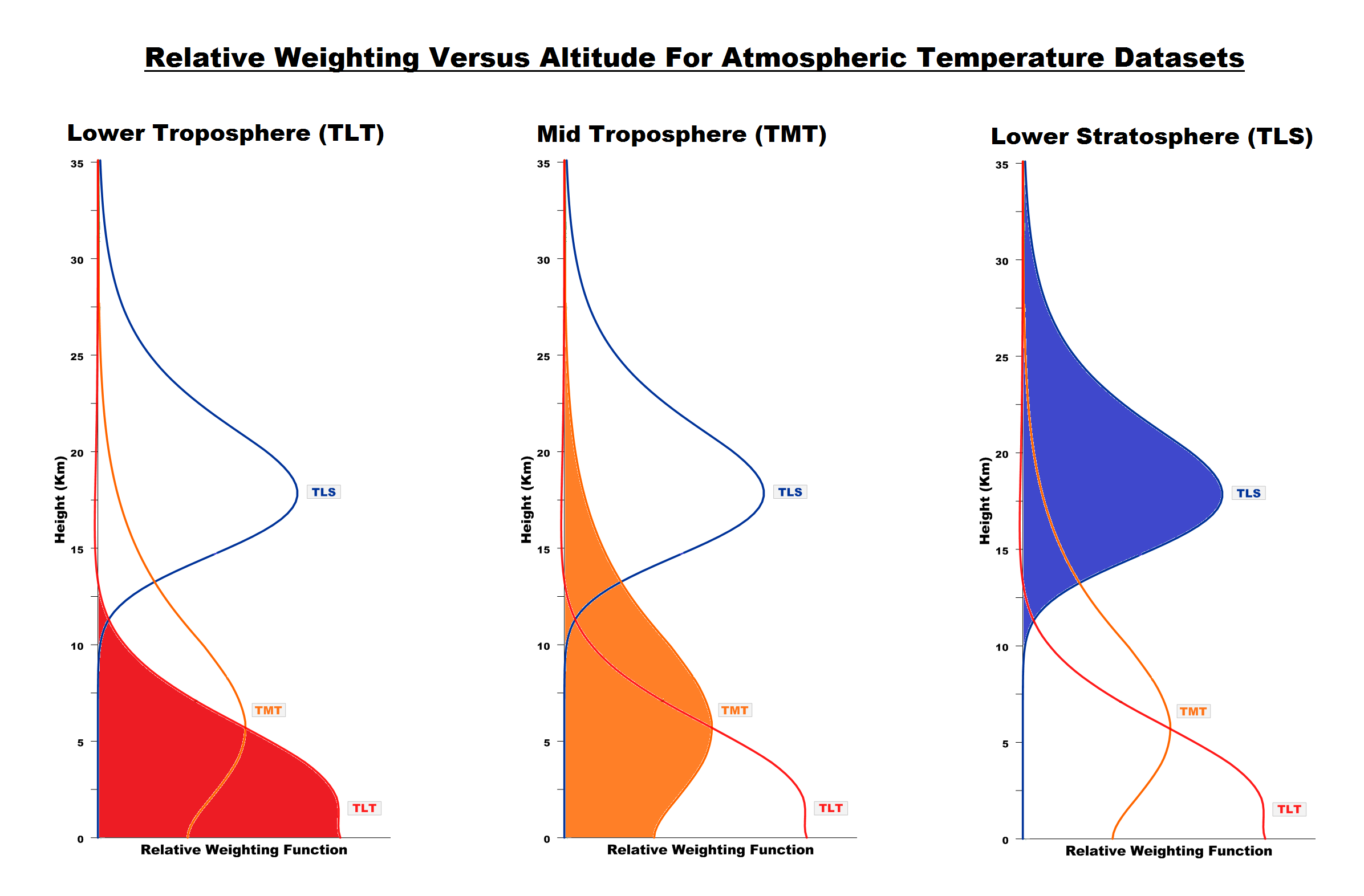
Update: The May 2014 UAH lower troposphere temperature anomaly is +0.33 deg C. It is rose sharply (an increase of about +0.14 deg C) since April 2014.

Figure 4 – UAH Lower Troposphere Temperature (TLT) Anomaly Data
RSS Lower Troposphere Temperature (TLT) Anomaly Data
Like the UAH lower troposphere temperature data, Remote Sensing Systems (RSS) calculates lower troposphere temperature anomalies from microwave sounding units aboard a series of NOAA satellites. RSS describes their data at the Upper Air Temperature webpage. The RSS data are supported by Mears and Wentz (2009) Construction of the Remote Sensing Systems V3.2 Atmospheric Temperature Records from the MSU and AMSU Microwave Sounders. RSS also presents their lower troposphere temperature data in various subsets. The land+ocean TLT data are here. Curiously, on that webpage, RSS lists the data as extending from 82.5S to 82.5N, while on their Upper Air Temperature webpage linked above, they state:
We do not provide monthly means poleward of 82.5 degrees (or south of 70S for TLT) due to difficulties in merging measurements in these regions.
Also see the RSS MSU & AMSU Time Series Trend Browse Tool. RSS uses the base years of 1979 to 1998 for anomalies.
Update: The May 2014 RSS lower troposphere temperature anomaly is +0.29 deg C. It rose (an increase of about +0.04 deg C) since April 2014.

Figure 5 – RSS Lower Troposphere Temperature (TLT) Anomaly Data
A Quick Note about the Difference between RSS and UAH TLT data
There is a noticeable difference between the RSS and UAH lower troposphere temperature anomaly data. Dr. Roy Spencer discussed this in his July 2011 blog post On the Divergence Between the UAH and RSS Global Temperature Records. In summary, John Christy and Roy Spencer believe the divergence is caused by the use of data from different satellites. UAH has used the NASA Aqua AMSU satellite in recent years, while as Dr. Spencer writes:
…RSS is still using the old NOAA-15 satellite which has a decaying orbit, to which they are then applying a diurnal cycle drift correction based upon a climate model, which does not quite match reality.
I updated the graphs in Roy Spencer’s post in On the Differences and Similarities between Global Surface Temperature and Lower Troposphere Temperature Anomaly Datasets.
While the two lower troposphere temperature datasets are different in recent years, UAH believes their data are correct, and, likewise, RSS believes their TLT data are correct. Does the UAH data have a warming bias in recent years or does the RSS data have cooling bias? Until the two suppliers can account for and agree on the differences, both are available for presentation.
In a more recent blog post, Roy Spencer has advised that the UAH lower troposphere Version 6 will be released soon and that it will reduce the difference between the UAH and RSS data.
13-YEAR+ (161-MONTH) RUNNING TRENDS
As noted in my post Open Letter to the Royal Meteorological Society Regarding Dr. Trenberth’s Article “Has Global Warming Stalled?”, Kevin Trenberth of NCAR presented 10-year period-averaged temperatures in his article for the Royal Meteorological Society. He was attempting to show that the recent halt in global warming since 2001 was not unusual. Kevin Trenberth conveniently overlooked the fact that, based on his selected start year of 2001, the halt at that time had lasted 12+ years, not 10.
The period from January 2001 to April 2014 is now 161-months long—more than 13 years. Refer to the following graph of running 161-month trends from January 1880 to April 2014, using the GISS LOTI global temperature anomaly product.
An explanation of what’s being presented in Figure 6: The last data point in the graph is the linear trend (in deg C per decade) from January 2001 to May 2014. It is basically zero (about 0.02 deg C/Decade). That, of course, indicates global surface temperatures have not warmed to any great extent during the most recent 160-month period. Working back in time, the data point immediately before the last one represents the linear trend for the 161-month period of December 2000 to April 2014, and the data point before it shows the trend in deg C per decade for November 2000 to March 2014, and so on.

Figure 6 – 161-Month Linear Trends
The highest recent rate of warming based on its linear trend occurred during the 160-month period that ended about 2004, but warming trends have dropped drastically since then. There was a similar drop in the 1940s, and as you’ll recall, global surface temperatures remained relatively flat from the mid-1940s to the mid-1970s. Also note that the mid-1970s was the last time there had been a 161-month period without global warming—before recently.
17-YEAR (204-Month) RUNNING TRENDS
In his RMS article, Kevin Trenberth also conveniently overlooked the fact that the discussions about the warming halt are now for a time period of about 16 years, not 10 years—ever since David Rose’s DailyMail article titled “Global warming stopped 16 years ago, reveals Met Office report quietly released… and here is the chart to prove it”. In my response to Trenberth’s article, I updated David Rose’s graph, noting that surface temperatures in April 2013 were basically the same as they were in June 1997. We’ll use June 1997 as the start month for the running 17-year trends. The period is now 204-months long. The following graph is similar to the one above, except that it’s presenting running trends for 204-month periods.
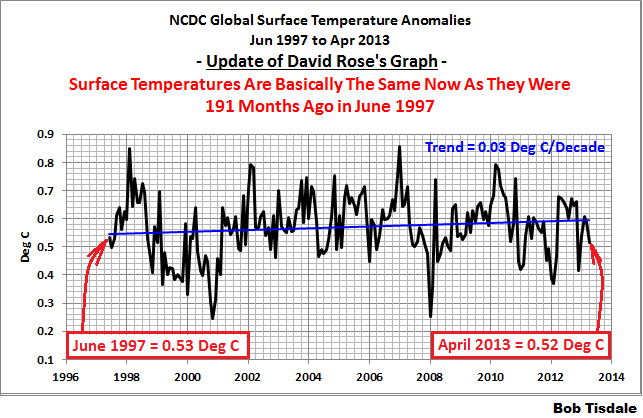

Figure 7 – 204-Month Linear Trends
The last time global surface temperatures warmed at this low a rate for a 204-month period was the late 1970s, or about 1980. Also note that the sharp decline is similar to the drop in the 1940s, and, again, as you’ll recall, global surface temperatures remained relatively flat from the mid-1940s to the mid-1970s.
The most widely used metric of global warming—global surface temperatures—indicates that the rate of global warming has slowed drastically and that the duration of the halt in global warming is unusual during a period when global surface temperatures are allegedly being warmed from the hypothetical impacts of manmade greenhouse gases.
A NOTE ABOUT THE RUNNING-TREND GRAPHS
There is very little difference in the end point trends of 13+ year and 16+ year running trends if HADCRUT4 or NCDC or GISS data are used. The major difference in the graphs is with the HADCRUT4 data and it can be seen in a graph of the 13+ year trends. I suspect this is caused by the updates to the HADSST3 data that have not been applied to the ERSST.v3b sea surface temperature data used by GISS and NCDC.
COMPARISONS
The GISS, HADCRUT4 and NCDC global surface temperature anomalies and the RSS and UAH lower troposphere temperature anomalies are compared in the next three time-series graphs. Figure 8 compares the five global temperature anomaly products starting in 1979. Again, due to the timing of this post, the HADCRUT4 and NCDC data lag the UAH, RSS and GISS products by a month. The graph also includes the linear trends. Because the three surface temperature datasets share common source data, (GISS and NCDC also use the same sea surface temperature data) it should come as no surprise that they are so similar. For those wanting a closer look at the more recent wiggles and trends, Figure 9 starts in 1998, which was the start year used by von Storch et al (2013) Can climate models explain the recent stagnation in global warming? They, of course found that the CMIP3 (IPCC AR4) and CMIP5 (IPCC AR5) models could NOT explain the recent halt in warming.
Figure 10 starts in 2001, which was the year Kevin Trenberth chose for the start of the warming halt in his RMS article Has Global Warming Stalled?
Because the suppliers all use different base years for calculating anomalies, I’ve referenced them to a common 30-year period: 1981 to 2010. Referring to their discussion under FAQ 9 here, according to NOAA:
This period is used in order to comply with a recommended World Meteorological Organization (WMO) Policy, which suggests using the latest decade for the 30-year average.

Figure 8 – Comparison Starting in 1979
###########

Figure 9 – Comparison Starting in 1998
###########

Figure 10 – Comparison Starting in 2001
AVERAGE
Figure 11 presents the average of the GISS, HADCRUT and NCDC land plus sea surface temperature anomaly products and the average of the RSS and UAH lower troposphere temperature data. Again because the HADCRUT4 and NCDC data lag one month in this update, the most current average only includes the GISS products.

Figure 11 – Average of Global Land+Sea Surface Temperature Anomaly Products
The flatness of the data since 2001 is very obvious, as is the fact that surface temperatures have rarely risen above those created by the 1997/98 El Niño in the surface temperature data. There is a very simple reason for this: the 1997/98 El Niño released enough sunlight-created warm water from beneath the surface of the tropical Pacific to permanently raise the temperature of about 66% of the surface of the global oceans by almost 0.2 deg C. Sea surface temperatures for that portion of the global oceans remained relatively flat until the El Niño of 2009/10, when the surface temperatures of the portion of the global oceans shifted slightly higher again. Prior to that, it was the 1986/87/88 El Niño that caused surface temperatures to shift upwards. If these naturally occurring upward shifts in surface temperatures are new to you, please see the illustrated essay “The Manmade Global Warming Challenge” (42mb) for an introduction.
MONTHLY SEA SURFACE TEMPERATURE UPDATE
The most recent sea surface temperature update can be found here. The satellite-enhanced sea surface temperature data (Reynolds OI.2) are presented in global, hemispheric and ocean-basin bases.
TABLE OF CONTENTS OF UPCOMING BOOK
I linked a copy to the post here of the Table of Contents for my upcoming book about global warming, climate change and skepticism. Please take a look to see if there are topics I’ve missed that you believe should be covered. I’ve already removed the introductory chapters for climate models from Section 1, and provided a separate section for those model discussions. Section 1 now only includes the chapters that introduce global warming and climate change topics. (Thanks, Gary.) Please also post any comments you have on that thread at my blog. Otherwise, I might miss them.
Thanks
Bob Tisdale
From HenryP on June 20, 2014 at 12:31 pm:
Oh please, except for the satellites none of them are “balanced”. The SST coverage is so sparse they’re hardly worth mentioning, but that’s what we have.
I used RSS, a satellite-based dataset, so that was as balanced as it gets. It shows the annual signal. I showed how using partial years contaminates trends with the annual signal. Done.
You deliberately selected datasets that most closely confirmed to your “balanced” dataset. Thus confirmation bias, you expected matching to your dataset. You ignored the most current versions of datasets and selected older ones that matched what you expected, even selected a lesser-used variation of a version for the better match, which is cherry-picking. Done.
Can you show the cooling using the most recent versions of the most common datasets, as anyone new to the conversation would stumble across?
@kadaka
apart from my own, I do not know of any data set that gives me this result for the change in minima:
last 40 years (from 1974) 0.004K/annum
last 34 years (from 1980) 0.007K/annum
last 24 years (from 1990) 0.004K/annum
last 14 years (from 2000) -0.009K/annum
there is no room for any AGW
whatsoever?
sorry, it is the prerogative of the investigator to trust his own results more than that of others.
done.
no further discussion possible
Simon says:
You both seem disturbed I would visit Realclimate…
Not at all. What bothers me is the rampant censorship at both blogs.
Next:
I’m wondering how you both (the denial tag team) go to ensure you are reading all the available information?
It would be stupid to read everything, no? Pretty soon you would get into creationist theory, astrology, etc. WUWT covers all the bases. Use the search box, you can find anything you need to know. The other blogs you mentioned censor so that you only get what they want you to read. They want you to be their parrot. Fortunately, neither one has much traffic.
++++++++++++++++++++
Phil. says:
So yes, you asserted, without any evidence…
Phil you dope, I posted a graph of the stratosphere. That is evidence. My evidence is better than yours, for one simple reason: CAGW is your religion, whereas I am willing to change my mind based on facts. Since there are no facts supporting CAGW, I remain a scientific skeptic.
Re: the missing tropospheric hot spot, the predicted “fingerprint of global warming”, it never appeared. That alarmist prediction has failed miserably, just like all the other alarmist predictions, and you rebutted nothing. Only your religious Belief convinces you otherwise.
Clearly you don’t know what a rebuttal is, no surprise.
Certainly you don’t know what a rebuttal is. You don’t even know what evidence is, even when it is spoon-fed to you.
You may now return to your state of constant psychological projection.
dbstealey
“Out of all the websites mentioned, only WUWT allows and encourages all points of view. If that fact doesn’t separate the propaganda blogs from the science site for you, nothing will.”
——————-
While it may be true that WUWT is more tolerant of a range of views in the comments section, you would be hard pushed to convince anyone that its articles promote anything but the skeptical view. And if you think otherwise, perhaps you would be kind enough to provide links that offer the pro AGW view. And, yes, I know, SS and RC are guilty of the same thing, but you have accused them of being propaganda sites. In fact I can’t really see any difference between WUWT, RC and SS in that regard. All three hold a view and promote that view.
From Simon on June 20, 2014 at 7:42 pm:
Gee, Ira Glickstein PhD did the whole “Visualizing the ‘Greenhouse Effect'” series, five parts, here’s the last one which has links to the others:
http://wattsupwiththat.com/2011/05/07/visualizing-the-greenhouse-effect-light-and-heat/
There was also a 4-part Ferdinand Engelbeen series, “Engelbeen on why he thinks the CO2 increase is man made”. Last one which has links to the others:
http://wattsupwiththat.com/2010/09/24/engelbeen-on-why-he-thinks-the-co2-increase-is-man-made-part-4/
So how CO2 produces its share of the greenhouse effect is covered, and how the CO2 increase is anthropogenic.
If you need something that more specifically endorses AGW, you can write it up pretty and polite, back it with good references using publicly-available data for confirmation by replication, and submit it. If it’s at the normal publication standards and you’re willing to throw your baby at the starving dingos and watch what happens, you have as good a shot at getting published here as anyone else who does the same.
kadaka
This quote is from the first page you referenced and supports my point perfectly, and that is this website only prints skeptical articles. Clearly this guy follows the thinking on this site and indeed for the most part mine.
“The main scientific question for me, is how much does the increase in human-caused CO2 and human-caused albedo reduction increase the mean temperature above what it would be with natural cycles and processes? My answer is “not much”, because perhaps 0.1ºC to 0.2ºC of the supposed 0.8ºC increase since 1880 is due to human activities. The rest is due to natural cycles and processes over which we humans have no control. The main public policy question for me, is how much should we (society) do about it? Again, my answer is “not much”, because the effect is small and a limited increase in temperatures and CO2 may turn out to have a net benefit.”
However I will concede the second article does not support there views of most readers here and so was a risk to print. I know from years of coming here that that is a rarity though. But… well done finding it, you clearly know this site well.
Simon:
Amusement at your cognitive dissonance is starting to be replaced by annoyance at its nuisance.
For example, at June 20, 2014 at 10:04 pm you start your post saying
You wrote this as part of your attempts to pretend WUWT is similar to the failed pro-AGW propagandist echo chamber web sites you are trying to promote. And your writing it is jaw-droppingly stupid because each of those web sites would censor any post which attempted to say anything other than their propaganda.
Simply, your own words are evidence that you are wrong. “This website” (i.e. WUWT) does NOT “only prints skeptical articles”. It is printing the silly articles from you.
Richard
richardscourtney
And then I said???
Simon:
re your silly post June 21, 2014 at 2:55 am.
You said nothing after your statements which I quoted and commented.
If you intended to say something then perhaps you can now correct your oversight.
However, in attempt to show I am trying to be helpful I add the following for you.
WUWT often provides and/or links to pro-AGW papers if only to refute them. Indeed, WUWT sometimes links directly to RC with the result that RC gets some visitors (it merits nobody wasting time by visiting it). One such example is here where a link to an RC item is provided in its first sentence which says
The peopaganda blogs you are trying to promote never link to articles on WUWT.
Simon, please try to think before posting. Your puerile maundering is disruptive.
Richard
@- Richard Courtney
“Firstly, your link does NOT report “several thousand years of no discernible sea level rise”.
Importantly, your link shows NO recent acceleration in sea level change.
And your assertion that such change is a direct indication of global warming is refuted by the lack of change to sea level rise rate reported in your link. As you say, “Expanding water and melting it takes a lot of Joules” but there is no evidence of recent loss of land ice and there has been no global warming to expand water for at least the last 17 years while the rate of sea level rise did not change.”
Thank you for checking the link I gave for sea level rise. You are correct it does not show the evidence for the assertions I made that the rate is accelerating and that previously there had been little change for several thousand years.
I am happy to provide links to the supporting evidence for those facts if you wish.
I hesitate to provide too many links, especially to PDF files of the original research as it seems to delay the acceptance of the post. Presumably because some sort of check is made that they are not bad links.
However. I will post a link to refute this assertion you made, –
@-“but there is no evidence of recent loss of land ice ”
http://www.wgms.ch/mbb/sum12.html
izen:
I am replying to your post addressed to me at June 21, 2014 at 5:16 am which is here.
Thankyou for agreeing that your link does NOT show what you claimed when you now write
However, I am saddened that you fail to admit that the link you provided shows you were wrong and – instead of admitting that YOUR link shows you were wrong – you claim you could provide some other link which would support your false claims although you don’t. And you say you don’t provide it because you “hesitate to provide too many links”; well, you provide none and that certainly cannot be “too many”.
Then you conclude by following that bollocks with this
It is clear from the context in which I made the statement that I was talking about TOTAL land ice. Your link discusses glaciers and its only mention of Antarctic ice is the Bahia del Diablo, Hurd and
Johnson glaciers which do not encompass much of the Antarctic ice; i.e. your link does not mention most of the ice on Earth.
Richard
PS I would be interested to know if you are having a competition with Phil. to see which of you can make the most ridiculous post on WUWT.
izen says
However. I will post a link to refute this assertion you made, –
@-”but there is no evidence of recent loss of land ice ”
http://www.wgms.ch/mbb/sum12.html
henry says
interesting that your link provides me with the information that Norway is (also) cooling down (everything seems positive).
My own results show that it has been cooling significantly in Alaska, at a rate of -0.55K per decade since 1998 (Average of ten weather stations).
http://oi40.tinypic.com/2ql5zq8.jpg
That is almost one whole degree C since 1998. And it seems NOBODY is telling the poor farmers there that it is not going to get any better. NASA also admits now that antarctic ice is increasing significantly.
http://wattsupwiththat.com/2013/10/22/nasa-announces-new-record-growth-of-antarctic-sea-ice-extent/#more-96133
So clearly, together with my previous comments, which you have ignored, we (on earth) are cooling down from the [top] latitudes down.
Looking at minimum temperatures,
http://wattsupwiththat.com/2014/06/18/may-2014-global-surface-landocean-and-lower-troposphere-temperature-anomaly-update/#comment-1666344
and setting the speed of warming/cooling out against time you get a perfect binomial (parabolic), rsquare equal to 1. That means there is no AGW, whatsoever. All warming (in the past) and all cooling (in the present) is natural. Someone Good made it so. Only a fool would say in his heart there is no God. The whole sun-earth system has been cleverly designed so that it cannot overheat.
Phil. says:
“I guess…”
Guessing is all you have, and your guesses have been 100% wrong. You also ‘guess’ that human activity is causing runaway global warming. But guesses do not take the place of evidence.
The planet itself shows you are wrong. Global warming stopped, and all your backing and filling does nothing to change that fact. You just keep digging, to the amusement of rational readers.
You label Richard Courtney — a published, peer reviewed author — as a “troll”. Mr Courtney is not afraid to put his name to his words like you are. Until and unless you identify yourself, you have as much credibility as Mickey Mouse. But not much more.
So really, who are you, “Phil.”? Are you here to amuse us with your impotent consternation over the fact that Planet Earth is making you wrong? If so, you’re succeeding.
=====================
Izen,
Aside from you being wrong as always, what is the big deal with sea level rise? The alarmist clique was flat wrong in all their predictions about accelerating SL. And your link says nothing about sea levels accelerating. The only takeaway I got from a cursory reading was that the planet is recovering from the LIA, nothing more. There is no evidence of any ‘human fingerprint’.
Further, what is your fixation with ice cover? The most reasonable explanation is that the planet is naturally recovering from the LIA. Anything more is a stretch.
++++++++++++++++++++++
Simon says:
you would be hard pushed to convince anyone that [WUWT] articles promote anything but the skeptical view. And if you think otherwise, perhaps you would be kind enough to provide links that offer the pro AGW view.
You still don’t get it. WUWT has a skeptical perspective because all honest scientists are skeptics. The alarmist position is that human activity will cause runaway global warming. Skeptics say: “Prove it.” Or at least post convincing evidence and/or observations showing what you claim. But so far, all you have are assertions that follow the CAGW narrative. That isn’t good enough her at the internet’s “Best Science & Technology” site.
There is no evidence whatever to support the catastrophic AGW belief. In fact, not only is there no runaway global warming, as was incessantly predicted by Algore and many others, but global warming has stopped.
Question: what will it take to convince you that the alarmist clique is wrong? Anything? Or has CAGW become a religious belief, which does not allow you to accept what the planet is clearly telling everyone else?
dbstealey
“Question: what will it take to convince you that the alarmist clique is wrong? Would anything convince you? Or has CAGW become your religious belief, which will not allow you to accept what the planet is clearly telling everyone else?”
—————————-
I could ask you the same question i.e why do you have this blind belief nothing is happening? I’ve explained I look for answers by reading a variety of material, you seem to feel justified staying on the skeptical sites. I say that gives me an advantage, you say it doesn’t. By the I am not a religious man and feel accusing me of being so i rather pointless. Re, what is the the planet telling us? I think it is clear we are still warming. The empirical data (which you seem to love) is telling us just that. Last month was the warmest (April) combined land and ocean on record according to NOAA. May is not our yet, but it is looking like being a high one too. The empirical data is also telling us we have net ice loss on this precious planet. That is a worry. Ice doesn’t usually me;e;t unless you heat it. So before you bang on about no empirical data, I would suggest you read it first.
richardscourtney
“The peopaganda blogs you are trying to promote never link to articles on WUWT.”
—————————————–
Richard, I think you will find SKS often provides links to WUWT. I read it so I know. Although it would be fair to say it is not to promote the ideas here, more to mock or refute them. To be honest I find that stuff all a bit tedious. As for Realclimate, in my experience the articles there are certainly worth reading. They tend to (but not always) steer away from sneering at other sites and focus the science. A good thing I think. While their traffic may be lower than WUWT they do get a good number of responses to articles. Thank you once again for taking the time to respond to my posts. Look forward to your reply as always.
dbstealey
More empirical data for you. It seems May is also the warmest on record.
http://www.bdtonline.com/latest/x1396895706/May-2014-was-the-hottest-may-in-recorded-history
That’s two in a row. See, I think anybody who reads both sides of the argument, would struggle to deny the upward trend. After all, warmest is warmest. You, on the other hand seem to find no difficultly ignoring the empirical evidence. And yet the funny thing is you keep telling us you never see any. Seems you almost have a faith that keeps you going. Wait, isn’t that a religious thing?
Simon:
In your post at June 21, 2014 at 1:40 pm you assert
No, Simon. Anybody who has learned elementary arithmetic knows that two data points do not provide a trend.
Only a biased true believer seeking anything to support an evidence-free belief would have made your assertion.
Richard
Simon says:
June 21, 2014 at 1:40 pm
dbstealey
More empirical data for you. It seems May is also the warmest on record.
This is the warmest May ever recorded by GISS. However on RSS it is sixth; on UAH, version 5.5 it is fourth; and on Hadsst3 it is second.
richardscourtney
No, Simon. Anybody who has learned elementary arithmetic knows that two data points do not provide a trend.
——————————–
Richard, so pleased you mentioned trend… Let’s look at the “long term” lower troposphere trend in figure 8. The one that started this conversation. The one that starts before 1998. Well what do you know…. it is up.
Now lets go to Roy Spencers front page graph. The indisputable satellite data….
http://www.drroyspencer.com/latest-global-temperatures/
There it is again… a long term upward trend. And as you are the one who seems to prefer longer term graphs, please don’t bother me with short term graphs that start at 1998. I’ve seen those. I am thinking they will not be used again when the developing El Nino breaks new records this year.
wbrozek
This is the warmest May ever recorded by GISS. However on RSS it is sixth; on UAH, version 5.5 it is fourth; and on Hadsst3 it is second.
———————
The ones you quote are land or ocean. That’s why NOAA’s any day now date will be interesting… it is both.
Simon says:
June 21, 2014 at 3:05 pm
But, these miniscule “trends” you speak of are no different from the long term coming out of the LIA, established long before CO2 putatively had any significant effect.
All the major temperature sets are affinely similar since the late 70’s. But, if you take the ones which extend farthest back, and take out that long term trend, they are all falling in relative terms.
This decline should not be happening, if CO2 were the driving force, given that it is higher than ever. SkS can fudge and prevaricate all they like, but AGW is a dead hypothesis walking. At some point, you have to stop seeing things through the lens of what you may want them to be, and recognize them for what they are.
Bart
“At some point, you have to stop seeing things through the lens of what you may want them to be, and recognize them for what they are.”
I would offer you the same advice as you look at Roy Spencers graph
http://www.drroyspencer.com/latest-global-temperatures/
Simon says:
…why do you have this blind belief nothing is happening?
1) It is not “blind”. I post numerous links to observations and raw data.
2) It is not a “belief”. Belief belongs to those who say that runaway global warming is happening. It isn’t.
3) Being a skeptic means that those putting forth a hypothesis such as CAGW means the alarmist crowd must prove it, because skeptics have nothing to prove.
Next:
By the I am not a religious man and feel accusing me of being so i rather pointless. Re, what is the the planet telling us? I think it is clear we are still warming.
There has been no global warming for 17 years. That is empirical evidence; or as you put it: “the indisputable satellite data”.
Also, note that GISS “adjusts” its so-called ‘data’ — and the GISS adjustments always show scarier warming than empirical observations. The preposterous thing is, you believe Gavin Schmidt! Maybe you can give us a credible explanation why he refuses to debate. You know, an explanation that doesn’t generate amusing comments.
Earth to Simon: global warming has stopped. How much more evidence do you need?
Next:
The empirical data is also telling us we have net ice loss on this precious planet.
Wrong again. Where do you get your misinformation?? Note the red line. It shows that global ice cover is higher than its 30-year average. Go argue with Cryosphere if you don’t like it. But making baseless assertions like “net ice loss” shows confirmation bias and cherry-picking.
Next simple Simon says:
There it is again… a long term upward trend. And as you are the one who seems to prefer longer term graphs, please don’t bother me with short term graphs that start at 1998.
Simon, you are unaware of a lot of things, so I’ll explain. Dr. Phil Jones, in the CRU emails, May 7, 2009 wrote:
‘Bottom line: the ‘no upward trend’ has to continue for a total of 15 years before we get worried.’
That comment was in response to the fact that global warming had stopped for two years. Jones thought he was on solid ground when he wrote that global warming would have to stop for 15 years, from 1997. Now it has been 17+ years, almost 18. So it was your heroes who designated 1997 as the benchmark year.
You call that “short term”. Fine, let’s look at the long term. Notice that the planet is warming from the LIA — with no recent acceleration? It takes a fool to argue that human emissions make a difference, after looking at the long-term temperature record.
My advice: quit digging. Take a few months and read the WUWT archives. Get up to speed; you aren’t right now. Because it’s clear you are parroting alarmist misinformation.
[And seeing your typing, you’d better calm down, or your head might explode from your cognitive dissonance.]
dbstealey
I see you have only mentioned sea ice. If you had read and understood what I said you would realise I meant net ice. We are talking volume….. mass balance of glaciers etc. I’ll keep it simple for you…. Empirical evidence tells us the sea level is rising. That water comes from somewhere? Have a guess?(yes I know some is through thermal expansion, more evidence of a warming world) I’ll tell you… melting Ice. Sea ice has little affect on sea level rise so it clearly is coming from somewhere. That’s right, the ice on the land. Now here is the (clincher) thing. The level is not going down, so if it is going up…. there must be more ice melting than freezing.
So where is it coming from. It seems Antarctica and Greenland are the major culprits, but glaciers in other parts of the world are also major contributors. I will provide an Empirical link for you.
http://en.wikipedia.org/wiki/Glacier_mass_balance#mediaviewer/File:Glacier_Mass_Balance.png
Please let me know if you don’t understand any of this.
dbstealey says:
June 21, 2014 at 4:16 pm
Forget it. He’s a religious believer. He didn’t even read what I wrote, and replied with something incoherent.
Bart
Im sorry but I addresses the only part of your post worth addressing and that was the irony of your last statement. The rest was pretty much wordy bunkum. No offence.