This post updates the data for the three primary suppliers of global land+ocean surface temperature data—GISS through May 2014 and HADCRUT4 and NCDC through April 2014—and of the two suppliers of satellite-based global lower troposphere temperature data (RSS and UAH) through May 2014.
Initial Notes: To make this post as timely as possible, only GISS LOTI and the two lower troposphere temperature datasets are for the most current month. The NCDC and HADCRUT4 data lag one month.
This post contains graphs of running trends in global surface temperature anomalies for periods of 13+ and 17 years using GISS global (land+ocean) surface temperature data. They indicate that we have not seen a warming halt (based on 13 years+ trends) this long since the mid-1970s or a warming slowdown (based on 17-years trends) since about 1980. I used to rotate the data suppliers for this portion of the update, also using NCDC and HADCRUT. With the data from those two suppliers lagging by a month in the updates, I’ve standardized on GISS for this portion.
Much of the following text is boilerplate. It is intended for those new to the presentation of global surface temperature anomaly data.
Most of the update graphs in the following start in 1979. That’s a commonly used start year for global temperature products because many of the satellite-based temperature datasets start then.
We discussed why the three suppliers of surface temperature data use different base years for anomalies in the post Why Aren’t Global Surface Temperature Data Produced in Absolute Form?
GISS LAND OCEAN TEMPERATURE INDEX (LOTI)
Introduction: The GISS Land Ocean Temperature Index (LOTI) data is a product of the Goddard Institute for Space Studies. Starting with their January 2013 update, GISS LOTI uses NCDC ERSST.v3b sea surface temperature data. The impact of the recent change in sea surface temperature datasets is discussed here. GISS adjusts GHCN and other land surface temperature data via a number of methods and infills missing data using 1200km smoothing. Refer to the GISS description here. Unlike the UK Met Office and NCDC products, GISS masks sea surface temperature data at the poles where seasonal sea ice exists, and they extend land surface temperature data out over the oceans in those locations. Refer to the discussions here and here. GISS uses the base years of 1951-1980 as the reference period for anomalies. The data source is here.
Update: The May 2014 GISS global temperature anomaly is +0.76 deg C. It warmed slightly (an increase of about 0.03 deg C) since April 2014.

Figure 1 – GISS Land-Ocean Temperature Index
NCDC GLOBAL SURFACE TEMPERATURE ANOMALIES (LAGS ONE MONTH)
Introduction: The NOAA Global (Land and Ocean) Surface Temperature Anomaly dataset is a product of the National Climatic Data Center (NCDC). NCDC merges their Extended Reconstructed Sea Surface Temperature version 3b (ERSST.v3b) with the Global Historical Climatology Network-Monthly (GHCN-M) version 3.2.0 for land surface air temperatures. NOAA infills missing data for both land and sea surface temperature datasets using methods presented in Smith et al (2008). Keep in mind, when reading Smith et al (2008), that the NCDC removed the satellite-based sea surface temperature data because it changed the annual global temperature rankings. Since most of Smith et al (2008) was about the satellite-based data and the benefits of incorporating it into the reconstruction, one might consider that the NCDC temperature product is no longer supported by a peer-reviewed paper.
The NCDC data source is usually here. NCDC uses 1901 to 2000 for the base years for anomalies. (Note: the NCDC has been slow with updating the normal data source webpage, so I’ve been using the values available through their Global Surface Temperature Anomalies webpage. Click on the link to Anomalies and Index Data.)
Update (Lags One Month): The April 2014 NCDC global land plus sea surface temperature anomaly was +0.72 deg C. See Figure 2. It showed a rise (an increase of +0.05 deg C) since March 2014.

Figure 2 – NCDC Global (Land and Ocean) Surface Temperature Anomalies
UK MET OFFICE HADCRUT4 (LAGS ONE MONTH)
Introduction: The UK Met Office HADCRUT4 dataset merges CRUTEM4 land-surface air temperature dataset and the HadSST3 sea-surface temperature (SST) dataset. CRUTEM4 is the product of the combined efforts of the Met Office Hadley Centre and the Climatic Research Unit at the University of East Anglia. And HadSST3 is a product of the Hadley Centre. Unlike the GISS and NCDC products, missing data is not infilled in the HADCRUT4 product. That is, if a 5-deg latitude by 5-deg longitude grid does not have a temperature anomaly value in a given month, it is not included in the global average value of HADCRUT4. The HADCRUT4 dataset is described in the Morice et al (2012) paper here. The CRUTEM4 data is described in Jones et al (2012) here. And the HadSST3 data is presented in the 2-part Kennedy et al (2012) paper here and here. The UKMO uses the base years of 1961-1990 for anomalies. The data source is here.
Update (Lags One Month): The April 2013 HADCRUT4 global temperature anomaly is +0.64 deg C. See Figure 3. It increased (about +0.10 deg C) since March 2014.

Figure 3 – HADCRUT4
UAH Lower Troposphere Temperature (TLT) Anomaly Data
Special sensors (microwave sounding units) aboard satellites have orbited the Earth since the late 1970s, allowing scientists to calculate the temperatures of the atmosphere at various heights above sea level. The level nearest to the surface of the Earth is the lower troposphere. The lower troposphere temperature data include the altitudes of zero to about 12,500 meters, but are most heavily weighted to the altitudes of less than 3000 meters. See the left-hand cell of the illustration here. The lower troposphere temperature data are calculated from a series of satellites with overlapping operation periods, not from a single satellite. The monthly UAH lower troposphere temperature data is the product of the Earth System Science Center of the University of Alabama in Huntsville (UAH). UAH provides the data broken down into numerous subsets. See the webpage here. The UAH lower troposphere temperature data are supported by Christy et al. (2000) MSU Tropospheric Temperatures: Dataset Construction and Radiosonde Comparisons. Additionally, Dr. Roy Spencer of UAH presents at his blog the monthly UAH TLT data updates a few days before the release at the UAH website. Those posts are also cross posted at WattsUpWithThat. UAH uses the base years of 1981-2010 for anomalies. The UAH lower troposphere temperature data are for the latitudes of 85S to 85N, which represent more than 99% of the surface of the globe.
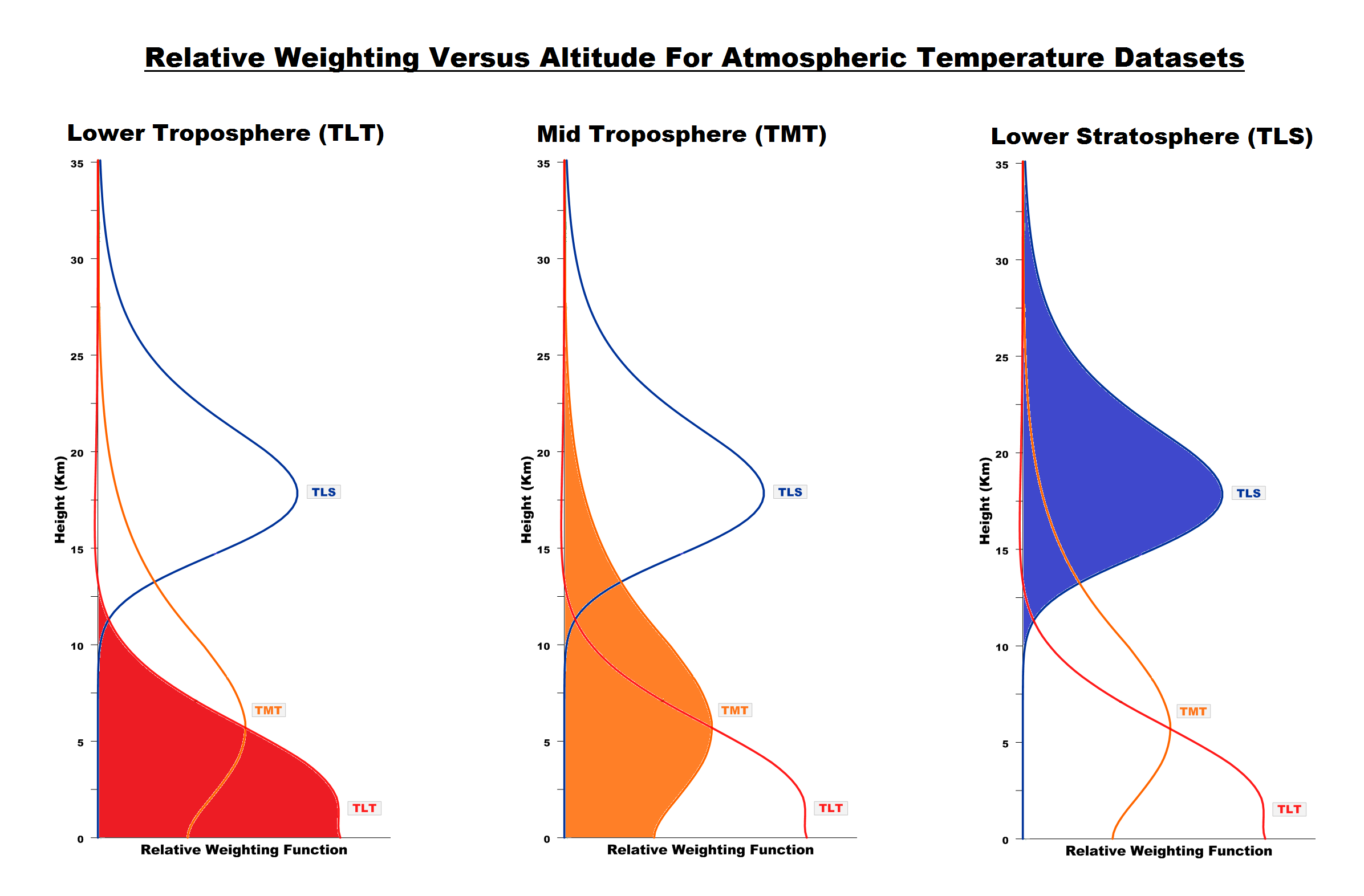
Update: The May 2014 UAH lower troposphere temperature anomaly is +0.33 deg C. It is rose sharply (an increase of about +0.14 deg C) since April 2014.

Figure 4 – UAH Lower Troposphere Temperature (TLT) Anomaly Data
RSS Lower Troposphere Temperature (TLT) Anomaly Data
Like the UAH lower troposphere temperature data, Remote Sensing Systems (RSS) calculates lower troposphere temperature anomalies from microwave sounding units aboard a series of NOAA satellites. RSS describes their data at the Upper Air Temperature webpage. The RSS data are supported by Mears and Wentz (2009) Construction of the Remote Sensing Systems V3.2 Atmospheric Temperature Records from the MSU and AMSU Microwave Sounders. RSS also presents their lower troposphere temperature data in various subsets. The land+ocean TLT data are here. Curiously, on that webpage, RSS lists the data as extending from 82.5S to 82.5N, while on their Upper Air Temperature webpage linked above, they state:
We do not provide monthly means poleward of 82.5 degrees (or south of 70S for TLT) due to difficulties in merging measurements in these regions.
Also see the RSS MSU & AMSU Time Series Trend Browse Tool. RSS uses the base years of 1979 to 1998 for anomalies.
Update: The May 2014 RSS lower troposphere temperature anomaly is +0.29 deg C. It rose (an increase of about +0.04 deg C) since April 2014.

Figure 5 – RSS Lower Troposphere Temperature (TLT) Anomaly Data
A Quick Note about the Difference between RSS and UAH TLT data
There is a noticeable difference between the RSS and UAH lower troposphere temperature anomaly data. Dr. Roy Spencer discussed this in his July 2011 blog post On the Divergence Between the UAH and RSS Global Temperature Records. In summary, John Christy and Roy Spencer believe the divergence is caused by the use of data from different satellites. UAH has used the NASA Aqua AMSU satellite in recent years, while as Dr. Spencer writes:
…RSS is still using the old NOAA-15 satellite which has a decaying orbit, to which they are then applying a diurnal cycle drift correction based upon a climate model, which does not quite match reality.
I updated the graphs in Roy Spencer’s post in On the Differences and Similarities between Global Surface Temperature and Lower Troposphere Temperature Anomaly Datasets.
While the two lower troposphere temperature datasets are different in recent years, UAH believes their data are correct, and, likewise, RSS believes their TLT data are correct. Does the UAH data have a warming bias in recent years or does the RSS data have cooling bias? Until the two suppliers can account for and agree on the differences, both are available for presentation.
In a more recent blog post, Roy Spencer has advised that the UAH lower troposphere Version 6 will be released soon and that it will reduce the difference between the UAH and RSS data.
13-YEAR+ (161-MONTH) RUNNING TRENDS
As noted in my post Open Letter to the Royal Meteorological Society Regarding Dr. Trenberth’s Article “Has Global Warming Stalled?”, Kevin Trenberth of NCAR presented 10-year period-averaged temperatures in his article for the Royal Meteorological Society. He was attempting to show that the recent halt in global warming since 2001 was not unusual. Kevin Trenberth conveniently overlooked the fact that, based on his selected start year of 2001, the halt at that time had lasted 12+ years, not 10.
The period from January 2001 to April 2014 is now 161-months long—more than 13 years. Refer to the following graph of running 161-month trends from January 1880 to April 2014, using the GISS LOTI global temperature anomaly product.
An explanation of what’s being presented in Figure 6: The last data point in the graph is the linear trend (in deg C per decade) from January 2001 to May 2014. It is basically zero (about 0.02 deg C/Decade). That, of course, indicates global surface temperatures have not warmed to any great extent during the most recent 160-month period. Working back in time, the data point immediately before the last one represents the linear trend for the 161-month period of December 2000 to April 2014, and the data point before it shows the trend in deg C per decade for November 2000 to March 2014, and so on.

Figure 6 – 161-Month Linear Trends
The highest recent rate of warming based on its linear trend occurred during the 160-month period that ended about 2004, but warming trends have dropped drastically since then. There was a similar drop in the 1940s, and as you’ll recall, global surface temperatures remained relatively flat from the mid-1940s to the mid-1970s. Also note that the mid-1970s was the last time there had been a 161-month period without global warming—before recently.
17-YEAR (204-Month) RUNNING TRENDS
In his RMS article, Kevin Trenberth also conveniently overlooked the fact that the discussions about the warming halt are now for a time period of about 16 years, not 10 years—ever since David Rose’s DailyMail article titled “Global warming stopped 16 years ago, reveals Met Office report quietly released… and here is the chart to prove it”. In my response to Trenberth’s article, I updated David Rose’s graph, noting that surface temperatures in April 2013 were basically the same as they were in June 1997. We’ll use June 1997 as the start month for the running 17-year trends. The period is now 204-months long. The following graph is similar to the one above, except that it’s presenting running trends for 204-month periods.
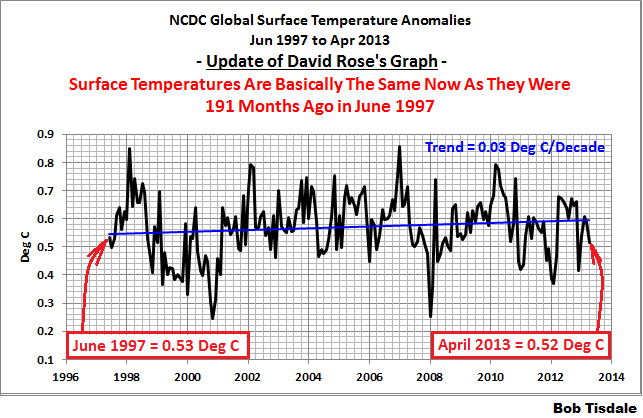

Figure 7 – 204-Month Linear Trends
The last time global surface temperatures warmed at this low a rate for a 204-month period was the late 1970s, or about 1980. Also note that the sharp decline is similar to the drop in the 1940s, and, again, as you’ll recall, global surface temperatures remained relatively flat from the mid-1940s to the mid-1970s.
The most widely used metric of global warming—global surface temperatures—indicates that the rate of global warming has slowed drastically and that the duration of the halt in global warming is unusual during a period when global surface temperatures are allegedly being warmed from the hypothetical impacts of manmade greenhouse gases.
A NOTE ABOUT THE RUNNING-TREND GRAPHS
There is very little difference in the end point trends of 13+ year and 16+ year running trends if HADCRUT4 or NCDC or GISS data are used. The major difference in the graphs is with the HADCRUT4 data and it can be seen in a graph of the 13+ year trends. I suspect this is caused by the updates to the HADSST3 data that have not been applied to the ERSST.v3b sea surface temperature data used by GISS and NCDC.
COMPARISONS
The GISS, HADCRUT4 and NCDC global surface temperature anomalies and the RSS and UAH lower troposphere temperature anomalies are compared in the next three time-series graphs. Figure 8 compares the five global temperature anomaly products starting in 1979. Again, due to the timing of this post, the HADCRUT4 and NCDC data lag the UAH, RSS and GISS products by a month. The graph also includes the linear trends. Because the three surface temperature datasets share common source data, (GISS and NCDC also use the same sea surface temperature data) it should come as no surprise that they are so similar. For those wanting a closer look at the more recent wiggles and trends, Figure 9 starts in 1998, which was the start year used by von Storch et al (2013) Can climate models explain the recent stagnation in global warming? They, of course found that the CMIP3 (IPCC AR4) and CMIP5 (IPCC AR5) models could NOT explain the recent halt in warming.
Figure 10 starts in 2001, which was the year Kevin Trenberth chose for the start of the warming halt in his RMS article Has Global Warming Stalled?
Because the suppliers all use different base years for calculating anomalies, I’ve referenced them to a common 30-year period: 1981 to 2010. Referring to their discussion under FAQ 9 here, according to NOAA:
This period is used in order to comply with a recommended World Meteorological Organization (WMO) Policy, which suggests using the latest decade for the 30-year average.

Figure 8 – Comparison Starting in 1979
###########

Figure 9 – Comparison Starting in 1998
###########

Figure 10 – Comparison Starting in 2001
AVERAGE
Figure 11 presents the average of the GISS, HADCRUT and NCDC land plus sea surface temperature anomaly products and the average of the RSS and UAH lower troposphere temperature data. Again because the HADCRUT4 and NCDC data lag one month in this update, the most current average only includes the GISS products.

Figure 11 – Average of Global Land+Sea Surface Temperature Anomaly Products
The flatness of the data since 2001 is very obvious, as is the fact that surface temperatures have rarely risen above those created by the 1997/98 El Niño in the surface temperature data. There is a very simple reason for this: the 1997/98 El Niño released enough sunlight-created warm water from beneath the surface of the tropical Pacific to permanently raise the temperature of about 66% of the surface of the global oceans by almost 0.2 deg C. Sea surface temperatures for that portion of the global oceans remained relatively flat until the El Niño of 2009/10, when the surface temperatures of the portion of the global oceans shifted slightly higher again. Prior to that, it was the 1986/87/88 El Niño that caused surface temperatures to shift upwards. If these naturally occurring upward shifts in surface temperatures are new to you, please see the illustrated essay “The Manmade Global Warming Challenge” (42mb) for an introduction.
MONTHLY SEA SURFACE TEMPERATURE UPDATE
The most recent sea surface temperature update can be found here. The satellite-enhanced sea surface temperature data (Reynolds OI.2) are presented in global, hemispheric and ocean-basin bases.
TABLE OF CONTENTS OF UPCOMING BOOK
I linked a copy to the post here of the Table of Contents for my upcoming book about global warming, climate change and skepticism. Please take a look to see if there are topics I’ve missed that you believe should be covered. I’ve already removed the introductory chapters for climate models from Section 1, and provided a separate section for those model discussions. Section 1 now only includes the chapters that introduce global warming and climate change topics. (Thanks, Gary.) Please also post any comments you have on that thread at my blog. Otherwise, I might miss them.
Thanks
Bob Tisdale
An Inquirer,
James Abbott also used the term “rebound”.
The fact is that the LIA was abnormally cold. It was a world wide event, and one of the coldest episodes of the entire 10,700 year Holocene. No one knows for sure what caused it.
Anyway, I see little difference between ’emerging’, ‘recovery’, and ‘rebound’ None are due to rising CO2, which is the unfounded claim of the alarmist crowd. The recovery has remained within clearly defined parameters, and global warming is certainly not accelerating. That by itself deconstructs the “carbon” scare/hoax.
I agree that no particular state of the climate is ‘normal’, unless they all are. The climate is natural, it is not man-made. What is observed are natural fluctuations within a rising global warming trend, and CO2 has nothing measurable to do with it.
dbstealey
Evidence = Troposphere warming…. Stratosphere cooling.
“the 1997/98 El Niño released enough sunlight-created warm water from beneath the surface of the tropical Pacific to permanently raise the temperature of about 66% of the surface of the global oceans by almost 0.2 deg C.”
—
I’m glad to know that the temperature increase from the 1997/98 El Niño is “permanent” and therefore the planet should never again experience another ice age.
Simon:
Your post at June 18, 2014 at 8:49 pm says in total
That is too terse.
Please explain
(a) why you think “Troposphere warming…. Stratosphere cooling” is “evidence” of anthropogenic (i.e. man-made) global warming (AGW),
(b) the recent (i.e. since 1950) histories if those parameters,
and
(c) what those histories indicate about the existence of AGW.
Richard
Simon,
For many years the alarmist prediction was that a tropospheric hot spot — the so-called ‘fingerprint of AGW’ — would appear. But when the evidence was assembled, there was no tropospheric hot spot. It didn’t exist.
So that ‘evidence’ is merely evidence of another failed prediction.
As for a cooling stratosphere, that was a later fallback position, predicted after the failure of the supposed tropospheric hot spot. But like the tropospheric hot spot, that prediction didn’t pan out either, because the stratosphere stopped cooling.
Thus, your putative ‘evidence’ is not evidence at all. The alarmist crowd’s CAGW predictions have failed. All of them.
kadaka (KD Knoebel) says: “But Mr. Tisdale, it is clearly evident on that graph, the land temperatures are averaging a step higher than the oceans.”
The upward shift in the CRUTEM4 data after the 1997/98 El Nino would be even more evident if you’d subtract the HADSST3 data from it. You’d also see that there was also a shift in the volatility, with SST and LST varying at different rates in response to the volcanos and strong ENSO events before 1997/98 than after. Data are right here in the KNMI Climate Explorer. It would take you 2 minutes:
http://climexp.knmi.nl/selectfield_obs.cgi?someone@somewhere
Then you could search the data for where the shift occurred. You’ll likely find it in the mid-to-high latitudes of the Northern Hemisphere (20N-60N).
Regards
Anyone fancy doing a pixel count on gray areas where nasa has no coverage according to this tweet ?
https://twitter.com/ClimateOfGavin/status/479039470365605889
Its a fairly significant proportion of land mass has almost no temperature.
Adam from Kansas says: “So far, there seems to be no imminent signs of catastrophic warming or catastrophic cooling.”
Thank you. Much ado about nothing, as they say.
jamesibbotson says: “Anyone fancy doing a pixel count on gray areas where nasa has no coverage according to this tweet ?”

It’s worse than that. The NOAA ERSST.v3b sea surface temperature data used by GISS has been infilled, so you’re missing the areas where there’s also no source data for the ocean surfaces. Here’s a map of the source ICOADS SST data for May 2014.
Cheers
Aerosols!
Mike M says:
Aerosols!
Or: Carbon soot!
That is all speculation. Conjecture, with no supporting measurements. Just like there are no supporting measurements quantifying the degree of global warming due to AGW.
Just prior to the Holocene global temperatures fluctuated by tens of whole degrees, within only a decade or two. But over the past century and a half, global T has been amazingly steady, fluctuating only ≈0.8ºC. That is nothing.
Keep that in mind when self-serving bureaucrats like Gavin Schmidt run in circles and arm-wave like Chicken Little over a few tenths of a degree fluctuation.
dbstealey
An expanded version of why there is ample evidence for the troposphere warming and the stratosphere cooling…. straight from the Royal Society and the US Academy of Sciences.
“In the early 1960s, results from mathematical/physical models of the climate system first showed that
human-induced increases in CO2 would be expected to lead to gradual warming of the lower atmosphere
(the troposphere) and cooling of higher levels of the atmosphere (the stratosphere). In contrast, increases in the Sun’s output would warm both the troposphere and the full vertical extent of the stratosphere. At that time, there was insufficient observational data to test this prediction, but temperature measurements from weather balloons and satellites have since confirmed these early forecasts. It is now known that the observed pattern of tropospheric warming and stratospheric cooling over the past 30 to 40 years is broadly consistent with computer model simulations that include increases in CO2
and decreases in stratospheric ozone, each caused by human activities. The observed pattern is not consistent with purely natural changes in the Sun’s energy output, volcanic activity, or natural climate variations such as El Niño and La Niña.”
But I come back to my point. The stance of denying the influence of CO2 on the warming climate is now redundant. The debate is now about how much warming and how much damage…. and what is to be done, if anything?
“the 1997/98 El Niño released enough sunlight-created warm water from beneath the surface of the tropical Pacific to permanently raise the temperature of about 66% of the surface of the global oceans by almost 0.2 deg C.”
==========
El Niño blocked the upwelling from the deep ocean in the Eastern Pacific that normally moderates temperatures in the Pacific and globally. It is lack of cooling from the deep that causes temperatures to rise with each El Niño. When El Niños are more frequent temperatures rise, when they are less frequent upwelling increases and we get cooling. It is the cold water from the deep oceans that leads to more or less energy at the surface, than can be explained by solar radiation alone.
Simon:
At June 19, 2014 at 11:09 am you assert
No! Standing up for truth is never “redundant”.
There is no “evidence” for an “influence of CO2 on the warming climate”; none, zilch, nada. Three decades of research conducted world-wide at a cost of over US$5 billion per year has failed to find any such evidence.
One could equal the veracity of your assertion by saying
The stance of denying the influence of the Easter Bunny on the warming climate is now redundant. The debate is now about how much warming and how much damage…. and what is to be done, if anything?
It seems I need to provide the following yet again.
The Null Hypothesis says it must be assumed a system has not experienced a change unless there is evidence of a change.
The Null Hypothesis is a fundamental scientific principle and forms the basis of all scientific understanding, investigation and interpretation. Indeed, it is the basic principle of experimental procedure where an input to a system is altered to discern a change: if the system is not observed to respond to the alteration then it has to be assumed the system did not respond to the alteration.
In the case of climate science there is a hypothesis that increased greenhouse gases (GHGs, notably CO2) in the air will increase global temperature. There are good reasons to suppose this hypothesis may be true, but the Null Hypothesis says it must be assumed the GHG changes have no effect unless and until increased GHGs are observed to increase global temperature. That is what the scientific method decrees. It does not matter how certain some people may be that the hypothesis is right because observation of reality (i.e. empiricism) trumps all opinions.
Please note that the Null Hypothesis is a hypothesis which exists to be refuted by empirical observation. It is a rejection of the scientific method to assert that one can “choose” any subjective Null Hypothesis one likes. There is only one Null Hypothesis: i.e. it has to be assumed a system has not changed unless it is observed that the system has changed.
However, deciding a method which would discern a change may require a detailed statistical specification.
In the case of global climate no unprecedented climate behaviours are observed so the Null Hypothesis decrees that the climate system has not changed.
Importantly, an effect may be real but not overcome the Null Hypothesis because it is too trivial for the effect to be observable. Human activities have some effect on global temperature for several reasons. An example of an anthropogenic effect on global temperature is the urban heat island (UHI). Cities are warmer than the land around them, so cities cause some warming. But the temperature rise from cities is too small to be detected when averaged over the entire surface of the planet, although this global warming from cities can be estimated by measuring the warming of all cities and their areas.
Clearly, the Null Hypothesis decrees that UHI is not affecting global temperature although there are good reasons to think UHI has some effect. Similarly, it is very probable that AGW from GHG emissions are too trivial to have observable effects.
The feedbacks in the climate system are negative and, therefore, any effect of increased CO2 will be probably too small to discern because natural climate variability is much, much larger. This concurs with the empirically determined values of low climate sensitivity.
Empirical – n.b. not model-derived – determinations indicate climate sensitivity is less than 1.0°C for a doubling of atmospheric CO2 equivalent. This is indicated by the studies of
Idso from surface measurements
http://www.warwickhughes.com/papers/Idso_CR_1998.pdf
and Lindzen & Choi from ERBE satellite data
http://www.drroyspencer.com/Lindzen-and-Choi-GRL-2009.pdf
and Gregory from balloon radiosonde data
http://www.friendsofscience.org/assets/documents/OLR&NGF_June2011.pdf
Indeed, because climate sensitivity is less than 1.0°C for a doubling of CO2 equivalent, it is physically impossible for the man-made global warming to be large enough to be detected (just as the global warming from UHI is too small to be detected). If something exists but is too small to be detected then it only has an abstract existence; it does not have a discernible existence that has effects (observation of the effects would be its detection).
To date there are no discernible effects of AGW. Hence, the Null Hypothesis decrees that AGW does not affect global climate to a discernible degree. That is the ONLY scientific conclusion possible at present.
And, of course, for the same reason the Null Hypothesis decrees that the Easter Bunny does not affect global climate to a discernible degree.
Richard
Richard. I think you need a little lie down or you are going to turn into butter.
Simon:
Your post at June 19, 2014 at 2:42 pm which says in total
It seems you are pointing out that my being an exemplar of the milk of human kindness has risk.
OK. Let me correct the risk by making a statement so simple and undeniable that even you may understand it.
Simon, every statement in each of your posts to this thread is unadulterated nonsense.
I hope that adjusts things to be as you want them to be.
Richard
Richard.
Simon, every statement in each of your posts to this thread is unadulterated nonsense.
Why thank you. Maybe the butter has been in the sun a bit long and gone sour? In a warming world that happens faster.
Simon
Simon says:
An expanded version of why there is ample evidence for the troposphere warming and the stratosphere cooling…. straight from the Royal Society and the US Academy of Sciences.
Another Appeal to Authority fallacy. Think for yourself instead of relying on corrupted societies. [See Section 2].
And:
But I come back to my point. The stance of denying the influence of CO2 on the warming climate is now redundant.
Nonsense. Your point, as usual, is simply an assertion — just like Phil’s. You both avoided my challenge upthread:
“…as I have been requesting for several years now, please post testable, measurable, empirical evidence, showing conclusively the fraction of a degree of warming directly attributable to human-emitted CO2. If you do so, you will be the first.”
Enough with your Belief-based assertions. They are nothing more than your opinion. Try using the Scientific Method for once, and post testable, measurable scientific evidence.
Next, pay attention to what Richard Courtney is trying to tell you about the climate Null Hypothesis, which has never been falsified. Your last comments to him makes it clear that you have run out of rational arguments.
Finally, you say:
The debate is now about how much warming and how much damage…. and what is to be done…
Complete nonsense, unless and until you can specifically quantify the degree of global warming that is attributable to anthropogenic CO2 using testable measurements. Your Precautionary Principle argument is another fallacy: you might get hit by a car when you cross the street, so either never cross the street, or we need to build a multi-billion dollar network of pedestrian bridges across the country on roads everywhere. Otherwise, there’s no telling how much damage and injuries might result. Same-same as: “What is to be done?” about [non-existent] AGW.
Nothing should be done, until we at least understand how the climate works. Science is all about predictions. Isn’t it? But not one CAGW prediction has ever happened. They have all been flat wrong. The miserable failure of GCMs to predict the current 17+ years of no global warming is egg on the faces of the Chicken Little contingent. Why should anyone listen to a crowd that has been 100% wrong?
Wake me when the first wild-eyed alarmist prediction comes true. Until then, nothing should be done — and the money already wasted on the “carbon” scare should be refunded to taxpayers.
dbstealey
Science is all about predictions. Isn’t it? But not one CAGW prediction has ever happened. They have all been flat wrong
————————-
Seems to me I gave you a prediction that came true with the troposphere and I supplied you with a reference from two reputable sources. Seems to me I have no chance convincing you if you don’t accept what I have offered. We could g on and on but it would be pointless you have not eyes that see.
Have a nice day.
Simon,
I posted empirical evidence showing that stratospheric cooling has stopped. Furthermore, that was only half of your [non]evidence. The other half was the predicted tropospheric hot spot. I also posted empirical evidence showing that prediction was also a failure.
The one who refuses to accept reality is you, my friend. Catastrophic AGW is your religion, therefore you reject real world proof that your predictions have all failed.
So run along now back to Pseudo-skeptical Pseudo-science, or realclimate, where you can be among other anti-science head nodders. They like baseless assertions at those thinly-trafficked blogs, so long as you toe the swivel-eyed Chicken Little line. But here, we like testable, measurable, verifiable science
dbstealey:
In your post at June 19, 2014 at 3:33 pm you say to Simon
Yes, you did.
I write to ensure onlookers recognise that Simon knows his so-called “evidence” indicates the opposite of his assertions. And we know he knows because he did not reply to my post addressed to him at June 19, 2014 at 1:00 am which said in total
I knew the answers to those requests, and you subsequently provided references which answered those requests.
If those answers had supported Simon’s assertions then he would have wanted to provide – or at least to support – those answers. He chose to ‘forget’ those answers and that can only be an indication that he knows those answers refute his assertions.
Richard
Simon, you fail to consider the caveats of general circulation models, caveats the authors admit to. Do you know what they are? And what they may have in terms of power to affect climate and weather pattern variations if we understood them more fully? Do you know that weather pattern variations are known by all climate scientists to not cancel out? Some intrinsic natural long term variations last 60 years or more and models are notoriously bad at replicating them without using fudge factors. In fact, whenever a model uses a fudge factor, it is because the mechanisms in terms of dynamics or calculations are not fully understood.
Pamela Gray
I’m not really interested in models. I am just making the point that to deny CO2’s hand in modern day warming is to stick your head in the sand. It is widely accepted by both sides of the argument now that CO2 is a greenhouse gas and as such it has a warming effect. Whether or not it is catastrophic is the only real discussion now. dbstealey assumes I think it will be catastrophic. He assumes wrong. What I am sure of, is that it is entirely possible it will be, but not guaranteed.
dbstealey
During our discussion you made the point that I visit the likes of Skeptical Science and other sites that look at the other side of the argument. Actually I am proud to say that I do, along with being a frequent visitor here. I think it important to get all angles when it comes to a complex debate like this. The fact you think sites like that are beneath contempt, I think says a lot about your fixed thinking.
Simon,
You are correct. I view blogs like Skeptical Science [SS] as beneath contempt. That blog in particular has censored several of my comments. I finally gave up trying. And I was very careful to not give them any cause to censor my comments, having read here about others being censored by SS. I had only posted graphs like this. But John Cook apparently does not want people like you or anyone else seeing evidence like that.
There is no “other side of the argument” at SS, because they do not allow any real debate. The truth is sifted from the narrative at WUWT through honest and open debate. But if debate is not permitted, then the blog is nothing but propaganda, hoping to lead readers by the nose. You would be wise to shun any blog that refuses to allow open and uncensored debate.
SS is unreliable, censoring, and worse, they delete portions of skeptics’ comments to make the comment mean something entirely different — and then they argue with their fabrication! Giving them any credence at all is dealing with the devil. It’s bad business.
Finally, Richard Courtney is right when he points out that you shy away from answering anything. We are both waiting for you to address our points. If you don’t, you are just running interference. I suspected that from your first comment yesterday.