This post updates the data for the three primary suppliers of global land+ocean surface temperature data—GISS through May 2014 and HADCRUT4 and NCDC through April 2014—and of the two suppliers of satellite-based global lower troposphere temperature data (RSS and UAH) through May 2014.
Initial Notes: To make this post as timely as possible, only GISS LOTI and the two lower troposphere temperature datasets are for the most current month. The NCDC and HADCRUT4 data lag one month.
This post contains graphs of running trends in global surface temperature anomalies for periods of 13+ and 17 years using GISS global (land+ocean) surface temperature data. They indicate that we have not seen a warming halt (based on 13 years+ trends) this long since the mid-1970s or a warming slowdown (based on 17-years trends) since about 1980. I used to rotate the data suppliers for this portion of the update, also using NCDC and HADCRUT. With the data from those two suppliers lagging by a month in the updates, I’ve standardized on GISS for this portion.
Much of the following text is boilerplate. It is intended for those new to the presentation of global surface temperature anomaly data.
Most of the update graphs in the following start in 1979. That’s a commonly used start year for global temperature products because many of the satellite-based temperature datasets start then.
We discussed why the three suppliers of surface temperature data use different base years for anomalies in the post Why Aren’t Global Surface Temperature Data Produced in Absolute Form?
GISS LAND OCEAN TEMPERATURE INDEX (LOTI)
Introduction: The GISS Land Ocean Temperature Index (LOTI) data is a product of the Goddard Institute for Space Studies. Starting with their January 2013 update, GISS LOTI uses NCDC ERSST.v3b sea surface temperature data. The impact of the recent change in sea surface temperature datasets is discussed here. GISS adjusts GHCN and other land surface temperature data via a number of methods and infills missing data using 1200km smoothing. Refer to the GISS description here. Unlike the UK Met Office and NCDC products, GISS masks sea surface temperature data at the poles where seasonal sea ice exists, and they extend land surface temperature data out over the oceans in those locations. Refer to the discussions here and here. GISS uses the base years of 1951-1980 as the reference period for anomalies. The data source is here.
Update: The May 2014 GISS global temperature anomaly is +0.76 deg C. It warmed slightly (an increase of about 0.03 deg C) since April 2014.

Figure 1 – GISS Land-Ocean Temperature Index
NCDC GLOBAL SURFACE TEMPERATURE ANOMALIES (LAGS ONE MONTH)
Introduction: The NOAA Global (Land and Ocean) Surface Temperature Anomaly dataset is a product of the National Climatic Data Center (NCDC). NCDC merges their Extended Reconstructed Sea Surface Temperature version 3b (ERSST.v3b) with the Global Historical Climatology Network-Monthly (GHCN-M) version 3.2.0 for land surface air temperatures. NOAA infills missing data for both land and sea surface temperature datasets using methods presented in Smith et al (2008). Keep in mind, when reading Smith et al (2008), that the NCDC removed the satellite-based sea surface temperature data because it changed the annual global temperature rankings. Since most of Smith et al (2008) was about the satellite-based data and the benefits of incorporating it into the reconstruction, one might consider that the NCDC temperature product is no longer supported by a peer-reviewed paper.
The NCDC data source is usually here. NCDC uses 1901 to 2000 for the base years for anomalies. (Note: the NCDC has been slow with updating the normal data source webpage, so I’ve been using the values available through their Global Surface Temperature Anomalies webpage. Click on the link to Anomalies and Index Data.)
Update (Lags One Month): The April 2014 NCDC global land plus sea surface temperature anomaly was +0.72 deg C. See Figure 2. It showed a rise (an increase of +0.05 deg C) since March 2014.

Figure 2 – NCDC Global (Land and Ocean) Surface Temperature Anomalies
UK MET OFFICE HADCRUT4 (LAGS ONE MONTH)
Introduction: The UK Met Office HADCRUT4 dataset merges CRUTEM4 land-surface air temperature dataset and the HadSST3 sea-surface temperature (SST) dataset. CRUTEM4 is the product of the combined efforts of the Met Office Hadley Centre and the Climatic Research Unit at the University of East Anglia. And HadSST3 is a product of the Hadley Centre. Unlike the GISS and NCDC products, missing data is not infilled in the HADCRUT4 product. That is, if a 5-deg latitude by 5-deg longitude grid does not have a temperature anomaly value in a given month, it is not included in the global average value of HADCRUT4. The HADCRUT4 dataset is described in the Morice et al (2012) paper here. The CRUTEM4 data is described in Jones et al (2012) here. And the HadSST3 data is presented in the 2-part Kennedy et al (2012) paper here and here. The UKMO uses the base years of 1961-1990 for anomalies. The data source is here.
Update (Lags One Month): The April 2013 HADCRUT4 global temperature anomaly is +0.64 deg C. See Figure 3. It increased (about +0.10 deg C) since March 2014.

Figure 3 – HADCRUT4
UAH Lower Troposphere Temperature (TLT) Anomaly Data
Special sensors (microwave sounding units) aboard satellites have orbited the Earth since the late 1970s, allowing scientists to calculate the temperatures of the atmosphere at various heights above sea level. The level nearest to the surface of the Earth is the lower troposphere. The lower troposphere temperature data include the altitudes of zero to about 12,500 meters, but are most heavily weighted to the altitudes of less than 3000 meters. See the left-hand cell of the illustration here. The lower troposphere temperature data are calculated from a series of satellites with overlapping operation periods, not from a single satellite. The monthly UAH lower troposphere temperature data is the product of the Earth System Science Center of the University of Alabama in Huntsville (UAH). UAH provides the data broken down into numerous subsets. See the webpage here. The UAH lower troposphere temperature data are supported by Christy et al. (2000) MSU Tropospheric Temperatures: Dataset Construction and Radiosonde Comparisons. Additionally, Dr. Roy Spencer of UAH presents at his blog the monthly UAH TLT data updates a few days before the release at the UAH website. Those posts are also cross posted at WattsUpWithThat. UAH uses the base years of 1981-2010 for anomalies. The UAH lower troposphere temperature data are for the latitudes of 85S to 85N, which represent more than 99% of the surface of the globe.
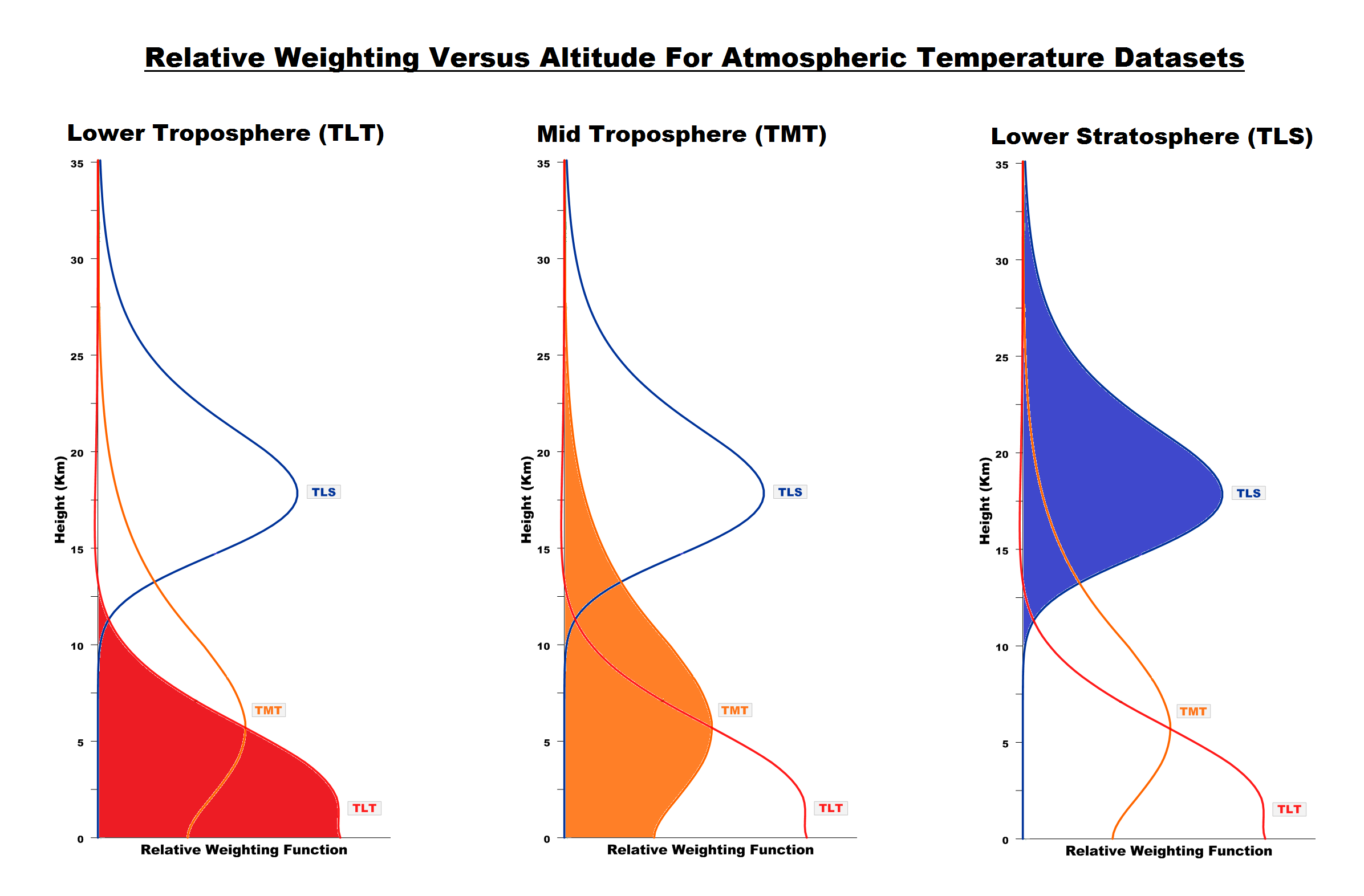
Update: The May 2014 UAH lower troposphere temperature anomaly is +0.33 deg C. It is rose sharply (an increase of about +0.14 deg C) since April 2014.

Figure 4 – UAH Lower Troposphere Temperature (TLT) Anomaly Data
RSS Lower Troposphere Temperature (TLT) Anomaly Data
Like the UAH lower troposphere temperature data, Remote Sensing Systems (RSS) calculates lower troposphere temperature anomalies from microwave sounding units aboard a series of NOAA satellites. RSS describes their data at the Upper Air Temperature webpage. The RSS data are supported by Mears and Wentz (2009) Construction of the Remote Sensing Systems V3.2 Atmospheric Temperature Records from the MSU and AMSU Microwave Sounders. RSS also presents their lower troposphere temperature data in various subsets. The land+ocean TLT data are here. Curiously, on that webpage, RSS lists the data as extending from 82.5S to 82.5N, while on their Upper Air Temperature webpage linked above, they state:
We do not provide monthly means poleward of 82.5 degrees (or south of 70S for TLT) due to difficulties in merging measurements in these regions.
Also see the RSS MSU & AMSU Time Series Trend Browse Tool. RSS uses the base years of 1979 to 1998 for anomalies.
Update: The May 2014 RSS lower troposphere temperature anomaly is +0.29 deg C. It rose (an increase of about +0.04 deg C) since April 2014.

Figure 5 – RSS Lower Troposphere Temperature (TLT) Anomaly Data
A Quick Note about the Difference between RSS and UAH TLT data
There is a noticeable difference between the RSS and UAH lower troposphere temperature anomaly data. Dr. Roy Spencer discussed this in his July 2011 blog post On the Divergence Between the UAH and RSS Global Temperature Records. In summary, John Christy and Roy Spencer believe the divergence is caused by the use of data from different satellites. UAH has used the NASA Aqua AMSU satellite in recent years, while as Dr. Spencer writes:
…RSS is still using the old NOAA-15 satellite which has a decaying orbit, to which they are then applying a diurnal cycle drift correction based upon a climate model, which does not quite match reality.
I updated the graphs in Roy Spencer’s post in On the Differences and Similarities between Global Surface Temperature and Lower Troposphere Temperature Anomaly Datasets.
While the two lower troposphere temperature datasets are different in recent years, UAH believes their data are correct, and, likewise, RSS believes their TLT data are correct. Does the UAH data have a warming bias in recent years or does the RSS data have cooling bias? Until the two suppliers can account for and agree on the differences, both are available for presentation.
In a more recent blog post, Roy Spencer has advised that the UAH lower troposphere Version 6 will be released soon and that it will reduce the difference between the UAH and RSS data.
13-YEAR+ (161-MONTH) RUNNING TRENDS
As noted in my post Open Letter to the Royal Meteorological Society Regarding Dr. Trenberth’s Article “Has Global Warming Stalled?”, Kevin Trenberth of NCAR presented 10-year period-averaged temperatures in his article for the Royal Meteorological Society. He was attempting to show that the recent halt in global warming since 2001 was not unusual. Kevin Trenberth conveniently overlooked the fact that, based on his selected start year of 2001, the halt at that time had lasted 12+ years, not 10.
The period from January 2001 to April 2014 is now 161-months long—more than 13 years. Refer to the following graph of running 161-month trends from January 1880 to April 2014, using the GISS LOTI global temperature anomaly product.
An explanation of what’s being presented in Figure 6: The last data point in the graph is the linear trend (in deg C per decade) from January 2001 to May 2014. It is basically zero (about 0.02 deg C/Decade). That, of course, indicates global surface temperatures have not warmed to any great extent during the most recent 160-month period. Working back in time, the data point immediately before the last one represents the linear trend for the 161-month period of December 2000 to April 2014, and the data point before it shows the trend in deg C per decade for November 2000 to March 2014, and so on.

Figure 6 – 161-Month Linear Trends
The highest recent rate of warming based on its linear trend occurred during the 160-month period that ended about 2004, but warming trends have dropped drastically since then. There was a similar drop in the 1940s, and as you’ll recall, global surface temperatures remained relatively flat from the mid-1940s to the mid-1970s. Also note that the mid-1970s was the last time there had been a 161-month period without global warming—before recently.
17-YEAR (204-Month) RUNNING TRENDS
In his RMS article, Kevin Trenberth also conveniently overlooked the fact that the discussions about the warming halt are now for a time period of about 16 years, not 10 years—ever since David Rose’s DailyMail article titled “Global warming stopped 16 years ago, reveals Met Office report quietly released… and here is the chart to prove it”. In my response to Trenberth’s article, I updated David Rose’s graph, noting that surface temperatures in April 2013 were basically the same as they were in June 1997. We’ll use June 1997 as the start month for the running 17-year trends. The period is now 204-months long. The following graph is similar to the one above, except that it’s presenting running trends for 204-month periods.
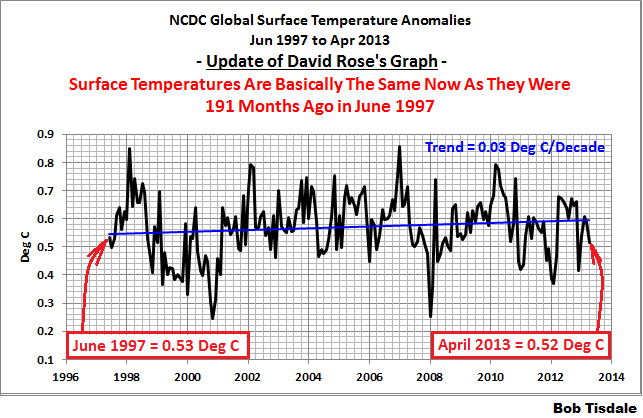

Figure 7 – 204-Month Linear Trends
The last time global surface temperatures warmed at this low a rate for a 204-month period was the late 1970s, or about 1980. Also note that the sharp decline is similar to the drop in the 1940s, and, again, as you’ll recall, global surface temperatures remained relatively flat from the mid-1940s to the mid-1970s.
The most widely used metric of global warming—global surface temperatures—indicates that the rate of global warming has slowed drastically and that the duration of the halt in global warming is unusual during a period when global surface temperatures are allegedly being warmed from the hypothetical impacts of manmade greenhouse gases.
A NOTE ABOUT THE RUNNING-TREND GRAPHS
There is very little difference in the end point trends of 13+ year and 16+ year running trends if HADCRUT4 or NCDC or GISS data are used. The major difference in the graphs is with the HADCRUT4 data and it can be seen in a graph of the 13+ year trends. I suspect this is caused by the updates to the HADSST3 data that have not been applied to the ERSST.v3b sea surface temperature data used by GISS and NCDC.
COMPARISONS
The GISS, HADCRUT4 and NCDC global surface temperature anomalies and the RSS and UAH lower troposphere temperature anomalies are compared in the next three time-series graphs. Figure 8 compares the five global temperature anomaly products starting in 1979. Again, due to the timing of this post, the HADCRUT4 and NCDC data lag the UAH, RSS and GISS products by a month. The graph also includes the linear trends. Because the three surface temperature datasets share common source data, (GISS and NCDC also use the same sea surface temperature data) it should come as no surprise that they are so similar. For those wanting a closer look at the more recent wiggles and trends, Figure 9 starts in 1998, which was the start year used by von Storch et al (2013) Can climate models explain the recent stagnation in global warming? They, of course found that the CMIP3 (IPCC AR4) and CMIP5 (IPCC AR5) models could NOT explain the recent halt in warming.
Figure 10 starts in 2001, which was the year Kevin Trenberth chose for the start of the warming halt in his RMS article Has Global Warming Stalled?
Because the suppliers all use different base years for calculating anomalies, I’ve referenced them to a common 30-year period: 1981 to 2010. Referring to their discussion under FAQ 9 here, according to NOAA:
This period is used in order to comply with a recommended World Meteorological Organization (WMO) Policy, which suggests using the latest decade for the 30-year average.

Figure 8 – Comparison Starting in 1979
###########

Figure 9 – Comparison Starting in 1998
###########

Figure 10 – Comparison Starting in 2001
AVERAGE
Figure 11 presents the average of the GISS, HADCRUT and NCDC land plus sea surface temperature anomaly products and the average of the RSS and UAH lower troposphere temperature data. Again because the HADCRUT4 and NCDC data lag one month in this update, the most current average only includes the GISS products.

Figure 11 – Average of Global Land+Sea Surface Temperature Anomaly Products
The flatness of the data since 2001 is very obvious, as is the fact that surface temperatures have rarely risen above those created by the 1997/98 El Niño in the surface temperature data. There is a very simple reason for this: the 1997/98 El Niño released enough sunlight-created warm water from beneath the surface of the tropical Pacific to permanently raise the temperature of about 66% of the surface of the global oceans by almost 0.2 deg C. Sea surface temperatures for that portion of the global oceans remained relatively flat until the El Niño of 2009/10, when the surface temperatures of the portion of the global oceans shifted slightly higher again. Prior to that, it was the 1986/87/88 El Niño that caused surface temperatures to shift upwards. If these naturally occurring upward shifts in surface temperatures are new to you, please see the illustrated essay “The Manmade Global Warming Challenge” (42mb) for an introduction.
MONTHLY SEA SURFACE TEMPERATURE UPDATE
The most recent sea surface temperature update can be found here. The satellite-enhanced sea surface temperature data (Reynolds OI.2) are presented in global, hemispheric and ocean-basin bases.
TABLE OF CONTENTS OF UPCOMING BOOK
I linked a copy to the post here of the Table of Contents for my upcoming book about global warming, climate change and skepticism. Please take a look to see if there are topics I’ve missed that you believe should be covered. I’ve already removed the introductory chapters for climate models from Section 1, and provided a separate section for those model discussions. Section 1 now only includes the chapters that introduce global warming and climate change topics. (Thanks, Gary.) Please also post any comments you have on that thread at my blog. Otherwise, I might miss them.
Thanks
Bob Tisdale
richardscourtney says:
June 25, 2014 at 12:36 pm
Troll posting as Phil.:
I have read your post at June 25, 2014 at 12:28 pm.
As I understand it,
Which clearly you don’t.
1.
You do not dispute that your argument about the hotspot asserts there has been no global warming from any cause.
2.
You want to argue about what you claim Spencer said because that will smokescreen the fact of your argument about the hotspot asserting there has been no global warming from any cause.
3.
You have abandoned your original – and very silly – assertion that stratospheric cooling was not used as a “fallback” when the hotspot failed to occur.
Do you agree that is a fair and accurate summary?
No, it’s wrong in all particulars, nice try at trying to distort the post though.
Akin to asking the question: “When did you start beating your wife?”
HenryP says:
June 25, 2014 at 3:42 am
“I’d be interested to hear from you whether you agree with me that the climate is changing, naturally, i.e. we are cooling”
Of course, we are. It’s just a repeat of the pattern in the 1930-1950 range.
Trick says:
June 25, 2014 at 5:52 am
“When the appeal is properly made to a generally accepted authority it is not a fallacy.”
No, it is always a fallacy to claim the truth or falsity of a statement depends on the person making it. You can attach a likelihood of truth or falsity based on the source, but you cannot make a definitive determination.
Simon says:
June 25, 2014 at 11:54 am
“…who to believe….the entire authoritative scientific community and the planet itself…”
When you get to define who is authoritative and who is not, and cherry pick the evidence you use, you can prove to yourself quite nearly anything you want to prove.
However, you appear to know little of the history of science. It has not generally, or even usually on the frontiers, been the case that the majority of widely acknowledged experts on a particular issue has been right. In fact, the entire history of science is replete with dead ends pursued and dogma adhered to until a shift in understanding revealed the conventional wisdom to have been erroneous.
Moderator
Thank you for your reply..
Internet phantoms who have… no name… get no respect here. If you think your opinion or idea is important, elevate your status by being open and honest. People that use their real name get more respect than phantoms with handles. The idea of the blog is to learn and discuss. Constantly changing the subject, and a refusal to discuss subjects that are raised but then may lead to an uncomfortable conclusion for one party are not acceptable behavior. Discussion requires an honest give and take, no mater where it leads.
——————————————————————————-
My name is indeed Simon. I can’t think why given people here have the weirdest handles (as they do on most blogs), you would think I would be making a name like Simon up. But for the record it is indeed my name.
I don’t believe I have done anything but state facts without getting personal. Something others here who don’t agree with me have found difficult to do. All I have really done is state a position that I maintain is not that far from Mr Watts himself and that is there has been warming, there very well could be more and at this stage it is unsure how much damage it will do?
Thank you again for the reply.
Troll posting as Phil.:
I attempted to cut through the bluster and ad homs. in your post at June 25, 2014 at 12:28 pm and – in my post at June 25, 2014 at 12:36 pm – to state the only three pieces of real information I could discern in your post. I said those were what I understood your post to have said and I asked you
At June 25, 2014 at 1:16 pm you have replied saying I had not understood and responding to my summary by saying in total
Clearly, I did not ask a “have you stopped beating your wife” question and I would be interested to know in what way you think I “distorted your post” other than my failure to mention its ignorant and childish insults. Importantly, I fail to understand how my post was “wrong in all particulars” and I would welcome information as to what you did intend if not the “particulars” I stated.
These are the “particulars” which summarised my understanding of what you wrote, and I would welcome your corrections of them if they are not what you intended to say.
Richard
Bart 1:22pm: “..it is always a fallacy to claim the truth or falsity of a statement depends on the person making it.”
OT and agreed in the case you mention since your circular appeal example is improperly produced. When the appeal is properly made to a generally accepted authority it is not a fallacy.
******
OT Q: “When did you start beating your wife?”
Successful counter that attempt at entrapment with simple A: I have never beaten my wife.
Well, unless you previously admitted to such under oath and IF you want to admit having a wife.
Usually followed up with: “You dodged my question.” Stop that with a redirected Q back: How could I have beaten a wife I never had?
Q’s: Is blog commenting entertaining? & How are you?
A: It’s complicated.
Simon says:
June 25, 2014 at 2:06 pm
You may have missed a key, and put in a non-existent e-mail account. I think I’ve lost some that way.
Bart
However, you appear to know little of the history of science. It has not generally, or even usually on the frontiers, been the case that the majority of widely acknowledged experts on a particular issue has been right. In fact, the entire history of science is replete with dead ends pursued and dogma adhered to until a shift in understanding revealed the conventional wisdom to have been erroneous.
————————————
While you are of course right that history is full of people/scientists who have got things wrong, it is a dangerous road to assume that means it is a likelihood that all things scientists assert or agree on will most likely be wrong. Science (in the last 100 years anyway) has got a whole lot more right than it has wrong, I’d rather put my faith in mainstream science than not. It’s why I immunize my kids (and myself), fluoridate my water and exercise every day.
Simon says:
June 25, 2014 at 6:49 pm
“It’s why I immunize my kids (and myself), fluoridate my water and exercise every day.”
And, no doubt, avoid tobacco products. But, these are all influences which can be studied in controlled experiements over short timeframes, and cause and effect thereby validated. When you are on the frontiers where such closed loop experimentation is impossible, “expert” opinion is really nothing more than a semi-informed guess.
Look, Simon, in the last century, scientists have been wrong about eugenics, about continental drift, about the steady state theory of the universe, and about the bacterial origins of stomach ulcers, to name a few of the most glaring errors made by consensus science. And, the establishment scientists are wrong about global warming. You can’t get around the 18 year-and-counting halt in global temperatures. If CO2 were actually so powerful a climate modulator as they have proposed, and it has increased an additional 30% above its pre-industrial concentration during the interval of the stagnant temperatures, then there is a blatant contradiction.
I would direct you again to my first comment in this thread. Read it this time for comprehension. Look at the plots. And, realize that there is nothing going on today which shows any deviation from the long established pattern. And, that long established pattern A) has nothing to do with us, and B) is one of modest, natural warming, meriting no particular concern.
Bart
Much of what you say is true…. I’m just not sure about the “natural trend thing.” I think it unwise to assume the temp will follow a straight line with CO2. and that if it doesn’t, it somehow proves it is all over rover for the proof it (CO2)has an influence on our climate. It is an interesting time we live in and I can’t wait to see what the next few years have in store. I actually think there is every chance the temp will not rise any more, simply because as we know this is a hugely complex thing and maybe science has it wrong. If that is the case, then that is great news. As Prof Richard Alley once said… if this were a movie I would push fast forward and race to the end to see what happens.
[snip]
bart says
http://www.woodfortrees.org/plot/hadcrut4gl/from:1900/to:2015/plot/hadcrut4gl/from:2002/to:2015/trend/plot/hadcrut3gl/from:1987/to:2015/plot/hadcrut3gl/from:2002/to:2015/trend/plot/rss/from:1987/to:2015/plot/rss/from:2002/to:2015/trend/plot/hadsst2gl/from:1987/to:2015/plot/hadsst2gl/from:2002/to:2015/trend/plot/hadcrut4gl/from:1987/to:2002/trend/plot/hadcrut3gl/from:1987/to:2002/trend/plot/hadsst2gl/from:1987/to:2002/trend/plot/rss/from:1987/to:2002/trend
Henry says @Bart
interesting link and graph.
btw could you just show me how you got that written as a nice short link?
{I forgot or else the way as it was shown to me last time does not work here anymore}
First of all, the graph from 1900 shows a general upward trend which I think is mostly due to improved equipment as time goes by, e.g. before 1950 thermometers were not even re-calibrated at regular intervals. Since the seventies we started with thermo-couples and automatic recording equipment which must have caused a big jump in accuracy as well. I find something similar happened with the SSN data as well.
Interesting also, that you have identified where we are more or less on the timescale of the Gleissberg cycle.
According to my calculations and the positions of the planets we are now around 1925/1926.
I reckon you are the cleverest of us all here, so I want to challenge you a bit by giving me a prediction as to where we are headed with this graph for the next 46 years or so:
http://ice-period.com/wp-content/uploads/2013/03/sun2013.png
Note the bi-nomials (quadratics) you can draw from the top to bottom (hyperbolic, + field strength) and from the bottom to the top (parabolic, – field strength). Seemingly [to me] it must come to a dead end stop around 2015 or 2016?
Simon says:
June 25, 2014 at 7:34 pm
Fair enough. Sorry for my cross words earlier. I’m sick to my teeth of the whole thing, and certain that it is piffle, and sometimes lose patience.
HenryP says:
June 25, 2014 at 10:39 pm
You embed the links like this (using less than and greater than signs instead of parentheses)
(a href=”linkname”)words you want to appear(/a)
“…giving me a prediction as to where we are headed with this graph for the next 46 years or so…”
My bet is that the future will look something like this.
Bart
My bet is that the future will look something like this.
————————-
Looks reasonable. As good a bet as any.
Troll posting as Phil.:
Thankyou for attempting to answer my request at June 25, 2014 at 2:10 pm for you to explain what you thought I had misunderstood in your post at June 25, 2014 at 12:28 pm.
Your attempt is at June 25, 2014 at 9:30 pm and is very strange. It makes me wonder if you suffer from dyslexia or some similar malady: if so, then perhaps you would say that to permit your illogical behaviour to be considered with charity.
You say to me
As everybody can see, I repeatedly tried that but you repeatedly selected from the quotations, avoided answering my points, changed subject, and ‘moved goalposts’. Eventually, I tried to cut through that ‘Gordion Knot’ of your accumulated falsehoods and to summarise what I understood you to have said. Now you complain because I tried to summarise the issues: that complaint could be your dyslexia or your duplicity but it is hard to imagine any other understanding of it.
I turn from those general points to the three specifics which I stated were what I understood you to have said.
I wrote
You have replied
No! That is a summary of your refusal to address the effect of the issue which you raised and I repeatedly put back to you. And you DID write “your argument”.
At e.g. June 25, 2014 at 3:55 am you claimed of the tropospheric hot spot
And you wrote that in response to my REPEATEDLY writing to you
I really am beginning to think that your many falsehoods are a result of your mental condition. You asserted the hotspot “can be caused by any source of warming”, you repeatedly refused to answer my point that if your assertion is true then there has been no global warming from any cause, and when I summarise that as “You do not dispute that your argument about the hotspot asserts there has been no global warming from any cause” you reply that it is something you “did not write”.
Troll, can you understand the problems your assertions cause me? I answer what you write and you reply, “This is your ‘summary’ of something I didn’t write!” Discussion is not possible when you provide such non sequiter.
My second summation of my understanding of your words said
Your reply says in total
I made no “insinuation”: I made a blunt statement.
You raised the issue of Spencer which I refused to address because it is not relevant. Of importance is that if your assertion is true then the absence of the hotspot combines with your assertion to indicate that there has been no global warming. Who has or has not supported your assertion alters that not one jot.
No ‘mind reading’ is involved. If you did not raise the irrelevance as a smokescreen then why did you raise it? And why did you not dispute my understanding of it being a smokescreen when I raised that in a previous post?
You raise an additional red-herring presumably as additional smokescreen. The hot-spot is missing: it has not been detected. People can “discuss” that as much as they like, but the rate of warming at altitude is not observed to be 2x to 3x the rate of warming at the surface in the tropics; i.e. the hot spot is missing.
The fact that the hot spot was determined to be missing is why the “fallback” mentioned by dbstealey was adopted.
Your dispute of my third point is surreal.
I wrote
And you have replied
Say what!? Have you completely abandoned your senses?
This entire dispute was your ridiculous assertion that dbstealey was wrong when he wrote at June 19, 2014 at 1:28 am saying in total
The entire debate between me and you has been about that. But you now reply to my saying to me,
“You have abandoned your original – and very silly – assertion that stratospheric cooling was not used as a “fallback” when the hotspot failed to occur.”
And you assert that you “did not make that claim” which was”fabrication” by me.
Importantly, I joined debate of that with you at June 20, 2014 at 1:25 am where I wrote
The fact that dbstealey was right is not affected in any way by your pretending (to yourself?) that you having stated an irrelevance ‘proves’ something.
In summation, it is clear that your post I am answering demonstrates that my attempted summary of your assertions was completely correct.
Richard
@bart
thanks, I hope this works:
trend from 1987
I am with you on your graph where you show cooling until 2040. The rest: I don’t think so.
I am convinced that temperature [and the warming of the past] is [was] driven exclusively by the sun. In this respect the graph of the sun’s magnetic field that I quoted to you is relevant on what way it is going to go. Namely, my results on the speed of warming over the longest period (i.e. from 1973/1974) for which we have very reliable records, show maxima : means: minima
0.034 : 0.012 : 0.004 in degrees C/annum.
That is ca. 8:3:1. So it was maxima pushing up minima and means and not the other way around.. Anyone can duplicate this experiment and check this trend in their own backyard or at the weather station nearest to you. AGW theory assumes increasing minima pushing up means. I already showed from my results for minima that there is no AGW, as there is no room for it in my equation.
Global cooling has now set in [from 1995, when looking at energy-in] and it will continue until 2038
There might be some [cooling] lag as well. That means when looking at the longer period, the planet will not start warming again until 2050.
I believe the general upward trend from 1900-1970 was largely due to improved sample size and better measuring and recording equipment. If true, that simply means that by 2050 temperatures will be back to where we were in 1950. The [apparent] 90-100 year weather cycle is called a Gleissberg cycle.
HenryP says:
June 26, 2014 at 5:46 am
Well, maybe. All I’m sure of is it isn’t being driven by anthropogenic release of latent CO2, and there is no indication of anything catastrophic waiting in the wings. I’m a lot more worried about real threats to humanity, like antibiotic resistant microbes, or nuclear proliferation, or asteroid strikes. It strikes me that CO2-phobia (carbdiphobia might be a good neologism) may be a coping mechanism, a way of transferring the terror we ought to feel about actual threats to something we know, in the backs of our minds, isn’t really a threat at all.
In any case, I think we have too little data, and too little investigation of it while unserious scientists pursue the monomania known as AGW, to say for sure what is going to happen in the future. Given that lack, I think the most likely event will be for established patterns to continue into at least the near term, hence my projection.
@bart
yes, looking back the climate scientists are to blame for a lot of the false alarm causing a lot of loss of money. It is such a great pity. The CO2 nonsense is incomprehensible in view of the facts. If you are interested you can read some of my musings here:
http://blogs.24.com/henryp/2011/08/11/the-greenhouse-effect-and-the-principle-of-re-radiation-11-aug-2011/
As to the CFC’s red herring, I was actually caught up with it, working [in industry] to try and get rid of them. In hindsight, I find it was also nonsense.
After my investigations’ results, I figured that there must be a small window at the top of the atmosphere (TOA) that gets opened and closed a bit, every so often. Chemists know that a lot of incoming radiation is deflected to space by the ozone and the peroxides and nitrogenous oxides lying at the TOA. [Trenberth knew this, but he only evaluated ozone, he never checked the other chemicals]. These chemicals are manufactured from the extreme UV coming from the sun. Luckily we do have measurements on ozone, from stations in both hemispheres. I looked at these results. Incredibly, I found that ozone started going down around 1951 and started going up again in 1995, both on the NH and the SH. Percentage wise the increase in ozone in the SH since 1995 is much more spectacular.
I had now already found three exact confirmations for the dates of the turning points of my A-C wave for energy-in. The mechanism? We know that there is not much variation in the total solar irradiation (TSI) measured at the TOA. However, there is some variation within TSI, mainly to do with the UV (C). It appears (to me) that as the solar polar fields are weakening, more energetic particles are able to escape from the sun to form more ozone, peroxides and nitrogenous oxides at the TOA.
http://ice-period.com/wp-content/uploads/2013/03/sun2013.png
In turn, these substances deflect more sunlight to space when there is more of it. So, ironically, when the sun is brighter, earth will get cooler. This is a defense system that earth has in place to protect us from harmful UV (C). The atmosphere protects us from harmful radiation coming from the sun.
Most likely there is some gravitational- and/or electromagnetic force that gets switched every 44 year, affecting the sun’s output. How? You tell me.
Phil. says:
June 25, 2014 at 9:30 pm
[snip]
Mods: Why?
richardscourtney says:
June 26, 2014 at 2:11 am
Troll posting as Phil.:
Thankyou for attempting to answer my request at June 25, 2014 at 2:10 pm for you to explain what you thought I had misunderstood in your post at June 25, 2014 at 12:28 pm.
Your attempt is at June 25, 2014 at 9:30 pm
No it isn’t, it’s been erased!