From Georgia Tech: Studies examine puzzling summertime streaks
Martian experts have known since 2011 that mysterious, possibly water-related streaks appear and disappear on the planet’s surface. Georgia Institute of Technology Ph.D. candidate Lujendra Ojha discovered them while an undergraduate at the University of Arizona.(picture follows)
These features were given the descriptive name of recurring slope lineae (RSL) because of their shape, annual reappearance and occurrence generally on steep slopes such as crater walls. Ojha has been taking a closer look at this phenomenon, searching for minerals that RSL might leave in their wake, to try to understand the nature of these features: water-related or not?
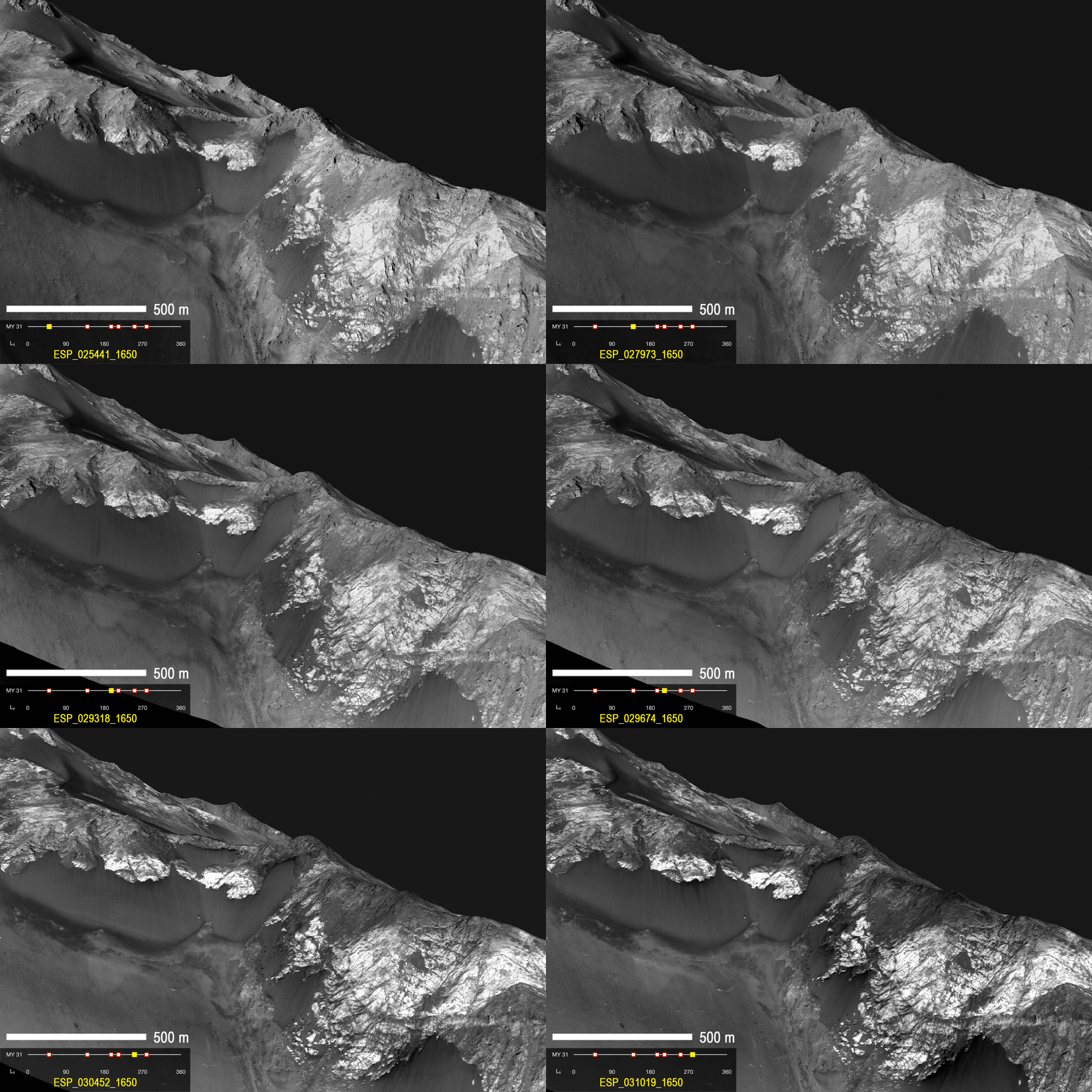

Dark flow like features called Recurring Slope Lineae emanating from bedrock exposures at Palikir crater on Mars during southern summer. These flows are observed to form and grow during warm seasons when surface temperature is hot enough for salty ice to melt, and fade or completely disappear in cold season. Arrows point to bright, smooth fans left behind by flows.
Ojha and Georgia Tech Assistant Professor James Wray looked at 13 confirmed RSL sites using Compact Reconnaissance Imaging Spectrometer for Mars (CRISM) images. They didn’t find any spectral signature tied to water or salts. But they did find distinct and consistent spectral signatures of ferric and ferrous minerals at most of the sites. The minerals were more abundant or featured distinct grain sizes in RSL-related materials as compared to non-RSL slopes.
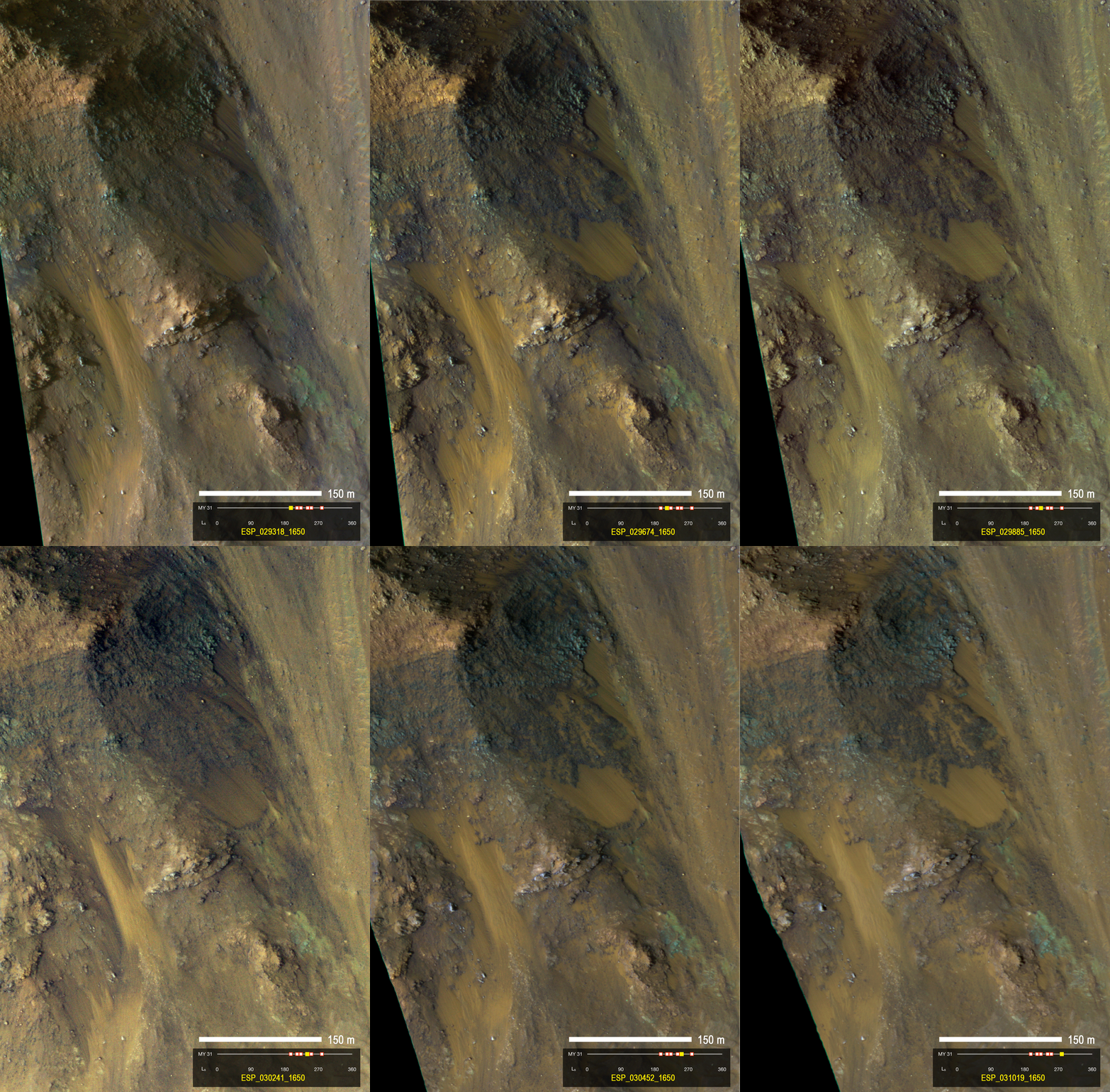
“We still don’t have a smoking gun for existence of water in RSL, although we’re not sure how this process would take place without water,” said Ojha. “Just like the RSL themselves, the strength of the spectral signatures varies according to the seasons. The signatures are stronger when it’s warmer and less significant when it’s colder.”
The research team also notes that the lack of water-related absorptions rules out hydrated salts as a spectrally dominant phase on RSL slopes. For example, ferric sulfates have been found elsewhere on Mars and are a potent antifreeze. If such salts are present in RSL, then they must be dehydrated considerably under exposure to the planet’s conditions by the time CRISM observes them in the mid-afternoon.
The findings were recently published in Geophysical Research Letters, and the Georgia Tech duo’s newest paper, published in the journal Icarus, indicates that predicting where RSL will appear is, at best, a guessing game.
Ojha, Wray, and several Arizona-based colleagues looked at every image gathered by the High Resolution Imaging Science Experiment (HiRISE) from March to October of 2011. They hunted for areas that were ideal locations for RSL formation: areas near the southern mid-latitudes on rocky cliffs. They found 200, but barely any of them had RSL.
“Only 13 of the 200 locations had confirmed RSL,” said Ojha. “There were significant differences in abundance and size between sites, indicating that additional unknown factors such as availability of water or salts may play a crucial role in RSL formation.”
Comparing their new observations with images taken in previous years, the team also found that RSL are much more abundant some years than others. Water on Mars today seems elusive at best – there one year, gone the next.
“NASA likes to ‘follow the water’ in exploring the red planet, so we’d like to know in advance when and where it will appear,” Wray said. “RSL have rekindled our hope of accessing modern water, but forecasting wet conditions remains a challenge.”
Ojha and Wray are also among several co-authors on another RSL-related paper published this month in Nature Geoscience. That study, led by the University of Arizona’s Alfred McEwen, found some RSL in Valles Marineris, near the Martian equator.
I can’t see any evidence for water. Just the usual disturbances on dry sand banks. Mars is covered in dust, so when stuff moves it disturbs the dust. Leaving the marks of freshness.
Really great vid’s Paul thanks they bring back memories playing in the Dunes. OK. looking at the Mars pics (enhanced) I see where every flow is they seem to originate between two mountain tops (mountain passes) ,with the low gravity, the high wind speed and dust storms that can last for months I think it has little to do with “the evidence of water” (sorry duster) I think it is”DUST IN THE WIND” one of my fav’s btw.
OK, pedant alert, but shouldn’t it be “Experts on the planet Mars” and not “Martian experts” ?
These are Martian experts (as the people from Huddersfield who post on here will attest to):
Whoever said send another probe fell for NASA’s propaganda. NASA is a genius at hints and innuendo about Mars. Each mission is designed to prove nothing except government must steal more money for future missions. And they do it well.
Seems like wishful thinking. Some people really want there to be water. If there actually was water, it probably wouldn’t be so hard to detect.
“Martians” or “experts on the planet Mars”
Both can be misinterpreted – perhaps it should be “experts here who study Mars..”
Meh – we know what he meant
That there is water ice on & especially in Mars is not in doubt. Whether it ever flows on the surface before ablating or sublimating in the thin atmosphere is another issue. There is some evidence that liquid water might have existed on Mars long ago.
IMO the report that rover Curiosity detected practically no methane in Mars air last year was a severe blow to proponents of present life on the Red Planet.
“Martians” or “experts on the planet Mars”
Both can be misinterpreted – perhaps it should be “experts here who study Mars...!!!!
Meh – we know what he meant..!!!!
Steve says:
February 11, 2014 at 11:11 am
> Send a probe to one of the poles! Not sure why we haven’t done that…
Latitude 90 or just high latitude?
Mars Polar Lander, failed at landing at 76°S 195°W
http://www.astronautix.com/craft/marander.htm
Phoenix found water ice at 68.22°N 125.7°W
http://phoenix.lpl.arizona.edu/index.php
I don’t know if it’s water or not but it is refreshing to see scientist who desperately want to find water being honest about what there findings have not found. No smoking gun and they’re honest enough to not fabricate one out of a tree ring.
What they really are seems more important to them than what they want them to be.
Much as I’d like there to be water, I’ll have to go with a sandy wind showing a different trace depending which way it has blown. Some other landforms said to be water-etched, are similarly likely to be wind-etched over many aeons.
What?
Mars through a period of time had a hot core, IE dynamo which produced and held a significant magnetosphere, just like our rock…
Within a magnetosphere lies the others, including a troposphere AKA possible life and definitely water…
What happens when a core goes cold???
You certainly don’t need to be a genius to figure than one out!
Then, again, is there fossils or life elsewhere? But, isn’t the emergence and maintenance of life a process of radical contingency? That is, is a unique and unrepeatable past totally necessary? Or does life emerge through space like mushrooms when some conditions are present? So, how many conditions are necessary: three, four, trillions, infinite? Only one, water or any sort of God? Is God the word that means infinite conditions, absolute necessity? Anyway, how did the life that emerge in a given conditions resist when switching to a different moment? How does life resist time itself, the effects of entropy? But, is it possible for human beings to recognise a simpler life than their own brain only? On the other hand, beyond likeness, is it possible to recognise a complex life than their brain, is this the extra-terrestrial life that some people are searching unsuccessfully? However, is there an origin of life or would it be as finding a cut in the material history of the universe, an infinite void that human language patches now? Along these lines, there is a peculiar book, a short preview in goo.gl/rfVqw6 Just another suggestion, far away from dogmas or axioms.
Leeward sand a dust accumulation, I’d say. shame.
Here is a video that demonstrates that at least some of the flows n Mars are not simply from millions of years of wind blowing:
john:
Your post at February 11, 2014 at 2:27 pm says of my comment at February 11, 2014 at 1:02 pm
Sorry, but no. I am not discussing wind-blown sandstorms: I am discussing fluidised sand.
The wind energy is reduced by air density in linear relation.
The wind energy is increases in proportion to the cube of the wind speed.
The requirement is sufficient wind force to lift a sand grain against gravity which is smaller on Mars than Earth. When the bulk of individual particulates on a surface start to move then the fluidisation will occur both as a result of particles impacting with the surface (bouncing) and the CO2 atmosphere flowing between the particles adding fluidisation energy.
Richard
These dark Martian flows or Recurring Slope Lineae (RSL) are:
– seasonal – they appear (relatively dark) and extend down the steep slopes (25° to 40°) during late spring through summer, fade in winter, and return during the next spring.
– they seem to start very narrow (from a single point), like a spring of a river and get wider down the slope. Normally they’re roughly around 5 m wide (but also wider) and can get 100s m long.
– they favor warmer, equator-facing slopes
– are very distinctive – these dark features appear different from other types of features on Martian slopes
Some pictures:
http://ida.wr.usgs.gov/fullres/divided/m08076/m0807686b.jpg
http://ida.wr.usgs.gov/fullres/divided/m09021/m0902167a.jpg
http://ida.wr.usgs.gov/fullres/divided/m09024/m0902487d.jpg
Seems like the Chinese moon rover couldn’t wake up from its sleep:
http://www.universetoday.com/109266/earth-bids-chinas-yutu-moon-rover-farewell-forever/
richardscourtney says: February 11, 2014 at 1:02 pm
[…]
So, my question to any geologists who may be so kind as to enlighten me is
How does one distinguish between a Martian pebble that has been “rounded” by water and a Martian pebble that has been “rounded” by a fluidised flow of small particulates?
While I make no claim to be a geologist, I’ve spent many years rock-hounding, and cutting and polishing stone for jewelry. In a completely fluid scenerio, it would be impossible to distinguish a dry versus wet environment. I was going to comment on what I thought at first would be the discerning observation, until I understood you meant a stone in motion in a dry environ. I had grasped on memories of stones protruding above the soil in high plains desert-like areas of the southwest US. These stones, often agates, a hard amorphous silica, will be perfectly polished on the exposed surface from airborne particle abrasion, and the subsurface stone will be unpolished. This would be on hilltops in areas where there is less than 12″ of precipitation annually, and a consistent wind, and not what you meant, as the stone is stationary.
“How does one distinguish between a Martian pebble that has been “rounded” by water and a Martian pebble that has been “rounded” by a fluidised flow of small particulates?”
Wind-polished and water-plished rocks look very different. They have diffent shapes and very different surface textures. As for rocks rounded “by a fluidised flow of small [dry] particulates”, I don’t think anyone has ever seen one. Rounding stones takes decades to millenia, whle fluidised flows are typically very short-lived events.
tty:
Thankyou for your reply to me at February 12, 2014 at 9:56 am which says
Many people have seen many stones rounded “by a fluidised flow of small [dry] particulates””. I have seen very many (thousands). Everyone who has conducted scaled modelling studies of fluidised bed combustion systems has seen – and probably handled – them. Stones round in hours (n.b. not decades) when fluidised.
At issue is how one would identify effects of water flows and fluidised particulate flows on Mars.
Fluidised particulate flows are rare and short-lived on Earth, but so what?
Whether or not they are rare and short-lived on Mars, weathering from water may not happen on Mars. Hence, on Mars effects of non-aqueous weathering could accumulate over millenia without being obliterated by aqueous weathering.
Richard
Rainbow Beach Australia. Check out the photos.
I see exactly this sort of splash on the sand dunes at Rainbow Beach. It’s caused by the old hard dune sands above drying out in the sun, and being disturbed by the wind. Small splashes of coloured sand falls and leaves streaks of colour down the face of the dune.
I believe that is what you are seeing.
Box of Rocks says:
February 11, 2014 at 11:23 am
“Those thingies on the surface of Mars are not created by water.
Water cuts a 3 dimensional channel with a lot of meanders. Just look at your favorite river on a map.”
Meanders form with a long term steady flow of reasonably pure liquid water on a flat-ish plane. The features we’re looking at probably weren’t formed that way. It’s probably more closely related to California-style mudslides or flash floods in desert areas like Las Vegas. Fast, devastating and short lived.
bazza says:
February 11, 2014 at 12:56 pm
Michael mann said the lines were caused by global warming.Or someone dragging a hockey stick through the dirt.While looking for a tree.
******************************************************************************************
A hockey stick or knuckles?
SteveT
=====================================================================
I don’t think we have the means to check out the texture of the rock’s surfaces.
I had one of those “Rock Tumblers” once. It took a few days to polish a stone. It seems to me that friction and abrasion are what is primarily needed rather than time. That is, the more friction and abrasion, the less time would be required.
I don’t say that as points to argue but as points to consider.