From Georgia Tech: Studies examine puzzling summertime streaks
Martian experts have known since 2011 that mysterious, possibly water-related streaks appear and disappear on the planet’s surface. Georgia Institute of Technology Ph.D. candidate Lujendra Ojha discovered them while an undergraduate at the University of Arizona.(picture follows)
These features were given the descriptive name of recurring slope lineae (RSL) because of their shape, annual reappearance and occurrence generally on steep slopes such as crater walls. Ojha has been taking a closer look at this phenomenon, searching for minerals that RSL might leave in their wake, to try to understand the nature of these features: water-related or not?
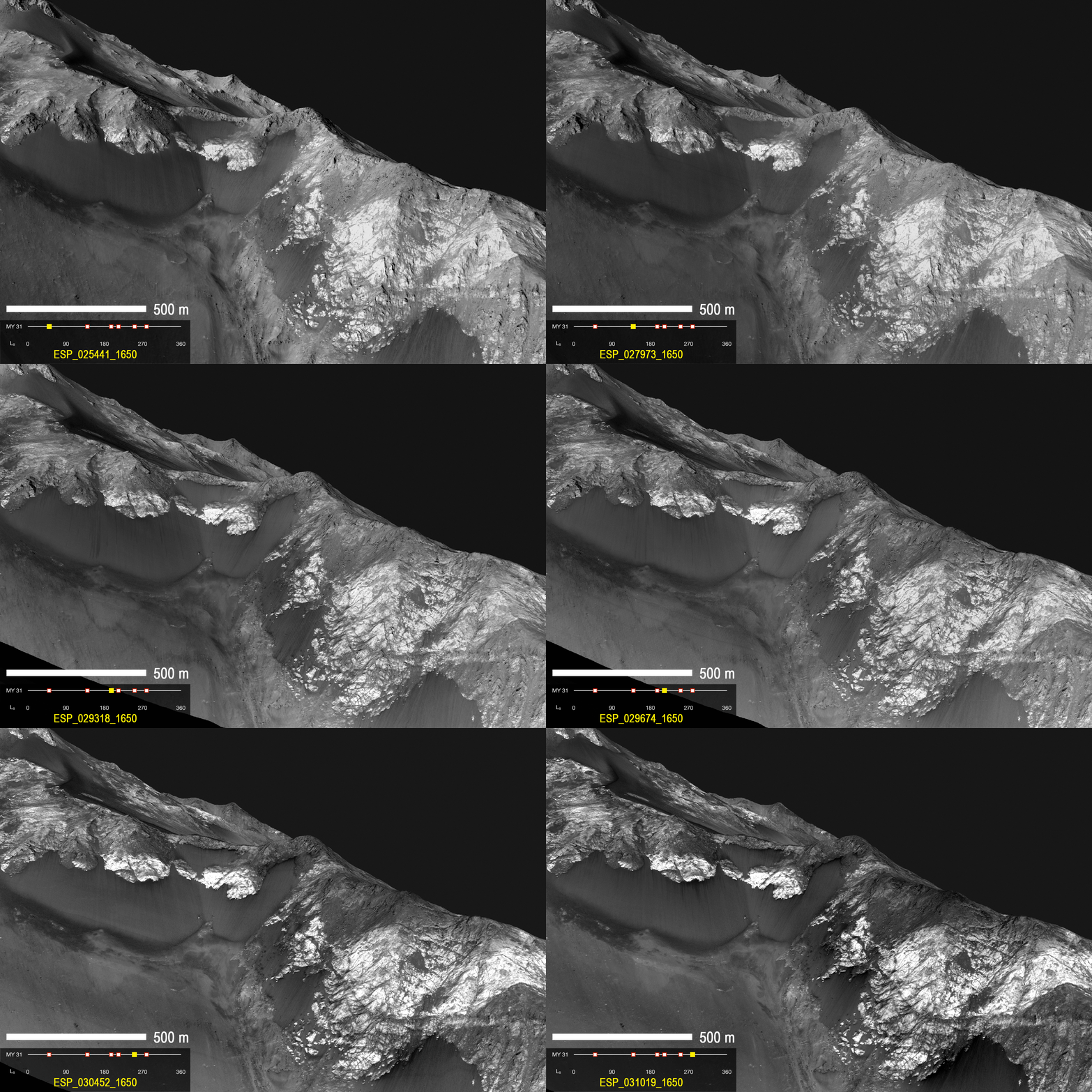

Dark flow like features called Recurring Slope Lineae emanating from bedrock exposures at Palikir crater on Mars during southern summer. These flows are observed to form and grow during warm seasons when surface temperature is hot enough for salty ice to melt, and fade or completely disappear in cold season. Arrows point to bright, smooth fans left behind by flows.
Ojha and Georgia Tech Assistant Professor James Wray looked at 13 confirmed RSL sites using Compact Reconnaissance Imaging Spectrometer for Mars (CRISM) images. They didn’t find any spectral signature tied to water or salts. But they did find distinct and consistent spectral signatures of ferric and ferrous minerals at most of the sites. The minerals were more abundant or featured distinct grain sizes in RSL-related materials as compared to non-RSL slopes.
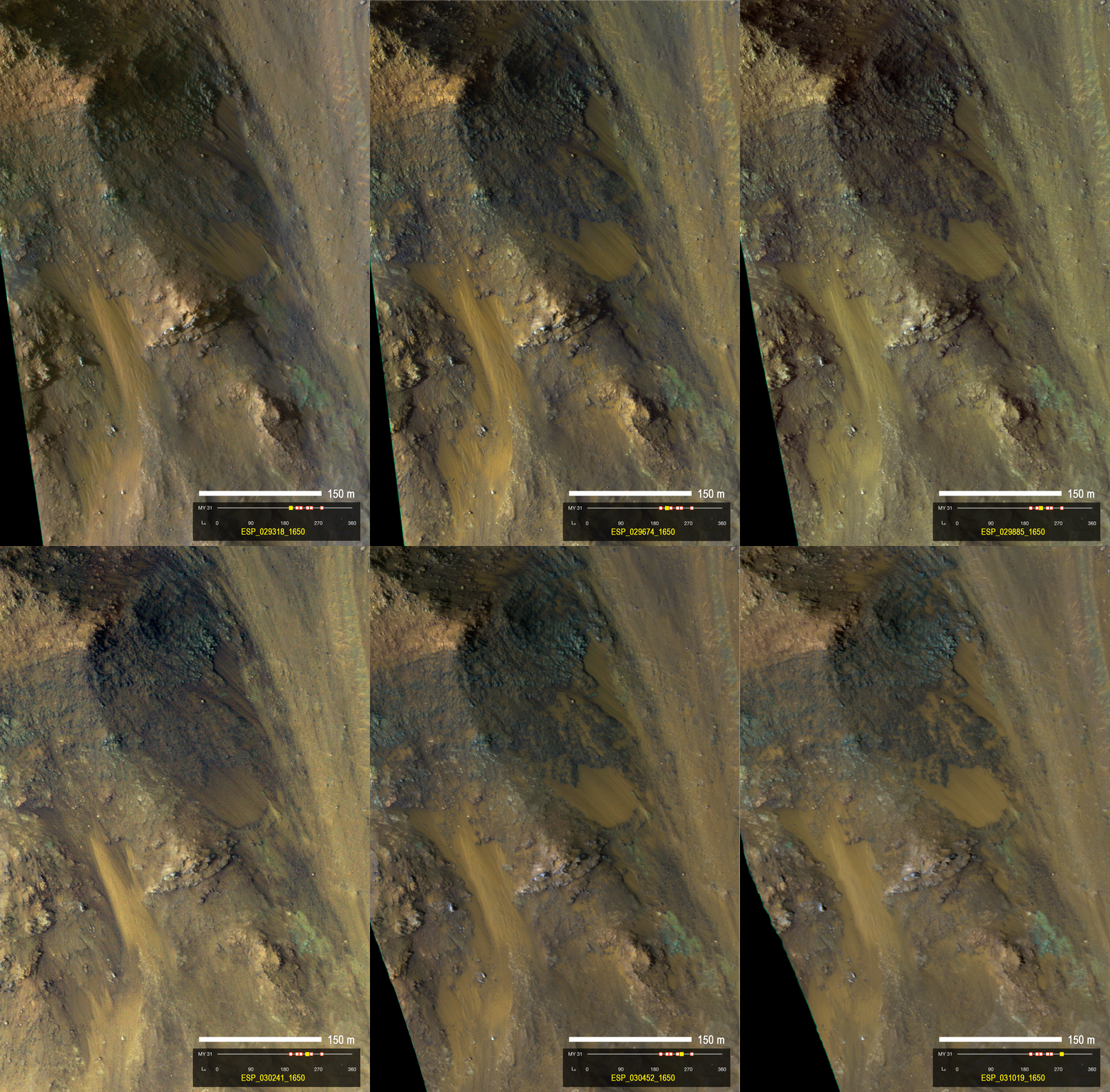
“We still don’t have a smoking gun for existence of water in RSL, although we’re not sure how this process would take place without water,” said Ojha. “Just like the RSL themselves, the strength of the spectral signatures varies according to the seasons. The signatures are stronger when it’s warmer and less significant when it’s colder.”
The research team also notes that the lack of water-related absorptions rules out hydrated salts as a spectrally dominant phase on RSL slopes. For example, ferric sulfates have been found elsewhere on Mars and are a potent antifreeze. If such salts are present in RSL, then they must be dehydrated considerably under exposure to the planet’s conditions by the time CRISM observes them in the mid-afternoon.
The findings were recently published in Geophysical Research Letters, and the Georgia Tech duo’s newest paper, published in the journal Icarus, indicates that predicting where RSL will appear is, at best, a guessing game.
Ojha, Wray, and several Arizona-based colleagues looked at every image gathered by the High Resolution Imaging Science Experiment (HiRISE) from March to October of 2011. They hunted for areas that were ideal locations for RSL formation: areas near the southern mid-latitudes on rocky cliffs. They found 200, but barely any of them had RSL.
“Only 13 of the 200 locations had confirmed RSL,” said Ojha. “There were significant differences in abundance and size between sites, indicating that additional unknown factors such as availability of water or salts may play a crucial role in RSL formation.”
Comparing their new observations with images taken in previous years, the team also found that RSL are much more abundant some years than others. Water on Mars today seems elusive at best – there one year, gone the next.
“NASA likes to ‘follow the water’ in exploring the red planet, so we’d like to know in advance when and where it will appear,” Wray said. “RSL have rekindled our hope of accessing modern water, but forecasting wet conditions remains a challenge.”
Ojha and Wray are also among several co-authors on another RSL-related paper published this month in Nature Geoscience. That study, led by the University of Arizona’s Alfred McEwen, found some RSL in Valles Marineris, near the Martian equator.
Send a probe to one of the poles! Not sure why we haven’t done that…
Very interesting observations, these dark seasonal flows. Amateurs observed it earlier in pictures of Mars surface. Around 2000, I think. NASA kinda denied it for some time.
http://en.wikipedia.org/wiki/Seasonal_flows_on_warm_Martian_slopes
Those thingies on the surface of Mars are not created by water.
Water cuts a 3 dimensional channel with a lot of meanders. Just look at your favorite river on a map.
“We still don’t have a smoking gun for existence of water in RSL, although we’re not sure how this process would take place without water,” said Ojha.
In climate science, the above sentence would read: “This is consistent with the existence of water in RSL, and we can’t think of any way this process would take place without water, therefore the science is settled; it’s water. Send bags of money.”
Well done, Ojha. Nice work, real science!
My guess? They are the leech fields for subterranean cities.
I wonder what the little green fellows think our cities are, when they view us through telescopes and see spots glow at night?
FYI, Martians were forced to move underground 6847 years ago when their environmentalists got carried away, and devised machines to clean up their atmosphere. (They couldn’t get the blame things to turn off, which is why they have so little atmosphere left.)
FLUID ≠ Water.
Solid particles can behave as a fluidized mass.
Again… hype from the panspermists and NASA trying to increase funding.
Can’t they produce a model that will tell them when temperatures will be just right for the water flows to occur and then position the Mars Reconnaissance Orbiter to get photos of the event? Or don’t they have that much confidence in models?
Box of Rocks says:
February 11, 2014 at 11:23 am
Those thingies on the surface of Mars are not created by water.
Water cuts a 3 dimensional channel with a lot of meanders. Just look at your favorite river on a map.
Those gullies are three dimensional. You need to look at 3D images. There are several sources of orbital images that include anaglyph images where the resolution is sufficient to make out fairly fine grained surface detail.
Meanders are an inverse function of slope, that is the flatter the surface a fluid flows across, the greater the meandering, “flatter” meaning the plane of the slope is closer to being perpendicular to the local gravitational field. Local geological structure also has an effect on the linearity of streams. In the case of Mars, the material being gullied is sediment slopes in steep canyons. The sediments are probably, but not certainly, aeolian or volcanoclastic in origin.
There are meanders on Mars in appropriate terrain – they are not common, but present. Also, the term “water” as applied is a bit misleading. The argument is that the streaks are the result of seasonally liquifying brine liquified brine, which has enough salt dissolved to delay the evaporation of the water component. A liquified brine flow could carry silt and sand along, dessicating as it went, creating precisely what has been seen in hundreds of images now.
It is worth noting that such flows were considered a possibility decades ago based on the available empirical evidence and known physics. Since the mobile units have landed there have been observations of both frost and condensing water droplets on the units themselves (I think Spirit was the specific rover). The droplets lasted longer than expected, but were not unanticipated.
All that said, the argument about surface geomorphological processes on Mars is still largely from analogy. In this sense it is very like the climate debate. Lots of “theory,” lots of “models,” mostly in conflict, and empirical data that doesn’t match anything as well as you would wish. Mars is an alien environment, and while the general energy processes that shape the surface have to be analogous to those on earth, the Devil, as they say, is in the details. Until we can land someone on Mars to look very closely at those details, we simply won’t know for sure.
ARRGH – “…seasonally liquifying brine liquified brine…” -> “…seasonally liquifying brine …”
Box of Rocks says:
February 11, 2014 at 11:23 am
“Those thingies on the surface of Mars are not created by water. Water cuts a 3 dimensional channel with a lot of meanders. Just look at your favorite river on a map.”
On almost flat surfaces on the earth, meanders appear. But on a steep slope on our own earth the running water create a straight channel that run paralel to each other without much meanders like form. This is a basic geomorphology of the land. We are on steep slope here.
” annual reappearance and occurrence generally on steep slopes such as crater walls.”
Papy Boomer,
looks like wind to me.
No doubt its anthropogenic…
There are many other fluids other than water that vaporize and condense like water does. I’m thinking alcohol but, that’s normal. 🙂
Michael mann said the lines were caused by global warming.Or someone dragging a hockey stick through the dirt.While looking for a tree.
Thanks Duster – I was about to respond to the meander comment, but you saved me the trouble.
Friends:
We have been here before several times: those interested can use the WUWT Search facility for
Mars water.
In one previous thread I wrote the following post. It contains a question and I now provide a similar question; viz.
So, my question to any geologists who may be so kind as to enlighten me is
How does one distinguish between a Martian gully that has been “cut” by water and a Martian gully that has been “cut” by a fluidised flow of small particulates?
Richard
=================
richardscourtney says:
September 28, 2012 at 1:28 am
Friends:
I am writing to ask a question in hope that someone can answer it for me.
The information about the image says
OK. I know nothing about how “rounding” occurs in water but I am very familiar with wear that occurs in fluidised beds of (mostly) silica sand.
Gravity is less on Mars than on Earth so stones would roll along on Mars more easily than on Earth.
Atmospheric density is much less on Mars than on Earth so winds of similar velocity would have much less force on Mars than on Earth. However, wind speeds are often much higher on Mars than on Earth. According to the Viking lander, on Mars the average wind speed is ~30 m/sec (108 km/hr, 67 mi/hr) and wind speeds of 80 m/sec (288 km/hr, 179 mi/hr) are not unusual. However, on Earth storms of more than 117 mi/hr are defined as hurricanes or typhoons and are rare.
Wind energy increases as the cube of wind speed so the energy of Martian wind acting on small stones and gravel would often be comparable to the energy of Earth hurricanes acting on similar stones and gravel. Also, the lower gravity on Mars would make it easier for winds to lift sand and gravel from the surface to induce a moving fluidised bed of particulates despite the lower atmospheric density. Indeed, severe dust storms are observed on Mars.
The potential for fluidisation of sand and gravel by Martian winds must be high especially when the winds are flowing through valleys. Hence, I would expect there to be occasional flows of fluidised sand and gravel moving over the Martian surface especially in valleys.
So, my question to any geologists who may be so kind as to enlighten me is
How does one distinguish between a Martian pebble that has been “rounded” by water and a Martian pebble that has been “rounded” by a fluidised flow of small particulates?
Richard
I’m with Paul Westhaver. I don’t doubt that there is some particulate acting as or in a manner close to a fluid. I think it also may be driven or affected by weather. ( although i am aware of the argument that Martian weather has little energy, I’m not really in a position to make a stand on that )
I’m just pleased that the red planet is not a dead planet and it has some dynamism.
“Georgia Institute of Technology Ph.D. candidate Lujendra Ojha”
He would be a graduate student. Use Ph.D. with his name when he are one.
nice video of sand behaving like a fluid.. to Toccata and Fugue
Nice video of sand flowing under the influence of gravity in the absence of water.
It is likely to be a dry flow, but a good candidate for a lubricant would be sublimating CO2loosening up the material as microscopic CO2 ice went directly to vapor. By the way, these flows have been observed since prior to 2003.
http://astronomy.swin.edu.au/sao/guest/hoffman/
http://books.google.com/books?id=SsiEeJAt7b8C&pg=PA320&lpg=PA320&dq=nick+hoffman+mars+studies&source=bl&ots=Uhgvc8DNKk&sig=JQJbxu-1oh64kaKXC44tka6a7fo&hl=en&sa=X&ei=CZr6UvX8C6bgyQGf-oGgCg&ved=0CFAQ6AEwBQ#v=onepage&q=nick%20hoffman%20mars%20studies&f=false
Dutch wet sandbox reasearch:
http://www.geo.uu.nl/~gpostma/index%20new1.htm
Experimental studies of dynamic morphology of fans and deltas establishing time constraints for water release required for formation of similar-shaped fans and deltas in craters of Mars
Sedimentary fan features (deltas and alluvial fans) provide an important record of surface water flow. Understanding the defining characteristics (particularly the duration) of this flow is integral to understanding the history of water and, potentially, life on Mars. Studies of fan morphology can provide constraints on some of these defining characteristics. The unique morphology of some Martian stepped (terraced) fans allow us to put minimum and maximum time constraints on water flow on Mars. The studies are done in collaboration with Dr. Erin Kraal, Virginia Tech US, and with the department of Physical Geography, Utrecht, Dr. M. Kleinhans
AP says:
February 11, 2014 at 12:45 pm
looks like wind to me.
——-
Me too. Snow also acts in a similar manner in windy locations.
However, it is almost a certainty that sub-surface water is present on Mars and may be present at the surface in its frozen state, near or on the poles.
The shame of it all is that we could have been there by now. Instead, the money was pissed away by idiots building monuments to themselves.
““NASA likes to ‘follow the water’ in exploring the red planet, so we’d like to know in advance when and where it will appear,” Wray said. “RSL have rekindled our hope of accessing modern water, but forecasting wet conditions remains a challenge.””
Why don’t they just get the UK’s Met Office to make a long range weather forecast for Mars and look where they predict a drought. If Met Office not available, use Tim Flannery.
richardscourtney says:
February 11, 2014 at 1:02 pm
Wind energy plays a role on mars, but due to the thin atmosphere there, I suspect it isn’t as drastic as say here on earth due to air density. Here, when I measured wind, we could assume air density at 1.201kg/m2 at sea level. While you are correct about wind energy itself, factoring in air density will produce markedly different results on mars.