Guest essay by Jan Zeman
To err is human, for messing up consistently one needs a computer. -New proverbs
Because there was a lot of publicity around the Cowtan and Way 2013 paper I decided to look into the issue.
I was not much interested in their methods (since I’m not much interested in methods of data torture, besides they have already been scrutinized by much more knowledgeable people), but rather in the following questions:
- Where did they obtain data such data that would support a “two and a half times greater” rise of global temperature anomaly “trends starting in 1997 or 1998” in their “hybrid global reconstruction” when compared to HadCRUT4 global temperature anomaly data-set?
- What such data really show and whether such data agree with other data or not?
Because the main rationale of their analysis seems to me being that there is some missing coverage for the HadCRUT4 global temperature anomaly dataset “with the unsampled regions being concentrated at the poles and over Africa” and that it is the alleged reason why the HadCRUT4 data-set is purportedly biased, first what I have looked for was whether there actually are other data covering the regions and what trends one can find there.
Tropics
For starter let’s see a comparison of HadCRUT4 and satellite lower troposphere data for tropics:

(I note that I chose trend period exactly October-October to avoid potential disputes about the seasonal variations and cherry-picking. The data and calculations are available here)
What we immediately see on the graph is that the HadCRUT4 trend 1997-present for tropics (30S-30N) is flat (but it is slightly rising for globe ~0.046°C per decade). We also see that both the UAH (the data-set Cowtan and Way likely used for their “reanalysis“ of the HadCRUT4 data-set) and the RSS satellite records show descending temperature trend in the 1997-present period for tropics. Only satellite data which show a rising temperature trend in tropics is UAH lower troposphere-land.
But since the UAH data-set shows the descending trend for tropics when the oceans (covering ~70% of the tropical region) are included, it is clear, that the satellite data-sets including the UAH for the tropics as whole clearly do not show warming in the tropics for the period. So they hardly can in a consistent way contribute to change the flat HadCRUT4 tropics trend into a rising trend for the period.
We can therefore immediately conclude that if Cowtan and Way used the UAH tropics-land data-set to anyway do so, it would be absolutely inconsistent, directly contradicted not only by the another satellite data-set (RSS), but by the UAH satellite data-set itself – which doesn’t show warming in tropics as whole for the period in question, moreover it shows visibly a cooling trend for tropics. So to take from the UAH data-set only the land data showing the warming, mess up the official data-set (showing flat trend for tropics and warming presumably somewhere else) with them, allegedly correcting its alleged bias, it would be clearly a sign of a bias on their side to put it extremely mildly.
In any case a hypothesis, that the UAH satellite data-sets somehow can change HadCRUT4 trend in tropics into a rising one for the period 1997-present is therefore not only contradicted by the RSS satellite record, but it is directly falsified by the UAH lower troposphere temperature anomaly dataset for tropics itself, because it shows descending trend there.
The divergence
Recently in the article written by Steven McIntyre he showed, that the Cowtan and Way hybrid global data start to markedly, one could say “hockeyschtickly”, diverge from the HadCRUT4 global data in about ~2005. He showed it well on this his picture:

The graph shows that it is in about 2005, where the Cowtan and Way data start to show a quite consistent divergence from the HadCRUT4 data – before they show a negative trend and then quite suddenly a positive one. Good to note here, that one of the two authors even participated in the discussion below the McIntyre’s article at the Climate Audit, but he didn’t objected it. Similar break-point for both Cowtan and Way data-sets is shown by Bob Tisdale here, and he notes what it has likely to do with the polar amplification.
It is clear from the graph the divergence most likely is the chief source of the rising trend in their global hybrid data-set purporting to tackle the bias in the HadCrut4.
There was another article written about the possible origins of this divergence in their datasets, so I will not repeat once written. And since the tropics do not show a warming trend – as I have shown above (- and I note that in the period since 2005 the HadCRUT4 data-set shows for tropics 30S-30N the relatively impressive downward trend of -0.134°C per decade – which is hard to beat with infilling poor coverage with invented values in the polar regions, simply because the 30S-30N is exactly half of the Earth surface area, while both polar regions combined less than 10%!), let’s have look at the other region where they claim low coverage causes a bias in the HadCRUT4 – the polar regions – and see what really is going on there in the period of the divergence. Because it has possibly broader implications than just falsifying Cowtan and Way 2013 results.
Polar Regions
Let’s first see what show the lower troposphere satellite data for the polar regions:

(used data and calculations available here)
What we see on the graph is that since the 1997 there is rising trend both in Arctic (steeper) and Antarctic (less steep). However this trend clearly have stopped in the Arctic before 2005 in both the satellite datasets, while it continued rise in the UAH dataset for Antarctica.
Let’s see why:

Again as in the tropics the land record in the UAH data-set shows much steeper slope than ocean record – which shows almost flat trend in the UAH.
It very much seems that the UAH data-set for the Antarctica land is contradicted by the RSS dataset.
Are there other data-sets which would support the rising trend in UAH data since 2005?
Quite to the contrary – there are other which contradict it.
First, there are the data from the Antarctica surface stations. I took the data from GHCN for them, I have made a sample of 20 surface-stations (all Antarctica surface-stations available at GHCN which are not missing more than one year data since 1997 and have data to present) and I have plotted their temperature mean with trends:

(used data and calculations available here)
From the above graph it is quite clear that although there is a rising temperature trend since the 1997, there is no rising temperature trend after 2005 measured at the surface stations in the Antarctica. The majority of them show a descending trend in the period and especially those further in the Antarctica inland (e.g. slopes for some of them: Amundsen-Scott: -1.56°C, Byrd station: -1.25, Vostok: -1.08°C) .
So is there actually a warming trend in the polar regions since the 2005?
As I have shown most definitely not in the Arctic. No data-set we have looked at shows there a warming trend since 2005.
But is there a warming in the Antarctica? The UAH data-set (although contradicted by the majority of the Antarctica surface-stations especially those in inland and by the RSS data-set) shows a warming both for land and ocean there.
Can we further contradict the UAH data-set, not just for the land, but the ocean too? I think we can very well.
Sea ice
There actually is a data-set, which very well covers the polar and sub-polar regions. It is not a temperature data-set, but it has a lot to do with temperature. It is the NSIDC sea ice index data-set and it covers the polar regions with daily cadence, extremely rarely missing coverage and with no major issues (-at least since 1988 – in 1987 there is a discontinuity) – because the sea-ice is unlike the surface temperature actually very well sensible by the satellite instruments. So let’s have look what it shows:
 |
(data with calculations are available here)
We can immediately see on the graph the monthly global sea-ice extent recently reached the highest level since 1999. Also the southern sea-ice extent – in the region which is allegedly warming according to the UAH and Cowtan with Way – reached not only higher level than in the 2005, higher than in the 1997, but it very recently again reached likely the all time high in the history of the satellite sea ice extent measurements since 1978 – which oddly went unnoticed by our climate watchdogs. (And as I look into the NSIDC daily sea ice data – available here and I do a small extrapolation – if Cowtan and Way can why not me just for fun – over the one remaining month, it looks to me very likely also this whole year sea ice averages will be the highest since 2003 and possibly even since 1999 – if you don’t believe just look carefully at this graph from UIUC.)

Mind also the trends in the above graph (which have periods exactly global minimum-to-minimum and maximum to maximum using the resolution of the daily data from 2005 global minima and maxima to 2013 minima and maxima) – both are rising.
But it is not temperature which is rising there, it is the sea ice extent. And it really doesn’t much look consistent with the Cowtan and Way global warming trend allegedly due to alleged warming in the polar regions.
Water usually doesn’t freeze on hundreds of thousands square kilometers areas upon a warming.
Grace to NSIDC we can also compare the maps for both hemispheres yearly maxima. Here it is for Arctic, mind the numbers:

We see that the yearly maximum area and extent were higher for Arctic in 2013 than in 2005. Which further confirms both the RSS and UAH satellite data for lower troposphere temperature anomaly in the Arctic, although it should be definitely mentioned that the Arctic sea ice still shows a descending trend in the period 2005- present. Nevertheless this trend has more than twice less steep slope than in Antarctica for the sea ice extent and more than half less steep slope for the sea ice area. So there is the observed net gain in the global sea ice trends of about 1.5 million square kilometers per decade for the sea ice extent and about 1 million square kilometers per decade for the global sea ice area.
I would very much think that if we speak about the global temperatures and their trends, we must also consider global not hemispherical trends which indicate them, and especially in the case of an oceanic phenomena as is the sea ice, because there is very uneven distribution of the ocean over the globe and the Arctica sea ice is also unlike that around Antarctica quite very constrained by the surrounding land as we see on the above map and subjected to currents from south on the side of the Atlantic.
Here is the comparison for Antarctica:

(Source here)
Even we can question whether the rising global sea ice trends have statistical significance, there quite clearly is no descending global sea ice trend since at least the 2005 (where the Cowtan and Way data start to diverge from the HadCRUT4 to presumably other direction than sea ice implies). Such descending trend (or at least flat) on the other hand one finds in (nearly) all official data-sets for the global temperature anomaly – including the UAH global data-set for the lower troposphere – the trend looks to me perfectly flat, but actually it shows a rising trend: +0.09°C together with HadSST2 and HadSST3 which show even +0.3°C …per thousand years… (I note that in my opinion the very slightly rising SST trends are right and caused by the current solar cycle maximum).

Closing remarks
It very much looks that the trend break-point in the Cowtan and Way data is itself a result of a bias, and miserable failure, likely when trying to account for the positive polar amplification – the problem is that most likely in times when there is quite likely a negative one.
It very much looks there quite is no reason to believe there is a warming trend in the global surface temperatures at least since 2005 – and even much less because of a bias in the global surface temperature anomalies due to the allegedly insufficient coverage in the tropical and polar regions.
In fact the global sea-ice data supported by multiple other data-sets give quite a very compelling evidence to the contrary.
And data is what counts in the science, which has the method based on the falsification not a confirmation bias. If the data don’t agree with a hypothesis it is in the overwhelming majority of cases the hypothesis which is falsified, not the data.
In this case the extensive real data quite falsify a hypothesis literally based on no data (which are invented to make such hypothesis possible) moreover clearly postulated to significantly change the outcome of the real official data-set (whatever we maybe think about the Hadley Center, CRU and MetOffice at least it is based on real measurements and with still relatively conservative approach without infills when compared to other global data-sets as NCDC or GISTEMP LOTI*) and moreover for such purpose with quite clear intent to cast a doubt about the current at the very least flat if not a cooling global surface temperature anomaly trend.
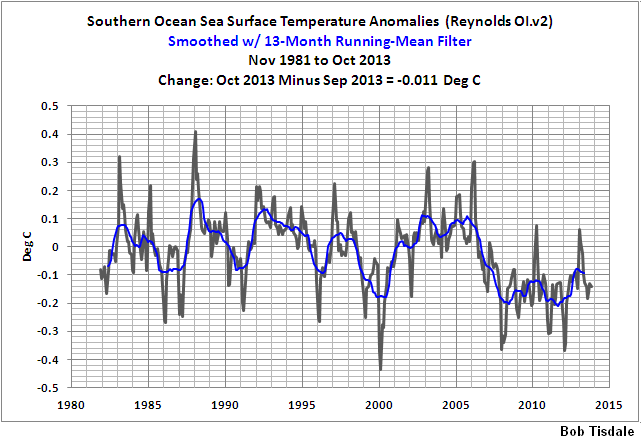
Will we believe that while the ocean somewhere cools (-as Bob Tisdale shows for southern ocean – see the footnote – and there is virtually nothing else there than ocean between the Antarctica and the 60S) – which looks quite confirmed by the rising sea ice extent there and while the tropics cool too with quite impressive rate and moeover we do not find a rising temperature trend in Arctic in any of the two satellite datasets – will we really believe there is a warming trend? A warming somewhere (maybe in Antarctica and around, and most likely not) somehow able to change the whole most likely flat or descending global surface temperature anomaly trend into a warming one – moreover with a “hypothesis that warming has accelerated…four times as likely as the hypothesis that warming has stopped“? Or we will rather take it as for other reasons than a global warming overheated Cowtan and Way computers dream?
To put it differently: Besides the data, isn’t the pathetic effort to manufacture a global warming trend using HadCRUT4 dataset and cherrypicked satellite data perhaps to allow the CAGW meme persist a little bit more, deliberately or not, the best sign of cooling?
————————————————
* If one wants to brush up on how it relates to the sea ice I recommend the final note from Bob Tisdale’s article here, which, to make this bit shorter, I allow myself to point out just one sentence from: “GISS masks (effectively deletes) sea surface temperature data anywhere sea ice has existed.”
I also note that he also shows quite consistent temperature decline for southern ocean SST from yet other data-set (Reynolds Ol.v2) – see his graph here – from here.
Kip Hansen says:
December 4, 2013 at 11:07 am
Having read the essay here, I am not entirely sure that the author, Jan Zeman, actually read Cowtan and Way 2013. He does not even approach the real questions Cowtan and Way raised, nor answer them, nor refute them. C&W is about “what happens when we infill missing temperature data for geographical cells not currently covered”? This graph
http://www-users.york.ac.uk/~kdc3/papers/coverage2013/media_summary.png
is their summary (don’t blame me, it is their site)
I actually did, not only the presentation, but the paper itself – and what you link is exactly what I didn’t like – the bold red trend implying the media message “there is a steep temperature trend”, 25° steep (I’ve actually measured it for fun), not 10° steep. Which according to their own figure 5 in their own paper mostly comes into existence in their hybrid data after 2005 where nearly all comparable data available contradict such development of the global surface temperature anomaly. I’m not so interested in their questions I’m more interested in the result and the result what happens when satellite data measuring something else than surface temperature are infilled into surface record empty cells is clearly bad and especially in its presentation you link which I consider being more a propaganda than a serious presentation of scientific results.
wlad from brz says:
December 4, 2013 at 2:17 pm
The data and calculation link in article points to an Excel worksheet without the appropriate extension. Add the extension .xlsx to the downloaded file in order to open it in MS Excel or Libre Office Calc.
The spreadsheet extension is actually .xls not .xlsx. It is created in the Open Office and exported to .xls Excel 97/2000/XP format, it opens without problem for me and as I checked with my colleague for him too. So if there is a problem it is most likely on your side.
Thinking through the logic underlying the C&W what is happening is that they are re-confirming that the HadCRUT4 data series has a large upward trend in time in it.
Basically there are holes in the HadCRUT4 data set. By bridging/infilling between known data points on either side of the hole they can then insert the missing values. This is done by using a lower trend data set (UAH) but force adjusted to the HadCRUT4 set on a month by month, cell by cell basis.
This skips round the rather inconvenient work of aligning the two data sets first (over the time they overlap).
If they in filled with a non-adjusted UAH value (i.e. absolute rather than relative) then I suspect the trend they discover would disappear.
Or OLS align the data sets directly
http://woodfortrees.org/plot/rss/offset:-0.09/plot/uah/plot/hadcrut4gl/offset:-0.29/scale:0.85/from:1979
ATheoK says:
December 4, 2013 at 2:48 pm
it puts hear say against someone’s published paper
What “hear say” you mean? I actually put official datasets against (a result made using one or two) and calculations made from them – linked in the above article.
Take the C&W 2013 paper itself along with it’s data and methods apart to find where they abducted the data.
Why? I’ve stated quite clearly in the article I’m not much interested in their methods. And to brighter ones it is quite clear where – they used the UAH TLT data (which is the record of lower tropospheric layer temperature anomaly which is only a proxy to the surface temperatures – and especially in the polar regions where the solar irradiance has high incidence angle and anyway also more than half of it which eventually reaches the surface is immediately reflected by the snow&ice back to the atmosphere, so what TLT actually measures there is more the insolation variability – at least clearly more than the surface temperatures … that btw is likely one of the reasons why the RSS doesn’t even bother to measure the TLT at the highest latitudes, where the average insolation incidence angle is close to 90° and where the proxy quality of the TLT to the surface temperatures tends to zero…) nearly as if it were the surface data itself. I didn’t mentioned it much openly in the article, because I’m decent person and the task was to falsify their resulting trend, not to embarrass the authors.
Others also pointed out other or related problems I linked in the article.
Whether their article is published or not it doesn’t much matter, it if anything makes the things worse, because their “‘razzle dazzle play’ lot of flash, dash” resulting red bold trend quite clearly disagrees not only with multiple other datasets including even sometimes perhaps with the UAH data itself, but with common sense (especially when we consider their own article in the figure 5 quite gives a hint where/when the red global trend has most of its origin and that there is the rising global sea ice trend for the same period which due to higher cadence of the daily sea ice data is unlike the temperature anomaly trends already on the edge of the statistical significance – and the trend in fact is flat or rising in period at least since 2001…) – and in my opinion quite begs retraction.
Jeff Alberts says:
December 4, 2013 at 6:14 pm
Jan Zeman, I don’t know if there’s any merit to your essay or not, but I do know that your grammar and punctuation leave a lot to be desired. If English is your second language, perhaps a native English-speaking proofreader would have been a good idea.
No insult intended, just an observation. Presentation is as important as content.
Yeah, you are absolutely right, I’m not English native. I in fact thought somebody who is will at least read the article before publication and if needed correct the language. And I quite wonder, why there were made certain changes in it, but the language problems were not corrected. I hope you at least understand the graphs and ideas.
Reply to tumetuestumefaisdubien1 December 5, 2013 at 3:47 am ==>
1. If this user is really Jan Zeman — would you PLEASE comment under your real name, or at least the same name used as author of the essay in question? Truthfully, it makes you look rather silly. If your real name is Jan Zeman, I suggest you use it. If your real name is tumetuestumefaisdubien (where ever the word breaks go), that’s OK too. But use just ONE name, the same in both places.
2. In my opinion, you are attacking the paper’s conclusion (well, part of it), without addressing the paper , its methods, found data and results themselves. This is not science — this is simply a slash-and-hack attack. WUWT has its own resident slash-and-hack attackers and has no need of another. If you wish to simply comment that you think other data and other methods — your chosen data and yourchosen methods — don’t support their conclusions, that’s fine, but don’t pretend to to be addressing the paper. You are just taking exception to a single phrase (not even a whole sentence) from their paper. C&W already state that other methods and data don’t support their claim — this is, in fact, the root of their claim. To prove it for them does not inform us of anything new — we knew that when we read C&W 2013.
3. I though C&W were spinning wildly too — see my comments at http://tinyurl.com/padltg2 .
Who be you!? Jan Zeman?
Your article above is the razzle dazzle.
Putting official datasets against C&W 2013, does what? Here are apples, there are pears. You did not show us errors in the C&W 2013, methods, mathematics, spatial, data and so on.
This leaves your article as a statement of your faith, your opinion of why ‘you’ believe C&W 2013 findings are in error.
Where is the proof C&W 2013 has errors in their reconstruction? That there are errors, many of us agree; but evidence is necessary to convince others and to progress in the world of published papers, rebuttals or confirmations..
reply to
Kip Hansen says:
December 5, 2013 at 7:28 am
First, I’ve already replied this once yesterday (our time here in Europe), but my post never appeared here – which I find quite weird under my own article. I would think that if the WUWT doesn’t want presence of my opinions here I rather wonder it first publishes my article. And in any case one could find it quite unfair.
Second, next time completely avoid directive and offensive tone. The GD arrogant outbursts will have no discernible effect on my decisions anyway. My identity is purely my private business and it only tells scores about you if you call it silly. Not speaking that I have this nick here for years and I will not change it just because you chose want me to, not speaking it is not easy in the wordpress system.
Third, the result or conclusion, or the “red scarf” bold red trend if you want, is what only I find possible to falsify and so maybe scientific in nature with the C&W13.
The rest I don’t at all. – It is inherently impossible to falsify method which using the dataset measuring something else (TLT) changes outcome of a dataset measuring something else (surface temperature). Especially at the high latitudes the TLT proxy validity related to surface temperature tends to zero for obvious reasons (at least to those who unlike the Cowtan&Way, their adherents and would-like critics understand a bit the TLT satellite measurement issue) – and I don’t really even wonder the RSS doesn’t even bother to measure it there (not speaking that it is anyway quite irrelevant for the global temperatures given the area size, not speaking the polar climate has substantially different cycles due to substantially different insolation profile, there is quite different relation – if any positive at all – between the TLT and surface temperature due to relatively extremely high incidence angles of the solar irradiation, endemic cloudiness and extremely high surface albedo than for rest of the world and that a searching for a missing heat at poles through “found data” for troposphere perhaps to account for polar amplification looks especially in times of the solar activity descent unprecedented at least in the last two centuries quite more like a product of the phenomenas frequent with inmates of certain institutions than anything else).
I don’t consider the methods from the realm of science worth of that trademark and especially not in metrologic sense at all (compared to that the Hadley Center methods are relatively quite outstanding example of conservative science), so I really don’t understand why I should be interested in it more than what I deem appropriate for it or even dig in the pile of the nonsense trying to create good data literally from thin air, which good to note they likely would never do if not provided with the computer power to calculate whatever one wishes and never asking whether it has to do something with a reality or not.
But you are anyway quite out of spot when it comes to the primary objective of my article, which was not attacking the C&W13 (I don’t have anything against the authors, I don’t know them and therefore I don’t find impossible they could be congenial fellows). -Unlike my bad grammar (I can’t help myself I’m not English native) the original title of my article was changed (making now false impression it is all about C&W13) as well as other details in the article – which I find on the edge of a censorship and definitely abusive – so I’ll think twice in the future to submit anything here and you must not be too afraid I’ll competite with others here. (-I have more serious things to do than fight with windmills and with my age and education I already know the arrogance, bad manners and breeding is not something too curable as is not the ignorance.)
The primary objective of the article was to show using the suitable framework that there is no rising surface temperature trend recently (whatsoever and in general) using the real data – the data of arguably much better quality when it comes especially to what it really measures and how acurately. And the global surface temperature anomaly is especially not rising in the period where the C&W13hybrid diverges up – and I note not only according to S. McIntyre and B. Tisdale, but the figure 5 from the very paper. In contradiction to that the seaice trends are rising not only in the 2005-present period of the divergence, but – what a coincidence – have flat or rising trend quite exactly in the period the global datasets for the global surface temperature anomaly (I mean before transplanting the incompatible tropospheric data into it and naturally causing the patients health problems to exacerbate) quite unisono show flat or descending trends – in the period ~2000-1 to present.
I wonder how a research paper which has results from the very beginning contradicted by all available data including the purportedly used UAH dataset – in its case at least clearly for the divergence period – moreover putting proverbial apples into boxes with oranges (moreover in the regions where we Czechs for the content of the boxes difference would rather use our own idiom which could be translated as “sky and bagpipes”) and making literally absolutely unsubstantiated claims in their overpublicized paper summary, how it could pass a peer-review, that’s quite a mystery to me.
But in the realm of the CAGW climate propogandistic stunts in fact I don’t wonder so much – we have seen this in the past many times, including claims more or less on par with claiming that water freezes upon warming, that Earth is discwordly flat, not spinning, orbiting at circular orbit, insolated evenly from all sides with negligible variation and with surface ε=1 while at the same time applying the Stefan-Boltzman law to such outstanding planetary size piles of assumptive unrealities all peppered with unseen university kind of manners.
We have seen this many times even here, realizing we are perhaps quite alone with knowledge against the sheer ignorance, game of one legged playing the ball with paraplegic and that perhaps the only consolation which remains is that the nature especially its laws is on our side, so we will prevail – you can be sure about it as that tomorrow the sun will rise and one day you die.
Fourth, I was in fact partially inspired also by your “red scarf” article you link (btw. as I look there you still owe me the answer to my question relevant to the tricking – in that case of yourself – there in the discussion below) so I decided to have some fun with the real data and show what’s really the trick with the global surface temperature anomaly – which you apparently didn’t understand then – and maybe even didn’t want to understand judging from your “moderation note” there – and which you apparently don’t understand now either.
Jan Zeman
Reply to Jan Zeman ==> Take several deep breathes and calm yourself.
Item 1: Sorry you had a comment disappear…such is the Internet and blogging world. I am acquainted (in the digital world) with both the major moderators here and it is unlikely that they snipped or blocked your comment (unless they have some auto-magical system that deletes comments containing ‘bad words’ or something and you accidentally used them).
Item 2: You will not gain any respect by anonymity here…certainly not by using more than one false identity. It does not instill confidence in others. It is not until you state “Yes, I’m not and English native, I’m actually a Czech. I did what I could to make my points in your language.” (December 4, 2013 at 12:22 pm) that you even vaguely claimed to be the author of the essay in question. Before that, who would know? How did you expect us to find this out? When did you plan to introduce yourself by your “other” name? It is THIS social failing that is silly. Who could care what you chose to call yourself? But, we have a right to know with whom we are conversing, even if just relative to the essay and its author.
Item 3: Try not to take yourself so seriously. Please read some of the other comments, some by people who *really* know what they are talking about (unlike me). There are several of them who have pointed out the same things I do . There are lots of ways to look at global temperatures and an infinite number of opportunities to draw trend lines on graphs (I am not a fan of trend lines on graphs 🙂 C&W 2013 actually shows and proves nothing substantial — really only that a different method of infilling produces a different result (which everyone already knows). They fail to discover/state why their method produces results different in the way that they are–what’s the reason for the differences boxed in my little graphic at the Red Scarf piece?. That’s it. See Steve M and others above.
Come on, this was a good first try….don’t despair about the editing, you acknowledge yourself that your English is rough and so someone tried to sort some of it out, I’m sure. They were trying to help and make your overall piece acceptable. They did post it. If they botched a couple of “corrections” — that’s the price one pays. Maybe next time, find a native Czech/English speaker you can sit down with and work through it so it comes out understandable *and* to your satisfaction.
And, of course, you got beat up in the comments — as a reader here, you should have expected this. Ignore the crazies and learn from the dozen or so sensible, knowledgeable souls that offered their insight. Your next piece will be better if you do.
My Red Scarf Trick essay was meant to be light and humorous. I did not want to argue anything as boring as Climate Science with the readers at WUWT as a result…I still don’t.
Kip Hansen – “They fail to discover/state why their method produces results different in the way that they are–what’s the reason for the differences boxed in my little graphic at the Red Scarf piece?”
They discuss that very point on the FAQ page they put up regarding their paper:
KR == They discuss only TWO years specifically, not the departures for periods of years (HADCRUT hot 97-2000 , HADCRUT cool 2005 – present). This is the unanswered question.
Besides, they only talk at it, they offer no real analysis.
Kip Hansen – Please read the link to their FAQ; C&W discuss the effects of ENSO and the most negative Arctic Oscillation values in 50 years WRT to those years. They _have_ presented an analysis. As to the rest of the period analyzed, those are dependent on details of global distribution, and C&W give 5×5 degree maps of their data if you are interested in how the extended coverage affects global temperature estimates over time.
Jan Zeman – You have (as Kip noted) attacked the C&W 2013 conclusions without actually evaluating their methods, and (as I noted) without discussion of their validation tests – clearly holding up against hold-outs and wholly independent temperature measurements _in the Arctic_. They have demonstrated improvements on existing methods; you have not actually criticized anything in their paper. C’est la vie – just don’t expect your criticisms to be taken seriously if they aren’t relevant to the work.
The trends since 1998 are not statistically significant, the C&W results are well within the 95% uncertainty range of HadCRUT4, and as they note such short trends are just not meaningful – this is really a demonstration of the errors in looking at (too) short term trends with insufficient data, and how those can be thrown by very small changes in estimates. Trends since 2005, as emphasized in this post, are even less significant, and it is absurd to draw conclusions from them – much as comparing last week in my neighborhood (1C) to this week (14C) cannot support arguing that NH winter has ended.
KR says:
December 6, 2013 at 9:28 pm
just don’t expect your criticisms to be taken seriously if they aren’t relevant to the work.
Tell others who will or will not be taken seriously usually is a sign of pathetic weakness of argument.
Just btw if you believe that the framework of scientific method somehow too much cares about somebodys methods before result and its agreement with reality you must have confused science with a religious denomination.
The trends since 1998 are not statistically significant, the C&W results are well within the 95% uncertainty range of HadCRUT4, and as they note such short trends are just not meaningful.
I would think that what is not meaningful is usually not made in bold red and widely publicized.
Apropos the trends in the temperature records since 1998 aren’t maybe statistically significant, but as the authors note the statistical insignificance doesn’t mean there’s no trend and they are right. Quite unfortunate for them in this regard and to the claims made in conection with their red bold trend and the Gauss curve graph at their paper summary page is that actually the global seaice trends will most likely become statisticaly significant say significantly sooner than their red bold trend – which as we all know well, let’s not pretend, will regardless what methods they used automaticaly falsify whole paper. For you not to make silly assumptions and comments in the future about trends I will reveal a secret for you: the trend significance is not directly dependent on how long or short the trend period is but on the probablity the tendency is not random.
Kip Hansen says:
December 6, 2013 at 10:22 am
Take several deep breathes and calm yourself.
I’m OK, I amuse myself with all this. Although it is quite a drag when comments you spend half an hour writing then disappear. – And it is not first time – for example I replied also ATheoK last post 9:17 pm – and what a coincidence the same: as I see now it is not here. I only can hope this goes through – I think that if this goes like this the world most viewed will very soon be reported as most often loosing posts in discussions.
It is not about taking myself seriously, it is about taking issues which are important seriously. You can’t do progress with attitude of your “moderation note” and mentoring others i.e. about what to take seriously.
It is not intended to offend you, more like advice, but actually you replies are full of mentoring and I don’t think it makes good impression as well as the repeating yourself in direct insults, only what it insults is a good taste. Just look at your last paragraph – wouldn’t you after all find it pretty insulting to all readers of the WUWT? I would think one shouldn’t take oneself too seriously, indeed.
To the note 2: I actually did only one comment here before 12:22 pm. And apropos what’s the diference between knowing me as Jan Zeman or tumetuestumefaisdubien (a citation from one of my favorites – Marguerite Duras novel Hiroshima mon amour), isn’t more important what I say than who I’m? I didn’t conceal my identity here (and there are several users I’ve communicated with in the past who know my name) and implying something like that is again insulting – because if I would really want to, you would never realize who I’m.
Concerning the graphs and trends – you must not use trends to disprove other trends, but it is quite convenient and graphic for shoving whats really going on within the curves in graphs. You maybe don’t like trends, but it is actually very powerful tool of the statistics if you know what you are doing, which I happen to know, because I have education in statistics. In many cases in science the trends are ultimate means of proof – and it, I strongly think, will work also in this case and quite well, because the trend analysis here finds quite very strikingly simmilar trend turning points in several different datasets, moreoverer the trends in seaice – unlike the ones in the temperature records including CW13 propagandistic product – already touch almost on the standard statistical significance – which is maybe not important for magicians, but in science it usually is pretty important.
And this is not just about disproving Cowtan and Way and their paper, at least not in the first place – although implanting the polar surface record with TLT looks to me like – if I use your favorite word – silly when we consider the conditions there and what plays role in the tropospheric temperatures variation and what with the surface air temperature variation there and what correlation we can expect for the high latitudes.
But I note that’s clearly not the primary cause of the CW13 result, as I look in it the polar and African tropospheric data would be unable to change Hadcrut4 global trend so much -for the areas being too small compared to the rest of the world, not speaking that the UAH TLT global has not so much steeper trend in the 1997-2012 period than Hadcrut4 as “two and half times”, so the inner inconsistence with the “two and a half times faster” warming in CW13 hybrid allegedly made using UAH, relative to the original Hadcrut4 becomes quite apparent. So I would recommend not to trick ourselves into believing much the idea the CW13 is a honest piece of science with result which just happens to disagree with anything else comparable. But that’s furthest I want to go with implications about the methods.
In fact I’m amazed how some people (not all) got tricked into believing my essay is primarily about attacking C&W paper, helped by the unfortunate change of the title. It isn’t.
It is about absolutely central question all this business here is about (and if there wouldn’t be such question, most likely this site wouldn’t even exist and we would amuse ourselves elsewhere): whether there is the global warming or not.
And my article is primarily about showing there is virtually no real data whatsoever making such claim in last more than decade – claim, which C&W explicitely and very prominently in overal message of their article undisputably do and therefore it begs falsification – but not falsification of their data fudging methods, but the claim – not just that there is the global warming, but that it is “two and half times faster” – in general.
Real data falsify such claims and especially the seaice data, which is measured by method giving unlike any globalized temperature data quite extremely little space to a doubt and the hundreds of thousands sq. km of ice is simply a proof one can’t simply dispute out just pointing elsewhere (as you undoubtedly repeatedly do, maybe because the magicians simply tend to conceal the trick). It is a physical evidence many whole states are much smaller than that.
If C&W wouldn’t make the bombastic claim about faster global warming, based on extremely doubtful infilling of the HadCrut4, quite likely made with not scientific, but political activist motivation, virtually nobody including me would ever care about their paper. It has no sense to bagatelize it. I don’t know if you, but many people frequenting this site I believe could actually realize that CW13 primary message – prominently publicized although it is impossible to prove it, simply because their trend is not statisticaly significant – should be rebutted.
Reply to tume-etc ==> Good luck to you in your future endeavors.
“….CW13 primary message – prominently publicized although it is impossible to prove it, simply because their trend is not statisticaly significant – should be rebutted.” That’;s certainly true, and you had a chance to give it a try….but did something else instead. That’s all that I, and many others, have pointed out.
tuest;
If you use FF, Chrome or Safari, you can install an add-on called Lazarus which saves every post you make. You can decide for how long. You need never lose an entry.