Guest essay by Joe Born
Is the Bern Model non-physical? Maybe, but not because it requires the atmosphere to partition its carbon content non-physically.
![bern_irf[1]](http://wattsupwiththat.files.wordpress.com/2013/12/bern_irf1.gif)
A Bern Model for the response of atmospheric carbon dioxide concentration 


![\rho_{CO_2}(t)=C_{CO2}\int\limits_{-\infty}^{t}E_{CO_2}(t')\left[ f_{CO_2,0}+\sum\limits_{S=1}^{n} f_{CO_2,S}e^{-\frac{t-t'}{\tau_{CO_2,S}}} \right]dt' .](https://s0.wp.com/latex.php?latex=%5Crho_%7BCO_2%7D%28t%29%3DC_%7BCO2%7D%5Cint%5Climits_%7B-%5Cinfty%7D%5E%7Bt%7DE_%7BCO_2%7D%28t%27%29%5Cleft%5B+f_%7BCO_2%2C0%7D%2B%5Csum%5Climits_%7BS%3D1%7D%5E%7Bn%7D+f_%7BCO_2%2CS%7De%5E%7B-%5Cfrac%7Bt-t%27%7D%7B%5Ctau_%7BCO_2%2CS%7D%7D%7D+%5Cright%5Ddt%27+.&bg=ffffff&fg=000&s=0&c=20201002)
The “Bern TAR” parameters thus adopted state that the carbon-dioxide-concentration increment 

where the 


There are a lot of valid reasons not to like what that equation says, the principal one, in my view, being that the emissions and concentration record we have is too short to enable us to infer such a long time constant. What may be less valid is what I’ll call the “partitioning” version of the argument that the Bern model is non-physical.
That version of the argument was the subject of “The Bern Model Puzzle.” According to that post, the Bern Model “says that the CO2 in the air is somehow partitioned, and that the different partitions are sequestered at different rates. . . . Why don’t the fast-acting sinks just soak up the excess CO2, leaving nothing for the long-term, slow-acting sinks? I mean, if some 13% of the CO2 excess is supposed to hang around in the atmosphere for 371.3 years . . . how do the fast-acting sinks know to not just absorb it before the slow sinks get to it?” (The 371.3 years came from another parameter set suggested for the Bern Model.)
The comments that followed that post included several by Robert Brown in which he advanced other grounds for considering the Bern Model non-physical. As to the partitioning argument, though, one of his comments actually came tantalizingly close to refuting it. Now, it’s not clear that doing so was his intention. And, in any event, he did not really lay out how the circuit he drew (almost) answered the partitioning argument.
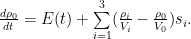
So this post will flesh the answer out by observing that the response defined by the “Bern TAR” parameters is simply the solution to the following equation:

where

But that equation describes the system that the accompanying diagram depicts. And that system does not impose partitioning of the type that the above-cited post describes.

In the depicted system, four vessels of respective fixed volumes 


Additionally, a gas source can add gas to the first vessel at a rate 

If appropriate selections are made for the 
The gas represents carbon (typically as a constituent of carbon dioxide, cellulose, etc.), the first vessel represents the atmosphere, the other vessels represent other parts of the carbon cycle, the membranes represent processes such as photosynthesis, absorption, and respiration, and the stimulus 
I digress here to draw attention to the fact that I’ve just moved the pea. The flow from the source does not represent all emissions, or even all anthropogenic emissions. It represents the flow only of carbon that had previously been sequestered for geological periods as, e.g., coal, and that is now being returned to the cycle of life. Thus re-defining the model’s emissions quantity finesses the objection some have made that the Bern Model requires either that processes (implausibly) distinguish between anthropogenic and natural carbon-dioxide molecules or that atmospheric carbon dioxide increase without limit.
Now, there’s a lot to criticize about the Bern Model; many of the criticisms can be found in the reader comments that followed the partitioning-argument post. Notable among those were richardscourtney’s . Also persuasive to me was Dr. Brown’s observation that the atmosphere holds too small a portion of the total carbon-cycle content for the 0.152 value assigned to the infinite-time-constant component to be correct. And much in Ferdinand Engelbeen’s oeuvre is no doubt relevant to the issue.
As the diagram shows, though, the left, atmosphere-representing vessel receives all the emissions, and it permits all of the other vessels to compete freely for its contents according to their respective membranes’ permeabilities. So what is not wrong with the model is that it requires the atmosphere to partition its contents, i.e., to withhold some of its contents from the faster processes so that the slower ones get the share that the model dictates.
Related articles
- On CO2 residence times: The chicken or the egg? (wattsupwiththat.com)
William Astley says:
December 4, 2013 at 9:24 am
The origin of black coal is not biological which is relevant to this discussion
William, the origin of natural gas may can be discussed and may be organic or inorganic or (probably) both. But you are completely wrong about the origin of coal: it is mostly all plants, including enclosed imprints of leaves structures (have them seen myself, my youngest daughter studied geology). The formation of coal can be followed in all its stages all over the world. Here an example:
http://fossillady.files.wordpress.com/2010/08/fossils-0461.jpg
That doesn’t exclude that some fields may be of inorganic origin, but that anyway is a small minority compared to the amounts that are clearly of organic origin. And there should be distinctions in isotope ratio’s, inclusions of other elements and tracers, etc.
Thus sorry, it is irrelevant for this discussion, as the ~1 GtC/yr carbon sink in vegetation is here and now and may be used by some different creature some 200 million years from now…
In reply to:
Ferdinand Engelbeen says:
December 4, 2013 at 12:43 pm
William Astley says:
December 4, 2013 at 9:24 am
The origin of black coal is not biological which is relevant to this discussion
William, the origin of natural gas may can be discussed and may be organic or inorganic or (probably) both. But you are completely wrong about the origin of coal: it is mostly all plants, including enclosed imprints of leaves structures (have them seen myself, my youngest daughter studied geology). The formation of coal can be followed in all its stages all over the world. Here an example:
http://fossillady.files.wordpress.com/2010/08/fossils-0461.jpg
That doesn’t exclude that some fields may be of inorganic origin, but that anyway is a small minority compared to the amounts that are clearly of organic origin. And there should be distinctions in isotope ratio’s, inclusions of other elements and tracers, etc.
Thus sorry, it is irrelevant for this discussion, as the ~1 GtC/yr carbon sink in vegetation is here and now and may be used by some different creature some 200 million years from now…
In reply to:
You are looking but not thinking physically. Gold specifically discusses the cases of single imprints of leafs and sticks in black coal.
The CH4 gas flowed into the sedimentary rock and left an imprint of a leaf. It is physically impossible to convert biological material into black coal and leaves an imprint of a leaf.
Gold states: First, why did the odd fossil, retain its structure with perfection, sometimes down to the cellular level, when other presumably much larger quantities of such debris adjoining it were so completely demolished that no structure remains… Second, fossils are sometimes filled solid with carbon with being deformed. Every cell of the plant seems to have been filled with the same coaly material that forms the bulk of the coal outside the fossil. …
William, I have mentioned a couple of the paradoxes Gold notes. There is paradox after paradox. I was able on my own to find other paradoxes as where friends who have looked at different coal seams. The coal seams are up to 30 meters thick almost pure carbon with ash content less than 1%. That is impossible to explain with a biological origin.
You comment that sorry the massive injection of primordial CH4 into the mantel is not relevant to the natural sources of CO2 is irrational.
It looks as though they’ve pretty much turned out the lights at this page. Against the possibility that someone may nonetheless visit this page and be misled by an ambiguity in my previous comment, though, I’ll belatedly clarify it. But I hasten to add that this has nothing to do with the point of the post or the logic that it employs; it deals only with a tangential question posed by Greg (and a comment about flows I made to bobl).
In the previous comment I said of the time constant with which the carbon-14 fraction would decay after, say, a bomb-caused carbon-14 pulse that “determining the behavior of the C14 ratio involves knowing the leftward and rightward components that sum to those net flows, and the development above is silent about that.” The first clause of that sentence is correct. The second could be considered correct, too, but only after a certain amount of interpretation.
Specifically, my fifth and sixth equations above actually are not silent about the constituent, leftward and rightward flow components in the diagrammed system. But it is only the net flows, not the constituent flows, that affect the solution, i.e., the Bern equation. And that equation is itself an approximation to the behavior of a more-complicated Bern model that specifies a more-complicated group of constituent flows. That is, constituent flows much different from the ones the diagrammed model uses (but netting to the same values) could yield that solution, too.
So the reason why the diagrammed model should not be understood to say anything about carbon-14-concentration decay is not that it is silent about its own constituent flows but rather that, unlike the net flows, the constituent flows are not intended to approximate real-world behavior.
[The “lights” do not ever “go out” on any thread, but – yes – older threads are rarely updated by readers. Mod]
[The “lights” do not ever “go out” on any thread, but – yes – older threads are rarely updated by readers. Mod]
That is one of the nice things about this blog, it never (or very seldom) closes the “leave a reply”…
BTW, for some reason the “older threads” button disappeared (for Internet Explorer) in the home/overview page, which makes it quite difficult to go back to older discussions…