Since Paul Hudson has made a bold claim at the BBC related to a recent interview with solar scientist Mike Lockwood: BBC – Real risk of a Maunder minimum ‘Little Ice Age’, I thought it appropriate to share this recent communications that raises some of the same issues about the UV portion of the solar spectrum during this lull in solar activity, which has been in significant decline in the last decade.
Dr. Jan Zeman of Prague writes:
While discussing the recent article by Stan Robertson
(http://wattsupwiththat.com/2013/10/10/the-sun-does-it-now-go-figure-out-how/)
at the WUWT I’ve stumbled upon this very interesting voluminous paper in
Atmospheric Chemistry and Physics:
Recent variability of the solar spectral irradiance and its impact on climate modelling
Ermolli et al, April 2013 See: http://www.atmos-chem-phys.net/13/3945/2013/acp-13-3945-2013.pdf
The paper discusses quite very surprising results from the SORCE spectral irradiance data, comparing it to other spectral data and models available, suggesting that spectral radiance variability throughout solar cycle could be considerably higher than thought until now,
especially in the UV regions.

[This has] significant implications for atmospheric chemistry and its modeling, while also suggesting that the spectral variability in some other important regions of the solar spectrum (visible and >1μm IR) is not in phase with solar cycle – which I think is potentially another huge elephant in the room for CAGW.
And although it is at all not focus of the article as I look into it and into the SORCE spectral data there could be perhaps implications not only for atmospheric physics, but for the total effective surface irradiation variability, with possible consequences especially for the
SST modulation – which was the subject of the Robertson’s article – and which in my opinion is burdened with multiple omissions, which for sake of feedback I’ll allow myself to name:
1. Failing to take into account the most trivial fact the ocean is
preferentially at lower than average latitudes (-here:
http://tumetuestumefaisdubien1.sweb.cz/GLOBAL-LAND-SEA-STRATIFICATION-1DEGresolution.xls
You can find the 1° resolution ocean/land stratification, which I compiled recently for my research using Google Earth Pro and -which can sometimes prove useful reality check for all the various insolation-ocean implications, using often blindly global averages, which for obvious reasons can’t apply to ocean without major correction)
2. Failing to take into account that ocean has considerably lower reflectivity than is the Earth surface average and therefore absorbs way over average solar irradiance than the Earth surface in average absorbs under same insolation. -which both very likely result in gross underestimation of the incoming solar irradiance (the 160W/m^2 figure) for ocean. (from my own calculations (using the above ocean geographic stratification, atmospheric spectral absorption and seawater optical properties numbers) comes out that the average effective ocean insolation is well over 200W/m^2 -even if all ocean under sea-ice and therefore receiving no significant insolation is fully included into the averaging).
3. On the other hand the 390W/m^2 ocean radiation is quite clearly overestimation at least for the explicitly stated 288 K surface temperature due to the fact seawater has lower emissivity than ε=1 (classical Trenberth budget fallacy) – which only would justify the
390W/m^2 figure and which would be already almost 4 W/m^2 lower even in quite still rather unlikely case the sea surface has ε=0.99 – which is usually the emissivity of standard laboratory blackbodies. Not speaking that higher evaporation and higher atmospheric temperature resulting from higher insolation inevitably causes more water in atmosphere, more latent heat released there, eve higher atmospheric temperature resulting in higher atmospheric radiation slowing heat radiative transfer from the surface.
4. Failing to take into account that ocean photic layer insolation has three dimensions in the highly transparent medium as seawater and that the spectral irradiance varies several orders of magnitude for different spectral bands and different depths of the ocean photic layer (here you can see graph of estimation I made using water transmittance data and
ASTM G173-03 spectrum recalculated for slightly different normal incidence angle:
![OCEAN-PENETRATION-BY-SOLAR-SPECTRUM[1]](http://wattsupwiththat.files.wordpress.com/2013/10/ocean-penetration-by-solar-spectrum1.png?quality=75)
…which results in very uneven heat content distribution and so the surplus irradiation caused by the solar cycle insolation variation very likely doesn’t produce so prominent temperature signal amplitude at the shallow depths where the SST is usually measured (at very least not in such phase with solar cycle variability to be easily quantifiable and comparable) and doesn’t reflect more than part of the actual heat content changes in the ocean photic layer caused by insolation variability.
5. Failing to take into account the fact that highest surface spectral solar irradiance variability in phase with solar cycle is in UVA – not given only by the solar spectrum variability itself but also by the asymetricity of the solar spectra absorbtion in the atmosphere for UVA and IR regions – even without any considering the SORCE surprising SSI data (-which also seem to show the variability in visible and >1μm IR regions is NOT in phase with solar cycle TSI variability – which in the >1μm IR region – not penetrating water deeper than ~10 centimeters (an usually much much less) would directly mean that the solar cycle IR variability cancels by its phase large part of the solar cycle signal in
the surface temperature data while the heat content throughout the photic layer anyway rises and descends with the solar cycle variability at the depths higher than is the depth of the layer heated by the solar IR.
In any case the 0.09 watt/m2 solar cycle variation amplitude figure looks to me rather like gross underestimation for ocean and all the omissions together cast serious doubts about the outcome of the Robertson’s analysis, especially its quantification in the resulting
“3.6” ratio.
The surprising finds from the SORCE SSI data by Ermoli et al. (I must say I’m also very surprised when looking into the SORCE SSI data) could be interesting maybe even for the WUWT readers. -Even the spectral irradiance is quite special topic, I have a feeling that if ever there will be a comprehensive linking between solar activity variability and surface temperatures, it will come from the side of the spectral irradiance variation – because it is what in different bands causes the different ocean surface layers be heated considerably differently due to very different water transmissivities for different wavelengths.
(- only what I found at WUWT about the Ermolli et al. paper is the very short note in the Oct 13 roundup linking to the Bosse&Vahrenholt article mentioning the paper – but unfortunately without mentioning the main focus of the article – UV variability and atmospheric chemistry – and rather seems to just point out quite cherrypicked figure “10%” variability – which one in fact finds in the SORCE SSI data actually at the edge of the MUV region – almost completely unsignificant for surface irradiation, and actually the variability upperbound for UV significantly reaching surface is lower at least by factor 5.
P.S.: In the attachment you find a picture you can have some fun with.
(I never thought it is so good laugh falsifying Lockwood & Frohlich 2007
“1987 claim” by one sole yellow OLS flat trendline – anyone can plot at WFT.)

============================================================
(Anthony) WUWT has covered this topic of UV solar spectral variation previously, see these articles:
UV low during recent solar minimum
SORCE’s Solar Spectral Surprise – UV declined, TSI constant
Note this graph:
 Between 2004 and 2007, the SORCE Solar Irradiance Monitor (blue line) measured a decrease in ultraviolet radiation (less than 400 nanometers) that was a factor of four to six larger than expected (black line). In the visible part of the spectrum (400 to 700 nanometers), SIM showed a slight increase in comparison to what was expected. Measurements (red) from another ultraviolet radiation-sensing instrument called SOLSTICE compare well with those from SIM. Note: different scales are used for values at wavelengths less and more than 242 nanometers (see left and right axes respectively). Credit: Joanna Haigh/Imperial College London
This figure in the Ermolli et al paper suggest that UV has had the lions share of change from 2004-2008

For solar UV irradiance change to have an effect on Earth’s surface temperatures, you need a mechanism. One mechanism noted above is related to optical depth spectral sensitivity of the ocean, another might related and be biological. This paper from 2007 covers the same wavelengths discussed above:
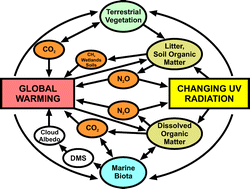
Interactive effects of solar UV radiation and climate change on biogeochemical cycling
Zepp et al Photochem. Photobiol. Sci., 2007,6, 286-300
DOI: 10.1039/B700021A
Abstract: This report assesses research on the interactions of UV radiation (280–400 nm) and global climate change with global biogeochemical cycles at the Earth’s surface. The effects of UV-B (280–315 nm), which are dependent on the stratospheric ozone layer, on biogeochemical cycles are often linked to concurrent exposure to UV-A radiation (315–400 nm), which is influenced by global climate change. These interactions involving UV radiation (the combination of UV-B and UV-A) are central to the prediction and evaluation of future Earth environmental conditions. There is increasing evidence that elevated UV-B radiation has significant effects on the terrestrial biosphere with implications for the cycling of carbon, nitrogen and other elements. The cycling of carbon and inorganic nutrients such as nitrogen can be affected by UV-B-mediated changes in communities of soil organisms, probably due to the effects of UV-B radiation on plant root exudation and/or the chemistry of dead plant material falling to the soil. In arid environments direct photodegradation can play a major role in the decay of plant litter, and UV-B radiation is responsible for a significant part of this photodegradation. UV-B radiation strongly influences aquatic carbon, nitrogen, sulfur and metals cycling that affect a wide range of life processes. UV-B radiation changes the biological availability of dissolved organic matter to microorganisms, and accelerates its transformation into dissolved inorganic carbon and nitrogen, including carbon dioxide and ammonium. The coloured part of dissolved organic matter (CDOM) controls the penetration of UV radiation into water bodies, but CDOM is also photodegraded by solar UV radiation. Changes in CDOM influence the penetration of UV radiation into water bodies with major consequences for aquatic biogeochemical processes. Changes in aquatic primary productivity and decomposition due to climate-related changes in circulation and nutrient supply occur concurrently with exposure to increased UV-B radiation, and have synergistic effects on the penetration of light into aquatic ecosystems. Future changes in climate will enhance stratification of lakes and the ocean, which will intensify photodegradation of CDOM by UV radiation. The resultant increase in the transparency of water bodies may increase UV-B effects on aquatic biogeochemistry in the surface layer. Changing solar UV radiation and climate also interact to influence exchanges of trace gases, such as halocarbons (e.g., methyl bromide) which influence ozone depletion, and sulfur gases (e.g., dimethylsulfide) that oxidize to produce sulfate aerosols that cool the marine atmosphere. UV radiation affects the biological availability of iron, copper and other trace metals in aquatic environments thus potentially affecting metal toxicity and the growth of phytoplankton and other microorganisms that are involved in carbon and nitrogen cycling. Future changes in ecosystem distribution due to alterations in the physical and chemical climate interact with ozone-modulated changes in UV-B radiation. These interactions between the effects of climate change and UV-B radiation on biogeochemical cycles in terrestrial and aquatic systems may partially offset the beneficial effects of an ozone recovery.
Related articles
- New paper finds solar UV varies up to 100 percent during solar cycles, confirms solar amplification mechanism (tallbloke.wordpress.com)
- The Sun Does It: Now Go Figure Out How! (wattsupwiththat.com)
- Current Sunspot Cycle Weakest In 190 Years – Recent Model Temperature Deviation Due To Solar Activity, Experts Say (notrickszone.com)
yeah…UV variation may be the joker in the pack…but remember…the vast majority of solar output is in the visible part of the spectrum…the good old bell curve…
UV penetrates the oceans to 300 m. A lag today will only be climatologically evident after a decade.
“the good old bell curve”
An anthropocentric view? The spectrum at our orbit is 40% IR, 40% visible and 20% UV.
Only 1% of the IR reaches the surface.
Sound familiar ?
http://www.newclimatemodel.com/new-climate-model/
TSI reconstructed chart 1610 to 2012.
http://lasp.colorado.edu/lisird/tsi/historical_tsi.html
Central MN averages 270 cloudy days per year. This summer we wuz robbed. Crop this wet year Ok, but nothing like last year’s drought plagued harvest.
The millimeter wave regions are also intriguing – but there is little historical data to work with.
Well, well,
what can I say?
the clever people all knew about this beforehand
just by studying the data of warmth coming in (maxima)
but we I think we are not due for a LIA
I think we will survive?
http://blogs.24.com/henryp/2013/04/29/the-climate-is-changing/
Most sunlight is in the IR, not visible part of the spectrum.
The spectral distribution of the solar energy at sea level comprises roughly 3–7% of UV (290–400 nm), 44% of visible light (400–700 nm), and 53% of infrared (IR) radiation (700–1440 nm), at a power of about 1120–1000 watts/m2. But at the top of the atmosphere, the distribution is about 10% UV, 40% visible & 50% IR, at 1366 watts/m2.
Two solar threads in two hours !
vukcevic says:
October 28, 2013 at 10:06 am
The sun must be entering an active phase.
There are those who think the sun is “hotter” when there are less spots…
but it cools the air here…
why?
find out fore yourself
http://blogs.24.com/henryp/2013/04/29/the-climate-is-changing/
milodonharlani says:
October 28, 2013 at 10:02 am
” at sea level” incoming radiation, apart from the most energetic UV, is scattered.
The atmosphere heats the surface primarily by conduction.
re: comma (European notation)
Graph ‘Ocean penetration by solar spectrum’
100,000 = 100 meters 000 millimeters and not 100 thousand meters
@Gary Young gulrud
oceans are heated by incoming UV, mostly
like you said earlier.
even at 300 m
and even with some lag in time
before the heat/cold comes out of the closet…
It would be educational to the audience if the Ev of the wavelengths were also put in the labels. The variability of the energy has big effects on the output of solar cells. If the photons do not generate carriers they just contribute to the heat. A standard Sun illuminator is now used to evaluate solar cells.
The energy of the photons at the higher energies drive a lot of important photochemical reactions.
There is also a whole world to be publicised in the far Ir and millimetre waves. These wavelengths have effects on organic molecules and who knows what else..
milodonharlani says:
October 28, 2013 at 10:02 am
Most sunlight is in the IR, not visible part of the spectrum.
The spectral distribution of the solar energy at sea level comprises roughly 3–7% of UV (290–400 nm), 44% of visible light (400–700 nm), and 53% of infrared (IR) radiation (700–1440 nm), at a power of about 1120–1000 watts/m2. But at the top of the atmosphere, the distribution is about 10% UV, 40% visible & 50% IR, at 1366 watts/m2.
=======================================================================
True, but solar UV is a major driver of atmospheric chemistry especially in the upper atmosphere. For this reason while UV is relatively small portion of solar radiance energy wise, variance in UV could have significant impacts on how efficiently the earth sheds heat to space.
“For solar UV irradiance change to have an effect on Earth’s surface temperatures, you need a mechanism. One mechanism noted above is related to optical depth spectral sensitivity of the ocean, another might related and be biological.”
The Ermolli et al paper itself mentions a solar amplification mechanism via ozone production:
“Although total solar irradiance (TSI) shows only a small variation ( 0.1% per solar cycle), significant (up to 100 %) variations are observed in the ultraviolet (UV) region of the solar spectrum. In a “top-down” mechanism, these UV changes are thought to modify middle atmospheric (lower mesospheric and stratospheric) O3 [ozone] production, thereby indirectly altering background temperatures (for a review see Gray et al., 2010). These temperature changes can then modulate upward propagating planetary waves, and amplify the solar signal in stratospheric O3 and temperatures. The temperature changes will also affect the rates of chemical reactions which control ozone. This mechanism has been well accepted.”
http://hockeyschtick.blogspot.com/2013/10/new-paper-finds-solar-uv-varies-up-to.html
Re the optical depth spectral sensitivity of the ocean, even RealClimate admits longwave infrared from greenhouse gases cannot penetrate or directly heat the oceans. RC claims GHGs heat the oceans by decreasing the temperature gradient, but since there has been no increase in atmospheric temperature for 20 years, there has been no decrease of the temperature gradient, and hence no heating of the oceans by increased greenhouse gases.
RealClimate admits doubling CO2 could only heat the oceans 0.002ºC at most
http://hockeyschtick.blogspot.com/2012/09/realclimate-admits-doubling-co2-could.html
gary gulrud says:
October 28, 2013 at 10:13 am
The atmosphere heats the surface primarily by conduction.
========
Say what!
gary gulrud says:
October 28, 2013 at 10:13 am
MattS says:
October 28, 2013 at 10:33 am
I know & agree, & have caught flak from Dr. S as a result. My comment on the IR containing the majority of TSI was in response to:
gopal panicker says:
October 28, 2013 at 9:43 am
yeah…UV variation may be the joker in the pack…but remember…the vast majority of solar output is in the visible part of the spectrum…the good old bell curve…
I neglected to paste his comment heading.
Of course, a plot of the TSI database averaged over the most recent 11 years follows the change in temperature during the 20th century a lot better than a monotone series of CO2. But I am not saying anything new here. D’Aleo noticed that a long time ago. Add in the ENSO and AMO, and you get a model with predictive ability. But nobody ever got a grant to investigate something simple and easy you know.
” have caught flak from Dr. S ”
My sympathies, honestly.
mkelly says:
October 28, 2013 at 10:51 am
As alluded to by HockeSchtick and others, IR does not penetrate the surface. Whatever the state of matter absorption of IR raises a molecules kinetic energy which it immediately shares by conduction with its surroundings. Re-radiation of IR at the secular wavelength of its absorption is negligible.
The emissivity of solids like dirt, green leaves, even snow is on the order of 1000 times stronger than low pressure gases. The direction of long-wave radiation is overwhelmingly one from the surface to the atmosphere and outer space.
gary gulrud says:
October 28, 2013 at 11:15 am
The atmosphere heats the surface primarily by conduction.
Gary read what you wrote. The atmosphere does not heat the surface. It’s vice versa.
Exactly.