Since Paul Hudson has made a bold claim at the BBC related to a recent interview with solar scientist Mike Lockwood: BBC – Real risk of a Maunder minimum ‘Little Ice Age’, I thought it appropriate to share this recent communications that raises some of the same issues about the UV portion of the solar spectrum during this lull in solar activity, which has been in significant decline in the last decade.
Dr. Jan Zeman of Prague writes:
While discussing the recent article by Stan Robertson
(http://wattsupwiththat.com/2013/10/10/the-sun-does-it-now-go-figure-out-how/)
at the WUWT I’ve stumbled upon this very interesting voluminous paper in
Atmospheric Chemistry and Physics:
Recent variability of the solar spectral irradiance and its impact on climate modelling
Ermolli et al, April 2013 See: http://www.atmos-chem-phys.net/13/3945/2013/acp-13-3945-2013.pdf
The paper discusses quite very surprising results from the SORCE spectral irradiance data, comparing it to other spectral data and models available, suggesting that spectral radiance variability throughout solar cycle could be considerably higher than thought until now,
especially in the UV regions.

[This has] significant implications for atmospheric chemistry and its modeling, while also suggesting that the spectral variability in some other important regions of the solar spectrum (visible and >1μm IR) is not in phase with solar cycle – which I think is potentially another huge elephant in the room for CAGW.
And although it is at all not focus of the article as I look into it and into the SORCE spectral data there could be perhaps implications not only for atmospheric physics, but for the total effective surface irradiation variability, with possible consequences especially for the
SST modulation – which was the subject of the Robertson’s article – and which in my opinion is burdened with multiple omissions, which for sake of feedback I’ll allow myself to name:
1. Failing to take into account the most trivial fact the ocean is
preferentially at lower than average latitudes (-here:
http://tumetuestumefaisdubien1.sweb.cz/GLOBAL-LAND-SEA-STRATIFICATION-1DEGresolution.xls
You can find the 1° resolution ocean/land stratification, which I compiled recently for my research using Google Earth Pro and -which can sometimes prove useful reality check for all the various insolation-ocean implications, using often blindly global averages, which for obvious reasons can’t apply to ocean without major correction)
2. Failing to take into account that ocean has considerably lower reflectivity than is the Earth surface average and therefore absorbs way over average solar irradiance than the Earth surface in average absorbs under same insolation. -which both very likely result in gross underestimation of the incoming solar irradiance (the 160W/m^2 figure) for ocean. (from my own calculations (using the above ocean geographic stratification, atmospheric spectral absorption and seawater optical properties numbers) comes out that the average effective ocean insolation is well over 200W/m^2 -even if all ocean under sea-ice and therefore receiving no significant insolation is fully included into the averaging).
3. On the other hand the 390W/m^2 ocean radiation is quite clearly overestimation at least for the explicitly stated 288 K surface temperature due to the fact seawater has lower emissivity than ε=1 (classical Trenberth budget fallacy) – which only would justify the
390W/m^2 figure and which would be already almost 4 W/m^2 lower even in quite still rather unlikely case the sea surface has ε=0.99 – which is usually the emissivity of standard laboratory blackbodies. Not speaking that higher evaporation and higher atmospheric temperature resulting from higher insolation inevitably causes more water in atmosphere, more latent heat released there, eve higher atmospheric temperature resulting in higher atmospheric radiation slowing heat radiative transfer from the surface.
4. Failing to take into account that ocean photic layer insolation has three dimensions in the highly transparent medium as seawater and that the spectral irradiance varies several orders of magnitude for different spectral bands and different depths of the ocean photic layer (here you can see graph of estimation I made using water transmittance data and
ASTM G173-03 spectrum recalculated for slightly different normal incidence angle:
![OCEAN-PENETRATION-BY-SOLAR-SPECTRUM[1]](http://wattsupwiththat.files.wordpress.com/2013/10/ocean-penetration-by-solar-spectrum1.png?quality=75)
…which results in very uneven heat content distribution and so the surplus irradiation caused by the solar cycle insolation variation very likely doesn’t produce so prominent temperature signal amplitude at the shallow depths where the SST is usually measured (at very least not in such phase with solar cycle variability to be easily quantifiable and comparable) and doesn’t reflect more than part of the actual heat content changes in the ocean photic layer caused by insolation variability.
5. Failing to take into account the fact that highest surface spectral solar irradiance variability in phase with solar cycle is in UVA – not given only by the solar spectrum variability itself but also by the asymetricity of the solar spectra absorbtion in the atmosphere for UVA and IR regions – even without any considering the SORCE surprising SSI data (-which also seem to show the variability in visible and >1μm IR regions is NOT in phase with solar cycle TSI variability – which in the >1μm IR region – not penetrating water deeper than ~10 centimeters (an usually much much less) would directly mean that the solar cycle IR variability cancels by its phase large part of the solar cycle signal in
the surface temperature data while the heat content throughout the photic layer anyway rises and descends with the solar cycle variability at the depths higher than is the depth of the layer heated by the solar IR.
In any case the 0.09 watt/m2 solar cycle variation amplitude figure looks to me rather like gross underestimation for ocean and all the omissions together cast serious doubts about the outcome of the Robertson’s analysis, especially its quantification in the resulting
“3.6” ratio.
The surprising finds from the SORCE SSI data by Ermoli et al. (I must say I’m also very surprised when looking into the SORCE SSI data) could be interesting maybe even for the WUWT readers. -Even the spectral irradiance is quite special topic, I have a feeling that if ever there will be a comprehensive linking between solar activity variability and surface temperatures, it will come from the side of the spectral irradiance variation – because it is what in different bands causes the different ocean surface layers be heated considerably differently due to very different water transmissivities for different wavelengths.
(- only what I found at WUWT about the Ermolli et al. paper is the very short note in the Oct 13 roundup linking to the Bosse&Vahrenholt article mentioning the paper – but unfortunately without mentioning the main focus of the article – UV variability and atmospheric chemistry – and rather seems to just point out quite cherrypicked figure “10%” variability – which one in fact finds in the SORCE SSI data actually at the edge of the MUV region – almost completely unsignificant for surface irradiation, and actually the variability upperbound for UV significantly reaching surface is lower at least by factor 5.
P.S.: In the attachment you find a picture you can have some fun with.
(I never thought it is so good laugh falsifying Lockwood & Frohlich 2007
“1987 claim” by one sole yellow OLS flat trendline – anyone can plot at WFT.)

============================================================
(Anthony) WUWT has covered this topic of UV solar spectral variation previously, see these articles:
UV low during recent solar minimum
SORCE’s Solar Spectral Surprise – UV declined, TSI constant
Note this graph:
 Between 2004 and 2007, the SORCE Solar Irradiance Monitor (blue line) measured a decrease in ultraviolet radiation (less than 400 nanometers) that was a factor of four to six larger than expected (black line). In the visible part of the spectrum (400 to 700 nanometers), SIM showed a slight increase in comparison to what was expected. Measurements (red) from another ultraviolet radiation-sensing instrument called SOLSTICE compare well with those from SIM. Note: different scales are used for values at wavelengths less and more than 242 nanometers (see left and right axes respectively). Credit: Joanna Haigh/Imperial College London
This figure in the Ermolli et al paper suggest that UV has had the lions share of change from 2004-2008

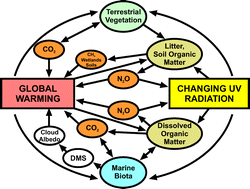
For solar UV irradiance change to have an effect on Earth’s surface temperatures, you need a mechanism. One mechanism noted above is related to optical depth spectral sensitivity of the ocean, another might related and be biological. This paper from 2007 covers the same wavelengths discussed above:
Interactive effects of solar UV radiation and climate change on biogeochemical cycling
Zepp et al Photochem. Photobiol. Sci., 2007,6, 286-300
DOI: 10.1039/B700021A
Abstract: This report assesses research on the interactions of UV radiation (280–400 nm) and global climate change with global biogeochemical cycles at the Earth’s surface. The effects of UV-B (280–315 nm), which are dependent on the stratospheric ozone layer, on biogeochemical cycles are often linked to concurrent exposure to UV-A radiation (315–400 nm), which is influenced by global climate change. These interactions involving UV radiation (the combination of UV-B and UV-A) are central to the prediction and evaluation of future Earth environmental conditions. There is increasing evidence that elevated UV-B radiation has significant effects on the terrestrial biosphere with implications for the cycling of carbon, nitrogen and other elements. The cycling of carbon and inorganic nutrients such as nitrogen can be affected by UV-B-mediated changes in communities of soil organisms, probably due to the effects of UV-B radiation on plant root exudation and/or the chemistry of dead plant material falling to the soil. In arid environments direct photodegradation can play a major role in the decay of plant litter, and UV-B radiation is responsible for a significant part of this photodegradation. UV-B radiation strongly influences aquatic carbon, nitrogen, sulfur and metals cycling that affect a wide range of life processes. UV-B radiation changes the biological availability of dissolved organic matter to microorganisms, and accelerates its transformation into dissolved inorganic carbon and nitrogen, including carbon dioxide and ammonium. The coloured part of dissolved organic matter (CDOM) controls the penetration of UV radiation into water bodies, but CDOM is also photodegraded by solar UV radiation. Changes in CDOM influence the penetration of UV radiation into water bodies with major consequences for aquatic biogeochemical processes. Changes in aquatic primary productivity and decomposition due to climate-related changes in circulation and nutrient supply occur concurrently with exposure to increased UV-B radiation, and have synergistic effects on the penetration of light into aquatic ecosystems. Future changes in climate will enhance stratification of lakes and the ocean, which will intensify photodegradation of CDOM by UV radiation. The resultant increase in the transparency of water bodies may increase UV-B effects on aquatic biogeochemistry in the surface layer. Changing solar UV radiation and climate also interact to influence exchanges of trace gases, such as halocarbons (e.g., methyl bromide) which influence ozone depletion, and sulfur gases (e.g., dimethylsulfide) that oxidize to produce sulfate aerosols that cool the marine atmosphere. UV radiation affects the biological availability of iron, copper and other trace metals in aquatic environments thus potentially affecting metal toxicity and the growth of phytoplankton and other microorganisms that are involved in carbon and nitrogen cycling. Future changes in ecosystem distribution due to alterations in the physical and chemical climate interact with ozone-modulated changes in UV-B radiation. These interactions between the effects of climate change and UV-B radiation on biogeochemical cycles in terrestrial and aquatic systems may partially offset the beneficial effects of an ozone recovery.
Related articles
- New paper finds solar UV varies up to 100 percent during solar cycles, confirms solar amplification mechanism (tallbloke.wordpress.com)
- The Sun Does It: Now Go Figure Out How! (wattsupwiththat.com)
- Current Sunspot Cycle Weakest In 190 Years – Recent Model Temperature Deviation Due To Solar Activity, Experts Say (notrickszone.com)
Actually Leif seems to me to be in an unusually benign mood tonight – almost affable in fact.
Just trying to be fair, if the real data was “colour” and grey was extrapolation, this study seems to be long on extrapolation. Do I smell a model?
Dr. Page, I’m glad you posted that. It showed that I need to clarify my sloppy writing. btw, below, I am not attacking your assertions, just sympathizing with Dr. Svalgaard looking at the above dialogue from his point of view.
************************************
@Dale Rainwater. Svalgaard: I did not think you were displaying a bad mood above. I just thought you might be headed there after quite a long series of somewhat repetitive questioning which was sometimes based on misunderstanding what you said or was based on persistent assumptions the refuting of which I’m sure you found a bit trying at times.
Their was a discussion here a few weeks ago about SORCE using a new aperture that produced less scatter and, as a result, the graphs were reset to a lower level. This can be seen in Fig 2 at
http://www.uksolphys.org/uksp-nugget/37-what-is-our-current-understanding-of-solar-irradiance-variations/ this is UVB data and compares well with Fig 4 above.
This may explain the
lsvalgaard says: “I don’t think there is a useful method at the moment. Cyclomania is not very useful, unless you know the physics [e.g. we can predict that summer will be warmer than winter, because we know why]. At some point in the future modeling will eventually work.”
+++++++++++++
I do not think we need to know why summer is warmer than winter to be able to predict that summer is warmer than winter. This in fact is the point Norman is making, and you help validate his thinking here. Not knowing why is not important in making that prediction. When I was a kid, I knew for a fact that summer would be warmer than winter because, well, it’s common sense to a kid to know this. Later, I learned why I was right – but that did not make me more right.
Dr Norman Page says:
October 28, 2013 at 5:05 pm
Not so – look at the width of the peak in 1000 Fig3 If 2003+/- was the peak we should see some increase in the cooling rate by 2018-20
As Yogi Berra said: “if I hadn’t believed it, I wouldn’t have seen it”. I admit that some people are more gullible than I am, and it takes all kinds…
Solar activity controls climate
http://lasp.colorado.edu/lisird/tsi/historical_tsi.html
Obvio spanish, Duh etc….
@Eliza
>Obvio Spanish…
En realidad no es obvio… That TSI reconstruction is based on sunspot group counts, which historically are biased by different counting methods. When that bias is removed the gradual increase in TSI disappears.
http://wattsupwiththat.com/2013/10/07/september-solar-slump-continues/#comment-1441656
http://www.leif.org/research/Solar-Petaluma–How%20Well%20Do%20We%20Know%20the%20SSN.pdf (see slide #18)
“Solar spectral irradiance, UV, and declining solar activity – a Maunder Minimum mechanism for cooler temperature?”
There are too many very cold seasons close to solar cycle maxima for this to be right. While a lack of Aurora regularly correlates to colder episodes.
lsvalgaard says:
”Cyclomania is not very useful, unless you know the physics [e.g. we can predict that summer will be warmer than winter, because we know why].”
People planted crops based on the observed cycles for thousands of years before understanding why the seasons were there. They could predict that summer would be warmer than winter without any understanding of why.
Cyclomania may not be very useful, but cyclophobia isn’t very helpful either.
John West says:
October 29, 2013 at 5:25 am
“Cyclomania may not be very useful, but cyclophobia isn’t very helpful either.”
>>>>>
Wow, what a great line to read first thing this morning! Thank you, John.
Leif,
A couple of questions for you. Why are the NASA and NOAA sunspot #’s about half of your active area counts? A different way of counting?
Also, is this pattern near 1970, 1990, and 2013 at the beginning of each 22 year cycle meaningful? The pattern I am referring to is where it looks like the phases are going to cross and then they backtrack a bit and finally cross a year or so later. All my questions are referring to the graphics that Anthony has linked to his solar page. Thanks.
well,
it’s all cycles really.
The cycles coming from outside are predictable. There is a bit of chaos coming from inside (earth) but eventually outside will win from inside….
I was amazed to find from my own results that William Arnold was correct
both, in predicting the cooling AND warming periods
in his paper
http://www.cyclesresearchinstitute.org/cycles-astronomy/arnold_theory_order.pdf
I remember that Leif called it a ‘junk” paper when I first queried him on it.
Now look where we are:
http://blogs.24.com/henryp/2013/04/29/the-climate-is-changing/
So you must not always listen to what he says.
@Bill_W
if you were to study that paper from W.Arnold that I mentioned earlier
you would have figured out that one whole solar cycle consists of two consecutive 11 year cycles
quote
In 1966 Edward R. Dewey stressed the importance of the 22 year sunspot cycle in “The 22-Year Cycle in Sunspot Numbers, Alternate Cycles Reversed.” Then in 1970, in “Cycle Synchronies,” Dewey demonstrated positive correlations between the sunspot primary cycle and its harmonic multiples and subharmonics with periodic earthly cycles: including, Business Failures, Stock Prices, International War Battles, Floods in the Mississippi Valley, Rainfall in London, Tree Ring Growth, and literally thousands of other cycles whose turnpoints turn in unison with mechanical
precision. As early at 1801, William Herschel, also known for his discovery of Uranus, had found comparative cycles in sunspot numbers and the price of wheat
end quote
Note also this quote (and the diagram that goes with it)
Sunspot groups observed from 1901-1913, 1923-1933 were as the left diagram, while sunspot groups observed from 1913-1923, 1933-1944 were as the right diagram. Nicholson also pointed out that the length of the 22-year Hale-Nicholson sunspot cycle should be measured minimum to minimum, in as much as sunspots of both polarity overlap near and after minimums.
etc.
to answer your peculiar question.
“UV-B radiation strongly influences aquatic carbon, nitrogen, sulfur and metals cycling that affect a wide range of life processes.”
It’s true: the amount of RF – for SIM, may have no significance.
I. UV-B is a small RF … but, eg, it kills … (de facto kills phytoplankton – could influence cloud cover) and affects the decomposition – disables – block (or – if weakened – vice versa) great flow passages of large amounts of energy, changing the earth system’s ability to absorb the energy (eg ozone, clouds, water in the stratosphere, etc.).
Gray et al. 2010, wrote: “A value of 0.24 Wm-2 solar radiative forcing difference from Maunder Minimum to the present is currently considered to be more appropriate than the 0.12 Wm-2 estimated by IPCC …”
Lockwood (http://rspa.royalsocietypublishing.org/content/466/2114/303.full) wrote:
“In other words, the feedback must essentially double the GHG forcing if they are the cause of the GMAST rise. On the other hand, our best estimate of the first term on the right-hand side of equation (10.1) is 0.23 W m−2 (ΔITS=1.3 W m−2).” “If … … 65 per cent of the observed warming were due to solar effects … … plus the feedback would need to supply 0.65×5.15=3.35 W m−2. In this case, the feedback must supply 3.35−0.23=3.12 W m−2, which means that they need to explain an amplification of the solar input by a factor of 13.5.”
13.5 … – Impossible? But however it was in the past!
N. Shaviv perfectly explains – proves: “According to the IPCC (AR4), the solar irradiance is responsible for a net radiative forcing increase between the Maunder Minimum and today of 0.12 W/m 2 (0.06 to 0.60 at 90% confidence). We know however that the Maunder minimum was about 1°C colder …” “This requires a global sensitivity of 1.0/0.12°C/(W/m 2 ).” For doubling the CO 2 we obtain, in this way – for such “… plus the feedback …” – up to 31 degrees C warming … (circa 15 C – if “we use” Gray, et al.)
The physicists of atmosphere would be “prohibit” to deal with climate change,
without an examination of “biogeochemical cycling” …
More UV-B – phytoplankton – the more clear skies …
… or changed frequency of El Nino – worth reading: Quantification of the Feedback between Phytoplankton and ENSO in the Community Climate System Model, Jochum et al, 2010.
II. Not only in a short time we are dealing with “… not in phase with solar cycle …” (http://www.wsl.ch/info/mitarbeitende//frank/publications_EN/Raspopov_etal_PPP_2008.pdf) Raspopov et al. 2006 (2008, coauthors eg: Esper, Frank):
“An appreciable delay in the climate response to the solar signal can occur (up to 150 years). In addition, the sign of the climate response can DIFFER from the solar signal sign [as TSI]. The climate response to long-term solar activity variations (from 10s to 1000s years) manifests itself in different climatic parameters, such as temperature, precipitation and atmospheric and oceanic circulation.”
Let me remind also (once again) the publication of NASA (http://science.gsfc.nasa.gov/sed/index.cfm?fuseAction=datatools.view&&project_id=38&navOrgCode=610&navTab=nav_researchers): “Based on SIM observations Cahalan et al. [2010] demonstrate REMARKABLE different climate responses (stratosphere, troposphere, ocean mixed layer) to SORCE-based and proxy-based SSI variations. The OUT-OF-PHASE SSI variations also have implications to re-examine the connection of the Sun and stratosphere, troposphere, biosphere, ocean, and Earth’s climate.”
John West says:
October 29, 2013 at 5:25 am
“Cyclomania may not be very useful, but cyclophobia isn’t very helpful either.”
++++++
John: We both agree. And we’re not saying “either all cycles are valid or none are”… Accusing someone of being a cyclomaniac ends the ability for cogent discussion and sides form.
Animals have evolved to be good at seeing cycles and responding to them sometimes not even being cognizant of the cycles. The diurnal solar cycles have been shown to create processes which lead to melatonin production from the amino acid tryptophan. This believed to be related to what induces different states of our sleep processes. Animals did not need to prove the sun would rise for them to rely on it.
Cyclomania, another word for hind casting. It worked very well for predicting SC24’s maximum. A lot better than other methods. Having said that, the prize went to the expert who kept changing his bet right up to the finish line.
Sunspot says
Cyclomania, another word for hind casting.
Henry says
there is no hind casting in my best fit, here,
http://blogs.24.com/henryp/2012/10/02/best-sine-wave-fit-for-the-drop-in-global-maximum-temperatures/
also, from the looks of it, earth energy stores are getting empty now,
meaning average temps. will fall by as much as maxima are falling now.
by 2040 things will be the same here as it was in 1950. You can bet on that.
Hindcasting is what the ipcc and their ignorant scientsists did, by looking at the rise in ST and linking it directly to be “caused” by an increased CO2 / GHG content. Then they came up with MODTRAN. Do you remember that? Allocating the values for each GHG increased since 1750, instead of understanding that the relationship is causal, i.e. more heat into the oceans releases more CO2.
I am still amused by that. By the sheer immense stupidity of it.
milodonharlani says:
October 28, 2013 at 10:02 am
“Most sunlight is in the IR, not visible part of the spectrum.
The spectral distribution of the solar energy at sea level comprises roughly 3–7% of UV (290–400 nm), 44% of visible light (400–700 nm), and 53% of infrared (IR) radiation (700–1440 nm), at a power of about 1120–1000 watts/m2. But at the top of the atmosphere, the distribution is about 10% UV, 40% visible & 50% IR, at 1366 watts/m2.”
According to official standard global tilt surface reference spectrum the spectral irradiance for your bands is: 290-400nm 9.8%, 401-700nm 45.8%, 701-1440nm 44.2% for standard AM1.5 atmospheric conditions. The TOA distribution is 290-400nm 16.3%, 401-700nm 41.9%, 701-1440nm 41.7% for standard AM0 TOA spectrum. All percentages are relative to 100% – the whole partial 290-1440nm band irradiance.
tumetu etc says
The TOA distribution is 290-400nm 16.3%,
Henry says
the question is about the variation in that amount TOA and what that (small) variation causes.
i.e. from 1995 ozone (+ peroxides + ntric oxides etc) is rising, allowing (somewhat) less heat to accumulate into the (mostly SH) oceans.
study ozone results NH and SH and my tables and you will figure it out.
gary gulrud says:
October 28, 2013 at 10:13 am
milodonharlani says:
October 28, 2013 at 10:02 am
” at sea level” incoming radiation, apart from the most energetic UV, is scattered.
The atmosphere heats the surface primarily by conduction.
No, atmosphere heats surface primarily by IR radiation and not by conduction. The conductive net-heating is in direction surface-> atmosphere – and resulting convection, thermals, because it is the surface which is most heated by solar irradiation -simply because its materials have much higher absorptivity for solar spectrum than air – which results in higher average temperature than surface air has, absolutely preventing net-heat transfer from atmosphere to surface by conduction due to 2nd law of thermodynamics. In case of ocean and all seas lakes and rivers (and also wet land – especialy after rain) there is also another very powerful factor and that is heating of the atmosphere by latent heat of evaporation which on global scale transports around one third of the heat from surface to the atmosphere which the surface received by absorbing solar irradiation.
vukcevic says:
October 28, 2013 at 10:17 am
“re: comma (European notation)
Graph ‘Ocean penetration by solar spectrum’
100,000 = 100 meters 000 millimeters and not 100 thousand meters”
Yeah the comma should be decimal point, but I have european Open Office, so we have comma instead of decimal point – the Y axis is 100 meters, 10 meters, 1 meter, 10 centimeters, 1 centimeter, 1 millimeter. Mind the also the scale is logarithmic – in fact the penetration depth differences are huge – several orders of magnitude for different parts of the solar spectrum and are of course also dependent on incidence angle – but not so much, because there is always big refraction on the air/water interface for high angles – for example at 60° incidence angle the penetration angle is only ~40° after refraction. The graph is for 36.75° incidence angle, which from what I calculated from the ocean/land stratification is the average day (sunrise-sunset) incidence angle for whole global ocean and whole year equinox-equinox. The calculation of the graph values was made that I took the ASTM G173-03 standard surface spectrum and half-transmittance (50% absorbed – 50% transmitted) depth numbers I obtained using water empirical absobtion index taken from multiple sources in the literature then I multiplied the spectral irradiances by the calculated halftransmittance depth, normalized the results back to halftransmittance penetration depth and recalculated for the 36.75° incidence angle and its respective refraction angle 26.64° + then I made the same for quarter-transmittance (75% absorbed 25% transmitted) and for 1/1024 transmittance (1023/1024 absorbed and 1/1024 transmitted). It is just a first estimation – there for example is omited the surface spectral reflectance – but it would anyway not change the result much because water refraction index varies little over the part of solar spectrum in question.
gopal panicker says:
October 28, 2013 at 9:43 am
“UV variation may be the joker in the pack”
I think that joker in the pack will be also the over 1 micrometer IR antiphase variation – if confirmed all the hypotheses so far about solar activity – sea surface temperature relation will go straight to the bin.
HenryP says:
October 29, 2013 at 11:37 pm
“Henry says
the question is about the variation in that amount TOA and what that (small) variation causes.
i.e. from 1995 ozone (+ peroxides + ntric oxides etc) is rising, allowing (somewhat) less heat to accumulate into the (mostly SH) oceans.
study ozone results NH and SH and my tables and you will figure it out.”
I would be surely interested in some more ozone data, it could be useful for my global empiric insolation model I’m working on.
Most important in UV for surface insolation is 300-400nm – there the solar cycle variation according to the newest SSI data from SORCE SIM looks like over 2% and absolute like ~7mW/nm ( ~0.7W/m^2 at TOA variation for whole band – more than half of the TSI solar cycle variation), so it would be nice to know even better how much of it really gets to the surface.