
Guest Post By Werner Brozek, Edited By Just The Facts
In order to answer the question in the title, we need to know what time period is a reasonable period to take into consideration. As well, we need to know exactly what we mean by “stalled”. For example, do we mean that the slope of the temperature-time graph must be 0 in order to be able to claim that global warming has stalled? Or do we mean that we have to be at least 95% certain that there indeed has been warming over a given period?
With regards to what a suitable time period is, NOAA says the following:
”The simulations rule out (at the 95% level) zero trends for intervals of 15 yr or more, suggesting that an observed absence of warming of this duration is needed to create a discrepancy with the expected present-day warming rate.”
To verify this for yourself, see page 23 of this NOAA Climate Assessment.
Below we present you with just the facts and then you can assess whether or not global warming has stalled in a significant manner. The information will be presented in three sections and an appendix. The first section will show for how long there has been no warming on several data sets. The second section will show for how long there has been no significant warming on several data sets. The third section will show how 2012 ended up in comparison to other years. The appendix will illustrate sections 1 and 2 in a different way. Graphs and tables will be used to illustrate the data.
Section 1
This analysis uses the latest month for which data is available on WoodForTrees.org (WFT). (If any data is updated after this report is sent off, I will do so in the comments for this post.) All of the data on WFT is also available at the specific sources as outlined below. We start with the present date and go to the furthest month in the past where the slope is a least slightly negative. So if the slope from September is 4 x 10^-4 but it is – 4 x 10^-4 from October, we give the time from October so no one can accuse us of being less than honest if we say the slope is flat from a certain month.
On all data sets below, the different times for a slope that is at least very slightly negative ranges from 8 years and 3 months to 16 years and 1 month:
1. For GISS, the slope is flat since May 2001 or 11 years, 7 months. (goes to November)
2. For Hadcrut3, the slope is flat since May 1997 or 15 years, 7 months. (goes to November)
3. For a combination of GISS, Hadcrut3, UAH and RSS, the slope is flat since December 2000 or an even 12 years. (goes to November)
4. For Hadcrut4, the slope is flat since November 2000 or 12 years, 2 months. (goes to December.)
5. For Hadsst2, the slope is flat since March 1997 or 15 years, 10 months. (goes to December)
6. For UAH, the slope is flat since October 2004 or 8 years, 3 months. (goes to December)
7. For RSS, the slope is flat since January 1997 or 16 years and 1 month. (goes to January) RSS is 193/204 or 94.6% of the way to Ben Santer’s 17 years.
The following graph, also used as the header for this article, shows just the lines to illustrate the above. Think of it as a sideways bar graph where the lengths of the lines indicate the relative times where the slope is 0. In addition, the sloped wiggly line shows how CO2 has increased over this period:
The next graph shows the above, but this time, the actual plotted points are shown along with the slope lines and the CO2 is omitted:

Section 2
For this analysis, data was retrieved from WoodForTrees.org and the ironically named SkepticalScience.com. This analysis indicates how long there has not been significant warming at the 95% level on various data sets. The first number in each case was sourced from WFT. However the second +/- number was taken from SkepticalScience.com
For RSS the warming is not significant for over 23 years.
For RSS: +0.127 +/-0.136 C/decade at the two sigma level from 1990
For UAH, the warming is not significant for over 19 years.
For UAH: 0.143 +/- 0.173 C/decade at the two sigma level from 1994
For Hacrut3, the warming is not significant for over 19 years.
For Hadcrut3: 0.098 +/- 0.113 C/decade at the two sigma level from 1994
For Hacrut4, the warming is not significant for over 18 years.
For Hadcrut4: 0.095 +/- 0.111 C/decade at the two sigma level from 1995
For GISS, the warming is not significant for over 17 years.
For GISS: 0.116 +/- 0.122 C/decade at the two sigma level from 1996
If you want to know the times to the nearest month that the warming is not significant for each set, they are as follows: RSS since September 1989; UAH since April 1993; Hadcrut3 since September 1993; Hadcrut4 since August 1994; GISS since October 1995 and NOAA since June 1994.
Section 3
This section shows data about 2012 in the form of tables. Each table shows the six data sources along the left, namely UAH, RSS, Hadcrut4, Hadcrut3, Hadsst2, and GISS. Along the top, are the following:
1. 2012. Below this, I indicate the present rank for 2012 on each data set.
2. Anom 1. Here I give the average anomaly for 2012.
3. Warm. This indicates the warmest year on record so far for that particular data set. Note that two of the data sets have 2010 as the warmest year and four have 1998 as the warmest year.
4. Anom 2. This is the average anomaly of the warmest year just to its left.
5. Month. This is the month where that particular data set showed the highest anomaly. The months are identified by the first two letters of the month and the last two numbers of the year.
6. Anom 3. This is the anomaly of the month immediately to the left.
7. 11ano. This is the average anomaly for the year 2011. (GISS and UAH were 10th warmest in 2011. All others were 13th warmest for 2011.)
Anomalies for different years:
| Source | 2012 | anom | warm | anom | month | anom | 11ano |
|---|---|---|---|---|---|---|---|
| UAH | 9th | 0.161 | 1998 | 0.419 | Ap98 | 0.66 | 0.130 |
| RSS | 11th | 0.192 | 1998 | 0.55 | Ap98 | 0.857 | 0.147 |
| Had4 | 10th | 0.436 | 2010 | 0.54 | Ja07 | 0.818 | 0.399 |
| Had3 | 10th | 0.403 | 1998 | 0.548 | Fe98 | 0.756 | 0.340 |
| sst2 | 8th | 0.342 | 1998 | 0.451 | Au98 | 0.555 | 0.273 |
| GISS | 9th | 0.56 | 2010 | 0.66 | Ja07 | 0.93 | 0.54 |
If you wish to verify all rankings, go to the following:
For UAH, see here, for RSS see here and for Hadcrut4, see here. Note the number opposite the 2012 at the bottom. Then going up to 1998, you will find that there are 9 numbers above this number. That confirms that 2012 is in 10th place. (By the way, 2001 came in at 0.433 or only 0.001 less than 0.434 for 2012, so statistically, you could say these two years are tied.)
For Hadcrut3, see here. You have to do something similar to Hadcrut4, but look at the numbers at the far right. One has to back to the 1940s to find the previous time that a Hadcrut3 record was not beaten in 10 years or less.
For Hadsst2, see here. View as for Hadcrut3. It came in 8th place with an average anomaly of 0.342, narrowly beating 2006 by 2/1000 of a degree as that came in at 0.340. In my ranking, I did not consider error bars, however 2006 and 2012 would statistically be a tie for all intents and purposes.
For GISS, see here. Check the J-D (January to December) average and then check to see how often that number is exceeded back to 1998.
For the next two tables, we again have the same six data sets, but this time the anomaly for each month is shown. [The table is split in half to fit, if you know how to compress it to fit the year, please let us know in comments The last column has the average of all points to the left.]
| Source | Jan | Feb | Mar | Apr | May | Jun |
|---|---|---|---|---|---|---|
| UAH | -0.134 | -0.135 | 0.051 | 0.232 | 0.179 | 0.235 |
| RSS | -0.060 | -0.123 | 0.071 | 0.330 | 0.231 | 0.337 |
| Had4 | 0.288 | 0.208 | 0.339 | 0.525 | 0.531 | 0.506 |
| Had3 | 0.206 | 0.186 | 0.290 | 0.499 | 0.483 | 0.482 |
| sst2 | 0.203 | 0.230 | 0.241 | 0.292 | 0.339 | 0.352 |
| GISS | 0.36 | 0.39 | 0.49 | 0.60 | 0.70 | 0.59 |
| Source | Jul | Aug | Sep | Oct | Nov | Dec | Avg |
|---|---|---|---|---|---|---|---|
| UAH | 0.130 | 0.208 | 0.339 | 0.333 | 0.282 | 0.202 | 0.161 |
| RSS | 0.290 | 0.254 | 0.383 | 0.294 | 0.195 | 0.101 | 0.192 |
| Had4 | 0.470 | 0.532 | 0.515 | 0.527 | 0.518 | 0.269 | 0.434 |
| Had3 | 0.445 | 0.513 | 0.514 | 0.499 | 0.482 | 0.233 | 0.403 |
| sst2 | 0.385 | 0.440 | 0.449 | 0.432 | 0.399 | 0.342 | 0.342 |
| GISS | 0.51 | 0.57 | 0.66 | 0.70 | 0.68 | 0.44 | 0.56 |
To see the above in the form of a graph, see the WFT graph below.:

Appendix
In this part, we are summarizing data for each set separately.
RSS
The slope is flat since January 1997 or 16 years and 1 month. (goes to January) RSS is 193/204 or 94.6% of the way to Ben Santer’s 17 years.
For RSS the warming is not significant for over 23 years.
For RSS: +0.127 +/-0.136 C/decade at the two sigma level from 1990.
For RSS, the average anomaly for 2012 is 0.192. This would rank 11th. 1998 was the warmest at 0.55. The highest ever monthly anomaly was in April of 1998 when it reached 0.857. The anomaly in 2011 was 0.147 and it will come in 13th.
Following are two graphs via WFT. Both show all plotted points for RSS since 1990. Then two lines are shown on the first graph. The first upward sloping line is the line from where warming is not significant at the 95% confidence level. The second straight line shows the point from where the slope is flat.
The second graph shows the above, but in addition, there are two extra lines. These show the upper and lower lines for the 95% confidence limits. Note that the lower line is almost horizontal but slopes slightly downward. This indicates that there is a slightly larger than a 5% chance that cooling has occurred since 1990 according to RSS per graph 1 and graph 2.
UAH
The slope is flat since October 2004 or 8 years, 3 months. (goes to December)
For UAH, the warming is not significant for over 19 years.
For UAH: 0.143 +/- 0.173 C/decade at the two sigma level from 1994
For UAH the average anomaly for 2012 is 0.161. This would rank 9th. 1998 was the warmest at 0.419. The highest ever monthly anomaly was in April of 1998 when it reached 0.66. The anomaly in 2011 was 0.130 and it will come in 10th.
Following are two graphs via WFT. Everything is identical as with RSS except the lines apply to UAH. Graph 1 and graph 2.
Hadcrut4
The slope is flat since November 2000 or 12 years, 2 months. (goes to December.)
For Hacrut4, the warming is not significant for over 18 years.
For Hadcrut4: 0.095 +/- 0.111 C/decade at the two sigma level from 1995
With Hadcrut4, the anomaly for 2012 is 0.436. This would rank 10th. 2010 was the warmest at 0.54. The highest ever monthly anomaly was in January of 2007 when it reached 0.818. The anomaly in 2011 was 0.399 and it will come in 13th.
Following are two graphs via WFT. Everything is identical as with RSS except the lines apply to Hadcrut4. Graph 1 and graph 2.
Hadcrut3
The slope is flat since May 1997 or 15 years, 7 months (goes to November)
For Hacrut3, the warming is not significant for over 19 years.
For Hadcrut3: 0.098 +/- 0.113 C/decade at the two sigma level from 1994
With Hadcrut3, the anomaly for 2012 is 0.403. This would rank 10th. 1998 was the warmest at 0.548. The highest ever monthly anomaly was in February of 1998 when it reached 0.756. One has to back to the 1940s to find the previous time that a Hadcrut3 record was not beaten in 10 years or less. The anomaly in 2011 was 0.340 and it will come in 13th.
Following are two graphs via WFT. Everything is identical as with RSS except the lines apply to Hadcrut3. Graph 1 and graph 2.
Hadsst2
The slope is flat since March 1997 or 15 years, 10 months. (goes to December)
The Hadsst2 anomaly for 2012 is 0.342. This would rank in 8th. 1998 was the warmest at 0.451. The highest ever monthly anomaly was in August of 1998 when it reached 0.555. The anomaly in 2011 was 0.273 and it will come in 13th.
Sorry! The only graph available for Hadsst2 is this.
GISS
The slope is flat since May 2001 or 11 years, 7 months. (goes to November)
For GISS, the warming is not significant for over 17 years.
For GISS: 0.116 +/- 0.122 C/decade at the two sigma level from 1996
The GISS anomaly for 2012 is 0.56. This would rank 9th. 2010 was the warmest at 0.66. The highest ever monthly anomaly was in January of 2007 when it reached 0.93. The anomaly in 2011 was 0.54 and it will come in 10th.
Following are two graphs via WFT. Everything is identical as with RSS except the lines apply to GISS. Graph 1 and graph 2.
Conclusion
Above, various facts have been presented along with sources from where all facts were obtained. Keep in mind that no one is entitled to their own facts. It is only in the interpretation of the facts for which legitimate discussions can take place. After looking at the above facts, do you think that we should spend billions to prevent catastrophic warming? Or do you think that we should take a “wait and see” attitude for a few years to be sure that future warming will be as catastrophic as some claim it will be? Keep in mind that even the MET office felt the need to revise its forecasts. Look at the following and keep in mind that the MET office believes that the 1998 mark will be beaten by 2017. Do you agree?

Rachel says: February 12, 2013 at 7:58 pm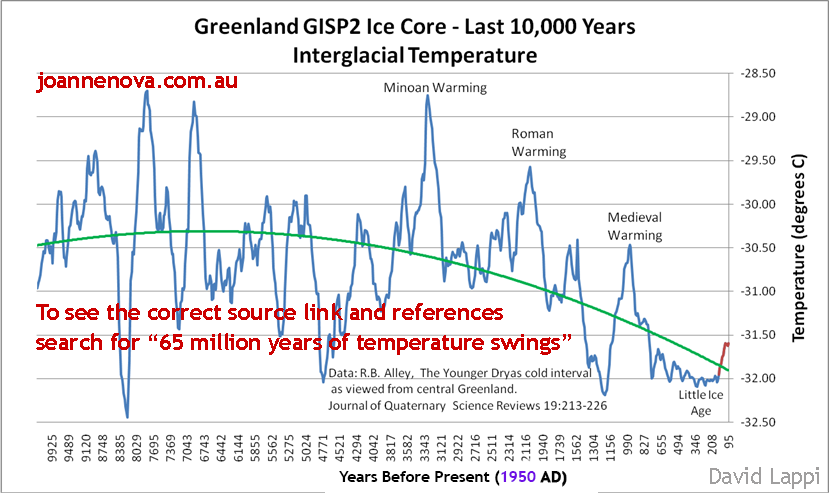 JoNova.com – Click the pic to view at source[/caption]
 climate4you.com – Ole Humlum – Professor, University of Oslo Department of Geosciences – Click the pic to view at source[/caption]
 University of Michigan’s – Global Change Program – Click the pic to view at source[/caption]
 TBD – Click the pic to view at source[/caption]
 CDIAC ORNL – Click the pic to view at source[/caption]
 climate4you.com – Ole Humlum – Professor, University of Oslo Department of Geosciences – Click the pic to view at source[/caption]
 TBD – Click the pic to view at source[/caption]
 NOAA – National Climate Data Center – Click the pic to view at source[/caption]
 University of Michigan’s – Global Change Program – Click the pic to view at source[/caption]
 carleton.edu – Click the pic to view at source[/caption]
 http://www.oocities.org – Click the pic to view at source[/caption]
 GlobalWarmingArt.com – Click the pic to view at source[/caption]
 GlobalWarmingArt.com – Click the pic to view at source[/caption]
 GlobalWarmingArt.com – Click the pic to view at source[/caption]
Global warming has not stalled, and Global warming is not a question to wait out; it is a fact, and it is happening. Strings of warm temperatures are unlikely to be due by chance. Small sets of data are meaningless in this case, and a trend in data must be examined over millions of years, not recent peaks or troughs. By doing this you will see that the trend proves that the annual temperature is increasing.
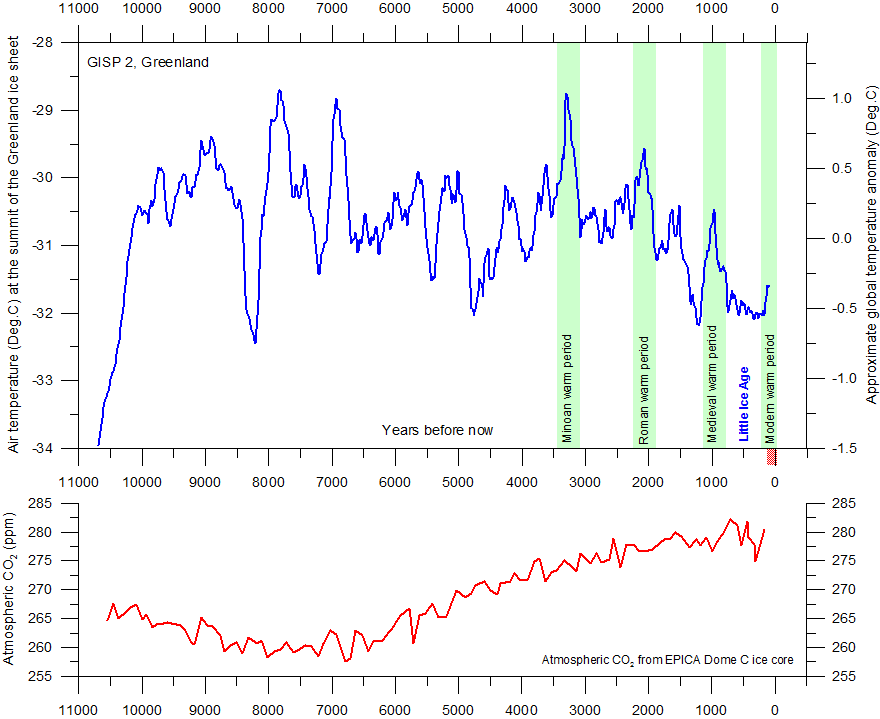
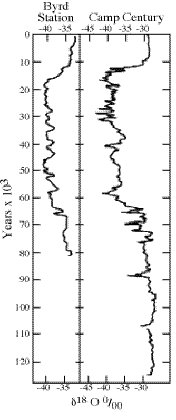
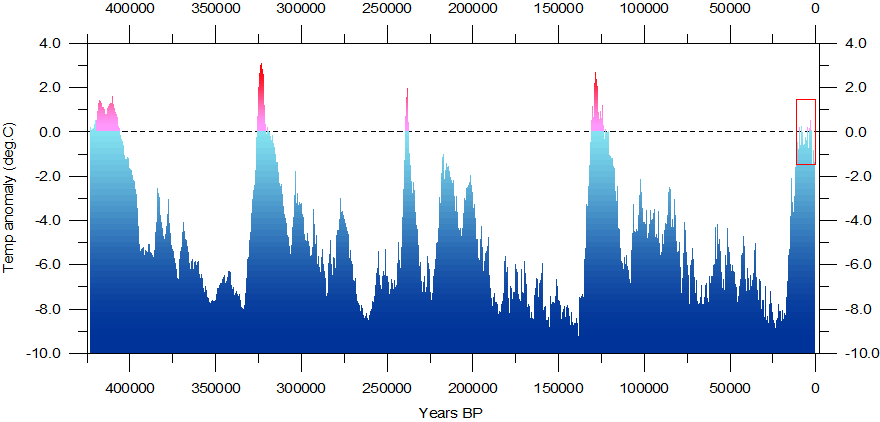
Ummm, sure, per the following paleoclimate graphs can you please point out this warming trend “over millions of years” that you believe to exist?
10,000 Years GISP2 Ice Core
[caption id="" align="alignnone" width="578"]
11,000 years GISP2 Temperature Since 10700 BP with CO2 from EPICA DomeC
[caption id="" align="alignnone" width="578"]
120,000 Years
[caption id="" align="alignnone" width="350"]
140,000 Years Antarctic/Vostok
[caption id="" align="alignnone" width="578"]
400,000 Years Antarctica/Vostok
[caption id="" align="alignnone" width="578"]
450,000 Years Temperature Anomaly
[caption id="" align="alignnone" width="578"]
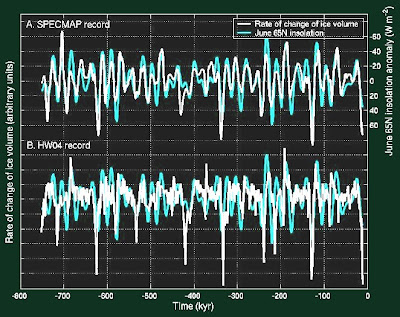
750,000 Years Rate of Change of Ice Volume and June 65N Insolation
[caption id="" align="alignnone" width="578"]
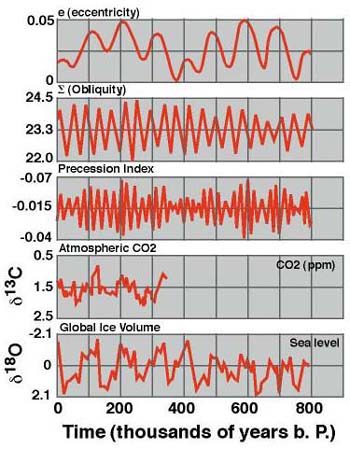
800,000 Years Orbital and Millennial Antarctic Climate Variability
[caption id="" align="alignnone" width="632"]
800,000 Years Orbital and Millennial Antarctic Climate Variability
[caption id="" align="alignnone" width="632"]
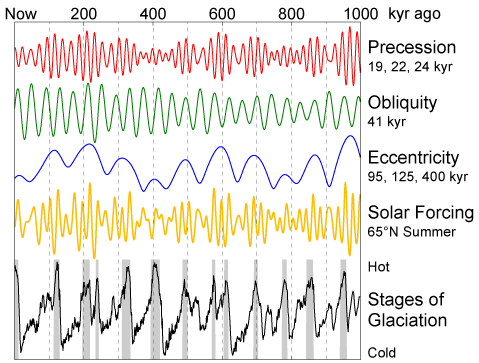
1,000,000 Years
[caption id="" align="alignnone" width="578"]
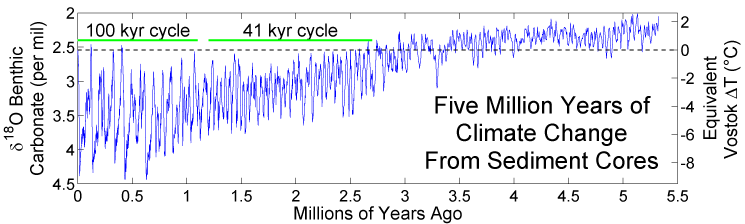
5,000,000 Years Antarctica/Vostok Temperature
[caption id="" align="alignnone" width="578"]
5,500,000 Million Years
[caption id="" align="alignnone" width="578"]
65,000,000 Years
[caption id="" align="alignnone" width="578"]
540,000,000 Years
[caption id="" align="alignnone" width="578"]
Justthefactswuwt,
Excellent rebuttal. Anyone can see that we are currently in a cold phase — not a full blown Ice Age, but a temporary cool interglacial that could end at any time. It was not that many thousands of years ago that the northern U.S. was covered in mile-thick glacier ice. That will certainly happen again.
If Rachel replies, I expect her to back up her belief system with facts similar to those that you have posted above. But of course, she probably will either not reply, or she will go off on an emotional rant devoid of any scientific evidence. Because lacking empirical evidence, emotion is the driving force behind the belief system of climate alarmists.
For the record.
I never stated that temperature is accelerating, nor did I “climb down” from that position. I stated, in reference to a paper which presented data from 1880 to 2007 that the temperature had accelerated over that period.
http://www.skepticalscience.com/pics/AMTI.png
The Great Abuser has never been able to grasp the distinction between present and past, no matter how many times I explain it.
As my posts here demonstrate, I am of the opinion that short term trends are too prone to uncertainty to be taken as a guide to long term trends.
justthefactswuwt says:
February 12, 2013 at 8:52 pm…
Yes Rachel is mistaken. Global temperatures have varied wildly over geologic timescales. As your plots indicate, a primary driver is changes in the Earth’s axis tilt and orbit.
The thing is that for these factors have had an insignificant effect on temperature change in the last 150 years – a blink in geologic timescales. For the first time in the Earth’s history, humans have been affecting climate by burning huge amounts of carbon locked up in the earth’s crust and pumping large amounts of greenhouse gasses into the atmosphere as a waste product.
Attempts to account for the increase in temperature since the onset of the industrial revolution using entirely “natural” forcings without including this anthropogenic factor have not matched the temperature data.
Glad to see that Shehan is once again climbing down from his formerly repeated claim that global warming has been ‘accelerating’. If necessary, I will post his bogus SkS “accelerating” graph — covering quite a long time frame [not just “short term trends”] — which is the basis for Shehan’s alarmist argument.
The fact is that global warming since the LIA is entirely natural. The planet has been warming along the same long term trend line for hundreds of years — whether CO2 was low, or high. Thus, CO2 makes no measurable difference to global warming. None at all.
Therefore, the demonization of harmless, beneficial “carbon” is completely falsified by verifiable, testable scientific evidence. The CO2=CAGW conjecture fails. It was always a stupid assumption anyway.
I had a look at my own data set again, (47 weather stations, with complete or nearly complete records, balanced by latitude and balanced by @sea/inland 70/30 – longitude does not matter)
specifically looking at the speed of warming :
The speed of warming/cooling for means is 0.014K/annum calculated from 1974 (38 yrs), 0.013K/annum from 1980 (32 yrs), 0.014 from 1990 (22 years) and -0.017 from 2000 (12 years).
The speed of warming/cooling for maxima is 0.036K/annum from 1974 (38 yrs), 0.029K/annum from 1980 (32 yrs), 0.014 from 1990 (22 years) and -0.016 from 2000 (12 years).
So basically, we changed sign from warming to cooling, at least before 2000….
I can therefore confirm that I would expect “a stalling” for an even longer period than 12 years.
From your graphs, it seems to me Hadcrut3 comes nearest to my own observations.
Does anyone know: What exactly is the difference between Hadcrut3 and HADCRUT4?
Huh?
I already posted the “bogus” SkS “accelerating graph”.
And yes it covers “quite a long time frame” (from 1850 to 2010) compared to the short time periods of less than a couple of decades. But not so long that factors that operate over geologic timescales must be taken into account.
Which is the point I have been making here. Only multi decadal timeframes can give reliable trends.
I told you all that this person has comprehension difficulties.
HenryP says:
February 12, 2013 at 10:00 pm …
http://www.thegwpf.org/an-updated-hadcrut4-and-some-surprises/
A complaint levelled at earlier Hadcrut versions was that it had limited sampling from higher latitudes in the Northern hemisphere, where greater warming has been observed and thus underestimated the global temperature.
Philip Shehan says:
February 12, 2013 at 9:51 pm
Attempts to account for the increase in temperature since the onset of the industrial revolution using entirely “natural” forcings without including this anthropogenic factor have not matched the temperature data.
Then can you explain why the last 30 years is no different from a 30 year period about 70 years ago. See
http://www.woodfortrees.org/plot/hadcrut3gl/from:1900/plot/hadcrut3gl/from:1912/to:1942/trend/plot/hadcrut3gl/from:1982.58/to:2012.58/trend
“#Selected data from 1912
#Selected data up to 1942
#Least squares trend line; slope = 0.0154488 per year”
“#Selected data from 1982.58
#Selected data up to 2012.58
#Least squares trend line; slope = 0.0151816 per year”
HenryP says:
February 12, 2013 at 10:00 pm
Does anyone know: What exactly is the difference between Hadcrut3 and HADCRUT4?
Do you mean other than making the hottest year 2010 instead of 1998? Presumably Hadcrut4 is more accurate since it does things like taking more northern stations into account properly making it more like GISS. Perhaps others have a more complete answer.
richardscourtney says:
February 11, 2013 at 3:00 pm
At this point, it’s possible to resolve the recent temperature records with the models by correcting for the effects of ENSO, solar forcing, and volcanoes, since these are not (and cannot be) explicitly modeled many years into the future. So, I don’t see the models as being “discrepent” with reality. Still, as I’ve mentioned, I would rather see a full hindcast run using the known ENSO, solar, and volcanic data rather than just a statistical fit, as Rahmstorf and Fostr presented.
I would say that the models were having a problem if the discrepency between them and the temperature data could not be resoved with such corrections. In that case, it would be necessary to see what could be done to fix the models, with newer data, bettter understanding of basic processes, different parameter selection for processes that were not known precisely, etc. With these, you could then see whether the fit was better, or whether you had to go back to the drawing board, or whatever.
It remains to be seen whether some of this is happening now, with James Annan’s criticism of some sensitivty estimates. Even so, that might just move sensitivity down to a lower end of the range, the kind of thing that should be happening as more data comes in. But for real improvements, I’m waiting for better understanding and modeling of cloud formation, and computer hardware capable of modeling it on a sufficiently fine scale.
Werner.
The evidence I had in mind was this (and other references which show much the same thing but I frankly cannot be bothered searching for at the moment):
http://www.grida.no/publications/other/ipcc_tar/?src=/climate/ipcc_tar/wg1/figspm-4.htm
Have not looked to see if the detail of this figure explains your question about the two thirty year periods.
Werner: Some more recent model comparisons are given here (Figure 2 and discussion above)
http://www.csiro.au/en/Outcomes/Climate/Reliability-Climate-Models/In-detail.aspx
Philip says
A complaint leveled at earlier Hadcrut versions was that it had limited sampling from higher latitudes in the Northern hemisphere, where greater warming has been observed and thus underestimated the global temperature.
Henry says
Interesting.
When I considered the sample I was going to take, I thought that
1) longitude would not matter, because I would be looking at average yearly temps. at that specific spot on earth and record how that spot changes over time. So, the earth’s seasonal up and down shift during the year would be included and cancelled out and since earth rotates every 24 hours I would be looking continuously at exactly the correct amount of energy beamed down, so to speak.
2) I thought it would be very important to balance my sample by latitude! In fact when you add all my plus and negative latitudes you come to just about zero. Otherwise you would /could get a bit of a warped picture of the actual global temperature trend.
3) just as a further precaution I also balanced my sample by @sea/inland 70/30 because I considered that inland rises and falls usually are much more dramatic then those at or near sea.
Nevertheless, at first glance my results for means do look meaningless. However, by looking at the development of the maxima,
http://blogs.24.com/henryp/2012/10/02/best-sine-wave-fit-for-the-drop-in-global-maximum-temperatures/
you do begin to see that my means also make sense. We are on a parabolic looking curve and earth is trying to balance and straighten things out. There is some lag between what (change) we get from the sun and what earth is putting out (average temp.)
Note that as shown in the second graph of the quoted blog, it looks like each particular place on earth is on its own sine wave of energy (change) coming from the sun.
Having said that, and knowing what I know now, I would say that if (all?) the data sets being quoted here did not take into account to balance the sample by latitude, neither by 70/30 sea/land, I would expect to get and to see lob sided results.
I’m really confused here as to what the argument actually is, from many people here. Not targeting any one person in particular, but let’s look at this trend:
Trend: 0.038 ±0.137 °C/decade (2σ)
So it could be as high as 0.175 C/decade or as low as -0.099 C/decade with 95% confidence. So one side of the argument simply says “there you go, warming is still continuing, we’ve still got 0.175 C/decade worth of warming potentially going on, how can you say it’s stalled?” even though the 0.175 C/decade is the HIGHEST end of the estimate…there’s no-one saying “the temperature is falling at a rate of -0.099 C/decade, what are we going to do!?” This “let’s look at the high side of each estimate” argument is clearly biased, whereas what people have ludicrously called the “denier” side is simply saying that the actual trend, i.e. the computed trend which lies exactly between the two extreme estimates, is lower than before (whatever the error bars). Some here say “stalled” (and that would apply to those data sets where the trend is actually zero), but personally I don’t even see the need to go so far – it seems pretty clear the rate of temperature rise has recently slowed in ALL data sets and that is entirely contradictory to what was expected. It really is just a question of semantics. Basically whatever way you look at it, what was happening previously (i.e. 70’s through to end of 90’s) is no longer happening to the same extent, and this runs contrary to projections. So the projections needs adjusting? Certainly – and the MET office, for instance, have already started doing just that as their recent announcements showed.
Before anyone starts ranting about the noise in the data, short time periods, blah blah blah. I know all that, and have demonstrated my understanding of that in previous posts, and what I’m saying above is not contradicted by anything you might have to say about that. Whatever way you look at it, something has changed, something has happened/is happening, and that needs investigating. End of story.
Graham, you are right. It has been cooling. My research suggests this cooling is natural.
Philip Shehan says:
February 12, 2013 at 11:34 pm
Thank you for the input. They talk about different models but this post seems to suggest that the models are in big trouble. Suppose we were living in 1945 and had the data until then. You would well be justified in saying that warming is accelerating at that point in time. However looking back, we see the opposite happened after 1945. And at the present time, there have been a number of posts that show we are at or below the very lowest projections of the models.
Graham W says:
February 13, 2013 at 5:43 am
Thank you, and I agree with you. About three years ago I had a talk with a person who believed in CAGW and I believe he was a former university professor. That was just after Phil Jones said the warming was not 95% significant over the last 15 years and he thought the headlines: “No warming for 15 years” were extremely untruthful. He also said that what happens over 8 years means nothing, but what happens over 15 years cannot be easily ignored. In my opinion, policy makers should look at just two things:
1. What is the most recent rate of warming without the error bars?
2. Is the time period long enough that it cannot be ignored?
Werner Brozek says:
“…can you explain why the last 30 years is no different from a 30 year period about 70 years ago?”
That is the crux of the argument. Since there is no measurable difference in global warming between times when CO2 was low, and times when CO2 is high, then CO2 does not matter. QED
And we know why it does not matter: the warming effect of adding more CO2 is inconsequential at current concentrations. That is why global warming is currently stalled.
It is amusing to watch the consternation of CAGW true believers, as they are confronted with the plain fact that Planet Earth herself is falsifying their cherished beliefs. It turns out that “carbon” does not matter at all regarding natural global warming. They have been barking up the wrong tree the whole time.
Will they admit they were wrong? No. Their incurable cognitive dissonance will not allow it.
Werner: (Excuse me if this post does not contain references which I do not have readily to hand or detailed number crunching. I have a day job I must attend to. Will try to post refs later.)
The temperature behaviour before and after 1945 is another demonstration of what I have been saying. The temperatures seem to drop off a cliff for the 16 year period after 1940 but recover and continue an upward trend thereafter, with a similar slope as for the period 1910 to 1940.
http://www.woodfortrees.org/plot/hadcrut3vgl/compress:12/offset/plot/hadcrut3vgl/from:1850/to:2010/trend/offset/plot/hadcrut3vgl/from:1940/to:1956/trend
If you look at the models I gave in the above posts none of them seem to adequately account for the local peak around 1940 with or without the AGW contribution. I submit that the models are pretty good at hindcasting otherwise but obviously there are some things they cannot account for yet.
Anyway, with actual data or models, you need to look at the long term trend, not what happens for a couple of decades or less.
Graham writes: “Whatever way you look at it, something has changed, something has happened/is happening, and that needs investigating.”
Quite so. The apparent change recently have been explained by the contribution of natural forcings (solar cycles, el nino/la nina etc) which are giving a cooling contribution. Factoring those in gives a trend more in line with past decades. (Sorry, been looking for a particular published paper but can’t find it at the moment)
The Foster and Rahmstorf adjustments to the temperature trend calculator I have been using also attempt to account for solar cycles etc which generally give more positive slopes recently and a lower uncertainty range.
http://www.skepticalscience.com/temperature_trend_calculator.html
I have not used that in my analyses because one has to be a bit wary of such adjustments in case they are merely post hoc fudge factors designed to give the desired result rather than an objective adjustment based on sound theory. Not that I am accusing those authors or the ones of the paper(s) I can’t locate at the moment, but you have to take a close look at such adjustments and I did not want to buy into that argument.
You see I am skeptical in the true sense when it comes to not wishing to overinterpret data.
Philip Shehan says:
“You see I am skeptical in the true sense when it comes to not wishing to overinterpret data.”
LOL! As If. Shehan is desperate to find something — anything — that supports his alarmist belief system. But unfortunately for him, the planet itself is ridiculing his beliefs. And he has been forced to climb down from his preposterous assertions that global warming is ‘accelerating’. It isn’t.
In fact, global warming is currently stalled, thus dealing a severe blow to the climate alarmists’ wrongheaded belief in their debunked CO2=CAGW conjecture. Empirical evidence shows that CO2 is harmless, and that it is beneficial to the biosphere — which is starved of CO2. Those are verifiable, testable facts. Contrast those scientific facts with the fact-free and false demonization of harmless, beneficial “carbon” [by which the confused alarmist contingent means CO2 — a tiny trace gas].
Philip Shehan says:
February 13, 2013 at 2:51 pm
Anyway, with actual data or models, you need to look at the long term trend, not what happens for a couple of decades or less.
That is very true. However the models are way off in their projections. As far as I know, the steepest rise for any period is about 0.17/decade for any period of 15 years or more. This only gives 1.7/century. This is clearly not alarming. If you know of a larger slope than 0.17/decade for at least 15 years, please let me know. Then if we go to larger times such as 40 or 50 or more years, this slope of 0.17/decade is never maintained. So why is any one concerned about 3 or 4 or 6 degrees of warming by the year 2100? The required rates have never been seen and all who believe that CO2 causes some warming agree that the law of diminishing returns applies to CO2.
D.B. Stealey says:
February 13, 2013 at 3:24 pm
In fact, global warming is currently stalled, thus
Thank you for your contributions here! However I need to point out that the above needs to be updated for UAH. As you know, UAH saw a huge jump in January and due to the way the numbers worked out, the straight line changed from 8 years and 3 months to 4 years and 7 months, so the present line slopes up very noticeably. It should now start from July 2008 or 2008.5.
I could give you the new set of lines, but even that would not be completely correct since WFT has not updated WTI, GISS, and Hadcrut3 since November. I was able to get the GISS and Hadcrut3 slope to December using SkS. That pushed things back to March for these two sets, but if I gave you the March date, the line would slope up on WFT since it does not have the very low December values. I wrote to Paul Clark but had no success. If you can use your influence to get GISS and Hadcrut3 and WTI updated to the end of December, I would really appreciate it.
Here is the latest. The ones with a * are where changes have occurred from what is stated in this report.
*1. UAH: since July 2008 or 4 years, 7 months (goes to January)
*2. GISS: since March 2001 or 11 years, 10 months (goes to December) (Confirmed by SkS)
3. Combination of 4 global temperatures: since December 2000 or 12 years (goes to November) * (I know this is different, but I do not know what it is, perhaps 2 or 3 months more.)
*4. HadCrut3: since March 1997 or 15 years, 10 months (goes to December) (Confirmed by SkS)
5. Sea surface temperatures: since March 1997 or 15 years, 10 months (goes to December)
6. RSS: since January 1997 or 16 years, 1 month (goes to January)
RSS is 193/204 or 94.6% of the way to Santer’s 17 years.
7. Hadcrut4: since November 2000 or 12 years, 2 months (goes to December.)
Werner,
The time frame has changed due to the current anomaly, but that does not change the fact that not only is there no accelerating trend in global warming, but as of now, global warming is still stalled.
We need more global warming. We are now at the cool end of the Holocene. And with more global warming, we will get the benefit of more CO2. It’s a win-win!
Philip Shehan says:
“Quite so. The apparent change recently have been explained by the contribution of natural forcings (solar cycles, el nino/la nina etc) which are giving a cooling contribution. Factoring those in gives a trend more in line with past decades. (Sorry, been looking for a particular published paper but can’t find it at the moment)”
So I have heard. There are two things about this that puzzle me though:
1) This seems to be mentioned (though I’m not accusing you of this necessarily) at a certain point in the dialogue when a reduction in the rate of warming has been accepted…and only then. I don’t understand why there are these two dual “modes of defence”, if you like, which ought to be mutually exclusive, yet are often used in tandem. You are first told that warming is all “business as usual”. Everything is happening still within the expected boundaries. Then, if successfully challenged, the argument morphs into “natural forcings have now temporarily cancelled the warming effect to an extent”…but if that’s true, then warming HAS slowed. So mode of defence number one is invalidated. It’s no longer ludicrous to claim that warming has slowed/stalled even though before it apparently was!
2) Isn’t the idea of natural forcings not having such a cooling effect over the 70s to late 90s warming period and then suddenly having a cooling effect like they supposedly have now less logical than the idea of CO2 having little effect and climate change being dominated by natural forcings? Because if you argue that the natural forcings changed from being positive over that period to being negative (or lower) recently to try to defend the former position, then that explanation would also apply to the latter position…only the latter position also makes more sense being as how CO2 levels have risen at an increasing rate?
So I downloaded the HADCRUT4 data from 1958, and got the 95% confidence interval of a linear fit from 1958 to Nov 2012. It gave warming of between 0.115 and 0.129 at the 95% confidence interval.
Then I ran it for every start data until 5 years ago, and each time took the end point to be Nov 2012. The earliest start date for which the 95% confidence interval included zero was April 1997. After a while the 95% confidence no longer included zero, until October 1998. After that, the 95% confidence interval of the warming trend has always included zero. Except, in 3 months since then both the upper and lower values were below zero (but I really shouldn’t have told you guys that).
So I can’t understand how you could get a date in 1995 where it was possible at the 95% certainty level that there was no warming.
Is it because I’m not taking into account autocorrelation? Or some other error?