Guest Post by Ira Glickstein.
What’s the difference between a whimsical fable and an environmental fallacy?
- On the outside, fables are light-hearted fibs. But oh so true on the inside.
- Environmental fallacies are just the opposite, serious and plausible on the outside but hiding egregious falsehoods on the inside.
Environmentalists have promoted the theory that human civilization is the main cause of global warming. They argue that Governments worldwide must take immediate drastic action to prevent a catastrophe. The chain of proof in their human-caused climate catastrophe theory is broken in at least six places:

Fossil fuels cause some air pollution, but the most dangerous air pollution comes from the fallacies uttered by environmentalists :^). If the voting public is misled by this kind of “environmentalist air pollution” our free economy will be destroyed, and with it, the most successful experiment so far of free peoples governing themselves. Only a High-Intellect Twit (HITwit), a person who is smart in some academic domain but quite foolish otherwise, could come up with and believe all these fallacies!
Environmental fallacy #1: Scientists have an accurate measure of warming since 1880.
Environmental fallacy #2: Human activities, primarily fossil fuels, are the main cause.
Environmental fallacy #3: Scientists can accurately predict future warming scenarios.
Environmental fallacy #4: Human-caused warming will lead to an environmental disaster.
Environmental fallacy #5: “Green” energy and conservation can replace most fossil fuel.
Environmental fallacy #6: Therefore, the Government must mandate and subsidize “green” energy to save our Planet.
Each of the above statements has a germ of truth that gives a patina of scientific validity to the argument, but none of them can stand close examination.
FALSEHOOD #1. Scientists have an accurate measure of warming since 1880, and it is at least 0.8⁰C.
The statement is false because the very US government-funded scientists charged with analyzing thermometer readings agree that their own past analyses are faulty, or that the raw data is of poor quality, or both. By their own admission, they have had to analyze and re-analyze the data multiple times. They have corrected their previous errors by more than plus or minus a quarter degree, altering the supposed warming trend by up to half a degree.
NASA GISS emails, released under the Freedom of Information Act, include one by climate scientist Makiko Sato [1] that details how official data, issued in 1999 for US mean surface temperatures, showed 1934 more than 0.5⁰C warmer than 1998. That result, indicating a strong cooling trend in the US, was, let us say, inconvenient for the case of a warming world. Sato details seven adjustments that cooled 1934 and warmed 1998 until, according to three 2007 analyses, they were nearly equal, a net change of more than half a degree. (Re-analysis continued after Sato’s 2007 email. According to the latest available reports [2], 1998 was 0.078⁰C warmer than 1934. Our tax dollars at work! The 1934 data is old enough to collect Social Security, yet they are still making it work for them.)
This is not a cherry-picked example. Starting in 2001, virtually all officially reported US temperatures prior to the 1970’s have been systematically adjusted down, thus exaggerating apparent warming. Temperatures after the 1970’s have been systematically adjusted up, further exaggerating the claimed warming. [3]
Apologists point out that this is only US surface temperature data and the US covers only about 2% of the Earth’s surface. However, if US data analyzed by US scientists has half a degree of “adjustment” slop in it, how much worse must worldwide data be? If the wiggle room in data analysis (0.5⁰C) is almost as large as what they claim to have measured (0.8⁰C), the official US, UK and other adjusted climate data has no scientific validity. It is anecdotal, at best.
The truth: The Earth has warmed a bit since 1880, but no more than 0.4⁰C.
FALSEHOOD #2. Human activities, primarily fossil fuels, are the main cause.
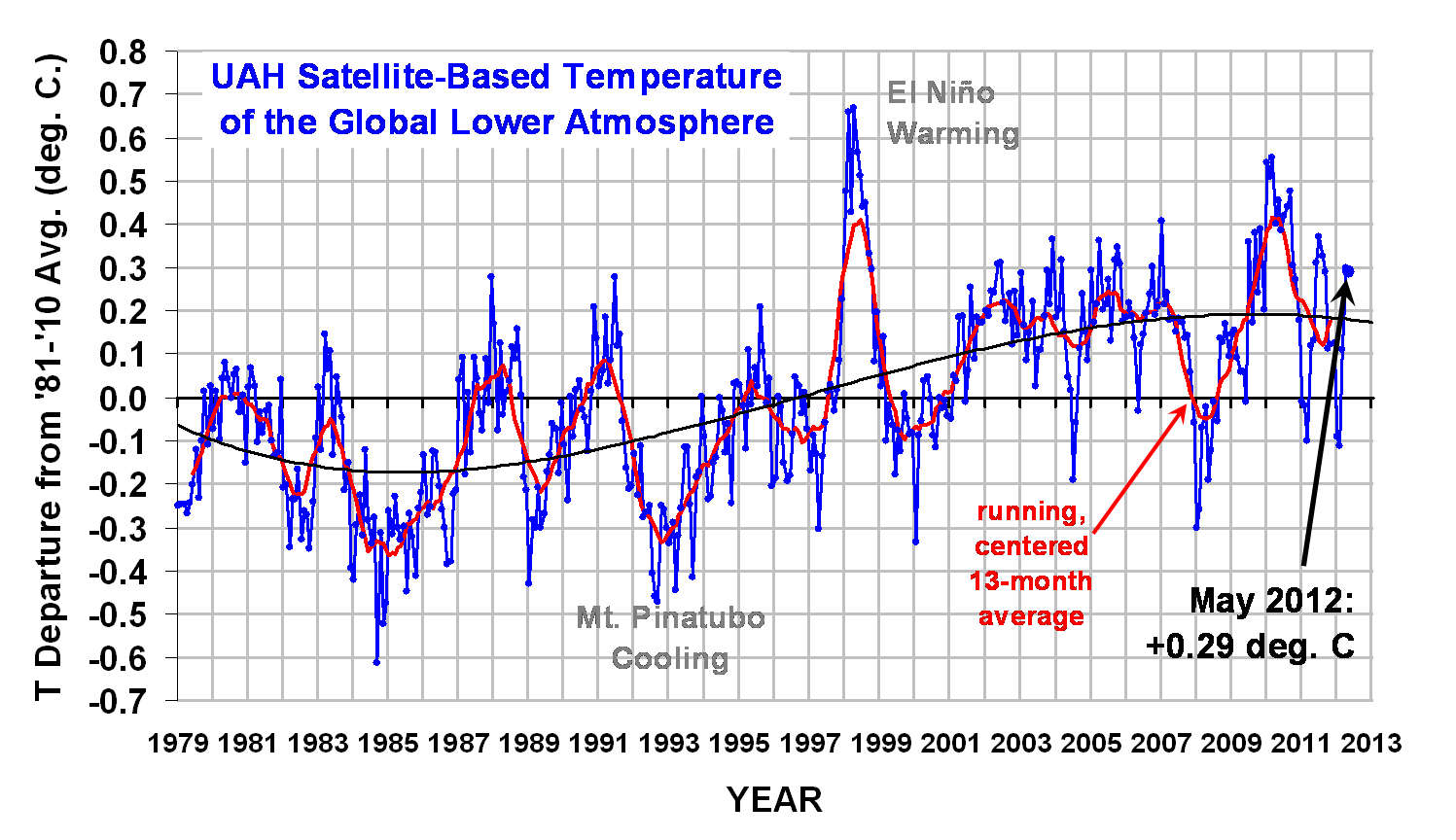
This statement is false because, even as carbon dioxide (CO2) levels continue their rapid exponential rise [4], global temperatures, as measured by satellite sensors [5] over the past dozen years, have stabilized and even dropped a bit. If CO2 was the main cause of temperature rise, temperatures would have had to go up over this period, at least a bit. They have not, which disproves the strength of the causal relationship. There must be other causes that are greater than burning fossil fuels.
The Truth: While human-caused CO2 and other “greenhouse” gases undoubtedly have effects on temperatures, they are not the main cause of recent warming. Human activities will not, indeed cannot, cause any kind of “tipping point” or “runaway” warming. It is becoming clear the main cause is natural cycles, such as Solar activity that modulates cosmic rays [6], and multi-decadal ocean oscillations, neither of which is under control or influence by humans.
One way to “lie with statistics” is to plot the data with an axis of the graph at an arbitrary value that exaggerates the variations. The figure below plots Temperature in Kelvin (above Absolute Zero) against CO2 levels referenced to zero, and indicates that Temperatures have remained quite stable as CO2 has gone up quite visibly.

FALSEHOOD #3. Scientists can accurately predict future warming scenarios.
This statement is false because official warming scenarios depend upon a misunderstanding of the nature and magnitude of Equilibrium Climate Sensitivity. ECS is how much temperatures will rise given a doubling of CO2.
The Intergovernmental Panel on Climate Change (IPCC) assumes ECS is a mono-modal distribution with the most likely value lying between 2⁰C to 4.5⁰C, with an asymmetric “fat tail” that extends out to 10⁰C or higher, and with a single peak at 3⁰C. However, this conclusion is based on combining the results of ten separate studies, from 2001 through 2006, that are each quite different [7]. They peak at various temperatures, from 1.1⁰C to 3.8⁰C. Some of the study results hardly overlap. Indeed, the one thing they have in common is their “fat tails” that extend out beyond 6⁰C, which turns out to be impossible based on the limited glaciation of the Last Glacial Maximum (LGM).
In 2011, Andreas Schmittner showed that ECS is multi-modal, with at least two separate peaks for data taken over land, and five separate peaks for over water [8]. A multi-modal distribution generally indicates that different populations have been conflated and, therefore, all bets are off with respect to the scientific validity of predictions of means that assume a mono-modal variable.
In addition, Schmittner showed that “fat tails” beyond about 6⁰C incorrectly retrodict the LGM as a totally frozen “snowball Earth”. However, it is well known that the LGM did not extend equatorwards beyond 40⁰ north and south latitudes. Thus, ECS-based models are not scientifically valid. [9]
The Truth: All else being equal, a doubling of CO2 levels will increase average temperatures by less than 1⁰C, and most likely less than 0.5⁰C. Climate models overestimate warming because they wrongly assume that clouds, on net, cause positive feedback. They also ignore the effect on cloud formation of cosmic ray modulation due to natural solar cycles.
Indeed, natural forces not under human control or influence are as likely to drive us into a period of global cooling as global warming. Future generations may come to thank us for the bit of added warmth due to our burning of fossil fuels.
FALSEHOOD #4. Human-caused warming will lead to an environmental disaster.
This statement is false because humans simply do not have the capability to cause more than relatively moderate warming and increases in CO2 levels that cannot imperil human civilization.
The Truth: The supposed disaster of global warming has been overhyped. As Climate-gate and other scandals have revealed, the temperature data have been diddled, the books cooked, and climate models have failed to predict the near-term future, much less the long term.
Predictions of imminent disaster due to human activities are overstated speculations at best. Recent moderate warming and CO2 increases are likely to be of net benefit to human civilization.
FALSEHOOD #5. “Green” energy and conservation can replace most fossil fuel.
This statement will be true at some time in the distant future because fossil fuels are not renewable and therefore cannot last forever. However, for the foreseeable future (a century or two) the statement is clearly false.
Hydroelectric and nuclear power are the two significant “green” sources that make economic sense now and into the forseeable future.
Technological developments have made offshore oil as well as oil sands and shale oil much more attractive than anyone predicted a decade ago. Fracking has driven the price of natural gas way down. Coal to gas, coal to liquid, and other new technologies will make coal, our most plentiful fossil fuel, both cleaner and cheaper.
So-called “green” energy has proven to be much more costly than fossil energy, and, except for some special cases, it cannot succeed in the marketplace without massive government mandates and subsidies.
The Truth: Fossil fuels will be our primary source of energy for many decades into the future, even as “green” energy slowly increases in importance. As fossil sources become scarcer and therefore more and more expensive compared to “green” sources, the energy industry will voluntarily switch to non-fossil energy and consumers will, in their own self-interest, embrace efficiency. To some limited extent that is happening now. It should be encouraged by allowing free market forces to do their magic.
FALSEHOOD #6. Therefore, the Government must mandate and subsidize “green” energy to save our Planet.
This statement is false because the underlying assumptions are false. Our Planet is not in danger. “Green” energy cannot replace most fossil sources in the foreseeable future. And, a “cure” based on Government mandates and subsidies will most likely be worse than the “disease”.
There is nothing inherently wrong with wind, solar, ethanol, or any of the other harebrained schemes the climate change authorities have seduced us into supporting with taxpayer funding. No, the problem is with the process of public funding that inevitably distorts true market forces. It is a process that in-errantly chooses exactly those solutions that benefit special interests while making the real problem worse.
The Truth: Without doubt, fossil fuels are limited. Oil, natural gas, and even coal may be exhausted within the next century or two. Less expensive sources will run out first. Deep ocean oil, Arctic oil, shale oil, and additional fossil fuel technologies yet to be developed, will eventually raise the price of fossil energy to the point where market forces will drive industry to invest their own money to develop alternatives.
When the government picks winners, using our taxpayer money, you can be sure special interests, such as politically connected corporations and unions, will pressure the bureaucrats to choose net losers. Corn Ethanol has been a gigantic payoff to agricultural interests. It has raised the price of grain worldwide which has been a disaster for the poorest among us. Solar projects, such as Solyndra, wasted billions while creating zero permanent jobs and less than zero usable energy.
Government-provided seed money has been wasted on crazy schemes that have their own environmental drawbacks. Wind power kills birds and exposes animals (including humans :^) to noise pollution. Both wind and solar energy require backup by fossil fueled power plants when the wind doesn’t blow and the sun doesn’t shine.
Private companies invest their hard-earned money only when there is a good chance it will pay off for their investors. Thus, they generally pick net winners. If a private venture turns sour, private money is lost and those responsible may lose their jobs and their employer may be forced out of business. That necessary process has been called “creative destruction”.
When government wastes our money on a loser, no one gets fired. The politically-connected recipients say the equivalent of “oops” (but in more legal mumbo-jumbo words), and keep their profits, except for the fraction they re-invest in further political contributions. The public agency responsible continues to blow taxpayer dollars. (What do we call it when a government program happens to pick a real winner? An accident. :^)
Fossil fuels cause some air pollution, but the most dangerous air pollution comes from the fallacies uttered by environmentalists :^). If the voting public is misled by this kind of “environmentalist air pollution”, our free economy will be destroyed, and with it, the most successful experiment so far of free peoples governing themselves. Only a High-Intellect Twit (HITwit), a person who is smart in some academic domain but quite foolish otherwise, could come up with and believe all these fallacies!
REFERENCES
[1] Makiko Sato, Email dated 14 August 2007 to James Hanson, NASA GISS, Original at http://www.judicialwatch.org/files/documents/2010/783_NASA_docs.pdf (page 48), annotated copy and detailed explanation at http://wattsupwiththat.com/2010/12/25/do-we-care-if-2010-is-the-warmist-year-in-history/
[2] NASA GISS, Contiguous 48 U.S. Surface Air Temperature Anomaly (C), accessed 9 June 2012, from http://data.giss.nasa.gov/gistemp/graphs_v3/Fig.D.txt
[3] NASA GISS systematic distortion of US mean temperature data. http://wattsupwiththat.com/2011/01/16/the-past-is-not-what-it-used-to-be-gw-tiger-tale/
[4] NOAA Atmospheric CO2 measured at Mauna Loa observatory. http://www.esrl.noaa.gov/gmd/ccgg/trends/#mlo_full
[5] University of Alabama at Huntsville (UAH) Satellite-Based Temperature of the Lower Global Atmosphere. http://www.drroyspencer.com/wp-content/uploads/UAH_LT_1979_thru_May_2012.png
[6] Nigel Calder, 2012, Svensmark’s Cosmic Jackpot, http://calderup.wordpress.com/2012/04/24/a-stellar-revision-of-the-story-of-life/
[7] Intergovernmental Panel on Climate Change, 2007, figure 9-20, http://www.ipcc.ch/publications_and_data/ar4/wg1/en/figure-9-20.html
[8] Schmittner, A., Urban N. M., Shakun, J. D., Mahowald, N. M., Clark, P. U., Bartlein, P. J., Mix, A. C., and Rosell-Melé, A. (2011), Climate Sensitivity Estimated From Temperature Reconstructions of the Last Glacial Maximum, Science, 334, 1385-1388,doi: 10.1126/science.1203513. (Behind a paywall, but free access via Schmittner’s blog, http://mgg.coas.oregonstate.edu/~andreas/ Then scroll down to the paper, click on pdf.)
[9] Ira Glickstein, 2011, CO2 Sensitivity is Multi-Modal – All bets are off. An analysis of Schmittner, 2011, paper: http://wattsupwiththat.com/2011/12/18/co2-sensitivity-is-multi-modal-all-bets-are-off/
Ira,
I will have one more try.
First I must deal with a couple of misconceptions in your latest response.
MISCONCEPTION 1
You say: What I get from that is that “sensible heat energy” (which I believe refers to longwave IR upwelling from the surface plus heat conducted and convected from the surface towards the TOA) needs to be converted into outgoing radiation to space.
No! The term ‘sensible heat’ just means the thermal kinetic energy contained in the air molecules (GHGs and non-GHGs alike) as would, for example, be measured by a thermometer. It does not, repeat not, include radiation – which is not heat at all but an entirely separate form of energy.
It is only the sensible heat that has to be converted to radiation before it can escape to space. Any radiation that manages to reach the TOA, whether originating directly from the earth’s surface or from thermalised GHG molecules somewhere in the atmosphere, just escapes to space anyway.
MISCONCEPTION 2
I do not understand why we need GHGs to “convert” the heat energy from the surface into radiation. You already agreed that, absent GHGs, all the upwelling surface radiation would escape to space, leaving the surface colder, by tens of degrees, than it currently is.
You ‘need’ GHGs in the atmosphere precisely so that its surface temperature is several tens of degrees higher than it otherwise would do, absent GHGs. The ability of GHGs to radiate efficiently to space is absolutely necessary for this to happen. So in that (colloquial) sense we ‘need’ them to explain the enhanced surface temperature that we observe in practice as opposed to the much colder S-B calculated temperature of an earth whose atmosphere is either GHG-less or is altogether devoid of an atmosphere.
ATMOSPHERIC MODEL:
Let me now summarise my understanding of how energy flows through the atmosphere and see whether we can at least come to a suitable agreement on an Atmospheric Model.
If a planetary body has an atmosphere containing GHGs, there are three routes for energy to flow from the earth’s surface to space:
ROUTE 1: ~59% of the heat at the earth’s surface is transferred to sensible heat in the atmosphere, either by (i) conduction of the earth’s surface heat to air molecules immediately in contact with it (14%), or (ii) by evaporation of water to form water vapor molecules (45%). In either case the sensible heat contained in those molecules is transported upwards through the atmospheric column by molecular convection.
The remaining 41% of the heat at the earth’s surface is converted to radiant energy and is radiated into the atmosphere where it follows one of two routes:
ROUTE 2: ~29% is converted to radiation which is subsequently absorbed by GHG molecules in the atmosphere and is thereby thermalised (meaning that the radiation is anihilated and replaced by additional sensible heat).
ROUTE 3: ~12% of the heat is converted to radiation which escapes directly to space through what is known as the ‘atmospheric window’ (i.e. it is emitted at those wavelengths that none of the GHGs can absorb).
SO WHY IS THE SURFACE ATMOSPHERIC TEMPERATURE FIXED?
You say…
It would seem to me that the role of GHGs is not to help or speed the conversion and emission of radiation to be Lost to Space, but rather the opposite, to impede that radiation. Please explain.
Well, in the light of the above atmospheric model, I hope you now agree that the only vital role of GHGs is to enable the flow of sensible heat up the atmospheric column, cooling to space via radiation. If you took those GHGs away, the molecules towards the top of the column would be unable to cool by converting their sensible heat to radiation. In this case the column would (eventually) become isothermal and would be at the same temperature as the surface.
And (this is the coup de grace), the temperature at the hot end (ground level) is fixed by the Gas Law. This is because, as I have carefully explained a couple of times before, in the absence of any variation in VOLUME or PRESSURE, the Gas Law ensures that our ‘average’ sample of air at ground level has a temperature that is dictated solely by the rate of flow of heat through it.
And since that rate of heat flow is derived from the Sun, it is fixed.
So the TEMPERATURE IS FIXED irrespective of how much extra GHG you might add to the atmosphere.
Q.E.D.
David Socrates: You have the last word. Best of luck with your theory.
(Oh, and enjoy the missing piece of “blueberry pie” :^)
Ira Glickstein
PS: From a high of nearly 3000 page views a day (12 Oct) we are down to a couple dozen today, so it appears interest has tapered down. THANKS to all who participated and made valuable comments.
ira. the Earth’s core/mantle does not retain the heat of formation. That error was in Lord Raleigh’s calculation of planet age as being about 40,000 years in the 1700’s. Later evidence from fossils and newly discovered radioactivity changed everything. Remaining heat is due to the radioactive decay of potassium, thorium, a little uranium and other radioactive elements. The age of Jupiter is the same as the solar system, 4.6 Ba. Big Bang, thought to have started everything, was (roughly) 13.6Ba ago. Our sun is a second generation star, thank goodness, which will extend its age from that of short lived first generation stars. Unless you know differently.
I still hold that adiabatic compressive heating is the source of much of the atmospheric heat not the GHG theory. Your explanation that a ”little” of the downwelling radiation is from the sun, the rest from re-radiated LIR completely discounts the trillions of molecule/molecule radiative transfers that must happen as photons travel the short distance through the atmosphere to the surface, all of which will contribute to the LIR and microwave packet of energy reaching the surface assumed to be from re-radiation. Measurement of this is impossible and any claim that these energy consuming reactions are not important is a complete leap of PC GHG theory faith. Adiabatic compressive heating also explains atmospheric lapse rate which is measured daily using radiosonde/dropsonde data to calculate cloud layer heights dew point etc through the atmosphere. Non have revealed the predicted troposphere heat anomaly, Kevin T’s travesty.
So we are back where we started.
John Marshall: You are correct when you say “…The age of Jupiter is the same as the solar system, 4.6 Ba. Big Bang, thought to have started everything, was (roughly) 13.6Ba ago.”. I was wrong to conflate the age of the Earth and Jupiter with the original Big Bang. Thank you for setting me straight.
An internet search indicates that internal radioactive decay within the Earth’s core is a larger heat source than I thought it was, but it seems absoutely true that the warmth of the core of both the Earth and Jupiter is due to internal sources, and not external. These include heat left over from the original formation of the planets plus radioactive decay. The internal core temperatures of the Earth (5,700 K) and Jupiter (36,000 K) would rule out, IMHO, any significant contribution from “adiabatic compressive heating” in the Earth’s Atmosphere or Jupiter’s gaseous envelope.
As for your last point, regarding the contribution of longwave IR due to the Sun’s rays heating the Atmosphere on its way down, I would like to see what sources you may have. For example, a comparison of day vs night measurements of downwelling radiation.
Finally, please read the defense of the Atmospheric “greenhouse effect” by an actual Climate Scientist who is well known at WUWT as Skeptic-friendly, Roy W. Spencer, Ph. D. (Warning for sensitive Disbelievers, he actually uses the term “back radiation” as part of his explanation. :^)
Ira Glickstein
I do not have such data but inbound radiation must affect all. An internet search does display a diagram of the various adsorbed and emitted frequencies. Of the, so called, GHG’s the bulk is water vapour which has similar adsorption/emission spectra to othe GHG’s like CO2. One photon’s route will impinge on more than one GHG molecule, by the law of averages the number must number in the trillions increasing towards the surface by increasing atmospheric pressure guaranteeing more collisions. Each collision will loose energy reducing the inbound frequency, increasing the wavelength, of that energy. SIR-LIR-MW. How a simple measurement at the surface measuring this bundle of frequencies can dictate that most is from the re-rediated since the surface radiated energy is within the same energy bracket.
Looking at a garden greenhouse, with its IR opaque glass, it is the visible light that heats the interior producing IR which cannot radiate through the glass so increasing internal temperature. The stucture also reduces mixing with exterior cooler air. So in the atmosphere. Visible light will heat the atmosphere, produce more IR. but in the atmosphere there is an open top, far bigger in area than the surface so easier for heat to radiate away. Due to all the atmospheric energy reactions an atmosphere reduces the heat at the surface. See my moon example a couple of blogs above. Temperature extremes on the moon are far higher than on earth, with the same insolation.
John Marshall wrote, in part: “Looking at a garden greenhouse, with its IR opaque glass, it is the visible light that heats the interior producing IR which cannot radiate through the glass so increasing internal temperature. The stucture also reduces mixing with exterior cooler air. “
That explanation of a physical greenhouse is the one I learned in grade school, but it turns out not to be completely true. Yes, the glass roof of a greenhouse does pass most visual light (shortwave) and is mostly opaque to longwave radiation, but the major reason any greenhouse works is that the Sunlight is absorbed by and warms the stone and earth which warm the air by conduction and convection and the walls and roof keep the warmed air from escaping and cooler outside air from entering. This explanation has been proven by the success of greenhouses made with IR-transparent plastic roofs and walls.
As for the Moon, the high temperature on the sunlit side is, as you say, much higher than that on Earth, but the low temperature on the dark side is much, much lower, so the average surface temperature of the Moon is quite a bit cooler, by tens of degrees, than that on Earth. Therefore, your claim that “Due to all the atmospheric energy reactions an atmosphere reduces the heat at the surface.” is totally wrong. Extreme high and low temperatues on the Moon both exceed high and low temperatues on Earth, but the average Earth temperature is some 33⁰C warmer than that of the Moon, thanks to our GHG-laden Atmosphere.
Ira Glickstein
Ira,
I see that the phoenix arises…
You say to John Marshall:
As for your last point, regarding the contribution of longwave IR due to the Sun’s rays heating the Atmosphere on its way down, I would like to see what sources you may have.
How about the following:
http://bouman.chem.georgetown.edu/S02/lect23/Solar_Spectrum.png
The yellow area to the right of the ~700nm dotted line represents the Watts per sq. metre of infrared radiation absorbed in the atmosphere, whilst the sum of the red areas to the right of the 700nm dotted line represent the Watts per sq. metre of infrared radiation that does reach the surface.
David Socrates and John Marshall:
See http://bouman.chem.georgetown.edu/S02/lect23/budget.jpg for a Sunlight budget diagram from the same source as David’s link, which provides the information John and I were seeking.
Note that 30% of the Sunlight is reflected back to space by clouds and other light-colored materials in the Atmosphere and on the Earth surface and therefore does not contribute any energy to the Atmosphere or the Earth surface at all. When we say the albedo of the Earth is about 0.3, that comes from 1 (total Sunlight) – 0.7 (absorbed) = 0.3 (reflected = albedo).
About 19% is absorbed by the Atmosphere and clouds, and 51% is absorbed by the Earth surface. So, if we count only the Sunlight that is actually absorbed by the Atmosphere and Earth surface, most of the Sunlight (about 73%) is absorbed by the Earth surface (and later emitted as longwave IR into the Bottom of the Atmosphere) while the remaining Sunlight (about 27%) is absorbed directly into the Atmosphere (including clouds).
I do not understand the point David is making when he adds:
There is nothing magic about the area to the right of the ~700nm vertical dotted line. Energy is energy as noted by the Y axis label that says “W[atts]/m[eter]^2/nm[nanometer]”. Watts are watts, whether we call them “visible light” or “untraviolet light” or “near-infrared light” or “mid-infrared heat” or “far infrared heat”.
We distinguish between them only because the human sensory system “sees” (with our eyes) what we quite naturally call the “visible light” spectrum as LIGHT and feels (with our skin) what we naturally call the mid- and far-infrared region as HEAT. Even though we cannot see ultraviolet or near-infrared with our eyes, we call that radiation “light” because it is near the visible band. The point is, no matter the wavelength of the radiation, short, medium, or long, when it is absorbed by some material substance, it is energy, and, as such, it warms that material.
Thus, the yellow area to both the LEFT and RIGHT of the ~700nm dotted line represents the Watts per sq. meter of total Sunlight radiation absorbed in the Atmosphere, while the sum of the red areas to the LEFT and RIGHT of the 700nm dotted line represent the Watts per sq. meter of total Sunlight radiation that does reach the Earth surface and is absorbed.
Ira Glickstein
The Wood experiments in the 1920’s demonstrated that visible light does a lot of warming. Using IR opaque and transparent materials on two enclosed boxes showed very little temperature difference when exposed to sunlight. My GH explanation may not have been as clear as I would have wished. The visible light heats the internal surfaces which emit IR which is trapped by the IR opaque glass. As this process continues the internal heat increases but to the point of equilibrium when conducted heat through the glass and framework loose heat to the atmosphere through convection and radiation.
I agree that the ”average” temperature on the moon is lower than earth by your calculations but are they? The maximum temperature on earth is +50C, the minimum -80C giving an ”average” of -15C somewhat different to the calculated temperature of +15. I am only doing the same as you using the same assumptions of max/min. According to Essex, Mckitrick and Andressen in the paper ‘Does a Global Temperature Exist’ published in the Journal of Equilibrium Thermodynamics June 2006 no such average temperature is actually correct. To try to get such an average ignores the physical ever changing aspect facing the only source of heat, the sun. Whilst average heating will be a given amount the rotation and tilt of the planet changes everything to the extent that an average is meaningless. The temperature difference between max/min on earth is 130C(K) far less than the difference between max/min on the moon and that is down to having an atmosphere. Max. temperatures are lower because of the energy loss in the atmosphere. Min. temperature is higher but there are many energy transfers throughout the atmosphere and many, many inputs, negative and positive, that affect the minimum temperature.
My assertion that the GHG theory violates the 2nd Law is laid out in a paper by Joseph Reynen, Atmospheric Adsorption by IR Sensitive Molecules (2011) which may be of interest.
John Marshall:
The controversy over the “back radiation” results from widespread misuse of the term “heat” by climatologists.In his paper.Occuring as it does in the midst of a heat transfer problem, this is a serious error! In his paper, Mr. Reynen adds to the muddying with a terminological misuse that confuses a scalar with a vector.
At a space point in a field of electromagnetic radiation, the “heat flux” is a vector that is the vector sum of the various Poynting vectors at the same space point. The radiative heat flux vector may be decomposed into a pair of vectors. One of these vectors is the vector sum of those Poynting vectors that are incident on a surface that contains the space point; this vector is called the “vector irradiance. The other vector is the vector sum of those Poynting vectors that are transmitted through the surface or are reflected by this surface; this vector is called the “vector radiosity.” The intensity of the vector irradiance is called the “irradiance.” The intensity of the vector radiosity is called the “radiosity.” The radiative heat flux is the vector difference between the vector radiosity and vector irradiance. Reynen calls the intensity of the radiative heat flux the “heat flux” but this usage confuses a scalar with the associated vector. The term “back radiation” is also incorrect; it should be called the “vector irradiance in the IR band, or something similar. As the vector irradiance in the IR band is not a heat flux, it is not bound by the 2nd law of thermodynamics.
In climatological arguments, a common source of error is to imply that the absolute value of the intensity of the radiative heat flux is the absolute value of the difference between the radiosity and the irradiance but this is true only under the condition that the two vectors are co-linear, as they are in the case of parallel plates radiating against each other. At Earth’s surface, the two vectors are generally not co-linear.
In my previous post, please correct the first sentence to read “The controversy over the ‘back radiation’ results from widespread misuse of the term “heat” by climatologists. Occuring as it does in the midst of a heat transfer problem, this is a serious error!”
OK but climatologists insist on using temperature as a metric for heat. It is, partially, but no account is made in the models for specific heat content. Water saturated air contains far more heat than dry air and it is heat that drives the system not temperature.
2nd law violations are present in the GHG theory and claims that this basic law can be broken ”in parts but be good overall” is completely false. It must apply to every small part of the total or it will not apply at all. Since PPM’s are impossible we must assume that the 2nd law must apply at all times to every small part of a system.