Guest Post by Ira Glickstein.
What’s the difference between a whimsical fable and an environmental fallacy?
- On the outside, fables are light-hearted fibs. But oh so true on the inside.
- Environmental fallacies are just the opposite, serious and plausible on the outside but hiding egregious falsehoods on the inside.
Environmentalists have promoted the theory that human civilization is the main cause of global warming. They argue that Governments worldwide must take immediate drastic action to prevent a catastrophe. The chain of proof in their human-caused climate catastrophe theory is broken in at least six places:

Fossil fuels cause some air pollution, but the most dangerous air pollution comes from the fallacies uttered by environmentalists :^). If the voting public is misled by this kind of “environmentalist air pollution” our free economy will be destroyed, and with it, the most successful experiment so far of free peoples governing themselves. Only a High-Intellect Twit (HITwit), a person who is smart in some academic domain but quite foolish otherwise, could come up with and believe all these fallacies!
Environmental fallacy #1: Scientists have an accurate measure of warming since 1880.
Environmental fallacy #2: Human activities, primarily fossil fuels, are the main cause.
Environmental fallacy #3: Scientists can accurately predict future warming scenarios.
Environmental fallacy #4: Human-caused warming will lead to an environmental disaster.
Environmental fallacy #5: “Green” energy and conservation can replace most fossil fuel.
Environmental fallacy #6: Therefore, the Government must mandate and subsidize “green” energy to save our Planet.
Each of the above statements has a germ of truth that gives a patina of scientific validity to the argument, but none of them can stand close examination.
FALSEHOOD #1. Scientists have an accurate measure of warming since 1880, and it is at least 0.8⁰C.
The statement is false because the very US government-funded scientists charged with analyzing thermometer readings agree that their own past analyses are faulty, or that the raw data is of poor quality, or both. By their own admission, they have had to analyze and re-analyze the data multiple times. They have corrected their previous errors by more than plus or minus a quarter degree, altering the supposed warming trend by up to half a degree.
NASA GISS emails, released under the Freedom of Information Act, include one by climate scientist Makiko Sato [1] that details how official data, issued in 1999 for US mean surface temperatures, showed 1934 more than 0.5⁰C warmer than 1998. That result, indicating a strong cooling trend in the US, was, let us say, inconvenient for the case of a warming world. Sato details seven adjustments that cooled 1934 and warmed 1998 until, according to three 2007 analyses, they were nearly equal, a net change of more than half a degree. (Re-analysis continued after Sato’s 2007 email. According to the latest available reports [2], 1998 was 0.078⁰C warmer than 1934. Our tax dollars at work! The 1934 data is old enough to collect Social Security, yet they are still making it work for them.)
This is not a cherry-picked example. Starting in 2001, virtually all officially reported US temperatures prior to the 1970’s have been systematically adjusted down, thus exaggerating apparent warming. Temperatures after the 1970’s have been systematically adjusted up, further exaggerating the claimed warming. [3]
Apologists point out that this is only US surface temperature data and the US covers only about 2% of the Earth’s surface. However, if US data analyzed by US scientists has half a degree of “adjustment” slop in it, how much worse must worldwide data be? If the wiggle room in data analysis (0.5⁰C) is almost as large as what they claim to have measured (0.8⁰C), the official US, UK and other adjusted climate data has no scientific validity. It is anecdotal, at best.
The truth: The Earth has warmed a bit since 1880, but no more than 0.4⁰C.
FALSEHOOD #2. Human activities, primarily fossil fuels, are the main cause.
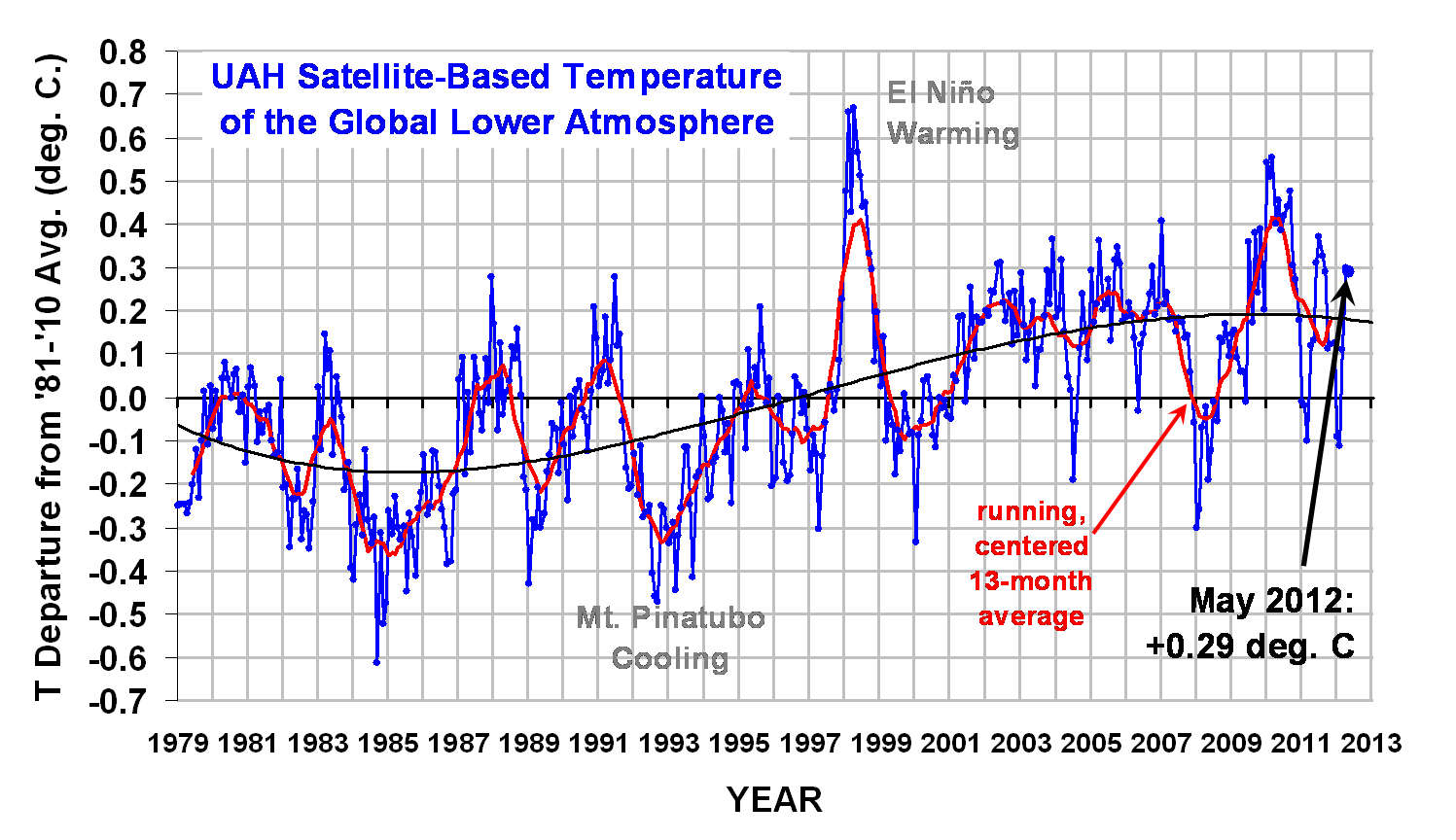
This statement is false because, even as carbon dioxide (CO2) levels continue their rapid exponential rise [4], global temperatures, as measured by satellite sensors [5] over the past dozen years, have stabilized and even dropped a bit. If CO2 was the main cause of temperature rise, temperatures would have had to go up over this period, at least a bit. They have not, which disproves the strength of the causal relationship. There must be other causes that are greater than burning fossil fuels.
The Truth: While human-caused CO2 and other “greenhouse” gases undoubtedly have effects on temperatures, they are not the main cause of recent warming. Human activities will not, indeed cannot, cause any kind of “tipping point” or “runaway” warming. It is becoming clear the main cause is natural cycles, such as Solar activity that modulates cosmic rays [6], and multi-decadal ocean oscillations, neither of which is under control or influence by humans.
One way to “lie with statistics” is to plot the data with an axis of the graph at an arbitrary value that exaggerates the variations. The figure below plots Temperature in Kelvin (above Absolute Zero) against CO2 levels referenced to zero, and indicates that Temperatures have remained quite stable as CO2 has gone up quite visibly.

FALSEHOOD #3. Scientists can accurately predict future warming scenarios.
This statement is false because official warming scenarios depend upon a misunderstanding of the nature and magnitude of Equilibrium Climate Sensitivity. ECS is how much temperatures will rise given a doubling of CO2.
The Intergovernmental Panel on Climate Change (IPCC) assumes ECS is a mono-modal distribution with the most likely value lying between 2⁰C to 4.5⁰C, with an asymmetric “fat tail” that extends out to 10⁰C or higher, and with a single peak at 3⁰C. However, this conclusion is based on combining the results of ten separate studies, from 2001 through 2006, that are each quite different [7]. They peak at various temperatures, from 1.1⁰C to 3.8⁰C. Some of the study results hardly overlap. Indeed, the one thing they have in common is their “fat tails” that extend out beyond 6⁰C, which turns out to be impossible based on the limited glaciation of the Last Glacial Maximum (LGM).
In 2011, Andreas Schmittner showed that ECS is multi-modal, with at least two separate peaks for data taken over land, and five separate peaks for over water [8]. A multi-modal distribution generally indicates that different populations have been conflated and, therefore, all bets are off with respect to the scientific validity of predictions of means that assume a mono-modal variable.
In addition, Schmittner showed that “fat tails” beyond about 6⁰C incorrectly retrodict the LGM as a totally frozen “snowball Earth”. However, it is well known that the LGM did not extend equatorwards beyond 40⁰ north and south latitudes. Thus, ECS-based models are not scientifically valid. [9]
The Truth: All else being equal, a doubling of CO2 levels will increase average temperatures by less than 1⁰C, and most likely less than 0.5⁰C. Climate models overestimate warming because they wrongly assume that clouds, on net, cause positive feedback. They also ignore the effect on cloud formation of cosmic ray modulation due to natural solar cycles.
Indeed, natural forces not under human control or influence are as likely to drive us into a period of global cooling as global warming. Future generations may come to thank us for the bit of added warmth due to our burning of fossil fuels.
FALSEHOOD #4. Human-caused warming will lead to an environmental disaster.
This statement is false because humans simply do not have the capability to cause more than relatively moderate warming and increases in CO2 levels that cannot imperil human civilization.
The Truth: The supposed disaster of global warming has been overhyped. As Climate-gate and other scandals have revealed, the temperature data have been diddled, the books cooked, and climate models have failed to predict the near-term future, much less the long term.
Predictions of imminent disaster due to human activities are overstated speculations at best. Recent moderate warming and CO2 increases are likely to be of net benefit to human civilization.
FALSEHOOD #5. “Green” energy and conservation can replace most fossil fuel.
This statement will be true at some time in the distant future because fossil fuels are not renewable and therefore cannot last forever. However, for the foreseeable future (a century or two) the statement is clearly false.
Hydroelectric and nuclear power are the two significant “green” sources that make economic sense now and into the forseeable future.
Technological developments have made offshore oil as well as oil sands and shale oil much more attractive than anyone predicted a decade ago. Fracking has driven the price of natural gas way down. Coal to gas, coal to liquid, and other new technologies will make coal, our most plentiful fossil fuel, both cleaner and cheaper.
So-called “green” energy has proven to be much more costly than fossil energy, and, except for some special cases, it cannot succeed in the marketplace without massive government mandates and subsidies.
The Truth: Fossil fuels will be our primary source of energy for many decades into the future, even as “green” energy slowly increases in importance. As fossil sources become scarcer and therefore more and more expensive compared to “green” sources, the energy industry will voluntarily switch to non-fossil energy and consumers will, in their own self-interest, embrace efficiency. To some limited extent that is happening now. It should be encouraged by allowing free market forces to do their magic.
FALSEHOOD #6. Therefore, the Government must mandate and subsidize “green” energy to save our Planet.
This statement is false because the underlying assumptions are false. Our Planet is not in danger. “Green” energy cannot replace most fossil sources in the foreseeable future. And, a “cure” based on Government mandates and subsidies will most likely be worse than the “disease”.
There is nothing inherently wrong with wind, solar, ethanol, or any of the other harebrained schemes the climate change authorities have seduced us into supporting with taxpayer funding. No, the problem is with the process of public funding that inevitably distorts true market forces. It is a process that in-errantly chooses exactly those solutions that benefit special interests while making the real problem worse.
The Truth: Without doubt, fossil fuels are limited. Oil, natural gas, and even coal may be exhausted within the next century or two. Less expensive sources will run out first. Deep ocean oil, Arctic oil, shale oil, and additional fossil fuel technologies yet to be developed, will eventually raise the price of fossil energy to the point where market forces will drive industry to invest their own money to develop alternatives.
When the government picks winners, using our taxpayer money, you can be sure special interests, such as politically connected corporations and unions, will pressure the bureaucrats to choose net losers. Corn Ethanol has been a gigantic payoff to agricultural interests. It has raised the price of grain worldwide which has been a disaster for the poorest among us. Solar projects, such as Solyndra, wasted billions while creating zero permanent jobs and less than zero usable energy.
Government-provided seed money has been wasted on crazy schemes that have their own environmental drawbacks. Wind power kills birds and exposes animals (including humans :^) to noise pollution. Both wind and solar energy require backup by fossil fueled power plants when the wind doesn’t blow and the sun doesn’t shine.
Private companies invest their hard-earned money only when there is a good chance it will pay off for their investors. Thus, they generally pick net winners. If a private venture turns sour, private money is lost and those responsible may lose their jobs and their employer may be forced out of business. That necessary process has been called “creative destruction”.
When government wastes our money on a loser, no one gets fired. The politically-connected recipients say the equivalent of “oops” (but in more legal mumbo-jumbo words), and keep their profits, except for the fraction they re-invest in further political contributions. The public agency responsible continues to blow taxpayer dollars. (What do we call it when a government program happens to pick a real winner? An accident. :^)
Fossil fuels cause some air pollution, but the most dangerous air pollution comes from the fallacies uttered by environmentalists :^). If the voting public is misled by this kind of “environmentalist air pollution”, our free economy will be destroyed, and with it, the most successful experiment so far of free peoples governing themselves. Only a High-Intellect Twit (HITwit), a person who is smart in some academic domain but quite foolish otherwise, could come up with and believe all these fallacies!
REFERENCES
[1] Makiko Sato, Email dated 14 August 2007 to James Hanson, NASA GISS, Original at http://www.judicialwatch.org/files/documents/2010/783_NASA_docs.pdf (page 48), annotated copy and detailed explanation at http://wattsupwiththat.com/2010/12/25/do-we-care-if-2010-is-the-warmist-year-in-history/
[2] NASA GISS, Contiguous 48 U.S. Surface Air Temperature Anomaly (C), accessed 9 June 2012, from http://data.giss.nasa.gov/gistemp/graphs_v3/Fig.D.txt
[3] NASA GISS systematic distortion of US mean temperature data. http://wattsupwiththat.com/2011/01/16/the-past-is-not-what-it-used-to-be-gw-tiger-tale/
[4] NOAA Atmospheric CO2 measured at Mauna Loa observatory. http://www.esrl.noaa.gov/gmd/ccgg/trends/#mlo_full
[5] University of Alabama at Huntsville (UAH) Satellite-Based Temperature of the Lower Global Atmosphere. http://www.drroyspencer.com/wp-content/uploads/UAH_LT_1979_thru_May_2012.png
[6] Nigel Calder, 2012, Svensmark’s Cosmic Jackpot, http://calderup.wordpress.com/2012/04/24/a-stellar-revision-of-the-story-of-life/
[7] Intergovernmental Panel on Climate Change, 2007, figure 9-20, http://www.ipcc.ch/publications_and_data/ar4/wg1/en/figure-9-20.html
[8] Schmittner, A., Urban N. M., Shakun, J. D., Mahowald, N. M., Clark, P. U., Bartlein, P. J., Mix, A. C., and Rosell-Melé, A. (2011), Climate Sensitivity Estimated From Temperature Reconstructions of the Last Glacial Maximum, Science, 334, 1385-1388,doi: 10.1126/science.1203513. (Behind a paywall, but free access via Schmittner’s blog, http://mgg.coas.oregonstate.edu/~andreas/ Then scroll down to the paper, click on pdf.)
[9] Ira Glickstein, 2011, CO2 Sensitivity is Multi-Modal – All bets are off. An analysis of Schmittner, 2011, paper: http://wattsupwiththat.com/2011/12/18/co2-sensitivity-is-multi-modal-all-bets-are-off/
Thanks, Richard.
Terry Oldberg and richardscourtney:
Terry is correct that ECS cannot be directly measured or even inferred to a high level of precision, and I believe Richard would agree. However, although Terry seems to disagree, it is completely SCIENTIFIC to make indirect observations and measurements and draw logical conclusions from them.
The Mauna Loa measurements of CO2 levels are credible, and they show an increase since the 1960 level of about 315 ppmv to over 390 ppmv today. CO2 is rising at a rate that is unprecedented since we have been able to measure it. Based on Ice Core measurements, we believe it was at about 280 ppmv prior to 1880. Satellite measurements of Global Temperatures from 1979 to the present show an increase of at least 0.2⁰C. While temperature measurements prior to the satellite era are questionable, it is pretty clear that they rose about 0.2⁰C between 1880 and 1979, so the Earth has warmed about 0.4⁰C since 1880.
I think all of us should accept the above measurements as being accurate to at least one significant figure.
The “official” climate (hockey) Team has taken this data and run wild with it. The Alarmists and Warmists have convinced much of the media and political establishment and a good part of the population that Global Warming so far is about twice the amount that has actually occured. They blame most of this on human activities, namely land use changes and overuse of fossil fuels. They predict that the unprecedented increase in CO2 is mainly due to human activities and that it will lead to catastrophic consequences that will destroy human civilization on Earth as we know it unless govenments take drastic actions to severely restrict use of fossil fuels.
Most of us on WUWT accept the CO2 and temperature measurements as I have summarized them above. However, we are properly Skeptical about the exaggerated amount of warming claimed by the “official” Team (0.8⁰C) as well as their models of Equilibrium Climate Sensitivity that yield ECS estimates of 2⁰C to 4.5⁰C.
So, we point to studies that conclude that ECS is most likely less than 0.5⁰C. We also point out that Global temperatures have not increased at all over the past decade and a half, and may have actually dropped a bit, despite the undoubtedly rapid increase in CO2 levels over that period of time.
OK, as Terry points out, none of this, on either side, has been exactly measured. So, to use his vocabulary, it is “inferred” and not “observed”. Terry says further:
Yes Terry, that ‘a’ is “inferred” does not PROVE that A is true, but, No Terry, it DOES IMPLY that it is true.
The word you used is IMPLY which means to strongly suggest the truth or existence of something, or to involve by logical necessity, or to express or indicate indirectly. It is definitely SCIENTIFIC to INFER and PREDICT trends and consequences based on INDIRECT measurements. Indeed, most of SCIENCE is based on indirect measurements and observations. To suggest otherwise is, non-scientific :^)
To summarize, neither Warmists nor Skeptics can absolutely PROVE our inferences from the limited measurements that are available, but it is definitely scientific to interpret and model the measuerments and make predictions. As I have tried to show in the main topic above, the predictions of the Warmists have not held up very well over the past decade and a half. That does not PROVE that they are wrong, but it certainly IMPLIES as much, and it definitely is SCIENTIFIC to accept the implication they are wrong.
The predictions of the Skeptics have held up very well over the past decade and a half. Again that does not PROVE we are right, but it certainly IMPLIES as much, and it definitely is SCIENTIFIC to accept the implication we are right.
Ira Glickstein
Ira Glickstein:
As you point out, that ‘a’ is inferred implies that A is true. However, as the equilibrium temperature is not observable, one cannot infer ‘a’ while acting within constraints belonging to the scientific method of inquiry that require the empirical falsifiability of claims. Relaxation of these constraints yields the dogmatic method of inquiry wherein ‘a’ may be inferred and A is true.
My comment on Lance Armstrong, on Bloomberg, was: From Mr. Zip to Mr. Zippo.
Ira commented that some of our CO2 produced have a positive feedback on temperature. Only if you are drawn into the GHG theory. This theory has yet to be confirmed and it is certainly not needed for the extra temperature required to increase the surface temperature from that calculated using Black Body formula. I have yet to be convinced that this planet acts as a black body. There is a process that increases surface temperature, works regardless of atmospheric composition and has been proved many times:- adiabatic compressive heating by gravity. Use of the combined gas formula for our atmosphere produces the required temperature. It works on Venus and produces the surface temperature required there. The same process starts solar fusion, explains why Jupiter radiates more heat that it receives despite having a non GHG atmosphere and is why diesel engines work.
But if Ira wants to still believe the thermodynamic law violating GHG theory it’s up to him.
Earth to John Marshall ! ! ! :^) You say: “…GHG theory … has yet to be confirmed and it is certainly not needed for the extra temperature required to increase the surface temperature from that calculated using Black Body formula.”
OK, so you seem to accept the Stefan-Boltzmann(SB) law, which is encouraging, and that the average surface temperature of the Earth is higher than it would be by SB calculations. It is about 33⁰C (58⁰F) warmer.
You appear to attribute that 33⁰C (58⁰F) to “adiabatic compressive heating by gravity”. OK, Atmospheric pressure at the surface of the Earth is about 14.7 pounds per square inch (14 psi) and, you believe, that STATIC pressure causes, via “adiabatic compressive heating by gravity”, 33⁰C (58⁰F) increase in temperature.
OK, say it is 20⁰F outside and you have no heater in your house. So, you seal it up real tight and pump air in until the pressure goes up by 14.7 psi. I agree that will TEMPORARILY increase inside temperatures a bit (but most likely not by 58⁰F). But then, unless your house is perfectly insulated, which is impossible, the inside pressure will remain high, BUT your home will eventually cool to the ambient temperature outside which is 20⁰F.
If you do not agree to that, you do not properly understand conservation of energy.
Ira Glickstein
Ira Glickstein says, October 12, 2012 at 6:56 pm says:
David Socrates, Terry Oldberg (good to “see” you here again), and Ken Harvey: The Atmospheric “Greenhouse Effect” definitely DOES NOT violate the first or second Laws of Thermodynamics.
Nope, I never said it did. So that’s a straw man.
We have been through this many times on WUWT and I (and the management) agree that the Atmospheric “Greenhouse Effect” is real, and disbelieving in that fact does not help our Skeptic cause one whit.
So this is all a matter of belief it it, rather than science? That’s exactly what warmists do.
I accept it as real but question the magnitude of the effect.
A theory that has a predicted outcome lying somewhere between zero and infinity is unscientific. It is not, even in principle, falsifiable.
As a reasonable Skeptic and based on my knowledge of physics and reading the scientific literature and WUWT, I believe ECS (Equilibrium Climate Sensitivity, which is the expected average increase in global temperatures if CO2 levels double, all else remaining the same) is less than 1.0⁰C and most likely less than 0.5⁰C, in contrast to the “official” Warmist view that it is 2⁰C to 4.5⁰C.
Believe what you (and the management) like. I stand by my original comment that a theory that is not able to quantify its own expected result is not a valid scientific theory. The warmists can’t verify their figure of 2 to 4.5degC. You can’t verify your figure of 0.5 to 1degC. So it is unresolvable and therefore is unscientific.
Disbelievers like you guys, in effect, say ECS is 0.0⁰C.
Nope, I never said it was. I said that the feedback theory is not quantifiable and that therefore it is not scientific.
I have said it several times now. Let me just say it once more: the feedback theory does not predict an outcome value. Therefore it is not falsifiable. Therefore it is unscientific. This should be shouted from the rooftops by all skeptics. Any other approach plays straight into the hands of the warmists.
Ira Glickstein says, October 15, 2012 at 8:48 am: Earth to John Marshall ! ! ! :^) You say: “…GHG theory … has yet to be confirmed and it is certainly not needed for the extra temperature required to increase the surface temperature from that calculated using Black Body formula.”… the average surface temperature of the Earth is higher than it would be by SB calculations. It is about 33⁰C (58⁰F) warmer.
Earth to Ira: duh!
(1) An atmosphere-less earth would not be 33degC colder. It would be more like 90degC colder. This has been demonstrated both theoretically and empirically. The conventional black body calculation has been shown to be wrong because it first averages the incident radiation across the earth’s surface and then uses the S-B formula to calculate the corresponding average temperature. This violates Holder’s Inequality theorem which says that “averaging a function’s set of input values (in this case flux densities) and applying the result to the function does not produce the same output as applying each of the input values separately to the function and averaging the corresponding set of outputs (at least not if the function is non-linear as is very much the case with S-B).
So if you first use the S-B function repeatedly to calculate the temperature at each point on the earth and then average those temperature values, you get the correct theoretical result which is a 134degC lower temperature than ambient. Doing it the other way round, as is conventionally done, gives you the 33degC value which is simply wrong. This error has now been confirmed empirically: the moon’s average surface temperature has been determined to be about 90degC below earth ambient. (The difference between the moon’s 90degC and the theoretical 134degC black body value is due to the heat retention properties of the moon’s regolith). Nevertheless the moon’s mean temperature is nearly 3 times further below ambient than the conventional 33degC result.
You say: You appear to attribute that 33⁰C (58⁰F) to “adiabatic compressive heating by gravity”. OK, say it is 20⁰F outside and you have no heater in your house. So, you seal it up real tight and pump air in until the pressure goes up by 14 psi. I agree that will TEMPORARILY increase inside temperatures a bit (but most likely not by 58⁰F). But then, unless your house is perfectly insulated, which is impossible, the inside pressure will remain high, BUT your home will eventually cool to the ambient temperature outside of 20⁰F.
Earth to Ira: duh!
(2) This is the hoary old ‘bicycle tyre pumping’ story – except you have decided to pump up a whole house instead. The earth’s surface atmospheric temperature is not due to it being ‘pumped up adiabatically’ (billions of years ago, presumably). That would indeed have been a transient experience! Instead it is due to the steady state flow of energy arriving from the sun, passing up through the atmosphere, and back out to space. That continuous energy flow maintains a fixed surface air temperature because the only other variable, the surface air pressure, is itself fixed (1 bar) being itself a consequence of the (fixed) weight of atmosphere above the surface. So, sorry, there’s no room for any temperature variation due to CO2 or any other GHG.
Here too, there is empirical evidence to back up this theory. The Venus atmosphere has almost 100% CO2 whereas earth has almost 0% CO2 – the perfect laboratory experiment. Yet, as Harry Dale Huffman discovered, the Venus atmosphere temperature at any chosen pressure (that lies within the pressure range of the earth’s troposphere) is almost exactly the same as the earth’s temperature at that same given pressure (after adjusting for the two planets’ relative distances from the sun).
End of story.
Thanks, David Socrates, for your detailed reply.
I hope John Marshall (October 15, 2012 at 2:56 am) reads the following words copied from your most recent posting:
Indeed, you and I agree that it is not what John Marshall called “adiabatic compressive heating by gravity” that is responsible for the surface of the Earth being warmier than calculated by the SB Law. As you so aptly say, a one-time adiabatic pump-up would be a transient experience and the Earth surface would have cooled long ago if it was simply gravity acting on the Atmosphere. (For now, let us leave the question of whether it is 33⁰C or 90⁰C that has to be made up by some warming mechanism. The point is that the surface of the Earth is quite a bit warmer than it would be absent an Atmosphere.)

So what is the Atmospheric warming mechanism? Well, you say, again correctly IMHO, “… the steady state flow of energy arriving from the sun, passing up through the atmosphere, and back out to space.” That is what somehow warms the Earth surface. Right! But how?
Well, as I show in my Visualizing the “Greenhouse Effect” series, particularly the chapter on Emission Spectra, actual measurements have been made of the heat energy in the longwave infrared spectra departing the Top of the Atmosphere and heading back out to be Lost to Space, as observed by sensors on satellites, and of the heat energy in the longwave infrared spectra coming out of the Bottom of the Atmosphere and being absorbed by the surface of the Earth, as seen by sensors on the surface of the Earth.
And, guess what, those measurements square with the so-called Atmospheric “Greenhouse Efffect”. The spectra graphs show the signature of the absorption and emission spectra of the most influential so-called “Greenhouse” Gas which is H2O (water vapor) and of the less influential but still important absorption and emission spectra of our friend, CO2, both of which make life as we know it possible on Earth.
So, if that is not the explanation of how the Atmosphere utilizes the flow of energy arriving from the Sun to cause the surface of the Earth to be warmer than it would be absent the Atmosphere, what is? Please supply details and link them to actual measurements.
Please explain how your explanation (which I confess I do not yet understand) comports with the graphs of inputs and outputs of longwave infrared heat energy from the Top of the Atmosphere to Space and, more importantly, the downwelling longwave heat energy from the Bottom of the Atmosphere to the surface of the Earth. (The longwave infrared energy from the Bottom of the Atmosphere warming the surface of the Earth is, of course, in addition to the UV/visual/shortwave infrared that arrives daily from the Sun and initially warms the surface of the Earth.)
Ira Glickstein
PS: Here is an animation from the above link that simplifies the explanation:
David Socrates, Ira asks you “So what is the Atmospheric warming mechanism?” meaning related to pressure. Ira, would like your thoughts too but if I remember right you didn’t quite get my drift long ago, maybe this time.
Ask any qualified astronomer or radio astronomer, it is from mass extinction and its units are the mass extinction coefficient. All molecules or atoms are disturbed by all frequencies evenly and this all-spectrum absorption is pressure dependent. You can see its effect magnified to its limit measuring light radiance coming from stars just above the horizon, and guess what, that light is reduced 34 times less than when the same star is directly zenith. So just where exactly does that 33/34th of the energy disappears to?
David, I read your comment and agree with what you are saying. That is why I was surprised that Ira had finally considered that the ECS even be lower then 0.5. I take that very literally, could even be zero for not only co2 but all GHGs. I am beginning to think we have been fed a load of dung much deeper than most of the posts here at wuwt portrays, I think its flaws are in the way radiation is being handled completely by the climatologists.
All light (e/m) is attenuated by all matter, yes even gases of any type. The influence is not of rovibration absorption lines but in the interaction of the electric field with the electrons about the matter’s atoms. Think of translational levels which are not quantitized. The effect is very small compared to rotation or vibration events but these events happen to all frequencies of the e/m waves and to interaction with each and every atom or molecules depending on the exact proximity (density), polarization plane, instantaneous electron configuration and frequency.
Have you ever wondered how the air gets warm and so fast early in the morning? Put a thermometer on the ground’s surface… it isn’t from conduction, that’s for sure. The grounds cooler than the air! The ground or ocean water only absorbs more that the air by mass extinction when the coefficient gets smaller as the sun rises higher and the ground absorption reaches a maximum and air a minimum at zenith. Yes Ira, GHGs specific lines are also absorbing and radiating but their first absorption is high in the atmosphere when the sun is low… extinction is a continuous process, the more mass traversed the weak the light (speaking of any e/m here).
I am not trying so say that GHGs vibration lines have no hand for their interaction is very strong and line specific and especially water molecules are bound to have a hand in it. But this is a bit getting back into Ira’s bouncing photon description which is by far too simplistic. Rotation and vibration absorption and emission is really no more than long reaching and very fast line specific conduction as far a energy transfers in an atmosphere is concerned. Think along those lines when explaining why absorption and warming depends on pressure (and really it the density, not the pressure but in an atmosphere they always closely track each other – see optical thickness and mass absorption or mass extinction (meaning this only depend on the shear mass of the gas transversed)).
I don’t have the complete answers yet, still searching, but this topic brings back some deeper reading on radiation some forty years ago when I was an assistance to the astronomy professor and had an entire university library at my hands. Now the closest is some forty miles away or I might have already found the real answer I’m looking for. So far I have found but one thing, if it’s somewhere on the web it sure hides itself well! Maybe you or someone else can investigate that realm a bit.
Started to re-write this for better flow but I’m out of time so please just befuddle through my hobbled together thoughts above.
Ira-
The atmosphere is not a static body of gas it is dynamic in 3 dimensions. I assume you understand the Fohne Effect, the reason why katabatic winds get warmer as they descend, there is vertical movement with convection and displacement so in no way can you compare increasing house pressure with the atmosphere.(Like comparing the atmosphere with a greenhouse which it definitely is not.).
Bodies with an atmosphere are cooler than one without whilst receiving the same radiation. Compare the earth and moon. Both receive the same insolation but sunlit areas of the moon get to 150C or higher, shade areas -150C or lower. Earth high temperature rarely exceeds 50C or goes below -80C.
Gravity dictates that molecules of CO2 are concentrated near the surface. The per volume concentration is around 400ppmv but we are not talking about the same volume at the surface compared to that at the tropopause which is 5 times larger. The volume increases as you ascend. Both water vapour and CO2 adsorb IR and when saturated emit at a lower frequency/energy, due to energy used increasing the molecular kinetic energy. Radiated energy from the surface is at the same energy level or lower, due to work done at the surface raising temperatures, and this energy is not at the adsorption frequency but at or below the emission band so how does this low level of energy get re-emitted to the surface? also at height the temperature is much lower, due to the lapse rate, imposed by gravity as is the heating effect, and the 2nd law of thermodynamics forbids transmission of heat(energy) from cold to hot.
The GHG theory dictates that as atmospheric CO2 concentrations rise, as at the moment, temperature will rise. Temperatures remain static to a slight drop!
The GHG theory dictates that there will be a temperature anomaly at the mid to high troposphere. Non has been found, temperatures fall with height following the adaibatic lapse rate.
The GHG theory dictates that as atmospheric CO2 concentrations rise so the emitted energy from the earth will fall. We have rising CO2 levels but emitted energy remains the same and has done since satellites started to measure this metric 30 years ago.
All the crisis events that the GHG theory claim have failed to come about. It is time that this benighted theory was laid to rest.
And yes I agree that the SB formula is correct for describing and calculating black body radiation but there is only one truly black body in this solar system—- the sun.
[John Marshall: 1) What you call the “Fohne Effect” (which I would pronounce “Phoney”) is spelled “föhn” or “foehn” on Wikipedia and, in any case I do not follow how it explains what we all agree is the higher surface temperature on a planet with an atmosphere vs one without. 2) Once an atmosphere reaches an equilibrium temperature, it absorbs and emits at exactly the same energy levels due to conservation of energy. 3) About half of this radiation reaches the surface, and is absorbed, warming the surface. Once the surface reaches an equilibrium temperature, the surface absorbs and emits at exactly the same energy levels due to conservation of energy. 4) The second law of thermodynamics does not forbid a photon emitted from a colder surface to be absorbed by a warmer surface. Only a NET transfer of heat energy is forbidden from colder to warmer. 5) Yes, Earth surface temperatures have remained nearly static for the past decade and a half, while CO2 levels continue their rapid rise. What this proves is that rising CO2 due to human activities is NOT the MAIN cause of warming over the past century, but that other NATURAL causes are the MAIN cause and some NATURAL causes of cooling (probably reduced Solar activity) are counteracting the relatively minor effect of rising CO2. 6) Yes, the Earth (and even the Sun) are not ideal blackbodies, but the approximation is close enought for many practical calculations- Ira]
Ira, thanks in turn for your speedy reply.
Let’s first try and establish some principles on which I hope we can agree:
PRINCIPLE 1: Yes, we both agree that “adiabatic compressive heating by gravity” is NOT the mechanism that could possibly keep the earth’s atmosphere at its current surface temperature. That is and always has been a ridiculous argument with no scientific merit.
PRINCIPLE 2: Yes, I agree that for the sake of focus it is best to set aside the discussion about whether in the absence of an atmosphere the earth’s mean surface temperature would be 33deg C or ~90degC cooler (important though I believe that discussion is, for very fundamental reasons that can be discussed another time).
PRINCIPLE 3: Radiation is energy flow, not heat flow. So no laws of thermodynamics are violated by a cooler body radiating towards a warmer body (how would it know anyway?!). If two isolated bodies at different temperatures radiate towards one another, the cooler body will get warmer and the warmer body will get cooler. This is simply because the net energy flow is greater in one direction than in the other. So the warmer body is losing net energy and the cooler body is gaining net energy. Anybody who argues otherwise is guilty of perpetrating another ridiculous argument of no scientific merit.
PRINCIPLE 4: All matter absorbs and re-emits radiation all the time, including ALL atmospheric gases. GHGs absorb particularly strongly at atmospheric temperatures. The direction of emission of each individual emitted photon is random. Consequently, a significant proportion of photons are bound to travel from matter that is at a lower temperature towards matter that is at a higher temperature.
PRINCIPLE 5: The term ‘back radiation’ is needlessly divisive because it implies something special about a photon that happens to be traveling towards the earth’s surface. There is nothing special about it at all. So why annoy professional scientists unnecessarily by using the term?
OK, if you agree to the above this leaves us clear room to debate the real issue of what causes the ‘atmospheric warming effect’.
You say it is GHGs, principally H20 and CO2. I say it is the effect of a constant flow of energy passing through the air on its way back out to space. We have both already presented evidence, theoretical and empirical:
Your theoretical argument is that GHGs are strong absorbers of (a certain fraction of) the radiation flowing through the atmosphere. When they re-radiate, a proportion will be travelling downwards towards the earth’s surface and some will reach it. According to PRINCIPLE 3, this will slow down the rate of cooling of the earth’s surface so the surface will be warmer with the GHGs in the atmosphere than it would be if they were absent.
Your empirical evidence in support of the above theory is the satellite-derived spectra of ToA radiation showing significant absorption notches in what would otherwise be the expected smooth black body curve to which the earth’s emissions would otherwise approximate.
My theoretical argument is that a cubic metre of air at ground level has (by definition) a fixed volume and also a fixed pressure, the latter being in turn fixed by the weight of the mass of air above, all the way up the ‘atmospheric column’ to space. In those circumstances, the Universal Gas Law requires that, for a steady rate of energy flow through that cubic metre of air from the ground upwards, its temperature will be fixed. This leaves no room for ANY change in temperature unless the energy flow varies for any reason – e.g. a long term change in the sun’s output or a long term change in cloud cover. This means that that the temperature cannot be affected materially by the presence or absence of atmospheric CO2, because if it were, that would violate the Universal Gas Law. (I keep the discussion focussed on CO2 because it is the increase in this gas that is widely accused of causing global warming but of couse it is true for all the GHGs including H2O.)
I have two empirical arguments in support of the above theory. Firstly, in the last 161 years of the relatively reliable instrumental temperature record, there has been no sign of an increase in global temperature above that which could reasonably be considered to be natural variability. Using the HadCRUT3 offical data set, the long term linear regression slope is 0.41degC per century. See http://www.thetruthaboutclimatechange.org/tempsworld.html
My second empirical argument is based on Harry Dale Huffman’s amazing discovery about the pressure profile within the section of the Venus atmosphere that corresponds to the pressure profile of the earth’s troposphere. He has shown that, pressure-for-pressure, the temperatures are almost identical (after correcting for the relative distances of Venus and earth from the sun), just as you would expect from the Universal Gas Law. It is an especially important finding because the atmosphere of Venus is almost all CO2 (96.5%) whereas the earth’s atmosphere is almost entirely devoid of CO2 (0.04%) thus dramatically refuting the idea that CO2 has any special kind of warming effect over and above any other gas. This is a truly remarkable finding which in my view has never been successfully challenged. (There have been some pathetic attempts, like putting it down to ‘coincidence’!) I think it stands as the only really important empirical discovery so far in the troubled history of climate science.
Like you, I am an engineer not a theoretical physicist. I strongly believe that empirical evidence always trounces theory. I argue therefore that my empirical evidence strongly and unambiguously supports the ‘Gas Law’ warming theory and that at the same time it flatly contradicts your theoretical argument. Therefore I respectfully submit that there must be a flaw in your theory, despite the apparent empirical support you have provided.
DS above in his 1st principle claims that adiabatic compressive heating cannot work in an atmosphere. Fair enough but how do you explain the extra heat radiated by the gas giants. Jupiter has an atmosphere of hydrogen and helium, neither known for their GHG properties yet Jupiter has a very large heat signature despite receiving very little heat from the sun. There is no other process but the adiabatic compression by gravity.
I assume that DS has never owned a diesel vehicle.
[John Marshall: Yes “Jupiter radiates 1.6 times a much energy as falls on it from the Sun. Thus, Jupiter has an internal heat source. It is thought that much of this heat is residual heat left over from the original collapse of the primordial nebula to form the Solar System, but some may come from slow contraction (liquids are highly incompressible, so Jupiter cannot be contracting very much.)…” Quote source here.]
John Marshall says, October 17, 2012 at 6:49 am: DS above in his 1st principle claims that adiabatic compressive heating cannot work in an atmosphere. Fair enough but how do you explain the extra heat radiated by the gas giants.
John, I don’t have to. I haven’t the faintest idea. It is not at all pertinent to this thread which relates to rocky planets and the question of why their atmospheres are warmer than their surfaces would be without an atmosphere. Ira says CO2. I say the Gas Law.
Perhaps, having graciously accepted your ludicrous error about “adibatic compressive heating” being the cause of atmospheric warming, you would kindly address yourself to the issue under discussion, namely my statement in my last post to the effect that theory and empirical evidence both support the position that there is no room for CO2 (or any other so-called greenhouse gas) to provide any measurable contribution to the atmospheric temperature enhancement because it is ALL accounted for by the Gas Law, as I have carefuly explained.
Ira seems to be hiding under a table somewhere after my last onslaught and it’s clearly down to you now to carry the can. So, do you agree with me? Or do you agree with Ira?
[David, I was not “hiding under a table” but rather, out of respect for your ideas and theory, I was composing a rather long, somewhat detailed, and completely convincing response. See my Comment immediately below. Enjoy! – Ira]
David Socrates (October 16, 2012 at 4:31 am), thanks again for a very substantive posting, most of which I can agree to wholeheartedly.
I heartily AGREE with each and every PRINCIPLE listed above, except I have a minor quibble with PRINCIPLE 5.
It is true that there is nothing special about the photons that happen to be travelling towards the surface of the Earth EXCEPT for the fact that those photons that pass out of the Bottom of the Atmosphere and strike the surface and are absorbed will add energy to the molecules that make up the surface, energizing (warming) them and causing them to emit more longwave IR than had they not been struck by a downwelling photon. By the same token, there is nothing special about the photons that happen to be traveling towards Space EXCEPT for the fact that those photons that escape the Top of the Atmosphere contain energy that is lost forever.
I prefer the term “downwelling radiation” though “back radiation”, while not my preference, is also acceptable to me since it describes longwave radiation that is (mostly) the result of heating of the Atmosphere from upwelling longwave radiation. This radiative energy is coming BACK to the Earth surface INSTEAD of continuing off to be Lost in Space as it would be absent an Atmosphere. (I say “mostly” because some of the downwelling longwave radiation is due to energy from the original shortwave radiation from the Sun heating the air on the way down, so, technically speaking, that part of the downwelling radiation is not coming “back”.)
So (so far) we agree, but for a minor quibble in wording.
Now let us get to the meat of your argument.
Clear enough, but there is not “a steady rate of energy flow through” your cubic meter of air! During the early afternoon, when the Sun is brightest and the Earth surface is warmest, there is a high flow of longwave energy, call it H, upwelling into the Bottom of the Atmosphere (BOA). In the depths of night, long after the Sun has set and the Earth surface is coolest, there is a lower flow of longwave energy, call it L, upwelling into the BOA. So, your cubic meter of air must cool down at night and warm up in the daytime. Right?

How does this happen? Well, when the Sun sets the Earth surface cools. The cooler surface produces less than H upwelling radiation. So, the air molecules have less radiation to absorb and they continue to emit longwave radiation and the air cools. As the night progresses, upwelling radiation decreases to L. Then, when the Sun rises the next day, and the surface of the Earth begins to heat up to daytime temperatures, the upwelling radiation increases once again to H, and the air warms once again. Day follows night and season follows season, so, while the average flow may be more or less steady, the actual flow at a given time of day or night or season will vary considerably. Right?
So, late at night, when the air is coolest, let us remove the CO2 and H2O “greenhouse” gases (GHG) from the Atmosphere and see what happens when the Sun rises again. OK, the surface of the Earth warms up due to incoming Sunshine and it emits H amount of upwelling longwave IR, as usual. However, that radiation is not appreciably absorbed by the N2 and O2 and, since we removed the GHG, there is no H2O or CO2 to absorb it, so most of it passes through the Atmosphere and out to be Lost to Space. So, the air does not heat up as much as it did before we removed the GHG. (Yes, the O2 will absorb some upwelling longwave IR so the air will warm some, but not as much as it did the previous day when CO2 and H2O were present in the Atmosphere.)
Since the air did not absorb as much upwelling IR as usual, it will be cooler when nighttime comes and will emit less downwelling IR towards the Earth surface, so the surface will be cooler than it was the previous night. Thus, the next morning, when the Sun rises, it will not be able to raise the temperature of the cooler than normal Earth surface as much as usual. This sequence will repeat day and night and day and night until the Arctic and Antarctic snowcaps spread closer and closer to the Equator. As the snowcaps cover more and more of the Earth surface, the albedo (reflectiveness) of the surface will increase, and more and more of the shortwave IR from the Sun will be reflected back and through the Atmosphere and be Lost to Space before it has any opportunity to warm the Earth. The result will be a “snowball Earth”.
By the above reasoning, your ideas about the Universal Gas Law and the steady flow of energy do not seem to hold water (pun intended :^).
But, speaking of water, you will probably say, so long as there is water on the surface of the Earth you cannot remove all the H2O from the Atmosphere. Yes, the surface water will evaporate and soon there will be plenty of water vapor in the air and, as we all know, H2O is the most prevalent and effective GHG. Fair enough.
So let us remove only the CO2. Now, have a look at the following diagram (from here where you can read more detail).
For now, just look at the center area where I have graphed the measured absorption/emission spectra for H2O and CO2. Please notice that there is a range, between about 14μ and 17μ (microns = millionths of a meter), where H2O has a limited effect but CO2 has a strong effect. If we eliminate CO2 completely from the Atmosphere, the upwelling longwave IR in that 14μ – 17μ range (which is very strong according to the purple graph below the CO2 spectra) will not be absorbed as much by the Atmosphere and will therefore largely be Lost to Space.
Note particularly that the top portion of the graphic shows a large “bite” taken out of the outgoing radiation spectrum at the TOA as observed by a sensor in a satellite. Please note further that that missing “bite” almost exactly matches the range, from 14μ – 17μ where CO2 is strongly active and H2O is not. (I don’t like lawyers, but one example of circumstantial evidence they love to quote is when a piece of fresh blueberry pie is missing and little Johnny is found with blue goo all over his mouth. It is pretty clear Johnny took the missing bite of pie. Just as clear, don’t you think, that the CO2 took the substantial “bite” out of the outgoing radiation that, absent the CO2, would have been Lost to Space?)
Thus, if we leave H2O in the Atmosphere, but remove the CO2, we will have the cooling situation sketched in my paragraphs above, but it will not be as rapid or dramatic. The Earth surface will cool, year by year, the icecaps will progress, slowly but surely, equatorwards, and, at some point, when natural cycles push Earth towards an ice age (as they do every 100,000 years or so) we will get into not just a regular ice age, but we will get a “snowball Earth” ice age with little or no liquid water remaining near the equator. The resultant high albedo, will, absent CO2, prevent Earth from recovering from that extreme ice age. Note: The Last Global Maximum (LGM) ice age, about 20,000 years ago, did not ice up within +40º latitude and -40º latitude of the equator. Thus, of the 180 latitude degrees between the poles, the middle 80º segment centered on the equator, remained ice-free, so there was liquid water available to be evaporated and act as a GHG and the albedo was not nearly as high as it would be for a “snowball Earth”.
So, the good news is that CO2 is absolutely essential for the Earth to recover from ice ages. It is also essential to all biological life on Earth. Three cheers for CO2 (and the other carbon gases).
The “bad” news for your theory, David Socrates, is that I have demonstrated that GHG levels in general, and CO2 in particular, DO have an effect on the temperature of that meter cube of air, despite the Universal Gas Law.
I hope the above explanation will convince you that CO2, and the level of CO2, does have an effect on the temperature of the Atmosphere and the Earth surface. It is a small effect, with Equilibrium Climate Sensitivity (ECS) a fraction of what the IPCC and the “official” climate (hockey) Team would have us believe, but ECS IS CERTAINLY NOT ZERO.
I am a (slightly-Lukewarm) Skeptic, but I do not claim to be any kind of a climate expert. However, based on what several Skeptic-friendly certified climate experts tell us here at WUWT, I think it is a valid Skeptic position to accept that ECS is definitely more than 0.0ºC or 0.1ºC or 0.2ºC. ECS is most likely less than 1.0ºC, and most probably between 0.4ºC and 0.5ºC.
QED. (And I hope you take my comments, and the time and effort I spent to compose them, as a compliment to your thoughtful postings here in this thread. I really appreciate your efforts and ideas and I respect your opinions.)
Ira Glickstein
DS’s Principle 3, Radiation is energy flow not heat flow. Heat is but part of the energy spectrum and is radiated like all other forms of energy. (As far as the atmosphere is concerned most heat lost is by convection, to the tropopause then radiation.)
The 2nd law must apply to all forms of energy since heat is energy. If the 2nd law did not apply then a PPM would be possible. It is not.
A vacuum flask is used to delay cooling by re-radiating the escaping heat back into the substance in the flask. But the temperature still falls.
Ira. Why call the Fohne (the spelling in my book) effect phoney. It is the application of saturated and dry adiabatic lapse rates and certainly exists, see the Chinook Wind. Reasonable explained on Wikipedia.
John Marshall: The spelling on Wikipedia is “föhn” (see the two dots top the letter “ö”?) which they transliterate to “foehn”. Your spelling “Fohne” would be pronounced “phoney” by most English speaking persons, so I was making a little joke.
In any case what has the föhn effect, which is that the lee side of a mountain tends to be warmer, to do with the cause of the Earth surface being warmer than is calculated using the SB law? If the physics in your book concludes that the föhn effect is a significant cause of a warm Earth surface, is it indeed “Fohne”.
Please explain the connection.
Ira Glickstein
Ira: My goodness your jokes are coming thick and fast. perhaps this whole debate is Fohne? 🙂
John Marshall: You say DS Principle 3… The 2nd law must apply to all forms of energy since heat is energy.
That is wrong in logic and wrong in reality. The 2nd Law only applies to heat. That is, kinetic energy of molecular motion. Radiation is a form of energy that can go in any direction anywhere without violating anything.
Ira,
Thanks for responding so fullsomely. Disappointingly you have responded with a straw man and a lecture describing yet again the theory you support.
First the staw man When most people have discussions about anything to do with the world mean surface temperature they are talking about the temperature averaged in space (i.e. over the whole surface of the earth) and averaged over time (typically several years at the very least, if not several decades). Therefore introducing the diurnal cycle into the discussion really isn’t very helpful or relevant.
So please take my observations about what happens to a cubic meter of air at ground level to refer to what happens to it when suitably averaged over the whole surface of the earth and over a very long time interval. Otherwise we will find we are just having a meaningless conversation about the weather.
Now the lecture. Factoring out the diurnal cycle stuff, all you have responded with is a description of how CO2, being a GHG, must be the cause of extra warming. Yes I know that’s your theory. The reason I don’t support it is not because I can see an obvious flaw in it but because the theory I put forward involves the Ideal Gas Law. Unless you can actually see a flaw in that theory then it must stand against your, much more complex and therefore more questionable, theory. So far, you haven’t shown me where my reasoning is wrong – just repeated your theory back to me!
But thanks nevertheless for your considered thoughts. What we must never forget is that we are on the same side in the great global warming debate. It is a mark of maturity of skeptics that they can debate between themselves on the finer points while the warmists just spout their usual pseudo-scientific bile and venom. And you never know, you and I might even reach some important conclusions some day!
Ira: Looking through your “Visualising the Greenhouse Effect” article (http://wattsupwiththat.com/2011/03/10/visualizing-the-greenhouse-effect-emission-spectra/_) I came upon this gem in the blog response trail:
Arno Arrak says, March 10, 2011 at 10:11 am:
You have gone to great lengths to explain the spectral absorption features of the greenhouse gases. These gases are in the atmosphere and that is what they do. But it is unhelpful to know what the gases that are sitting there do when the atmosphere is in a stationary state. What is important to know is how does the addition of more carbon dioxide to the atmosphere change this picture. We are told that if you do that the atmospheric absorption will simply increase at the wavelengths that the added gas absorbs and in proportion to the amount added. But is this really true? There are no direct instrumental measurements of this and we simply have to believe theory about it. But what if there was a way to actually observe how the total atmospheric absorption changes as we increase the amount of CO2 we add to the atmosphere? It turns out that there is as Ferenc Miskolczi has pointed out. NOAA has been keeping a database of weather balloon observations since 1948 and these can be used to determine the relevant atmospheric absorption parameters. Miskolczi used this database to calculate how the global annual infrared optical thickness of the atmosphere varied throughout these years. And he found that the optical thickness of the atmosphere in the infrared where carbon dioxide absorbs remained constant for 61 years, with a value of 1.87. This tells us that the transparency of the atmosphere in the infrared did not change for 61 years despite constant addition of CO2 to the atmosphere through all this long stretch of time. Hence, the greenhouse absorption signature of the added carbon dioxide which we are told about simply isn’t there. This is an empirical finding, not something derived from theory, and it overrides any calculations from theory that do not agree with it. Theories that disagree must either be modified or discarded. I want to point out also that his work came out in 2009 and no one so far has attempted to present any peer-reviewed arguments against it. Miskolczi concludes: “It will be inferred that CO2 does not affect the climate through the greenhouse effect.”
Now there you have some direct empirical proof that refutes the GHG theory. As an angineer, surely you value experimental data observations over theory? What more do I need to do to persuade you?
David Scorates: I am sorry, but your theory that all we have to do is imagine a cubic meter of air under static conditions does not make sense to me. The pressure and temperature of any cubic meter of air on the actual Earth varies warm day by cold night and warm summer by cold winter year after year.
At best, we may say that the average over lots of day/night and summer/winter cycles is about the same over decades or centuries, but even that is not correct since the Medieval Warm Period (which the “official” climate -hockey- Team has tried to make go away) included decades that were considerably warmer than now, and the Dalton Minimum was a lot colder than now.
Do not be mislead by the average. If my left foot was in a pail of very hot water and my right foot in a bucket of ice, you could say that, on the average I was “comfortable”, but that would not describe the situation very well, would it?
However, let us accept a static situation for the sake of argument. Please give a step-by-step explanation of how the flow of radiative energy through an Atmosphere lacking GHGs causes the Earth surface to be about 33ºC (or as you claim 90ºC) warmer than the SB law calculation would say it should be.
Imagine the average shortwave radiation falling on the Top of the Atmosphere (TOA) and the average short- and longwave radiation leaving the TOA was constant. Please assume an atmosphere consisting of an Ideal Gas such as is approximated by pure N2 of the same approximate mass as our actual Atmosphere. Then repeat the same calculations for an Atmosphere of the same approximate mass composed of N2, O2, H2O and CO2 in proportions similar to that on Earth. If your calculations come out the same, I will have to accept your theory.
Details please! (advTHANKSance)
Ira Glickstein
David Socrates: If the Atmosphere was an Ideal Gas that had no “greenhouse” gas (GHG) properties, it would be transparent to both short- and longwave radiation. So let your cubic meter of air be some pure non-GHG air.
1) Sunshine would pass through and be absorbed by the Earth surface according to the average albedo of that surface. Since the non-GHG air would be transparent to shortwave radiation, it would not be subject to radiative absorption/emission so it could not heat up except by conduction and convection.
2) The surface would warm, according to how much energy was absorbed as calculated by the SB law.
3) The surface, when it reached equilibrium, would emit longwave radiation of exactly the magnitude of the received shortwave radiation (of course multiplied by the albedo).
4) Since the non-GHG air would be transparent to all longwave radiation, the upwelling radiation from the surface would pass through the atmosphere and be Lost to Space.
5) The radiative balance would be maintained. At equilibrium, the Solar shortwave radiation IN (times the albedo) = the longwave radiation OUT.
6) The surface would be at the temperature calculated by the SB law.
7) By conduction and convection, the air would warm up, with the air near the surface being nearly as warm as the surface, and the air further up being cooler, according to some lapse rate.
8) So, your cubic meter of air would be at or below the SB calculated temperature of the surface.
I have done the calculations and that cubic meter of air is about 33ºC cooler than an actual average cubic meter of air in our actual Eart Atmosphere at whatever altitude you pick.
Please do your calculations and explain how your cubic meter of air is at the approximate average temperature measured on the actual Earth.
advTHANKSance
Ira
PS: Of course, you could assume that there would be H2O (in the form of water vapor) in your cubic meter of air. So there would be a GHG in the air that could absorb longwave radiation upwelling from the surface and warm up as a result. Now, please go through the steps necessary to explain how, given H2O in the air, the surface warms up to a temperature that is 33ºC (or 90ºC) warmer than the SB calculation. Can you do it without assuming downwelling longwave radiation from the air to the surface? I don’t think so.
The re-radiation of LIR has been shown to exist by the measurement of the radiation received at the surface. That radiation being in the emission band for CO2 and H2O, roughly the same. But how do you guarantee that this is from re-radiated LIR and not from the emission due to inbound solar radiation? Both, if re-radiation exists, will be within the same emission band. Perhaps this claim is a leap of faith.
I still fail to understand why the atmosphere of Jupiter has no bearing on our atmosphere. Both are gaseous and both are subject to the same physical laws. The fact that Jupiter has no rocky surface has no bearing on atmospheric physics in fact the Jovian atmosphere is so dense that solar light/energy would not reach anywhere near the probable metallic hydrogen surface but just below the top of the atmosphere. The claim that heat produced by that atmosphere is primordial does not really hold water because heat loss over 4.6Ba would have removed this heat. Present day heat is being generated by compression due to a violent atmosphere. Remember if Jupiter was a little larger there would be two suns in this system and adiabatic compression by gravity causes the start of nuclear fusion.
John Marshall, you wrote, in part: “The re-radiation of LIR has been shown to exist by the measurement of the radiation received at the surface. That radiation being in the emission band for CO2 and H2O, roughly the same. But how do you guarantee that this is from re-radiated LIR and not from the emission due to inbound solar radiation? Both, if re-radiation exists, will be within the same emission band. Perhaps this claim is a leap of faith….”

Good point, and partly true. As you may know, the radiation spectrum from any warm body depends upon its temperature and the Sun approximates a black body at about 5800 K (Kelvin, degrees C above absolute zero). As the graphic below (from here where you can read more details) indicates, the Sun has a radiation spectrum centered at around 0.5μ (microns – millionths of a meter). If you look closely you will see that Solar radiation is close to zero by the time it gets to 4μ and is much, much less than Earth radiation when it gets to 10μ. Earth approximates a black body at about 288 K and its radiation spectrum centers around 10μ. Therefore, the downwelling longwave IR that is absorbed by the Earth surface is nearly all from the Atmosphere, but there is, as you suspect, a tiny bit from the Sun. Also, on the way down, Sunlight does heat some gases in the Atmosphere and they would re-radiate in all directions, including downwelling, in the longwave IR spectrum. But, again, this is not significant compared to the downwelling radiation from Atmospheric heating due to upwelling Earth radiation.
As for Jupiter, you are right that it has had a long time to cool (you say 4.6 billion years but I believe it is closer to 13.7 billion years). However, as you also point out, Jupiter is really big, almost the size of a sun, and the heat from its formation has not yet radiated away so it can still emit about 1.6 times the radiation is gets from the Sun. You and I cannot really get our minds around such great masses and such long periods of time in comparison to which our less than 100 year lifespans and 100 Kilo masses are insignificant. As you know, the core of the Earth is still hot from the formation of the planets billions of years ago. Some of that heat energy may come from nuclear decay and that may also be the case for Jupiter, but I am not sure.
Ira Glickstein
Ira, Thank you for at last engaging with the Ideal Gas Law-related theory of atmospheric warming rather than just repeating back to me the CO2 warming theory!
Also thank you for accepting the ‘averaging’ argument. Although there are indeed dangers in averaging (particular where the extreme non-linearity of the 4th power S-B Law is concerned!) I do not think they apply in this particular discussion.
Although you are now at last willing to debate the Ideal Gas Law-related theory of why the earth is several tens of degrees warmer than it would be without an atmosphere, I note that you have not yet addressed the corroborating evidence that I also put forward. Perhaps you are planning to do so later. In science, theories abound. Most turn out to be wrong. It is the nature of the human condition to jump to theoretical conclusions only to see them shattered by facts.
But theories that are accompanied by compelling evidence have to be taken much more seriously. I have already put forward to you in a prevous post what are for me two pieces of compelling evidence for the Ideal Gas Law-related warming theory, namely:
(1) The instrumental temperature record shows a gentle long term warming of only 0.4degC per hundred years. This is indistinguishable from natual variation. This is consistent with the Ideal Gas Law-related theory but it is not consistent with the CO2 warming theory.
(2) Harry Dale Huffman’s Venus-earth atmospheric presure comparison conforms exactly to what one would expect from a simple application of the Ideal Gas Law. It also stunningly refutes the CO2 warming theory because the Venus atmosphere is almost all composed of CO2 whereas the earth’s atmosphere contains almost none.
I have now added (in my most recent posting above to you) a third item of compelling empirical evidence from Arno Arrak that I only discovered yesterday but which was reported to you back in March 2011 in your own blog article, namely:
(3) Over the period 1948 to 2008, weather balloon records show no variation in the optical thickness of the atmosphere in the infra red band where CO2 absorbs. This post-war period is the one in which the majority of the increase in atmospheric CO2 concentration occurred.
All three of these pieces of evidence point strongly towards the Gas Law-related warming theory, and strongly away from the CO2 warming theory. This is why it is very hard for me to see on empirical grounds why the CO2 warming theory is still discussed by serious physicists and engineers.
I can now attempt to answer your specific question. Why, indeed, is the Gas Law-related atmospheric warming theory a satisfactory theoretical explanation for the 3 pieces of strong empirical evidence I have given above?
Ah! but first I have to clear away a misconception in your second blog response immediately above. A GHG-less atmosphere is not relevant to this debate. Such an atmosphere would not be able to radiate ANY of its energy to space. All the radiation to space would come directly from the surface, passing through the perfectly transparent atmosphere. So the surface temperature, as you say, would be set according to the simple S-B relationship just as if it were a planet entirely devoid of atmosphere.
So what we must use as our starting model is an atmosphere that has a high enough concentration of GHGs towards the top of the atmosphere (TOA) to do an efficient radiating job. The earth has plenty enough. It only needs a small proportion of GHGs towards the TOA to convert the sensible heat energy that is flowing upwards into radiation which can then successfully exit to outer space. This upward flow of sensible heat energy (from hot to cold!) is the reason why there is a negative temperature profile from the ground towards space.
Given this real-world model, we can now ask the question, what according to the Gas Law-related warming theory will happen to the near-surface temperature if we add an extra bit of GHG?
The answer, of course, is nothing!
1. The VOLUME of our hypothetical cubic metre of surface air is…er…fixed.
2. The PRESSURE is also fixed by the weight of air above, all the way up to space. This weight cannot change because there is a fixed mass of air in the atmosphere and gravity is constant.
3. There must be a fixed amount of energy passing up through the atmosphere because this is dictated by the steady state incoming flow of energy from the sun, which we both agree has to find its way back out if we are to achieve steady state.
4. Therefore that cubic metre of air will have a fixed TEMPERATURE.
Wow! this is so simple and obvious, theoretically.
Plus the killer is that it is supported by the three extraordinarily compelling lines of empirical evidence I outlined above.
What more do you want, Ira?
David Socrates: We are making some progress, but, at this point in this topic thread am not sure how many readers are still tuned in. I would like to see some comments from anyone still here.
I was especially encouraged when you wrote this:
OK, we at least agree that some amount of GHG is required for the surface of the Earth to be warmer than what you call the simple S-B relationship. A planet with an atmosphere totally lacking in GHG would be the same as a planet with no atmosphere at all.
So, in your Ideal Gas law theory, a planet with an atmosphere with a small amount of GHG would have a warmer surface than a planet with zero GHG, and a planet with a bit more than small amount of GHG would be warmer than one with only a small amount in its atmosphere. Right?
It is clear that you understand the above objection because you hasten to add:
OK, once we have enough GHG to do the job, adding more will not help any. A reasonable idea. If you put a black shade on a window, and that shade blocks all the incoming light, there is no need to add another shade on top of it, because all the light is already being blocked by the first shade.
So, if we have enough GHG in the atmosphere, say from H2O (water vapor) too “do an efficient radiating job” it will not increase the radiation to add some more H2O or some CO2 since all the radiating needed to be done is already being done. Is that your argument?
That is a good argument, but, I am sorry to have to tell you it does not apply in this case. Please look again at the middle of the graphic I posted above at October 17, 2012 at 4:54 pm. The graphic is based on actual measurements of IR radiation at different wavelengths passing through H2O and CO2 at the approximate concentrations they have in the Earth’s Atmosphere.
Notice that, from about 18μ to 40μ, H2O pretty much completely absorbs (and re-emits) ALL the upwelling radiation from the Earth surface. That means that, for that portion of the spectrum, any absorption/emission by CO2, no matter how much CO2 is added, will not change anything. The H2O alone is doing 100% of the job, so adding more GHGs can do nothing more. If that were true for the entire longwave IR spectrum, I would have to agree with your theory.
But, alas, it is not. Look at the range from about 14μ to 17μ. The available H2O is only absorbing/emitting about half the upwelling Earth surface radiation in this range. Now, look at the CO2 trace for about 14μ to 17μ, The CO2 is absorbing/emitting strongly in this range. What this proves to me is that the H2O alone cannot do the complete job in this range. Thus, if you have an Earth with only H2O as a GHG, there will be some portion of the upwelling surface radiation that is not absorbed and that therefore freely escapes out of the TOA. You already admitted that a planet with zero GHG would have a cooler surface than one with GHG, so, for this portion of the spectrum, where H2O alone cannot in your words “do an efficient radiating job”, the addition of CO2 can make a difference.
A small amount of CO2 will make a small difference in surface temperatures. A larger amount will make a larger difference, up to some maximum level where this 14μ to 17μ portion of the spectrum is fully covered.
Back to my window shade analogy. In a room with several windows (each corresponding to some portion of the longwave IR spectrum) if you have totally blocked some of the windows with black shades, but some with only light gray shades, you will still get some light coming in. That shade system will not “do an efficient” shading job. So, we need more shading on the window that has only light gray shades. If we add some additional shading to that window and block more of the light, there will be less light coming into the room.
H2O “blocks” some of the IR spectrum “windows” efficiently, but some other “windows” less efficiently. CO2 happens to “block” precisely that “window” that needs more “blocking” to do the whole job more “efficiently”.
Thus, adding CO2 to the Earth Atmosphere will have an effect on the surface temperature. Not as much as the “official” climate (hockey) Team would have us believe, but, nevertheless more than zero. You make the excellent and completely true observation that, despite continued rapid increase of CO2, the surface has warmed only moderately. Indeed, one of the points in my original topic posting was that over the past decade and a half surface temperatures have not warmed andmay have actually cooled a bit. That proves that the effect of CO2 is less than the effect of natural cycles, and disproves the IPCC contention that human-produced CO2 is the MAIN cause of Global Warming.
Why can’t we just stop at this point and agree that the “official” climate (hockey) Team has over-hyped the GHG theory, cooked the books of temperature measurement data, and miscalculated Equilibrium Climate Sensitivity and exaggerated it by a factor of three to ten? Just because the Team believes a bunch of HITwit things, it does not mean that everything they believe is foolish. The GHG theory is true. That it has just been over-stated for political power reasons does not detract from its basic truth.
********************************************
By the way, other than stating the Ideal Gas law, and citing some examples from planets that are very different from the Earth, you still have not explained the mechanism by which a GHG Atmosphere makes the surface warmer than calculated by simple SB.
You give an enticing hint as to how your theory works:
What I get from that is that “sensible heat energy” (which I believe refers to longwave IR upwelling from the surface plus heat conducted and convected from the surface towards the TOA) needs to be converted into outgoing radiation to space. I do not understand why we need GHGs to “convert” the heat energy from the surface into radiation. You already agreed that, absent GHGs, all the upwelling surface radiation would escape to space, leaving the surface colder, by tens of degrees, than it currently is.
It would seem to me that the role of GHGs is not to help or speed the conversion and emission of radiation to be Lost to Space, but rather the opposite, to impede that radiation. Please explain.
Also please explain how your theory accounts for the measured longwave IR downwelling from the Bottom of the Atmosphere towards the surface, as graphed in my comment October 17, 2012 at 4:54 pm.
Further, how does your theory account for the large piece of “blueberry pie” (graphed in my comment October 17, 2012 at 4:54 pm) that is missing from the longwave radiation spectrum measured by a sensor on a satellite. Can you explain why that missing piece is precisely at the point of the spectrum, about 14μ to 17μ, where H2O does a less than complete job of absorbing/emitting while CO2 does a good job? Please provide details.
Ira Glickstein