Guest Post by Ira Glickstein.
What’s the difference between a whimsical fable and an environmental fallacy?
- On the outside, fables are light-hearted fibs. But oh so true on the inside.
- Environmental fallacies are just the opposite, serious and plausible on the outside but hiding egregious falsehoods on the inside.
Environmentalists have promoted the theory that human civilization is the main cause of global warming. They argue that Governments worldwide must take immediate drastic action to prevent a catastrophe. The chain of proof in their human-caused climate catastrophe theory is broken in at least six places:

Fossil fuels cause some air pollution, but the most dangerous air pollution comes from the fallacies uttered by environmentalists :^). If the voting public is misled by this kind of “environmentalist air pollution” our free economy will be destroyed, and with it, the most successful experiment so far of free peoples governing themselves. Only a High-Intellect Twit (HITwit), a person who is smart in some academic domain but quite foolish otherwise, could come up with and believe all these fallacies!
Environmental fallacy #1: Scientists have an accurate measure of warming since 1880.
Environmental fallacy #2: Human activities, primarily fossil fuels, are the main cause.
Environmental fallacy #3: Scientists can accurately predict future warming scenarios.
Environmental fallacy #4: Human-caused warming will lead to an environmental disaster.
Environmental fallacy #5: “Green” energy and conservation can replace most fossil fuel.
Environmental fallacy #6: Therefore, the Government must mandate and subsidize “green” energy to save our Planet.
Each of the above statements has a germ of truth that gives a patina of scientific validity to the argument, but none of them can stand close examination.
FALSEHOOD #1. Scientists have an accurate measure of warming since 1880, and it is at least 0.8⁰C.
The statement is false because the very US government-funded scientists charged with analyzing thermometer readings agree that their own past analyses are faulty, or that the raw data is of poor quality, or both. By their own admission, they have had to analyze and re-analyze the data multiple times. They have corrected their previous errors by more than plus or minus a quarter degree, altering the supposed warming trend by up to half a degree.
NASA GISS emails, released under the Freedom of Information Act, include one by climate scientist Makiko Sato [1] that details how official data, issued in 1999 for US mean surface temperatures, showed 1934 more than 0.5⁰C warmer than 1998. That result, indicating a strong cooling trend in the US, was, let us say, inconvenient for the case of a warming world. Sato details seven adjustments that cooled 1934 and warmed 1998 until, according to three 2007 analyses, they were nearly equal, a net change of more than half a degree. (Re-analysis continued after Sato’s 2007 email. According to the latest available reports [2], 1998 was 0.078⁰C warmer than 1934. Our tax dollars at work! The 1934 data is old enough to collect Social Security, yet they are still making it work for them.)
This is not a cherry-picked example. Starting in 2001, virtually all officially reported US temperatures prior to the 1970’s have been systematically adjusted down, thus exaggerating apparent warming. Temperatures after the 1970’s have been systematically adjusted up, further exaggerating the claimed warming. [3]
Apologists point out that this is only US surface temperature data and the US covers only about 2% of the Earth’s surface. However, if US data analyzed by US scientists has half a degree of “adjustment” slop in it, how much worse must worldwide data be? If the wiggle room in data analysis (0.5⁰C) is almost as large as what they claim to have measured (0.8⁰C), the official US, UK and other adjusted climate data has no scientific validity. It is anecdotal, at best.
The truth: The Earth has warmed a bit since 1880, but no more than 0.4⁰C.
FALSEHOOD #2. Human activities, primarily fossil fuels, are the main cause.
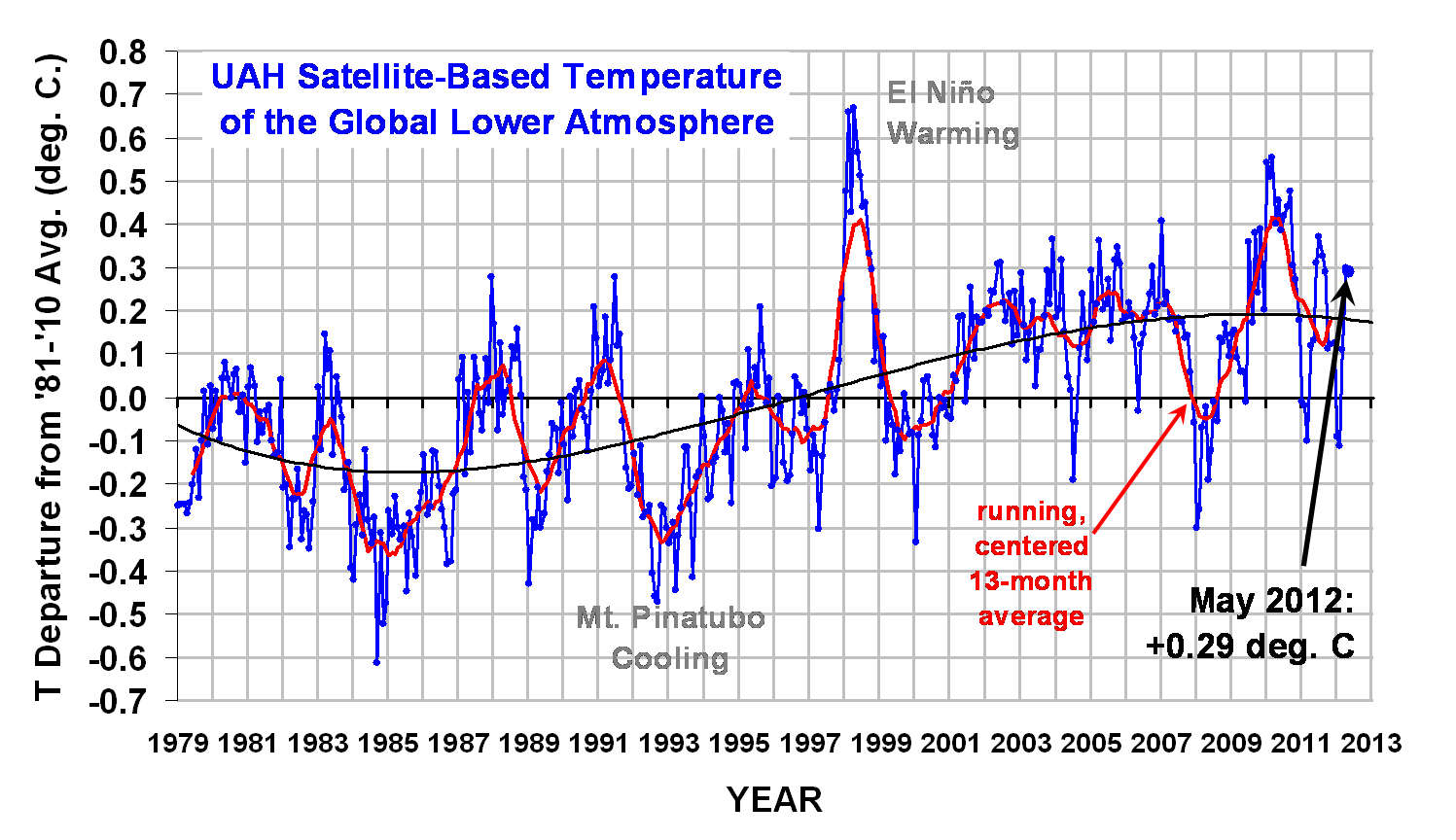
This statement is false because, even as carbon dioxide (CO2) levels continue their rapid exponential rise [4], global temperatures, as measured by satellite sensors [5] over the past dozen years, have stabilized and even dropped a bit. If CO2 was the main cause of temperature rise, temperatures would have had to go up over this period, at least a bit. They have not, which disproves the strength of the causal relationship. There must be other causes that are greater than burning fossil fuels.
The Truth: While human-caused CO2 and other “greenhouse” gases undoubtedly have effects on temperatures, they are not the main cause of recent warming. Human activities will not, indeed cannot, cause any kind of “tipping point” or “runaway” warming. It is becoming clear the main cause is natural cycles, such as Solar activity that modulates cosmic rays [6], and multi-decadal ocean oscillations, neither of which is under control or influence by humans.
One way to “lie with statistics” is to plot the data with an axis of the graph at an arbitrary value that exaggerates the variations. The figure below plots Temperature in Kelvin (above Absolute Zero) against CO2 levels referenced to zero, and indicates that Temperatures have remained quite stable as CO2 has gone up quite visibly.

FALSEHOOD #3. Scientists can accurately predict future warming scenarios.
This statement is false because official warming scenarios depend upon a misunderstanding of the nature and magnitude of Equilibrium Climate Sensitivity. ECS is how much temperatures will rise given a doubling of CO2.
The Intergovernmental Panel on Climate Change (IPCC) assumes ECS is a mono-modal distribution with the most likely value lying between 2⁰C to 4.5⁰C, with an asymmetric “fat tail” that extends out to 10⁰C or higher, and with a single peak at 3⁰C. However, this conclusion is based on combining the results of ten separate studies, from 2001 through 2006, that are each quite different [7]. They peak at various temperatures, from 1.1⁰C to 3.8⁰C. Some of the study results hardly overlap. Indeed, the one thing they have in common is their “fat tails” that extend out beyond 6⁰C, which turns out to be impossible based on the limited glaciation of the Last Glacial Maximum (LGM).
In 2011, Andreas Schmittner showed that ECS is multi-modal, with at least two separate peaks for data taken over land, and five separate peaks for over water [8]. A multi-modal distribution generally indicates that different populations have been conflated and, therefore, all bets are off with respect to the scientific validity of predictions of means that assume a mono-modal variable.
In addition, Schmittner showed that “fat tails” beyond about 6⁰C incorrectly retrodict the LGM as a totally frozen “snowball Earth”. However, it is well known that the LGM did not extend equatorwards beyond 40⁰ north and south latitudes. Thus, ECS-based models are not scientifically valid. [9]
The Truth: All else being equal, a doubling of CO2 levels will increase average temperatures by less than 1⁰C, and most likely less than 0.5⁰C. Climate models overestimate warming because they wrongly assume that clouds, on net, cause positive feedback. They also ignore the effect on cloud formation of cosmic ray modulation due to natural solar cycles.
Indeed, natural forces not under human control or influence are as likely to drive us into a period of global cooling as global warming. Future generations may come to thank us for the bit of added warmth due to our burning of fossil fuels.
FALSEHOOD #4. Human-caused warming will lead to an environmental disaster.
This statement is false because humans simply do not have the capability to cause more than relatively moderate warming and increases in CO2 levels that cannot imperil human civilization.
The Truth: The supposed disaster of global warming has been overhyped. As Climate-gate and other scandals have revealed, the temperature data have been diddled, the books cooked, and climate models have failed to predict the near-term future, much less the long term.
Predictions of imminent disaster due to human activities are overstated speculations at best. Recent moderate warming and CO2 increases are likely to be of net benefit to human civilization.
FALSEHOOD #5. “Green” energy and conservation can replace most fossil fuel.
This statement will be true at some time in the distant future because fossil fuels are not renewable and therefore cannot last forever. However, for the foreseeable future (a century or two) the statement is clearly false.
Hydroelectric and nuclear power are the two significant “green” sources that make economic sense now and into the forseeable future.
Technological developments have made offshore oil as well as oil sands and shale oil much more attractive than anyone predicted a decade ago. Fracking has driven the price of natural gas way down. Coal to gas, coal to liquid, and other new technologies will make coal, our most plentiful fossil fuel, both cleaner and cheaper.
So-called “green” energy has proven to be much more costly than fossil energy, and, except for some special cases, it cannot succeed in the marketplace without massive government mandates and subsidies.
The Truth: Fossil fuels will be our primary source of energy for many decades into the future, even as “green” energy slowly increases in importance. As fossil sources become scarcer and therefore more and more expensive compared to “green” sources, the energy industry will voluntarily switch to non-fossil energy and consumers will, in their own self-interest, embrace efficiency. To some limited extent that is happening now. It should be encouraged by allowing free market forces to do their magic.
FALSEHOOD #6. Therefore, the Government must mandate and subsidize “green” energy to save our Planet.
This statement is false because the underlying assumptions are false. Our Planet is not in danger. “Green” energy cannot replace most fossil sources in the foreseeable future. And, a “cure” based on Government mandates and subsidies will most likely be worse than the “disease”.
There is nothing inherently wrong with wind, solar, ethanol, or any of the other harebrained schemes the climate change authorities have seduced us into supporting with taxpayer funding. No, the problem is with the process of public funding that inevitably distorts true market forces. It is a process that in-errantly chooses exactly those solutions that benefit special interests while making the real problem worse.
The Truth: Without doubt, fossil fuels are limited. Oil, natural gas, and even coal may be exhausted within the next century or two. Less expensive sources will run out first. Deep ocean oil, Arctic oil, shale oil, and additional fossil fuel technologies yet to be developed, will eventually raise the price of fossil energy to the point where market forces will drive industry to invest their own money to develop alternatives.
When the government picks winners, using our taxpayer money, you can be sure special interests, such as politically connected corporations and unions, will pressure the bureaucrats to choose net losers. Corn Ethanol has been a gigantic payoff to agricultural interests. It has raised the price of grain worldwide which has been a disaster for the poorest among us. Solar projects, such as Solyndra, wasted billions while creating zero permanent jobs and less than zero usable energy.
Government-provided seed money has been wasted on crazy schemes that have their own environmental drawbacks. Wind power kills birds and exposes animals (including humans :^) to noise pollution. Both wind and solar energy require backup by fossil fueled power plants when the wind doesn’t blow and the sun doesn’t shine.
Private companies invest their hard-earned money only when there is a good chance it will pay off for their investors. Thus, they generally pick net winners. If a private venture turns sour, private money is lost and those responsible may lose their jobs and their employer may be forced out of business. That necessary process has been called “creative destruction”.
When government wastes our money on a loser, no one gets fired. The politically-connected recipients say the equivalent of “oops” (but in more legal mumbo-jumbo words), and keep their profits, except for the fraction they re-invest in further political contributions. The public agency responsible continues to blow taxpayer dollars. (What do we call it when a government program happens to pick a real winner? An accident. :^)
Fossil fuels cause some air pollution, but the most dangerous air pollution comes from the fallacies uttered by environmentalists :^). If the voting public is misled by this kind of “environmentalist air pollution”, our free economy will be destroyed, and with it, the most successful experiment so far of free peoples governing themselves. Only a High-Intellect Twit (HITwit), a person who is smart in some academic domain but quite foolish otherwise, could come up with and believe all these fallacies!
REFERENCES
[1] Makiko Sato, Email dated 14 August 2007 to James Hanson, NASA GISS, Original at http://www.judicialwatch.org/files/documents/2010/783_NASA_docs.pdf (page 48), annotated copy and detailed explanation at http://wattsupwiththat.com/2010/12/25/do-we-care-if-2010-is-the-warmist-year-in-history/
[2] NASA GISS, Contiguous 48 U.S. Surface Air Temperature Anomaly (C), accessed 9 June 2012, from http://data.giss.nasa.gov/gistemp/graphs_v3/Fig.D.txt
[3] NASA GISS systematic distortion of US mean temperature data. http://wattsupwiththat.com/2011/01/16/the-past-is-not-what-it-used-to-be-gw-tiger-tale/
[4] NOAA Atmospheric CO2 measured at Mauna Loa observatory. http://www.esrl.noaa.gov/gmd/ccgg/trends/#mlo_full
[5] University of Alabama at Huntsville (UAH) Satellite-Based Temperature of the Lower Global Atmosphere. http://www.drroyspencer.com/wp-content/uploads/UAH_LT_1979_thru_May_2012.png
[6] Nigel Calder, 2012, Svensmark’s Cosmic Jackpot, http://calderup.wordpress.com/2012/04/24/a-stellar-revision-of-the-story-of-life/
[7] Intergovernmental Panel on Climate Change, 2007, figure 9-20, http://www.ipcc.ch/publications_and_data/ar4/wg1/en/figure-9-20.html
[8] Schmittner, A., Urban N. M., Shakun, J. D., Mahowald, N. M., Clark, P. U., Bartlein, P. J., Mix, A. C., and Rosell-Melé, A. (2011), Climate Sensitivity Estimated From Temperature Reconstructions of the Last Glacial Maximum, Science, 334, 1385-1388,doi: 10.1126/science.1203513. (Behind a paywall, but free access via Schmittner’s blog, http://mgg.coas.oregonstate.edu/~andreas/ Then scroll down to the paper, click on pdf.)
[9] Ira Glickstein, 2011, CO2 Sensitivity is Multi-Modal – All bets are off. An analysis of Schmittner, 2011, paper: http://wattsupwiththat.com/2011/12/18/co2-sensitivity-is-multi-modal-all-bets-are-off/
[Chad, it is true that the magnitude of the effect of human activities on climate has been way overstated (for political power), but I cannot go along with your refusal to “concede ANY effect”. [The Atmospheric “Greenhouse Effect” is real. See my WUWT series Visualizing the “Greenhouse Effect” [Physical Analogy, Atmospheric Windows, Emission Spectra, Molecules/Photons and Light/Heat]. – Ira] (in response to Chaz Wosniak above)
With all due respect to you and your opinion, Ira, please back it up with your reformulated version of the first and second laws of thermodynamics. This is the place where discussion should have started following on Hansen et al, back in 1981.
David Socrates, Terry Oldberg (good to “see” you here again), and Ken Harvey: The Atmospheric “Greenhouse Effect” definitely DOES NOT violate the first or second Laws of Thermodynamics.
We have been through this many times on WUWT and I (and the management) agree that the Atmospheric “Greenhouse Effect” is real, and disbelieving in that fact does not help our Skeptic cause one whit. I accept it as real but question the magnitude of the effect. As a reasonable Skeptic and Based on my knowledge of physics and reading the scientific literature and WUWT, I believe ECS (Equilibrium Climate Sensitivity, which is the expected average increase in global temperatures if CO2 levels double, all else remaining the same) is less than 1.0⁰C and most likely less than 0.5⁰C, in contrast to the “official” Warmist view that it is 2⁰C to 4.5⁰C. Disbelievers like you guys, in effect, say ECS is 0.0⁰C.
Please view my WUWT Visualizing series from last year to see how so-called “greenhouse gases” (mainly H2O and CO2) make the Earth around 33⁰C warmer than it would be if the Atmosphere was just Nitrogen. For those of us (like Einstein and me) who need a mechanical analogy to understand physics, I provide that in the first posting of the series.
Please have a look (or Terry another look) and try to follow my argument with an open mind. Then, come back and we’ll talk about it. OK? [Physical Analogy, Atmospheric Windows, Emission Spectra, Molecules/Photons and Light/Heat]
advTHANKSance
Ira
Ira Glickstein:
Thanks for the friendly response! You’ve mischaracterised my position. This position is not that the equilibrium climate sensitivity (ECS) has a numerical value of 0 Celsius per doubling of the CO2 concentration implying insensitivity of the equilibrium temperature to the CO2 concentration. Neither is it that the ECS has some other value. Instead, my position is that the notion that the ECS has a specific numerical value is scientifically nonsensical. It is nonsensical because the ECS is , by definition, the change in the equilibrium temperature from a change in the logarithm of the CO2 concentration yet the equilibrium temperature is not observable.
Not bad, despite the usual sprinkling of lukewarmer nonsense.
But the opening contrast of “… whimsical fable and an environmental fallacy” is lame and clumsily formulated
To be conherent, the contrast should say:
“On the outside, fables are light-hearted fibs. But oh so true on the inside.
Environmental fallacies are just the opposite, serious and plausible on the outside but hiding egregious falsehoods on the inside.”
[Brian H, I have adopted your suggested improved wording and Edited my main topic accordingly. Thanks! Sorry you see “the usual sprinkling of lukewarmer nonsense” in my main topic, but time will tell if the Warmists, Lukewarmers, or Skeptics turn out to be closest to the “truth”. – Ira]
typo: coherent not
conherentActually, I do see the contrasts you are trying to draw, but you are trying too hard! “ugly realities” would require a substantiation of much of the conspiracy theory explanation of climatology’s rise. Not that that’s impossible to do, but your following text doesn’t really attempt that.
Not that he needs any support from myself, but Terry Oldberg is completely correct. None of the numeric values that are associated with the climate sensitivity of CO2 have any meaning in physics. And, in any event. they are based on highly dubious physics, and the output of non-validated models. They can never be measured. The dubious physics relates to the no-feedback climate sensitivity being estimated without taking in to account the change in lapse rate. If the atmopshere is presented with an extra forcing, such as that associated with increased CO2 concentrations, the the whole atmosphere will respond, not just the radiation term.
As I pointed out in the second comment to this story, such little empirical data as we have strongly suggests that the actual value of total climate sensitivity, which can be measured in theory, is indistinguishable from zero.
How do we know that clouds have a negative feedback? I thought this was still up for debate.
In fact, I thought that concentrating H2O in clouds, away from the ground, would drive more evaporation, allowing the atmosphere to hold more heat. That would allow it to spread heat more effectively and, with the T^4-dependence in energy-outflow from the Earth, drive up the temperature.
Hi David, Terry, and Ken.
I outlined at least one way in which the Greenhouse Effect raises the temperature in agreement with the laws of thermodynamics. Let’s put that question to rest.
Stephen:
In placing me among the list of recipients for your message of Oct 13, 2012 at 8:09 am, you seem to have assumed that I’m among the folks who argue that the numerical value of the equilibrium climate sensitivity (TECS) is nil. That assumption is incorrect. My argument is that TECS is a scientifically nonsensical quantity in light of the impossibility of observing its numerical value.
Ira Glickstein, Jim Cripwell and etc:
I write in hope of resolving the difference between those who think increased atmospheric CO2 concentration will result in some rise in global temperature and those who think it will not.
I am convinced that increased atmospheric CO2 concentration will result in some rise in global temperature, but I am also convinced any such temperature rise would be too small for it to be discernible and, therefore, it would only have an abstract existence. I explain this as follows.
Before presenting my argument, I point out I remain to be convinced that human emissions are or are not the cause – in part or in whole – of the observed recent CO2 rise. However, the cause of a rise in atmospheric CO2 concentration is not relevant to the effect on global temperature of that rise.
My view is simple and can be summarised as follows. The feedbacks in the climate system are negative and, therefore, any effect of increased CO2 will be too small to discern. This concurs with the empirically determined values of low climate sensitivity obtained by Idso, by Lindzen&Choi, etc..
Therefore, I say the man-made global warming from man’s emissions of greenhouse gases (GHG) would be much smaller than natural fluctuations in global temperature so it would be physically impossible to detect the man-made global warming.
Of course, human activities have some effect on global temperature for several reasons. For example, cities are warmer than the land around them, so cities cause some warming. But the temperature rise from cities is too small to be detected when averaged over the entire surface of the planet, although this global warming from cities can be estimated by measuring the warming of all cities and their areas.
Similarly, the global warming from man’s GHG emissions would be too small to be detected. Indeed, because climate sensitivity is less than 1 deg.C for a doubling of CO2 equivalent, it is physically impossible for the man-made global warming to be large enough to be detected. If something exists but is too small to be detected then it only has an abstract existence; it does not have a discernible existence that has effects (observation of the effects would be its detection).
I hold this view because I am an empiricist so I accept whatever is indicated by data obtained from observation of the real world.
Idso’s “8 natural experiments” provide a “best estimate” of climate sensitivity of 0.37 deg.C for a doubling of atmospheric CO2.
His paper can be read at
http://www.warwickhughes.com/papers/Idso_CR_1998.pdf
Idso’s finding was obtained using 8 different methods from measurements obtained at the surface of the Earth.
And Idso’s finding is similar to the finding of climate sensitivity of about 0.4 deg.C for a doubling of atmospheric CO2 obtained by Lindzen&Choi in their paper which analysed ERBE data from the tropics.
Their paper can be read at
http://www.drroyspencer.com/Lindzen-and-Choi-GRL-2009.pdf
Its conclusions include
And
Climate sensitivity is less than 1.0 deg.C for a doubling of climate sensitivity and, therefore, any effect on global temperature of increase to atmospheric CO2 concentration only has an abstract existence; it does not have a discernible existence that has observable effects.
Richard
[Richard, your comment helps to resolve the issue for me. I hope the others in this conversation will go along. You report credible estimates of 0.37⁰C (Idso) and 0.4⁰C (Lindzen & Choi), which comport well with my main topic posting that says “All else being equal, a doubling of CO2 levels will increase average temperatures by less than 1⁰C, and most likely less than 0.5⁰C.” I hope we can all agree that these ECS estimates are so low that it almost doesn’t matter which one turns out to be correct because even the largest will definitely NOT result in any kind of “tipping point” catastrophe. Furthermore, the effects of human-made CO2 and land use are so small compared to the effects of natural cycles that we may never know the exact value of ECS, or, indeed, if there really is such a thing as an exact value! THANKS for clarifying the issue for me, and I hope most of the others in this thread. – Ira]
Stephen (at 8:01), in what you are saying “In fact, I thought that concentrating H2O in clouds, away from the ground, would drive more evaporation”, I don’t believe I have ever found that statement “drives more evaporation” with cloud cover to be true. Maybe give some data or links to back that up.
My life-long experience has been that surfaces such as streets and vegetation always remains wetter, longer (less evaporation), after a rain has ceased but when it remains cloudy that if the sky suddenly becomes clear after the rain. That point you raises is the exactly opposite. Please explain from what you get this idea. Some simple real world examples will suffice.
Hi Ira,
i agree to most of Your arguments falsifying global warmng, despite I don’t think that CO2 causes warming at all. And please show me the physics book explaining the greenhouse effect. In my opinion You can’t argument against “global” warming with “national” data in 1) You are using only US-temperatures and citing only US-Scientists, US-surface being only anout 1,5% of the world. In addition, your sentence: “However, if US data analyzed by US scientists has half a degree of “adjustment” slop in it, how much worse must worldwide data be?” is unscientific and at least offensive……
Have a nice day and please excuse my rather rusty english..
richardscourtney, you might be interested in this. Ken Gregory has extended some of Dr. Miskolczi’s radiosonde work that has now extended to include ECS. His plot shows the lowest if earlier starting point is used of 0.25 C but the majority of later years lie between 0.3 C and 0.4 C for the ECS, right in line with Lindzen, Choi, Idso.
Ref: http://www.friendsofscience.org/assets/documents/OLR&NGF_June2011.pdf
Richard Courtney, you write “I write in hope of resolving the difference between those who think increased atmospheric CO2 concentration will result in some rise in global temperature and those who think it will not.”
Everything you have written, I thoroughly agree with, and I think you have summarized the situation correctly, and satisfied Ira. However, I think you have omitted one important part. If, as we all agree, the actual climate sensitivity of CO2 is so small that it is negliglible, then somewhere in the physics presented by the proponents of CAGW there must be a fundamental error. There has to be, otherwise they would not come up with numbers that are far greater than anything we agree is the correct value. The question to me, is where is this error?
I believe the error is in the way the no-feedback climate sensitivity is derived. No-feedback climate sensitivity is an abomination in physics. It is a hypothetical, meaningless number which can never be measured. But the way it is derived is based on highly dubious physics, which assumes that the atmosphere responds to a change in radiative forcing by only affecting the radiation term. This, to me, is clearly wrong., The atmosphere must repsond by also changing the lapse rate.
What I am waiting for, is for the proponents of CAGW to agree with this, and do a proper estimation of the no-feedback climates sensitivity, with the change of lapse rate included. I suspect that if we ever get this value, no-one will ever need to talk about feedbacks again, because this number will be found to be too small to be significant.
wayne and Jim Cripwell:
I am responding to your posts addressed to me at 10:48 am and October 13, 2012 at 11:15 am, respectively, in this one reply. I do this for convenience of readers of this thread and this single reply is not intended as an offence to either of you.
wayne, thankyou for the link in your post at October 13, 2012. I was not aware of that. It seems we now have three independent determinations of climate sensitivity which agree; one is from surface data, one is from satellite data and one is from balloon data. So, your link confirms my view. Thankyou.
Jim Cripwell, you say to me
I agree and – more importantly – so does Lindzen.
In conclusion, my post seems to have resolved the disagreement and that pleases me.
Richard
Richard, you write “I agree and – more importantly – so does Lindzen.”
That is wonderful news, and I am delighted. I would love to know where Lindzen has added his voice on this issue. Has he written anything, or is this based on some sort of conversation you have had with him?
Jim Cripwell:
Lindzen summarises his view on the lapse rate negative feedback in his paper at
http://www.nap.edu/openbook.php?record_id=10850&page=21
The section on ‘Lapse Rate Feedback’ begins on page 24.
His comments are muted in this peer reviewed paper but I think his meaning is clear.
His paper titled ‘Climate v. Climate Alarm’ is more forthright and can be read at
http://noconsensus.files.wordpress.com/2011/08/acs-2011-lindzen1.pdf
The entire paper is worthy of note, but its pages 18 to 20 are especially relevant to your question.
Lindzen also did a Guest Article on WUWT which is pertinent and the subsequent thread had much discussion of the lapse rate issue. It is at
http://wattsupwiththat.com/2009/03/30/lindzen-on-negative-climate-feedback/
I hope this is sufficient answer to your question concerning Lindzen’s view that adjustment of the lapse rate is an inevitable negative feedback on increase to radiative forcing. If you want more then you can follow references in the links or get back to me.
Richard
richardscourtney:
Arguments that you’ve made in this thread assume the scientific legitimacy of the equilibrium climate sensitivity (aka TECS, the ECS, the CS, the climate sensitivity). If I’m not mistaken, in the same thread I’ve proved the scientific illegitimacy of the same concept.
Terry Oldberg:
I am disappointed that my attempt to resolve the disagreement failed. At October 13, 2012 at 2:07 pm you say to me
You are mistaken.
Richard
richardscourtney:
Thank you for taking the time to respond. What is your counter argument?
Terry Oldberg:
In retrospect I think my post addressed to you at October 13, 2012 at 3:10 pm was too abrupt. In fairness I should have explained my answer to you. I apologise for that error and write to correct it.
You have stated your point several times; for example at October 12, 2012 at 9:40 pm you say of your “position”
Many things are not observable and or measurable but that does not mean they are “scientifically nonsensical”.
Equilibrium states of dynamical systems are often not observable and are not directly measurable because they are never achieved. But both scientists and engineers often estimate them.
Richard
richardscourtney (Oct. 13, 2012 at 3:27 pm):
For use in logical discourse, the phrase “scientifically nonsensical” is unacceptably ambiguous. In the context of debate, terms that make ambiguous reference to the associated ideas promote the acceptance of false conclusions by negating the law of non-contradiction. Though the law is a true proposition, the negated law is a false proposition. When the negated law enters an argument as a false premise, the conclusion of this argument can appear to the audience to be true when it is false or unproved. Informally, this debating tactic is called “doublespeak.”
In the article at http://judithcurry.com/2011/02/15/the-principles-of-reasoning-part-iii-logic-and-climatology/ I disambiguate pertinent terms in the language of climatology. I suggest that we use this disambiguation in our debate if you have no objection.
As a result of the research on the use of language in climatology that is reported in the above referenced article, I’ve discovered that ambiguity of reference of the terms “science” and “scientific” to the associated ideas often lead people to believe climatological conclusions to be true when they are false or unproved. The question of how to disambiguate these two terms was taken up by a federal court in the United States in the context of the circumstances in which it was permissible for testimony to be described in court as “scientific” testimony. This proceeding resulted in the disambiguation that is known as the Daubert standard. According to Wikipedia ( http://en.wikipedia.org/wiki/Daubert_standard ) the court defined ‘scientific methodology’ as the process of formulating hypotheses and then conducting experiments to prove or falsify the hypothesis…” This is the basis for the disambiguations of the terms “science” and “scientific” that I adopt in my article.
Under this disambiguation, a methodology that assigns a numerical value to TECS cannot be described as “scientific” in view of the non-observability of the equilibrium temperature. It is in this sense of the term “scientific” that TECS is “scientifically nonsensical.” Under the same disambiguation, a methodology that makes claims about the numerical value of TECS can be described as “pseudo-scientific” if it appears to be scientific.
@jim Cripwell
“… such little empirical data as we have strongly suggests that the actual value of total climate sensitivity, which can be measured in theory, is indistinguishable from zero.”
I want to second this as bringing a dose of reality to the topic of AGW. After subtracting the hype and speculation that is the consequence of a good dose of “maybe’s” there is only a small positive value left for ECS. Working as I do in the measurement of things all of which have an uncomfortably low precision, it is a daily grind to remind people that a calculated result slightly better or worse than some other calculated value is not actually ‘different’.
It is really helpful (for me) to put a confidence index on numbers but most people can’t grasp what that means. Putting visual error bars on charts is informative. Putting a plus-minus on two values is usually helpful. For example and “ECS of 0.4 +-0.3” is meaningful and probably true within our current knowledge pool.
Terry Oldberg:
At October 13, 2012 at 6:55 pm you say to me
No. The climate sensitivity has been measured by a variety of methods (which have been linked in this thread by me and wayne). A measured value is an observation and, thus, demonstrates that your claim of “non-observability” is untrue.
I fail to see the value and purpose of your argument.
In my opinion, the important issue was stated by me in my post at October 13, 2012 at 9:03 am and has been restated in different words by Crispin in Beijing at October 13, 2012 at 4:39 pm.
Richard
PS Please do not be offended if I do not reply to any further posts for many hours because I have important duties today.
richardscourtney:
I take issue with your assumption that there is equilibrium temperature that is available for measurement. At an (x, y, z) space point in Earth’s atmosphere, the equilibrium temperature is the temperature that would be measured if all of the strengths of all of various forcings were to be held constant at every point in space and time, if the composition of Earth and its atmosphere were to be held constant at every point in space and time and if the observer were to wait for an infinite amount of time before measuring the temperature. In reality, the strengths, composition and temperature fluctuate continuously in space and in time. Also, a real observer cannot wait for an infinite amount of time. Thus, in reality there is not an equilibrium temperature that is available for measurement.
Richard Courtney, you write “No. The climate sensitivity has been measured by a variety of methods (which have been linked in this thread by me and wayne). A measured value is an observation and, thus, demonstrates that your claim of “non-observability” is untrue. ”
I take issue with this statement. It is theoretically possible to measure total climate sensitivity. You observe how much CO2 levels rise in the atmosphere, and you observe how much temperature rises as a result of this increase in CO2 concentration. This would give a measure of total climate sensitivity. No-one has actually made such measurements. My own look at this way of measuring CS has led me to conclude that CS is indistinguishable from zero.
‘
Other than this, all the numbers associated with CS have only been estimated; mostly by highly dubious physics. There is empirical data to support the idea of an increase in radiative forcing as more CO2 is added to the atmopshere. But there is no empirical data whatsoever that has been used as a basis for any claimed numeric value of CS.
Jim Cripwell:
I am responding to your post at October 14, 2012 at 3:49 am but I fail to understand the point you are making so I cannot answer it. Sorry.
As an addendum, I think this discussion is devolving into an ‘Angels On A Pin’ discussion. If that is not so then I would welcome being enlightened.
Richard
Richard, you write “but I fail to understand the point you are making so I cannot answer it.”
Maybe I am being supersensitive, but I am appalled by the lack of the use of empirical data by the proponents of CAGW. They rely on hypothetical data, and the output of non-validated models. So the point I am trying to make is that none of the numbers that are routinely claimed to be values for CS are based on any empirical data; any actual measurements. So when I see you claim that some of the numbers are based on measured data, I bristle.
The point is that, because we do not understand what causes natural variations, it is impossible to claim that any particular observed change in temperature was actually caused by increasing levels of CO2. So, it is impossible to use empirical data to measure CS. I rely on negative data, which cannot prove anything. There is no sign that CO2 has affected the trend of global temperatures. Now, tomorrow, next week, next year, or some time in the future, a strong CO2 signal could emerge, and I would be proven wrong. But until that happens there is no sign that CO2 affects global tempertratures, and hence there is a strong indication that the CS of CO2 is indistinguishable from zero.
Jim Cripwell and Terry Oldberg:
In this one post I am replying to your posts at October 14, 2012 at 7:35 am and October 14, 2012 at 8:34 am, respectively, for the convenience of other readers and not as an intended slight to either of you.
Jim and Terry,
Please be assured that my ‘Angels On A Pin’ comment addressed to Jim was – and is – genuine. I do fail to see the importance of this esoteric issue but I am replying to your posts because the issue clearly matters to you sufficiently for you to each ‘come back’ to me.
Jim,
You say
OK, I now ‘get it’. Thankyou.
You are making a philosophical point concerning whether we can ‘know’ what is measured.
I am not a trained philosopher but my studies lead me to fully understand how amateur philosophy can be very, very wrong. Despite that I will give my views so it is clear I am not avoiding your point. And I hope any philosophers will correct me if I get this wrong.
1.
Changes in (a) radiative forcing and (b) temperature change can be measured. Therefore, the change temperature associated with a change to radiative forcing can be quantitatively observed.
2.
Change in radiative forcing from a given increase atmospheric CO2 equivalent can be calculated from SB.
3.
The calculation of (2) can be inserted in the relationship of (1) to determine the temperature change associated with a change in atmospheric CO2 concentration.
The result of (1) to (3) provides an indication of climate sensitivity to atmospheric CO2 concentration. However, as I understand it, you are saying that is not an empirical determination because stages (2) and (3) are calculations and not measurements.
As I said, I am not a philosopher so I shall reply to that on the basis of measurement theory and – as I also said – I hope any philosophers reading this will say if my answer differs from the true philosophical answer. My point is as follows.
Many measurements are conducted using a direct inference from a calculation of a fundamental physical equation. For example, some optical pyrometers do it, and the ZAF corrections applied in quantitative energy dispersive analysis of X-rays (QEDX) are each calculated using radiative physics. All such measurements are said to be empirical.
Hence, many empirical measurements use a calculation from a fundamental physical equation as part of their procedure. However, such measurement methods (e.g. the instruments they use) are calibrated, and no calibration standard exists for climate sensitivity.
In my opinion, the lack of calibration for climate sensitivity measurements does NOT stop the measurements being empirical. It reduces their reliability and their precision. Please note that this is my opinion and not a fact.
I agree that climate sensitivity is indistinguishable from zero. Please read my post at October 13, 2012 at 9:03 am and take especial note of its analogy with ‘global warming from cities’. The point is that “indistinguishable from zero” is zero for practical purposes but is not zero in actuality.
I hope the above is clear.
Terry,
You write saying to me
I again point out that I am not a philosopher and your point is also philosophical. Hence, philosophers may want to jump on me for stating my view (which would be a benefit to all including me).
I agree that an equilibrium value of climate sensitivity will never be achieved and, therefore, it cannot be directly measured. However, as I said, scientists and engineers often calculate (estimate?) equilibrium values that are not achieved. I understand that such estimates have great value for chemists when determining reaction rates (I am not a chemist).
If a calculated value has use then I don’t see a problem with calculating it (assuming the calculation is possible).
Please note, Terry, I am not avoiding your point. I genuinely fail to see its importance.
I apologise to both of you that this answer is inadequate but it is the best I can do.
Richard
richardscourtney:
I don’t believe that “esoteric” is an apt descriptor of the problem under discussion. You are well equipped for participation in this discussion if acquainted with the elements of logic.
Though not a degreed philsopher of science, I acquired on the job training in this discipline in the period of 13 years in which I designed and managed scientific studies for a living. In designing a study I had to have a command over certain aspects of the philosophy of science to avoid commission of errors of methodology. Over time, I learned how to avoid commission of errors of this type.
To think clearly about the methodology of science one must distinguish between the idea of an “observed state” and the idea of an “inferred state.” Let A designate a proposition. A is the proposition that “The system is in state ‘a’.”
That state ‘a’ is “observed” implies that proposition A is true. That ‘a’ is “inferred” does not imply that A is true. To conflate the two kinds of state is to invite the unproved conclusion that when ‘a’ is inferred, A is true. In the context of debate, to conflate them for this purpose is to stoop to the unscrupulous tactic that is known as “doublespeak.”
Now let ‘a’ designate the numerical value of the equilibrium temperature. As I demonstated in an earlier post, ‘a’ cannot be observed. However, through the use of various climatological tools ‘a’ can be inferred. Your argument for the observability of the equilibrium temperature conflates the idea of an “observed state” with the idea of an “inferred state” thus inviting the unproved conclusion that A is true.In truth, one cannot prove A because the equilibrium temperature cannot be observed.