
By WUWT regular “Just The Facts”
In the US we are currently being bombarded with claims that “this summer is ‘what global warming looks like'” from the Associated Press and “summer heat wave an early indication of global warming” from MSNBC, as well as insinuations like “Record heat, derecho storm: Does global warming get blame?” from USA Today and “Did global warming intensify the derecho in Washington, D.C.?” from the Washington Post. Furthermore, the association between “Global Warming” and regional weather is being pushed by our supposed scientific leaders, e.g. National Oceanic and Atmospheric Administration (NOAA) chief Jane Lubchenco recently stated that:
“Many people around the world are beginning to appreciate that climate change is under way, that it’s having consequences that are playing out in real time and, in the United States at least, we are seeing more and more examples of extreme weather and extreme climate-related events”.
So does observational data support these claims and insinuations? Let’s take a look…
Global Surface Temperatures:
Generally, when referring to Earth’s “climate” warming, proponents of the Catastrophic Anthropogenic Global Warming (CAGW) narrative refer to Earth’s Surface Temperature, e.g. “Global warming is the unusually rapid increase in Earth’s average surface temperature over the past century primarily due to the greenhouse gases released by people burning fossil fuels.” NASA Earth Observatory
As such, here’s NASA’s Goddard Institute for Space Studies (GISS) Global Monthly Mean Surface Temperature Anomaly – 1996 to Present:
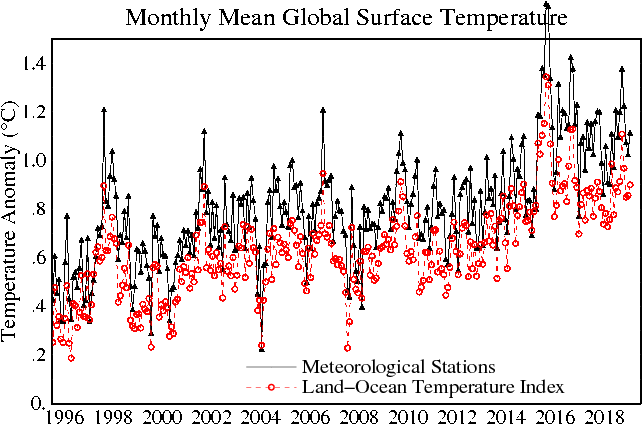
Looking across the last 16 years, current Global Surface Temperature does not appear unique or extreme.
NOAA’s National Climate Data Center (NCDC) Global Year To Date Average Temperature Anomaly Compared to 5 Warmest Years on Record:

Nothing unique or extreme there, unless of course Global Warming kicked in in June…
UK Met Office’s – Hadley Center – Climate Research Unit (CRU) Annual Global Average Land Temperature Anomaly – 1850 to 2011;

and the UK Met Office – Hadley Center – Climate Research Unit (CRU) Monthly Global Average Land Temperature – 1850 to 2011

Depending on the time frame, it certainly seems that Earth’s Surface Temperature has increased, but an approximately .6 Celsius Global Temperature Anomaly doesn’t appear to portend “extreme weather and extreme climate-related events”. Furthermore, the surface temperature record is burdened with issues of questionable siting, changes in siting, changes in equipment, changes in the number of measurement locations, modeling to fill in gaps in measurement locations, corrections to account for missing, erroneous or biased measurements, and the urban heat island effect. Thus to see the big picture on the temperature “Earth’s Temperature”, it also helps to look up.
Atmospheric Temperatures:
Since 1979 Earth’s “temperature” has also been measured via satellite. “The temperature measurements from space are verified by two direct and independent methods. The first involves actual in-situ measurements of the lower atmosphere made by balloon-borne observations around the world. The second uses intercalibration and comparison among identical experiments on different orbiting platforms. The result is that the satellite temperature measurements are accurate to within three one-hundredths of a degree Centigrade (0.03 C) when compared to ground-launched balloons taking measurements of the same region of the atmosphere at the same time.” NASA
Here is RSS Global Temperature Lower Troposphere (TLT) – Brightness Temperature Anomaly- 1979 to Present;


and this is the University of Alabama – Hunstville (UAH) Global Lower Atmosphere Temperature Anomalies – 1979 to Present:

Note: Per John Christy, RSS and UAH anomalies are not comparable because they use different base periods, i.e., “RSS only uses 1979-1998 (20 years) while UAH uses the WMO standard of 1981-2010.”
The June UAH Lower Atmosphere Temperature Anomaly was 0.37 degrees C above the 30 year average, which does not appear to be unique or extreme in the historical context.
Now looking only at the RSS Continental US Temperature Lower Troposphere (TLT) Brightness Temperature Anomaly;

there has clearly been a significant spike in temperatures in 2012, however the RSS Northern Hemisphere Temperature Lower Troposphere (TLT) Brightness Temperature Anomaly;

it does not appear unique or extreme, and the RSS Southern Hemisphere Temperature Lower Troposphere (TLT) Brightness Temperature Anomaly;

is currently only slightly above average, and certainly not indicative of unique or extreme warming. This evidence would seem to indicate that the short-term Continental US Lower Troposphere Temperature spike;

was a regional weather event versus “an early indication of global warming”.
Furthermore, RSS Southern Polar Temperature Lower Troposphere (TLT) Brightness Temperature Anomaly;

is currently negative and shows a .012 K/C per decade decrease. Apparently that’s also “what global warming looks like”…
To this point we’ve only addressed the Lower Troposphere Temperatures, as such, the following Temperature Anomaly plots from RSS will increase in altitude as is illustrated here:
Again, here is RSS Temperature Lower Troposphere (TLT) – Brightness Temperature Anomaly- 1979 to Present;
and here is RSS Temperature Middle Troposphere (TMT)- Brightness Temperature Anomaly- 1979 to Present;

According to Remote Sensing Systems, “For Channel (TLT) (Lower Troposphere) and Channel (TMT) (Middle Troposphere), the anomaly time series is dominated by ENSO events and slow tropospheric warming. The three primary El Niños during the past 20 years are clearly evident as peaks in the time series occurring during 1982-83, 1987-88, and 1997-98, with the most recent one being the largest.” RSS
Also, the 2009 – 10 El Niño event is called out on this RSS Latitudinal Temperature Lower Troposphere (TLT) Brightness Temperature Anomaly from 1979 to Present;

Lower and Middle Tropospheric temperatures show slow warming overlaid with the El Niño/La Niña Southern Oscillation (ENSO) cycle, including four comparatively large El Niño events. Tropospheric temperatures appear to have flattened since the large El Niño in 1998 and offer no indication that Earth is experiencing rapid or extreme warming.
Moving higher in the atmosphere, RSS Temperature Troposphere / Stratosphere (TTS) – Brightness Temperature Anomaly- 1987 to Present;

has been flat since, with a trend of just -.011 K/C per decade. The 1997-98 and 2009 – 10 El Niño events are still readily apparent in the plot, as is a spike from the 1991 eruption of Mt. Pinatubo. Note that the effect of Mt. Pinatubo is the opposite in the Lower and Middle Troposphere versus the Troposphere / Stratosphere (TTS), i.e. “Large volcanic eruptions inject sulfur gases into the stratosphere; the gases convert into submicron particles (aerosol) with an e-folding time scale of about 1 year. The climate response to large eruptions (in historical times) lasts for several (2-3) years. The aerosol cloud causes cooling at the Earth’s surface, warming in stratosphere.”
Ellen Thomas, PHD Wesleyan University
It is interesting that, incorporating the impact of three significant surface driven warming events, Troposphere / Stratosphere Temperatures (TTS) have been quite stable, however there is regional variation here as well.
RSS Northern Hemisphere Temperature Troposphere / Stratosphere (TTS) – Brightness Temperature Anomaly- 1987 to Present;

has been increasing by .047 K/C per decade, whereas the RSS Southern Hemisphere Temperature Troposphere / Stratosphere (TTS) – Brightness Temperature Anomaly- 1987 to Present;

has been decreasing by -.068 K/C per decade.
Moving higher still in the atmosphere, the RSS Temperature Lower Stratosphere (TLS) – Brightness Temperature Anomaly – 1979 to Present;

“is dominated by stratospheric cooling, punctuated by dramatic warming events caused by the eruptions of El Chichon (1982) and Mt Pinatubo (1991).” RSS
The eruptions of El Chichon and Mt Pinatubo are readily apparent in the Apparent Atmospheric Transmission of Solar Radiation at Mauna Loa, Hawaii:

“The stratosphere” … “in contrast to the troposphere, is heated, as the result of near infrared absorption of solar energy at the top of the aerosol cloud, and increased infra-red absorption of long-wave radiation from the Earth’s surface.”
“The stratospheric warming in the region of the stratospheric cloud increases the latitudinal temperature gradient after an eruption at low latitudes, disturbing the stratospheric-troposphere circulation, increasing the difference in height of the troposphere between high and low latitudes, and increasing the strength of the jet stream (polar vortex, especially in the northern hemisphere). This leads to warming during the northern hemisphere winter following a tropical eruption, and this warming effect tends to be larger than the cooling effect described above.” Ellen Thomas, PHD Wesleyan University
The Lower Stratosphere experienced “dramatic warming events caused by the eruptions of El Chichon (1982) and Mt Pinatubo (1991).” RSS “The long-term, global-mean cooling of the lower stratosphere stems from two downward steps in temperature, both of which are coincident with the cessation of transient warming after the volcanic eruptions of El Chichon and Mt. Pinatubo.” … “Here we provide observational analyses that yield new insight into three key aspects of recent stratospheric climate change. First, we provide evidence that the unusual step-like behavior of global-mean stratospheric temperatures is dependent not only upon the trend but also on the temporal variability in global-mean ozone immediately following volcanic eruptions. Second, we argue that the warming/cooling pattern in global-mean temperatures following major volcanic eruptions is consistent with the competing radiative and chemical effects of volcanic eruptions on stratospheric temperature and ozone. Third, we reveal the contrasting latitudinal structures of recent stratospheric temperature and ozone trends are consistent with large-scale increases in the stratospheric overturning Brewer-Dobson circulation” David W. J. Thompson Colorado State University
Above the Stratosphere we have the Mesosphere and Thermosphere, neither of which have I identified current temperature time series for, but of note is that on “July 15, 2010” “A Puzzling Collapse of Earth’s Upper Atmosphere” occurred when “high above Earth’s surface where the atmosphere meets space, a rarefied layer of gas called “the thermosphere” recently collapsed and now is rebounding again.”

“This is the biggest contraction of the thermosphere in at least 43 years,” says John Emmert of the Naval Research Lab, lead author of a paper announcing the finding in the June 19th issue of the Geophysical Research Letters (GRL). “It’s a Space Age record.”
The collapse happened during the deep solar minimum of 2008-2009—a fact which comes as little surprise to researchers. The thermosphere always cools and contracts when solar activity is low. In this case, however, the magnitude of the collapse was two to three times greater than low solar activity could explain.
“Something is going on that we do not understand,” says Emmert.
The thermosphere ranges in altitude from 90 km to 600+ km. It is a realm of meteors, auroras and satellites, which skim through the thermosphere as they circle Earth. It is also where solar radiation makes first contact with our planet. The thermosphere intercepts extreme ultraviolet (EUV) photons from the sun before they can reach the ground. When solar activity is high, solar EUV warms the thermosphere, causing it to puff up like a marshmallow held over a camp fire. (This heating can raise temperatures as high as 1400 K—hence the name thermosphere.) When solar activity is low, the opposite happens.” NASA
In summary, Earth’s Lower and Middle Troposphere appear to have warmed slowly, overlaid with the El Niño/La Niña Southern Oscillation (ENSO) cycle, including four comparatively large El Niño events, and tempered by the cooling effects of the eruption of El Chichon (1982) and Mt Pinatubo (1991). Lower and Middle Tropospheric temperatures appear to have flattened since the large El Niño in 1998 and offer no indication of rapid or extreme warming. Tropospheric / Stratospheric temperatures appear to have been influenced by at least three significant surface driven warming events, the 1997-98 El Niño, and the eruptions of El Chichon in 1982 and Mt Pinatubo in 1991, but have maintained a stable overall trajectory. Stratospheric temperatures appear to have experienced two “dramatic warming events caused by the eruptions of El Chichon (1982) and Mt Pinatubo (1991).”, and “unusual step-like behavior of global-mean stratospheric temperatures” which has resulted in a significant stratospheric cooling during the last 30 years. Lastly, “during deep solar minimum of 2008-2009” “the biggest contraction of the thermosphere in at least 43 years” occurred and “The magnitude of the collapse was two to three times greater than low solar activity could explain.”
Ocean Temperatures:
“The oceans can hold much more heat than the atmosphere. Just the top 3.2 metres of ocean holds as much heat as all the world’s air.” Commonwealth of Australia – Parliamentary Library
As such, changes in Ocean Heat Content are important in understanding Earth’s “Temperature”. Here is NOAA’s NODC Global Ocean Heat Content from 0-700 Meters – 1955 to Present;

and here is the same from Ole Humlum’s valuable climate data site Climate4you.com, NODC Global Ocean Heat Content – 0-700 Meters – 1979 to Present:

It seems apparent from the plots above that Global Ocean Heat has increased over the last several decades, however Global Ocean Heat doesn’t appear to show rapid or extreme warming.
Sea Level:
“Global sea level is currently rising as a result of both ocean thermal expansion and glacier melt, with each accounting for about half of the observed sea level rise, and each caused by recent increases in global mean temperature. For the period 1961-2003, the observed sea level rise due to thermal expansion was 0.42 millimeters per year and 0.69 millimeters per year due to total glacier melt (small glaciers, ice caps, ice sheets) (IPCC 2007). Between 1993 and 2003, the contribution to sea level rise increased for both sources to 1.60 millimeters per year and 1.19 millimeters per year respectively (IPCC 2007).” Source NSIDC
Global Mean Sea Level Change – 1993 to Present:

Global Mean Sea Level Change Map with a “Correction” of 0.3 mm/year added May, 5th 2011, due to a “Glacial Isostatic Adjustment (GIA)” – 1993 to Present:

Again, no indications of rapid or extreme warming here.
Snow and Ice:
A proxy often cited when measuring “Earth’s Temperature” is amount of Snow and Ice on Earth. According to the United States Geological Survey (USGS), “The vast majority, almost 90 percent, of Earth’s ice mass is in Antarctica, while the Greenland ice cap contains 10 percent of the total global ice mass.” Source USGA
However, there is currently there is no generally accepted measure of ice volume, as Cryosat is still in validation and the accuracy of measurements from Grace are still being challenged. Sea Ice Area and Extent are cited as proxies for “Earth’s Temperature”, however there is significant evidence that the primary influences on Sea Ice Area and Extent are in fact wind and Atmospheric Oscillations. With this said, here are
Global, Arctic & Antarctic Sea Ice Area from 1979 to Present;

Global Sea Ice Area Anomaly – 1979 to Present:

Northern Hemisphere Sea Ice Area Anomaly, 1979 to Present;

Southern Hemisphere Sea Ice Area Anomaly, 1979 to Present;

Arctic Sea Ice Extent – 15% or greater

Antarctic Sea Ice Extent – 15% or Greater

There appears to have been a negative trend in Northern Hemisphere Sea Ice Area and Extent and a positive trend in Southern Hemisphere Sea Ice Area and Extent, thus the resultant Global Sea Ice Area trend appears to be slightly negative.
In terms of land based data, here is 20 Year Northern Hemisphere Snow Cover with 1995 – 2009 Climatology from NCEP/NCAR;

Northern Hemisphere Snow Cover Anomalies 1966 – Present from NCEP/NCAR;

Northern Hemisphere Winter Snow Extent – 1967 to Present from Rutgers University;

Northern Hemisphere Spring Snow Extent – 1967 to Present:

Northern Hemisphere Fall Snow Extent – 1967 to Present:

While none of the Snow plots offers a global perspective, when looking at the Northern Hemisphere, there appears to have been a slight increase in Snowcover and Winter Snow Extent, a decrease in Spring Snow Extent and no change in Fall Snow Extent over the historical record.
Based on the limited Global Ice and Snow measurements available, and noting the questionable value of Sea Ice Area and Extent as a proxy for temperature, not much inference can currently be drawn from Earth’s Ice and Snow measurements. However, there does not appear to be any evidence of rapid or extreme warming in Earth’s Ice and Snow measurements.
Conclusion:
“Earth’s Temperature” appears to have increased during the last several decades, but there does not appear to be any evidence of rapid or extreme warming. Claims and insinuations that recent temperatures and weather in the Continental US are caused or related to “Global Warming” are not supported by the observational data.
Additional information on “Earth’s Temperature” can be found in the WUWT Reference Pages, including the Global Temperature Page and Global Climatic History Page
Please note that WUWT cannot vouch for the accuracy of the data/graphics within this article, nor influence the format or form of any of the graphics, as they are all linked from third party sources and WUWT is simply an aggregator. You can view each graphic at its source by simply clicking on it.
Discover more from Watts Up With That?
Subscribe to get the latest posts sent to your email.
Would there be any alarm without a model that says we should be alarmed?
Did alarm from observations promote the need for models?
Or
Did the ability to produce models promote alarm?
Does alarm promoted by the models demand further refinement of the models?
Do the refined models produce further alarm?
Then
Do we not have a self professing prophecy?
Just The Facts,
I enjoy and hate it when you do that. 🙂 TMI!!! BTW, you get the Southern Hemisphere sea ice….. you posted the northern twice.
But, seeing how you started with a reference to this summer, and how it’s the hottest evuh, maybe you’d want to add another graph or two, I plotted RSS’ Jan-May for the last 30 years. This year, so far, is the 14th coldest of the 30, 3rd coldest of the last 15. (2008 and 2011 being colder), so much for a warming world…… http://suyts.wordpress.com/2012/07/09/reality-check-to-the-profoundly-stupid-the-u-s-isnt-the-entire-globe-this-year-is-the-3rd-coldest-in-the-last-15-years/
As to the snow extent, (I need to update it to reflect this year) it may be more relevant to view the last 20 years….. fall, winter, and spring combined. If one does, one sees absolutely no change in NH snow cover.
http://suyts.wordpress.com/2012/04/16/why-reporters-dont-add-their-name-and-how-to-lose-all-credibility-in-less-than-two-paragraphs/
Just doing my part! 🙂
2012 in Perspective so far on Five Data Sets
2012 started off rather cold but has warmed up since then. So the present rank is not the most meaningful number. Therefore I will also give the ranking by assuming the latest month’s anomaly will continue for the rest of the year.
Note the bolded numbers for each data set where the lower bolded number is the highest anomaly recorded so far in 2012 and the higher one is the all time record so far. There is no comparison.
With the UAH anomaly for June at 0.369, the average for the first six months of the year is (-0.089 -0.111 + 0.111 + 0.299 + 0.289 + 0.369)/6 = 0.145. If the average stayed this way for the rest of the year, its ranking would be 10th. This compares with the anomaly in 2011 at 0.153 to rank it 9th for that year. On the other hand, if the rest of the year averaged at least the June value, which is more likely if the El Nino gets stronger, then 2012 would come in at 0.257 and it would rank 3rd. (1998 was the warmest at 0.428. The highest ever monthly anomalies were in February and April of 1998 when it reached 0.66.) In order for a new record to be set in 2012, the average for the last 6 months of the year would need to be 0.71. Since this is above the highest monthly anomaly ever recorded, it is virtually impossible for 2012 to set a new record or to even come in second.
With the GISS anomaly for May at 0.65, the average for the first five months of the year is (0.34 + 0.41 + 0.47 + 0.55 + 0.65)/5 = 0.484. If the average stayed this way for the rest of the year, its ranking would be 10th. This compares with the anomaly in 2011 at 0.514 to rank it 9th for that year. 2010 was the warmest at 0.63. The highest ever monthly anomalies were in March of 2002 and January of 2007 when it reached 0.88. If the May anomaly continued for the rest of the year, 2012 would end up 4th.
With the Hadcrut3 anomaly for May at 0.474, the average for the first five months of the year is (0.217 + 0.194 + 0.305 + 0.482 + 0.474)/5 = 0.3344. This is about the same as the anomaly in 2011 which was at 0.34 to rank it 12th for that year. 1998 was the warmest at 0.548. The highest ever monthly anomaly was in February of 1998 when it reached 0.756. If the May anomaly continued for the rest of the year, 2012 would end up 9th.
With the sea surface anomaly for April at 0.292, the average for the first four months of the year is (0.203 + 0.230 + 0.242 + 0.292)/4 = 0.242. If the average stayed this way for the rest of the year, its ranking would be 14th. This compares with the anomaly in 2011 at 0.273 to rank it 12th for that year. 1998 was the warmest at 0.451. The highest ever monthly anomaly was in August of 1998 when it reached 0.555. If the April anomaly continued for the rest of the year, 2012 would end up 12th.
With the RSS anomaly for June at 0.338, the average for the first five months of the year is (-0.058 -0.121 + 0.074 + 0.333 + 0.233 + 0.338)/6 = 0.133. If the average stayed this way for the rest of the year, its ranking would be 13th. This compares with the anomaly in 2011 at 0.147 to rank it 12th for that year. 1998 was the warmest at 0.55. The highest ever monthly anomaly was in April of 1998 when it reached 0.857. If the June anomaly continued for the rest of the year, 2012 would end up 8th.
So on all five of the above data sets, for their latest anomaly average, the 2012 average so far is close to that of 2011. If present trends continue, 2012 will be warmer than 2011, but a record is out of reach on all sets.
On all data sets, the different times for a slope that is flat for all practical purposes range from 10 years and 9 months to 15 years and 7 months. Following is the longest period of time (above 10 years) where each of the data sets is more or less flat. (*For any positive slope, the exponent is no larger than 10^-5, except UAH which WAS 0.00103655 per year or 0.10/century in May, but the June value is not on WFT yet, however it will definitely go up and while it will not be flat, the slope will not be statistically significant.)
1. UAH: since October 2001 or 10 years, 9 months (goes to June, but note * above)
2. GISS: since May 2001 or 11 years, 1 month (goes to May)
3. Combination of the above 4: since October 2000 or 11 years, 6 months (goes to March) (Hadcrut3 is SLOW!!)
4. HadCrut3: since January 1997 or 15 years, 3 months (goes to March)
5. Sea surface temperatures: since January 1997 or 15 years, 4 months (goes to April)
6. RSS: since December 1996 or 15 years, 7 months (goes to June)
7. Hadcrut4: since December 2000 or 11 years, 6 months (goes to May using GISS. See below.)
See the graph below to show it all for #1 to #6.
http://www.woodfortrees.org/plot/hadcrut3gl/from:1997/trend/plot/gistemp/from:2001.33/trend/plot/rss/from:1996.9/trend/plot/wti/from:2000.75/trend/plot/hadsst2gl/from:1997/trend/plot/uah/from:2001.75/trend
For #7: Hadcrut4 only goes to December 2010 so what I did was get the slope of GISS from December 2000 to the end of December 2010. Then I got the slope of GISS from December 2000 to the present. The DIFFERENCE in slope was that the slope was 0.0046 lower for the total period. The positive slope for Hadcrut4 was 0.0041 from December 2000. So IF Hadcrut4 were totally up to date, and IF it then were to trend like GISS, I conclude it would show no slope for at least 11 years and 6 months going back to December 2000. (By the way, doing the same thing with Hadcrut3 gives the same end result, but GISS comes out much sooner each month.) See:
http://www.woodfortrees.org/plot/hadcrut4gl/from:2000/to/plot/hadcrut4gl/from:2000.9/trend/plot/gistemp/from:2000/plot/gistemp/from:2000.9/to:2011/trend/plot/gistemp/from:2000.9/trend
Given the global readership of WUWT, I am amused at the assertion that ‘we’ are being bombarded with the extreme weather = gobal warming message.
Down here in Australia the Warmists are eerily quiet right now, no surprise really given that most of the metropolitan and populated areas are having cold spells not seen for 50 years and bountiful rain.
When I was in the radio business in London many years ago, the media sales guys made good use of what were known as ‘Ice Cream Packages’. Put simply, any company wishing to sell weather related products could buy and book airtime on a flexible basis. So if the temperature went above a certain threshold for a certain period of time the station would run all those ads for ice-cream, sunglasses, sun cream, bee sting ointment etc etc.
One of the very first things that struck me as ‘wrong’ about the global warming scare was the ruthless and brilliant campaigns that swung into action every time we had a few days of summer weather. Suddenly the media would be full of ‘s’cientists predicting doomster scenarios.
The public has been sold Global Warming like ice cream.
As the original premise of the Global Warming Scare wears out, we should be prepared for attempts to ‘re-position’ the brand.
Given the ignorance of the general population about the history of weather events in their locality we can expect the alarmists to take full advantage of every heatwave, flood and storm in their marketing mix.
Never mind, ultimately this strategy will fail too as the doomster promises fail to materialize in the longer term. (Remember Al Gore’s image of multiple Hurricanes bearing down on the US? Ha!)
Now anyone thinking that what I’ve written above is mere speculation, should bear in mind that I (as a writer for hire) was approached by and did indeed pitch material to a top PR company which was engaged in the scare campaign. Thankfully I didn’t get the job!
Thanks for going through all of this info. Maybe now I’ll be able to get a good nights sleep.
Northern sea ice anomaly is shown twice in stead of Southern.
Apart from that a great post, thanks!
Yes, it’s been a hot summer here in the US, and the media hounds are howling from the comfort of their air conditioned offices.
All the charts and graphs are nice and pretty, but why go to all the bother. Just compare the mid-Atlantic region of the U.S. with the U.K. Average the temps and precipitation from two areas together and you get a slightly cool and wet start to Summer. That puts it all into perspective.
James Sexton says: July 10, 2012 at 4:20 pm
I enjoy and hate it when you do that. 🙂 TMI!!!
Perhaps next time I’ll go for a CO2 chart, a top hat and a rabbit… 🙂
BTW, you get the Southern Hemisphere sea ice….. you posted the northern twice.
Corrected, Thanks.
England calling.
I suppose there is only so much energy to go around. You guys in the States may be sweltering but for the first time ever we have had to fire up the Rayburn in July !
One of the claims stated in NPR’s coverage of this was a supposed strengthening of Texas droughts. Pure nonsense. I did the usual 30-second disproof of this.
http://polistrasmill.blogspot.com/2012/07/yet-another-30-second-disproof.html
charles nelson says: July 10, 2012 at 4:22 pm
Given the global readership of WUWT, I am amused at the assertion that ‘we’ are being bombarded with the extreme weather = gobal warming message.
Down here in Australia the Warmists are eerily quiet right now, no surprise really given that most of the metropolitan and populated areas are having cold spells not seen for 50 years and bountiful rain.
Good point, very topocentric of me. I’ve added “In the US” prior to “we are currently being bombarded”.
Thank you
I predict that by October we begin to see cooling, ……..
In the NH of course.
Great Summary! Thanks!
Jay Davis says: July 10, 2012 at 5:08 pm
All the charts and graphs are nice and pretty, but why go to all the bother.
To help keep WUWT’s readers well informed and make the Warmist faithful squirm…
Christians began the Christian era by predicting its end. It’s a collective mental habit we have to expect the world to end. The warming alarmists are displacing their chiliastic expectations on planetary climate. Freud would call it a neurosis. Non-neurotic people try to discipline their unruly emotional selves with scientific method. To believe that one has true knowledge of what the future holds is comforting, even if the future is a catastrophe; but to be able to be comfortable with uncertainty, that is enlightenment!
Anyone see ABC leftwing propaganda with Diane Sawyer tonight? An undisclosed government agency has confirmed that this weather we just experienced is climate!!! Didn’t disclose what this unmentioned agency based this on. Didn’t say anything about any scientific study that backed this claim up. Said that the drought areas were getting more droughty and the flood areas were getting more floody. Didn’t name any of these areas that were experiencing this phenomena.
But I will take Lila “Diane” Sawyer’s word for it. Because if you can’t trust a peroxide-headed, botox-filled waif, who can you trust?
we are all preaching to the choir on this site! how do we get the message out to the masses? maybe we have to convince the “press” they will win a pulitzer prize by reporting the “rest of the story”! it will make them famous!
David Ball says: July 10, 2012 at 5:29 pm
I predict that by October we begin to see cooling, ……..
Funny. As George Will put it this week, “How do we explain the heat? One word. Summer.”
While all the MSM hype on USA Heatwave and heat related deaths.
I see there wasn’t all the same hype about cold related deaths.
Freezing temperatures kill 16 in Chile this year
http://www.presstv.ir/detail/2012/07/09/250123/cold-weather-kills-16-in-chile-this-year/
Very well done status report. Fodder here to ruminate on for the remainder of the summer. Thank you. It is refreshing to get mostly the facts without piles of opinions and the results of other peoples biases. We each come very well equipped with biases as it is.
charles nelson says:
July 10, 2012 at 4:22 pm
Given the global readership of WUWT, I am amused at the assertion that ‘we’ are being bombarded with the extreme weather = gobal warming message.
Down here in Australia the Warmists are eerily quiet right now, no surprise really given that most of the metropolitan and populated areas are having cold spells not seen for 50 years and bountiful rain.
========================================================================
They can only be heard where the warm wind blows.
Wait a few months.
Green Sand said:
“Would there be any alarm without a model that says we should be alarmed?
Did alarm from observations promote the need for models?”
By now we all know that the alarm came first the models second.
Decades ago, the Hive trotted out the Global Warming alarm
as the latest way for elites to control the masses.
Tax-funded scientists obligingly built positive feedback into the models,
no matter the embarrasingly flimsy assumptions that required.
The Hive’s zombie-like mind-robots still swarm academe by the thousands,
reciting the climate-change catechism as if it were actual fact.
We have to wake them up one at a time,
by never letting up presenting the plethora of evidence
for the unglamorous null hypothesis,
which this post so admirably presents.
You should ignore the global view and look at the USA hotspot. That’s GLOBAL warming. Am I clear?