Guest post by David Archibald
A number of solar parameters are weak, and none is weaker than the Ap Index:

Figure 1: Ap Index 1932 to 2026
Figure 1 shows the Ap Index from 1932 with a projection to the end of Solar Cycle 24 in 2026. The Ap Index has not risen much above the previous floor of activity in the second half of the 20th Century. It is also now far less volatile. With now less than a year to solar maximum in 2013, the Ap Index is now projected to trail off to a new low next decade.

Figure 2: Mean Field, TSI, F10.7 Flux and Sunspot Count from 2008
This figure is from: http://www.leif.org/research/TSI-SORCE-2008-now.png
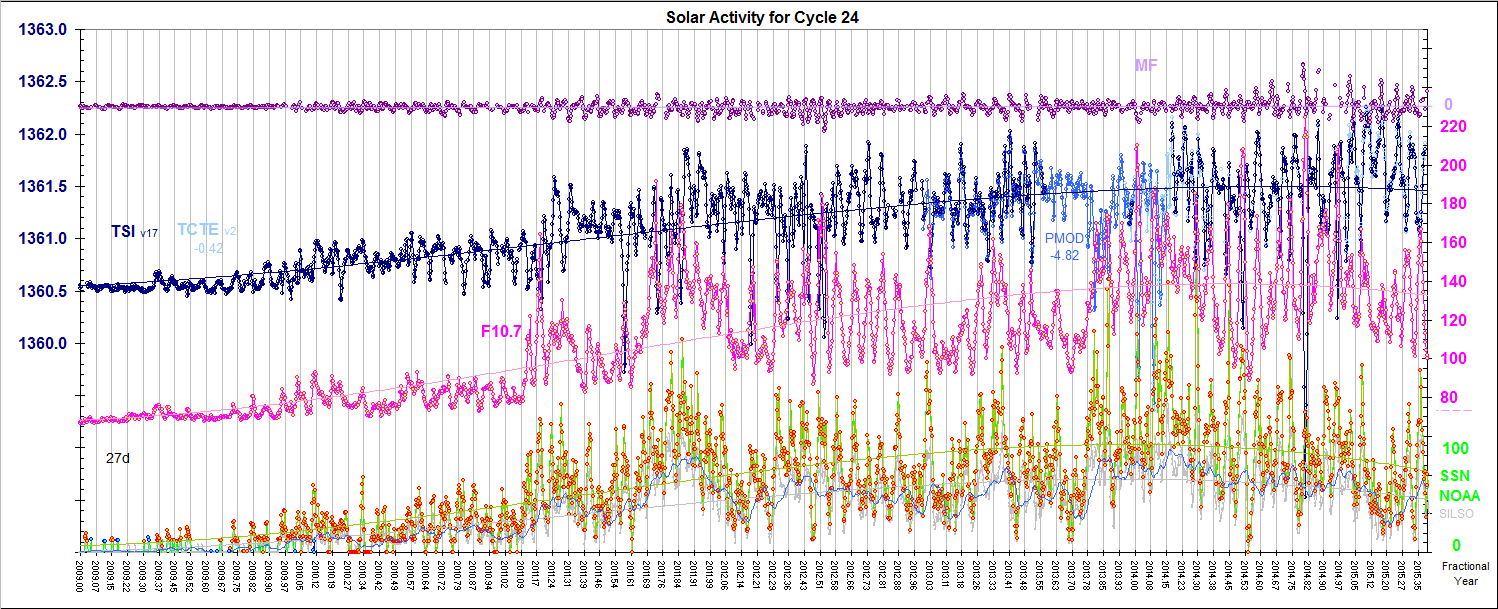
What is evident from Figure 2 is that the spikes down in the F10.7 flux and sunspot count are almost to absolute minimum levels. The underlying level of activity is only a little above that of solar minimum.

Figure 3: Oulu Neutron Count 1964 – 2026
Similar to the Ap Index, activity is only slightly above levels of previous solar minima. The figure includes a projection to the end of Solar Cycle 24 in 2026 which assumes that the neutron count in the next minimum will be similar to that of the 23/24 minimum. Previous cold periods have been associated with significant spikes in Be10 and C14. Perhaps the neutron count might get much higher yet into the 24/25 minimum.

Figure 4: UAH Monthly Temperature versus Low Global Cloud Cover
The cloud cover data for this figure was provided by Professor Ole Humlum. There is a significant relationship between low global cloud cover and global temperature. Assuming that the relationship is linear and remains linear at higher cloud cover percentages, this figure attempts to derive what cloud cover percentage is required to get the temperature decline of 0.9°C predicted by Solheim, Stordahl and Humlum in their paper entitled “The long sunspot cycle 23 predicts a significant temperature decrease in cycle 24” available at: http://arxiv.org/pdf/1202.1954v1.pdf
Figure 4 suggests that the predicted result will be associated with a significant increase in cloudiness.

Figure 5: Low Level Cloud Cover plotted against Oulu Neutron Count
This figure, most likely repeating other people’s work, suggests that there is little correlation between neutron count and cloud cover. Higher neutron counts may be a coincident with colder climate than a significant causative factor. Perhaps EUV, the Ap Index and other factors are more significant in climate change. Also, on a planet with a bistable climate of either ice age or interglacial, it may be that accidents of survival of snowpack over the northern summer are also important.
Perth-based scientist David Archibald is a Visiting Fellow of the Institute of World Politics in Washington where he teaches a course in Strategic Energy Policy.
This behavior:
http://www.robertb.darkhorizons.org/TempGr/uvp2324a.PNG
is out of character for any butterfly progression of Solar Cycle we have on record.
And this Sunspot Umbral Area progression underscores that L&P effect:
http://www.robertb.darkhorizons.org/TempGr/uSC24vs13_14.GIF
Leif: “Welcome to Solar Max” Autumn of 2011.
Henry Clark says
Ozone is a separate topic, but the albedo change was outright major in its radiative forcing.
Henry@Henry
You have to see the cause and effect.
On its own, ozone deflects ca. 20-25% of all incoming sunlight, in the range of its highest energy,
i.e. 0-0.5 microns.
for the change in ozone, see here:
http://www.iac.ethz.ch/en/research/chemie/tpeter/totozon.html
from 1970 to 1995 ozone dropped by about 10% (ca. 30 DU)
so there is your (main) reason for the observed warming
obviously with more heat coming in, you also get more water evaporation and more clouds, etc. and a variety of other weapons that earth has in its arsenal, come into action, that may put a brake on run away warming.
– which is why there is life on earth at all.
However, since 1995, I am sure due to what is happening on the sun,
ozone is on the increase again,
\
and indeed, global cooling is here:
http://www.letterdash.com/henryp/global-cooling-is-here
Dont bother replying, somehow I get the feeling that writing more would not be productive…
vukcevic says:
July 3, 2012 at 11:56 pm
As a practical and experienced engineer I respectfully disagree.
Engineers are usually not given to your flights of fancy.
-12 months have 13 full rotations (at ~27 days) which is perfectly adequate for the purpose.
The result you get from such a short period is valid for that period only and if you select another year you’ll find different values, so your ‘principal rotation number’ is not well defined using such a short period, especially since there are several periods of interest and they beat against each other. But it is clear that you’ll not learn, as usual.
Leif Svalgaard says:
July 4, 2012 at 5:50 am
Engineers are usually not given to your flights of fancy.
A luxury strictly reserved for the spare time mental unproductive activity.
vukcevic says:
July 4, 2012 at 6:00 am
“Engineers are usually not given to your flights of fancy.”
A luxury strictly reserved for the spare time mental unproductive activity.
For once you are correct: they are unproductive in earnest.
****
vukcevic says:
July 3, 2012 at 11:56 pm
Leif Svalgaard says:
July 3, 2012 at 3:46 pm
…………..
As a practical and experienced engineer I respectfully disagree.
****
As an engineer, one of the first rules I learned was not to waste time & effort reinventing the wheel. Empirical TSI measurements & its variability (insignificant) are the “wheel”.
Magnetic fields do not affect a mechanical TSI/albedo/water/water-vapor heat engine. OK, magnetic fields could conceivably affect cloudiness via GCRs, but this is far from being shown to be a significant effect.
beng says:
July 4, 2012 at 8:51 am
OK, magnetic fields could conceivably affect cloudiness via GCRs, but this is far from being shown to be a significant effect.
Plus that it has been going the wrong way lately, falsifying the claim.
Leif Svalgaard says:
July 3, 2012 at 6:03 pm
“Perhaps the best way to counter CAGW is to show that their beloved solar connection doesn’t work, forcing them to accept that there are (perhaps) a multitude of other natural variations in the complex climate system.”
The climatologist William Connolley — who is one of the top several CAGW movement agents in the team on the website with the most readers of all (Wikipedia) — can be seen at http://en.wikipedia.org/w/index.php?title=Solar_variation&diff=225168755&oldid=225139260 adding “if any” to the solar variation article in order that more of the public would think solar variation has had no effect on climate whatsoever. There are other examples such as eliminating references and info which people are not supposed to ever see at http://en.wikipedia.org/w/index.php?title=Solar_variation&diff=295047907&oldid=294874813 and http://en.wikipedia.org/w/index.php?title=Solar_variation&diff=38166555&oldid=38156487
As for the IPCC versus solar/GCR effects on climate: http://wattsupwiththat.com/2012/02/22/omitted-variable-fraud-vast-evidence-for-solar-climate-driver-rates-one-oblique-sentence-in-ar5/
(One can tell what the IPCC really doesn’t like by what they minimize, like only mentioning carbon fertilization in passing in several sentences in their giant reports to practically dismiss it in vagueness, rather than mentioning the major growth increase under elevated CO2 — +300 ppm CO2 resulting in around +36% to rice yields, even +24% for the C4 plant of corn, +33% to wheat, and so on under appropriate fertilizer application meanwhile — or the 40 billion ton increase in biomass of global terrestrial vegetation 1910->1990 estimated by ORNL during a small fraction as much relative CO2 increase mixed with climate variation, etc).
Your response to such as Dr. Spencer’s http://www.drroyspencer.com/2011/05/indirect-solar-forcing-of-climate-by-galactic-cosmic-rays-an-observational-estimate/ will be either (1) skip over it (2) try to discredit it — utterly predictable. (Likewise on http://www.agu.org/pubs/crossref/2009/2009GL038429.shtml etc). #1 / #2 are the same as those of the CAGW proponents I used to argue with elsewhere.
With this weak cycle 24, solar activity has overall gone down since 2002 in sunspots but not particularly until since the start of 2004 in effect on observed cosmic ray flux. But actually MSU global temperature data since the start of 2004 does shows relative cooling since then as a plot at
http://www.woodfortrees.org/plot/rss/from:2004/to:2013/plot/rss/from:2004/to:2013/trend highlights, even though of course superimposed on other influences like the AMO/PDO/ENSO/etc. ocean oscillations.
Leif Svalgaard says:
July 3, 2012 at 5:51 pm
I’m not responsible for what other people think of my ‘effort’. Here is what I think about the sun’s influence on climate http://www.leif.org/research/Does%20The%20Sun%20Vary%20Enough.pdf
If you look at slide 3 and 20 you may want to assert that I attribute the MWP to them darn vikings and their SUVs as the logical conclusion of your rant.
You don’t say anything in those slides one way or another about the cause of the MWP or LIA (or Holocene Climate Optimum for that matter) except for the theme of your presentation being portraying solar variation as not being a cause.
If you were to manage to get your revising of solar reconstructions increasingly prevalent, that would help others slip across claims such as the LIA being just due to volcanoes (like http://wattsupwiththat.com/2012/04/13/dronning-maud-meets-the-little-ice-age/ discussing one such claim — wrong timing) or due to variation in the human population of the time, as in “Europe’s “Little Ice Age” may have been triggered by the 14th Century Black Death plague, according to a new study” at http://news.bbc.co.uk/2/hi/science/nature/4755328.stm
But, anyway, that is not what I was asking for, which was rather:
“Can you link to any several posts in a row, anywhere out of hundreds to thousands of posts, on WUWT or elsewhere else where you spent paragraphs seriously arguing against any substantial element of the CAGW movement’s claims, in a manner not helpful to it? I don’t even mean 10% of posts or even 1% but just a few, something that someone unbiased and interested only in promoting scientific truth should end up engaged in sooner or later … [with] a tenth of the passionate motivation you show for aiming to counter solar-GCR climate linkage studies and data”
If having no such post to link, such is a rather one-sided pattern, considering you’ve made probably thousands of posts against there being substantial solar contributions to post-LIA global warming — certainly hundreds at an utter minimum.
This is reminiscent of, long ago, my first suspicions on so-called “mainstream” global warming presentations, which started to arise when noticing article after article practically solely presented global warming as causing negative effects — very suspicious for supposed lack of bias, when a fraction of a degree temperature change is in large portions similar to that seen if someone moves tens of miles closer to the equator (something at worst close to almost an even mixture of benefits versus tradeoffs in climate, wildlife, etc).
Leif Svalgaard says:
July 3, 2012 at 5:51 pm
“And sometimes you have to trust people [in particular me] especially if they don’t have a dog in the race.
Or I can trust, in particular, other people, like Dr. Spencer, Dr. Shaviv, Dr. Svensmark, Dr. Lindzen, Dr. Abdussamatov, etc
HenryP:
Saying ozone has a major effect is a separate matter from showing the cloud cover / albedo changes earlier discussed are minor.
Let’s do a partial analogy:
Person C says his object (a bus) masses a lot.
Person P says his object (a car) masses a lot, therefore the mass of person C’s object is minor. — That does not logically follow.
Such is part of what annoyed me about your response.
But for more specifics:
HenryP says:
July 4, 2012 at 1:38 am
“for the change in ozone, see here:
http://www.iac.ethz.ch/en/research/chemie/tpeter/totozon.html
from 1970 to 1995 ozone dropped by about 10% (ca. 30 DU)
so there is your (main) reason for the observed warming”
You want data more clearly global, and you want data for variation in UV reaching the surface (as one can not assume each 1% change in ozone amount means a 1.0% change in UV reaching the surface). What you want is more like this:
http://disc.sci.gsfc.nasa.gov/measures/documentation/2009%20JD012219%20Global%20Increase%20in%20UV.pdf
As implied in such, average UV irradiance at the surface increased by a few percent. (Of course, it gets into a lot more details and specifics, but giving the link is faster than me rewriting much).
While not the most convenient source but one I came across quickly for a link here, http://hera.ugr.es/doi/15020034.pdf illustrates how UV in wattage terms is 3% to 5% of all sunlight reaching the surface (a higher portion of the total solar spectrum in space by far but that before the atmosphere including ozone and clouds). If averaged day and night, 365 days a year, from poles to the equator, sunlight of all wavelengths reaching the surface is several hundred W/m^2. So a few percent increase in total irradiance reaching the surface is a few tenths of a W/m^2 change.
That is actually quite substantial in climate terms. Do, though, compare to the W/m^2 figures I was talking about before from cloud cover and albedo change.
—————–
* While total solar irradiance in space is around 1366 W/m^2, the amount passing through a circular area in space with an area of r^2, where r is the radius of Earth, to subsequently hit Earth’s atmosphere is what is available before atmospheric reflectance and absorption, versus the spherical Earth’s 4r^2 surface area. If averaged day and night, 365 days a year, from poles to the equator, average solar irradiance at the surface is somewhat under 1/4th of that: several hundred W/m^2.
It’s easy to overlook the changes to the global jet streams, which arrived circa 2009. They being the sluggishness with which they take High & Low Pressure systems Eastward. As for the low clouds, they appeared likewise in 2009 and peaked. All that awaits now is for the Solar Activity to slide back down to 2009 levels, where I would rationally expect the GCR’s (Neutron Counts) to once again shoot upwards. It is no small coincidence that the GCR’s peaked in 2009, the pit of SC23/24 Solar Activity. Fast forward to this year, 2012, where weather systems are stuck like flies on sticky paper, deluging the Pacific Northwest and the UK while the main mass of the US heartland has been roasted by a monolithic High Pressure system.
No, there are no changes evident to Earth’s Climate systems, just a little bit of Twilight Zone weather. A little dab will do you.
Henry Clark says:
July 4, 2012 at 10:26 am
You don’t say anything in those slides one way or another about the cause of the MWP or LIA (or Holocene Climate Optimum for that matter) except for the theme of your presentation being portraying solar variation as not being a cause.
I don’t say what the cause is because I don’t know what the cause is, except two things that are not the cause:
1) Man-made CO2 [because we didn’t make much during the MWP]
2) The Sun, because the relationships don’t hold up to scrutiny [and I do know something about the Sun]
But any complex system has lots of opportunities for internal, natural oscillations.
If you were to manage to get your revising of solar reconstructions increasingly prevalent, that would help others slip across claims such as the LIA being just due to volcanoes
Shows your bias and agenda, God forbid that I should be correct, so all the evil people can slip by contrary views [correct or not].
Or I can trust, in particular, other people, like Dr. Spencer, Dr. Shaviv, Dr. Svensmark, Dr. Lindzen, Dr. Abdussamatov, etc
I guess that every agenda has its own gods, even if the gods are fallible.
Henry@HenryC
The paper you quote says;
8. Summary
[56] Satellite measurements of ozone and cloud plus
aerosol reflectivity have been used to estimate zonal average
changes in UV irradiance (300 to 325 nm) over the past
30 years (1979 to 2008) using a simplified radiative transfer
approach based on Beer’s Law for both monochromatic and
action spectrum weighted irradiances.
Now carefully look here:
http://albums.24.com/DisplayImage.aspx?id=cb274da9-f8a1-44cf-bb0e-4ae906f3fd9d&t=o
do you see that the major portion of the energy being cut off by the ozone lies between 0.2 and 0.3 microns? (200-300 nm). So the measurements at 300-325, although indicative, do not help me much…..
Also remember that water absorbs strongly in the 200-300 nm region, which is then converted to heat.
I don’t think that the things I see happening have really yet been properly researched.
If you have a 10% decrease in ozone then obviously that (white) portion in between the red line and the red body will (at least) become 10% smaller? It is that extra heat coming in and slamming (mostly) into the oceans that caused the global warming 1970-1994.
Don’t forget that according to my own analysis global warming turned to cooling somewhere in 1994
\ so far I have been only able to correlate this with the increase and decrease in the observed ozone concentration
HenryP says:
July 4, 2012 at 11:20 am
“Now carefully look here:
http://albums.24.com/DisplayImage.aspx?id=cb274da9-f8a1-44cf-bb0e-4ae906f3fd9d&t=o
do you see that the major portion of the energy being cut off by the ozone lies between 0.2 and 0.3 microns? (200-300 nm). So the measurements at 300-325, although indicative, do not help me much…..
Also remember that water absorbs strongly in the 200-300 nm region, which is then converted to heat.”
Well, for what reaches the ground:
1) The portion below 320 nm is smaller than the 320-400 nm range by far. For instance, where UV-B is ultraviolet radiation of shorter than 320 nm:
“Of the global UV radiation at the ground, 94% is UV-A, 6% is UV-B.”
http://www.temis.nl/uvradiation/info/uvindex.html
2) The portion shorter than 300 nm in wavelength is relatively tinier still, even compared to the part of UV-B between 300 and 320 nm.
For example:
http://eurosun-project.org/var/eurosun_site/storage/images/media/images/a-solar-uv-spectrum-measured-on-the-ground/1421-1-eng-GB/A-solar-UV-spectrum-measured-on-the-ground_pagewidth.jpg
Also, figure 1 in this:
http://www.esrl.noaa.gov/gmd/grad/neubrew/docs/publications/Slaper_95GL02824.pdf
Note the logarithmic scale in the above’s figure 1.
Within a few nm beyond 300 nm, when starting to approach what would be UV-C (280nm and less — more precisely: 100-280 nm in definition), in relative energy terms it drops to basically zero before ground level.
Change it by any moderate percentage, and the part below 300 nm is still almost zero, whether the measurement is conducted now or in the 1990s or any other time.
If one forgives the looseness of this extreme analogy, if we lowered ocean mass and depth by 10%, there would still be about zero light reaching the bottom of the oceans.
UV-C at the surface under the atmosphere was next to nil before; it is next to nil now too.
On the other hand, though, the change in surface irradiance from the main portion of UV, between 300 and 400 nm, UV-A and a little UV-B, is substantial in energy terms.
Paul Vaughan (July 3, 2012 at 9:44 pm) wrote:
“The sun modulates westerly winds (via equator-pole temperature gradients):
http://i49.tinypic.com/219q848.png
This robust observation from LOD is rigidly founded on:
A. Law of Conservation of Angular Momentum.
B. Central Limit Theorem.”
–
Leif Svalgaard (July 3, 2012 at 11:22 pm) responded:
“It does more than that. […] But solar activity […] modulates the basic input at the barely observable limit.”
—————————————–
The signal is robust and easily observed using dozens of methods. Here’s a different angle on it: http://i46.tinypic.com/2yw7711.png . If you consider the signal “barely observable”, you’re relying on grossly suboptimal (in this context) methods. Although incredibly useful, a hammer isn’t the right tool for gracefully sinking a screw.
Paul Vaughan says:
July 4, 2012 at 7:14 pm
The signal is robust and easily observed using dozens of methods. Here’s a different angle on it
Without explanation of P.5 and M.5 your graph has little value.
@Leif Svalgaard (July 4, 2012 at 7:31 pm)
As previously explained:
http://i46.tinypic.com/2yw7711.png
CH = Coronal Holes
nCRm = neutron Count Rate (moscow)
M.5 & P.5 = Schwabe-extent (11 year) Morlet & Paul wavelet power of semi-annual Length of Day (LOD)
HenryC says
http://wattsupwiththat.com/2012/07/02/the-sun-has-changed-its-character/#comment-1024536
I think you still don’t get it. Read my post again. Do you understand why we measure nothing on the ground? It is the ozone filtering it for out for us, deflecting it out to space. It is our shield. However, in the SH, the ozone layer is much thinner, in fact we have the ozone hole (where there is no ozone ) nearby to us here in South Africa. Skin cancer is a major problem here – only fools go out and stay in the sun here without proper protection…
Looking at my first data set and at the differences between the results from the northern hemisphere(NH) and the southern hemisphere (SH), (especially the maxima!) what we see is happening from my results is that more (solar) heat went into the SH oceans and is taken away by water currents and/or weather systems to the NH. That is why the NH is (was) warming and that is why the SH does (did) not warm.
http://www.letterdash.com/HenryP/henrys-pool-table-on-global-warming
Paul Vaughan says:
July 4, 2012 at 8:04 pm
As previously explained
You cannot assume that such is remembered over any length of time.
But, now that you reminf me, we have had this discussion before and your new graph adds nothing new, except committing the elementary error of plotting the extensively smoothed values together with the ragged unsmoothed real solar data. Now because of the solar cycle variation of TSI implies a [barely detectable] temperature variation of 0.1C, one would expect some response in atmospheric parameters that depend on temperature. Is that what you think you are seeing?
HenryP says:
July 4, 2012 at 8:36 pm
I think you still don’t get it. Read my post again. Do you understand why we measure nothing on the ground? It is the ozone filtering it for out for us, deflecting it out to space.
No, Ozone does not ‘deflect’ anything. Ozone absorbs the UV and is heated in the process. That is why we don’t measure anything on the ground.
@Leif Svalgaard (July 4, 2012 at 8:47 pm)
I’m finished dealing with you.
Paul Vaughan says:
July 4, 2012 at 9:06 pm
@Leif Svalgaard (July 4, 2012 at 8:47 pm)
I’m finished dealing with you.
You are welcome.
Leif says
No, Ozone does not ‘deflect’ anything. Ozone absorbs the UV and is heated in the process.
Henry says
ooh please….
don’t tell me you have been listening to Phil.
Plse refer to:
http://www.letterdash.com/HenryP/the-greenhouse-effect-and-the-principle-of-re-radiation-11-Aug-2011
You better study that – and challenge me on that, if you dare. Your meme of absorption being converted to heat is a general misconception that I have heard a lot but it is not consistent with actual observations.
In the case of incoming UV, we must also consider the reaction of oxygen with UV,
producing the ozone;
HenryP says:
July 4, 2012 at 9:24 pm
You better study that – and challenge me on that, if you dare.
no need to, as you probably won’t listen anyway.Perhaps you should study this http://igaco-o3.fmi.fi/ACSO/files/daumont_et_al_1992.pdf instead.
HenryP says:
July 4, 2012 at 9:24 pm
You better study that – and challenge me on that, if you dare.
Or perhaps this http://www.ozonelayer.noaa.gov/science/basics.htm is more accessible
Henry@Leif
you avoid the subject.
I agree that some portion of absorbed radiation in the absorptive regions of the spectrum of the molecule converts to heat
but do you understand the principle of re-radiation?