by John R. Christy and Roy W. Spencer
University of Alabama in Huntsville
A new paper by Stephen Po-Chedley and Quang Fu (2012) (hereafter PCF) was sent to us at the end of April 2012 in page-proof form as an article to appear soon in the Journal of Atmospheric and Oceanic Technology. The topic of the paper is an analysis of a single satellite’s impact on the rarely-used, multi-satellite deep-layer global temperature of the mid-troposphere or TMT. Some of you have been waiting for our response, but this was delayed by the fact that one of us (J. Christy) was out of the country when the UW press release was issued and just returned on Tuesday the 8th.
There are numerous incorrect and misleading assumptions in this paper. Neither one of us was aware of the paper until it was sent to us by Po-Chedley two weeks ago, so the paper was written and reviewed in complete absence of the authors of the dataset itself. In some cases this might be a normal activity, but in a situation where complicated algorithms are involved, it is clear that PCF did not have a sufficient understanding of the construction methodology.
By way of summary, here are our main conclusions regarding the new PCF paper:
1) the authors’ methodology is qualitative and irreproducible
2) the author’s are uninformed on the complexity of the UAH satellite merging algorithm
3) the authors use the RSS (Remotes Sensing Systems) satellite dataset as “verification” for their proposed UAH NOAA-9 calibration target adjustment for TMT, but barely mention that their TLT (lower tropospheric) results are insignificant and that trends are essentially identical between UAH and RSS without any adjustment in the NOAA-9 calibration coefficient
4) the authors neglected the main TMT differences among the datasets – and instead try to explain the UAH v. RSS trend difference by only two years of NOAA-9 data, while missing all of the publications which document other issues such as RSS problems with applying the diurnal correction.
The paper specifically claims to show that a calibration target coefficient of one satellite, NOAA-9, should be a value different than that calculated directly from empirical data in UAH’s version of the dataset. With an adjustment to the time series guesstimated by PCF, this increases the UAH overall global trend by +0.042 °C/decade. Their new UAH trend, being +0.042 warmer, then becomes the same as the TMT trend from RSS. This, they conclude, indicates a verification of their exercise.
More importantly, with regard to the most publicized UAH dataset, the temperature of the lower troposphere (TLT), there was no similar analysis done by PCF – an indication that their re-calculations would not support their desired outcome for this dataset, as we shall demonstrate below.
All of this will soon be moot, anyway. Since last year we have been working on v6.0 of the UAH datasets which should be ready with the tropospheric temperature datasets before summer is out. These will include (1) a new, more defensible objective empirical calculation to correct for the drift of the satellites through the diurnal cycle, and (2) a new hot calibration target effective emissivity adjustment which results in better agreement between simultaneously operating satellites at the calibration step, making the post-calibration hot-target adjustment PCF criticizes unnecessary. So, since our new v6.0 dataset is close to completion and submission for publication, we have chosen this venue to document PCF’s misinformation in a rather informal, but reproducible, way rather than bother to submit a journal rebuttal addressing the older dataset. However, to show that version 5.4 of our datasets was credible, we discuss these issues below.
The Lower Tropospheric Temperatures (TLT)
We shall return to TMT below, but most of the research and popular use of the UAH datasets have focused on the lower tropospheric temperature, or TLT (surface to about 300 hPa, i.e. without stratospheric impact). Thus, we shall begin our discussion with TLT because it is rightly seen as a more useful variable because it documents the bulk heat content of the troposphere with very little influence from the stratosphere. And [this is important in the TMT discussion] the same hot-target coefficients for NOAA-9 were used in TLT as in TMT.
PCF focused on the deep layer TMT, i.e. temperature of the surface to about 75 hPa, which includes quite a bit of signal above 300 hPa. As such, TMT includes a good portion of the lower stratosphere – a key weakness when utilizing radiosondes which went through significant changes and adjustments during this time. [This was a period when many stations converted to the Vaisala 80 radiosonde which introduced temperature shifts throughout the atmosphere (Christy and Norris 2004).]
As indicated in their paper, it seems PCF’s goal was to explain the differences in trend between RSS and UAH, but the history of this effort has always been to find error with UAH’s products rather than in other products (as we shall see below). With us shut out of the peer-review cycle it is easy to assume an underlying bias of the authors.
Lord Kelvin told us that “All science is numbers”, so here are some numbers. First, let’s look at the “global” trends of UAH and RSS for TLT (70S to 82.5N) for Jan 1979 to Apr 2012:
+0.137 °C/decade UAH LT (70S-82.5N)
+0.134 °C/decade RSS LT (70S-82.5N)
These trends are, for all practical purposes, identical. This, however, hides the fact that there are indeed differences between the two time series that, for one reason or another, are balanced out when calculating the linear trend over the entire 30+ year period. As several papers have documented (see Christy et al. 2011, or C11, for the list – by the way, C11 was not cited by PCF) the evidence indicates RSS contains a spurious warming in the 1990’s then a spurious cooling from around 2002 onward (note that the RSS temperature anomaly for last month, April, 2012, was 0.08°C cooler than our UAH anomaly).
This behavior arises, we believe, from an over-correction of the drift of the satellites by RSS (in the 1990’s the satellites drifted to cooler times of day, so the correction must add warming, and in the 2000’s the satellites drifted to warmer times of day so a correction is needed to cool things down.) These corrections are needed (except for the Aqua satellite operating since 2002, which has no diurnal drift and which we use as an anchor in the UAH dataset) but if not of the right magnitude they will easily affect the trend.
In a single paragraph, PCF admit that the UAH TLT time series has no significant hot-target relationship with radiosonde comparisons (which for TLT are more robust) over the NOAA-9 period. However, they then utilize circular reasoning to claim that since RSS and UAH have a bit of disagreement in that 2-year period, and RSS must be correct, that then means UAH has a problem. So, this type of logic, as stated by PCF, points to their bias – assume that RSS is correct which then implies UAH is the problem. This requires one to ignore the many publications that show the opposite.
Note too that in their press release, PCF claim that observations and models now are closer together for this key parameter (temperature of the bulk troposphere) if one artificially increases the trend in UAH data. This is a questionable claim as evidence shows TLT for CMIP3 and CMIP5 models averages about +0.26 °C/decade (beginning in 1979) whereas UAH *and* RSS datasets are slightly below +0.14 °C/decade, about a factor of 2 difference between models and observations. We shall let the reader decide if the PCF press-release claim is accurate.
The key point for the discussion here (and below) is that TLT uses the same hot-target coefficients as TMT, yet we see no problem related to it for the many evaluation studies we have published. Indeed this was the specific result found in Christy and Norris 2004 – again, work not cited by PCF.
The Mid-Tropospheric Temperature (TMT)
About 12 years ago we discovered that even though two different satellites were looking at the same globe at the same time, there were differences in their measurements beyond a simple bias (time-invariant offset). We learned that these were related to the variations in the temperature of the instrument itself. If the instrument warmed or cooled (differing solar angles as it orbited or drifted), so did the calculated temperature. We used the thermistors embedded in the hot-target plate to track the instrument temperature, hence the metric is often called the “hot target temperature coefficient.”
To compensate for this error, we devised a method to calculate a coefficient that when multiplied by the hot target temperature would remove this variation for each satellite. Note that the coefficients were calculated from the satellite data, they were not estimated in an ad hoc fashion.
The calculation of this coefficient depends on a number of things, (a) the magnitude of the already-removed satellite drift correction (i.e. diurnal correction), (b) the way the inter-satellite differences are smoothed, and (c) the sequence in which the satellites are merged.
Since UAH and RSS perform these processes differently, the coefficients so calculated will be different. Again recall that the UAH (and RSS) coefficients are calculated from a system of equations, they are not invented. The coefficients are calculated to produce the largest decrease in inter-satellite error characteristics in each dataset.
To make a long story short, PCF focused on the 26-month period of NOAA-9 operation, basically 1985-86. They then used radiosondes over this period to estimate the hot-target coefficient as +0.048 rather than UAH’s calculated value of +0.0986. [Note, the language in PCF is confusing, as we cannot tell if they conclude our coefficient is too high by 0.051 or should actually be 0.051. We shall assume they believe our coefficient is too high by 0.051 to give them the benefit of the doubt.]
Recall, radiosondes were having significant shifts with the levels monitored by TMT primarily with the switch to Vaisala 80 sondes, and so over small, 26-month periods, just about any result might be expected. [We reproduced PCF’s Fig. 2 using only US VIZ sondes (which had no instrument changes in the 26-month period and span the globe from the western tropical Pacific to Alaska to the Caribbean Sea) and found an explained variance of less than 4% – an insignificant value.]
Another problematic aspect of PCF’s methodology is that when looking at the merged time series, one does not see just NOAA-9’s influence, but the impact of all of the other satellites which provided data during 1985-86, i.e. NOAA-6, -7 and -8 as well. So, it is improper to assume one may pick out NOAA-9’s impact individually from the merged satellite series.
That PCF had little understanding of the UAH algorithm is demonstrated by the following simple test. We substituted the PCF value of +0.048 directly into our code. The increase in trend over our v5.4 TMT dataset was only +0.022 °C/decade for 1979-2009 (not 0.042), and +0.019 °C/decade for 1979-2012.
To put it another way, PCF overestimated the impact of the NOAA-9 coefficient by a factor of about 2 when they artificially reconstructed our dataset using 0.048 as the NOAA-9 coefficient. In fact, if we use an implausible target coefficient of zero, we still can’t return a trend difference greater than +0.037 °C/decade. Thus PCF have incorrectly assumed something about the construction methodology of our time series that gave them a result which is demonstrated here to be faulty.
In addition, by changing the coefficient to +0.048 in an ad hoc fashion, they create greater errors in NOAA-9’s comparisons to other satellites. Had they contacted us at any point about this, we would have helped them to understand the techniques. [There were 4 emails from Po-Chedley in Aug and Sep 2011, but this dealt with very basic facts about the dataset, not the construction methodology. Incidently, these emails were exchanged well after C11 was published.]
PCF brought in a third dataset, STAR, but this one uses the same diurnal corrections and sequential merging methodology as RSS, so it is not a truly independent test. As shown in C11, STAR is clearly the outlier for overall trend values due to a different method of debiasing the various satellite data and a differing treatment of the fundamental brightness temperature calibration.
We have additional information regarding UAH’s relatively low error statistics. Using radiosondes to evaluate microwave temperatures requires great care. In our tests, we concentrated on sondes which had documented characteristics and a high degree of consistency such as the US VIZ and Australian sondes. These comparisons have been published a number of times, but most recently updated in C11.
Here are the comparisons for the US VIZ radiosonde network (stretching from the western tropical Pacific to Alaska down across the conterminous US and to the Caribbean.) As you can see, UAH MT provides the lowest error magnitudes and highest reproducibility of the three data sets. Similar results were found for the Australian comparisons.
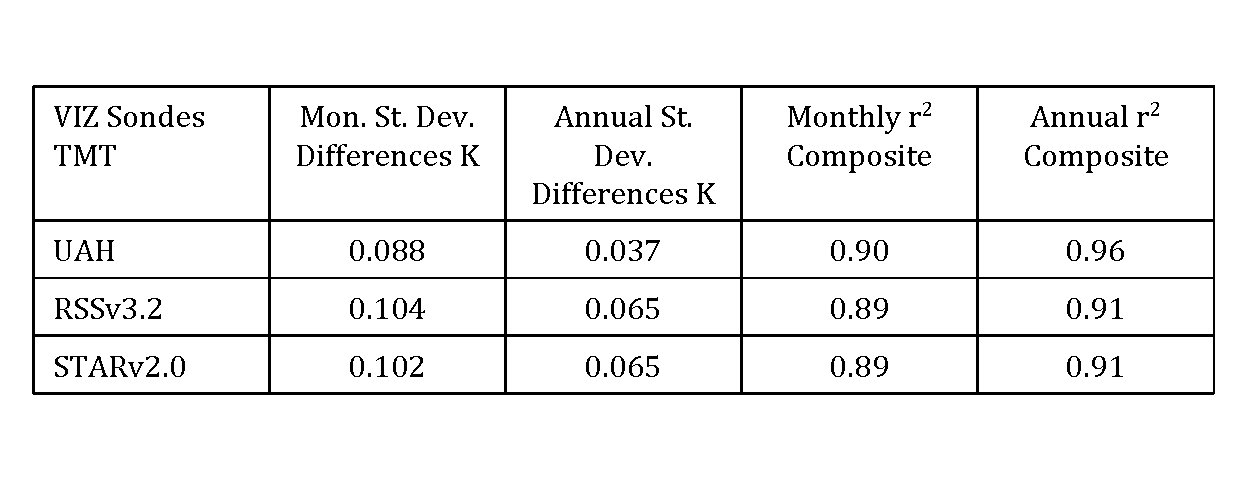
For data through April 2012 we have the following global TMT trends: UAH +0.045, RSS +0.079 and STAR +0.124 °C/decade. So, RSS, in the middle, is closer to UAH than STAR, yet PCF chose to examine UAH as the “problem” dataset. Had PCF wanted to pick some low-hanging fruit regarding the differences between UAH, RSS and STAR, they would have (a) looked at the diurnal differences between UAH and RSS (see publications) or (b) looked at a simple time series of differences between the three datasets (below). One thing that pops out is a spurious upward shift in STAR TMT relative to UAH and RSS of about +0.06 °C on precisely 1 Jan 2001 – an obvious beginning-of-year glitch. Why not look there?

The Bottom Line
In conclusion, we believe that the result in PCF was a rather uninformed attempt to find fault with the UAH global temperature dataset, using an ad hoc adjustment to a single, short-lived satellite while overlooking the greater problems which have been documented (published or as demonstrated in the figure above) regarding the other datasets.
And think about this. If PCF is correct that we should be using a revised NOAA-9 coefficient, and since we use the same coefficient in both TMT and TLT, then the near perfect agreement currently between RSS and UAH for TLT will disappear; our TLT trend will become warmer, and then RSS will have the lowest warming trend of all the satellite datasets. The authors of the new study cannot have it both ways, claiming their new adjustment brings RSS and UAH closer together for TMT (a seldom used temperature index), but then driving the UAH and RSS trends for TLT farther apart, leaving RSS with essentially the same warming trend that UAH had before.
Since it is now within 3 months of the publication cutoff for research to be included in the IPCC AR5, one is tempted to conclude that PCF will be well-received by the Lead Authors (some of whom are closely associated with the RSS dataset) without critical evaluation such as briefly performed here. However, we cannot predict what the AR5 outcome will be or, for that matter, what waning influence the IPCC might still exert.
That PCF brushed aside the fact that the UAH and RSS trends for the LOWER troposphere are essentially identical (for which the UAH NOAA-9 coefficient is the same) seems to us to be a diversionary tactic we have seen before: create a strawman problem which will allow the next IPCC report to make a dismissive statement about the validity of an uncooperative dataset with a minimum of evidence. We hope that rationality instead prevails.
References
Christy, J.R. and W. B. Norris, 2004: What may we conclude about global tropospheric temperature trends? Geophys. Res. Lett. 31, No. 6.
Christy, J.R., R.W. Spencer and W.B Norris (deceased), 2011: The role of remote sensing in monitoring global bulk tropospheric temperatures. Int. J. Remote Sens. 32, 671-685, DOI:10.1080/01431161.2010.517803.
Po-Chedley, S. and Q. Fu, 2012: A bias in the midtropospheric channel warm target factor on the NOAA-9 Microwave Sounding Unit. J. Atmos. Oceanic Tech. DOI: 10.1175/JTECH-D-11-00147.1.
Is this the same Spencer who said “I view my job a little like a legislator, supported by the taxpayer, to protect the interests of the taxpayer and to minimize the role of government.”
Anyone confirm that this is the same Spencer?
Tom;
Can you find a single solitary thing wrong with the technical explanation provided by Spencer and Christy?
If not, then all your pretentions are just silly, pointless and frankly, you should be embarrased.
‘just some guy’ says to ‘Tom’:
“The rest of your comments are subterfuge.”
All of Tom’s comments are subtrefuge.
I’ve been away for the last few hours, but checking back, a quick count shows 23 posts by “Tom”, more than 20% of the entire thread! I wonder if Tom has a life? Does he post throughout the day from his mom’s basement? [My excuse is an invalid wife, who I must stay close by. I pass the time b!tch-slapping anti-science trolls like Tom who argue with everyone else].
Tom should note that skeptics are the overwhelming consensus here. By Tom’s wacky ‘reasoning’, that automatically makes us right. [Aside from the plain fact, of course, that Tom is wrong.] He needs to re-read the Spencer/Christy aricle and watch them eviscerate the hapless punks who used pal review to end-run peer review.
Now, for the science: Spencer & Christy write in point #1:
1) the authors’ methodology is qualitative and irreproducible
Honestly, they could have stopped right there. If PCF’s results are not reproducible, then they are not testable. And if they ar not testable, they do not follow the scientific method. And if they do not follow the scientific method, they are pseudo-science. QED
Guys,
Everytime there’s a new troll who comes up with inane, pointless, factless and lying obfuscations. Tom is the latest iteration. Stop feeding such trolls.
@ur momisugly Smokey – so consensus is a good thing then when non-scientists reach it supporting an self-professed biased source, but bad when reached anywhere else.
Maybe I am just dizzy from your merciless slapping, but that appears to make utterly no sense.
@Venter – so skepticism on a “skeptical” site is a problem how, exactly?
That seems like an orthodoxy, or belief oriented, stance.
Venter,
I think I’ll take your advice. Because emotion-based pseudo-science isn’t my thing.
The so-called “consensus” or “conventional wisdom”, or “real world” IS reality. MUST be respected and followed …. WHEN IT IS BASED ON FACTS and experimental results and is verifiable.
A “religion” or “faith-based-consensus” that refuses as a convention (and a requirement to the become initiated into the fellowship) to release its data, its research, and its methods.
That cannot independently reproduce its methods and its research, except by other “believers” in the fellowship, using (what else!) but the same papers that the fellowship requires as a belief system.
That has no evidence for its research.
That relies on its fellowship-paid cronies to edit its “research” but refuses at the same time to publish anything except its fellowship-paying research.
That seduces money from its sponsors in the government to grant further “research” only by its fellowship for results only favorable to its fellowship, gaining in return trillions in power and money for its sponsors in the government.
That “religious” consensus has less “evidence” and fewer witnesses than religion based on spirituality and morals.
And is much less believable.
Note, however, that socialism and communism – responsible for killing hundreds of millions in only one century – still has millions of “believers” in that “consensus”. It makes those believers no less fervent for the failures of either system (perhaps even more fervent in their hatred of the truth, and their spirits and their fervor even stronger in their continued belief in failure!), but it makes neither socialism nor communism any more correct!
@Tom
It looks like PCF made two wrong assumptions about UAH’s TMT. The first being that the hot target coefficient was an independent variable and the other that NOAA-9 was the only satellite that mattered. Their analysis was apples to oranges in a sense, so the paper is of little value.
My question, however, is why the hot target coefficient is dependent on the diurnal drift, other smoothing factors, and the order that they are applied?
Let’s consider the homogenization procedures of both satellite and surface measurements. My understanding is that the surface indexes apply independent factor adjustments such as TOB and instrument variances first and then smooth the station measurements. UAH on the other hand applies an independent diurnal drift adjustment, smooths the satellite measurements, and then applies a hot target coefficient that is dependent on the previous steps. This I find odd and possibly the source of PCF’s confusion.
AJ
No Tom, we don’t like mindless and brainless trolls derailing discussions with their stupidity and lies.
I believe everyone here, including Drs Spencer and Christy, are missing the point of PCF, and therefore missing how it plays into the alarmists’ agenda.
Drs Spencer and Christy, in the above rebuttal, repeatedly point out that the mid-troposphere temperature record is “rarely used”. However, there is one thing it IS used for, something that is actually very crucial to the debate over CAGW, though, sadly, not very well known.
There are many possible causes for global warming, and they all have “signatures” that, if you look hard enough, you can clearly see. Warming caused by an increase in atmospheric carbon dioxide has the signature that the middle troposphere warms faster than the surface. But that has not happened. Just look at the trends presented here in Spencer and Christy’s rebuttal. According to UAH, Lower Troposphere (i.e., surface) temperatures have risen at a rate of 0.137C/decade, while MT temperatures have risen at a rate of just 0.45C/decade, less than one third of that of the surface. Even the more alarmist-friendly RSS records show 0.134C/decade in the LT, and 0.79 in the MT (less than 60% of LT), but the alarmists have come up with all kinds of “explanations” for why it LOOKS LIKE the MT isn’t warming as fast as the LT, and if you pile enough of these explanations on top of each other, and take them out to three standard deviations, you can just barely adjust that pesky MT temp up to slightly above the LT temp, and they claim this PROVES that the warming is anthropogenic in origin.
My favorite one was a couple of years ago when someone (not sure, but I THINK Trenberth was involved in this one too) claimed that the satellites, when specifically aimed at and calibrated for the MT, were nevertheless getting a signal that was partially composed of UPPER tropospheric, and even STRATOSPHERIC, temperatures. They applied some extremely generous (for them) assumptions and tortured the hell out of the numbers until the “adjusted” RSS (not UAH) TMT trend was only 10% below that of the TLT, and with a straight face claimed that this difference was “statistically insignificant”. So they concluded (in a way that no statistician would accept as valid) that the TMT trend was EQUAL TO the TLT trend, apparently forgetting that what they actually needed to prove was that TMT trend was GREATER THAN the TLT trend. (One wonders, if they had been able to “adjust” the TMT trend to 10% ABOVE the TLT trend, whether they would have used the same definition of “statistically significant”.) Curiously missing from this study was any discussion of whether the satellites, when aimed at and calibrated for the LOWER troposphere, were getting a similar corruption from the Middle Troposphere. You see, the satellite measurements of the LT are very much in line with surface thermometers and weather-balloon data, so they would have had to admit that no such signal corruption was finding its way into the LT temps, and then they would have had to explain how satellites can accurately record the temperature of the surface, 10 miles further away from the satellite, and with 10 miles more of atmospheric thickness to corrupt the signal, but can’t get an accurate read on the MT.
But they’ve never been able to come up with an explanation (or even a combination of explanations) for Spencer and Christy’s numbers. It’s just too big a difference to be explained by any of their made-up theories and bullspit “adjustments”. So, for the last 10 years, they’ve been trying to DISCREDIT UAH, with one theory after another about how Spencer and Christy flubbed the data. For example, they’ve been harping for YEARS about the “diurnial correction” of UAH, claiming Spencer and Christy aren’t doing it right. And this paper is just the latest lame attempt to discredit the UAH middle-tropospheric temperature record. Frankly, I think they’re shooting themselves in the foot with this, because the whole MT/LT inconsistency is a bit over the head of most of the general public (as is anything beyond “temperatures are warmer/cooler than they were before”), so the skeptics haven’t really pushed it like I believe they should. This paper might force our hand.
Why are you guys letting Tom bait you? He’s asking for proof that Spencer and Christy never published a paper critical of another paper without first consulting the author(s) of the original paper. But Spencer and Christy aren’t complaining about that. I guess they’re used to it after all these years. What they are complaining about is the fact that the authors of the critical paper don’t understand the algorithms Spencer and Christy used. Not as a matter of respect, but in order to do the calculations correctly, the authors SHOULD have consulted with Spencer and Christy (or someone else who understood Spencer and Christy’s work) before they started doing the math, and then maybe they would have gotten it right (of course, if they HAD gotten it right, it wouldn’t have proven what they set out to prove, which is why they INTENTIONALLY got it wrong).
And you need to just ignore Tom’s comments about the accessibility of the information. Maybe Spencer and Christy don’t PUBLISH the algorithms and raw data, but as true scientists, they are more than happy to provide any and all data, source code, or anything else used in the compilation of UAH data, to anyone who requests it. Compare that to the the other side. Not only do they REFUSE requests for raw data and code, but they fight, tooth and nail, against even valid FOI requests, and even when they are FORCED by law to give up the goods, drag their heels, delaying as much as possible. Their institutions (UVa, e.g.) fight against the very government (State of Virginia) which pays the bills for their research when that government asks for emails sent and received on a computer and internet account (both purchased with government funds), claiming it’s an invasion of privacy (when any government or university employee, or private-sector employee for that matter, knows damned well that there’s no expectation of privacy when you’re using your employer’s computer). They do everything in their power to keep their raw data and source code from ever seeing the light of day, even conspiring to DESTROY it rather than let it fall into enemy hands. The only way that Spencer and Christy’s code is “inacessible” is in the sense that most people just can’t understand it. It is not at all inaccessible in the sense that Hockey Team data and code are inaccessible, which is, for all intents and purposes, “Hell will freeze over before I let you see my raw data and source code!”
Tom understands both distinctions, but he’s willfully obscuring the issue and ignoring everything anyone here says to clear it up for him, while claiming, with a straight face, that no one is answering his questions. His questions have been answered over and over again, but he just keeps asking them. DO. NOT. FEED. THE. TROLL.
Interesting. Po Chedley is getting lambasted by public commenters over at UW’s press release for not getting input from Christy/Spencer before going public with thier paper. This is a big deal. The public is getting tired of this sort of chenanigans coming from academics.
Tom says:
May 10, 2012 at 6:02 am
@ur momisugly Bill Tuttle “Nope. It’s a generalist blog about “interesting things in life, nature, science, weather, climate change, technology, and recent news.”
Interesting, so that suggests that what is expressed here are simply opinions untethered to any valid science?
Nope. It suggests only that there haven’t been enough goats crossing your bridge to keep you occupied.
@Tom (whoever that is)
If Spencer and Christy have failed to communicate with authors whose work they criticize I fail to see how that excuses PCF. I don’t know either way whether Christry/Spencer are guilty of the same misconduct.
Where I come from we are taught that two wrongs don’t make a right. Were you taught that? A simple yes or no is all I need from you. 😉
Trevor says:
May 10, 2012 at 11:03 pm
re; mid-troposphere warming faster/slower than surface
Good point. Since the criticism doesn’t change surface temperature trend one should indeed ask why PCF bothered with it. It does indeed change the signature away from, for example, the cloud iris effect (Richard Lindzen) back to CO2.
The CO2 signature arises because back-radiation from CO2 does not warm the tropical ocean much but rather raises the evaporation rate instead. This causes surface temperature to remain nearly constant and the mid-troposphere to warm instead when the water vapor condenses due to adiabatic fall in temperature below the dew point.
I point this out because it’s not a well accepted notion on this blog that back radiation cannot raise water temperature due to the physics of LWIR absorption by water. The energy in back radiation is practically all carried out of the ocean instantly by evaporation. Climate boffins acknowledge this when they speak of the CO2 “signature” even if they won’t come right out and say why. On the other hand Lindzen’s cloud-iris hypothesis results in more or less short wave radiation reaching the ocean surface which effects surface temperature more than mid-troposphere temperature.
This appears to be all about discounting scientists like Lindzen and Svensmark who present an increasingly compelling alternative to man-made global warming by way of natural variation in cloud type and distribution caused by factors external to the earth.
@ur momisugly Venter – so anyone that raises questions on what is written here is a troll? Anyone that is skeptical and disagrees with the consensus here is inherently guilty of ” stupidity and lies”
Doesn’t that violate the very principle many claim to hold as a required activity to think for ones self, no?
If this is a site where skepticism is encouraged, why all the personal attacks and smears instead of any accountability for Spencer and Christy? Why not hold Spencer and Christy accountable to the very standard they are demanding Venter? Wouldn’t that be the responsible thing to do in the interest of science?
@bpascal – I mate. So you are agreeing then that Spencer and Christy are also in the wrong then?
Trevor said “He’s asking for proof that Spencer and Christy never published a paper critical of another paper without first consulting the author(s) of the original paper. But Spencer and Christy aren’t complaining about that.”
Spencer and Christy said “Neither one of us was aware of the paper until it was sent to us by Po-Chedley two weeks ago, so the paper was written and reviewed in complete absence of the authors of the dataset itself. ”
Maybe I still suffering from all the personal attacks and smears, but that sure sounds like Spencer and Christy complaining.
@Just some guy said “Po Chedley is getting lambasted by public commenters ”
If you actually look at those comments topics include “Obama”, “schizophrenia”, “mantra”, “money”, “evil”, etc.
So forgive me, kindly, if I look at your assertion as either spectacularly ill informed, or deliberately misleading.
I suppose there is one other possibility, which is that if you really believe that it is good science to blindly accept data from a source that has proclaimed publicly that science is secondary to his goal, perhaps responses that include “Obama”, “schizophrenia”, “mantra”, “money”, “evil”, etc. seems totally reasonable as well. My goodness, how silly would that be?
Having been butted off the bridge countless times in succession, the troll nonetheless climbs back up, and dripping water, triumphantly declares his victory.
Trevor says:
May 11, 2012 at 12:07 am
“Why are you guys letting Tom bait you?… ”
Thanks for the post Trevor, well said, you summarised it. Trolls do not try to make any constructive discussion, but just disruption.
Just some guy says:
May 11, 2012 at 12:14 am
“Interesting. Po Chedley is getting lambasted by public commenters over at UW’s press release for not getting input from Christy/Spencer before going public with thier paper. This is a big deal. The public is getting tired of this sort of chenanigans coming from academics.”
Good to hear this. Thanks.
Tom:
Go away.
Richard
@Tom
>…as Christy and Spencer are academics does that not make them part of the problem per your statement?
>Or are they somehow special and exempted? If so it would be most enlightening to understand that process.
+++++++++++++++++
I am making no statement against the works of academics, I am just not letting them have the keys to the farm just because they study bacteria, if you get my drift. Christy and Spencer are doing exactly what scientists, academics or not, are supposed to do: to train, educate, lead or support their fields, uncover new knowledge, confirm or re-evaluate old knowledge and to contribute the development of an ever-advancing civilisation.
I fortunately still float into and out of universities and the private sector enough to know at least something about where the benefits of academia and the private sector lie. On the academic side, I was asked this morning to provide a complete explanation of how a certain set of emissions was calculated by a PhD candidate. This is an uncompromising request – the answer has to be complete and will be examined in detail (as it has already by LBNL) to see that the method is robust. If a few holes can be picked in it I must close them. That is how science is done. I can’t hide anything and still get published. In the private sector, ‘the medium is the message’ and advertising claims exceed the product so much of the time there are laws needed to control them.
If one of the lecturers knows how to calculate the emissions handily, it does not mean they automatically get to write EPA standards or create legislation and national standards, no matter how perfectly they understand the math that underlies the methods. Advice from Hansen on how to run an economy and how to protect ‘nature’ (as if nature was a potential litigant) can be considered but decisions are subject to consideration of input from other opinion holders (as if they also might know what they are doing). The key to unlocking the climate controversey is the realisation that most of the argument protecting CAGW is personal attacks on those who show contradicting evidence, and on people providing evidence that no case was properly made in favour of the need for alarm or the stupendously expensive ‘solutions’ (as if carbon trading was a solution) they have vainly imagined. That so many proponents of climate alarmism benefit materially from it is telling.
@ur momisugly Crispin said “Academia always wanted to rule the world. That is why we keep them locked/tenured in ivory towers.”
Crispin said “I am making no statement against the works of academics, ”
Pardon my inability here, but are these not inherently conflicting assertion?
Maybe we can resolve that and then get back to why “The key to unlocking the climate controversey is the realisation that most of the argument protecting CAGW is personal attacks on those who show contradicting evidence” is an inherently wrong assertion.